In September 2014, Navanethem (Navi) Pillaywill finish her term as the UN High Commissioner for Human Rights. Since her appointment in 2008, she has been a principled and dedicated advocate for universal human rights, the protection of human rights defenders, accountability for perpetrators of human rights violations, and access to justice for victims. She has encouraged her staff to speak out and has done so herself courageously. Unanimity about her performance should not be expected – for that the topics she had to deal with are too controversial – but the human rights world generally has seen her as a ‘champion’ and one of them.
Defenders of the environment often face terrible consequences for their actions, suffering rights violations and violence, according to a new report by Friends of the Earth International to be released on June 26, during the 26th Session of the U.N. Human Rights Council . “A new case of violence against environmental rights defenders and violations of their rights is reported to us on average once a week, and this is just the tip of the iceberg,” said Lucia Ortiz, of Friends of the EarthInternational. “Environmental defenders who uphold the right of communities to determine their own development path in opposition to corporate-driven mega projects are subject to many types of human rights abuses, often committed by corporations or on their behalf”.
Friends of the Earth International recorded more than 100 incidents of violence against environmental rights defenders and violations of their rights in 27 countries around the world in the period November 2011 – October 2013. More than half of the killings recorded were targeted assassinations of peasant leaders and deaths of peasants during violent confrontations regarding land disputes, often involving the protection of peasant territories from polluting development projects such as hydroelectric dams, monoculture plantations or the extraction of oil, gas and minerals.
The new report calls on the UN Human Rights Council to create an international treaty to address corporate human rights violations. [On may 7, 2014, a global alliance of civil society organizations known as the Treaty Alliance representing more than 500 groups called on UN Human Rights Council members to support an initiative in June that would begin a process towards creating an international legally binding treaty to address corporate human rights violations. For more information read: www.foei.org/news/groups-call-for-un-treaty-to-tackle-corporate-human-rights-violations/ – A regulatory and enforcement framework that is legally binding for corporations has been proposed at the Council by a group of 84 nations since September 2013]
The following environmental defenders will be in Geneva on June 23-27:
1) Micaela Antonio Gonzalez from Guatemala and Victor Barro from Friends of the Earth Spain will expose the human rights violations by the Spanish company Hidralia in Guatemala.
2) Abeer Al Butmah from Friends of the Earth Palestine will expose the human rights violations by Israeli water company Mekorot in Palestine.
3) Godwin Ojo from Friends of the Earth Nigeria and Paul de Clerck from Friends of the Earth Europe will expose the human rights violations by Royal Dutch Shell in the Niger Delta.
4) Alberto Villarreal will expose the violations of the human right to health posed by the Philip Morris International challenge to the tobacco control legislation in Uruguay.
Friends of the Earth International is critical of ‘voluntary mechanisms’ such as the Global Compact and Ruggie’s UN Guiding Principles on Business and Human Rights and believes they have not reduced attacks on human rights defenders and are thus insufficient to protect human rights.
Yesterday, 6 June 2014, the UN and media reported that the U.N. Secretary-General Ban Ki-moon has proposed that Jordans U.N. ambassador, Prince Zeid Raad Zeid al-Hussein, as the new United Nations High Commissioner for Human Rights (to replace Navi Pillay who leaves in August after serving a second term). The General Assembly still has to approve, but usually no announcement is made unless there is already agreement.
Prince Zeid is generally well-liked as a diplomat and has established a solid reputation. He is a graduate of Johns Hopkins University and Cambridge University, has previously served as Jordans ambassador to the United States and Mexico. He was also a political affairs officer in UNPROFOR, the U.N. peacekeeping mission in the former Yugoslavia during the Balkan conflict.
Still, after a two women High Commissioners with broad experience in human rights and proven independence as judges before their appointments, it is fair to ask what human rights defenders can expect from this shift back towards a High Commissioner chosen for more diplomatic skills (as was the first one José Ayala-Lasso in 1994). Anyway, the only thing is to wait and see how he works out in practice. After all, another Prince, Sadruddin Aga Khan served as United Nations High Commissioner for Refugees from 1966 to 1978, and was excellent.
The ISHR Monitor of June 2014 contains a good wrap-up of the situation regarding reprisals against Human Rights Defenders written by Eleanor Openshaw under the title: “Reprisals: States must reduce unacceptable human cost of cooperating with UN”.
‘Regrettably, reprisals against persons cooperating with the United Nations, its mechanisms and representatives in the field of human rights continue. ...’ said UN Secretary-General Ban Ki-moon in 2013. In response, the UN Human Rights Council adopted a landmark resolution in September 2013 calling on the Secretary-General to designate a UN-wide senior focal point to combat reprisals. Regrettably, Human Rights Council resolution 24/24 was blocked by the UN General Assembly in New York in December 2013, but NGOs are now calling again on States to revisit the issue as a matter of priority. “The disappearance, arbitrary detention, ill-treatment and death of human rights defender Cao Shunli in retaliation for her efforts to hold China to account for its human rights record at the UN is just one example among many of the unacceptable human cost of cooperating with the UN,’ said Ms Openshaw.
A number of positive recent developments (referred to in earlier blog posts [https://thoolen.wordpress.com/tag/reprisals/]) include a May 2014 decision by the African Commission on Human and Peoples’ Rights in Angola to appoint its own focal point, and a joint statement delivered by Botswana on behalf of 56 States in Geneva in March 2014 recognising that ‘the current response by the UN and the member States in addressing reprisals is inadequate’ and calling on them to ‘address cases of reprisals through a more effective and coordinated approach.‘
‘With the opportunity for the General Assembly to revisit the issue in September, NGOs are urging States to transfer the political will shown on this issue in Angola and Geneva to New York, and achieve an outcome that challenges impunity for the perpetrators of reprisals and increases protection for human rights defenders and others who engage with the UN human rights system,‘ Openshaw said (Program and Advocacy Manager, e.openshaw[at]ishr.ch).
The Geneva Academy of International Humanitarian Law and Human Rights, organised an expert meeting on The Right to Privacy in the Digital Age‘ (hosted by the Permanent Missions of Austria, Brazil, Germany, Liechtenstein, Mexico, Norway, and Switzerland) in Geneva on 24-25 February 2014. The right to privacy is of great practical importance to human rights defenders who are often in the firing line of (mass) surveillance. The report is short and very readable and makes an excellent long read for the weekend. To help those pressed for time, here is the Summary of conclusions: Read the rest of this entry »
The Treaty Body that oversees the implementation of the International Covenant on Economic, Social and Cultural Rights, composed of independent experts, recently completed its review of China‘s compliance. In its conclusions (called ‘Concluding Observations’), the UN committee expressed serious concern about ‘instances where labour and human rights activists, and their lawyers, have been victims of repression and reprisals while taking up cases of violations of economic, social and cultural rights’ and said that China is obliged under international law ‘to protect human rights and labour activists, as well as their lawyers, against any form of intimidation, threat and retaliation‘.
[TheISHR had briefed the treaty body experts on the case of Chinese human rights defender, Cao Shunli, on of the 3 Final Nominees of the MEA 2014, who died in detention after being denied access to adequate health care. In its briefing, ISHR also expressed concern at ongoing intimidation and reprisals against other human rights defenders, saying, ‘The Chinese Government again restricted human rights defenders from travelling to Geneva to attend this session, a pattern which is widespread. We call on the Committee to recommend that the government immediately cease its harassment and intimidation of human rights defenders, and that it guarantee the right of everyone to safely access and communicate with international bodies, such as this Committee. Further, we request that the Committee remain vigilant about reprisals, and that it recommend that the Government investigate all cases of alleged reprisals, and hold perpetrators to account.’] [http://www.ishr.ch/news/china-un-committee-demands-respect-human-rights-activists-and-end-reprisals]
Two days earlier, 26 May, the NGO Chinese Human Rights Defenders reported that Chinese authorities have detained a top rights lawyer and questioned dozens of activists and family members of victims of the 1989 military crackdown on the Tiananmen Square pro-democracy movement after they held a seminar to mark the sensitive 25th anniversary.
On14 May 2014 Amnesty International published a new campaign video on torture.It is specially interesting as a very short summary – in images – of the history of the anti-torture campaigns started by AI under the leadership of Martin Ennals more than 40 years ago. Read the rest of this entry »
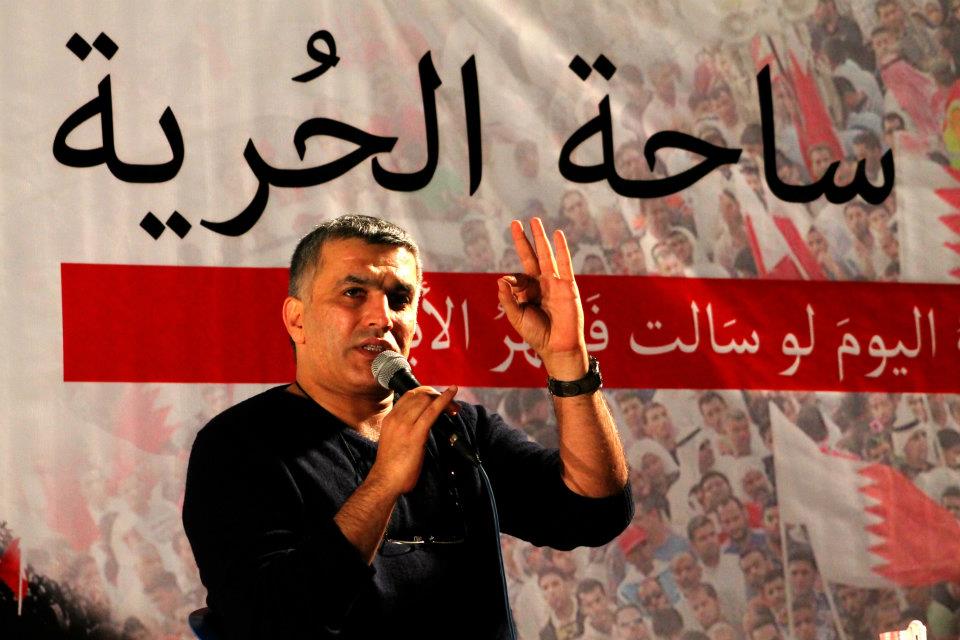
According to AhlulBayt News Agency prominent human rights defender Nabeel Rajab has been released in Bahrain today, 24 May 2014. The Bahrain Centre for Human Rights (BCHR) and the Gulf Centre for Human Rights (GCHR) welcome back their – respectively – President of the BCHR and General Secretary of the GCHR, free after a detention that lasted approximately two years. The two organisations warn that thousands of others continue to be imprisoned including BCHR and GCHR founder Abdulhadi Al-Khawaja and Naji Fateel. It is to be noted that Nabeel Rajab is being released because he served the full length of his arbitrary detention sentence.
Nabeel Rajab was initially sentenced on 16 August 2012, to three years in prison for advocating peaceful demonstrations to defend the civil and human rights of all the citizens in the country. On 11 December 2012, the Court of Appeal reduced the sentences to two years in prison. During his detention, he faced dire conditions and was subjected to ill-treatment and torture. The United Nations Working Group on Arbitrary Detention (WGAD) found that Nabeel’s detention was arbitrary as it resulted from the exercise of his universally recognized human rights. Despite this decision by the WGAD, all requests submitted to the authorities for an early release were summarily rejected.
Thanks to Theo van Boven, who alerted me, I am happy to report another small step in the war against reprisals. On 21 April 2014 the UN General Assembly adopted a resolution on the Strengthening on the Treaty Bodies in which operative paragraph 8 strongly condemns intimidation and reprisals against human rights defenders and others who coöperate with the treaty bodies. (A/RES/69/268). For text of resolution: http://www.un.org/en/ga/search/view_doc.asp?symbol=A/RES/68/268
On 16 May 2014 the International Service for Human Rights [ISHR] reports that the African Commission on Human and Peoples’ Rights has designated a high-level focal point to document and follow up on cases of intimidation and reprisals against human rights defenders that cooperate with the African human rights system. The spokesperson of the ISHR, Clement Voulé, welcomed the move and said: ‘The UN and its Member States should take note of the African Commission’s initiative and approve the designation of a high-level UN focal point’…‘Delegations in New York should also heed the call led by Botswana and joined by 56 States in Geneva in March to expedite this process and ensure a comprehensive, system-wide response to reprisals.’ While this is in itself good news and a step in the right direction, some caution is needed:
(1) The tasks of documenting, monitoring and encouraging effective Commission follow up on reprisals has been delegated to the existing African Special Rapporteur on Human Rights Defenders, Reine Alapini-Gansou [‘By designating me as a focal point, the Commission has acted on the need to strengthen its response to reprisals by monitoring cases and working with States to prevent recurrence and promote accountability’]. However, there is no indication that Commissioner Alapini-Gansou is given additional powers or resources.
Still, I hope we can all share the ISHR’s passionate statement that “Any other outcome will signal support for impunity for the perpetrators of reprisals and a betrayal of human rights defenders and others who engage with the human rights system”.


 Hans Thoolen on Human Rights Defenders and their awards