Archive for the 'UN' Category

Even landmark UN decision does not change Cambodia’s treatment of human rights defenders

March 11, 2017

I was reading (belatedly) about the UN Special Rapporteur on the situation of human rights in Cambodia, Rhona Smith, who in January 2017 intervened strongly in the case of the 5 Cambodian human rights defenders of ADHOC (#FreeThe5KH) who have been in detention since April last year. [https://humanrightsdefenders.blog/2016/05/04/civil-society-condemns-charges-human-rights-defenders-cambodia/] Only then did I realize that the case had led a few months earlier to a landmark decision by the United Nations Working Group on Arbitrary Detention (WGAD): the first time that any UN body has referred to HRDs as a protected group.


On 21 November 21, 2016, the WGAD ruled that the ongoing detention of Mr. Ny ChakryaDeputy Secretary-General of the National Election Committee (NEC), and four staff members of the Cambodian Human Rights and Development Association (ADHOC), Messrs. Ny SokhaYi SoksanNay Vanda, and Ms. Lim Mony, was “arbitrary.” Following a submission made by the Observatory for the Protection of Human Rights Defenders (OMCT-FIDH partnership), the Cambodian Center for Human Rights (CCHR) and the Cambodian League for the Promotion and Defense of Human Rights (LICADHO) in June 2016, the WGAD’s Opinion No. 45/2016 ruled that the five human rights defenders (HRDs) have been discriminated against based on their status as human rights defenders, and in violation of their right to equality before the law and equal protection of the law under article 26 of the ICCPR.” This is the first time ever that the WGAD – or any other UN mechanism receiving individual complaints – has referred to HRDs as a protected group that is entitled to equal legal protection under Article 26 of the International Covenant on Civil and Political Rights (ICCPR). The ruling also recognised the violation of the five HRDs’ “rights to offer and provide professionally qualified legal assistance and other relevant advice and assistance in defending human rights.”

 In addition, the WGAD found that the targeting of ADHOC staff members for having provided “legitimate legal advice and other assistance” violated the five HRDs’ right to freedom of association. It ruled that violations of fair trial rights (including the fact that the five were denied legal counsel from the beginning of their questioning), unjustified pre-trial detention, and statements made by the Cambodian authorities which denied the five the presumption of innocence – all of which contravene Cambodia’s international human rights obligations in respect to the right to a fair trial – are also serious enough to consider their ongoing detention as arbitrary. The WGAD concluded that “the deprivation of liberty of Ny Sokha, Nay Vanda, Yi Soksan, Lim Monyand Ny Chakrya, being in contravention of articles 7, 9, 10, 11 and 20 of the Universal Declaration of Human Rights and of articles 9, 10, 14, 22 and 26 of the International Covenant on Civil and Political Rights, is arbitrary.”

That Cambodian authorities are not impressed is shown by the continued detention of the 5 ADHOC HRDs and by the press release of 7 February 2017 calling for the cessation of the politically motivated criminal investigation of human rights defenders Am Sam-at and Chan Puthisak. Amnesty International, Civil Rights Defenders, Human Rights Watch, and the International Commission of Jurists signed the statement.
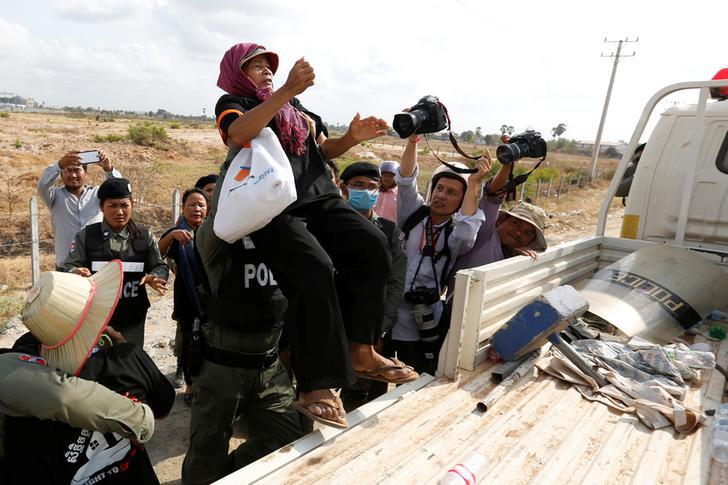
Phnom Penh 20170207 PHTO
Cambodian police detain protesters during a protest to free jailed activists in Phnom Penh, Cambodia May 9, 2016.© Reuters/Samrang Pring

Cambodian officials have accused Sam-at, a respected human rights monitor at the Cambodian League for the Promotion and Defense of Human Rights (LICADHO) for nearly 20 years, and Puthisak, a land rights activist from Boeung Kak Lake and former prisoner of conscience, of instigating violence at an October 10, 2016 demonstration. Para-police forces, who are regularly used to suppress demonstrations, violently dispersed what had been a peaceful protest in Phnom Penh. When Puthisak attempted to prevent para-police from confiscating a drum that was being used by a demonstrator, four or five para-police attacked him, repeatedly beating him on the head with their fists, according to a video of the incident. When Sam-at tried to stop the assault, the para-police attacked him, also beating him on the head. Both men sustained injuries that needed medical attention.

The investigation of Sam-at and Puthisak by the Cambodian authorities is a typically absurd and undisguised case of judicial harassment,” said Champa Patel, Southeast Asia and Pacific director at Amnesty International. “As usual, unnecessary and excessive use of force by the para-police goes unpunished, and those who work to promote and protect human rights find themselves subject to criminal proceedings.”


Sources:

http://www.un.org/apps/news/story.asp?NewsID=56036#.WMP0Dhhh2V4

Cambodia: In landmark decision, UN body declares the detention of five human rights defenders arbitrary #FreeThe5KH / December 18, 2016 / Urgent Interventions / Human rights defenders / OMCT

https://www.hrw.org/news/2017/02/07/cambodia-drop-farcical-investigation-human-rights-defenders

Independence of the Legal Profession subject of side event on 16 March 2017

March 9, 2017

Lawyers for Lawyers and The Law Society of England & Wales organize a UN side event on the “The Independence of the Legal Profession” on Thursday 16 March 2017, 3 – 5 pm in Room XXIII of the Palais des Nations, Geneva.

Keynote speaker: Diego García-Sayán, Special Rapporteur on the Independence of Judges and Lawyers


Panelists:

·        Khalid Baghirov, lawyer (Azerbaijan)

·        Ayse Bingol Demir, lawyer (Turkey) [https://humanrightsdefenders.blog/2015/01/23/persecution-of-lawyers-and-journalists-in-turkey-side-event-in-geneva-on-27-january/]

·         Michel Togué, lawyer (Cameroon) [https://humanrightsdefenders.blog/2013/02/13/death-threats-against-human-rights-defenders-alice-nkom-and-michel-togue-in-cameroon/]

The panelists will share their experiences, obstacles faced by members of  the legal profession in their respective countries, and possible ways to improve the safety of lawyers who work in challenging contexts.

The event is co-sponsored by the Permanent Missions of the Kingdom of the Netherlands, Australia and Paraguay as well as the following NGOs: – Lawyers’ Rights Watch Canada (LRWC),- Union Internationale des Avocats (UIA), – Southern African Litigation Centre (SALC), – International Commission of Jurists (ICJ), – Avocats Sans Frontières Suisse (ASF Switzerland), – International Bar Association’s Human Rights Institute (IBAHRI), – Judges for Judges (J4J), – Human Rights House Foundation and- Peace Brigades International (PBI, UK)

To register (for those without passes, until 12 March 2017): S.deGraaf@lawyersforlawyers.nl

For enquiriesRoberta.Taveri@lawsociety.org.uk


High-level endorsements of crucial role of human rights defenders in UN Human Rights Council

March 7, 2017

The 34th Session of the UN Human Rights Council started off last week (as usual) with the so-called “high-level segment” during which important officials addressed the Council [see: https://humanrightsdefenders.blog/2017/02/28/new-secretary-general-at-human-rights-council-tells-human-rights-defenders-and-i-am-on-your-side/].

On 6 March the ISHR reported on that first week during which several dignitaries emphasised the key role that a vibrant civil society plays in promoting and protecting human rights.

 The President of the General Assembly, Peter Thomson, highlighted the importance of civil society by calling States, the UN and civil society to work shoulder to shoulder and advance with common purpose. Other high-level speakers expressed concern regarding increasing restrictions to civil society space, particularly against HRDs and journalists.
  • Delegates from Botswana, the Czech Republic, Costa Rica, the European Union, France, Malta, Liechtenstein and Luxembourg, among others, reiterated their support to the work of HRDs and journalists and stressed the importance of guaranteeing their protection.
  • Delegates from Germany, Norway, Poland, Slovenia, Sweden and the United Kingdom, among others, condemned acts of reprisals against HRDs and emphasised that HRDs must be able to participate and engage with the Council without fear of intimidation or reprisals.

The pivotal role defenders play in promoting sustainable development was also recognised. Georgia underscored the importance of strengthening the role of NGOs and safeguarding civil society’s space to ensure they are heard. ‘Without close cooperation with all stakeholders, it is impossible to secure the sustainable development of the country.

So, there is no shortage of good statements in Geneva, but the what matters most is the upcoming renewal of the mandate of the Special Rapporteur on Human Rights Defenders and any real action on reprisals!

Source: #HRC34 | High-level officials kick off Council session, emphasise critical role of defenders | ISHR

Side event 6 march 2017: Environmental Human Rights Defenders

March 3, 2017

The Permanent Mission of Spain, the Office of the High Commissioner for Human Rights, the United Nations Environment Program, the UN Special Rapporteur on human rights and the environment, the Universal Rights Group, ABColombia, CIDSE, Franciscans International, ISHR, Kolko, Oidhac, and PBI are organizing a side event during the UN Human Rights Council.

Environmental Human Rights Defenders: Responding to a Global Crisis

Monday 6 March 2017 12h30 – 14h30 Room XXVII, Palais des Nations (Simultaneous interpretation English-Spanish)

Panel discussion:

Professor John Knox, UN Special Rapporteur on human rights and the environment, Member of the Board of Trustees, Universal Rights Group (URG)

Michel Forst, UN Special Rapporteur on human rights defenders

Amanda Kron, Legal Officer, UN Environment (UNEP)

Johana Rocha, Environmental and Human Rights Lawyer, Research Centre for Social Justice ‘Tierra Digna’ (Colombia)

Isela González Díaz, Alianza Sierra Madre (Mexico)

Objectives

• Raise the profile of the situation of environmental human rights defenders

• Move the international human rights community, especially members of the Human Rights Council, towards a greater understanding of that situation, and towards a greater determination to improve support for the work of EHRDs and protection of their rights.

• Launch new URG Policy Report, authored by Professor John Knox, UN Special Rapporteur on human rights and the environment, on the global situation of EHRDs.

• Present the Special Rapporteur’s recommendations to policymakers and policy-influencers.

• Launch new online resource portal for EHRDs. The portal has been created by the UN Special Rapporteur on human rights and the environment, URG, Not One More (N1M) and Global Witness, following proposals made by EHRDs themselves during consultations in Europe and Asia. Its development was made possible thanks to the generous support of the Ministry of Foreign Affairs of Spain.

fFor some of my earlier posts on environmental defenders, see: https://humanrightsdefenders.blog/tag/environmental-activists/

http://www.universal-rights.org/events-detail/interface-human-rights-protection-environmental-conservation-situation-environmental-human-rights-defenders/

New Secretary-General at Human Rights Council tells human rights defenders: “And I am on your side”

February 28, 2017

On 27 February 2017 the new Secretary General, António Guterres, addressed for the first time the UN Human Rights Council. For 10 years, he was the “other” High Commissioner (for Refugees), just down the road from the Palais des Nations where he was speaking. Some of his remarks are quoted here (from SG/SM/18456-HRC/25), especially the last paragraph dedicated to  human rights defenders and journalists: Read the rest of this entry »

Plethora of side events in Geneva parallel to the UN Human Rights Council

February 27, 2017

The number of ‘side events’ in Geneva during the UN Human Rights Council is mind boggling. A full (provisional) list of 7 pages can be found at: http://www.files.ishr.ch/public/hrc34/Draft-HRC34-NGO.pdf. Some days have from 15 to 20 (parallel) events a day! I will from time to time draw attention to some that are specifically relevant to human rights defenders such as the one mentioned below:

ISHR-logo-colour-highThe ISHR, together with the permanent mission of Finland, will organise and event on Ensuring sustainable development: the role and protection of defenders. On Thursday 2 March 2017, 10:30-11:45 in room 25. Palais des Nations. This event will explore the role and challenges faced by human rights defenders in contributing to sustainable development, and the interests and obligations of States and business should play in that regard. It will feature the participation of Joe Moses, the protagonist of the award-winning documentary “The Opposition” (extracts of which will be shown) about his activism in protecting the Paga Hill community from forced eviction in the wake of a real-estate project in Papua New Guinea, as well as experts from the UN and business community. see: https://humanrightsdefenders.blog/2016/04/14/showing-of-the-film-the-opposition-about-land-rights-in-papua-new-guinea-cancelled-until-further-notice/


34th Human Rights Council: ISHR guide to key issues for human rights defenders

February 24, 2017

A preview of what to look out for at the upcoming session of the UN Human Rights Council from 27 February – 24 March 2017. This selection of what is most relevant to human rights defenders is based on the excellent overview provided by the International Service for Human Rights (ISHR): Read the rest of this entry »

2017 (10): need to ‘reset’ for human rights movement

February 24, 2017

This is the last post in my “2017 series“.

Amnesty International (AI) on Tuesday 21 February 2017 released its Annual Report 2016/17. It contains a summary of an international human rights survey that discusses the role “rhetoric of fear, blame and hate” have played in rolling back human rights around the world. AI analyzed major political leaders that identify as anti-establishment, such as US President Donald Trump and Turkish President Tayyip Erdoğan, arguing that their rhetoric has led to dangerous impacts on policy. AI’s conclusion is for individuals to come together and push governments to respect human rights, stating, “we cannot rely on governments to protect our freedoms, and so we have to stand up ourselves.” AI said that inspiration should be found in the “civil rights activists in the USA, anti-apartheid activists in South Africa,” or things as recent as the International Women’s March and pro-democracy protests in Gambia. Beyond localized efforts, AI said that “global solidarity is crucial if we are to protect each other from those governments quick to portray dissent as a threat to national security and economic development.”

Last month the 2017 World Report from Human Rights Watch (HRW) stated that a surge in populist leaders in Europe and the US threatens human rights while inviting autocratic abuse in other nations [https://humanrightsdefenders.blog/2017/01/20/2017-3-hrw-reminds-world-of-continuing-repression-of-minorities-and-their-defenders/].

In September UN High Commissioner for Human Rights Zeid Ra’ad Al Hussein unleashed a scathing criticism of Western “demagogues,” accusing them of spreading populist xenophobia and racism.[https://humanrightsdefenders.blog/2016/09/14/un-high-commissioner-for-human-rights-states-may-shut-my-office-out-but-they-will-not-shut-us-up/]

See also: https://humanrightsdefenders.blog/2017/01/26/2017-6-predictions-on-trump-and-the-un-prophets-or-cassandras/

Source: JURIST – Amnesty: global politics threatening human rights

UN Special Rapporteur on Human Rights Defenders wraps up his first mandate

February 22, 2017

The UN Rapporteur on Human Rights Defenders, Michel Forst, has published his report (A/HRC/34/52) which covers the period of his first mandate:June 2014 and March 2017 [see also: https://humanrightsdefenders.blog/tag/mmichel-forst-2015-hrd-rapporteurichel-forst/  ].

In his report Michel Forst, provides a detailed summary of the activities he carried out during his first mandate, including statistics and trends based on the communications that he sent to States, his visits to a number of countries, the dialogues established with the authorities of various States, and the close cooperation developed with key stakeholders in the protection of human rights worldwide. The Special Rapporteur also presents the work in progress and the challenges and issues on which he plans to focus during his next mandate. The report includes suggestions for diversifying working methods, broadening the scope of cooperation with other key actors, and enhancing the visibility and accessibility of his mandate. Human rights defenders and the promotion of their work and their protection will remain at the core of the Special Rapporteur’s work.

After spending the past three years travelling around the world and documenting the situation of human rights defenders, the Special Rapporteur is more appalled than ever to see attacks against them multiplying everywhere, assailing bloggers, indigenous peoples, journalists, community leaders, whistle-blowers and community volunteers. Furthermore, the Special Rapporteur has become convinced that the incidents in question are not isolated acts but concerted attacks against those who try to embody the ideal of the Universal Declaration of Human Rights in a world free from fear and want. The Special Rapporteur is concerned by the lack of response to observations that have been made repeatedly since the establishment of the mandate.

We must be bolder and more creative in order to face up to threats that weigh heavily on civil society as a whole and on every individual fighting for fundamental rights and freedoms. The Special Rapporteur has also noted that intolerance thrives in part because people know little about their rights or the role of those who protect them. In that regard, it is more vital than ever to make the language of human rights accessible to all in order to ensure that civil society continues to enforce accountability.

As defenders face unprecedented attacks intended to undermine the legitimacy, credibility and sincerity of their commitment, it seems essential to quickly establish links between the specific actions undertaken by the Special Rapporteur and the pledges made at the United Nations when he was appointed in 2014. As populist, nationalist and fundamentalist movements of all kinds multiply, the Special Rapporteur remains convinced that more can be done under his mandate and that his office must continue to serve as a watchdog, a warning mechanism and a crucial resource for thousands of people. [Here he echoes sentiments expressed by others and referred to in this blog, see e.g. https://humanrightsdefenders.blog/2016/12/12/we-must-find-new-ways-to-protect-human-rights-defenders-and-to-counter-the-anti-human-rights-mood/ and the links to other such articles at the end of the post]

The report also identifies those areas in which, in view of the possible renewal of his mandate, the Special Rapporteur intends to become more involved so that his work remains relevant and responds as effectively as possible to defenders’ expectations.

I refer as source here not directly to the UN but draw attention to an excellent documentary service provided by RELIEFWEB:

Report of the Special Rapporteur on the situation of human rights defenders (A/HRC/34/52) – World | ReliefWeb

The Situation of Human Rights Defenders – Amnesty International’s Statement to the UN Human Rights Council 2017

February 15, 2017

The document “The Situation of Human Rights Defenders – Item 3: Amnesty International’s Written Statement to the 34th Session of the UN Human Rights Council (27 February- 24 March 2017)” could of course be obtained directly from AI. However, I do it via: http://www.refworld.org/docid/58a195034.html, in order to highlight this very useful service provided by the documentation service of the UN High Commissioner for Refugees (UNHCR) which regularly gives links to documentation concerning countries of origin of refugees. The entry will look like this:

Title The Situation of Human Rights Defenders – Item 3: Amnesty International’s Written Statement to the 34th Session of the UN Human Rights Council (27 February- 24 March 2017)
Publisher Amnesty International
Publication Date 13 February 2017
Topics Human rights activists | Human rights and fundamental freedoms
Reference IOR 40/5647/2017
Cite as Amnesty International, The Situation of Human Rights Defenders – Item 3: Amnesty International’s Written Statement to the 34th Session of the UN Human Rights Council (27 February- 24 March 2017), 13 February 2017, available at: http://www.refworld.org/docid/58a195034.html %5Baccessed 13 February 2017]
Disclaimer

In their submission AI states in part:

In 1998 the international community adopted, by consensus, the Declaration on the Right and Responsibility of Individuals, Groups and Organs of Society to Promote and Protect Universally Recognized Human Rights and Fundamental Freedoms thereby recognising the importance that civil society actors play in the defence of the values that underpin human rights. The Declaration stresses that we all have a role to fulfil as human rights defenders and urges States particularly to protect human rights defenders from harm as a consequence of their work.

However, almost two decades after that historical moment human rights defenders continue to be harassed, tortured, jailed and killed for speaking out against injustice. During the protests against the Dakota Access Pipeline in the USA last year, the security forces used excessive and unnecessary force when arresting members of the Standing Rock Sioux Tribe and other Indigenous communities who oppose its construction.

Over 3,500 human rights defenders have been killed since the Declaration was adopted in 1998 and according to recent figures released by Frontline Defenders, the number of killings in 2016 marked an increase in the number reported in the previous year.

These killings usually occur after threats and warnings. Berta Cáceres, the leading indigenous, environmental and women’s rights defender from Honduras was killed in March 2016 despite enjoying a high national and international profile. In the aftermath of her killing, Honduras was under increased pressure to protect its human rights defenders, nonetheless, in October 2016, José Ángel Flores and Silmer Dionisio George of the Unified Movement of the Aguán were murdered, and currently international organization Global Witness, along with Honduran organizations MILPAH, COPINH and CEHPRODEC are facing a smear campaign against them for their work defending land, territory and environmental rights.

Amnesty International also continues to receive reports of human rights defenders being subjected to unfounded criminal proceedings, arbitrary detention and judicial harassment, which prevents them from speaking up against injustice, delegitimizes their causes and creates a chilling effect on activities that promote human rights. Human rights defender Narges Mohammadi is serving 22 years’ imprisonment after being convicted of national security related charges in Iran. Her conviction stems from her peaceful human rights activities, including her work to end the death penalty and her 2014 meeting with the former European Union (EU) High Representative for Foreign Affairs and Security Policy.

In Egypt civil society has been subjected to an unprecedented crackdown. In 2016, the authorities intensified a criminal inquiry into NGOs’ registration and foreign funding that could lead to criminal prosecution and sentences reaching up to life imprisonment. The authorities have also subjected NGO personnel to interrogation, freezing of personal and organizational assets, preventing leading human rights defenders from foreign travel, arbitrary arrest and detention.

Amnesty International notes with concern that the organisations, networks and methods people rely on to stand up for their communities are also attacked. Unions are threatened. Lawyers and activists in China have been ill- treated and sometimes tortured in detention. In Pakistan, human rights defenders are labeled as ‘foreign-agents’. In Viet Nam, attacks against human rights defenders are common, and include beatings and daily harassment and surveillance.

In other parts of the world, newspapers are closed down. Social media are banned and digital conversations monitored. Taking to the streets to protest is impossible.

In Turkey, against the backdrop of the failed military coup in 2016, unfair criminal prosecutions under criminal defamation and counter-terrorism laws targeted political activists, journalists and other critics of public officials or government policy. Over 180 media outlets have been arbitrarily shut down and 80 journalists remain in pre-trial detention.

States also repeatedly interfere with human rights defenders’ ability to communicate safely and expose human rights violations to regional and international human rights mechanisms, including this Council and its mechanisms. Recently the Special Rapporteur on the situation on the situation of human rights defenders noted, with great concern, the number of human rights defenders that received social media threats simply for meeting with him on his visit to Mexico at the beginning of this year.

In Burundi in January 2017, the Bujumbura Court of Appeal ruled to disbar three lawyers and suspend another. Each had contributed to a civil society report to the UN Committee against Torture prior to its review of the country in July 2016. The permanent closure of five human rights organizations and the suspension of five others was ordered in October 2016 on the allegation that they tarnished the image of the country. One of the suspended organizations was later banned following publication of a controversial report.

……..Amnesty International urges the Human Rights Council to:

  1. Renew the mandate of the Special Rapporteur on the situation of human rights defenders and cooperate fully with it, including by encouraging swift and comprehensive responses to communications from the Special Rapporteur and acceptance of requests for country visits.
  2. Reaffirm that protecting human rights is necessary for individuals to live in dignity, and that deepening respect for these fundamental freedoms lays the foundation for stable, safe and just societies;
  3. Recognize the legitimacy of human rights defenders and applaud the role they play in the advancement of human rights, and urge States to facilitate and publicly support their work;
  4. Urge States to adopt and implement legislation which recognises and protects human rights defenders;
  5. Stress the urgent need for all States to establish national protection mechanisms for human rights defenders at risk;
  6. Urge States effectively to address threats, attacks, harassment and intimidation against human rights defenders, including, where applicable, by thoroughly, promptly and independently investigating human rights violations and abuses against them and bringing alleged perpetrators to justice in fair trials without recourse to the death penalty, and providing effective remedies and adequate reparations to the victims;
  7. Urge States to ensure that the criminal justice system or civil litigation is not misused to target nor harass human rights defenders;
  8. Refrain from bringing criminal charges or, other judicial proceedings or taking administrative measures against human rights defenders because of the peaceful exercise of their rights;
  9. Ensure that those who challenge injustice peacefully are not portrayed as threats to security, development or traditional values;
  10. Emphasize the fact that human rights defenders who work on gender equality, women’s rights or LGBTIQ rights face particular risk of being subjected to certain forms of violence and other violations that need to be particularly addressed;
  11. Pay particular attention to other groups who may be at risk, such as those who work for economic, social and cultural rights, defenders who work in the area of business and human rights; in an area exposed to internal conflict or a natural disaster; defenders living in isolated regions or conflict zones; and defenders working on past abuses, such as the families of victims of enforced disappearance;
  12. Condemn any acts of intimidation or reprisals against human rights defenders who cooperate or seek to cooperate with international human rights mechanism;
  13. Urge States to cooperate fully with the recently mandated Assistant Secretary-General for Human Rights to prevent, end and redress acts of reprisal and intimidation.

Source: Refworld | The Situation of Human Rights Defenders – Item 3: Amnesty International’s Written Statement to the 34th Session of the UN Human Rights Council (27 February- 24 March 2017)