Archive for the 'UN' Category

The saga of the “anti-NGO” committee in the UN continues

February 9, 2018

This blog has several times paid attention to the rather weird situation that the UN “NGO Committee” (at NY level) has a rather negative attitude towards the very NGOs that it is supposed to assist. See e.g.:

https://humanrightsdefenders.blog/2016/06/01/ngo-committee-of-the-un-shows-its-bizarre-bias-against-human-rights-ngos/

https://humanrightsdefenders.blog/2016/05/04/ishr-starts-campaign-to-monitor-committee-that-throttles-ngo-access-to-the-un/

https://humanrightsdefenders.blog/2016/02/08/un-committee-on-ngos-denies-ngo-the-right-to-speak/

https://humanrightsdefenders.blog/2015/06/07/uns-ngo-committee-seems-not-very-fond-of-ngos/

https://humanrightsdefenders.blog/2015/05/04/jean-daniel-vigny-hopes-to-improve-ngo-participation-at-the-un/

Now, on 29 January 2018, the International Service for Human Rights (ISHR) came out with the video above as well as the following statement:

A group of regional and international human rights NGOs was blocked from making a statement at the UN NGO Committee session today.  Despite a precedent set two years ago for the delivery of a general statement, all requests since have been refused.  Read here the NGOs’ call for leadership and reform:
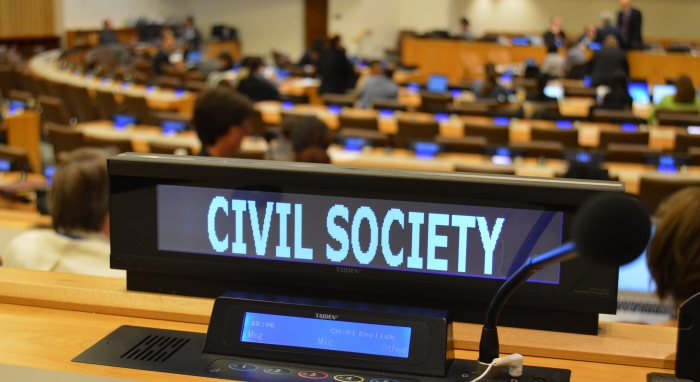
Today a group of NGOs sought to deliver a general statement  urging the Committee to embrace the principles of transparency, accountability and accessibility in its work to ensure its practice is fair, expeditious and apolitical. The ECOSOC NGO Committee reviews applications for accreditation, providing a gateway for NGOs into the UN.  It has been much criticised – by States, UN officials and NGOs – for practices including repeated questioning of applicants and multiple deferrals of applications for no good reason. The NGOs’ attempt to speak was blocked.

ISHR along with Amnesty International, Civicus, Conectas Diretos Humanos, Human Rights Watch, Jacob Blaustein Institute for the Advancement of Human Rights, International Commission of Jurists and Outright Action International came with two key calls for Committee and observer States, related to participation and membership.

1/  The NGO Committee must provide for remote participation by accredited NGOs:

ECOSOC recently requested the NGO Committee to institute regular meetings with accredited NGOs in regard to the ‘evolving relationship’ between NGOs and the UN. Despite the fact that these have been required since 1996, the meeting scheduled to take place in the next months, will be the first. The NGOs urge that provision be made for remote participation by accredited NGOs unable to travel to New York for the meeting. ‘Clearly, access to UN conversations should not be limited to those who have resources to travel to New York or Geneva or other major UN hubs.  A diversity of voices should be heard,’ they note.  ‘We hope that States will ensure that the principle of accessibility to UN processes will be applied when defining working methods for the upcoming meeting.’

2/  States with good records on key freedoms should stand for membership of Committee:

Safeguarding civil society space at the UN is an essential component in the struggle to protect civil society space globally.  With this in mind, the NGOs call on all States with a commitment to defending the work of civil society to put themselves forward as candidates for the elections to the Committee in April. ‘Action to defend civil society space at the UN starts here at this very Committee’, say the NGOs.

Uruguay invokes ‘right to be heard’ as statement is blocked:

In response to China and Russia’s objections to the presentation of the NGO statement, Uruguay spoke forcefully in favour of hearing from civil society.  Opposition to the NGOs’ ‘right to be heard’ went against the principle of transparency in Committee practice, Uruguay said.  It also represented a step back by a Committee whose very mandate speaks to strengthening links between NGOs and the UN system.

Through their statement, civil society could provide insights that contribute to improving the work of the Committee,’  Uruguay noted. Hearing the statement ‘would allow the Committee to understand civil society’s ideas, experiences and expectations.’ The EU, UK and US also made statements of support.  These were not enough to overcome the opposition.

As we were not permitted to deliver our statement to the Committee today, we shall now request a written version be circulated to all ECOSOC members,‘ said ISHR’s Eleanor Openshaw, reflecting on the morning’s events. ‘We shall also look into ways to ensuring NGOs can make general statements at the Committee in future.

https://www.ishr.ch/news/ngo-committee-ngos-blocked-delivering-statement
Prominent UK lawyers: Suspend Saudi Arabia from UN Human Rights Council

February 2, 2018

In July 2016 two major NGOs (HRW and AI) teamed up to try and get Saudi Arabia suspended from the UN Human Rights Council (https://humanrightsdefenders.blog/2016/07/05/amnesty-and-hrw-trying-to-get-saudi-arabia-suspended-from-the-un-human-rights-council/). Now Al-Jazeera reports that British lawyers have called for Saudi Arabia to be removed from the United Nations Human Rights Council, stating that the kingdom detains political and free speech activists without charge.

In a report released on Wednesday 31 January 2018 in London, Rodney Dixon QC and Lord Kenneth Donald John Macdonald said more than 60 individuals were detained in September last year, “many of whom are believed to be human rights defenders or political activists”.

“Our main recommendation is that steps should be taken by the General Assembly to suspend the government of Saudi Arabia from the [UN] Human Rights Council,” Dixon told Al Jazeera. It is “completely contradictory and ironic for a government with systemic patterns of abuse – as we have highlighted in the report – to be sitting on the council, and in fact previously to have chaired the council….That suspension will act as a major lever for the government to clean up their act and make a proper new start.”

The report, titled Shrouded in secrecy: the human rights situation in Saudi Arabia following arrests in September 2017, was commissioned by the relatives of detainees and will be forwarded to Saudi authorities. “Those detained have not been charged with any offence, and the information about the reasons for their arrests and circumstances of their imprisonment are very limited,” the report said. “There is cause for serious concern about the treatment of many of those detained, including Mr Salman Al-Awda who has recently been hospitalised and others who are, effectively, disappeared.” Awda is one of Saudi’s most popular Muslim leaders with almost 150 million followers on Twitter. He was recently hospitalised after five months of solitary confinement. It remains unclear why he was arrested..

Saudi Arabia’s membership in the United Nations Human Rights Council expires in 2019. “The suspension of membership rights is not simply a hypothetical possibility,” the report said.In February 2011, the council called for Libya to be suspended as the government of Muammar Gaddafi was being accused of human rights violations against civilians during the uprising. A month later, the General Assembly voted for the suspension of Libya’s membership – marking the first time it has used its power to revoke a country’s membership.

http://www.aljazeera.com/news/2018/01/uk-lawyers-remove-saudi-human-rights-council-180131114753148.html

Israel at 2018 UPR session denies restricting human rights defenders

January 29, 2018
On Wednesday, 24 January 2018 mwcnews reported on Israel‘s third Universal Periodic Review (UPR) session in Geneva.  A large part of the session was devoted to the usual and heated tit-for-tat with UN member states criticizing Israel for failing to abide by human rights laws and UN resolutions (“Israel is the only state in the world that can be called an apartheid state,” the South African delegate stated), while Aviva Raz Shechter, Israeli ambassador to the UN in Geneva, laid out bluntly how Israel was going to receive the recommendations of fellow members. “The continuous discrimination against Israel in the HRC and the unparalleled number of one-sided biased and political resolutions adopted regularly by the automatic majority of its members testifies not only to the unfair treatment of Israel but also to the deficiencies of the council itself and its agenda,” she said.

Shechter listed what she claimed were some areas of improvement in human rights in Israel compared with the last review, which was in 2013. These, she said, included new initiatives and measures taken by Israel to uphold the rights of people with disabilities, minorities, the LGBT community and women. However, Shechter’s minimal references to the situation of Palestinians in the occupied territories left many delegates unimpressed. Emi Palmor, the director-general of the Israeli ministry of justice, stayed on the defensive before highlighting what she called the improvements in the judiciary, from the introduction of some prisoners’ rights and safeguards for juvenile detainees to taking over investigations of complaints against the Israel Security Agency, better known as Shin Bet. “A large part will not listen to what I am saying … this council has not acquired its reputation for equality or impartiality,” she said.

Palmor contended that Israel had made progress with regards to the detention of minors by establishing a dedicated juvenile court, improving its system by which families are notified, as well as authorising courts to appoint attorneys for the minors “if they wished so”. Still, delegates from Belgium, Bolivia, Canada, Madagascar and other UN member states called upon Israel to allow civil society and independent human rights organisations on its territory to work freely. Some called on Israel to allow human rights bodies to conduct fact-finding missions to investigate allegations of war crimes and crimes against humanity. They expressed concern over the perceived targeting of human-rights defenders and independent nongovernmental organisations in the context of Israel’s NGO Transparency Law and Anti-Boycott Law. The recommendations and concerns were rejected by Palmor, who claimed that Israel places no legal restrictions on human rights associations.

[https://humanrightsdefenders.blog/2017/02/26/israel-denies-work-permit-to-human-rights-watch-and-continues-harassment-of-hrds/ and https://humanrightsdefenders.blog/2017/04/27/human-rights-watch-granted-israeli-work-permit-in-the-end/ and https://humanrightsdefenders.blog/2016/01/05/michael-sfardjan-israels-human-rights-activists-arent-traitors/]

Some delegates called upon Israel to ratify the optional protocol to the Convention against Torture and to uphold the Geneva Convention relative to the Protection of Civilian Persons in Time of War, which prohibits individual or mass forcible transfers and deportations of protected persons from occupied territory. Germany was one of the countries with concerns in this regard.…..

Shechter, the Israeli ambassador, said it was deplorable that UN representatives would use the UPR session as what she called a platform to politicise the human rights discourse. “It is a cynical and hypocritical attitude meant to distort the reality,” she said, adding however that Israel would continue to cooperate with the HRC and take “seriously” the recommendations made at Tuesday’s session.

http://mwcnews.net/news/middle-east/70152-israel-gets-flak-over-human-rights-record.html

First quantitative analysis of 16 years outgoing ‘communications’ by Special Rapporteurs on Human Rights Defenders

January 26, 2018

On 24 January 2018 an important study was made public about the work of the UN Rapporteurs on Human Rights Defenders. It concerns the study “Chasing Shadows: A Quantitative Analysis of the Scope and Impact of UN Communications on Human Rights Defenders (2000–2016)” by Janika Spannagel and published by the Global Public Policy Institute. At the bottom of this post there is link to downloading the full report. [see also: https://humanrightsdefenders.blog/2017/12/11/good-introduction-to-the-anniversary-of-the-un-declaration-on-hrds-in-2018/].

Each year, the United Nations Special Rapporteur on human rights defenders receives a large number of submissions regarding individual cases of concern. Only a fraction of these cases are addressed by the rapporteur’s communications procedure. Unlike outgoing communications, incoming cases are not publicly reported or even systematically registered by the UN. Furthermore, the criteria for the selection of cases (beyond basic eligibility) remain largely undefined. The consequences of case selection, whether according to explicitly stated rules or implicitly applied criteria, are quite significant. Currently, only 550 individual cases can be addressed by the mandate each year. [there are tremendous constraints in terms of staff.] Given this reality, the case selection process defines which types of defenders under pressure receive the UN’s attention and legitimization – and which do not. Nobody can determine with certainty how many cases have fallen through the cracks over the 17 years the mandate has been in existence, or who tends to benefit from the UN’s attention and who is often overlooked.

Based on extensive empirical research, this policy paper provides the first systematic analysis of all communications sent out to date. It finds credible indications that outgoing communications have a positive impact, but also demonstrates that there is room for improvement. In particular, a more deliberate prioritization of cases is required to ensure that the mandate can serve its protective purpose more effectively under the constraints of very limited resources.

The policy paper advocates an approach that aims to maximize the potential impact on the individual defender while systematically striving for a balanced documentation of cases. It makes an evidence-based argument for a number of adjustments and offers actionable recommendations to the mandate as well as to the Office of the High Commissioner for Human Rights, to states, and to civil society actors regarding how to enhance the effectiveness of UN efforts to protect threatened human rights defenders around the world.

Among others, the paper recommends that the use of joint special procedures communications should be the exception rather than the rule, that states’ replies to cases should be systematically monitored and the respective data publicly released, and that more concerted international action should be taken with regards to ‘softer’ forms of repression.

preview

Download PDF (679.81 KB)

see also: https://humanrightsdefenders.blog/2017/06/08/news-from-the-hrc34-mandate-of-the-special-rapporteur-on-human-rights-defenders-extended/

http://www.gppi.net/publications/human-rights/article/chasing-shadows/

Davos should address human rights violations say UN Working Group on Business and Human Rights.

January 24, 2018

As global leaders converge in Davos for the World Economic Forum, a group of United Nations experts called attention to the critical importance of human rights to the Forum’s objective this year which is: “Creating a Shared Future in a Fractured World”. “What we are seeing in the world today is the economically disenfranchised yearning for a fairer economic system that spreads the rewards of economic development to all,” said Anita Ramasastry, who chairs the UN Working Group on Business and Human Rights. “The inclusion of human rights objectives into political and economic decisions are crucial if economic reforms are to tackle the root causes of populism, global unrest, climate change and inequality”. [for some of my earlier posts on this topic: https://humanrightsdefenders.blog/tag/business-and-human…]

The experts stressed how Government and business leaders meeting in Davos wield the power and influence to set the world on a more inclusive and sustainable path. They recalled how world leaders had pledged “to realize the human rights of all” and “to leave no one behind” as core aspirations of United Nation Sustainable Development Goals to be achieved by 2030, and called on business leaders to support this pledge.

Governments and businesses should use the occasion of Davos to announce concrete actions to bring about positive change”, the experts said. “First of all, Governments and businesses must act in accordance with the UN Guiding Principles on Business and Human Rights by taking steps to respect the rights of workers across supply chains and avoid that business operations cause or contribute to adverse human rights impacts”.

The experts welcomed that the 2018 World Economic Forum includes a session on the “Global Prospects for Human Rights”, on the occasion of this year’s 70th anniversary of the Universal Declaration of Human Rights. At the same time, they regretted that human rights were inadequately captured in the World Economic Forum Global Risk Report 2018, released on 17 January 2018.

We call on Governments and business leaders at Davos to remind reach other that human rights are not a fringe issue but at the very core of what needs to be done to address the most pressing global risks,” the experts concluded.

The UN Working Group on human rights and transnational corporations and other business enterprises was established by the UN Human Rights Council in June 2011. Its current members are: Ms. Anita Ramasastry (current Chairperson), Mr. Michael Addo, Mr. Surya Deva, Mr. Dante Pesce (current Vice-Chairperson) and Mr. Pavel Sulyandziga.

http://www.ohchr.org/EN/NewsEvents/Pages/DisplayNews.aspx?NewsID=22603&LangID=E


Emirates at the UPR in Geneva: two sides of the same medal?

January 23, 2018

Sometimes it hard t believe that media have observed the same meeting. Here the case of the Emirates (UAE) which was the subject of a UPR session on 22 January 2018. The Middle East Eye says that “At UN meeting, rights groups slam UAE for arbitrary detention“, while The National sees that “UAE strategy will advance human rights in Middle East, Gargash tells UN council”.

Portrait of UAE founder Zayd Bin Sultan Nahyan at UAE’s culture exhibition at the Palace of Nations, Geneva (MEE/Amandla Thomas-Johnson)
Amandla Thomas-Johnson's picture Amandla Thomas-Johnson reports that Minister of State for Foreign Affairs Anwar Gargash strongly denied allegations that the country practises arbitrary detention. Gargash, who led a high-level delegation to a peer-review process called the Universal Periodic Review (UPR), which each UN-member state undergoes every five years. “I would like to affirm that the UAE does not arrest or detain any person arbitrarily,” he said. “A person is immediately informed of the accusations against them. Everything that takes place is in line with our laws and done with concrete safeguards against arbitrary detention and arrest.
The remarks from the senior Emirati diplomat starkly contrasted with the opinion of four UN Special Rapporteurs – independent experts mandated to look into human rights violations – who in 2016 called on the UAE to respect the rights of several foreign nationals who were arbitrarily detained. Gargash’s comments came amid a quick-fire session held at the human rights conference room, with over 100 country-delegates given just over a minute each to speak. Rights organisations that took part in the UPR process by submitting documents detailing alleged human rights abuses, had mixed responses to the session;
  • Safwa Aissa, Executive Director of the Geneva-based International Centre for Justice and Human Rights, said of the session: “It’s not bad, but we wanted something better, especially from European countries. We had met with many countries beforehand and made them aware of the situation in the countries.”
  • Similarly, Julia Legner from Geneva-based Alkarama Foundation said: “It was slightly disappointing. I was expecting harsher criticism, given that it’s a peer review by states. It’s clear that some states will always congratulate the UAE.” “There could have been stronger comments on the total silencing of civil society, the crackdown on freedom of expression, which has reached a limit where there is no human rights defenders operating from within the UAE.” Responding to Gargash’s claim that arbitrary detention is not practised, she said: “We beg to differ and we have evidence.”
  • Toby Cadman, an international human rights barrister, said that while the UPR is “an important process,” it often has “the appearance of the Eurovision Song Contest of International Justice whereby friendly States, regional, diplomatic and trade partners pat each other on the back rather than offer constructive criticism and call for change”. “The UAE UPR was indicative of that approach today. There is a real need for fundamental reform in the UAE criminal justice and penal system.” 

David Haigh, who is bringing a legal case against UAE authorities for his arbitrary arrest and torture, criticised Gargash’s comments as untruthful. “I was arbitrarily detained for 15 months before I was charged. In the judgments against me one of the UAE courts confirmed that I had complained of arbitrary detention,” Haigh told MEE after the session. “Of course there is arbitrary detention.” Haigh, who has now established a foundation and law firm to assist others who suffer injustice in the UAE, said arbitrary detention happens “time and time again”.


Advancing human rights is a critical factor in ensuring stable societies and promoting development, ..The Minister of State for Foreign Affairs said that as a model nation for youth in the region, the UAE had sought to strengthen human rights and legal safeguards within the review framework overseen by the UN High Commissioner for Human Rights….In the context of a region where extremism creates division and polarisation, Mr Gargash said advancing human rights was a “powerful antidote” to pernicious forces.

“The promotion of tolerance and the rejection of extremism is fundamental to the advancement of human rights in the UAE and the wider region,” he told a packed chamber at the Palais des Nations. “Piece by piece, we have developed a comprehensive strategy to advance the cause of human rights in the UAE.” The UAE will establish a national human rights institution in line with the Paris Principles and guidance of the reporting process before the end of the year, he said. In responses to contributions from the floor, Dr Gargash said the country would also study joining additional protocols and extending invitations to special rapporteurs…

In response to allegations based on reporting about pre-trial detention, Dr Gargash said there was no detention without an arrest warrant…“The UAE is a bastion of stability where people from about 200 nationalities live peacefully in social and religious harmony. We are committed to finding the right balance between protecting our legitimate need for security and preserving our reputation as an open society.”….

He also pointed to the UAE’s role as the world’s largest donor of official development assistance as a proportion of its national income….

In its submission, the Office of the High Commissioner for Human Rights recognised considerable developments in the UAE in the past four years. “UAE’s efforts in combating trafficking are marked as a good example,” the office said. “This included the Adoption of Federal Act Law No 1 of 2015, which provides protection for victims of trafficking, and the 2012 and 2015 Amendments of Federal Law No 51 of 2006 on combating trafficking.” It also hailed the progress in raising the status of women. “The National Strategy for Empowerment of Emirati Women in the UAE for 2015-2021 … provides a framework for government, private sector and civil society organisations to establish work plans to increase women’s presence and empowerment mainly in the economic sector in the UAE.”

Anwar Gargash, UAE minister of state for foreign affairs, tours Michael Møller, Director-General of the UN Office at Geneva, around UAE culture exhibition (MEE/Amandla Thomas-Johnson)

Cultural diplomacy: Earlier in the day, Gargash had been the focus of attention as he hosted the director-general of the UN in Geneva, Michael Moller, around a new cultural exhibition the UAE had officially opened minutes before the human rights session began a floor above. Spread over two floors and including mock Bedouin tents and a photo exhibit, women took centre-stage at the UAE’s latest efforts at cultural diplomacy, with a troop of women clad in sequined abayas performing a fashion show for onlookers. But The Middle East Eye said that “UAE’s efforts at cultural diplomacy came under fire by Julia Legner, at Alkarama”:  “It’s part of the propaganda machine of the UAE, trying to portray an image of culture and tolerance and inclusion and progress. They’re using it as a chance to cover up the dark side.” 

For my earlier posts on the UAE, see: https://humanrightsdefenders.blog/tag/uae/

http://www.middleeasteye.net/news/un-meeting-uae-heavily-criticised-rights-groups-arbitrary-detention-888227605

https://www.thenational.ae/world/gcc/uae-strategy-will-advance-human-rights-in-middle-east-gargash-tells-un-council-1.697809

NGOs in Geneva preparing for the 2018 Human Rights Council sessions

January 19, 2018

– in collaboration with the members of HRCnet – is hosting a welcome reception for Vojislav Šuc, the new President of the Human Rights Council on Wednesday 31 January 2018. This is a regular opportunity for civil society staff, human rights experts and diplomats to meet and greet the new President and Vice-Presidents of the Council in a relaxed atmosphere. Those who won’t be in Geneva that evening, can give their thoughts about what the Human Rights Council’s priorities for 2018 should be. Share them on Twitter using #HRC2018 and Michael Ineichen, Human Rights Council Advocacy Director of the ISHR, will share a selection with the HRC President.

See also: https://humanrightsdefenders.blog/2017/10/31/ishr-2018-training-for-human-rights-defenders-is-now-open-for-application/for 

https://humanrightsdefenders.blog/2017/02/24/34th-human-rights-council-ishr-guide-to-key-issues-for-human-rights-defenders/

UN rapporteurs decry Saudi Arabia’s use of anti-terror laws against human rights defenders

January 3, 2018

Independent Expert on Human Rights Michel Forst. Photo: Jean-Marc Ferré

On 2 January 2018 a group of four UN Special Rapporteurs (Michel ForstMr.  David Kaye, Ahmed Shaheed and Fionnuala D. Ní Aoláin) joined by José Antonio Guevara Bermúdez, Chair-Rapporteur of the Working Group on Arbitrary Detention) deplored Saudi Arabia’s continued use of counter-terrorism and security-related laws against human rights defenders and urged the release of all those detained for peacefully exercising their rights.

We are witnessing the persecution of human rights defenders for peacefully exercising their rights to freedom of expression, assembly, association and belief, as well as in retaliation for their work. The Government has ignored repeated calls by UN experts and others to halt these violations, rectify them, and prevent their recurrence.”

More than 60 prominent religious figures, writers, journalists, academics and civic activists are reported to have been detained in a wave of arrests since September, adding to a list of past cases which had already been raised by UN experts with the Government. “We have written to the Government requesting detailed information about these numerous arrests on terrorism, cyber-crime or any other state security-related charges during that period,” the experts said.

The experts noted that they are also seeking government clarification about how these measures are compatible with Saudi Arabia’s obligations under international human rights law, as well as with the voluntary pledges and commitments it made when seeking to join the UN Human Rights Council. “Despite being elected as member of the Human Rights Council at the end of 2016, Saudi Arabia has continued its practice of silencing, arbitrarily arresting, detaining and persecuting human rights defenders and critics,” they said.

In addition to previous cases and new arrests since September, the experts pointed to the country’s failure to implement two recent opinions of the UN Working Group on Arbitrary Detention, calling for “the release of all the human rights defenders concerned in these cases.”

See also: https://humanrightsdefenders.blog/2017/02/28/saudi-arabia-imprisoned-waleed-abu-al-khair-receives-another-human-rights-award/

http://www.ohchr.org/EN/NewsEvents/Pages/DisplayNews.aspx?NewsID=22570&LangID=E

Colombia: 2017 marks one year of peace effort but human rights defenders still suffer

December 31, 2017

The Bogotá Post of 24 November 2017 summarizes the situation in the following rather factual manner: “One year since the signing of the peace agreement with the FARC, and – as was to be expected – there have been a number of ups and downs in post-conflict Colombia. But while there are plenty of challenges, there are also a lot of people throughout the country working to address them.”  Re the killing of activists it says:  “The October protest violence in Tumaco was a reminder of the ongoing turbulence in the troubled region, which has the highest amount of coca production in the country. It highlighted both the issues surrounding forced coca eradication and the increased presence of armed groups and paramilitary activities as rival gangs compete to fill the vacuum left by the FARC. CINEP, a peace NGO, identified the presence of Clan Úsuga, Clan del Golfo, Clan Pacífico, La Empresa, Gaitanistas, Gente del Orden, Cártel de Sinaloa and Guerrillas Unidas del Pacífico in the region this year. A number of national and international NGOs have expressed serious concern about the killings of social activists and community leaders. On November 17 the UNHCR expressed growing concern about the increase in murders and threats. According to their figures, there have been 78 deaths this year and 13 suspected murders. In addition, at least 1,500 people have been displaced by threats and violence in 2017, although the report says the number may be higher because people are afraid to report abuses.

What’s being done? A landmark constitutional reform to prohibit neo-paramilitarism has been approved by congress, and recent military strikes targeting these groups have been successful in capturing some of their most influential leaders. Although steps to indict those responsible for killing social leaders have been made (54 indictments so far, according to President Santos), more long-term measures are needed. To that end, the government has established a national commission for security guarantees, but it has been slow to respond to the increasing dangers in affected regions.”

TeleSur reported on 21 December that “earlier today a community leader in Puerto Colombia, Putumayo was murdered along with his eight-year-old daughter. Pablo Oviedo was walking with his daughter and both were ambushed by a group and shot multiple times. The two were rushed to San Francisco de Asis Hospital in Puerto de Asis and declared dead.

Oviedo’s two brothers who are involved in the Human Rights Network in southern Colombia were also declared missing. The tragic death of father and daughter occurred hours after Colombian Defense Minister Luis Carlos Villegas had participated in security council meeting with the purpose of addressing the violence in the southwestern city of Mocoa. Social leaders present at the meeting wore masks to cover their faces in an attempt to avoid being swept away in the wave of violence.”

At least the UK Parliament took notice with “Early day motion 718”: ‘That this House notes with concern the increased risks faced by human rights defenders and community leaders in Colombia since the signing of the peace agreement with the FARC, and in particular the recent killings of land restitution leaders, Mario Castaño Bravo and Hernán Bedoya; is deeply disturbed that according to the United Nations High Commissioner for Refugees 78 defenders have been killed in the first 11 months of this year; further notes the vital importance of the work of human rights defenders in Colombia, and elsewhere; and calls on the Government to strengthen its efforts, bilaterally and through the EU, to protect human rights defenders and civil society leaders in Colombia, and to support and monitor the implementation of the peace agreement between the Colombian Government and the FARC.”

http://www.ohchr.org/en/NewsEvents/Pages/DisplayNews.aspx?NewsID=22215&LangID=E

see also: https://humanrightsdefenders.blog/2015/05/15/jorge-molano-from-colombia-laureate-of-2015-lawyers-for-lawyers-award/

and

https://humanrightsdefenders.blog/2016/01/06/latin-america-philippines-most-dangerous-places-for-human-rights-defenders/

———

https://thebogotapost.com/2017/12/04/pieces-of-peace/

https://www.telesurtv.net/english/news/Murder-of-Colombian-Social-Leader-Highlights-UN-Condemnation-20171221-0020.html

http://www.parliament.uk/edm/2017-19/718

https://www.reuters.com/article/us-colombia-human-rights-casualties/colombia-rights-activists-facing-danger-u-n-says-idUSKBN1EE2TQ

Bound to happen but still…High Commissioner Zeid announces he will not seek second term

December 22, 2017
The United Nations high commissioner for human rights, Zeid Ra’ad al-Hussein, left, is not seeking a second term. CreditSalvatore Di Nolfi/Keystone, via Associated Press

The United Nations High Commissioner for Human Rights, Zeid Ra’ad al-Hussein, has made the unusual decision to not seek a second four-year term. The decision was conveyed in a short statement that was emailed to his staff early this Wednesday and shared with some media. “Next year will be the last of my mandate”..  “After reflection, I have decided not to seek a second four-year term. To do so, in the current geopolitical context, might involve bending a knee in supplication; muting a statement of advocacy; lessening the independence and integrity of my voice — which is your voice.” “There are many months ahead of us: months of struggle, perhaps, and even grief — because although the past year has been arduous for us, it has been appalling for many of the people we serve” .

This is very much in line with his courageous statements and actions over the years often referred to in this blog [e.g. https://humanrightsdefenders.blog/2016/09/14/un-high-commissioner-for-human-rights-states-may-shut-my-office-out-but-they-will-not-shut-us-up/]. Still, a blow to the international human rights movement.

While most high level United Nations officials serve as long as their mandate allows, no single Human Rights Commissioner has served a full four-year second term. Zeid’s four-year term expires next September. It has been clear for months that some of the five veto-wielding permanent members of the United Nations Security Council would use their influence to block it. Mr. Zeid al-Hussein – to his credit – has been critical of all of them.

He has been outspoken about the Russian-backed government of Syria. He has warned of the prospects of genocide by the Chinese-backed government of Myanmar. And he has called out the Trump administration several times, most pointedly on the travel ban against citizens of Muslim-majority countries and after the demonstrations by white supremacists in Charlottesville. Mr. al-Hussein’s willingness to take on the powerful by name, along with what he has described as the “eye-watering stupidity” of abusive governments, made him few friends. Mr. al-Hussein proved confounding to many by defying classification: the first human rights chief from the Middle East but a sharp critic of violations by Arab governments; a Muslim who condemned Islamic militants; and a Jordanian prince who discarded his title to take the job and become an advocate for victims.

[see also e.g. https://humanrightsdefenders.blog/2016/10/15/martin-ennals-award-2016-relive-the-ceremony-in-13-minutes-or-in-full/]

——–

https://www.washingtonpost.com/news/worldviews/wp/2017/12/21/2017-the-year-even-the-u-n-human-rights-commissioner-gave-up-on-human-rights/?utm_term=.00b8792d71f7

https://mobile.nytimes.com/2017/12/20/world/un-human-rights-al-hussein.html