Archive for the 'UN' Category

Matiullah Wesa, Afghan human rights defender, released but what about the others?

October 30, 2023
FILE - Matiullah Wesa, a girls' education advocate, reads to students in the open area in Spin Boldak district in the southern Kandahar province of Afghanistan on May 21, 2022. The Taliban have freed the Afghan activist who campaigned for the education of girls, a local nonprofit organization said Thursday, Oct. 26, 2023. Wesa was arrested seven months ago and spent 215 days in prison, according to the group, Pen Path.
Matiullah Wesa, a girls’ education advocate, reads to students in the open area in Spin Boldak district in the southern Kandahar province of Afghanistan on May 21, 2022. Siddiqullah Khan/AP

On 26 October 2023 AP reported that the Taliban have freed an Afghan activist who campaigned for the education of girls. Matiullah Wesa was arrested seven months ago and spent 215 days in prison, according to the group, Pen Path.

The Special Rapporteur on Human Rights of the United Nations Human Rights Council, Rina Amiri,, has welcomed the release of Matiullah Wesa, the founder of the “Rah-e-Qalam” organization and an education activist, and has called for the freedom of all human rights defenders in Afghanistan. Richard Bennett, the Special Rapporteur on Human Rights of the United Nations, has requested the immediate and unconditional release of all individuals detained “arbitrarily for defending their rights and the rights of others.”

Ataullah Wesa, Matiullah’s brother, announced on his social media account that he had been released after 215 days. However, some human rights activists and well-known members of Afghan civil society remain in prison.

Amnesty International said that Wesa should never have been jailed for promoting girls’ rights to education.

The Taliban de-facto authorities must release human rights defenders and women protesters Rasool Parsi, Neda Parwani, Zholia Parsi and Manizha Sediqi and all others who are unfairly kept behind bars for standing up for equality and denouncing repression,” the rights group tweeted.

https://www.ourmidland.com/news/education/article/taliban-free-afghan-activist-arrested-7-months-18449253.php

https://www.ohchr.org/en/press-releases/2023/10/taliban-must-immediately-release-women-human-rights-defenders-say-un-experts

Results of the 54th session of the UN Human Rights Council

October 15, 2023

On 13 October 2023 the ISHR and other NGOs shared their reflections on the key outcomes of the 54th session of the UN Human Rights Council [see: https://humanrightsdefenders.blog/2023/09/11/human-rights-defenders-at-the-54th-session-of-the-un-human-rights-council/:

…We firmly condemn all crimes and other grave violations under international law committed by both Israel and Palestinian armed groups. Targeted and indiscriminate attacks against civilians can never be justified. We call on the ICC Office of the Prosecutor to accelerate its investigation into serious crimes committed by all parties in Palestine and Israel. We call on Israel to ratify the Rome Statute, and for the ICC to hold both State and non-State perpetrators of international crimes accountable. We call on the Commission of Inquiry to address the situation within the context of its root causes: settler colonialism, apartheid, and denial of the fundamental rights to self-determination and return of the Palestinian people, all amounting to grave violations of international law. We call on governments to immediately stop providing political and military support to Israel, while Ministers manifest a genocidal intent against Palestinians. On 9 October 2023, Yoav Gallant, Israel’s Minister of Defense, stated: “We are imposing a complete siege on [Gaza]. No electricity, no food, no water, no fuel – everything is closed. We are fighting human animals, and we act accordingly”. We deplore the dehumanization of all people, including not mentioning  Palestinian civilians’ killings in statements in this Council. As we gear up to celebrate the 75th anniversary of the UDHR, we remind this Council that for 75 years, generations of people in Gaza and historic Palestine have not been born free and equal in dignity and rights. Until this is addressed, the cycles of violence will not end. As Israel continues to bomb the Rafah crossing, the international community has a duty to guarantee immediate humanitarian access to besieged Gaza. We call on States to establish an international protective presence in the OPT, as called for by UN Special Procedures.  For 75 years, the international community has enabled impunity and failed to fulfill the right to self-determination of Palestinian people, including through their legitimate right to resist colonialism.

The Council has shown that it does have an important role to play in addressing violations amidst multiple human rights crises. We welcome the establishment of the mechanism on Sudan and the extension of the Special Rapporteur on Russia, inter alia, in this regard. But these stand in stark contrast to its failure to renew the critical mandate on Ethiopia, particularly in light of the expert finding of the acute risk of ongoing and further atrocity crimes, as well as other Council blind spots where mounting human rights violations remain ignored. We stress the need for the Council to take a principled approach and to address situations on their merits. 

We remain deeply concerned about reprisals against civil society actors who engage or seek to engage with UN bodies and mechanisms. We call on all States and the Council to do more to address the situation, including raise concerns about specific cases of reprisals and demand that governments provide an update on any investigation or action taken toward accountability. We welcome the adoption of the resolution on cooperation with the UN, including the reference to adequately resourced dedicated civil society focal points, however we are disappointed that several proposals by States and civil society to strengthen the text were not taken on board. The Secretary General’s most recent report on reprisals notes increased physical and digital surveillance of those cooperating with the UN and application of laws aimed at punishing or deterring cooperation. While the resolution takes notes of these trends we regret that the resolution does not fully address how these should be addressed. We welcome the strong focus on prevention and emphasis given to accountability. Nonetheless, the preventative role the Council could play in regard to reprisals, as signs of deterioration in civic space conditions, is overlooked. In addition, States’ monitoring and reporting responsibilities in relation to allegations of acts of intimidation or reprisal could be addressed more fully. Also, we welcome the call to the SG for adequate resources to be allocated to OHCHR to prevent and address allegations.

We welcome the resolution on preventable maternal mortality and morbidity, which reiterates that PMMM is a human rights issue that requires a human rights-based approach response, centering inter alia the principles of accountability, meaningful participation of primarily affected people, non-discrimination and equality and transparency. The resolution aims at garnering political will to curb maternal mortality and morbidity rates that have been stagnating and failing to meet SDGs targets. The resolution rightly highlights the full realization of the right to sexual and reproductive health and the provision of comprehensive sexual and reproductive health information and services, including comprehensive sexuality education and safe abortion (with the caveat of not when against national law), as pre-conditions to lower PMMM. We welcome the call to update the technical guidance on a HRBA to PMMM. We however deplore the amendments put forward seeking to weaken the text and apply a protectionist lens to women’s rights to bodily autonomy, taking away their agency and their status of full rights holders under IHRL.

We express our support for a new resolution on the right to privacy in the digital age, which contains strong new standards under the theme of data protection. The resolution also contains stronger language on remote biometric surveillance systems, such as facial recognition, stressing that they raise serious concerns with regard to their proportionality. While we applaud that the resolution acknowledges that some applications of new and emerging technologies may not be compatible with international human rights law, we call for future iterations to take a step further in establishing “red lines” and to call for bans of such technologies. We also urge the core group to address other emerging issues for the right to privacy in the future, such as social media monitoring.

We welcome the adoption of the resolution on the question of the death penalty aimed at ensuring that criminal justice systems are consistent with international human rights obligations in relation to capital punishment, with a focus on the relation between Art 6 and Art 14 of the ICCPR, particularly on the right to seek pardon or commutation of the sentence, and the right to have one’s conviction reviewed by a higher tribunal according to law. In accordance with the safeguards guaranteeing the protection of the rights of those facing the death penalty, as set out in the annex to Economic and Social Council Resolution 1984/50. We welcome that any attempt by a number of States to undermine the aim of the resolution through a number of amendments, have been rejected.           

We welcome the adoption of the resolution from rhetoric to reality: a global call for concrete action against racism, racial discrimination, xenophobia and related intolerance’ and the mandate renewal of the Working Group of Experts of People of African Descent (WGEPAD). We welcome that the rhetoric to reality resolution, interalia, strongly condemns the discriminatory treatment, unlawful deportations, excessive use of force and deaths of African migrants and migrants of African descent, including refugees and asylum-seekers, at the hands of law enforcement officials engaged in migration and border governance. It calls on States to ensure accountability and reparations for human rights violations at borders and to adopt a racial justice approach, including by adopting policies to address structural racism in the management of international migration. However, we regret that it did not reiterate that the transatlantic trade in enslaved Africans and colonialism were grave violations of international law that require States to make reparations proportionate to the harms committed and to ensure that structures in the society that are perpetuating the injustices of the past are transformed, including law enforcement and the administration of justice. We urge all States to fully implement the Durban Declaration and Programme of Action (DDPA). We also call on States to fully cooperate with the WGEPAD and EMLER including by accepting country visits, and implementing their recommendations as well as those from the Permanent Forum and the High Commissioner’s Agenda towards Transformative Change for Racial Justice and Equality.

We welcome the adoption of the resolution on the human rights situation in the Russian Federation, and the re-mandating of the Special Rapporteur. The human rights situation in Russia has drastically deteriorated in the past year, and the Special Rapporteur needs more time to report on the general situation in the country and the Council to equally be able to scrutinize the situation.

We welcome the adoption of the resolution on a Working Group on the rights of Peasants and Other People Working in Rural Areas. The resolution recognizes the contributions of peasants and other people working in rural areas in ensuring the right to adequate food and nutrition, a clean, healthy and sustainable environment, as well as to conserving and improving biodiversity. It calls upon all States and all stakeholders to cooperate fully with the Working Group on the Rights of Peasants and Other People Working in Rural Areas. The establishment of an interdisciplinary WG with balanced geographical representation will promote the effective and comprehensive implementation of the UNDROP and provide opportunities to share and promote good practices and lessons learned on the implementation of the UNDROP.

We welcome the adoption of the resolution on Afghanistan, which extends and strengthens the mandate of the Special Rapporteur. However, we are dismayed that the HRC once again failed to establish an independent investigative mechanism, despite compelling evidence for its need. This risks the entrenchment of impunity for crimes against humanity. This body must center rights holders and survivors, and heed the call of Afghan civil society, who have consistently asked for such a mechanism. We urge States to recognise the situation of women and girls in the country as amounting to gender apartheid, and to support the codification of this crime in the draft Articles on Crimes against Humanity.

We regret that the item 10 resolution on Yemen, again fails to respond to the urgent need for accountability for past and on-going violations and abuses in Yemen.

We welcome the adoption of the resolution on the enhancement of technical cooperation and capacity-building in the field of human rights and its focus on the Universal Periodic Review. The resolution contains a number of key references to the positive role civil society plays in technical assistance, and the possible role multi-stakeholder partnerships between States, UN agencies and civil society can play in supporting the implementation of international human rights obligations by UN Member States. The establishment of an online repository of technical cooperation and capacity-building activities could help civil society identify advocacy opportunities in regards to country-specific situations, in collaboration with UN agencies, as well as opportunities to share best practices and capitalize on lessons learned in regard to technical assistance.

We welcome the renewal of the mandate of the Special Rapporteur on the situation of human rights in Cambodia. In a context defined by systematic targeting and silencing of human rights defenders, critics and political opponents, the Special Rapporteur’s independent and objective assessment of the situation is more important than ever. However, we regret that the resolution once again failed to adequately reflect the reality of the situation and attempted to justify continuing restrictions on civil and political space on the basis of the country’s political and historical particularities as well as national legislation that contradict its international obligations.

We welcome the resolution on the rights of older persons and its important focus on the right of older persons to live free from violence, abuse, and neglect. Now, more needs to be done to ensure that older persons’ rights are protected in reality, including by establishing an international treaty on the rights of older persons.

We welcome the allocation of additional resources to the OHCHR in the area of economic, social and cultural rights, with the adoption of the resolution on ESCR and inequalities.

One year after the release of the OHCHR report finding possible crimes against humanity committed by China against Uyghurs and Muslim minorities, we deplore the sustained failure of this Council to engage in dialogue on the matter, let alone prevent the continuation of abuses. We regret the absence of a joint statement on China at the Council in 2023. The CESCR, the CEDAW, the CERD, the OHCHR, the ILO, as well as Special Procedures through three joint statements, nearly 30 press releases and over 100 letters to the government since 2018, have provided overwhelming evidence pointing to systematic and widespread human rights violations across the country. So long as the Council is not able to take principled action on the basis of objective criteria, other powerful perpetrators will feel empowered to continue committing atrocity crimes, relying on the Council’s silence. We reiterate our pressing call for all Council Members to support the adoption of a resolution establishing a UN mandate to monitor and report on the human rights situation in China.

Finally, we note the outcomes of the Human Rights Council elections. We welcome that Russia’s candidacy was defeated but regret the election of other members responsible for atrocity crimes, widespread civil society repression, and patterns of reprisals.

Signatories: International Service for Human Rights (ISHR), International Federation for Human Rights (FIDH), GIN SSOGIE NPC, Cairo Institute for Human Rights Studies, FIAN International, Asian Forum for Human Rights and Development (FORUM-ASIA).

See also: https://www.jurist.org/news/2023/10/un-human-rights-council-adopts-5-new-resolutions-including-renewal-of-un-mandate-in-burundi/ 

https://ishr.ch/latest-updates/hrc54-civil-society-presents-key-takeaways-from-human-rights-council/

https://rightlivelihood.org/news/54th-un-human-rights-council-we-shed-light-on-activist-repression-indigenous-peoples-plight-in-nicaragua-environmental-degradation/

Elections to the next UN Human Rights Council: some good and quite some bad news

October 13, 2023

A year after being suspended from the body, Russia will not be returning to the UN Human Rights Council in January, despite its best efforts. Running for one of two seats allocated to countries from Central and Eastern Europe, Russia received only 83 votes, significantly less than competitors Albania (123) and Bulgaria (163).

With this vote, States have acted in line with General Assembly resolution 60/251 and stopped Russia’s brazen attempt to undermine the international human rights system,’ said Madeleine Sinclair, co-director of ISHR’s New York office. ‘Russia must answer for a long list of crimes in Ukraine and for its ruthless and longstanding crackdown on civil society and individual liberties at home. We’re relieved voting States agreed that it could not have legitimately held a seat at the UN’s top human rights body,’. [see also: https://humanrightsdefenders.blog/tag/russia/]

In the only other competitive race, between States from Latin American and the Caribbean, the General Assembly re-elected Cuba, one of Russia’s most consistent allies. Cuba ran for one of three seats for Latin America and the Caribbean, facing three competitors and coming in first, with 146 votes, ahead of Brazil (144), the Dominican Republic (137) and Peru (108).

Results for Asia and Africa were as disappointing as they were predictable, with the election of China and Burundi. Both States ran in uncompetitive races, with only as many candidates as seats available, thus all but assured to win. They were elected with 154 (China) and 168 (Burundi), finishing bottom of each of their respective regional slates with noticeably fewer votes than their direct competitors. 

Both countries are objectively and manifestly unsuitable for the Human Rights Council in view of their domestic records, their past actions as Council members, and the very criteria that nominally governs membership of the Council.

ISHR has been campaigning to call on States at the General assembly to vote in accordance with resolution 60/251 and to use their votes to ensure a strong and principled Human Rights Council. ISHR produced a series of individual and regional scorecards examining the records of all 17 candidates running this year.

https://ishr.ch/latest-updates/general-assembly-states-stave-off-cynical-russian-attempt-to-return-to-the-human-rights-council/

For more on scoring, see: https://www.universal-rights.org/2023-elections-to-the-human-rights-council-did-ga-members-vote-according-to-human-rights-criteria/

Young human rights defenders from China (Uyghur, Tibetan and Hong Kong) trained on the UN’s human rights bodies.

October 6, 2023

ISHR and Freedom House hosted a group of young defenders from the diaspora for a training on UN human rights mechanisms and joint advocacy meetings in Geneva.

Eight activists working on Uyghur, Tibetan and Hong Kong rights across six countries, including Canada, Germany, India, the Netherlands, the United Kingdom and the United States, participated in the United Nations Advocacy Training (UNAT) program to learn and strategise together on ways to hold the Chinese government accountable for its human rights violations at the international level.

Why a training for youth diaspora activists?

Young activists play a critical role in diaspora movements to address and counter the Chinese government’s persecution of peoples from the Uyghur region, Tibet, and Hong Kong. When capacity building and support are available to them, they can meaningfully engage their host governments and international institutions, like the UN, to hold the Chinese government accountable for its ongoing abuses against their communities inside the People’s Republic of China, and acts of transnational repression outside Chinese borders. Unfortunately, youth diaspora activists don’t have many opportunities to convene and collaborate in those international spaces. 

Working together as allies and partners, these groups can help increase the confidence in their efforts and improve impact and sustainability. Opportunities to network, train together, and work on joint advocacy efforts will help individual diaspora groups communicate and coordinate more effectively amongst themselves and with other relevant local and international groups to amplify and sustain pressure on the Chinese government for meaningful human rights change.

Aged between 19 and 28 years old, this was the first time that young activists from these communities came together in Geneva to work on cross-cutting community issues and build solidarity. Participants are engaged in rights advocacy through their work with established groups like the Hong Kong Democracy Council, Free Uyghur Now, and the Uyghur Human Rights Project or have founded impactful youth led organisations in their host countries, such as Students for a Free Tibet, Harvard College Students for Uyghur Solidarity, and Uyghur Youth Initiative. They are working toward better visibility and accountability towards violations outlined in the UN’s Xinjiang report published last August 2022, including the curtailment of free assembly and expression, mass surveillance, forced labour, and cultural and religious persecution.

During the interactive training programme, participants engaged with one another through peer check-in sessions, with human rights experts and advocates through live Q&As, discussions on the Human Rights Council, Special Procedures, Treaty Bodies and the Universal Periodic Review, and considered how to engage in advocacy activities at the UN in order to effect change for their communities.

The in-person training was designed to coincide with the 54th Session of the Human Rights Council so that the participants could attend the United Nations for the first time in their careers. As well as receiving additional advocacy training modules on all the UN human rights mechanisms from a range of experts, participants had the opportunity to build networks in Geneva and around the world, engage in meetings with UN member States and UN staff, and produce a powerful solidarity video statement which summarises their call to action to the UN States members.

All of the participants expressed they were satisfied with the training and  increased their skills and networks to engage in advocacy at the UN. Freedom House and ISHR will continue to support these participants as they develop joint advocacy initiatives and build solidarity among their communities. 

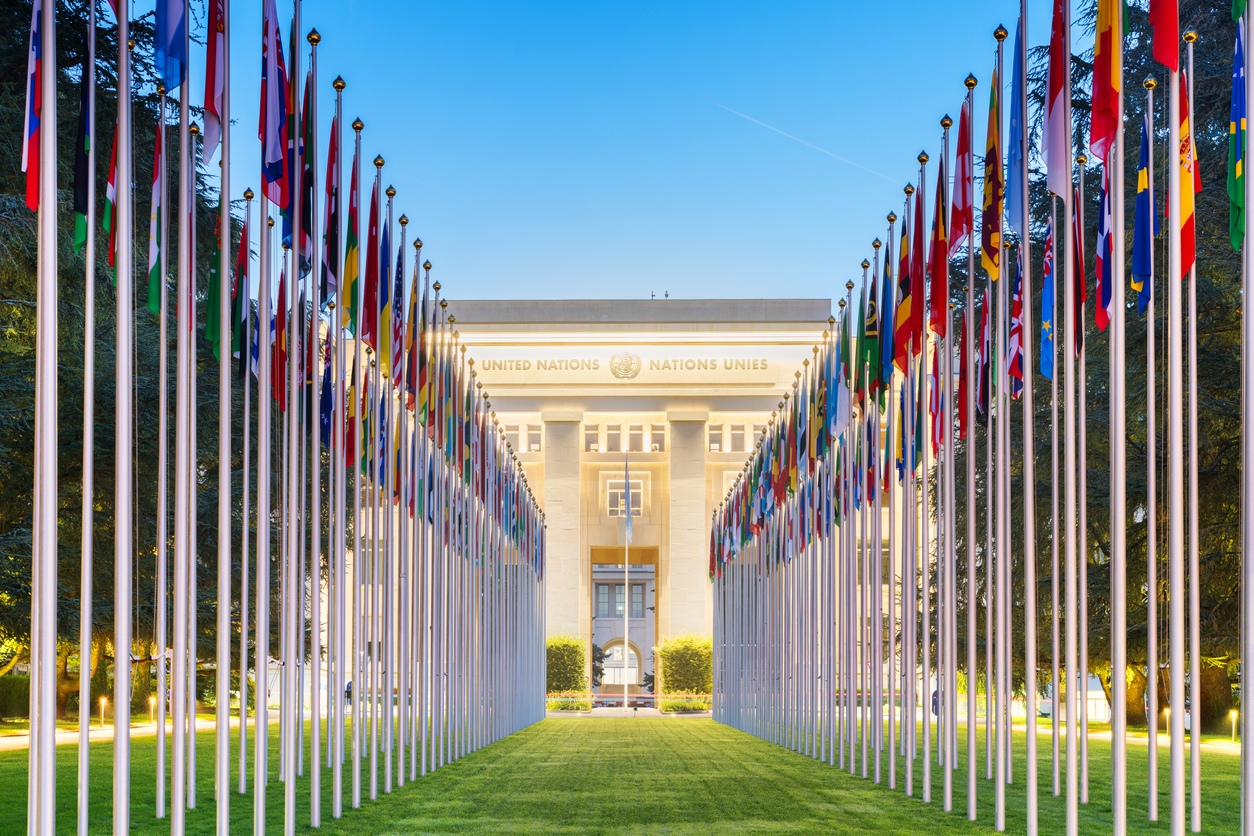
Participants in front of the flags of UN Member States, at UN Office at Geneva

Participants in front of the flags of UN Member States, at UN Office, Geneva

https://ishr.ch/latest-updates/young-uyghur-tibetan-and-hong-konger-defenders-share-their-priorities-with-the-uns-human-rights-bodies-in-geneva/

Human Rights Platform at the Gulbenkian Foundation hears Michel Forst worry about treatment of climate defenders

October 4, 2023

The LUSA news agency reported on 3 october that “the UN Special Rapporteur on environmental campaigners, Michel Forst” , said that climate activists are under increasing pressure in Europe, admitting that he was surprised by the violence with which several governments treat them. This is a somewhat misleading title as Michel Forst is the “Special Rapporteur on Environmental Defenders under the Aarhus Convention, Mr. Michel Forst” [see: https://humanrightsdefenders.blog/2022/07/22/aarhus-convention-on-environmental-information-gets-especially-experienced-rapporteur/]

Still, the message is what matters: “Rights defenders as a whole face a number of major challenges and risks in many countries, including in Europe, but those who are currently paying the highest price are precisely environmental activists and people trying to defend their land and the climate,” said Michel Frost in an interview with Lusa.

Forst was in Portugal today to take part in the international conference of the Human Rights Platform, taking place at the Gulbenkian Foundation in Lisbon, and confessed to Lusa that he didn’t understand the reasons behind this increase in pressure.

I don’t understand why, but the fact is that more and more politicians in more countries are comparing people who are actually peaceful demonstrators with violent terrorists,” he said, noting that he sees this “in Spain, the Netherlands, Denmark, the UK, Germany and Switzerland”.

The issue worries him a lot, he recognized, not least because different ways of attacking activists are being used in various countries.

“I toured more than 20 European Union (EU) countries to meet with activists and governments, inviting them to describe the atmosphere they face in their countries, and I can assure you that the situation is becoming very, very, very tense,” he said, pointing out that governments such as those in France or Austria classify these activists as “eco-terrorists or green Taliban”.

Michel Forst explained to Lusa that he is currently working with a group of non-governmental organizations (NGOs) “to try to better understand what is happening in Europe, with a view to guiding EU governments on how to respond to civil disobedience”.

Stressing that civil disobedience is regulated by international human rights law, the UN official said he was alarmed when he met judges from Spain, France and Germany and realized that they “didn’t understand international human rights law at all”.

Activists who engage in civil disobedience “should not be penalized”, but in reality we see that “judges and governments do not comply with international obligations”, Michel Forst pointed out.

For this reason, he explained, his aim for now is to provide documents and guidelines for states to ensure better fulfilment of their international obligations.

“Some states have been very receptive, such as Ireland and Norway, but many others have not,” he denounced, naming the example of the United Kingdom and adding that, in some cases, the police infiltrate groups in order to know what is being prepared and to be able to better control the activists.

“We now have evidence that some [environmental campaigners] have been placed under strict surveillance, with their phones being hacked and their computers being tapped,” he said.

For Michel Forst, environmental campaigners are no different from those who fight for human rights.

“It’s the same thing,” he emphasised, explaining that environmental activists are just gaining more visibility.

“They are using new forms of mobilisation that others haven’t used, like sticking their hands in the ground or handcuffing themselves to a barrier or breaking down doors to cut genetically modified maize,” he listed.

Their growing visibility leads them to face what human rights defenders were already facing, namely the fact that “civic space is shrinking in Europe,” he said, noting that this is not only his assessment, but also that of the Council of Europe and the EU Agency for Fundamental Rights.

And against this, Michel Forst expects only one thing: “A strong reaction from citizens”.

With regard to the authorities, the UN Special Rapporteur also expressed his expectations.

“We need to see the results [of the guidelines that will be issued] and then ask the most receptive.

Universal Declaration of Human Rights becomes 75 (#HumanRights75)

October 1, 2023

We are on a 75 day countdown to Human Rights Day. On 10 December every year is the anniversary of the Universal Declaration of Human Rights. This year, it is a milestone. #HumanRights75

UN Secretary-General’s Report 2022/23 on Reprisals : lack of progress

September 29, 2023

On Monday 18 September, over 50 activists, members of civil society organisations and diplomatic partners gathered on Geneva’s Place des Nations, unfurling a giant banner celebrating the right to defend human rights, as enshrined in the foundational UN Declaration on Human Rights Defenders.

The banner and gathering were meant to mark the 25th anniversary of the Declaration, which was adopted by the UN General Assembly in 1998. The document explicitly laid out the rights of human rights defenders and the protection owed to them by governments and businesses, emphasising that everyone has the right to advocate and defend rights and fundamental freedoms.

On 28 September 2023, the UN Secretary-General’s report on reprisals was presented, which covers the period from 1 May 2022 to 30 April 2023. Over 220 individuals and 25 organizations in 40 countries across the world faced threats and retaliation from State and non-State actors for cooperating with the UN on human rights.

Human rights defenders and other civil society actors are increasingly under surveillance and continued to face legal proceedings, travel bans and threats, and be given prison sentences for cooperating with the UN and the UN’s human mechanisms.

A global context of shrinking civic space is making it increasingly difficult to properly document, report and respond to cases of reprisals, which means that the number is likely much higher,” said Assistant Secretary-General for Human Rights Ilze Brands Kehris in her presentation to the Human Rights Council in Geneva. [see also: https://humanrightsdefenders.blog/2020/11/16/new-assistant-secretary-general-wants-to-improve-civil-society-participation-in-the-general-assembly/]

Among the growing trends noted in the report is the increase in people either choosing not to cooperate with the UN due to concerns for their safety, or only doing so if kept anonymous. 

Victims and witnesses in two-thirds of the States listed in the report requested anonymous reporting of reprisals, compared with one-third in last year’s report.  And most people who reported facing reprisals for their cooperation with the Security Council and its peace operations, as well as with the UN Permanent Forum on Indigenous Issues did so on the condition of anonymity.

A second trend was the increasing surveillance of those who cooperate or attempt to cooperate with the UN, being reported in half of the countries named in the report.  An increase in physical surveillance by State actors was also noted, likely linked to the return to in-person forms of engagement with the UN.

Third, almost forty-five per cent of the in the report continued to apply or enact new laws and regulations concerning civil society, counter-terrorism and national security, which punish, deter or hinder cooperation with the UN and its human rights mechanisms. 
These legislative frameworks represent severe obstacles to long-standing human rights partners of the UN worldwide, and were used to outlaw some of them, raid their offices, and question, threaten or try their staff.

Finally, the specificity and severity of acts of reprisals against women and girls, which constitute half of the victims in this year’s report, was once again identified with concern.

Most of them are human rights defenders and civil society representatives targeted for their cooperation with UN human rights mechanisms and peace operations, but there is also a significant number of judicial officers and lawyers subjected to reprisals for their cooperation with the UN in search of accountability and remedy.

We have a duty to those who put their trust in us,” said Brands Kehris. “That is why at the UN, we are determined to live up to our collective responsibility to prevent and address intimidation and reprisals against those who cooperate with the organization and its human rights mechanisms.” 

The 40 States referred to in the report are: Algeria, Afghanistan, Andorra, Bahrain, Bangladesh, Belarus, Burundi, Cameroon, China, Colombia, Cuba, Democratic Republic of the Congo, Djibouti, Egypt, France, Guatemala, India, Indonesia, Iran (Islamic Republic of), Iraq, Israel, Saudi Arabia, Libya, Maldives, Mali, Mexico, Myanmar, Nicaragua, Pakistan, the Philippines, Qatar, the Russian Federation, South Sudan, United Republic of Tanzania, United Arab Emirates, Uzbekistan, Viet Nam, Venezuela (Bolivarian Republic of), Yemen, and the State of Palestine.

The full report at A/HRC/54/61

https://ishr.ch/latest-updates/defenders-gather-before-the-un-headquarters-to-call-for-better-protection-of-their-work/

https://genevasolutions.news/human-rights/punished-for-speaking-up-at-the-un

British Airways ends solidarity trip for al-Khawaya

September 18, 2023

Maryam Al-Khawaja (second right) with members of the human rights delegation who were denied boarding a flight to Bahrain. (c) AI

Bahrani activist Maryam al-Khawaja said on Friday she was denied boarding on a flight to Bahrain by British Airways as she tried to return home to raise awareness of the condition of her imprisoned father. [see: https://humanrightsdefenders.blog/2023/09/14/more-join-maryam-al-khawajas-solidarity-trip-to-bahrain-to-be-continued/]

In a video message posted on X, Khawaja said she was not allowed to board a flight at London’s Heathrow Airport “despite being a Bahraini citizen”.

I was told I have to speak to Bahraini immigration if I want to get a boarding pass to Bahrain. So effectively we are being denied boarding by British Airways on behalf of the Bahraini government,” she said.

Agnes Callamard, the secretary-general of Amnesty International, was among those accompanying Khawaja and said on X that she had also been denied boarding. “Our human rights delegation members are all denied a boarding pass. We are told that British Airways has been instructed by the Bahrain immigration authorities not to give us a boarding pass,” she posted.

A spokesperson for the British Airways Press Office said: “All airlines are legally obliged to comply with immigration control laws and entry requirements for customers as set by individual countries,” he told Middle East Eye in a statement and a government spokesperson in Bahrain added: “…as with other countries, Bahrain reserves the right to refuse entry, if deemed necessary.”

Sayed Alwadaei, a Bahraini activist, and the director of advocacy at the UK-based Bahrain Institute for Rights and Democracy (BIRD), raised concern over al-Khawaja being denied boarding the flight.

“If a Bahraini citizen gets their rights denied at Heathrow airport, in London, in front of international observers and in front of heads of international rights organisations, then imagine what happens to prisoners behind bars, what is happening to Maryam’s father and other political prisoners who are suffering torture and systematic medical denial and slow death without anyone monitoring,” he told MEE. See: https://www.adhrb.org/2023/10/adhrb-at-hrc54-al-singace-al-khawaja-and-naji-fateel-face-reprisals-including-medical-neglect-2/#utm_source=rss&utm_medium=rss

Campaigners and the heads of human rights organisations informed MEE that they are planning to peacefully protest outside the Bahraini embassy in London later today in response to not being allowed to travel to Bahrain. 

Responding to the news, Olive Moore, the Executive Director of Frontline Defenders said that the decision not to let her board the flight was “unjustifiable“.

See also: https://www.ohchr.org/en/press-releases/2023/09/bahrain-un-expert-alarmed-health-human-rights-defenders-prison

https://www.theguardian.com/law/2023/sep/15/bahraini-human-rights-defender-stopped-from-travelling-to-kingdom-to-visit-imprisoned-father

https://www.middleeasteye.net/news/bahrain-activist-denied-boarding-british-airways-manama

Iran: One year after uprising in Iran the international community must combat impunity says Amnesty

September 15, 2023

The international community must pursue pathways for justice at the international level to address systemic impunity for Iranian officials responsible for hundreds of unlawful killings of protesters and widespread torture, Amnesty International said on 13 September 2023, as Iran marks the one-year anniversary of the “Woman Life Freedom” uprising.

Over the past year, Iranian authorities have committed a litany of crimes under international law to eradicate any challenge to their iron grip on power. These include hundreds of unlawful killings; the arbitrary execution of seven protesters; tens of thousands of arbitrary arrests; widespread torture, including rape of detainees; widespread harassment of victims’ families who call for truth and justice; and reprisals against women and girls who defy discriminatory compulsory veiling laws.

The anniversary of the ‘Woman Life Freedom’ protests offers a stark reminder for countries around the world of the need to initiate criminal investigations into the heinous crimes committed by the Iranian authorities under universal jurisdiction. Government statements calling on the Iranian authorities to halt the unlawful use of firearms against protesters, stop torturing detainees, and release all individuals detained for peacefully exercising their human rights remain as crucial as ever. These actions show victims they are not alone in their darkest hour.

The anniversary of the ‘Woman Life Freedom’ protests offers a stark reminder for countries around the world of the need to initiate criminal investigations into the heinous crimes committed by the Iranian authorities under universal jurisdiction. Diana Eltahawy, Amnesty International’s Deputy Regional Director for the Middle East and North Africa

The Iranian authorities have waged an all-out assault on the human rights of women and girls over the past year. Despite months of protests against Iran’s compulsory veiling laws, triggered by the arbitrary arrest and death in custody of Mahsa/Zhina Amini, the authorities have reinstated “morality” policing and introduced a raft of other measures that deprive women and girls who defy compulsory veiling of their rights.

These include the confiscation of cars and denial of access to employment, education, healthcare, banking services and public transport. Simultaneously, they have prosecuted and sentenced women to imprisonment, fines and degrading punishments, such as washing corpses.

This assault on women’s rights is taking place amid a spate of hateful official statements referring to unveiling as a “virus”, “social illness” or “disorder” as well as equating the choice to appear without a headscarf to “sexual depravity.”

The authorities are also working on new legislation that will introduce even more severe penalties for defying compulsory veiling.

Mass arbitrary detentions and summons

During the uprising and in the months that followed, the authorities arbitrarily arrested tens of thousands of men, women and children, including protesters, human rights defenders and minority rights activists.  Those arrested include at least 90 journalists and other media workers and 60 lawyers, including those representing families of individuals unlawfully killed. Scores of other lawyers were summoned for interrogations. [see e.g. https://humanrightsdefenders.blog/2023/05/11/now-it-is-the-turn-of-the-iranian-journalists-who-reported-on-mahsa-amini/]

Ahead of the anniversary, the authorities have intensified their campaign of arbitrary arrests targeting, among others, family members of those unlawfully killed, and forcing thousands of university students to sign undertakings not to participate in anniversary protests.

Execution of protesters

Over the past year, the authorities have increasingly used the death penalty as a tool of political repression to instil fear among the public, arbitrarily executing seven men in relation to the uprising following grossly unfair sham trials. Some were executed for alleged crimes such as damage to public property and others in relation to the deaths of security forces during the protests. All were executed after Iran’s Supreme Court rubber stamped their unjust convictions and sentences despite a lack of evidence and without carrying out investigations into their allegations of torture. Dozens remain at risk of execution or being sentenced to death in connection with the protests.

A crisis of impunity

The authorities have refused to conduct any thorough, independent and impartial investigations into the human rights violations committed during and in the aftermath of the “Woman Life Freedom” uprising and have failed to take any steps to hold those suspected of criminal responsibility to account.

Instead, authorities have applauded the security forces for suppressing the unrest and shielded officials from accountability, including two officials who admitted raping women protesters in Tehran. They have also dismissed complaints from victims and/or their families, threatening them with death or other harm if they pursued their complaints.

Amnesty International welcomed the establishment of a Fact-Finding Mission on Iran by the UN Human Rights Council in November 2022, yet much more is needed to combat the crisis of impunity for serious crimes in Iran – and to deter further cycles of bloodshed.

Amnesty International urges all states to consider exercising universal and other extraterritorial jurisdiction in relation to crimes under international law and other serious human rights violations committed by Iranian authorities, irrespective of the absence or presence of the accused in their territory. This includes initiating adequately resourced criminal investigations aimed at disclosing the truth about the crimes, identifying those suspected of responsibility, including commanders and other superiors and issuing, when there is sufficient admissible evidence, international arrest warrants. States should also contribute to achieving reparations for the victims.

https://www.amnesty.org/en/latest/news/

https://www.hrw.org/news/2023/09/15/iran-crackdown-dissent-ahead-protest-anniversary

see also:

https://www.fidh.org/en/region/asia/iran/iran-statement-on-the-un-fact-finding-mission-s-oral-upda

https://news.un.org/en/story/2023/09/1141017

https://www.ohchr.org/en/press-releases/2023/09/iran-un-experts-denounce-crackdown-public-commemoration-jina-mahsa-aminis

Group of UN Experts on Nicaragua finds escalating persecution against human rights defenders

September 14, 2023

Nicaragua has increased human rights violations and persecution of the opposition as it ratchets up its efforts to stifle dissent, a United Nations group of experts monitoring the country said on 12 September 2023.

The Group of Human Rights Experts on Nicaragua told the U.N. Human Rights Council in Geneva, Switzerland, that the government continues increasing pressure on human rights defenders to force them to leave the country.

That persecution has extended to the education sector, where the government has systematically cancelled the legal status of private universities and seized their campuses.

We have observed the intentional and severe deprivation of economic and social rights, in particular the right to education and academic freedom,” said Jan-Michael Simon, chair of the group. “Today, the university sector of Nicaragua as a whole no longer has independent institutions. Nicaragua is being stripped of its intellectual capital and critical voices, leaving the country’s prospects and development on hold.”

Last month, the government confiscated the prestigious Jesuit-run University of Central America in Nicaragua. It was the latest in a series of actions by authorities against the Catholic Church, but also among some 27 higher education institutions that have been cancelled and confiscated.

The group noted that religious figures, in particular from the Catholic Church, are increasingly targets of attacks and some have been forced to leave the country. Once abroad they are sometimes stripped of their nationality and have their assets in Nicaragua confiscated.

The university and other education institutions were important centers of dissent during the popular protests in April in 2018 that became a referendum on President Daniel Ortega’s administration. Ortega was re-elected after jailing seven potential competitors in 2021.

The government’s pursuit of the opposition has continued and intensified. Students and other opposition figures have been imprisoned or forced into exile.

In February, the Nicaraguan government put 222 prisoners on a plane to the United States, declaring them traitors.

The seriousness of these violations, in conjunction with the other crimes documented to date, perpetrated by reason of the political identity of the group targeted, leads the Group of Experts to conclude that these constitute prima facie the crime against humanity of persecution on political grounds,” the group said.

See also: https://humanrightsdefenders.blog/2022/02/21/nicaragua-death-in-detention-and-sham-trial/

https://www.ohchr.org/en/news/2023/09/group-experts-nicaragua-finds-escalating-persecution-against-dissent-and-crackdown?sub-site=HRC

https://abcnews.go.com/International/wireStory/nicaraguas-human-rights-violations-persecution-dissidents-rise-103128377