On 4 January 2024 ISHR published a massive, complete compilation of all recommendations issued by UN human rights bodies – including the UN Special Rapporteurs and Working Groups, the UN Treaty Bodies, and the Office of the High Commissioner for Human Rights – on the human rights situation in China since 2018. Recommendations are sorted by topic and community affected.
This repository compiles all recommendations issued by UN human rights bodies to the Government of the People’s Republic of China since 2018, the year of its third Universal Periodic Review (UPR).
This includes recommendations in: Concluding Observations issued by UN Treaty Bodies following reviews of China in 2022 (Committee on the Rights of Persons with Disabilities (CRPD)) and 2023 (Committee on Economic, Social and Cultural Rights (CESCR), Committee on the Elimination of Discrimination Against Women (CEDAW)), as well as in Decision 1 (108) on the Xinjiang Uyghur Autonomous Region (XUAR) by the Committee on the Elimination of Racial Discrimination (CERD) under its Early Warning and Urgent Action Procedure; communications and press releases by UN Special Procedures (Special Rapporteurs and Working Groups), including Opinions by the Working Group on Arbitrary Detention; press releases by the Office of the High Commissioner for Human Rights (OHCHR) as well as the OHCHR’s assessment of human rights in the XUAR.
These UN bodies are composed of independent, impartial experts, from all geographic regions.
The recommendations are categorised by key topic or community affected. Yet, this repository does not cover all topics, nor does it include all recommendations issued by the above-mentioned UN bodies.
This repository maintains the original language of the recommendation issued by a given UN body, with minor formatting changes. For the appropriate links please go to the original document.
This repository does not include recommendations to the Governments of Hong Kong and of Macao. Please click here for the repository of recommendations on Hong Kong, and here for the repository of recommendations on Macao.
The topics include very useful ones such as:
Chinese human rights defenders, lawyers and civil society organisations in mainland China
Uyghur region
Tibet
National security legal framework, judicial independence and due process
Surveillance, censorship and free expression
Reprisals, meaningful cooperation with the UN, and unrestricted access to the country for UN experts
Transnational repression
LGBTI rights
Business and human rights, including business activities overseas
On 21 November, ISHR celebrated the vital work of human rights defenders at a conference on ‘The Universal Declaration of Human Rights Seventy-Five Years On: Achievements and Current Challenges.’ A slightly shortened version of Phil Lynch’s (Executive Director of the International Service for Human Rights) speech is reproduced below.
Former High Commissioner for Human Rights, Navi Pillay, once called defenders the lifeblood of human rights. ‘They are the promoters of change,’ she said. ‘The people who ring the alarm bell about abuse’. She is right in at least two ways.
Firstly, because, even as most States take a selective and inconsistent approach to human rights principles and situations, defenders reaffirm that all human rights are universal and inalienable; that they are indivisible, interdependent and interrelated.
Defenders are also the lifeblood of human rights because defending and advocating for human rights is integral to realising them, particularly the rights of individuals and groups who have been subject to various and intersecting forms of discrimination and oppression.
This right is now firmly established in jurisprudence. UN Treaty Bodies and Special Procedures recognise that the work of defenders is so integral to the realisation of all human rights, that threats or attacks against them may amount to violations of the very rights for which they advocate…
The Declaration also went further than enshrining the fundamental right to defend rights. It elaborated existing binding international human rights law as it applies to defenders. This includes the right of defenders and their organisations to access resources, including from so-called ‘foreign sources’, as well as the right to communicate and cooperate with international bodies, free from any form of intimidation or reprisal.
Government action to implement the Declaration
25 years after its adoption, a number of States have enacted the Declaration at the domestic level with specific national law and mechanisms for the protection of defenders. Côte d’Ivoire, Burkina Faso, Mali, Niger, the DRC, Mongolia and Mexico are among the States that have taken this positive step.
Other States, including Norway, Finland, Switzerland, Ireland and Canada, among others, have adopted human rights defender guidelines heavily inspired by the Declaration, providing guidance to their embassies and diplomats about the protection of at-risk human rights defenders abroad.
Threats facing defenders
But much remains to be done.
Despite their vital work for gender justice and equality, women human rights defenders like Neda Parwan and Zholia Parsi in Afghanistan and Narges Mohammadi in Iran face systemic discrimination and arbitrary detention.
Despite their vital work for racial justice and non-discrimination, anti-racism activists like Assa Traoré in France or Marielle Franco in Brazil face judicial harassment and even death in the case of Marielle.
Despite their vital work for political justice and freedom of expression, pro-democracy activists like Abdulhadi Al Khawaja in Bahrain and Ahmed Mansoor, Maryam al-Balushi and Amina al-Abduli in the UAE all face unfair detention, torture and ill-treatment.
Despite their vital work for reproductive justice and women’s rights, defenders like Vanessa Mendoza in Andorra and Justyna Wydrzyńska in Poland face spurious legal charges and criminalisation.
And despite their vital work for environmental justice, environmental and land rights defenders like Sukhgerel Dugersuren in Mongolia and Trinh Ba Phuong in Vietnam face persecution and worse.
State pledges to recognise and protect defenders
Together with a coalition of 16 NGOs, ISHR is calling on States to make 5 key pledges on the recognition and protection of defenders.
First, States should publicly recognise the vital role of human rights defenders. Authorities should actively promote the work and achievements of defenders, so that we know them not just for the threats they face but also and foremost for their invaluable contributions to freedom, justice, equality and accountability.
Second, States should recognise and address the intersecting forms of discrimination and oppression that many defenders face. They should ensure defenders are protected and able to meaningfully participate in all relevant policy and decision-making processes.
Third, in genuine partnership with independent civil society actors, States should develop and implement specific national laws, policies and mechanisms for the protection of human rights defenders. They should also repeal or amend laws and policies which restrict and even criminalise defenders.
Fourth, States should refrain from any form of intimidation or reprisals against defenders who engage with the UN and other regional mechanisms. They should take a clear and public position against intimidation and reprisals, including by calling out and holding other States which commit such acts to account.
Fifth and finally, States should ensure that all threats and attacks against human rights defenders are the subject of prompt, impartial and independent investigations. Perpetrators must be held accountable, and effective remedies provided both to address the harms to the individual and to address any systemic or structural factors contributing to such threats or attacks.
Conclusion
Human rights defenders are essential agents of progress and positive change. Their work is vital for gender justice, racial justice, environmental justice, political justice and economic justice. Their work confronts and challenges power, privilege and prejudice. For this, they are frequently exposed to threats and attacks from governments, corporations and other unscrupulous actors. Their work contributes to good governance and accountability at the local, national and international levels.
To defend human rights is an act of bravery and solidarity and, above all, an act of hope and resolve. Hope for a future in which all peoples and communities enjoy freedom, dignity, justice and peace on a healthy planet, in line with the Universal Declaration. And resolve to work, individually and collectively, to realise that still magnificent vision.
UN experts today emphasised the need for the international community to support civil society groups expressing international solidarity in pursuit of peace and social justice and not to conflate international solidarity with antisemitism or islamophobia. It is a remarkably large group of UN experts (see below). They have issued the following statement:
We would like to raise public awareness about the need to support concrete actions by civil society groups that express international solidarity in our pursuit of peace and social justice.
The Universal Declaration of Human Rights, Article 1 establishes universal solidarity as the foundation for human rights: “All human beings are born free and equal in dignity and rights. They are endowed with reason and conscience and should act towards one another in a spirit of brotherhood [and sisterhood].”
Around the world, civil society groups have expressed international solidarity in marches and social media campaigns to call for peace and the protection of civilians in armed conflict. Moreover, they have also expressed international solidarity in pursuit of non-discrimination and equality (the core elements of positive peace) by advocating access to justice, truth, protection, and humane treatment for: children, women, members of the LGBTAIQ+ community, persons affected by leprosy (Hansen’s disease), persons with disabilities, racialized, indigenous groups, and other minorities subjected to violence, hate speech, and discrimination, families of disappeared persons, refugees and migrants, victims of terrorism/violent extremism and counter-terrorism/violent extremism measures, and the environment.
The recent significant engagement of people of all ages and diverse backgrounds in the expression of international solidarity is a powerful affirmation of the value of human rights as a narrative of emancipation in response to violence, oppression, and marginalisation.
It is imperative that civil society actors not be subject to censorship and reprisals for their expression of international solidarity, including loss of funding, loss of employment, arrest, attack, harassment, persecution, criminalisation, or other forms of penalisation.
Actions and expressions that promote transnational unity, empathy, tolerance, and cooperation are the elements of a strong culture of international solidarity in support of peace and social progress.
The most striking impact of the contemporary expressions of international solidarity is their embrace of the principle of humanity – the demand to protect life and alleviate human suffering. The combination of these two universal principles underscores the priority of exhausting peaceful dispute resolution mechanisms before using force.
We call on the international community to encourage International Solidarity expressions of civil society groups and human rights defenders that acknowledge that everyone should enjoy human rights without discrimination of any type. States should open civic spaces and refrain from criminalising non-violent actions and expressions that promote international solidarity. International Solidarity should not be conflated with antisemitism, islamophobia, or other movements that are examples of exclusionary, segregated unitary orientations which violate non-discrimination and equality principles.
International Solidarity promotes inclusion through bridge-building and invites everyone to stand up for peace as a fundamental premise for the enjoyment of human rights.”
Meet the winners of the Kids 4 Human Rights International Art Contest, an initiative of the Queen Sofia Children’s Art Museum of the Gabarrón Foundation, in collaboration with UN Human Rights, to raise awareness of the importance of the Universal Declaration of Human Rights.
It is a pleasure to join you to honour the achievements of human rights defenders across the globe. Three quarters of a century ago, in a world decimated by war, the United Nations General Assembly proclaimed that: “All human beings are born free and equal in dignity and rights”.
The Universal Declaration of Human Rights is a clarion call to act in accordance with a fundamental truth: that each of us is an equal member of a single human family.
Seventy-five years on, the world must recall that wisdom. And it must act on it. Because human rights are under attack around the world. Conflicts are raging, with appalling consequences for civilians as we are dramatically witnessing every single day with immense death and suffering in Gaza after the horrors of the 7 October attacks. Inequalities are deepening. Hunger and poverty are rising. Women’s rights are stalling, and in some cases, going into reverse. Civic space and media freedom is being rolled back.
New threats are blossoming – from catastrophic climate disasters, to artificial intelligence, which holds the potential for immense possibility, but also for immense peril. And age-old hatreds are resurging with a vengeance – from racism, to xenophobia, and religious intolerance. People are being violently targeted solely for their religion, their ethnicity or who they love.
But across the world, human rights defenders are lights in the darkness.
They are changing lives:
Fighting, educating, and holding power to account, to make human rights a living, breathing reality. This is deeply dangerous work. Last year, almost 450 human rights defenders, journalists and trade unionists were killed. Forty percent more than the previous year. Thirty-three vanished without a trace – a staggering three hundred percent increase from 2021.
In this context, today’s Human Rights Prize is all the more important. This prize has recognized the achievements of human rights defenders since 1968. It has honored luminaries such as Nelson Mandela, Malala Yusafzai and the International Committee of the Red Cross. See: https://www.trueheroesfilms.org/thedigest/awards/74A3B502-F3DF-4DDB-8D6F-672C03B4A008.
Julienne Lusenge from the Democratic Republic of the Congo;
Julio Pereyra from Uruguay;
The Amman Center for Human Rights Studies;
The Human Rights Center “Viasna”, working in Belarus;
And the Global Coalition of civil society organizations, Indigenous Peoples, social movements and local communities for “the universal recognition of the right to a clean, healthy and sustainable environment”.
Congratulations to you all. And thank you for everything you are doing. I would also like to pay tribute tonight to the thousands of unsung human rights defenders around the world.
Leaders of all kinds must take inspiration from you – our prize recipients today –and defend all human rights – political, civil, social, economic, and cultural.
The world needs leaders of countries, corporations, political parties, religious and civil organizations and beyond, to speak out against antisemitism, anti-Muslim bigotry, attacks on minority Christian communities, and all forms of hate and abuse. It needs them to protect human rights defenders, and bring those who threaten them to justice.
It needs them to embrace our common norms and values, to act on them, and be guided by the spirit of humanity and dignity embodied by the Universal Declaration – to prevent conflict, protect the planet and heal divides.
And to place human rights at the front and centre of efforts to update our international institutions at the Summit of the Future next September.
..
As we celebrate the 75th anniversary of the Universal Declaration of Human Rights, we need leaders of all kinds to embrace their role as human rights defenders too.
The occasion of UDHR@75 has let to many articles on its relevance to today’s world, which sees such a ‘heightened risk’ of mass atrocities due to global inaction and a diminished UN ‘responsibility to protect’ principle and ambition to prevent genocides, as stated by Julian Borger in the Guardian of 8 December 2023. These warnings come on the 75th anniversaries this weekend of the Genocide Convention and the Universal Declaration of Human Rights, both signed in the aftermath of the Holocaust in the hope that the world would act in concert to prevent a repeat of such mass slaughter.
Borger describes also in some detail how the USA’s ambition to stop atrocity crimes had “diminished in terms of its saliency within the administration as a guiding principle”
Two pieces in Geneva Solutions look at the UDHR closer:
One is by Pip Cook: “Universal Declaration of Human Rights: fit for the 21st century?” and the other by Marc Limon “After 75 years, what is the UN human rights system’s theory of change?”
The first starts with a good overview of the birth of the UDHR and then states: …”With the world facing human rights challenges on so many fronts, some might be tempted to dismiss the declaration as idealistic or unrealistic – a non-legally binding document that nations may claim to adhere to on the international stage but disregard entirely depending on their own political agendas. However, defenders of the UDHR argue that to judge it on how often it is violated is to miss its point altogether.
“I’m not sure how much the document can be judged on whether it’s always adhered to or not,” said Felix Kirchmeier, executive director of the Geneva Human Rights Platform. “That question comes up in human rights all the time, but it comes up much less in other domains. Nobody would ask whether health policy was still valuable now that we have the pandemic.”
“I think the declaration might be even more needed now than ever because it allows us to really see these core values and the universal approach to them,” he added. “The proof of its relevance is the fact that despite all violations of human rights and despite all the attacks to the universal validity of human rights, the document itself is not being disputed in any serious way,” he continued. “So I think that’s also proof of its strength.”
….Ultimately, perhaps the greatest value of the declaration is that it gave universal human rights a language. Known as the most translated document in the world, available in 500 different languages, it provides a rhetoric that people from all corners of the world still use to this day..
Pip closes with the words of Eleanor Roosevelt in her speech to the UN to mark the tenth anniversary of the declaration in 1958. Her words captured the reason why human rights are for every one of us, in all parts of our daily lives, as well as the world as a whole. “Where, after all, do universal human rights begin?” she began. “In small places, close to home – so close and so small that they cannot be seen on any maps of the world. Yet they are the world of the individual person; the neighbourhood he lives in; the school or college he attends; the factory, farm or office where he works.
The second piece by Limon – executive director of the Universal Rights Group - asks: …”Yet two equally – if not more – crucial questions linger: what was the Universal Declaration’s theory of change, meaning how did its authors intend for it to improve the situation of human rights for all “the Peoples” of the UN, and has the UN succeeded in translating the universal norms into local reality?”
Different actors have developed markedly different theories of what the UN human rights system is, what it is supposed to do, and how it is supposed to improve the situation of human rights at the national level.
For some, the system is mainly for the benefit of developing countries, and its principal utility is to respond to serious human rights violations and hold abusing states accountable. Its main purpose, in other words, is to protect human rights.
For others, it is a universal system in which all states should be treated equally. It is there to engage with them through cooperation and dialogue to gradually improve human rights laws, policies and practices over time, including through the delivery of international capacity-building support. The system’s main objective here is, in other words, to promote human rights.
For some, human rights norms should be in a constant state of progressive development, even in sensitive issues such as sexual orientation and gender identity, or sexual and reproductive health and rights, and should be imposed by the UN. Where states resist, it is because they are not committed to human rights and should be called out and forced to catch up.
For others, the UN is there to provide a platform where states can reach a common understanding of universal human rights norms. This is what happened in the case of the UN’s recognition of the right to a healthy environment. After that, it can provide capacity-building and technical support to help those countries making insufficient progress…
So, who is right? There is some truth to both views. For example, the mandate of the Human Rights Council explicitly includes both the protection and promotion dimensions of human rights. And therein lies the answer – the international human rights system, built from the foundations of the Universal Declaration, embodies different – yet complementary – theories of change.
The simple truth is that human rights change cannot be imposed from the outside, by certain states or even by the international community as a whole, without the consent of the state concerned. Bottom-up demands for change, for example, led by local civil society, can and frequently do succeed in securing improvements in the enjoyment of human rights, especially in democracies.
However, in many countries, the power imbalance between civil society and governments means that NGOs and local communities, acting alone, can be easily ignored or even suppressed.
Over a decade of the Universal Rights Group’s research shows that a winning approach, instead, is to combine top-down pressure for improvement with bottom-up calls for change within a framework that is accepted by the state or government and of which it feels a sense of ownership…
While the international human rights system, therefore, encapsulates different and complementary theories of change (think “carrot and stick”), for a vast majority of states, the vast majority of the time, the former theory of change is the most relevant.
As we celebrate the 75th anniversary of the Universal Declaration of Human Rights, there are increasing signs, from states (both developed and developing), civil society, the secretary general, the high commissioner, UN resident coordinators and others, of a shift towards a common understanding of this predominant theory of change. Building on that shared understanding and thereby effectively translating universal rights into local reality would truly be the best way to mark the adoption of this historic document.
Billy Porter is an American actor and singer, who first gained notice performing on Broadway before embarking on a solo career. He is a Grammy, Emmy and two-time Tony Award winner. He is a trailblazer in especially in the LGBTQI+ community including being first openly gay Black man to win an Emmy award. His performance of Audacity at the Royal Albert Hall in London was a world exclusive performance for the Human Rights 75 Concert on 10 December, 2023 in commemoration of the 75th anniversary of the Universal Declaration of Human Rights. #HumanRights75 and #act4rightsnow
On 8 December, 2023 the United Nations lead agency on international development, UNDP, posted its commitment to human rights:
..Protecting our rights to do so was enshrined in the Universal Declaration of Human Rights 75 years ago, and it has been our North Star for human rights ever since. The past three years have been defined by crises on a global scale. Conflict is at its highest since the Second World War. From Gaza to Ukraine, Sudan and Myanmar, people’s right to live without fear is being undermined. Climate change, brought about by humanity’s own actions, is stripping away the right of our children to a healthy and prosperous future. The COVID-19 pandemic brought to stark light the value of the right to health for all.
Three-quarters of a century on, we are at an important inflection point, where we must recalibrate and reconnect with the principles of the Universal Declaration of Human Rights if we want to shape a future that lives up to its vision. Doing so will not be easy. It will require action across many different spheres of life. Recognizing this, UNDP is prioritizing seven key areas where it is working to strengthen human rights.
Dignity and equality of rights is needed for all people and the rights of people living in crisis and conflict must be assured
If we don’t invest in human rights, we won’t achieve the Sustainable Development Goals
Ninety percent of Sustainable Development Goals (SDGs) targets align with the obligations outlined in international human rights frameworks. However, halfway to the 2030 deadline, development progress and the realization of Agenda 2030 is under threat due to the combined impacts of climate change, conflict, overlapping energy, food and economic shocks, and lingering COVID-19 effects. Human rights can be part of proactive solutions helping to address contemporary development challenges and pushing progress towards Agenda 2030. By adopting a human rights-based approach, UNDP is working to ensure that no one is left behind as we strive for sustainable development. For example, UNDP has worked to promote synergies between human rights and SDG systems in eight countries, including Sierra Leone, Uruguay and Pakistan, boosting both the efficiency and effectiveness of national efforts to advance human rights and sustainable development.
Human rights defenders must be able to speak out without fear
Human rights defenders face alarming threats, including intimidation and reprisals, in the pursuit of a goal that should be a shared aspiration for all – the creation of fair and peaceful societies. In 2022, there was a 40 percent increase in the killings of human rights defenders, journalists, and trade unionists compared to 2021. UNDP works with civil society, human rights defenders and national human rights institutions around the world to ensure those that want to speak out have the freedom to do so. In Thailand, UNDP conducted a study looking into the protection of human rights defenders at the request of the Ministry of Justice.
Young people must be included in efforts to protect the rights of future generations
Business can be a powerful driver of sustainable development, offering access to social and economic opportunities and a pathway to prosperity for many.
Human rights and the environment are interconnected
In the next 25 years, building resilience to biodiversity loss and climate change will be key to the realization of all human rights – including the right to a clean, healthy and sustainable environment.
Digital technology must unite, not divide
Technology can be a great enabler of equality and development by improving connectivity, financial inclusion, and public services, positively impacting the realization of human rights. But it can also have a dangerous downside, exacerbating existing inequalities and vulnerabilities. While over 80 percent of developed countries have access to the internet, only 36 percent of individuals in least-developed countries are online. UNDP puts human rights at the centre of its Digital Strategy, and supports countries to harness digital technology as a means to advocate for, protect, access, report on, and exercise human rights…
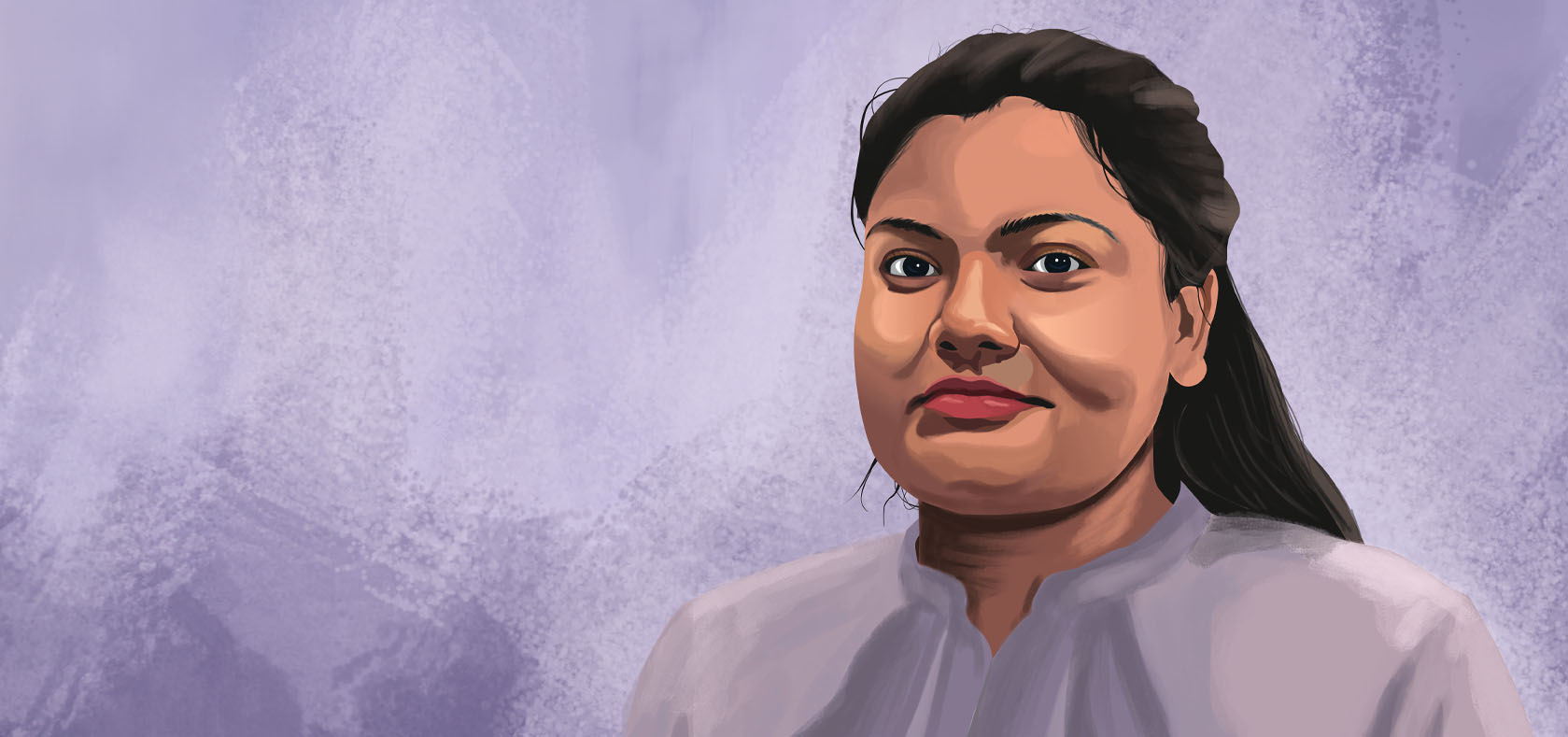
Anushani Alagarajah, human rights defender and executive director at the Adayaalam Centre for Policy Research. Illustration: UN Women Sri Lanka/Dinuk Senapatiratne
Anushani Alagarajah is a human rights defender who has worked closely with conflict-affected communities in the North and East of Sri Lanka. She is the Executive Director at the Adayaalam Centre for Policy Research, a non-profit research think-tank that works on public policy issues in Sri Lanka. On the occasion of the International Day for Women Human Rights Defenders, Ms. Alagarajah spoke about her work in post-conflict Sri Lanka.
I don’t know if I ever consciously decided to become a human rights defender. But when I was seven, there was a gang rape of a girl from our school. Her classmates held a sit-in protest. I didn’t know what rape meant, but children living with conflict grow up fast. I wanted to protest too. If I see injustice, I want to speak up.
As a child, it was horrible to live in bunkers [during the conflict], to come out and see ashes. I’ve been in survival mode my entire life. Seeing what’s happening in other countries, I worry that children will spend their entire lives trying to make sense of it, trying to be okay.
Grief is not only for people, it’s also for a place you called home, that belonged to you. For me, it was always about the childhood I didn’t have. I will probably be grieving that for the rest of my life.
I left Sri Lanka in 2009 to study in Bangladesh. I never wanted to come back. But from the time I left, I knew I had to return. I came home every summer, to conduct workshops with orphanages and conflict-affected communities.
I couldn’t run away. Afterall, I am from this community.
I was displaced thrice. I couldn’t sleep peacefully knowing I could have done something, and I didn’t do it. I thought, “I can try to make things better.” So, I returned after finishing my studies in 2014. Since then, I have been living my purpose in the community.
Whether it is the economic crisis or a lack of opportunities, a lasting political solution requires the political will for change.
It’s difficult when you come from a history of violence, conflict and trauma. During the conflict, a range of violent acts were committed against women.
Women bear the brunt of any damage, and are also expected to be the ones to rebuild, protecting the family unit, community and culture. Yet, particularly in the global South, women are not afforded resources.
Patriarchy is the norm.
Men can take a job in different places, access resources, work with men, divorce, remarry. Women cannot. They must provide out of nothing. Even though they suffered tragic, unspeakable experiences, they are still shackled by stereotypical expectations.
My own work is considered unfitting. I’m expected to be a good woman and get married. We are very far from being inclusive.
In the early days, I would try to talk to older activists about mental health, saying “I’m not doing okay”. But as a human rights defender, you’re almost expected to be superhuman. I think being sensitive helps me do my job better because I look out for others.
For the last four years, when my office researches something difficult, we check in with everyone about how they feel. Whenever one of us needs support, the community will hold them, providing a safe space to be vulnerable or angry. It took a long time for me to find this community.
You cannot heal on your own.
With my colleagues, I run practical workshops to create the next generation of activists, training people in small communities and villages to advocate for their rights. We have participants pick an issue, ideate a solution and work with relevant stakeholders. For example, we have young participants who want to reclaim an occupied land in their village. They met the parliamentarian and the Divisional Secretary’s Office and are now drafting a lease. If they have the courage and knowledge to do that at 20 years old, there is so much we can do. I’m always looking for a few people to take our struggle forward.
Sometimes, it only takes one person.
A wise woman once told me: “You will not see the changes you work for in your lifetime.” This helps put things in perspective. We can only chip at the corners so that one day, hopefully, things will be different. Giving up is not an option. We can’t stop now.”
On Friday 8 December 2023 the UN Office on Drugs and Crime (UNODC) said that more people were killed due to homicide than armed conflict and terrorism combined in 2021, with an average of 52 lives lost per hour worldwide. The Global Study on Homicide analyzes the complex dynamics behind these violent deaths and includes a special section on how organized crime is driving death rates up in Latin America and the Caribbean.
The report examines homicides related to criminal activities and interpersonal conflict, as well as “socio-politically motivated homicides” such as the deliberate killing of human rights defenders, humanitarian workers and journalists.
UNODC chief Ghada Waly said the loss of thousands of lives each year to homicide is “a sombre reminder” of the collective failure of the international community to reduce all forms of violence by 2030, in line with the Sustainable Development Goals (SDGs). The report revealed that during the period from 2019 to 2021, an average of roughly 440,000 deaths worldwide were due to homicide – more than conflict-related or terrorist killings combined.
UNODC said 2021 “was an exceptionally lethal year”, marked by 458,000 homicides. The spike was in part linked to economic repercussions from the COVID-19 pandemic and to a rise in organized crime and gang-related and socio-political violence in several countries.
Organized crime accounted for 22 per cent of homicides globally, and 50 per cent in the Americas, where competition among organized crime groups and gangs can spark a sudden and sharp rise in “intentional homicides”, as has happened in Ecuador and Haiti.
The Americas also lead the world in highest regional homicide rate per capita, with 15 per 100,000 population in 2021, or 154,000 people.
Africa had the highest absolute number of homicides at 176,000, or 12.7 per 100,000 population, “and available data suggests that the homicide rate is not falling, even as decreases have been registered in other regions,” the report said. Meanwhile rates in Asia, Europe and Oceania were far below the global per capita average of 5.8 per 100,000 population in 2021.
Firearms were used in most killings in the Americas in 2021, or roughly 75 per cent, whereas in Europe and Asia they were involved in 17 and 18 per cent of homicides, respectively.
Men accounted for 81 per cent of homicide victims and 90 per cent of suspects, but women are more likely to be killed by family members or intimate partners. “Although they represent 19 per cent of homicide victims in total, they account for 54 per cent of all killings in the home and 66 per cent of all victims of intimate partner killings,” UNODC said.
Aid workers under attack
The data also showed that the deliberate killings of human rights defenders, environmental defenders, community leaders, journalists, and aid workers represented nine per cent of global homicides. “The threat has increased for humanitarian aid workers, who witnessed a higher average number of fatalities over the period 2017-2022 than 2010-2016,” the authors said.


 Hans Thoolen on Human Rights Defenders and their awards