Two Chinese human rights lawyers serving jail sentences for “inciting subversion of state power,” Yu Wensheng (L) and Qin Yongpei (R), were permitted limited visits with their families, May 10, 2021. Yu Wensheng/Qin Yongpei
Jailed Chinese rights lawyer Yu Wensheng, who was held incommunicado for three years and sentenced to jail for “incitement to subvert state power,” was allowed a visit from relatives at the weekend, his wife said. Yu’s young son was allowed to visit his father in Nanjing Prison on May 9, along with his mother Xu Yan, Xu told RFA.
The couple’s son spoke with Yu by phone from behind a glass partition during the half-hour visit, Xu said.
“Yu Wensheng had a very good chat with our son,” she said. “Both them were laughing a lot, and there was no sense of strangeness.”
“Our son told his father that he missed him, and Yu was happy to hear that,” she said. “Yu told him that he had wanted to spend more time with him … and apologized for not being there longer than three years.”
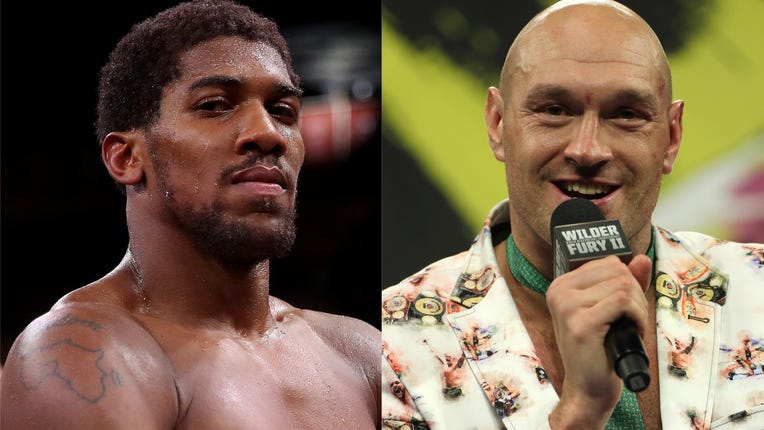
BT.com reports on 11 May 2021 that the all-British showdown between Anthony Joshua and Tyson Fury to determine the undisputed heavyweight champion is set to take place on one of the first two Saturdays in August in Saudi Arabia, according to promoter Eddie Hearn.)
“August 7, August 14,” Hearn said on Sky Sports when asked about a date for Joshua-Fury. “It’s a very bad secret that the fight is happening in Saudi Arabia. I don’t mind giving that information, Bob Arum’s already done it.
Responding to Hearn’s revelation that Joshua-Fury is on course to take place in Saudi Arabia, Kate Allen, director of Amnesty International UK, said in a statement to the PA news agency: “It comes as no surprise that Saudi Arabia is once again set to use a major sporting event as a means to sportswash its atrocious human rights record.
“By staging this high-profile fight, Saudi Arabia is yet again trying to shift the media spotlight away from its jailing of peaceful activists like Loujain al-Hathloul, its grisly state-sanctioned murder of Jamal Khashoggi and its indiscriminate bombing of civilians in neighbouring Yemen
“Simply put – Crown Prince Mohammed Bin Salman wants people around the world to be talking about sport in Saudi Arabia, not the dissidents being locking up after sham trials or the people being tortured in Saudi jails.
“When he fought in Saudi Arabia in 2019 it was disappointing that Anthony Joshua ducked the issue of human rights, and this time we hope he and his opponent can speak out in the build-up to the fight.
“A few well-chosen words about human rights from Joshua and Fury would mean a lot to Saudi Arabia’s beleaguered human rights defenders, helping to counteract the intended sportswashing effect of this boxing match.”
Alan Macleod in Mint-press News of 7 May 2021 studies in quite some detail the way in which the recently released Human Rights Watch (HRW) report has made waves around the world and the organised backlash that followed.
The 213-page study goes into detail about a range of racist laws and policies carried out by successive administrations, concluding that there is an “overarching Israeli government policy to maintain the domination by Jewish Israelis over Palestinians and grave abuses committed against Palestinians living in the occupied territory, including East Jerusalem.” The report accuses the state of Israel of widespread “institutional discrimination” and of “denying millions of Palestinians their fundamental rights…solely because they are Palestinian and not Jewish.” It further notes that, across Israel and the Occupied Palestinian Territories, it has “sought to maximize the land available for Jewish communities and to concentrate most Palestinians in dense population centers.”
“Prominent voices have warned for years that apartheid lurks just around the corner if the trajectory of Israel’s rule over Palestinians does not change,” said the organization’s executive director, Kenneth Roth. “This detailed study shows that Israeli authorities have already turned that corner and today are committing the crimes against humanity of apartheid and persecution.
Perhaps most importantly, Human Rights Watch is now openly calling for global action to end the repression. The report asks the International Criminal Court to investigate and prosecute those involved in Palestinian persecution. While not explicitly endorsing the Boycott, Divestment and Sactions (BDS) movement, Human Rights Watch directly advocates that “[s]tates should impose individual sanctions, including travel bans and asset freezes, against officials and individuals responsible for the continued commission of these serious crimes,” and for businesses to “cease business activities that directly contribute to the crimes of apartheid and persecution.”
A big splash
The report was widely covered across the world and has been heralded by Palestine solidarity activists, with experts seeing it as a potential turning point in the struggle for Palestinian sovereignty. “It was inevitable that Human Rights Watch would have to declare Israel an Apartheid state and, from what I hear, Amnesty International is going to be next to say it,” Asa Winstanley of the Electronic Intifada told MintPress. “It puts Israel’s backers in a difficult spot because Human Rights Watch is really part of the establishment so they cannot just dismiss it and it makes it impossible to ignore… It is harder for them to say Human Rights Watch is anti-Semitic, but they’re trying it anyway,” he added.
Trying indeed. Michigan Congresswoman Lisa McClain tweeted that “Human Rights Watch has shown again how they have an anti-Israel agenda,” suggesting they instead focus their attention on China or Iran’s repressive governments. “Hostility and hypocrisy are HRW’s hallmarks when it comes to Israel,” wrote the American Jewish Committee. The Jerusalem Post’s editorial board was equally condemnatory, denouncing what they saw as the “cynical appropriation of the suffering of the victims of the actual apartheid regime.” Other Israeli journalists described the report as “a disgrace to the memory of the millions who suffered under that policy [apartheid] in South Africa.” The news even made enough waves to force a response from the White House. Press Secretary Jen Psaki replied that “[a]s to the question of whether Israel’s actions constitute apartheid, that is not the view of this administration.”
Organized spontaneity
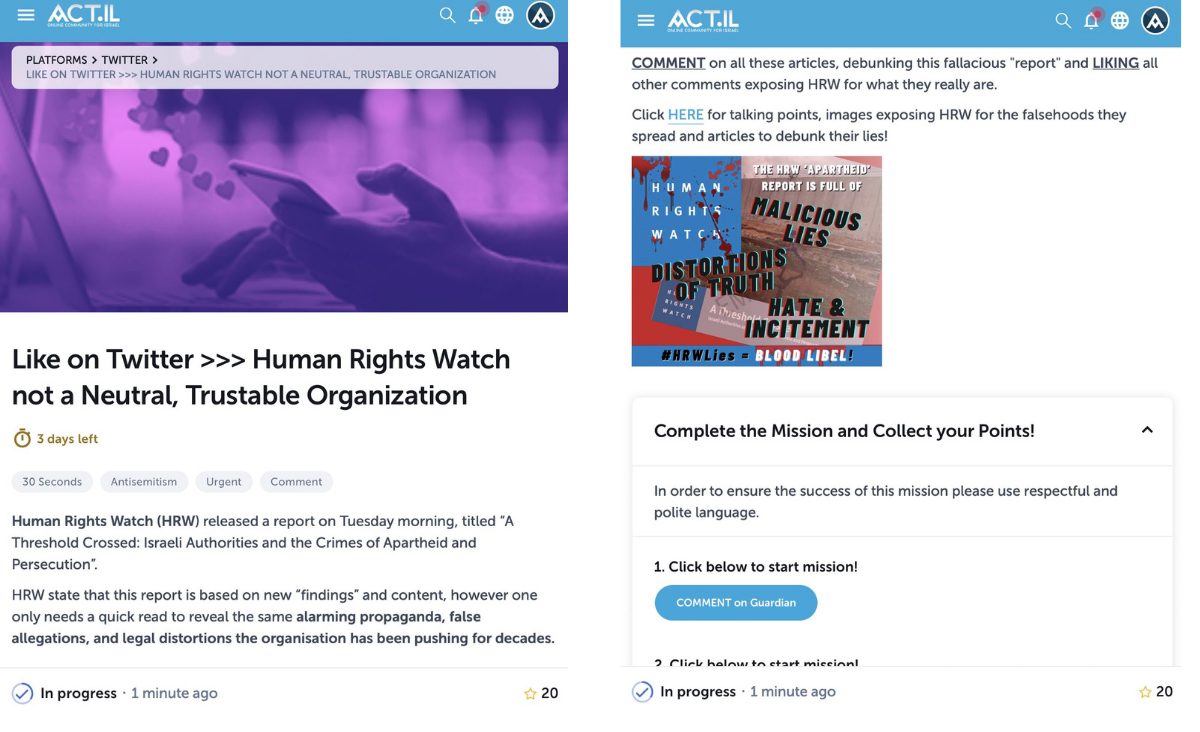
Yet much of the online anger at the report was actually manufactured by an Israeli government-sponsored app, Act.IL, which organized supporters of the Jewish state to act in sync to create an artificial groundswell of opposition to it. The app, which reportedly has a budget of over $1 million per year, instructed users to leave combative comments on Facebook, Twitter, and popular news outlets, and to like and promote others who did the same.
Human Rights Watch’s Facebook post announcing the report’s release has received over 1,400 comments, hundreds of them written in a similar, scathingly negative tone. One that the app directly told users to signal boost, for instance, described Palestinians as a people “indoctrinated with hate for Israel and Jews for over 100 years,” and claimed they were paid salaries to murder Israelis. It also presented the 1967 war and occupation as a humanitarian effort to bring electricity and other infrastructure to Arabs.
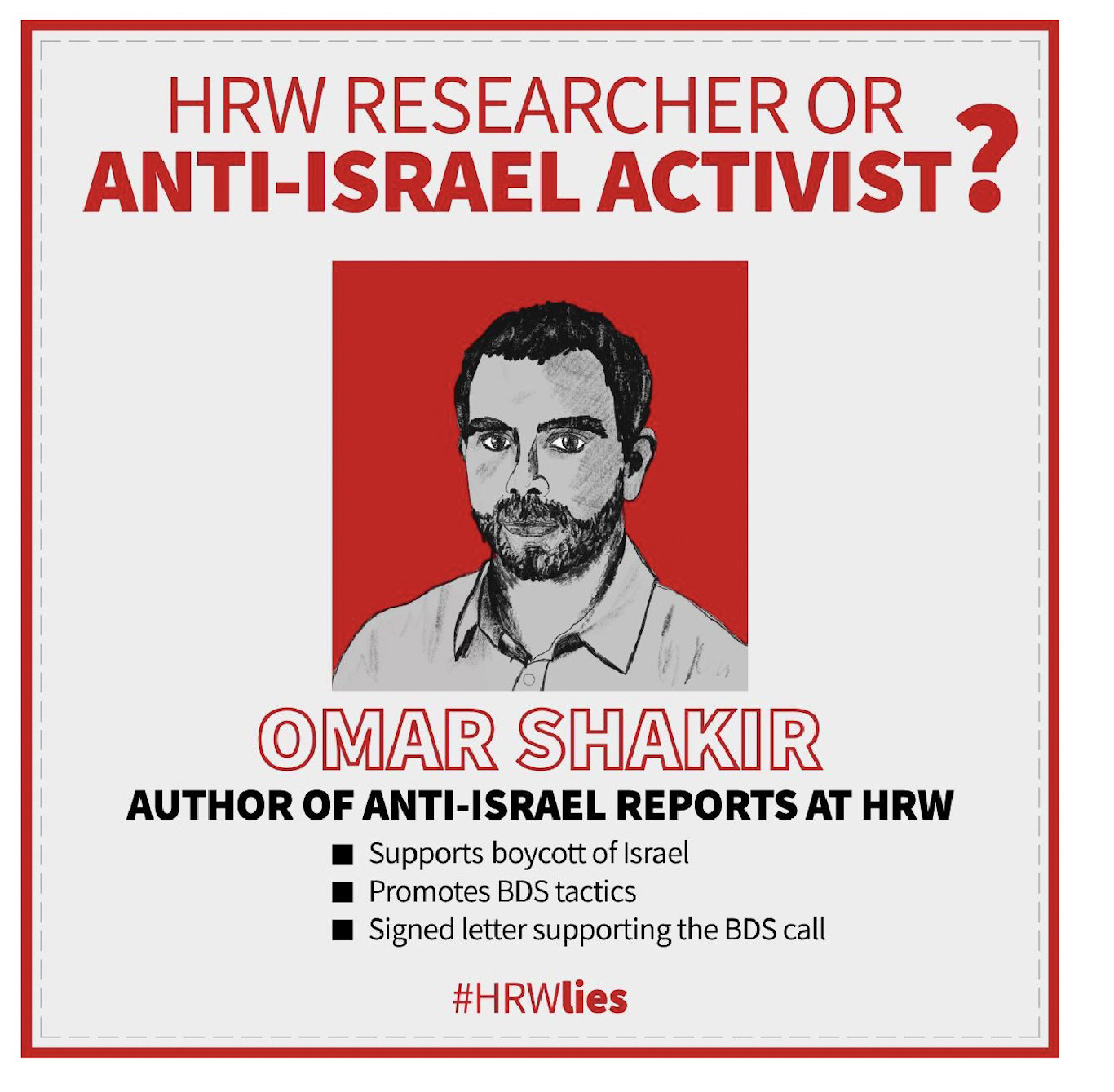
Another “mission” Act.IL gave its users was to promote a Facebook comment attacking the report as “nothing more than hate speech” and calling its lead author a “rabid anti-Zionist and Israel hater.”
One of the many images provided to Act.IL users for their astroturfing campaign against HRW
Act.IL is one of the chief tools in Israel’s online public relations enterprise. The app debuted in 2017 and is part of what Israeli Minister of Strategic Affairs Gilad Erdan called an “Iron Dome of Truth.” “Our cell phones are the number one weapon against us,” he explained, noting that public opinion in the U.S. was beginning to turn against them. While most of the app’s nearly 20,000 users are volunteers, a core of them are paid operatives, with many students receiving scholarships as a reward for their work.
The app has been designed to feel like a game, with points assigned for completing “missions” such as sharing pro-Israel videos, reporting anti-Israel content, signing petitions, or attending online seminars. Users can track their progress on leaderboards, earn badges and prizes, and chat with other members of the community. While it might feel like Animal Crossing or World of Warcraft for some, its creators see this very much as a new front in the war against Palestine. Israeli Justice Minister Ayelet Shaked categorizes BDS as “another branch of terrorism in the modern age,” and has been an important voice in taking the fight to a new front.
An Act.IL mission encouraging astroturfing of online discussions. Source | @AntiBDSApp
There is also an online toolkit full of folders of responses to typical questions and issues that arise. Users can, for instance, go to the BDS folder to find stock replies to their arguments. Or they can go to a specific folder to find articles, images and videos they can use to demonize Hamas.
The missions are organized by outlet, so users can, for instance, target only Facebook, Telegram, or other platforms they are most familiar with. At the time of writing, there are 10 missions each to complete on Facebook and YouTube, 30 on Instagram, 25 on Twitter.
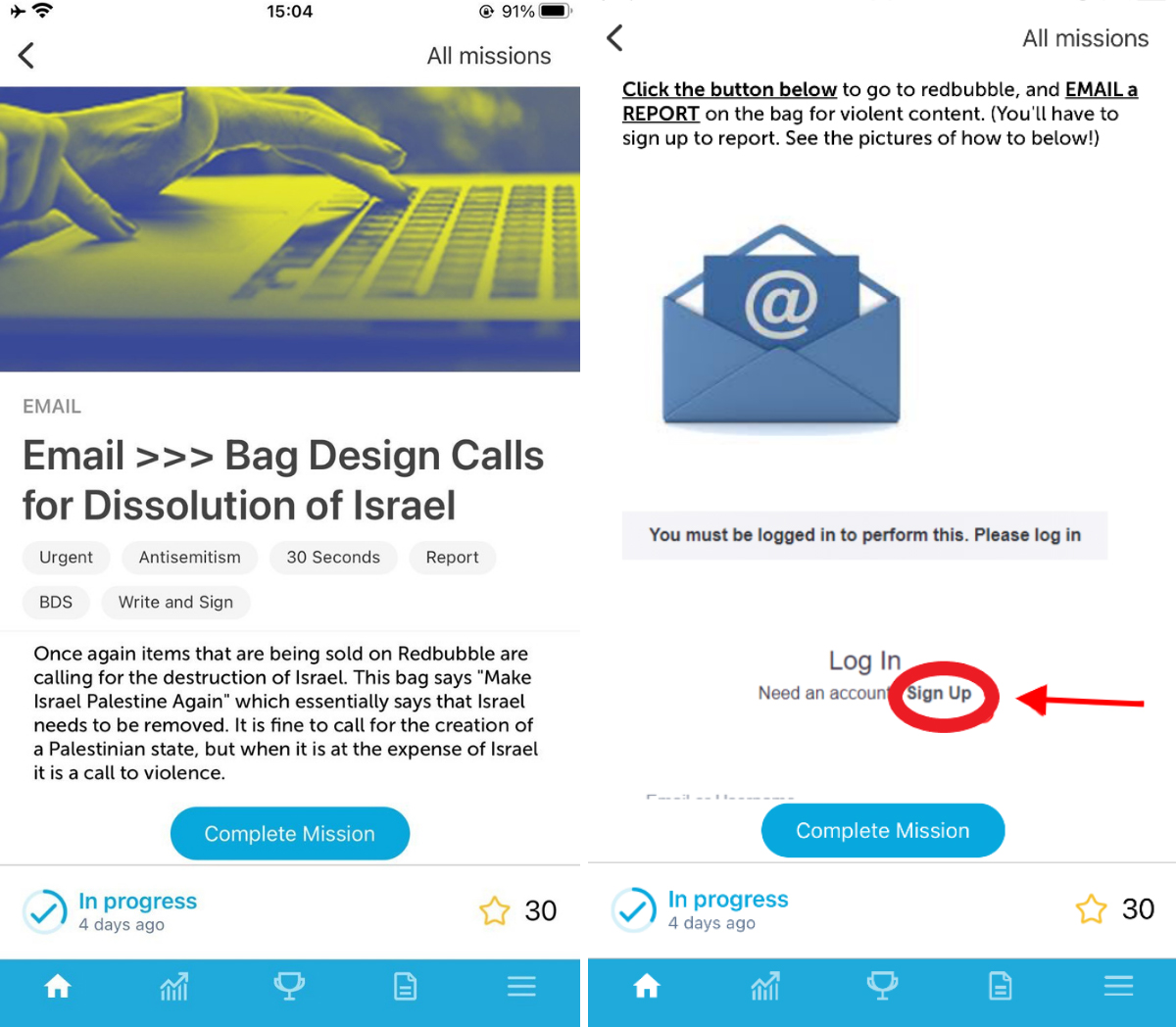
One current challenge is to upvote an answer to a question on Quora that asks about the validity and purpose of checkpoints in the West Bank. The answer claims they are purely about protection from terror attacks, and claims that Red Crescent ambulances are used to ferry bombs around the area. Other missions include pressuring an online store to remove a bag with a message stating “Make Israel Palestine Again.”
An Act.IL “mission” encouraging users to demand the removal of products with pro-Palestinian messaging
“It is quite astounding how openly they do it. But, of course, when you see a comment online, you wouldn’t necessarily think that it was coming from the Israeli government, but this is essentially what is happening,” Winstanley said. “Israel is not the only state to do this, but they do it fairly successfully.”
For all this, however, it is clear that Act.IL has a serious problem with user retention and lacks the volunteer numbers for it to be truly game changing.
Controlling the message
In a time of heightened awareness about foreign government interference online, it is particularly surprising that these operations can be openly carried out across virtually every major platform. Big tech companies like Twitter, YouTube and Facebook are constantly deleting tens of thousands of Russian, Chinese, Iranian and Cuban accounts belonging to what they claim are organized, state-sponsored disinformation campaigns.
In an effort to gauge the legality of its operations, MintPress reached out to Facebook, YouTube, Quora, and other big platforms used by Act.IL. We received no response from any of them. While this is particularly noteworthy — as these companies have teams of public relations representatives and are extremely forthright and timely with responses on other issues — it is perhaps not surprising. Facebook especially has long been working closely with the Israeli government in deciding which voices to censor. As far back as 2016, Ayelet Shaked boasted that Facebook removed 95% of the posts her office asked them to. Yet when Shaked herself called for a genocidal war against Palestine and its women, who give birth to “little snakes,” not only did the post remain online, it received thousands of likes and was widely circulated.
“The concern is that Facebook is adopting Israeli policy and terminology when it comes to defining what incitement is,” said Nadim Nashif, co-founder of 7amleh, the Arab Centre for the Advancement of Social Media. 7amleh was therefore dismayed when last year, Facebook appointed former Israeli Minister of Justice Emi Palmor to its Oversight Board, the council having the final say in the moderation of content on the platform used by 2.6 billion people worldwide. In her role as justice minister, Palmor was directly implicated in the persecution and subjugation of Palestinians.
Earlier this year, an Israeli Defense Forces soldier attempted to sue a Palestinian-American activist living in California over an allegedly slanderous Facebook post condemning her for participating in ethnic cleansing. Remarkably, the plaintiff attempted to convince a California judge to apply Israeli law to the incident, despite the fact that both she and the defendant are American citizens. https://cdn.iframe.ly/r7H7ueP?iframe=card-small&v=1&app=1
Inside the world of academia, professors critical of Israel have found themselves pushed out of the profession. In 2007, prominent critic of Israel Norman Finkelstein was denied tenure at DePaul University for political reasons. Seven years later, the University of Illinois “unhired” Steven Sailata for his comments denouncing Operation Protective Edge, the 2014 Israeli attack on Gaza. Emails showed that wealthy donors put significant pressure on the university to pull the plug on him. More recently, Cornel West was blocked from a tenured job at Harvard this year, despite having previously held tenure at Harvard, Princeton, and Yale. “Being the faculty advisor for the Palestinian student group was the one that probably went outside of the line for many Harvard staff,” West told Krystal Ball and Kyle Kulinski. “It’s a joke. It’s ridiculous. It’s ludicrous. It’s preposterous that it wouldn’t have something to do with politics.”
Top media figures have also paid the price for their support of BDS. CNN fired commentator Marc Lamont Hill after he made a speech at the United Nations calling for a free Palestine. Meanwhile, journalist Abby Martin was blocked from speaking at a conference at Georgia Southern University last year after she refused to sign a contract promising to renounce BDS. Georgia is one of dozens of U.S. states to have anti-BDS legislation, essentially forcing any would-be recipient of public contracts or funds, including government employees, to sign a pledge not to boycott Israel. Martin is currently suing the state of Georgia. MintCast Interviews Abby Martin About Her Anti-BDS Lawsuit & The Israel Lobby…
While Human Rights Watch’s report is new, the charge of apartheid is not. In 2017, a United Nations report “clearly and frankly concludes” that Israel is “a racist state that has established an apartheid system that persecutes the Palestinian people.” Earlier this year, Israeli human rights organization B’TSelem also used the word “apartheid,” claiming that Israel had established “a regime of Jewish supremacy from the Jordan River to the Mediterranean Sea.”…
Advocates for Palestine hailed Human Rights Watch’s study. Phyllis Bennis of the Institute for Policy Studies wrote:
There can be little doubt that much of HRW’s decision to issue this report now was based on the recognition that not only is it no longer political suicide to call Israeli apartheid what it is, but that we are now at a tipping point whereby failing to call out apartheid risks losing credibility for a human rights organization. It’s a huge victory for our movement.”
The battle, however, is far from won, and it is clear that the Israel lobby will continue to fight to hold back the tide until it is insurmountable.
Janika Spannagel on 29 Apr 2021 announced the publication of this new report of the International Service for Human Rights (ISHR). A virtual event to launch ISHR’s new quantitative analysis of the scope and impact of UN action to combat intimidation and reprisals will take place later today at 16h00 Geneva time
The ability of the UN human rights system to function depends on the testimonies of thousands of human rights defenders and victims from across the world who engage with UN mechanisms every year. However, interactions with the UN often come with risks for activists – many face reprisals from their home countries, ranging from severe, violent retaliation to equally effective administrative hurdles to their work in human rights.
Some of these reprisal cases are raised by UN bodies with the responsible government and reported in annual reports by the UN Secretary-General. However, what becomes of the affected individuals’ cases after the UN’s involvement remains largely unclear.
This study aims to both establish a clear understanding of which reprisal cases are raised by UN communications, and to shed light on the question of their effectiveness in improving individuals’ situations.
The project was funded by the International Service for Human Rights (ISHR) and conducted jointly with their New York office between November 2020 and March 2021.
Differenceday.com of 5 May 2021 reports on how World Press Freedom Day was celebrated in Brussels as Difference Day
At a time when independent and free media reporting is more essential than ever, press freedom continues to be under threat. In a declaration ahead of World Press Freedom Day on Monday, EU High Representative Josep Borrell states that journalists continue to experience harsh working conditions with increasing financial and political pressure, surveillance, arbitrary prison sentences or violence for doing their work.
According to the UNESCO Observatory, 76 journalists were killed since 2020, while many more were arrested, harassed or threatened worldwide. Of particular concern is gender-based violence targeting women journalists.
“Press freedom is a fundamental value for the European Union underpinned by many recent initiatives. Media freedom and the safety of journalists are key priorities of the new Human Rights and Democracy Action Plan and of the European Democracy Action Plan.”
In 2020, more than 400 journalists benefited from the EU mechanism for protection of Human Rights Defenders, while the EU took important actions to support journalists, independent media and the fight against disinformation in the context of the pandemic in many regions.
The EU is determined to do more, in Europe and abroad, the declaration continues. The EU will continue coordinating with international organisations and mechanisms and pioneer new approaches. One example is the European Commission’s proposal for a Digital Services Act aimed at holding the major platforms accountable to make their systems fairer, safer and more transparent.
EU will also continue its action to counter disinformation and seek with all partners effective means to support sustainable business models for independent media.
“Press freedom means security for all,” the declaration concludes.
The World Press Freedom Day on 3 May was declared by United Nations General Assembly in 1993. The day raises awareness of the importance of freedom of the press and reminds governments of their duty to respect and uphold the right to freedom of expression enshrined under Article 19 of the 1948 Universal Declaration of Human Rights.
Freedom of expression implies the respect for opinions of others. In Brussels the day is commemorated annually as Difference Day because it recognises the difference in people and their convictions.
“To celebrate freedom of expression is to celebrate diversity,” the Free University of Brussels and other organisers of Difference Day in Brussels stated. In the past, investigative journalism has been in the focus of the event. This year the attention is drawn to women journalists behind the news and on the front line.
Noelyn Nassuuna in KFM of 30 April 2021 reports that Ugandan women’s rights activist Rita Aciro is the winner of the 2021 European Union Human Rights Defenders’ Award.
The award is given annually by the European Union and Norway to recognise a human rights defender in Uganda for their outstanding contribution.
Speaking during the award ceremony last evening, the Germany Ambassador to Uganda Matthias Schauer said human rights need to be defended all over the world especially for disadvantaged groups.
While receiving the award, Aciro said it was an honour of the invisible Human Rights Defenders in homes, and public spaces who never have the spot light yet do an incredible job in giving a voice to women and girls.
Seven UN human rights experts on Thursday 29 April 2021 demanded the release of a Nigerian atheist and humanist, Mubarak Bala, who has been detained without charge by the police for a year over alleged blasphemy.
The experts’ demand add to calls by many human rights groups, including Amnesty International, in the last one year for the release of the activist who faces death penalty if convicted under the law being operated in many parts of Northern Nigeria.
Mr Bala who is the president of Humanist Association of Nigeria, was arrested at his home in Kaduna State on April 28, 2020 over his Facebook post considered to be critical of Islam. His post reportedly caused outrage among Muslims in many parts of highly conservative northern part of the country.
The detainee whose arrest was prompted by a petition by a lawyer, S.S Umar, backed by some Islamic figures, was later transferred to the neighbouring Kano State.
His whereabouts remained unknown to his family and lawyer for many months before he was later granted access to them.
Delivering judgment in a fundamental human rights enforcement suit filed on his behalf, a judge of the Federal High Court in Abuja, Inyang Ekwo, on December 21, 2020, declared Mr Bala’s detention illegal and ordered his immediate release.
The court also ruled that the denial of his ability to choose his own legal representation, constituted gross infringements of his rights to personal liberty, fair hearing, freedom of thought, expression and movement.
It awarded damages of N250,000 damages in his favour.
The 2021 World Press Freedom Index compiled by Reporters Without Borders (RSF) shows that journalism, the main vaccine against disinformation, is completely or partly blocked in 73% of the 180 countries ranked by the organisation.
This year’s Index, which evaluates the press freedom situation in 180 countries and territories annually, shows that journalism, which is arguably the best vaccine against the virus of disinformation, is totally blocked or seriously impeded in 73 countries and constrained in 59 others, which together represent 73% of the countries evaluated. These countries are classified as having “very bad,” “bad” or “problematic” environments for press freedom, and are identified accordingly in black, red or orange on the World Press Freedom map. To compare with last year, see: https://humanrightsdefenders.blog/2020/04/21/2020-world-press-freedom-index-is-out/
The Index data reflect a dramatic deterioration in people’s access to information and an increase in obstacles to news coverage. The coronavirus pandemic has been used as grounds to block journalists’ access to information sources and reporting in the field. Will this access be restored when the pandemic is over? The data shows that journalists are finding it increasingly hard to investigate and report sensitive stories, especially in Asia, the Middle East and Europe.
The 2021 Edelman Trust barometer reveals a disturbing level of public mistrust of journalists, with 59% of respondents in 28 countries saying that journalists deliberately try to mislead the public by reporting information they know to be false. In reality, journalistic pluralism and rigorous reporting serve to combat disinformation and “infodemics”, including false and misleading information.
“Journalism is the best vaccine against disinformation,” RSF secretary-general Christophe Deloire said. “Unfortunately, its production and distribution are too often blocked by political, economic, technological and, sometimes, even cultural factors. In response to the virality of disinformation across borders, on digital platforms and via social media, journalism provides the most effective means of ensuring that public debate is based on a diverse range of established facts.”
For example, President Jair Bolsonaro of Brazil (down 4 at 111th) and President Nicolás Maduro of Venezuela (down 1 at 148th) promoted medically unproven Covid-19 remedies. Their false claims were debunked by investigative journalists at media outlets such as Brazil’s Agência Pública and in-depth reporting by Venezuela’s few remaining independent publications. In Iran (down 1 at 174th), the authorities tightened their control over news coverage and stepped up trials of journalists in order to weaken the media’s ability to scrutinise the country’s Covid-19 death toll. In Egypt (166th), President Abdel Fattah Al-Sisi’s government simply banned the publication of any pandemic statistics that didn’t come from the Ministry of Health. In Zimbabwe (down 4 at 130th), the investigative reporter Hopewell Chin’ono was arrested shortly after helping to expose the overbilling practices of a medical equipment supply company.
Biggest movements in the Index
Norway is ranked first in the Index for the fifth year running even though its media have complained of a lack of access to state-held information about the pandemic. Finland maintained its position in second place while Sweden (up 1 at 3rd) recovered its third place ranking, which it had yielded to Denmark (down 1 at 4th) last year. The 2021 Index demonstrates the success of these Nordic nations’ approach towards upholding press freedom.
The World Press Freedom map has not had so few countries coloured white – indicating a country situation that is at least good if not optimal – since 2013, when the current evaluation method was adopted. This year, only 12 of the Index’s 180 countries (7%) can claim to offer a favourable environment for journalism, as opposed to 13 countries (8%) last year. The country to have been stripped of its “good” classification is Germany (down 2 at 13th). Dozens of its journalists were attacked by supporters of extremist and conspiracy theory believers during protests against pandemic restriction….The country that fell the furthest in 2021 was Malaysia (down 18 at 119th), where the problems include a recent “anti-fake news” decree allowing the government to impose its own version of the truth. Big descents were also registered by Comoros (down 9 at 84th) and El Salvador (down 8 at 82nd), where journalists have struggled to obtain state-held information about the government’s handling of the pandemic.
A human rights lens is urgently needed so that the opportunities of digital technology reach all of humanity and solutions can be found for risks online. Human rights Defenders are at the forefront of ensuring digital technology is inclusive, respectful of human rights and employed for human betterment. To offer our support to them and keep the spotlight on these issues, the Martin Ennals Award 2022 will reserve one of its three prizes for defenders working at the intersection of human rights and digital technology.
The deadline for nominations is: 30 May 2021. The independent Jury composed of 10 major NGOs will select three Finalists to the Award, who will be announced publicly in early 2022. The Laureate of the Award will be announced in the first semester of 2022.
Read the Nominations FAQ here to learn more about the nominations process.
Responding to the arbitrary arrest of prominent Vietnamese human rights defender Nguyen Thuy Hanh on 7 April , Ming Yu Hah, Amnesty International’s Deputy Regional Director for Campaigns, said: “The arrest of Nguyen Thuy Hanh is a blatant and politically-motivated attempt to silence one of the most respected human rights advocates in the country. Nguyen Thuy Hanh is an inspiring activist who has worked tirelessly to support unjustly detained persons in Viet Nam. Despite police beatings and years of harassment, she has remained steadfast in her efforts to help and support those in desperate need. Vietnamese jails are notoriously overcrowded and fail to meet minimum international standards. It is a travesty that Nguyen Thuy Hanh is being targeted for her humanitarian work in support of unjustly detained prisoners. She should be celebrated and supported for this work – not punished.
“We urge the Vietnamese authorities to immediately and unconditionally release Nguyen Thuy Hanh and to end their relentless attacks on human rights defenders and peaceful critics. Authorities must respect, protect, promote and fulfil the rights to freedom of expression, peaceful assembly, and association.” [see also yesterday’s: https://humanrightsdefenders.blog/2021/04/08/worries-about-rsf-laureate-pham-doan-trang-jailed-in-vietnam/
Nguyen Thuy Hanh is a human rights defender from Ha Noi. She founded the 50K Fund in 2017, through which she fundraised support for the families of unjustly detained persons across Viet Nam. In 2019 she won the Le Dinh Luong Human Rights Award an award given by the U.S.-based opposition party Viet Tan for her work supporting the families of prisoners of conscience.
She was arrested on 7 April 2021 and charged under Article 117 of the Criminal Code for “making, storing, or spreading information, materials or items for the purpose of opposing the State of the Socialist Republic of Viet Nam”, carrying a potential prison sentence of between five and 20 years.
Nguyen Thuy Hanh is also a vocal advocate for human rights with a popular Facebook account, where she frequently discusses human rights issues. She has faced multiple instances of harassment in retaliation for her peaceful human rights activism.
Nguyen Thuy Hanh nominated herself as an independent candidate for Ha Noi City in the 2016 National Assembly election. Since then, she has been subjected to harassment and intimidation on many occasions. Amnesty International recently called on the Vietnamese authorities to end their mounting crackdown on independent candidates and other critical voices ahead of the 2021 National Assembly election.
In January 2020, when police raided the village of Dong Tam in Ha Noi, leading to a deadly conflict, Nguyen Thuy Hanh fundraised for the family of a village leader who was killed by security forces. In retaliation, her bank account was frozen, with her bank reportedly telling Nguyen Thuy Hanh that police forced them to do so.
In June 2018, while engaging in a peaceful protest against the Law on Cybersecurity and the Law on Special Economic Zones, Nguyen Thuy Hanh was arrested and detained by police. She reported afterwards that she was severely beaten during the interrogation which resulted in injuries to her face. Police have also interrogated Nguyen Thuy Hanh on her work relating to the 50k Fund on many occasions.
Amnesty International’s 2016 report, Prisons Within Prisons, documented the widespread torture and other ill-treatment which prisoners of conscience are subjected to in Viet Nam.




 Hans Thoolen on Human Rights Defenders and their awards