Archive for the 'organisations' Category

Crackdown on Human Rights Lawyers in Belarus continues

October 27, 2021
Gennady Fedunych (left) and Natalia Matskevich (right) at the trial in Minsk, Belarus.
Gennady Fedunych (left) and Natalia Matskevich (right) at the trial in Minsk, Belarus. © Human Rights Center Viasna 2018

Anastasiia Zlobina, Assistant Researcher for Europe and Central Asia at Human Rights Watch reports that on 25 October 2021, the Minsk Bar Association disbarred prominent Belarusian defense lawyer Natalia Matskevich, the latest in a wide-raging and politically motivated crackdown on lawyers.

Matskevich is one of four lawyers who represented Viktar Babaryka, former presidential contender arrested on politically motivated charges in June 2020 in the run-up to the August 9 election. In July 2021, Supreme Court sentenced Babaryka to 14 years in prison for “grand bribery” and “laundering of illicit funds.”

On October 20, the Justice Ministry suspended the license of Evgeni Pylchenka, a lawyer who also represented Babaryka, pending the outcome of a disciplinary case against him. Matskevich’s disbarment and Pylchenka’s suspension came soon after they had filed an appeal in Babaryka’s case. Their colleagues said these sanctions were “absurd” and based on “ridiculous” allegations, including “some [supposedly] incorrectly worded questions to witnesses during trial.” 

In July, days after Babaryka’s verdict, authorities stripped his then-lawyer Dmitry Layevsky of his attorney’s license, citing “inappropriate comments about the work of his colleagues.” Prior to his disbarment, Layevsky had faced pressure from the authorities and the Minsk Bar Association.

In October 2020, the Justice Ministry terminated the license of Aliaksandr Pylchenka, another prominent member of Babaryka’s defense team, over supposed “incompetent comments to mass media”

According to Layevsky, Matskevich and Evgeny Pylchenka became “irreplaceable” in Babaryka’s case due to their detailed knowledge of the voluminous case as well as Babaryka’s trust in them.

Since August 2020, Belarusian authorities have been turning up the pressure on lawyers for publicly speaking out about human rights violations and in defense of clients in politically motivated cases. In addition to the obstruction of their work, lawyers have faced personal harassment such as threats, arbitrary detention, raids, revoked licenses, and administrative and criminal charges.

The Belarusian National Bar Association and its regional bars have continuously failed to protect their members.

At least 27 lawyers have already been banned or suspended in reprisal for speaking out against the recent wave of repressions in Belarus. See also: https://humanrightsdefenders.blog/2021/09/10/two-lawyers-from-belarus-share-lawyers-for-lawyers-award-2021/

In November, new restrictive amendments will enter into force, further increasing the Ministry of Justice’s authority over, and eviscerating the independence of, Belarusian lawyers. The arbitrary suspension and disbarment of Belarusian lawyers doesn’t just rob them of their ability to practice their profession, but undermines their clients’ right to legal counsel, and sends a chilling message of intimidation to their colleagues.

On October 26, the Belarusian human rights community issued a joint statement on their recognising another 12 persons as political prisoners, HRC Viasna reported. As of October 26, there are 833 political prisoners in Belarus on this list.

The updated list includes:

  • Syarhei Prus and Dzmitry Bondarau, who were sentenced under Part 3 of Article 130 of the Criminal Code to 5 years in a penal colony for creating and posting online a video calling for illegal actions against riot police officers of the Mahilioŭ regional department of internal affairs;
  • Dzmitry Sonchyk, who was sentenced under Art. 364 and Art. 369 of the Criminal Code to 5 years of imprisonment in a penal colony for insults and threats to police officers in comments in a Telegram channel in 2020 and 2021;
  • Andrey Razuvayeu , who was sentenced under Article 369 and 295 of the Criminal Code to 4 years in a penal colony for insulting a government official and keeping a small amount of hunting gunpowder;
  • Iryna Melkher, Anton Melkher, Halina Dzerbysh, Syarhei Razanovich, Lyubou Razanovich, Pavel Razanovich, who have been in custody on terrorism charges since early December 2020. According to the human rights defenders, they have not participated in any investigative actions, while the investigation is not formally completed, and the state propaganda resources back in 2020 claimed that the guilt and role of all those involved in the case was ‘established and proven’;
  • former investigator Yauhen Yushkevich. The circumstances of the new accusation of terrorism give grounds to believe that his detention may be arbitrary and related to his public activities, human rights activists stress;
  • Yauhen Buynitski, who was detained on charges under Part 3 of Art. 371 of the Criminal Code for organizing illegal border crossing by citizens fleeing arbitrary politically motivated persecution by the Belarusian authorities, which could have serious consequences for them – torture, cruel, inhuman, degrading treatment and illegal imprisonment.

https://www.hrw.org/news/2021/10/26/belarusian-authorities-retaliate-against-lawyers-defending-human-rights

Assault by Israel on Palestinian human rights NGOs

October 23, 2021

As if the fight against terrorists is not already complex enough, Israel has muddied the water more by accusing six prominent Palestinian human rights groups of being terrorist organisations, saying they have undercover links to a militant movement. Not surprisingly. most of the groups document alleged human rights violations by Israel and the Palestinian Authority.

The six are Al-Haq, a human rights group founded in 1979, [and the winner of 5 human rights awards, see: https://www.trueheroesfilms.org/thedigest/laureates/0F74BF45-72C4-9FDD-F96D-2B87BF6C7728] Addameer, Defence for Children International – Palestine, the Bisan Center for Research and Development, the Union of Palestinian Women’s Committees and the Union of Agricultural Work Committees.

The Israeli defence ministry said they were linked to the Popular Front for the Liberation of Palestine (PFLP), a secular political movement with an armed wing that in the past carried out attacks against Israel. The groups “were active under the cover of civil society organisations, but in practice belong and constitute an arm of the [PFLP] leadership, the main activity of which is the liberation of Palestine and destruction of Israel”, the defence ministry said. It claimed they were “controlled by senior leaders” of the PFLP and employed its members, including some who had “participated in terror activity”. The groups serve as a “central source” of financing for the PFLP and had received “large sums of money from European countries and international organisations”, the defence ministry said.

The groups, well known for their human rights work, have indeed quite openly received funding from EU member states, the United Nations and other donors.

Shawan Jabarin, the director of Al-Haq, said the move was an attempt to stifle criticism. “They may be able to close us down. They can seize our funding. They can arrest us. But they cannot stop our firm and unshakeable belief that this occupation must be held accountable for its crimes,he told the Times of Israel.

The Israeli human rights group B’Tselem called the government’s declaration “an act characteristic of totalitarian regimes, with the clear purpose of shutting down these organisations”. It added: “B’Tselem stands in solidarity with our Palestinian colleagues, is proud of our joint work over the years and is steadfast to continue so.”

Human Rights Watch and Amnesty International, who work closely with many of these groups, said in a joint statement:

This appalling and unjust decision is an attack by the Israeli government on the international human rights movement. For decades, Israeli authorities have systematically sought to muzzle human rights monitoring and punish those who criticize its repressive rule over Palestinians. While staff members of our organizations have faced deportation and travel bans, Palestinian human rights defenders have always borne the brunt of the repression. This decision is an alarming escalation that threatens to shut down the work of Palestine’s most prominent civil society organizations. The decades-long failure of the international community to challenge grave Israeli human rights abuses and impose meaningful consequences for them has emboldened Israeli authorities to act in this brazen manner.

How the international community responds will be a true test of its resolve to protect human rights defenders. We are proud to work with our Palestinian partners and have been doing so for decades. They represent the best of global civil society. We stand with them in challenging this outrageous decision.

The US Department of State spokesperson Ned Price said his office had not been given advance warning of the designation. “We will be engaging our Israeli partners for more information regarding the basis for the designation,” Price said on a telephone briefing with reporters in Washington.

The move by the Israeli government represents a challenge for the many European countries that provide financing to the six organizations, European governments, .. now risk being accused of funding terrorism if they continue financing the six groups. One senior European official working in the region admitted the move was likely aimed at putting pressure on donors’ decision-making but said there needed to be an analysis of any evidence put forward by Israel, said CNN Europe.

See also the 4 November post by Just Security: https://www.justsecurity.org/78884/the-downstream-effects-of-israels-terrorist-designation-on-human-rights-defenders-in-the-us/

See also: https://humanrightsdefenders.blog/2019/11/27/al-haq-named-2019-recipient-of-human-rights-and-business-award/

https://www.theguardian.com/world/2021/oct/22/israel-labels-palestinian-human-rights-groups-terrorist-organisations

https://www.aljazeera.com/news/2021/10/22/israel-palestinian-human-rights-groups-terrorism

https://www.msn.com/en-gb/news/world/stars-sign-letter-criticising-israel-s-move-to-label-palestinian-charities-as-terror-organisations/ar-AAQNM7

See also: https://www.commondreams.org/news/2022/01/06/dont-abandon-us-palestinian-rights-group-rebukes-dutch-government-halting-funding

https://news.un.org/en/story/2021/10/1103982

Alexei Navalny wins EU’s Sakharov Prize

October 21, 2021

Imprisoned Russian opposition leader Alexei Navalny has been awarded with the Sakharov Prize for Freedom of Thought. The award winner was selected by the leaders of the political parties represented in the European Parliament during a plenary session in Strasbourg on Wednesday 20 October 2021. [For more on this and other awards in the name of Sakharov, see: https://www.trueheroesfilms.org/thedigest/awards/BDE3E41A-8706-42F1-A6C5-ECBBC4CDB449]

Navalny, the most prominent foe of Russian President Vladimir Putin, was nominated alongside Afghan women, whose plight has taken centre stage after the Taliban takeover, and Jeanine Áñez, a Bolivian politician who became interim president in 2019 after alleged electoral fraud by Evo Morales. Áñez was later arrested for allegedly plotting coup d’état against Morales. [see: https://humanrightsdefenders.blog/2021/09/29/the-nominees-for-the-eus-sakharov-prize-2021/]

The award is supposed to be presented during a European Parliament session in Strasbourg on December 15, although this seems unlikely to happen in the case of Navalny since he’s currently serving a two-and-a-half-year jail sentence for fraud in Russia.

See also: https://www.trueheroesfilms.org/thedigest/laureates/c549c081-1c9f-489a-8ba6-6e2323cb9fcb

He says the charges were politically motivated to halt his challenge to the Kremlin. Russian authorities have opened a new criminal case against Navalny that could see him stay in jail for another decade.

Today’s prize recognises his immense bravery and we reiterate our call for his immediate release,” said David Sassoli, President of the European Parliament, in a tweet. The main political parties also celebrated the laureate’s work and recognition, although some

“His unbroken commitment for a democratic Russia is representative of the many activists who are fighting for liberal rights,” wrote David McAllister, a German MEP of the centre-right EPP group and chairman of the parliament’s committee on foreign affairs.

His bravery for freedom of thought and expression show how they are the precondition for democratic politics, human dignity & peace,” said Belgian MEP Guy Verhofstadt, from Renew Europe.

https://www.euronews.com/2021/10/20/alexei-navalny-wins-sakharov-prize-the-eu-s-highest-award-for-human-rights-work

48th session of the Human Rights Council: outcomes

October 19, 2021

On 11 October 2021 14 NGOs shared reflections on the key outcomes of the 48th session of the UN Human Rights Council, as well as the missed opportunities to address key issues and situations [See also: https://humanrightsdefenders.blog/2021/09/13/human-rights-defenders-issues-in-the-48th-session-of-he-un-human-rights-council/]:

We welcome the adoption of the resolution on the establishment of the UN Special Rapporteur on human rights and climate change, who will focus on the interdependence between human rights, a healthy environment, and combating climate change and we welcome the Council’s historic recognition of the human right to a clean, healthy and sustainable environment. These are vital steps towards addressing the climate crisis and achieving environmental justice.

Ensuring a safe and enabling environment for civil society participation at the national and international levels is essential.

We welcome the adoption by consensus of the resolution on cooperation with the UN in the field of human rights, in particular the invitation to the Secretary-General to submit his annual reprisals report to the General Assembly, which will ensure greater attention to the issue and contribute to a more coherent system-wide response across the UN.

We express concern over the reclassification of NGO written statements submitted to the 48th session of the HRC from Agenda Item 4 to Agenda Item 3 without informing or consulting with the submitting organizations, and without transparency for the reasons or scope of this reclassification.

We welcome that the resolution on equal participation in political and public affairs puts an important focus on the context of elections and on the impact of COVID-19, underscoring the importance of protecting civil society participation at every level  as part of an effective response to the pandemic, in post-pandemic recovery and as a vital component of democratic electoral processes. We regret that, in this and other resolutions, there has been systematic pushbacks against the inclusion of references to children’s right to participate in public affairs, in particular girls, in contravention of international human rights standards.

We also welcome the resolution on privacy in the digital age. Among other issues, the resolution responds to recent Pegasus revelations and includes new commitments on the use of privately-developed surveillance tools against journalists and human rights defenders. It is now essential that the Council goes further and champions the call made by various UN human rights experts to implement a global moratorium on the sale, export, transfer, and use of private surveillance technology without proper human rights safeguards. We also welcome new language in the text on privacy violations and abuses arising from new and emerging technologies, including biometric identification and recognition technologies. In future iterations of the text, we encourage the core group to go further in calling for a ban on technologies that cannot be operated in compliance with international human rights obligations.

With the withdrawal of the resolution on the realisation of a ‘better life’, we are glad to see that the Council’s mandate and resources will not be diverted to efforts that would distract from its core work or dilute human rights standards.

We regret that it was not possible to schedule the briefing by the Peacebuilding Commission (PBC) as per resolution 45/31 – and look forward to future opportunities for exchanges between the HRC and the PBC to learn from one another in efforts to address common contemporary challenges.

We deplore the abandonment of the Yemeni people by the HRC member States who did not support the renewal of the Group of Eminent Experts on Yemen. This failure of the HRC gives the green light to all parties to the conflict to continue their campaign of death and destruction in Yemen. We demand an international criminal investigative mechanism. Anything less is unacceptable.

We regret that the HRC has not responded to the calls of civil society and the evidence of widespread violations in countries including China, Egypt and Saudi Arabia where the situations manifestly warrant the establishment of international investigation and accountability mechanisms.

The establishment of a Special Rapporteur on the situation of human rights in Afghanistan supported by additional and dedicated expertise in OHCHR should bring much needed scrutiny. While we are disappointed that the Council did not establish the full-fledged investigative and monitoring mechanism that the situation warrants, we hope this decision represents a first step towards a stronger response to ensure accountability for human rights violations and crimes under international law in Afghanistan.

While the extension of international scrutiny in Burundi, including through ongoing documentation of violations, is welcome, we regret the absence of a clear strategy post-Commission of Inquiry. As the Burundian government continues to reject cooperation with the Council and its mechanisms and to deny violations, and given that the newly-created Special Rapporteur will not have access to the country for the foreseeable future, it is vital for the Council to rely on benchmarks to design the next steps of its action on, and engagement with, Burundi. We thank the COI for its important work since 2016. It has set the bar high for investigative mechanisms.

We welcome the extension of the mandate of the Special Rapporteur on the situation of human rights in Cambodia with a mandate to provide an additional oral update to the Council. However, the resolution falls short of the minimum action required to credibly address the increasing regression in democratic space and civil and political rights and to put in place necessary measures to create an environment conducive for free, fair and inclusive elections in 2022 and 2023, including mandating enhanced monitoring and reporting by the High Commissioner.

More than four years after the beginning of the conflict in the North-West and South-West regions in Cameroon, we deeply regret States’ failure, once again, to collectively address the country’s human rights crisis. As other international and regional bodies remain silent, the Council has a responsibility to act, including through the creation of an investigative and accountability mechanism. 

We welcome the renewal of the mandate of the Fact-Finding Mission (FFM) on Libya but regret that the mandate has only been extended for a 9-month period. The severity of ongoing and past violations and abuses in Libya, including war crimes, requires an FFM with a sustained and properly resourced mandate.

We welcome a second joint statement on Nicaragua, and urge concerned States to step up collective action in light of increasing repression ahead of the November 7 elections. Should the Government not revert course, it is fundamental that the Council takes stock and provides an adequate, strong response, including the establishment of an international mechanism at its 49th session.

We welcome the High Commissioner’s oral updates on the Philippines.  While the UN Joint Program on Human Rights (UNJP) might provide a framework for improvements, we remain concerned that the UN Joint Programme on Human Rights is instrumentalized by the Government only to please the international community. The national accountability mechanism fails to show meaningful progress. We continue to urge the Council to consider establishing a Commission of Inquiry on the Philippines, to eventually start the long-overdue independent and transparent investigation into the human rights violation in the country.

We welcome the robust resolution that extends the mandate of the Independent Expert on Somalia for a further year. 

While human rights advancements since 2019 in Sudan should be recognized, Sudan still faces significant human rights challenges including threats of the militarization of the State which is also the most challenging peril for women’s rights and WHRDs in Sudan. The transition is not complete, and political uncertainty remains. Against this backdrop, the Council’s decision to discontinue its formal monitoring of and reporting on Sudan is premature as the military establishment continues to pose a threat to democracy and stability in Sudan. We urge the Sudanese authorities to fully cooperate with the UN human rights system to address ongoing violations including sexual and gender based violence and the legacy of 30 years of dictatorship, including impunity for crimes under international law.

Signatories: International Service for Human Rights (ISHR), Cairo Institute for Human Rights Studies; DefendDefenders (East and Horn of Africa Human Rights Defenders Project); Commonwealth Human Rights Initiative (CHRI); FIDH; ARTICLE 19; International Commission of Jurists; FORUM ASIA; International Bar Association; Franciscans International; CIVICUS: World Alliance for Citizen Participation; Association of Progressive Communications – APC; child rights connect; Gulf Center for Human Rights

https://ishr.ch/latest-updates/hrc48-civil-society-presents-key-takeaways-from-human-rights-council/

United Arab Emirates: Dubai Expo continues whitewashing – EU Parliament call for boycott

October 4, 2021

Expo 2020 On 1 October 2021. Human Right Watch published “UAE: Tolerance Narrative a Sham Censorship; Surveillance; Prison or Barred Entry for Critics”. It stated that the United Arab Emirates authorities are using Expo 2020 Dubai to promote a public image of openness that is at odds with the government’s efforts to prevent scrutiny of its rampant systemic human rights violations. See also: https://humanrightsdefenders.blog/2021/09/03/uaes-new-human-rights-institute-sounds-like-a-joke/

Expo 2020 is a prominent global cultural event built on the free exchange of ideas. Domestic critics are routinely arrested and, since at least 2015, UAE authorities have ignored or denied requests for access to the country by United Nations experts, human rights researchers, and critical academics and journalists. The government’s pervasive domestic surveillance has led to extensive self-censorship by UAE residents and UAE-based institutions; and stonewalling, censorship, and possible surveillance of the news media by the government. “Dozens of UAE peaceful domestic critics have been arrested, railroaded in blatantly unfair trials, and condemned to many years in prison simply for trying to express their ideas on governance and human rights,” said Michael Page, deputy Middle East director at Human Rights Watch. “Expo 2020 is yet another opportunity for the UAE to falsely present itself on the world stage as open, tolerant, and rights-respecting while shutting down the space for politics, public discourse, and activism.” Expo 2020 is being held from October 1, 2021, to March 31, 2022, with the theme, “Connecting Minds, Creating the Future.”

This event, as with other expensive entertainment, cultural, sports, and educational events before it, is designed to promote a public relations image of the UAE as an open, progressive, and tolerant country while its abusive authorities forcefully bar all peaceful criticism and dissent, Human Rights Watch said.

…. Major international human rights organizations, including Human Rights Watch and Amnesty International, have also faced increased restrictions on their ability to visit and engage with government officials on human rights issues. Staff of both organizations were refused access to prisons and high-profile trials, and eventually admission to the country. UAE authorities have rarely responded to either organization’s requests for information or meetings.

The UAE has embarked on a decades-long effort to whitewash its reputation on the international stage. These efforts were made explicit in the government’s 2017 Soft Power Strategy, which includes cultivating “cultural and media diplomacy” as a central pillar and has a stated objective “to establish [the UAE’s] reputation as a modern and tolerant country that welcomes all people from across the world.” Expo 2020 is the latest in a long list of investments in ambitious cultural and educational projects that seek to further that goal, Human Rights watch said. Others include the acquisition of the Louvre, the Guggenheim, and New York University outposts, establishing Dubai as a luxury tourism destination, and hosting global cultural events such as the 2019 Special Olympics in Abu Dhabi and the upcoming World Expo in Dubai.  

While leading international academic and cultural institutions first established a presence in the UAE with the promise to serve the public good by promoting “ideas, discourse, and critical thinking,” they have since remained silent in the face of increasing repression of basic rights. … Some of those whose communications and devices were targeted by the government surveillance and who are residents of the UAE, were subsequently arrested and abused in detention.Among them is the prominent Emirati human rights activist Ahmed Mansoor. [See also: https://www.trueheroesfilms.org/thedigest/laureates/074ACCD4-A327-4A21-B056-440C4C378A1A] A UAE court sentenced Mansoor to 10 years in prison in May 2018 following a grossly unfair trial, partly based on private email exchanges and WhatsApp conversations. A 2016 Citizen Lab report demonstrated five other cases where arrests or convictions of users followed malware attacks against their Twitter accounts from 2012 to 2015. This repressive environment, coupled with the authorities’ use of advanced spyware to target anyone deemed a threat to the country, has led citizens, residents, and even journalists, academics, businessmen, and others who frequent the UAE to warily restrict their public criticism of the authorities. As one journalist said about their office based in Dubai, “The head of office is shit scared of the authorities … There is a practice of holding back stories if they can’t get official comment – which they often can’t. They don’t go hard on the UAE.” Governments and businesses have a human rights responsibility to avoid contributing to UAE authorities’ efforts to whitewash its abuses. As countries prepare to showcase their pavilions at the Dubai EXPO, they should help prevent the UAE’s whitewashing attempts by either advocating for the UAE to unconditionally release all those unjustly detained for exercising their right to free expression and to regularly open up the country, including its jails and its courts, to scrutiny by independent researchers and monitors, or not participate in the EXPO, Human Rights Watch said. “With widespread arrests, intimidation, surveillance, and retaliation that citizens and residents face for speaking out, Expo participants and other countries should raise concerns about rights abuses in the UAE,” ..The HRW report contains a lot more detail about the media repression.

The European Parliament has called on the United Arab Emirates to immediately release three prominent human rights defenders and urged EU member states to boycott next month’s Dubai Expo in order to “signal their disapproval” of rights violations. In a resolution adopted on Thursday, the parliament demanded the “unconditional release” of Ahmed Mansoor, Mohammed al-Roken, and Nasser bin Ghaith, as well as all other Emirati political activists and dissidents. Mansoor was arrested in 2017 on charges of publishing false information and rumours, and using social media to “damage the country’s reputation”.

According to letters that were published online in July, the 52-year-old said he had been held in solitary confinement since his arrest, cut off from the outside world as well as fellow prisoners.

Roken, a university professor and human rights lawyer, was arrested in July 2012, and convicted in July 2013 over charges of “establishing an organisation seeking to bring about the government’s overthrow”. He was sentenced to 10-years in prison and stood trial as part of a group that became known as the “UAE 94”. Former US intelligence officials admit to hacking for UAE at hearing in Virginia. See also: https://www.trueheroesfilms.org/thedigest/laureates/7B69B1D9-E359-444A-B448-02E8B9C0750C

Meanwhile, Ghaith, an economist, and human rights defender was arrested in August 2015 and jailed in March 2017 for 10 years over tweets that criticised Egypt, a key ally of the Gulf country. Ghaith had tweeted a picture of a burnt building in Cairo on 11 August 2015, a few days before the anniversary of the killing of hundreds of protesters in Rabaa square. 

In the resolution, which passed with 383 votes in favour, 47 towards and with 259 abstentions, the parliament criticised Mansoor’s prolonged detention and urged member states to boycott the upcoming World Fair in Dubai.

“In order to signal their disapproval of the human rights violations in the UAE, [the European Parliament] invites the international companies sponsoring Expo 2020 Dubai to withdraw their sponsorship and encourages member states not to participate in the event,” the resolution said.

Dubai has poured billions of dollars into Expo 2020, hoping the exhibition will generate new business and spur its economy amid a slowdown in growth due to the Covid-19 pandemic. 

Thursday’s strongly-worded resolution also condemned the role the UAE played in the extradition of women’s rights activist Loujain al-Hathloul. Hathloul was kidnapped in the UAE in 2018 and flown into Saudi Arabia against her will, where she faced a trial based on a loosely worded terror law often used to prosecute activists. She was released in February after almost three years in prison but is subject to a five-year travel ban and other restrictions.

On 15 September 2021 the Middle East Monitor has reported that the UAE had placed an additional 4 human rights defenders on its terror list:

Authorities in the United Arab Emirates (UAE) have placed 38 individuals and 15 companies on a terrorism list, saying they are “keen to target networks linked to the financing of terrorism.”

The updated list, issued by the Council of Ministers under Ministerial Resolution No. 83 of 2021, includes the names of four Emirati opposition figures living in exile: Ahmed Al Shaiba Al Nuaimi, Muhammad Saqr Al Zaabi, Hamad Al Shamsi and Saeed Al Tunaiji.

The UAE seeks to curb the political and legal activities of these activists who document human rights violations in the Emirates, WAM reported.

The four opposition activists are believed to be part of a small group that survived the state security apparatus’ 2012 arrest campaign of dozens of academics, lawyers, community leaders and students calling for political reform. However, they were outside the country and then tried in absentia in a case known as the “UAE94”.

The four opposition figures had announced the formation of the “Emirati League Against Normalisation” more than a year ago and issued a statement calling the normalisation agreement with the Israeli occupation a departure from the principles on which the UAE was founded.

https://www.hrw.org/news/2021/10/01/uae-tolerance-narrative-sham-0

https://www.middleeasteye.net/news/uae-european-parliament-release-political-prisoners-boycott-dubai-expo

https://www.middleeastmonitor.com/20210915-uae-puts-4-human-rights-defenders-on-terror-list/

https://www.middleeasteye.net/news/uae-ahmed-mansoor-activist-former-un-official-urges-release

The nominees for the EU’s Sakharov Prize 2021

September 29, 2021
Sakharov Prize for Freedom of Thought Award Ceremony 2020
Last year’s Sakharov Prize ceremony  

This year’s nominations for the European Parliament’s Sakharov Prize for Freedom of Thought were presented in a joint meeting of the foreign affairs and development committees and the human rights subcommittee in Brussels on 27 September 2021. They are:

Alexei Navalny, nominated by the EPP and Renew Europe for his courage in fighting for freedom, democracy and human rights, is a Russian opposition politician, anti-corruption activist and major political opponent of the country’s president Vladimir Putin. Known through his LiveJournal blog, YouTube and Twitter, where he has millions of followers he came to international prominence by organising demonstrations, running for office and advocating reforms against corruption in Russia, Putin and his government. In August 2020, while on a trip to Siberia, he was poisoned. He spent months recovering in Berlin, but returned to Moscow in January 2021 where he was arrested. In February he was sentenced to 2½ years in prison. Now incarcerated in a high-security penal colony, he went on a 23-day hunger strike in April to protest the lack of medical care. In June 2021, a Russian court banned Navalny’s regional offices and his Anti-Corruption Foundation.

Afghan women, nominated by S&D and the Greens/EFA for their brave fight for equality and human rights. Under the previous Taliban regime, women experienced forced marriage, high maternity mortality, low literacy, forced virginity tests and couldn’t travel without a male. Following the Taliban’s return to power, women are again excluded from government and education and their rights and freedoms are threatened. The women included in the nomination are:

  • Shaharzad Akbar – chair of the Afghan Independent Human Rights Commission (AIHRC)
  • Mary Akrami – head of the Afghan Women’s Network [see: https://www.trueheroesfilms.org/thedigest/laureates/C78046E0-F42F-8A60-205C-CC55E54281CD]
  • Zarifa Ghafari – mayor of Maidan Shar since 2018
  • Palwasha Hassan – activist and the director of the Afghan Women Educational Centre (AWEC)
  • Freshta Karim – founder of a mobile library and advocate for education and learning
  • Sahraa Karimi – first female president of the Afghan state film company
  • Metra Mehran – women empowerment and education advocate and co-founder of the Feminine Perspectives Movement
  • Horia Mosadiq – human and women’s rights activist
  • Sima Samar – human rights advocate, former Minister of Women’s Affairs and former chair of the Afghan Independent Human Rights Commission [see: https://www.trueheroesfilms.org/thedigest/laureates/4AEEBC97-C788-49F5-8DE1-33F7855D2192]
  • Habiba Sarabi – member of the negotiating team of the Islamic Republic of Afghanistan
  • Anisa Shaheed – political reporter


Jeanine Áñez,
nominated by the ECR, is a Bolivian politician and symbol of repression against dissidents and deprivation of due process and rule of law in Latin America. She became interim president in November 2019, after alleged electoral fraud by incumbent Evo Morales. In November 2020, after free and fair elections there was a peaceful transfer of power. However, on 13 March 2021 she was arrested on charges of “terrorism, sedition and conspiracy”. Accused of plotting a coup d’état against Morales, she has been imprisoned ever since.

Sultana Khaya, nominated by The Left, is a Sahrawi activist and human rights defender based in the Western Sahara, promoting the right to self-determination for the Sahrawi people. She is the president of the organisation League for the Defence of Human Rights and against Plunder of Natural Resources in Boujdour/Western Sahara and member of the Saharawi Organ against the Moroccan Occupation (ISACOM). She has been under de facto house arrest without a warrant since 19 November 2020. Since 2005, she has suffered physical attacks, death threats, torture and sexual assaults. Over the last year, the Moroccan authorities have intensified repression against Saharawi activists and journalists, who are subjected to ill-treatment, arbitrary arrests and harassment in order to silence or punish them for non-violent action against the occupation of Western Sahara. On 1 July 2021, the UN Special Rapporteur on Human Rights Defenders Mary Lawlor strongly condemned the reprisals against Sultana Khaya.

Global Witness, nominated by Marie Toussaint and other 42 MEPs, is a UK-based NGO, which for more than 25 years has investigated and exposed environmental and human rights abuses in the oil, gas, mining and timber sectors, tracking money and influence through the global financial and political system. Nowadays, it also focuses on the issue of the climate emergency, attacks on public space and civic freedoms and the protection of environmental defenders throughout the world. Since 2011, Global Witness and its 22 local partners have addressed abuses of power to protect human rights, verifying and publishing each year the number of defenders killed worldwide. Sewe also: https://humanrightsdefenders.blog/2021/09/13/global-witness-2020-the-worst-year-on-record-for-environmental-human-rights-defenders/

For more on the Sakharov Prize for Freedom of Thought see: https://www.trueheroesfilms.org/thedigest/awards/BDE3E41A-8706-42F1-A6C5-ECBBC4CDB449 

https://www.europarl.europa.eu/news/en/headlines/eu-affairs/20210916STO12702/sakharov-prize-2021-the-nominees

https://www.aninews.in/news/world/asia/european-group-nominates-11-afghan-women-for-human-rights-award20210928181723/

https://www.reuters.com/world/russias-navalny-nominated-eu-rights-prize-2021-09-27/

Belarus’s Kalesnikava Awarded Vaclav Havel Human Rights Prize

September 29, 2021

On 27 September 2021 RFE/RL’s Belarus Service reported that jailed Belarusian opposition figure Maryya Kalesnikava has won the Vaclav Havel Human Rights Prize awarded annually by the Parliamentary Assembly of the Council of Europe (PACE) to honor “outstanding” civil society action in the defense of human rights amid an ongoing crackdown in Belarus on pro-democracy activists and groups by authoritarian ruler Alyaksandr Lukashenka. See also: https://www.trueheroesfilms.org/thedigest/laureates/beff3c8d-0e20-4e88-9efb-cdfcb4c26f40


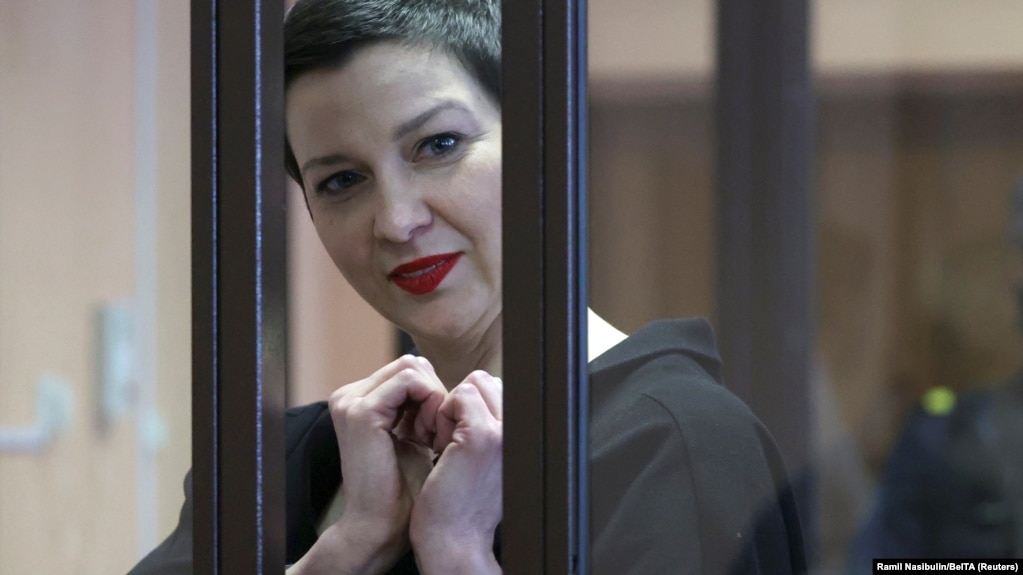
Maryya Kalesnikava forms a heart shape to supporters from inside a defendants' cage at her trial in Minsk on September 6.
Maryya Kalesnikava forms a heart shape to supporters from inside a defendants’ cage at her trial in Minsk on September 6.

The prize was presented by PACE President Rik Daems to Maryya’s sister, Tatsyana Khomich, at a special ceremony on September 27, the opening day of the autumn plenary session of the PACE in Strasbourg. For more on this award, see: https://www.trueheroesfilms.org/thedigest/awards/7A8B4A4A-0521-AA58-2BF0-DD1B71A25C8D

“In standing up against a regime which has chosen force and brutality against peaceful and legitimate protest, Ms. Kalesnikava showed that she is ready to risk her own safety for a cause greater than herself — she has shown true courage,” Daems said.

Accepting the prize on her sister’s behalf, Khomich said: “This award is a sign of solidarity of the entire democratic world with the people of Belarus. It is also a sign to us, Belarusians, that the international community supports us, and that we are on the right track.”

Kalesnikava and another opposition figure, Maksim Znak, were sentenced to prison terms of 11 and 10 years respectively on September 6, after being found guilty on charges with conspiracy to seize power, calls for action to damage national security, and calls for actions damaging national security by trying to create an extremist group. Both pleaded not guilty, rejecting the charges.

Kalesnikava, 39, was a coordinator of the election campaign of an excluded presidential aspirant, former Belgazprombank head Viktar Babaryka. After Babaryka was arrested weeks before the August 2020 presidential election, Kalesnikava joined forces with another presidential candidate, Svyatlana Tsikhanouskaya, whom the majority of Belarusians have called the winner in the election.

After joining Tsikhanouskaya’s support group, Kalesnikava became a member of the opposition Coordination Council and turned into a prominent leader of protests demanding the resignation of Lukashenka, who was officially announced the winner of the election demonstrators say was rigged and which the West has refused to acknowledge.

Kalesnikava was snatched from the streets of Minsk in September 2020 by masked men along with two staffers. The three were driven early the next day to the border, where authorities told them to cross into Ukraine.

Security officers reportedly failed to deport Kalesnikava because she ripped her passport into small pieces after they arrived in the no man’s land between Belarus and Ukraine. Her two associates entered Ukraine, but with no valid passport, Kalesnikava remained in the country and was subsequently detained.

See also: https://humanrightsdefenders.blog/2021/09/07/nominees-for-vaclav-havel-human-rights-prize-2021-announced/

In the meantime the Belarusian Justice Ministry has filed a lawsuit to dissolve the Belarusian Helsinki Committee, one of the country’s oldest independent human rights groups, Human Rights Watch said today. On September 30, 2021, the Belarus Supreme Court is scheduled to hold a hearing on the lawsuit. The move is part of wider effort by Belarusian authorities to silence all independent or critical voices in the country.

In a September 22 letter, five international human rights organizations, including Human Rights Watch, urged the Justice Ministry to withdraw its lawsuit, calling it “inappropriate [and] inconsistent with the Belarusian government’s obligations to respect and protect the legitimate work of human rights defenders.” They also said the lawsuit “violates a number of fundamental rights, including those of freedom of expression and association and due process.”

https://www.rferl.org/a/belarus-kalesnikava-havel-prize/31480306.html

https://www.euronews.com/2021/09/28/us-europe-rights-belarus

https://www.hrw.org/news/2021/09/29/belarus-authorities-target-top-human-rights-group

.

FIDH launches “SEE YOU IN COURT” campaign

September 29, 2021

The disastrous impact that multinationals have on the environment can no longer be denied. The human right to live in a healthy environment concerns us all, therefore, FIDH and its member organisations are launching coordinated legal actions across the world. The companies implicated and States which allow it to happen must be held accountable.

The first legal actions

It is time to recognize the right to a healthy environment as a fundamental human right and to hold companies accountable for their actions.

  • Environmental impact = human impact Because human rights and the environment are interdependent, it is crucial that States recognise the right to a healthy environment as a fundamental human right. Hundreds of organisations are fighting for a UN resolution to achieve international recognition of this.
  • Restoring a healthy environment to affected communities In the face of environmental disasters and human rights violations, the balance is still too often tipped in favour of the companies involved. Ensuring access to justice for those most affected and passing laws which hold multinationals accountable are also means to protect the planet.

https://seeyouincourt.fidh.org/?lang=en#

11 human rights defenders you need to follow on Instagram

September 14, 2021

Amnesty has collaborated with 11 artists, creatives and campaigners to illustrate the four basic freedoms on social media Four basic freedoms outlined in 1948 Universal Declaration of Human Rights have been reimagined as Freedom to Explore, Be, Imagine and Rebel

We [want to] inspire a new generation to know their rights – and claim them – Sacha Deshmukh

Amnesty International UK has collaborated with 11 artists to help a new generation of human rights defenders to better understand the four fundamental freedoms that every person has a right to.

Outlined in 1948, the Universal Declaration of Human Rights was based on four basic freedoms – freedom of speech, freedom to worship, freedom from want and freedom from fear.

But many young people today are unaware of the human rights they are entitled to, despite living at a moment in history when many of these basic freedoms are at risk of being taken away.

Now Amnesty has reimagined these four tenets for a modern audience, redefining the broad categories as the:

  • Freedom to Explore
  • Freedom to Be
  • Freedom to Imagine
  • Freedom to Rebel

Over the coming weeks, artists, creatives and campaigners will be sharing their interpretations of what these freedoms mean to them on Instagram.

Sacha Deshmukh, CEO of Amnesty International UK, said:

From the pandemic to the climate crisis to conflicts unfolding across the planet – we live in a world of unprecedented uncertainty. But there is hope.

“Sixty years after Amnesty International was founded, we are collaborating with 11 fantastic artists, creatives and campaigners to reimagine the four basic freedoms – inspiring a new generation to know their rights and claim them.

“Knowledge is power and at a time when many basic human rights are under threat, these artists are vital beacons of hope for their followers – and the wider world.”

11 artists who want to change the world for the better

  • Basma Khalifa (she/her @basmakhalifa) is a Sudanese multi-disciplinary creative and hosts the ‘Unpretty Podcast’ which discusses perceptions of beauty through the lens of people of colour. Basma has worked with BBC1, BBC3, Facebook, Apple and Vice. 
  • Das Penman (they/she @das.penman) Das started their Instagram page during lockdown as a means of creative expression but it has since grown into a safe space for discussions about politics, mental health and everything in between. Das combines a passion for drawing with current affairs to create the “Daisy Mail”, a round-up of news stories to help followers stay informed.
  • Jacob V Joyce (they/them @jacobvjoyce) is a non-binary artist with a focus on queer and decolonial narratives. Joyce’s work ranges from afro-futurist world building workshops to mural painting, comic books, performance art and punk music.
  • Joy Yamusangie (they/them @joyyamusangie) specialises in illustration, experimenting with a range of processes to produce mixed media pieces. Joy explores themes of memory, intimacy, race and culture from a personal perspective.
  • Bee Illustrates (they/them @beeillustrates) is a queer illustrator who uses their art to educate, empower and inform people on a range of topics including mental health, LGBTQ+ and anti-racism.
  • Radam Ridwan (they/them @radamridwan) is a queer non-binary multi-disciplinary artist of Indonesian heritage. Radam’s work centres on QTIPOC empowerment and has been published internationally with features in VICE, Vogue Italia, gal-dem and Gay Times.
  • Tahmina Begum (she/her @tahminaxbegum) is a journalist and has featured in HuffPostUK, Women’s Health, I-D, Dazed, Refinery29, Glamour, The Independent, Metro, The i and gal-dem.  She covers a wide scope of topics centring around the lives of Muslim women and women of colour.
  • Jaz O’Hara (she/her @theworldwidetribe) is a motivational speaker, podcaster and the founder of The Worldwide Tribe, an organisation supporting refugees and asylum seekers globally.
  • Anshika Khullar (they/them @aorists) also known as Aorists is an award-winning Indian, non-binary transgender artist with an interest in intersectional feminist narratives.  In addition to their editorial and literary projects, Anshika has appeared as a guest speaker and created video content for the Tate.
  • Antony Amourdoux (he/him @antony_amourdoux) was a Great British Bake Off 2018 contestant and remains a passionate baker. Antony was born in Pondicherry, India, where he learned to bake with his father. He supports a number of causes including LGBTQ rights.
  • Jess (she/her @thechroniciconic) campaigns about the unseen injustices around disability, mental health and neurodiversity by sharing both her lived experience and the voices of others. Jess’ goal is to destigmatise and normalise conversations on these subjects.

https://www.amnesty.org.uk/press-releases/know-your-freedoms-11-human-rights-defenders-you-need-follow-instagram-right-now

Human Rights Defenders issues in the 48th session of he UN Human Rights Council

September 13, 2021

The International Service for Human Rights (HRC) published again it – as usual – very useful Guide to the next (48th) Session of the UN Human Rights Council, from 13 September to 8 October 2021. Here is an overview of some of the key issues on the agenda directly affecting human rights defenders. Stay up-to-date: Follow @ISHRglobal and #HRC48 on Twitter, and look out for their Human Rights Council Monitor and during the session. [for last year’s, see: https://humanrightsdefenders.blog/2021/06/22/key-issues-affecting-hrds-in-47th-session-of-un-human-rights-council-june-2021/

Thematic areas of interest

Reprisals

On 29 September, the Assistant Secretary General Ilze Brands Kehris for Human Rights will present the Secretary General’s annual report on Cooperation with the United Nations, its representatives and mechanisms in the field of human rights (also known as ‘the Reprisals Report’) to the Council in her capacity as UN senior official on reprisals. The presentation of the report will be followed by a dedicated interactive dialogue, as mandated by the September 2017 resolution on reprisals. ISHR remains deeply concerned about reprisals against civil society actors who engage or seek to engage with UN bodies mechanisms. We continue to call for all States and the Council to do more to address the situation. The dedicated dialogue provides a key opportunity for States to raise concerns about specific cases of reprisals, and demand that Governments provide an update on any investigation or action taken toward accountability. An increasing number of States have raised concerns in recent sessions about individual cases of reprisals, including in Egypt, Nicaragua, Cuba, Saudi Arabia, Malaysia, Bahrain, Yemen, Burundi, China and Venezuela, Egypt, Burundi, Lao and China,  

During the 48th session, Ghana, Fiji, Hungary, Ireland and Uruguay will present a draft resolution on cooperation with the UN. The draft resolution aims to strengthen the responses by the UN and States to put an end to acts of intimidation and reprisals. ISHR urges all delegations to support the adoption of the draft resolution and resist any efforts to undermine and weaken it.

ISHR recently launched a study analysing 709 reprisals cases and situations documented by the UN Secretary-General between 2010 and 2020. The study examines trends and patterns in the kinds of cases documented by the UNSG, how these cases have been followed up on over time, and whether reprisal victims consider the UN’s response effective. Among other things, the study found that nearly half the countries serving on the Council have been cited for perpetrating reprisals. The study found that public advocacy and statements by high level actors condemning reprisals can be one of the most effective tools to prevent and promote accountability for reprisals, particularly when public pressure is sustained over time. The study also found that, overall, the HRC Presidency appears to have been conspicuously inactive on intimidation and reprisals, despite the overall growing numbers of cases that are reported by the UNSG – including in relation to retaliation against individuals or groups in connection with their engagement with the HRC – and despite the Presidency’s legal obligation to address such violations. The study found that the HRC Presidency took publicly reported action in only 6 percent of cases or situations where individuals or organisations had engaged with the HRC. Not only is this a particularly poor record in its own right, it also compares badly with other UN actors. [see also: https://humanrightsdefenders.blog/2021/05/06/un-action-on-reprisals-towards-greater-impact/]

In line with previous calls, ISHR expects the President of the Human Rights Council to publicly identify and denounce specific instances of reprisals by issuing formal statements, conducting press-briefings, corresponding directly with the State concerned, publicly releasing such correspondence with States involved, and insisting on undertakings from the State concerned to investigate, hold the perpetrators accountable and report back to the Council on action taken.

Environmental Justice

It’s high time the Council responds at this session to the repeated calls by diverse States and civil society to recognize the right of all to a safe, clean, healthy and sustainable environment and establish a new mandate for a Special Rapporteur on human rights and climate change. ISHR joins a broad civil society coalition in calling on all States to seize this historic opportunity to support the core-group of the resolution on human rights and environment (Costa Rica, Maldives, Morocco, Slovenia, Switzerland) as they work towards UN recognition of the right to environment so that everyone in the world, wherever they live, and without discrimination, can live in a safe, clean and sustainable environment. Furthermore, ISHR also joins a broad civil society coalition in calling on States to establish a new Special Rapporteur on climate change at this session. This new mandate is essential to strengthen a human rights-based approach to climate change, engage in country visits, undertake normative work and capacity-building, and further address the human rights impacts of climate responses, in order to support the most vulnerable. [see also the recent Global witness report: https://humanrightsdefenders.blog/2021/09/13/global-witness-2020-the-worst-year-on-record-for-environmental-human-rights-defenders/]

Other thematic reports

At this 48th session, the Council will discuss a range of civil, political, economic, social and cultural rights and issues through dedicated debates, including interactive dialogues with the:

  1. Special Rapporteur on the human rights to safe drinking water and sanitation
  2. Special Rapporteur on the negative impact of unilateral coercive measures on the enjoyment of human rights 
  3. Special Rapporteur on truth, justice, reparation and guarantees of non-recurrence
  4. Special Rapporteur on contemporary forms of slavery, including its causes and consequences 
  5. Working Group on Arbitrary Detention
  6. Working Group on Enforced or Involuntary Disappearances
  7. Special Rapporteur on the implications for human rights of the environmentally sound management and disposal of hazardous substances and wastes 
  8. The Special Rapporteur on contemporary forms of racism, racial discrimination, xenophobia and related intolerance

In addition, the Council will hold dedicated debates on the rights of specific groups including with the:

  1. High Commissioner on the current state of play of the mainstreaming of the human rights of women and girls in conflict and post-conflict situations
  2. Special Rapporteur  on the rights of indigenous peoples and the Expert Mechanism on the Rights of Indigenous Peoples
  3. Working Group of Experts on People of African Descent 

Country-specific developments

Afghanistan

ISHR has joined 50 civil society organisations to urge UN Member States to ensure the adoption of a robust resolution to establish a Fact-Finding Mission or similar independent investigative mechanism on Afghanistan as a matter of priority at the upcoming 48th regular session of the HRC.  We expressed profound regret at the failure of the recent HRC special session on Afghanistan to deliver a credible response to the escalating human rights crisis gripping the country, falling short of the consistent calls of the Afghanistan Independent Human Rights Commission (AIHRC), the UN High Commissioner for Human Rights, Special Procedures and civil society organisations, and does not live up to the mandate of the HRC to effectively address situations of violations of human rights, including gross and systematic violations. The Council must establish a Fact-Finding Mission, or similar independent investigative mechanism, with a gender-responsive and multi-year mandate and resources to monitor and regularly report on, and to collect evidence of, human rights violations and abuses committed across the country by all parties. 

China 

It has now been three years since High Commissioner Bachelet announced concerns about the treatment of Uyghurs and other Turkic Muslims – including mass arbitrary detention, surveillance and discrimination – in the Xinjiang Uyghur Autonomous Region of China. During the intervening three years, further substantial and incontrovertible evidence has been presented indicating crimes against humanity in the region. ISHR joins a 300+ strong coalition of global civil society that continues to call for accountability for these and other violations, including in Tibet and Hong Kong, by the Chinese authorities. At this session, ISHR highlights that arbitrary detention is – as has been noted by the Special Procedures – a systemic issue in China. Chinese authorities are long overdue in taking any meaningful action in response to the experts’ concerns, such as ceasing the abuse of ‘residential surveillance in a designated location’, or RSDL. ISHR reiterates its calls from the 46th and 47th sessions for a clearly articulated plan from OHCHR to ensure public monitoring and reporting of the situation, in line with their mandate and with full engagement of civil society, regardless of the outcome of long-stalled negotiations for High Commissioner access to the country. This would be a critical first step for future, more concrete actions that would respond to demands of victims, their families and communities, and others defending human rights in the People’s Republic of China. 

Burundi

We request the Council to continue its scrutiny and pursue its work towards justice and accountability in Burundi. The Council should adopt a resolution that acknowledges that despite some improvements over the past year, the human rights situation in Burundi has not changed in a substantial or sustainable way, as all the structural issues identified by the Commission of Inquiry on Burundi (CoI) and other human rights actors have identified since 2015 remain in place. The Council should adopt an approach that focuses on continued independent documentation on the situation of human rights in Burundi which should be carried out by the CoI, or a similarly independent mechanism or team of experts, who are solely focused on Burundi. The Council’s approach should also ensure that there is follow up to the work and recommendations of the CoI, in particular, on justice and accountability. See joint letter released ahead of the UN Human Rights Council’s 48th session.

Egypt

Despite Egypt’s assurances during the UPR Working Group in 2019 that reprisals are unacceptable, since 2017, Egypt has been consistently cited in the UN Secretary General’s annual reprisals reports. The Assistant Secretary-General raised the patterns of intimidation and reprisal in the country in the 2020 reprisals report, as well as UN Special Procedures documenting violations including detention, torture and ill-treatment of defenders. In her latest communication to the Government, the Special Rapporteur on human rights defenders highlighted the arbitrary detention of 12 defenders, including three targeted for their engagement with the UN: Mohamed Al-Baqer, human rights lawyer and Director of the Adalah Centre for Rights and Freedoms, arbitrarily detained since 29 September 2019; Ibrahim Metwally, coordinator for the Association of the Families of the Disappeared in Egypt, arbitrarily detained since 10 September 2017; and Ramy Kamel, Copitic rights activist, arbitrarily detained since 23 November 2019. Both States and the HRC Presidency should publicly follow up on these cases. Furthermore, in light of Egypt’s failure to address concerns expressed by States, the High Commissioner and Special Procedures, ISHR reiterates our joint call with over 100 NGOs on the Council to establish a monitoring and reporting mechanism on Egypt and will continue to do so until there is meaningful and sustained improvement in the country’s human rights situation. 

Nicaragua

The human rights crisis in Nicaragua has steadily deteriorated since May 2021. Given the reported lack of implementation of resolution 46/2 and the absence of meaningful engagement with the UN and regional mechanisms by the Government, stepping up collective pressure has become vital. We warmly welcome the joint statement delivered by Costa Rica on behalf of a cross-regional group of 59 States on 21 June 2021. This is a positive first step in escalating multilateral pressure. Further collective action should build on this initiative and seek to demonstrate global, cross-regional concern for the human rights situation in the country. In her oral update, the High Commissioner stressed ‘as set out in [the Council’s] latest resolution, I call on this Council to urgently consider all measures within its power to strengthen the promotion and protection of human rights in Nicaragua. This includes accountability for the serious violations committed since April 2018.’ We call on all States to support a joint statement at the 48th session of the Human Rights Council, urging the Government to implement priority recommendations with a view to revert course on the ongoing human rights crisis, and indicating clear intention to escalate action should the Nicaraguan Government not take meaningful action.

Saudi Arabia

While many of the WHRDs mentioned in previous joint statements at the Council have been released from detention, severe restrictions have been imposed including travel bans, or making public statements of any kind. Most of the defenders have no social media presence. Furthermore, COVID-19 restrictions and the G20 Summit in November 2020 coincided with a slow down in prosecutions of those expressing peaceful opinions and a decline in the use of the death penalty. However, throughout 2021 the pace of violations has resumed. This has included fresh new waves of arrests of bloggers and ordinary citizens, often followed by periods of enforced disappearance, lengthy prison terms issued against human rights defenders and prisoners of conscience, and abuse in prison, including deliberate medical neglect. In addition, despite announcing the halt of the death penalty against minors, the Saudi government recently executed someone who may have been 17 at the time of the alleged offense, and the number of executions in 2021 is already more than double the total figure for 2020. Saudi Arabia has refused to address the repeated calls by UN Special Procedures and over 40 States at the Council in March 2019, September 2019 and September 2020, further demonstrating its lack of political will to genuinely improve the human rights situation and to engage constructively with the Council. ISHR reiterates its call on the Council to establish a monitoring and reporting mechanism on the human rights situation in Saudi Arabia.

Venezuela 

With the environment becoming all the more hostile for civil society organisations in Venezuela, the Council will once again focus attention on the human rights situation in the country at the upcoming session. On 24 September, the Independent International Fact-Finding Mission will provide its second report to the Council building on its findings of likely crimes against humanity committed in the country. ISHR looks forward to making an oral statement during the dialogue with the Mission. In addition, the High Commissioner will provide an oral update on the situation in the country and the work of her office in-country, on 13 September. The Special Rapporteur on Unilateral Coercive Measures will present her report following her in-person visit to the country in February 2021. Finally, it’s expected that the report of the Secretary General on reprisals will include cases related to Venezuela. During all these opportunities to engage, States should remind Venezuela of the need to implement UN recommendations; engage with UN human rights mechanisms, including the Mission; and organise visits for Special Rapporteurs already identified for prioritisation by OHCHR. 

Yemen

ISHR joined over 60 civil society organisations to use the upcoming session of the HRC to establish an international criminally-focused investigation body for Yemen, and simultaneously ensure the continuity of the Group of Eminent Experts on Yemen (GEE) through an ongoing or multi-year mandate. In their last report, “A Pandemic of Impunity in a Tortured Land”, the UN Group of Eminent International and Regional Experts on Yemen (GEE) underscored Yemen’s “acute accountability gap”, concluding that the international community “can and should” do more to “help bridge” this gap in Yemen. They recommended that the international community take measures to support criminal accountability for those responsible for serious violations of international humanitarian law and egregious human rights abuses. In particular, they supported the “establishment of a criminally focused investigation body” (similar to the mechanisms established for Syria and Myanmar) and “stressed the need to realize victims’ rights to an effective remedy (including reparations)”.  Such a mechanism would facilitate and expedite fair and independent criminal proceedings, in accordance with international law standards, and lay the groundwork for effective redress, including reparations for victims. 

Other country situations:

The High Commissioner will provide an oral update to the Council on 13 September 2021. The Council will consider updates, reports and is expected to consider resolutions addressing a range of country situations, in some instances involving the renewal of the relevant expert mandates. These include:

  • Interactive Dialogue on the High Commissioner’s written update on Myanmar, including of Rohingya Muslims and other minorities, an interactive dialogue on the report of on the Independent Investigative Mechanism, and an Interactive Dialogue with the Special Rapporteur 
  • Oral update by the High Commissioner and enhanced interactive dialogue on the Tigray region of Ethiopia
  • Enhanced Interactive Dialogue with the Commission on Human Rights in South Sudan
  • Interactive Dialogue with the Commission of Inquiry on Syria and oral update by OHCHR on the extent of civilian casualties
  • Oral update by OHCHR and interactive dialogue on Belarus
  • Oral update by the High Commissioner on the progress made in the implementation of the Council’s 30th Special Session resolution on the Occupied Palestinian Territory, including East Jerusalem, and in Israel, and presentation of the High Commissiner’s report on allocation of water resources in Occupied Palestinian Territory, including East Jerusalem
  • Interactive Dialogue with the High Commissioner on Ukraine 
  • Enhanced Interactive Dialogue with the High Commissioner on the Democratic Republic of the Congo and on the final report of the team of international experts on the situation in Kasai
  • Enhanced Interactive Dialogue on the oral update of the High Commissioner on South Sudan
  • Interactive Dialogue with the Special Rapporteur on Cambodia and presentation of the Secretary-General’s report 
  • Enhanced Interactive Dialogue on the report of the High Commissioner on Sudan
  • Interactive Dialogue with the Independent Expert on Somalia
  • Interactive Dialogue with the Independent Expert on the Central African Republic 
  • Interactive Dialogue with the Fact-finding mission on Libya
  • Presentation of the High Commissioner’s report on cooperation with Georgia 
  • Oral update by the High Commissioner on the Philippines

#HRC48 | Council programme, appointments and resolutions

During the organisational meeting for the 48th session held on 30 August the President of the Human Rights Council presented the programme of work. It includes six panel discussions. States also announced at least 20 proposed resolutions. Read here the 87 reports presented this session. 

Appointment of mandate holders

  1. The Special Rapporteur in the field of cultural rights
  2. a member of the Working Group on the issue of human rights and transnational corporations and other business enterprises from Latin American and Caribbean States; 
  3. a member of the Working Group of Experts on People of African Descent, also from Latin American and Caribbean States (an unforeseen vacancy that has arisen due to the resignation of a current member).

Resolutions to be presented to the Council’s 48th session

At the organisational meeting on 30 August the following resolutions inter alia were announced (States or groups leading the resolution in brackets):

  1. Human rights situation in Burundi (EU)
  2. Human rights and environment (Costa Rica, Maldives, Morocco, Slovenia, Switzerland) 
  3. Cooperation with the United Nations, its representatives and mechanisms in the field of human rights  (Fiji, Ghana, Hungary, Ireland, Uruguay) 
  4. Human rights situation in Yemen (Belgium, Canada, Ireland, Luxembourg, Netherlands) 
  5. Elimination of child, early and forced marriage (Argentina, Canada  Italy, Honduras, Montenegro, Poland, Sierra Leone, Switzerland, UK, Uruguay, Zambia, Netherlands) 
  6. Technical assistance and capacity-building in the field of human rights in the Democratic Republic of the Congo (African Group) 
  7. Technical assistance and capacity-building to improve human rights in Libya (African Group)
  8. From rhetoric to reality: a global call for concrete action against racism, racial discrimination, xenophobia and related intolerance (African Group)
  9. Human rights and indigenous peoples (Mexico, Guatemala)
  10. Human rights situation in Syria (France, Germany, Italy, Jordan, Kuwait, Netherlands, Qatar, Turkey, UK, USA)
  11. Advisory services and technical assistance for Cambodia – mandate renewal (Japan) 
  12. Enhancement of technical cooperation and capacity-building in the field of human rights (Thailand, Brazil, Honduras, Indonesia, Morocco, Norway, Qatar, Singapore, Turkey)
  13. Technical assistance and capacity building to Yemen (Arab Group)
  14. Equal participation in political and public affairs (Czech Republic, Botswana, indonesia, Peru, Netherlands)
  15. Right of privacy in the digital age (Germany, Brazil, Liechtenstein, Austria, Mexico) 
  16. The question of the death penalty (Belgium, Benin, Costa Rica, France, Mexico, Mongolia, Moldova, Switzerland) 

Adoption of Universal Periodic Review (UPR) reports

During this session, the Council will adopt the UPR working group reports on Myanmar, Namibia, the Niger, Mozambique, Estonia, Belgium, Paraguay, Denmark, Somalia, Palau, Solomon Islands, Seychelles, Latvia, Singapore and Sierra Leone.

Panel discussions

During each Council session, panel discussions are held to provide member States and NGOs with opportunities to hear from subject-matter experts and raise questions. Six panel discussions are scheduled for this upcoming session:

  1. Biennial panel discussion on the issue of unilateral coercive measures and human rights
  2. Annual discussion on the integration of a gender perspective throughout the work of the Human Rights Council and that of its mechanisms
  3. Annual half-day panel discussion on the rights of indigenous peoples on the theme “Situation of human rights of indigenous peoples facing the COVID-19 pandemic, with a special focus on the right to participation” (accessible to persons with disabilities)
  4. Half-day panel discussion on deepening inequalities exacerbated by the COVID-19 pandemic and their implications for the realization of human rights (accessible to persons with disabilities)
  5. High-level panel discussion on the theme “The tenth anniversary of the United Nations Declaration on Human Rights Education and Training: good practices, challenges and the way forward” (accessible to persons with disabilities
  6. Panel discussion on the promotion and protection of human rights in the context of peaceful protests, with a particular focus on achievements and contemporary challenges (accessible to persons with disabilities)

Read here ISHR’s recommendations on the the key issues that are or should be on the agenda of the UN Human Rights Council in 2021.

https://ishr.ch/