On 6 March 2019 Global Geneva published an article by John Horekens entitled “Defending Human Rights Defenders: The Legacy of Martin Ennals”
Can a human rights award make a difference to the plight of victims by drawing public attention to their situation? Or even protect them from being killed or tortured? John Horekens argues that international prizes such as the Martin Ennals Award for Human Rights Defenders (MEA) can do just that. And even more. They recognize the courage and resilience of those who have decided to stand up for their rights, and the rights of others, regardless of the consequences.
It contains a short history of the MEA and argues forcefully for its place in Geneva. And has nice pictures!
Abdul Aziz Muhamat on stage in Geneva delivering his acceptance speech. The presentation slide was taken in Manus; on the left of Muhamat (blue T-shirt) is Behrouz Boochani (bare-chested) who was awarded Australia’s Victorian Prize for Literature in January 2019)
Abdul Aziz Muhamat, aka QNK002, is a Sudanese refugee currently interned by the Australians on Manus Island detention centre in Papua New Guinea. Standing left, here is at the MEA Award ceremony in Geneva in February, 2019. Arnold Tsunga, right, is a Zimbabwean lawyer and 2006 laureate in 2006 and currently an MEA Board member.
……………..
Martin Ennals in 1978. (Photo: Amnesty International).
It all started in London in 1992 when a group of Martin Ennals’ friends and relatives decided to commemorate the activist’s outstanding contribution to the modern human rights movement in creating this award. A founding member of the Anti-Apartheid Movement and the Secretary-General of the National Council for Civil Liberties, Ennals tirelessly advocated equal rights for all and for the development of global human rights. He created several non-governmental human rights organizations and was the first Secretary-General of Amnesty International (AI). During his tenure, AI was awarded inter alia the Nobel Peace Prize in 1977 and the UN Human Rights Award in 1978.
…..………
By 2007, close links had developed with the City of Geneva, leading to an agreement with the local government providing strong multi-year support for the ceremony itself. Its timing was moved in 2019 to February so as to benefit from increased public interest at a time when the Human Rights Council (HRC) prepares for its main session. Created in 2006 by the United Nations General Assembly, the HRC is the UN body responsible for strengthening the promotion and protection of human rights around the world and for addressing situations of human rights violations. It meets in Geneva for three regular sessions every year to discuss thematic human rights issues and situations that require its attention.
)
…..For Sandrine Salerno, municipal councillor and the leading proponent of the award within the City government, all this only underlines how deeply Geneva is committed to the defence of fundamental rights. “As a host to most major international organisations active in the human rights area, and with a long tradition of welcoming asylum-seekers, migrants, and people needing protection and assistance, the City of Geneva has made the promotion of human rights one its main international policy priorities.”
On the occasion of the MEA’s 25th anniversary in 2018, leaders of its jury organizations gathered with former laureates, providing an opportunity to discuss the state of human rights and human rights action today. In particular, they addressed issues such as how to influence authoritarians, counter populism, and the means for developing human rights action. “It is not easy to attribute impact to an organization working in the field of human rights”, says Dick Oosting, current Chairman of the Foundation Board. “Awards are only a tool.” But, he adds, “with its jury of ten major NGOs and its partnership with Geneva, the Martin Ennals Award has credibility that can provide real protection. We know this because our laureates and finalists tell us so.” Abdul Aziz Muhamat aka QNK002 on Manus Island can vouch for that.
John Horekens is a former senior official of the United Nations and of the international Red Cross. He is the vice-chairman of the Martin Ennals Foundation Board.
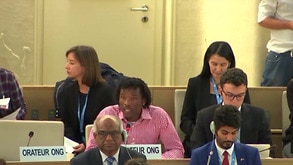
SBS news reports that award-winning Manus Island detainee Abdul Aziz Muhamat has spoken before the United Nations Human Rights Council over Australia’s ‘cruel’ asylum seeker policy. Speaking on behalf of the Human Rights Law Centre, the 25-year-old said: “After 6 years, we deserve our lives back and a future. We urge your mandates to take this up with the Australian government, which deserves to be held accountable by this Council.” [see also: https://humanrightsdefenders.blog/2019/02/18/aziz-thank-you-for-the-attention-but-now-i-have-go-back-to-detention/]
“We have no rights. We are not safe. We cannot go to Australia, or elsewhere, because the Australian Government will not allow it. We cannot go home, as it is unsafe. We are all sick and we have lost hope. We are in limbo.” He said the impact of six years of Australia’s offshore detention policy had exacted a physical and mental toll.
“As the Australian Government sits on the UN Human Rights Council, professing its commitment to human rights, it is indefinitely imprisoning nearly 1000 men and women in offshore refugee camps on Nauru and Manus,” said HRLC Legal Director Edwina MacDonald.
The award aims to recognize individuals, or exceptionally an organisation, who are working in conditions hostile to fundamental human rights, are at risk, and in need of protection.
Nominees must be currently active in the promotion and protection of human rights.
Nominations are welcome from all regions, genders, and human rights related themes. We take a broad view of what a human rights defender is. Nominations of women are particularly encouraged.
Special account is taken of those who combat human rights violations by courageous and innovative means.
Three finalists are selected and will be announced in October 2019. The laureate is selected from among them, and all three are invited to participate in the ceremony hosted by the City of Geneva, in February 2020.
The Jury of the Martin Ennals Award for Human Rights Defenders just announced that the 2019 Laureate is Abdul Aziz Muhamat, a Sudanese refugee activist being effectively detained on Manus island in Papua New Guinea as part of Australia‘s controversial policy of deterring arrivals. Read the rest of this entry »
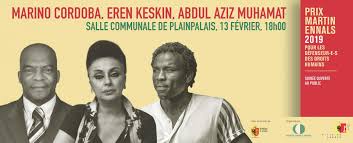
A reminder about the ceremony for the 2019 Martin Ennals Award for Human Rights Defenders which will be held on Wednesday 13 February, 2019 – 18h00 – Salle communale de Plainpalais (Rue de Carouge 52), Geneva, also known as Pitoëff. Please note that this location is different from previous years!
The laureate will be selected from among the three 2019 finalists:
Marino Cordoba <https://171895.g4.mp-stats.com/url-955662790-4564379-05122018.html> (Colombia) is an activist fighting for the political recognition and rights of the Afro-Colombian community, many of whom have been dispossessed of their land for the benefit of mining and forestry companies.
The laureate is selected by the Jury of the Martin Ennals Award, made up of ten of the world’s leading human rights organizations: Amnesty International, Human Rights Watch, Human Rights First, FIDH, World Organisation Against Torture (OMCT), Front Line Defenders, the International Commission of Jurists, Brot für die Welt, the International Service for Human Rights and HURIDOCS. [https://humanrightsdefenders.blog/2018/10/24/breaking-news-ennals-award-announces-its-3-finalists-for-2019/]
Short documentaries on the life of these finalists will be screened for the first time, giving a glimpse of their fight and the particularly difficult conditions in which they work. The evening will conclude with a receptionhosted by the City of Geneva, allowing the 2019 finalists, the Geneva community of human rights and the public to exchange in an informal setting.
Behrouz Boochani in November, 2017. Picture: Jason Garman/Amnesty International
With one of the MEA 2019 final nominees being detained on Manus island in the same way [see: https://humanrightsdefenders.blog/2018/10/24/breaking-news-ennals-award-announces-its-3-finalists-for-2019/ ] it is relevant to note that another such detainee has won literary awards in Australia! Iranian-Kurdish journalist and poet Behrouz Boochaniwon the richest Australian Victorian Prize for Literature ($100,000) for his hellish first-hand account of life as a detainee on the island. His book, No Friend But The Mountains: Writing From Manus Prison, also won the $25,000 prize for nonfiction at Victorian Premier’s Literary Awards on 31 January 2019. (The eligibility criteria requiring that the authors be Australian citizens or permanent residents was overlooked to award the prize.
Mr Boochani told the Herald Sun from Manus Island, where he has been detained for more than five years, that the award was a victory for literature, resistance and humanity. But, he added: “I don’t want to celebrate this achievement while I still see many innocent people suffering around me.
No Friend But The Mountains.
“If I could be there to accept the award I would explain how this award is a morality failure for Australia,” Mr Boochani said. “It is not just a failure on the part of the Australian government but a historical and moral defeat for those parts of the society who have been silent in the face of a barbaric policy over these years…It’s a huge cause of shame for a government that did not recognise us as human beings and did not recognise our human rights. It’s a challenge against a system that has lied to the public over the past years.”.
On 1 February Keyvan Allahyari, University of Melbourne, followed up with a thoughtful piece on why “Behrouz Boochani’s literary prize cements his status as an Australian writer”
Other Australian authors have also used their voices to bring attention to the plight of asylum seekers. During her acceptance speech for her second Miles Franklin Award in August 2018, Michelle de Kretser chastised politicians for their treatment of refugees on Nauru and Manus Island. To illustrate her point, she read a list of names of asylum seekers who have died there in the past five years. It is tempting to dismiss such actions as gesture politics by an urban elite. But each individual action has served to raise awareness of the Australian government’s policy of “offshore processing” for asylum seekers, and to fuse artistic expression with political activism in a particularly forceful manner.
The author has been awarded the Anna Politkovskaya Award (for investigative journalism), the Amnesty International Award (Australian section) and Liberty Victoria’s Empty Chair Award. These humanitarian awards have confirmed Boochani’s rapidly acquired high profile in the literary field. Last night’s news topped all of that to make Boochani the first “non-Australian” author to win the Victorian Premier’s Literary Awards. The Victorian government established these awards in 1985 to honour Australian writing. The specific challenge this poses to the definition of “Australian writing” can be seen as an intervention by the literary community into the field of politics. If a non-citizen who has never set foot on mainland Australia can win, who counts as an Australian author?…
With no clear solution to the indefinite detention of asylum seekers on Manus and Nauru in sight, the paradox of Boochani’s award success can only contribute further to public debate over the tangled logic of indefinite detention. It shows how cultural practices and political activism can be reconfigured to correspond with the newly created literary currency associated with refugee writing. For now, at least, Boochani is an “Australian writer” because Australia is morally implicated in what he wrote and how he wrote it.
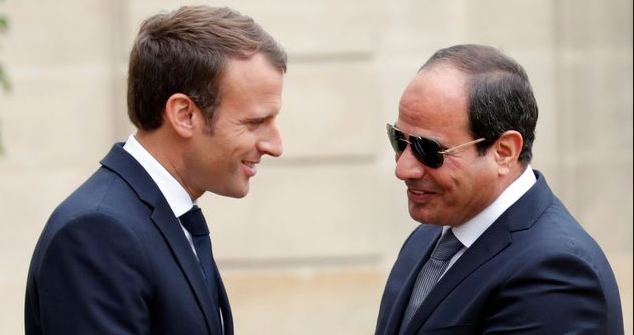
Emmanuel Macron lunched with Egyptianhuman rights defendersin Cairo on 29 January at the end of a three-day visit (for names see below). On Monday, the French president had visibly annoyed his Egyptian counterpart Abdul Fattah al-Sisi at a press conference, by saying that Sisi ought to restore civil rights and liberties for the good of his country. “Stability and lasting peace in Egypt go hand in hand with respecting individual rights and liberties within a state of law,” Macron said. “A dynamic, active, civil society remains the best rampart against extremism.” In response, President Sisi that “Egypt will not rise up with bloggers… Egypt will develop with efforts and patience.”
The French leader was even more forthright with French journalists in Cairo on Sunday night. He had given Sisi a list of political opponents including “journalists, homosexuals, men and women who have convictions” when Sisi visited Paris in October 2017. “Only two of them were freed,” Macron said. “That’s not enough. And things have got worse since.”
That the State does not have to do all the criminalisation of HRDs itself was shown a day after the meeting with the HRDs, when Egyptian lawyer Tarek Mahmoud filed a legal complaint against the heads of four of Egypt’s human rights organizations for “threatening national security”, according to local media reports. The complaint was filed on Wednesday against Mohamed Zaree, the director of the Cairo Institute for Human Rights Studies (CIHRS), Gamal Eid, the executive director of the Arabic Network for Human Rights Information, Mohamed Lotfy, the executive director of the Egyptian Commission for Rights and Freedoms, and Gasser Abdel-Razek, the executive director of the Egyptian Initiative for Personal Rights (EIPR). Tarek Mahmoud said in the complaint that the four men “provided French officials with false information on the political conditions in Egypt”. Mahmoud added that they were “insulting the Egyptian state and undermining the country’s national security, and collaborating with the terrorist Muslim Brotherhood group to achieve its goals of bringing down the Egyptian state.”
The Irish human rights group Frontline Defenders has presented a report on Egypt’s Attack on Labour Rights Defenders to French media in the run-up to Macron’s visit (with focus on the ill-treatment of workers at the Alexandria shipyard.).
On 28 January, 2019, the Unrepresented Nations and Peoples Organization (UNPO), the World Uyghur Congress (WUC) and Norwegian Uyghur Committee (NUK) announced that they have nominated the Chinese human rights defender Ilham Tohti for the Rafto Prize. With the completion of five years of his arrest, the organisations believe his peaceful trajectory in defense of the freedom and fully enjoyment of human rights by the Uyghur population in China is deserving of this prestigious prize. See also: https://humanrightsdefenders.blog/2018/01/15/today-ilham-tohti-completes-his-fourth-year-in-chinese-detention/.
[Ilham Tohti served as a professor of economics at Minzu University in Beijing where he specialized in research focused on Uyghur-Han relations, China’s ethnic policies and East Turkistan. Alongside his scholarship and teaching, Ilham is revered for establishing and maintaining Uyghur Online, a website dedicated to promoting Uyghur human rights and improved relations between Uyghur and Han Chinese people. Professor Tohti criticised oppressive policies against Uyghurs and wrote extensively on constructive approaches to overcome unequal treatment between ethnic groups. Notably, he called for dialogue and reconciliation, using his web platform as the primary vehicle. For his efforts, he was arrested by Chinese authorities on January 15, 2014. Despite the UN Working Group on Arbitrary Detention finding his detention to be arbitrary in March 2014, Tohti was sentenced to life in prison in September of that year on charges of “separatism” after just a two-day trial. The legal process involving Tohti was met with significant issues throughout. His lawyers were unable to meet him for six months following the initial arrest, his defense team was not provided with complete evidence by the prosecutor, nor were their requested witnesses allowed to testify during the trial. Ilham has been serving his life sentence since December 2014 at Urumqi’s No. 1 Prison. Since then, he has been allowed very few visits from his family. Complicating this has been his continued detention in Urumqi, despite his family living in Beijing – a likely punitive move from Beijing. ChinaChange has noted that Tohti has been held in solitary confinement until at least early 2016 and has been denied the right to communicate with family and friends aside from minimal visits. The WUC gathered 132 scholars and 19 civil society organisations in an open letter to urge the Chinese government to release Ilham Tohti from his arbitrary detention of the five-year anniversary of his arrest in January 2019.]
The WUC,the UNPO and the NUK encourage scholars and organisations to join in nominating Ilham Tohti. The deadline for nominations is Friday, February 1st. As the situation in East Turkistan continues to deteriorate, with more than one million innocent Uyghurs arbitrarily detained in internment camps and the Uyghur people facing unparalleled repression, Ilham Tohti’s life and work stands as an inspiration to continue the peaceful struggle for peace, understanding
On 4 December 2018 Jonathan Emmett wrote in a post about something that I had been wondering for weeks: “Are UK authors only prepared to defend the rights of people like themselves?”. Totally correct:
On Wednesday 13 February 2019, at 18:00 the Ceremony of the Martin Ennals Award for Human Rights Defenderswill take place at the Salle communale de Plainpalais, Geneva. The City of Geneva and the Martin Ennals Foundation invite you to attend and register now on the Martin Ennals Award’s website. The ceremony is organized with the support of the Republic and Canton of Geneva.
Eren Keskin (Turkey) is a lawyer who has been fighting for the rights of women, Kurds and the LGBTI community for over thirty years. She has been sentenced to 12 years in prison in March 2018, but is free while her case is under appeal.
Abdul Aziz Muhamat (Sudan) has been detained by Australia for 5 years in a detention centre for asylum seekers on Manus Island in Papua New Guinea. He is a strong advocate for the rights of asylum seekers. [see also: https://humanrightsdefenders.blog/2018/12/04/mea-nominee-aziz-abdul-muhamat-suffers-under-australias-endless-detention-policy/]
Marino Cordoba (Colombia) is an activist fighting for the political recognition and rights of the Afro-Colombian community, many of whom have been dispossessed of their land for the benefit of mining and forestry companies.
The laureate will be selected from among these three 2019 finalists:
The jury: The finalists and laureate are selected by the Jury of the Martin Ennals Award, made up of ten of the world’s leading human rights organizations: Amnesty International, Human Rights Watch, Human Rights First, FIDH, World Organisation Against Torture (OMCT), Front Line Defenders, the International Commission of Jurists, Brot für die Welt, the International Service for Human Rights and HURIDOCS.
Screening of documentaries on the finalists and reception
Short documentaries on the life of these finalists will be screened for the first time, giving a glimpse of their fight and the particularly difficult conditions in which they work. The evening will conclude with a reception hosted by the City of Geneva, allowing the 2019 finalists, the Geneva community of human rights and the public to exchange in an informal setting. Last year’s film portrait of the laureate can be seen here.
 Abdul Aziz Muhamat on stage in Geneva delivering his acceptance speech. The presentation slide was taken in Manus; on the left of Muhamat (blue T-shirt) is Behrouz Boochani (bare-chested) who was awarded Australia’s Victorian Prize for Literature in January 2019)
 Abdul Aziz Muhamat, aka QNK002, is a Sudanese refugee currently interned by the Australians on Manus Island detention centre in Papua New Guinea. Standing left, here is at the MEA Award ceremony in Geneva in February, 2019. Arnold Tsunga, right, is a Zimbabwean lawyer and 2006 laureate in 2006 and currently an MEA Board member.





 Hans Thoolen on Human Rights Defenders and their awards