On 19 October Michel Forst, UN Special Rapporteur on Human Rights Defenders, wrote a piece for the Monitor of the ISHR under the title “No more ‘business as usual’ when it comes to business and human rights defenders”. Read the rest of this entry »
Archive for the 'ISHR' Category
No more ‘business as usual’ when it comes to business and HRDs
November 11, 2015Iduvina Hernandez: Human Rights Defender from Guatemala
October 8, 2015The newsletter of the ISHR of 7 October 2015 carries an interview with Iduvina Hernandez, co-founder of Association for the Study and Promotion of Security in Democracy in Guatemala.
Iduvina Hernandez founded the Association for the Study and Promotion of Security in Democracy (SEDEM), together with US citizen Rachel Garst in 2000. As journalists, Iduvina and Rachel had studied the behaviour of armed forces and intelligence services which were linked to numerous human rights abuses. The organisation initially questioned the meaning of ‘oversight’ and ‘accountability’ of security services for the public as Guatemala was having raging debate about security forces and intelligence sources. In order to expand this discussion, the organisation started building citizen networks in the provinces providing them with training so as to enable them to conduct independent oversight of State security forces actions in their region.
Guatemala’s public security is handled by the military and dominated by a national security doctrine. Extra-judicial killings and enforced disappearances have been documented in a country still haunted by genocide. Civil society organisations have suggested that the militarisation of public security makes human rights abuses more probable, a fact that Iduvina’s organisation aims to change.
‘In a true democracy the military has nothing to do with citizen security.’
Iduvina believes human rights work is in her DNA since she grew up in a family where solidarity was a critical value. She remembers seeing people hidden in her home when she was a child, her father explaining that these people’s lives were in danger. At that point, Iduvina already felt like part of the framework working to protect them.
‘We can always do something for anyone, in any place, in any way.’
From an early age Iduvina was part of the student movement, working for student rights and then became a student leader for the University Students Association from 1976 to 1981. She lost many friends along the was due to disappearances or killings. She was even forced into exile but returned to the country as soon as she got the opportunity.
Challenges and threats to human rights defenders
One of Iduvina’s major challenges is linked to personal issues. As director of her own organisation she works on a volunteer basis and is therefore forced to have several jobs in order to sustain herself.
As for security conditions in Guatemala they expose human rights defenders to serious risks throughout their work. This usually includes being targeted by various Government actors and former members of the military often linked to the Government.
Iduvina highlights that though the social movement recently overthrew the former president, disappointingly there has not been any significant change in the political sphere.
‘The new person in charge is a fascist and very old. His policies, as well as his security policies, will be the same. We are afraid because we have a Government that does not respect human rights and certainly does not defend human rights.’
Iduvina states that the dangers that human rights defenders face in Guatemala stem from: Government action; Government policies; Government tolerance towards perpetrators; perpetrators’ actions; corruption; the composition of the judicial sector; and impunity.
The legislative framework for NGOs and human rights defenders
A restrictive law against NGOs was introduced in 2003 which imposed new conditions and limitations on NGOs – especially those working for the promotion of human rights. While registering a NGO used to be a simple process (only requiring registration at the city hall office) the 2004 amendment to the Constitution now requires NGOs to register at the Minister of Interio. This has become a real obstacle for human rights defence as NGOs now need approval to work legally and even to change their board membership. This particularly targets ngos working for the promotion of human rights. Iduvina’s organisation once had to wait 6 months to be registered, whilst another organisation not involved with human rights was registered in 10 days.
‘An organisation working against genocide was required to maintain the same board and president as they were not granted approval to change the legal representation. If you are not registered you cannot deal with the banks, you cannot receive donations, you are on standby.’
No specific law in Guatemala protects the work of human rights defender though there are a number of institutionstasked with their protection. Iduvina believes that oversight over the process of registering NGOs must be removed and thinks it necessary to have a law to protect the work of human rights defenders. Yet she believes it would be easier and more achievable to introduce a chapter on human rights defenders into the Special Ombudsman Law. With the composition of the current political system – dominated by right-wing ideas – this is still something she knows will be difficult to strive for. Attempting to implement such changes now would likely restrict human rights defenders further.
National and International Advocacy Goals
At the national level Iduvina is currently working on a draft national policy for the protection of human rights defenders. This includes the creation of focus groups and the use of workshops and interviews to identify the real needs of grassroots defenders.
At the international level, Iduvina says it is essential that the international community bears in mind that Guatemala is not a consolidated democracy and that human rights defenders continue to be at high risk.
‘It is more important today than it has ever been. The movement to overthrow the Government suggested that things were going to change in Guatemala. We need to make clear to the international community that although the demonstrations were a huge success, the root problems have not changed, not yet. We still need the international community’s eye on the country, especially as the new President is in many ways worse than the last – coming from the armed forces and involved in the genocide. He is an enemy of democracy.’
Iduvina would like the Special Rapporteurs on the situation on human rights defenders and on the promotion of truth, justice, reparation and guarantees of non-recurrence, to visit Guatemala. She would also welcome visits from other special procedures and treaty bodies, in particular those working to protect the rights to freedom of assembly and freedom of opinion and expression
The Future for Human Rights Defenders in Guatemala
The future for human rights defenders in Guatemala is two sided, says Iduvina. On one hand the social movement has helped to extend their work and in some spaces of society they will now achieve more respect and understanding for their work. On the other hand if the political system does not change, human rights defenders will be confronted with new threats and new levels of risks.
Source: Iduvina Hernandez: Human Rights Defender from Guatemala | ISHR
“In Defense of Life”: observer mission report to Mexico at side event Geneva
September 25, 2015
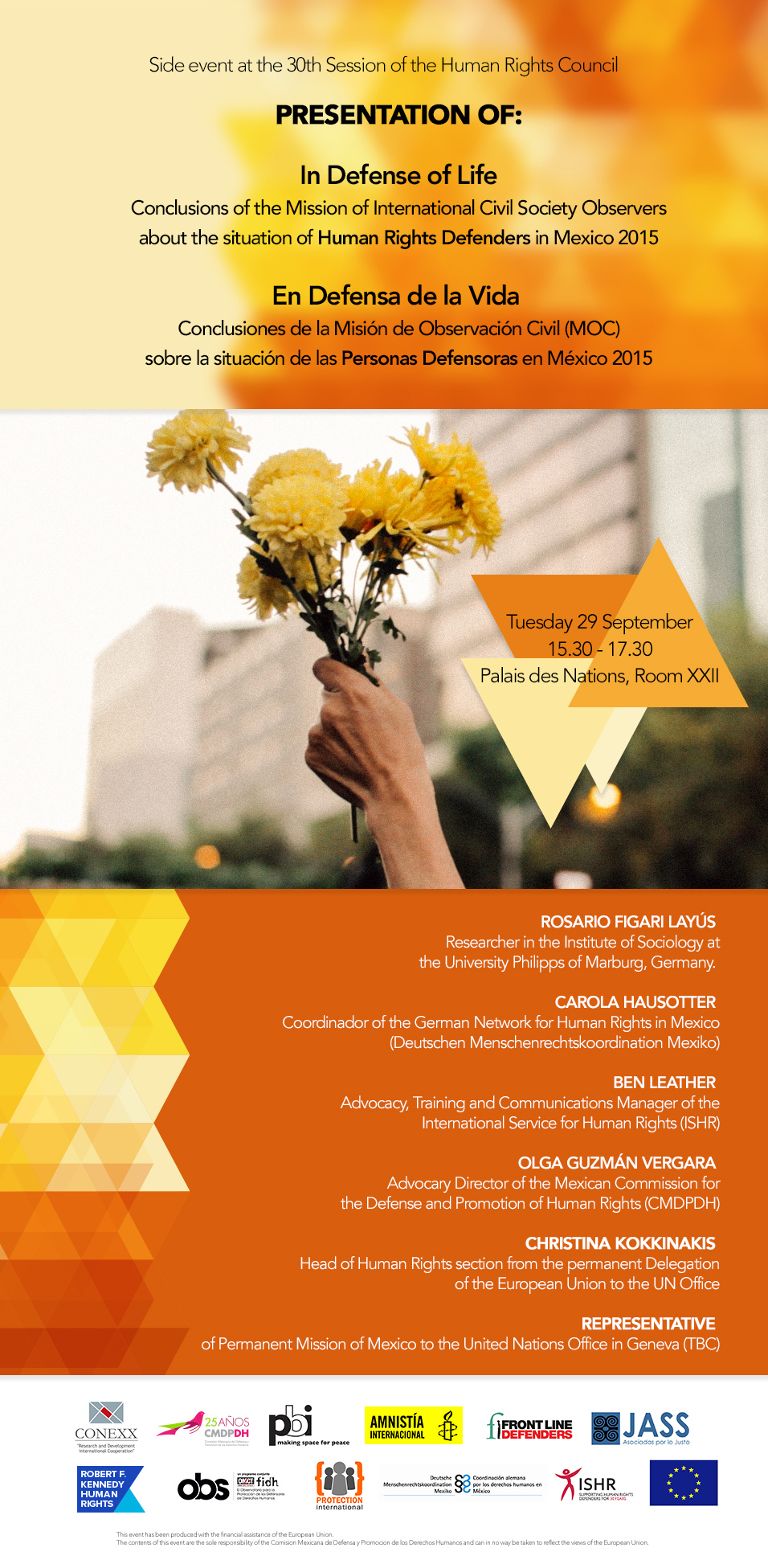
On Tuesday 29 September (15h30 – 17h30, Palais des Nations, Room XXII, Geneva), the CMDPDH, Asociación Civil and ISHR organise a side event about the situation for human rights defenders in Mexico. [A Mission of International Observers visited Mexico in November 2015 and will present its conclusions – under the title “In Defense of Life” – to the Mexican Government within the framework of the 30th session of the Human Rights Council.]
Panelists in the event are::
- Rosario Figari Layús – Researcher in the Institute for Interdisciplinary Research on Conflict and Violence (IKG) at the University of Bielefeld, Germany.
- Carola Hausotter – Coordinador of the German Network for Human Rights in Mexico (Deutschen Menschenrechtskoordination Mexiko)
- Ben Leather – Advocacy, Training and Communications Manager of the International Service for Human Rights (ISHR)
- Olga Guzmán Vergara – Advocary Director of the Mexican Commission for the Defense and Promotion of Human Rights (CMDPDH)
- Ambassador Jorge Lomónaco Tonda – Permanent Representative of Mexico to the UN in Geneva (TBC)
- Christina Kokkinakis – Head of Human Rights section from the Permanent Delegation of the European Union to the UN in Geneva
Download the flyer: HUMAN RIGHTS IN MEXICO
see previous posts: https://thoolen.wordpress.com/tag/mexico/
Human Rights Defenders are too often forced to play ‘whack-a-mole’
September 22, 2015On 18 June 2015, Rachel Ball, Director of Advocacy at the Human Rights Law Centre in Australia, reflects on a cross-regional consultation of human rights defenders facilitated by ISHR:
There’s a game that you sometimes find at amusement arcades called whack-a-mole. Toy moles rise out of their holes at random and the player uses a large mallet to whack the moles on the head and force them back into their holes. A successful player needs vigilance, composure and a quick eye.
For human rights defenders, the protection of civil society space is a lot like a game of whack-a-mole. Threats arise without warning and valuable time, resources and energy are spent opposing them.
Almost one year ago, the Human Rights Council passed a resolution urging States to ‘create and maintain, in law and in practice, a safe and enabling environment in which civil society can operate free from hindrance and insecurity’. In too many cases the Human Rights Council’s resolution has not translated into domestic action and last week in Geneva ISHR convened a group of expert whackers from around the world to share their experiences of threats to civil society space and strategies to counter those threats.
Participants discussed anti-protest laws, restrictions on the establishment and funding of civil society organisations, constraints on the work of journalists, and national security and counter-terrorism laws that unduly restrict freedom of association and assembly. Each of these restrictive practices constitutes a current threat to civil society space in my country, Australia, and it was both troubling to see the regularity with which these laws and policies arise around the world, and encouraging to be exposed to the skill and dedication of human rights defenders working to defeat them.
We discussed and debated strategies for protecting civil society space, including building and maintaining strong coalitions, engaging with UN human rights mechanisms and other international actors, working with Governments and legislatures, strategic litigation, monitoring and reporting and working with the media and social media. We shared stories of success as well as failure.
What was abundantly clear during the ISHR convening was that human rights defenders should not be spending their time whacking moles. Beyond our work protecting civil society space, we are engaged in issues like persecution on the basis of sexual orientation and gender identity, militarisation, sustainable development, climate change and refugee rights, to name a few.
The contribution of civil society actors to human rights challenges like these is vital. As the UN High Commissioner for Human Rights, Zeid Ra’ad Al Hussein, told the Human Rights Council at the opening of its 30th session last week, ‘When ordinary people can share ideas to overcome common problems, the result is better, more healthy, more secure and more sustainable States. It is not treachery to identify gaps, and spotlight ugly truths that hold a country back from being more just and more inclusive. When States limit public freedoms and the independent voices of civic activity, they deny themselves the benefits of public engagement, and undermine national security, national prosperity and our collective progress. Civil society – enabled by the freedoms of expression, association and peaceful assembly – is a valuable partner, not a threat.’
In addition to enabling civil society through the proper protection of freedom of expression, assembly and association, States should make public commitments to support civil society and protect civil society space. Those commitments should be backed up by legal and institutional protection against intimidation and reprisals, support for the establishment and operation of non-government organisations and mechanisms to ensure transparency and accountability.
Human rights defenders will return home from ISHR’s consultation, training and advocacy program with their mallets at the ready, but really it would better if we didn’t have to use them at all.
You can follow Rachel on Twitter at @RachelHRLC.
Source: Civil society space and whacking moles | ISHR
see also: https://thoolen.wordpress.com/tag/civil-society-organisations/
Alejandro González, corporate accountability human rights defender from Mexico
September 21, 2015A bit belatedly, I refer to the interview (19 June 2015) with Alejandro González in the Newsletter of the ISHR. Alejandro is a human rights specialist who works for PODER, an award winning and multi-faceted civil society organisation based in Mexico that helps build the capacities of communities, workers, NGOs, and other civil society groups affected by corporate malfeasance and accompanies their accountability campaigns.
‘We help communities participate in the consultative process. In the end, it is about what communities want. We are not in favour or against the project. We make sure communities know their rights and are aware of the potential positive and negative impacts of the project.’ Free, prior and informed consent of the local communities is needed to pass development projects in indigenous regions of Mexico. Recent reforms, however, have opened the energy sector to both national and international investment. Mexico is currently in a maelstrom of speculation. ‘This is a dangerous situation. Many powerful companies in Mexico have a poor track record in human rights and we are concerned that local communities will lose their power to defend their land rights. Communities affected by gas speculation can either be obliged to sell their land or be forcibly dispossessed. It is vital that we observe, facilitate and publicise these negotiations.’
PODER, together with rural communities, is currently conducting an ex ante human rights impact assessment on extractive projects in Puebla, Mexico. In other states, such as Hidalgo, Oaxaca, and Sonora, PODER conducts participatory research with communities and accompanies their advocacy efforts. In Oaxaca it is part of an international mission to monitor the Free, Prior and Informed Consent process regarding the construction of wind farms by Australian, Dutch, Japanese and Mexican corporations.
‘The government wants to use this case as a model – to set a precedent for all future negotiations. If it goes poorly, the consequences could be devastating … We have met frequently with the Dutch, European Union and other embassies to amplify the voices of local people. We have also conducted extensive research into the companies and provided this information to the community, to help them make informed decisions.’
Standing up to powerful economic actors is dangerous work. In 2013, Héctor Regalado Jiménez, member of the Popular Assembly of the Juchiteco People, was shot and killed after opposing the wind farms. ‘Another activist we were working with died in a suspicious car accident. We still don’t know what happened, but this is a common modus operandi in Mexico. The killers make it look like an accident. Community leaders are frequently subject to death threats and assaults.‘
Since PODER does not directly advocate on land rights issues, Alejandro is not in as much risk as the human rights defenders it supports, though he and his colleagues face increasing surveillance. He believes that a powerful political and corporate élite pose a major challenge to the work of business and human rights defenders across Mexico. ‘There is a small group of families who control most of the market. It is a secretive group who meet with the president and cabinet members behind closed doors. Together they decide the laws and regulations. That’s how they pushed through the reforms that opened up the energy sector.’
To address this lack of transparency in the government and private sector, PODER is involved in online platform such as “Who’s Who Wiki” (rindeucentas.org) and ‘MéxicoLeaks’ – a whistleblowing tool that allows people to send information of public interest through secure technologies that protect the identity of the source. The information received through MéxicoLeaks is then verified, analyzed and published by the partners of the alliance, made up of civil organizations and media outlets. “The investigations that follow allegations communicated via ‘MéxicoLeaks’ are dangerous. In a two-year period, 10 journalists were murdered and 326 attacked. We have seen an increasing use of cyber attacks – as hackers force outlets offline or bombard them with viruses. Any journalist who exposes government corruption can expect to lose his job.”
Despite these adverse conditions, Alejandro is positive that good business practice is in the best interests of businesses. ‘We make corporations aware that human rights violations are a material risk. For example, if a company pollutes a river, there will be mobilisation and litigation against the company as well as a huge attack on their reputation – all of which costs money. Making corporations aware of the cost of violating human rights puts pressure on them to improve their due diligence.‘
‘In Mexico we would like to see a civil society powerful enough to be on equal footing with both the authorities and the private sector. For this you need information, complete transparency in everything the government does and strong accountability mechanisms. The private sector must prioritise human rights with due diligence, and not merely refrain from doing harm, but actively to do good.’
Alejandro González: Mexican corporate accountability human rights defender | ISHR.
Interview with Lira Ismailova, Human Rights defender from Kyrgyzstan
September 21, 2015 on 21 September 2015 carries an interview with Lira Ismailova, a human rights defender from Kyrgyzstan.
She starts by crediting her mother, Tolekan Ismailova – a celebrated Kyrgyz human rights defender, with influencing her. Lira, previously a lawyer advocating for a wide range of human rights related issues, currently works at Bir Duino Kyrgyzstan – which focuses on defending freedom of association and protecting human rights defenders in Kyrgyzstan.
‘My first position in the field of human rights was with an NGO working for the protection of the rights of internal migrants. I then advocated for the repeal of the death penalty in Kyrgyzstan. I participated in a working group to prepare a draft law for reforming our criminal legislation, and on several reforms for the penitentiary system which included monitoring prisons in Kyrgyzstan.’ Lira’s work on the death penalty was ultimately successful in 2007 when President Bakiyev abolished the death penalty. However, this achievement did not herald a significant practical improvement in the human rights situation in Kyrgyzstan. Instead, since then, it is ‘much more difficult’ for human rights defenders on the ground.
Lira recalls numerous occasions when she and her family had to temporarily leave Kyrgyzstan for safety reasons. Lira highlighted the restrictions imposed on Bir Duino’s operations and recalled that its Kyrgyzstan office has been burgled twice in connection with attacks on ‘nationalists’. Bir Duino’s activities were also ‘supervised’ by authorities during the trial of well-known human rights defender Azimzhan Askarov in 2013 who is currently serving a life sentence in a Kyrgyz prison [https://thoolen.wordpress.com/2015/07/23/fury-about-us-award-for-askarov-in-kyrgyzstan-backlash-or-impact/].
Lira considers that the Kyrgyz government’s moves to create new restrictive legislation, along with the State Committee for National Security putting direct pressure on lawyers and human rights defenders, has added to the shrinking space for civil society. See also: https://thoolen.wordpress.com/2015/05/21/draft-laws-on-civil-society-restrictions-also-pending-in-kyrgyzstan-and-cambodia/
‘We need help from international institutions to raise awareness of the Government’s attempts to implement these restrictive laws and help us to stop these laws from passing in Parliament’
…..According to Lira, it is critical that, among other international mechanisms, the UN Special Rapporteur on the situation of human rights defenders visit Kyrgyzstan. Some of the main aims of such visit would be to observe the effect of Russian-derived legislation on civil society space and support human rights defenders, such as Askarov a defender who needs urgent humanitarian aid.
Lira adamantly talks about what needs to be done in Kyrgyzstan – the Government needs to ensure the protection of human rights defenders in accordance with the UN Declaration on human rights defenders; ensure that national legislation complies with this Declaration, including by repealing legislative barriers to obtaining financial resources, independence, freedom of association, assembly and expression; and create a parliamentary committee on observance of the situation with the human rights defenders.
Source: Lira Ismailova: Human Rights defender from Kyrgyzstan | ISHR
Elsa Saade talks about her work for “Gulf Centre for Human Rights”
July 28, 2015On 26 June 2015 the ISHR (International service for Human Rights) featured a portrait of Elsa Saade, a woman human rights defender who works for the Gulf Centre for Human Rights (GCHR), an independent, non-profit and non-governmental organisation that works to provide support and protection to human rights defenders in the Gulf region by promoting freedom of expression, association and peaceful assembly.
Elsa, who has worked closely on the issue of women human rights defenders in the Gulf and neighboring countries, explained how women human rights defenders are at particular risk. E.g. she received a message from a women defender stating that she could no longer talk, that she was going underground. ‘They are threatening to kill me’, she said. ‘They will arrest me. I need to disappear.’ Elsa confirmed that she could not mention the defender’s name or where she is from as it would endanger her life, however highlighted how women not only face pressures from the government or non-state actors when she stands up for human rights, but even faces societal and cultural clashes which could be reflected inside her home.
Elsa explained how States in the Gulf region are mostly patriarchal. The simplest example of patriarchy is the fact that women in Saudi Arabia cannot drive. Two women defenders in Saudi Arabia, Maysaa Al Amoudy and Lujain Al-Hathlol, who were caught driving as a statement to allow women to drive, were arrested and tried in the Specialized Criminal Court in Riyadh, which deals with cases of terrorism and State security. They currently await sentencing.
Elsa referred to the situation in Iran, KSA, and Syria, which she considers is especially bad. ‘If we hadn’t publicised certain cases, some of our human rights defenders would already be dead. If no-one knew their names, the government wouldn’t consider them, as if they didn’t exist. Those who exercise their right to freedom of expression face death threats, flogging and indefinite prison sentences.’..‘Some defenders fall silent but others gain confidence when bad things happen – it confirms the need to struggle for their rights. Although the conditions are depressing, it is inspiring to see how tragedies motivate women to raise their voice. Out of their misery they create something beautiful.’
At this point, Elsa further referred to cases of women Syrian refugees in Lebanon and how important their role in the house, family and society was. On that account she mentioned several challenges that humanitarian people who help Syrian refugees face. Having worked in the field she highlights that they are often at risk.
‘As a result of my work I have personally experienced challenges. I was put in a situation were I could have been beaten several times, just because I was helping the Syrian refugees.’ As a woman, and especially after having widened the scope of interest in the region’s several HRD cases, Elsa has begun to feel increasingly vulnerable. ‘The greater the exposure, the greater the risk. In Lebanon the situation is not so bad for women. But on a recent trip to Egypt I felt incredibly paranoid. I was on the constant look out. That is why so many women defenders prefer to stay on the low.’
Elsa is adamant, however, on the necessity of continuing her work to support human rights defenders.
‘Without human rights defenders, the reality would remain hidden. There is a clash between three concepts: reality, delusion and myth. You have the myth, the image that the State wants to portray; the delusion, as people keep quiet to put bread on the table; and the reality on the ground. Human rights defenders, be they journalists, bloggers, lawyers, teachers or women defenders, portray this reality. They are the ones who ask for accountability, for independent judges, for basic human rights.’
[The Gulf Centre supports and protects human rights defenders in different ways to eventually create a community of strong and safe human rights defenders protected by international mechanisms. Firstly, it can mobilise a network of prominent human rights defenders to generate support amongst each other. Secondly, it runs UN advocacy projects and provides funding and technical assistance for HRDs to attend UN meetings. Thirdly, it allocates private funding for relocation, personal finance, appeals, and assisting with the provision of safe havens in case they are in danger. Fourthly, it runs training workshops on various issues HRDs are in need of and specifically on how to engage with UN mechanisms and protection mechanisms.]
For previous posts on the Gulf center: https://thoolen.wordpress.com/tag/gulf-centre-for-human-rights/
Elsa Saade: Human rights defender from the Gulf Centre for Human Rights | ISHR.
Donors should work jointly against the wave of civil society repression
July 10, 2015The Newsletter of the International Service for Human Rights of 5 June 2015 carried an interesting piece written by two representatives of donors that are very active in the area of protection human rights defenders. Julie Broome, Director of Programmes with the Sigrid Rausing Trust, and Iva Dobichina, Programme Manager with the Open Society Foundation‘s Human Rights Initiative, wrote jointly about much-needed efforts to “turn the tide against the wave of civil society repression”. The piece follows in toto below, but some of the key points are: Read the rest of this entry »
Human rights defender Khalef Khalifa from Kenya in the spotlight
July 9, 2015 in its July 2015 Newsletter puts the spotlight on Khalef Khalifa, Executive Director of the NGO MUHURI in Kenya.
On 8 April 2015, the official Gazette notice listed 85 companies and organisations, including MUHURI and Haki Africa, as suspected of having links to terrorism and linking them as specified entities. On 20 and 21 April, the police raided the offices of both organizations, disabling their servers, carrying away hard disks and documents, allegedly to determine whether they had been involved in tax evasion. On 28 May, the Non-Governmental Organisations’ Coordination Board announced through the media that they had de-registered the organizations. On 12 June the court dismissed all charges against MUHURI and Haki Africa on the basis that there was no evidence against them.
Khalef Khalifa (KK): As you know, on the 12th June was a good day for us as both MUHURI and Haki Africa, were entirely vindicated in court. The judge dismissed all the charges against us and said that there was absolutely no evidence to link us to terrorism in any form and specifically forbade the police or even the Minister to make any such reference in the future. However the outstanding difficulty is that he refused to unfreeze our bank accounts on the basis that we had failed to include the Central Bank in our case against the state. They have now agreed to join our case calling for the accounts to be freed but we have to wait for another hearing before the judge makes his ruling and we can begin getting back to normal.

FLD: Given the various lines of attack that were opened against MUHURI it seems as though the government was out to get you?
KK: ...we were targeted on three fronts: by the police, the Revenue Commissioners and by the NGO Board. So while the government accused us of terrorism, the Revenue Commissioners descended on our office and took away all out financial documentation to look for evidence of tax avoidance and the NGO Board lodged a complaint that we had not kept them properly informed of our activities, and in particular that we had not informed them of new appointments to our board, as required by the NGO Law. In the final verdict, while the judge said there was no evidence of involvement in terrorism, both the Revenue Commissioners and the NGO Board had to concede that we were 100% compliant with the regulations. The only thing the NGO Board could trip us up on was that while we had notified the NGO Board of the new appointments, we had not used the appropriate, and newly introduced, form. What is interesting is that in the early stages of the case the government was totally focused on pursuing a case on the basis of terrorism, but they quite quickly changed tack and started looking for any small technical failures they could find to try and make a case against us. But they failed because we have always operated in an entirely open and transparent way.
KK: The real reason for their animus against MUHURI is that we are critical of the police and have investigated their involvement in extrajudicial executions and forced disappearances. There have been at least 52 such killings and disappearances in the Mombasa region in the last two years. The police claim to be fighting terror but in fact terror is a more accurate description of the way the police themselves work. In one incident 8 people were shot dead in a church. The police claimed that it was an attack by Al Shabaab. However when the perpetrators were arrested it was clear that they were not Muslims and in fact had no affiliation to any particular group. The police then hid the names and tried to maintain the fiction of an Al Shabaab attack.
FLD: Will the work of MUHURI get back to normal now?
KK: ...As soon as the accounts are unfrozen we will continue out work as normal. For us it is clear that the government wants to intimidate and frighten MUHURI but we will not be intimidated – we will not give up.
for full interview see: HRD Spotlight: Khalef Khalifa, Kenya | Front Line Defenders.
The more general backdrop can be found in earlier Front Line messages, the 5 June appeal by the Observatory [http://www.omct.org/human-rights-defenders/urgent-interventions/kenya/2015/06/d23190/] and the statements made by NGOs on 26 June 2015 at the adoption by the UN Human Rights Council of the report of the Universal Periodic Review [UPR] of Kenya:
– International Service for Human Rights (ISHR) : Kenya should create an enabling environment for the work of human rights defenders – including repealing restrictions on NGO access to foreign funding and amending or repealing the Information Communication Amendment Bill and Media Council Bill. The statement also emphasised the risks faced by LGBTI people and organisations in Kenya as a result of the criminalisation of same-sex conduct. ‘It is crucial that the voices of human rights defenders are safeguarded and encouraged. This assists to create a vibrant, independent and diverse civil society which is essential to protect human rights, democracy and the rule of law’ said Michael Ineichen of ISHR.
http://www.ishr.ch/news/kenya-safeguard-and-encourage-essential-voices-human-rights-defenders
AllAfrica.com reports on Human Rights Watch comments: “We note Kenya’s acceptance of some important recommendations such as commitments to investigate torture and extrajudicial killings, including the killing of activist Hassan Guyo, and to fully cooperate with the International Criminal Court. But we remain concerned that there has been little tangible progress in many key areas. The ongoing abuses and recent threats to civil society illustrate a lack of commitment to implement these recommendations.”
http://allafrica.com/stories/201506260835.html
London discussion on business and human rights defenders on 14 July
June 28, 2015The International Service for Human Rights [ISHR] and the Business & Human Rights Resource Centre [BHRRC] organize a well-stocked panel on “Business and the protection of human rights defenders” on 14 July 2015 (12h30-14h30) in London: DLA Piper, 3 Noble Street, London. RSVP by Friday 10 July. The discussion.. Read the rest of this entry »
 Hans Thoolen on Human Rights Defenders and their awards