Archive for the 'HRW' Category

SAVE THE DATE: MEA 2013 CEREMONY ON 8 OCTOBER IN GENEVA

June 29, 2013

The City of Geneva and the Martin Ennals Foundation announce the 2013 edition of Martin Ennals Award, which will take place on Tuesday 8 October 2013 at 18h00 at the Uni-Dufour, Geneva. The Laureate will be announced Read the rest of this entry »

The EU should toughen its stand on Bahrain on 30 June say 6 big NGOs

June 27, 2013

A JOINT STATEMENT by the following 6 international NGOs: Front Line Defenders, Gulf Center for Human Rights (GCHR), Human Rights Watch (HRW), International Federation for Human Rights (FIDH), International Partnership for Human Rights (IPHR), World Organisation Against Torture (OMCT) urge the EU to call for the release of human rights defenders and peaceful protest leaders in Read the rest of this entry »

Greece: xenofilia with racist edge says HRW report today

June 12, 2013

I happen to live – and quite happily – in Greece but there are moments that I am almost ashamed. I reported on some of these moments before, but today’s report by Human Rights Watch Read the rest of this entry »

Russian human rights defender Tanya Lokshina continues against all odds | Globalization | DW.DE | 12.06.2013

June 12, 2013

In the series Storytellers, Deutsche Welle gives the floor to Tanya Lokshina of HRW who has worked for 15 years in of the most difficult regions: Russia itself and conflict-ridden volatile areas like Chechnya and Dagestan as well as South Ossetia.

At first glance, Tanya Lokshina may not be the kind of person you would expect to travel to some of Russia’s most dangerous areas on a regular basis. But Read the rest of this entry »

Egyptian NGO bill with big shortcomings in crucial last phase

May 31, 2013
Egyptian President Mohammed Morsi
(Egyptian President Mohammed Morsi)

In the context of restrictive legislation to hinder the work of human rights defenders, the Egyptian case deserves urgent attention now. The law on NGOs is being rewritten in this important country and others in the region may follow the example. Despite recent amendments Read the rest of this entry »

Egyptian HRD and MEA Nominee, Mona Seif, under attack

May 3, 2013

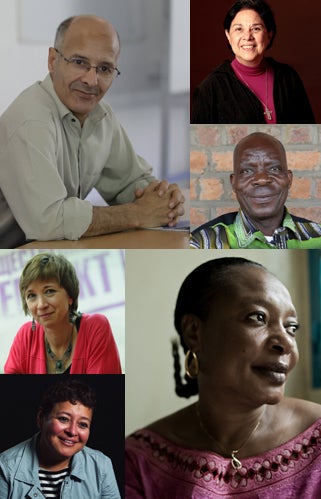
As readers of this blog know I would have readily reported on any developments surrounding the MEA especially since the Final Nominees 2013 were announced recently. A few days ago a controversy arose around the nomination of Mona Seif, the courageous Egyptian human rights defender who was selected because of her campaign against military trials for civilians. UN Watch, an NGO affiliated to the American Jewish Committee,  and famous for its strident monitoring of anything that smacks of  criticism of Israel, accused Mona Seif of being a terrorist sympathizer on the basis of 3 older tweets in which she strongly defended the right of Palestinians to resist Israeli occupation. The organisation started a twitter campaign to have Mona recalled as nominee.

Mona Seif, Egypt - Final Nominee MEA 2013

Mona Seif, Egypt – Final Nominee MEA 2013

The problem is that I am – in a personal capacity – the Chair of the Jury which is composed of ten of the world’s leading human rights NGOs (see list http://www.martinennalsaward.org). I am a non-voting chair whose only role is to facilitate the process and I do not participate in the selection. The board of the Martin Ennals Foundation also has no role in the selection as the Statutes provide for a fully independent Jury. Only the NGOs on the Jury can vote on the recipient of the MEA. Still, I feel that my capacity of Chair of the Jury obliges me to show restraint in speaking out.
Read the rest of this entry »

Human Rights Watch video on Russian civil society under Putin

April 29, 2013

This video accompanies a new 78-page report, “Laws of Attrition: Crackdown on Russia’s Civil Society after Putin’s Return to the Presidency,  which describes some of the changes since Putin returned to the presidency in May 2012. The authorities have introduced a series of restrictive laws, begun a nationwide campaign of invasive inspections of nongovernmental organizations, harassed, intimidated, and – in a number of cases – imprisoned political activists, and sought to cast government critics as clandestine enemies. The report analyzes the new laws, including the so-called “foreign agents” law, the treason law, and the assembly law, and documents how they have been used. Many of the new laws and the treatment of civil society violate Russia’s international human rights commitments, Human Rights Watch said.HRW_logo

https://www.hrw.org/node/115102

Myanmar President to get peace prize today, despite ethnic cleansing charge

April 23, 2013

I have on earlier occasions tried to point out that there is a (big) difference between peace awards and human rights awards. This time it is Dan Murphy in the Christian Science Monitor, who points to another example. While it could be argued that  Myanmar President U Thein Sein deserves to be praised for having made bold steps to move his country away from repression and conflict, he human rights record in the past and [as Human Rights Watch argues in a recent report) in the present would not be considered by many as a likely candidate for a human rights award.

The International Crisis Group’s plan to give its “In Pursuit of Peace” award to Myanmar President U Thein Sein later today and a new Human Rights Watch report on ethnic cleansing against ethnic Rohingya form such striking contrast, that Murphy wonders if Human Rights Watch timed the report to coincide with the gala party that the International Crisis Group (ICG) is planning to host for President Thein Sein later today at the swanky Pierre Hotel in New York City, and with a scheduled lifting of all but arms sanctions against Myanmar (also known as Burma) from the European Union.

Myanmars ruler to get peace prize, despite ethnic cleansing charge – CSMonitor.com.


Turkmenistan and Uzbekistan: non-cooperation should not pay!

April 22, 2013

Turkmenistan and Uzbekistan’s highly repressive policies are coming up for rare international scrutiny as from today (22 and 24 April 2013), Human Rights Watch said today. United Nations member countries gathering at the Human Rights Council in Geneva under the Universal Periodic Review (UPR) procedure should seize the opportunity to expose and denounce the ongoing repression in both countries and press for concrete steps to end abuses.HRW_logo

The governments of Turkmenistan and Uzbekistan stand out as among the most repressive in the world, Human Rights Watch said. Both also stand out for their failure to heed recommendations made during their previous Human Rights Council reviews, in December 2008. “The extraordinarily high levels of repression in both Uzbekistan and Turkmenistan, coupled with their governments’ refusal to acknowledge problems, let alone to address them, underscores the need for a strong, unified message,” said Veronika Szente Goldston, Europe and Central Asia advocacy director at Human Rights Watch.

In submissions on Turkmenistan and on Uzbekistan Human Rights Watch highlighted key concerns with respect to both countries, and the steps needed to address them. One immediate step – and crucial if crime should not pay ! – is that both governments should be urged to end their longstanding denial of access for the UN’s own rights monitors. Ten UN rapporteurs have requested such access to Turkmenistan, while the number of UN rapporteurs barred from Uzbekistan has reached 11!  Cooperation with the International Committee of the Red Cross ICRC is another pressing issue [On April 12, the ICRC took the unusual step of announcing publicly its decision to end prison visits to detainees in Uzbekistan].

Other key concerns in Turkmenistan include: The government’s longstanding use of imprisonment as a tool for political retaliation and draconian restrictions on freedom of expression and association, which authorities enforce by threatening, harassing, or imprisoning those who dare to question its policies, however modestly. The severe repression of civil society activism makes it impossible for independent human rights defenders and journalists to work openly.

via Turkmenistan/Uzbekistan: Abuses in International Spotlight | Human Rights Watch.


Defamation charges against Hall will chill labor rights in Thailand says Human Rights Watch

April 11, 2013

Proceedings in this case, brought by a fruit processing company before the South Bangkok criminal court, are scheduled for today April 11, 2013. The charges stem from a defamation complaint filed on February 14 by the Natural Fruit Company Limited against Andy Hall for an investigative report about serious labor rights violations at the company’s factory in Prachaub Kirikhan province. If convicted, Hall faces up to two years in prison. He is also facing civil damages of 300 million baht  (US$10 million).“Criminal charges against Andy Hall reflect an attempt to stifle serious reporting on alleged abuses by one of Thailand’s top fruit processors,” said Brad Adams, Asia director at Human Rights Watch. “Freedom to investigate abuses by corporations is critical to ensure compliance and accountability under Thai law and human rights standards.” The Natural Fruit Company, using a workforce comprised primarily of migrant workers from Burma, asserted that Hall defamed and damaged the company by “broadcasting false statements to public media.”HRW_logo

Hall’s report, “Cheap has a high price: Responsibility problems relating to international private label products and food production in Thailand,” researched and written with the Finnish nongovernmental organization FinnWatch, investigated the production practices of private label juices and fruit sold in Finland, including by Natural Fruit Company Limited. The report alleged that Natural Fruit Company Limited had committed serious labor rights abuses, including poor working conditions, unlawfully low wages, confiscation of workers’ official documents, use of child labor, and excessive overtime. Human Rights Watch, along with an increasing number of states and international authorities, believes that criminal defamation laws should be abolished, as criminal penalties are always disproportionate punishments for reputational harm and infringe on free expression.  Criminal defamation laws are open to easy abuse, resulting in very harsh consequences, including imprisonment. As repeal of criminal defamation laws in an increasing number of countries shows, such laws are not necessary for the purpose of protecting reputations. “The prosecution of Andy Hall strikes at the very core of efforts by human rights defenders to end pervasive abuses of workers in Thailand’s export industry,” Adams said. “International companies sourcing from Thailand should raise concerns with the government that using criminal charges to silence rights critics could adversely affect the overall reputation of Thailand’s major export sectors. The Thai government should welcome efforts to protect worker’s rights, not penalize them.”

via Thailand: Defamation Charges Chill Labor Rights Inquiries | Human Rights Watch.

also: http://www.nationmultimedia.com/opinion/Company-should-drop-case-against-British-rights-ac-30203542.html