Archive for the 'EU' Category

EU Rule of law enforcement: road is now free

February 17, 2022
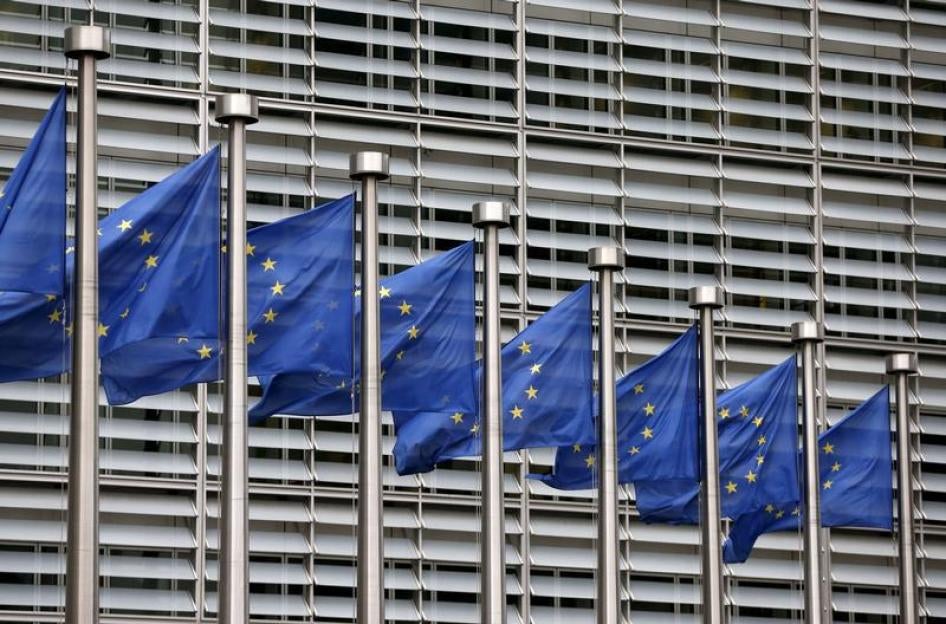
European Union flags flutter outside the EU Commission headquarters in Brussels, Belgium, October 28, 2015.
European Union flags flutter outside the EU Commission headquarters in Brussels, Belgium, October 28, 2015. © 2015 Reuters

The decision on February 16, 2022 by the Court of Justice of the European Union to allow EU institutions to tie funding to EU states to respect for the rule of law clears the way for strong action by the European Commission, Human Rights Watch said. The EU Court’s ruling dismissed the actions brought by Hungary and Poland against the new conditionality mechanism.

The EU Court has sent a clear signal that EU funds should be used in ways that uphold rather than undermine Europe’s democratic values,” said Philippe Dam, Europe and Central Asia Advocacy Director at Human Rights Watch. “The EU Commission should now act swiftly and demonstrate that defending the rule of law is at the top of its agenda.”

In December 2020 the EU adopted a regulation creating a new conditionality mechanism to protect the EU budget from rule of law breaches by an EU member state. A last-minute deal among EU member states obliged the Commission to wait for a ruling by the EU Court of Justice before finalizing the guidelines for applying the conditionality mechanism. Hungary and Poland brought legal action before the EU Court seeking to annul the rule of law conditionality mechanism in March 2021, initiating that process…

The court’s ruling confirms that “compliance by the Member States with the common values on which the European Union is founded (…) such as the rule of law and solidarity, justifies the mutual trust between those States.” The Court added that the EU “must be able to defend those values.”

The European Commission should demonstrate its stated commitment to protect the rule of law and democratic values in the EU by swiftly initiating procedures provided by the regulation, Human Rights Watch said. It should seek to suspend, reduce, or prevent new agreements to provide EU funds to a member state if it finds that the state has failed to respect the rule of law.

In applying the conditionality mechanism, the European Commission should ensure that a broad range of breaches to EU’s democratic values could lead it to recommend cutting funds to EU member states. These should include attacks on the independence of the judiciary, as well as state interference with media and civil society. The Commission should also seek to ensure that EU funding cannot be used to promote intolerance or discriminatory policies, including against women and lesbian, gay, bisexual, and transgender (LGBT) people and other minorities.

The Commission should also ensure that carrying out this procedure does not punish EU citizens for the actions of their governments, including by negatively affecting their economic and social rights. The Commission should conduct human rights impact assessments to determine the risk that people’s rights would be harmed by any decision and should divert rather than cut funding as required, to ensure that beneficiaries’ rights are not affected.

Hungary and Poland, the two EU countries that initiated legal action against the regulation, are already facing scrutiny for their poor rule of law records under the Article 7 procedure – the EU treaty provision dealing with governments that flout EU values, which can ultimately lead to the suspension of their voting rights in the Council. Hungary is among the largest recipients of EU funding per capita, and Poland is the largest overall net recipient.

Poland’s government has eroded judicial independence and ignored recent EU Court of Justice decisions. It also used its politically compromised constitutional tribunal to undermine women’s rights and the binding nature of EU law. LGBT and women’s rights activists face threats and harassment. In Hungary, restrictive laws target civil society groups, and the government or its supporters control most media outlets. A June 2021 law banned discussion on gender identity and sexual orientation, putting health providers, educators, artists, and broadcasters at risk of sanctions.

EU member states also have a serious responsibility to ensure that all member states respect EU’s democratic values and the rule of law. On February 22 they will hold a hearing on the situation of the rule of law in Poland under the Article 7 procedure. But since Article 7 was triggered in 2017 on Poland and in 2018 on Hungary, other EU member states have failed to take further action to hold those two governments to account.

..Proceedings under Article 7 should remain the cornerstone of the action against the erosion of EU values in countries like Hungary and Poland. The EU is equipped with the tools needed to stand up against member states that disregard the EU’s own democratic values, Human Rights Watch said. What has been missing is political will by the EU Commission and by leading EU member states to take decisive action and to hold states responsible for abuses to account.

The EU Court ruling underscores that EU institutions can fight back against the erosion of the rule of law within the bloc, but much depends on the European Commission quickly building on this momentum,” Dam said. “Tying EU money to EU values and strengthening scrutiny of rule of law abuses should go hand in hand to demonstrate that EU membership and respect for the rule of law are inseparable.

See also: https://humanrightsdefenders.blog/2020/01/13/european-judges-demonstrate-in-poland-against-the-muzzle-law/

https://www.hrw.org/news/2022/02/16/eu-top-court-approves-linking-eu-funds-rule-law

https://www.aljazeera.com/news/2022/2/16/poland-hungary-lose-legal-challenge-against-eu-rule-of-law-tool

NGOs protest harassment of Ambika Satkunanathan in Sri Lanka

February 17, 2022

On 14 February 2022 FIDH published a joint statement to support Sri Lankan human rights defender Ambika Satkunanathan:

We the undersigned human rights organizations, express our deep concern about the statement issued by the Sri Lankan Foreign Ministry on February 4, 2022, in which the government denounced testimony given by Ambika Satkunanathan, a leading human rights lawyer, to the European Parliament on January 27. The government statement clearly constitutes an act of harassment and intimidation. We condemn the Sri Lankan government’s tactics to intimidate human rights defenders, and express our full solidarity with Ms. Satkunanathan, a well-known, respected and courageous human rights defender. Targeting her for providing accurate testimony about the human rights situation in Sri Lanka to the European Parliament is completely unacceptable, and sends a chilling message to all Sri Lankan civil society, especially those in the north and east, who are already operating under considerable duress under the current administration.

Sri Lanka’s international partners, including the European Union, should publicly condemn the Sri Lankan government’s statement and express solidarity with Ms. Satkunanathan, who has been targeted for her international engagement, and increase their efforts to engage with Sri Lankan civil society at large.

The Foreign Ministry’s statement contains numerous false claims in an attempt to disparage and delegitimize a distinguished human rights advocate, placing her at risk of physical danger in retribution for her brave work. The government’s claim that her testimony was “reminiscent of LTTE [Liberation Tigers of Tamil Eelam] propaganda that once stoked hatred among communities,” and that “such allegations need to be refuted in the interest of social harmony” Is particularly insidious and dangerous.

The government’s statement mirrors its repeated practice of falsely equating human rights defenders and human rights advocacy with those pursuing “terrorism.” The statement’s language aligns these baseless allegations with vague and frequently abused provisions under the Prevention of Terrorism Act (PTA), exposing Ms. Satkunanathan to a heightened risk of threats, attacks and persecution.

Ms. Satkunanathan was a commissioner of the National Human Rights Commission of Sri Lanka before that body’s independence was compromised under the current administration and led the first national study on Sri Lanka’s prisons. Prior to that, she was for many years a legal consultant to the Office of the United Nations High Commissioner for Human Rights. She is the author of an important recent report on abuses committed during the so-called “war on drugs.”

We are concerned that the government’s statement seeks to place the blame on human rights defenders if the European Union determines that Sri Lanka failed to meet its human rights commitments under GSP+, the preferential tariff system. The European Union should remind the Sri Lankan government that the responsibility to uphold its international human rights obligations rests with the government. The government’s treatment of human rights defenders reflects its lack of respect for international human rights law.

We support Ms. Satkunanathan’s testimony to the European Parliament, which accurately described a situation already reported by the United Nations and many domestic and international human rights organizations. The government’s response contains numerous false statements, including:

- The government claims to be “engaged in long standing cooperation with the UN human rights mechanisms and the UN Human Rights Council.” On the contrary, in February 2020, soon after taking office, the government of President Gotabaya Rajapaksa withdrew Sri Lankan support from consensus resolutions of the council, repudiating commitments made by the previous government. Special Procedures mandate holders of the Council issued a statement on February 5, 2021, noting that their recommendations, including on torture, the independence of the judiciary, arbitrary detention, enforced disappearances, minority rights, counterterrorism, freedom of religion or belief, and freedom of assembly and association, had been ignored.

- The government claims to be “strengthen[ing] rule of law, access to justice and accountability.” However, President Rajapaksa campaigned on a platform of protecting “war heroes” from prosecution, and has appointed individuals implicated in war crimes to senior government posts. His presidential commission on “political victimization” has sought to interfere in judicial proceedings and block trials and investigations in human rights cases implicating the president’s associates and the president himself. The president pardoned Sunil Ratnayake, one of very few members of the armed forces ever convicted of human rights violations, who murdered eight Tamil civilians including children.

- The government denies that civic space is shrinking, as Ms. Satkunanathan described in her testimony. Yet under the current government, many human rights defenders have said that they are subjected to continual government intimidation, intrusive surveillance, and attempts to block their access to funds. In her most recent update to the Human Rights Council, High Commissioner Michelle Bachelet wrote that, “surveillance, intimidation and judicial harassment of human rights defenders, journalists and families of the disappeared has not only continued, but has broadened to a wider spectrum of students, academics, medical professionals and religious leaders critical of government policies.” The UN Special Rapporteur on contemporary forms of slavery in his end-of-mission statement last December documented government intimidation of civil society and a “shrinking civic space.”

- The government claims there is no “concrete evidence of discrimination against minorities.” In fact, for nearly a year the government banned the burial of people said to have died with Covid-19, causing immense distress to the Muslim community without any medical justification in what is only but one example of discrimination against ethnic and religious minorities. Such burials are now permitted only at a single remote site. In January 2021 High Commissioner Bachelet found that, “Tamil and Muslim minorities are being increasingly marginalized and excluded in statements about the national vision and Government policy… Sri Lanka’s Muslim community is increasingly scapegoated.” The High Commissioner’s findings are in line with reports by Amnesty International, Human Rights Watch, and others that the Prevention of Terrorism Act is used almost exclusively against members of the Tamil and Muslim communities. The government continues to deny efforts to commemorate war victims belonging to the Tamil community.

- The government denies Ms. Satkunanathan’s description of alleged extrajudicial killings committed in the context of Sri Lanka’s “war on drugs.” However, these abuses are widely documented. In September, High Commissioner Bachelet said, “I am deeply concerned about further deaths in police custody, and in the context of police encounters with alleged drug criminal gangs, as well as continuing reports of torture and ill-treatment by law enforcement officials.”

The Sri Lankan government’s statement attacking Ambika Satkunanathan for her testimony to the European Parliament’s Sub-Committee on Human Rights exemplifies threats faced by human rights defenders, particularly when they engage with foreign and international forums, and it further shows the government’s refusal to address the ongoing serious human rights violations taking place in the country. Instead of trying to silence those who seek to defend human rights, the government should give serious consideration to their input and contributions, and take urgent action to ensure that they can work in a safe environment without fear of reprisals.


https://www.fidh.org/en/region/asia/sri-lanka/sri-lanka-organisations-express-solidarity-with-human-rights-defender

https://en.wikipedia.org/wiki/Ambika_Satkunanathan

Myanmar: one year after the coup – only getting worse

February 2, 2022
A crowd of protesters wearing face masks, holding up an image of a woman, Aung San Suu Kyi.

On 1 February last year, the military seized power over Myanmar/Burma by overturning the election results and detaining State Counsellor Aung San Suu Kyi. The military is still controlling power by force and uses brutal violence against human rights defenders, civil society groups, and journalists in order to silence all forms of protest and dissent. More than 1,500 people have been killed by the military and over 8,000 people have been arrested.

The coup prompted mass protests and more than 1,500 people have been killed by the military. Over 8,000 people have been arrested in the harsh crackdowns. In a series of charges, Aung San Suu Kyi has been sentenced to several years in prison. Most recently, five new corruption charges against her were announced and in all she faces up to 164 years in jail. See also: https://humanrightsdefenders.blog/2021/09/30/rohingya-human-rights-leader-mohibullah-murdered-in-bangladesh-refugee/

Despite the military’s brutal response, people have come together to fight the dictatorship. Nationwide protests, boycotts, strikes, and coordinated civil disobedience movements have taken place. Journalists across the country have continued their work despite severe attacks by the military.  

A new report by Athan looks at how the military coup has affected journalists’ work and press freedom in the country. Throughout the country’s history, military coups have led to severe attacks on press freedom and the 2021 coup is no exception.  Since the launch of the coup, 141 journalists have been arrested and 13 have been sentenced to prison. On 10 December, photojournalists Ko Soe Naing and Ko Zaw Tun were arrested while taking photos of a nationwide silent strike. Ko Soe Naing was tortured to death at the interrogation centre four days later. Just a couple of weeks after that, editor of the Federal Journal, A Sai Kay (Aka) Sai Win Aung, was shot dead by the military in Lay Kay Kaw.  See also: https://humanrightsdefenders.blog/2021/05/11/three-democratic-voice-of-burma-journalists-and-two-activists-risk-refoulement-by-thailand/

According to Athan, the attacks on press freedom since the 2021 military coup have been the worst the country has seen.  “Journalists and news media require continuous support to sustain local media and its journalists in order to secure journalists’ careers and their safety, and to enable an environment for journalistic professionals and the industry,” says a representative from Athan about the report. 

On the one-year anniversary of the military coup in Myanmar, the High Representative on behalf of the European Union and the Foreign Ministers of Albania, Australia, Canada, New Zealand, Norway, Republic of Korea, Switzerland, the United Kingdom, and the United States, have made the following declaration:

….The European Union is deeply concerned by the continuing escalation of violence and the evolution towards a protracted conflict with regional implications. Since the military coup, the situation has continuously and gravely deteriorated. A large part of the population is now in a highly precarious situation, experiencing poverty, food shortages, displacement, and violence. ..

The European Union condemns in the strongest terms continuing grave human rights violations including torture, sexual and gender-based violence, the continued persecution of civil society, human rights defenders, and journalists, attacks on the civilian population, including ethnic and religious minorities by the Myanmar armed forces. Therefore, the EU calls for full accountability of the leaders responsible for the coup as well as of the perpetrators of violence and human rights violations. The EU also reiterates its firm demand for the immediate and unconditional release of all prisoners arbitrarily detained in relation to the coup and the return to power of democratically elected leaders.

As a matter of priority, the EU reiterates its calls for an immediate cessation of all hostilities, and an end to the disproportionate use of force and the state of emergency. The military authorities must ensure rapid, safe, and unhindered humanitarian access to all displaced persons and people in need, in all parts of the country. The European Union will continue to provide humanitarian assistance, in accordance with the principles of humanity, neutrality, impartiality, and independence and reiterates its call for the full and immediate respect of international humanitarian law…

In view of the escalating violence in Myanmar, increased international action is required in line with the already existing EU arms embargo on Myanmar. Since the military coup on 1 February 2021, the EU has imposed targeted sanctions on the Myanmar military, its leaders, and entities. In the absence of any swift progress of the situation in Myanmar, the EU stands ready to adopt further restrictive measures against those responsible for undermining democracy and the serious human rights violations in Myanmar.

It is a failed coup,” said Yanghee Lee, co-founder of the Special Advisory Group on Myanmar and former UN special rapporteur for human rights in the country in a CNN report of 1 February. “The coup has not succeeded in the past year. And that is why they are taking even more drastic measures to finish out the coup.” He reported on problems for human rights defenders already in 2015, see: https://humanrightsdefenders.blog/2015/03/19/myanmar-backsliding-by-prosecuting-human-rights-defenders-instead-of-perpetrators/

https://edition.cnn.com/2022/01/31/asia/myanmar-coup-anniversary-resistance-junta-intl-hnk-dst/index.html

EU launches a €1.5 billion 6-year plan to promote human rights and its defenders

December 17, 2021

w

On the eve of Human Rights Day (10 December 2021) and coinciding with the Summit for Democracy, the European Union launched the Global Europe Human Rights and Democracy programme. This programme, worth €1.5 billion, steps up EU support in promoting and protecting human rights and fundamental freedoms, democracy, and the rule of law and the work of civil society organisations and human rights defenders around the world during the period 2021–2027. The programme will promote and protect the universality of human rights, strengthen the rule of law and accountability for human rights violations and abuses, and defend the full and effective exercise of fundamental freedoms, including the freedom of expression, supporting independent journalism and media, while seizing opportunities and countering risks associated with digital and new technologies.

High Representative/Vice President Josep Borrell said: “Courageous people from all backgrounds are fighting on a daily basis for their civil liberties, for independent media and to safeguard democratic institutions, often at great personal risk. The European Union stands with them. The Global Europe Human Rights and Democracy programme will allow us to strengthen our support to and protection of universal human rights and democratic principles worldwide: for everyone, at any time and everywhere. Together with civil society organisations, human rights defenders, the UN Human Rights Office and the International Criminal Court, we will leave no one behind.”

International Partnerships Commissioner Jutta Urpilainen, said: “Human rights and democracy are a cornerstone of sustainable and inclusive development, and essential to addressing global challenges and ensure citizens reach their full potential and realise their aspirations. In whichever way you measure it – in stability, equality, economic growth, health or longevity – democracies always outperform other forms of government in the long run. I am proud to think of the countless human rights defenders, young people, women, girls and civil society organisations that the €1.5 billion Global Europe Human Rights and Democracy programme will empower to build a better tomorrow for all of us.

It has five overarching priorities:

  • Protecting and empowering individuals€704 million

Uphold all human rights, including by working towards the universal abolition of the death penalty, the eradication of torture and cruel and inhumane treatment, the fulfilment of basic needs, decent working conditions, the eradication of child labour, and a safe, clean, healthy and sustainable environment. The programme will promote equality, inclusion and respect for diversity, support human rights defenders and counter shrinking space for civil society, and strengthen the rule of law, ensure a fair and effective administration of justice, and close the accountability gap.

  • Building resilient, inclusive and democratic societies – €463 million

The programme will support functioning pluralist, participatory and representative democracies, and protect the integrity of electoral processes. It will, for instance, engage civil society observers in election observation and support pro-democracy organisations, networks and alliances.

  • Promoting a global system for human rights and democracy – €144 million

Enhance strategic partnerships with key actors, such as the Office of the UN High Commissioner for Human Rights (OHCHR), the International Criminal Court (ICC), regional human rights systems, national human rights institutions, the private sector, and the Global Campus of Human Rights.

  • Safeguarding fundamental freedoms, including harnessing the opportunities and addressing the challenges of digital and new technologies €195 million

Create and maintain an environment conducive to the full exercise of all fundamental freedoms both offline and online. For example, it will help strengthen the capacity of independent, pluralistic and quality media, including investigative journalists, bloggers and fact-checkers, to provide the public with reliable information through responsible and professional reporting. It will support civil society in fostering online media literacy and digital skills and in promoting an open, global, free and secure internet equally accessible to all.

  • Delivering by working together – €6.6 million

The earmarked funds can support the civil society in engaging with national authorities within the framework of the human rights dialogues that the EU conducts with partner countries, or finance training, studies, or exchanges of best practice. It underpins all of the activities.

In the first year of implementation, the EU will focus on promoting a global system for human rights and democracy. For example, in 2022–2024, the EU will support the Office of the United Nations High Commissioner for Human Rights with €16 million, the Global Campus of Human Rights with €10 million, and the International Criminal Court with €3 million. The EU will also support in 2022 the launch of a Team Europe Democracy initiative to reinforce the impact of EU and Member States’ global support to democracy. The 2021 action plan complements a number of urgent individual measures under the programme adopted earlier.

Background

The Global Europe Human Rights and Democracy programme is flexible as regards procedures, and supports civil society actions independently of the consent of partner countries’ governments and other public authorities. A substantial part of the programme will be implemented at country level. Subsequent calls for proposals covering the different activities, open to civil society organisations across the world, will be published in the coming months. See also: https://humanrightsdefenders.blog/2018/02/27/10611/

Funded under the thematic pillar of the new Neighbourhood, Development and International Cooperation Instrument (NDICI) – Global Europe, the Global Europe Human Rights and Democracy programme is the successor of the European Instrument for Democracy and Human Rights (EIDHR), which was established in 2006 to support civil society-led actions in the area of human rights and democracy in countries outside the EU. Under the previous financial period 2014–2020, the European Instrument for Democracy and Human Rights was allocated €1.33 billion.

NGOs demand EU to impose sanctions on NSO Group

December 7, 2021

Dozens of rights groups are urging the European Union to impose sanctions on the Israeli NSO Group to ban the company’s Pegasus surveillance technology. The letter sent to the EU was signed by 86 rights groups and independent experts, including Reporters Without Borders, Amnesty International, Human Rights Watch, the Electronic Frontier Foundation and Privacy International, among others. A consortium of media revealed that this powerful spyware was used extensively by several governments to spy on lawyers, journalists, political opponents and human rights activists.

Several victims of illegal surveillance have been identified in Hungary, where the government initially denied being a client of NSO Group, before admitting to having purchased the software. See also: https://humanrightsdefenders.blog/2021/11/10/palestinian-ngos-dubbed-terrorist-were-hacked-with-pegasus-spyware/

A good resource is here: https://www.haaretz.com/israel-news/MAGAZINE-nso-pegasus-spyware-file-complete-list-of-individuals-targeted-1.10549510

Several victims of illegal surveillance have been identified in Hungary, where the government initially denied being a client of NSO Group, before admitting to having purchased the software. See also:

There is overwhelming evidence that Pegasus spyware has been repeatedly used by abusive governments to clamp down on peaceful human rights defenders, activists and perceived critics,” Deborah Brown, senior digital rights researcher and advocate at Human Rights Watch, said in a statement. “The EU should immediately sanction NSO Group and ban any use of its technologies.”

The EU’s global human rights sanctions would allow the EU to adopt “ “targeted sanctions against entities deemed responsible for violations or abuses that are “of serious concern as regards the objectives of the common foreign and security policy”, including violations or abuses of freedom of peaceful assembly and of association, or of freedom of opinion and expression,” the letter read.

According to Human Rights Watch, these rights have been “repeatedly violated using NSO technology,” and, as highlighted by the UN Special Rapporteur on freedom of opinion and expression, “the use of spyware by abusive governments can also facilitate extrajudicial, summary or arbitrary executions and killings, or enforced disappearance of persons.” See also: https://humanrightsdefenders.blog/2021/10/04/big-coalition-urges-un-to-denounce-abuses-facilitated-by-spyware-technologies/

NSO Group was blacklisted by the US State Department at the beginning of November, and slapped with a sanction that drastically limited the business relationships the US company had with US customers or suppliers, according to the French newspaper Le Monde. “The EU should unequivocally close its doors to business with NSO Group,” Brown said.

“Targeted sanctions are necessary to that end, and to add to growing international pressure against the company and the out-of-control spyware industry.”

In Europe, several investigations are ongoing, but no sanctions have been formally imposed on the company. In addition to Hungary, several other countries are, or have been, customers of NSO Group – although this does not mean that all these countries have made illegal use of Pegasus.

In addition to Germany, several EU countries have purchased access to the software, according to Le Monde.

See also: https://www.haaretz.com/israel-news/tech-news/.premium.HIGHLIGHT.MAGAZINE-citizen-lab-vs-nso-the-institute-taking-down-israel-s-mercenary-spyware-firms-1.10536773

https://slate.com/technology/2021/12/apple-lawsuit-nso-group-q-cyber-pegasus.html

https://www.euronews.com/next/2021/12/03/pegasus-spyware-ngos-urge-the-eu-to-sanction-israeli-group-nso

And the latest: https://marketresearchtelecast.com/spyware-sale-at-nso-group-the-end-of-pegasus/226205/

as well as

https://www.irishtimes.com/news/ireland/irish-news/concern-activist-s-phone-infected-with-spyware-during-dublin-conference-1.4778962

in 2022 the following items can be added:

https://www.hrw.org/news/2022/01/26/human-rights-watch-among-pegasus-spyware-targets

https://thewire.in/tech/nso-chairman-quits-says-departure-unrelated-to-recent-scandals

Interpol: UAE Major General and Chinese Public Security Official are not good candidates for Interpol!

November 16, 2021

INTERPOL is going to have its General Assembly on the 23 – 24 November 2021 in Lyon. The election of both its President and a member of the Executive Committee look terrible. Already in 2017 there was a problem: see https://humanrightsdefenders.blog/2017/04/20/interpol-headed-by-chinese-police-official-human-rights-defenders-fearsome/. (The former chairman of Interpol Meng Hongwei was also a ministry of public security official, serving as vice-minister. However, Meng’s Interpol term ended prematurely in 2018 when he disappeared during a visit to China and was later jailed for 13 years on bribery charges, amid Xi Jinping’s anti-graft campaign targeting millions of officials.)

Several prominent members of the European Parliament (MEPs) have warned that the appointment of the Emirati official Major General Ahmed Nasser Al-Raisi to the position of president of Interpol would “undermine the mission and reputation” of the global police organisation. In a letter sent to the European Commission president, three MEPs urged European Union (EU) states to elect an Interpol chief that comes “from a country with an established criminal justice system and longstanding respect for human rights”.

The Gulf Center for Human Rights (GCHR), the French League for Human Rights and the International Federation for Human Rights are also concerned about the candidacy of Major General Ahmed Nasser Al-Raisi call to reject him.

Ahmed Al-Raisi has been Inspector General of the UAE’s Interior Ministry since 2015 and is also in charge of the UAE police force. Under his leadership, forces have carried out repeated and systematic arbitrary detentions and tortured prisoners of conscience and human rights defenders with complete impunity. One of the most emblematic cases concerns human rights defender Ahmed Mansour. Winner of the 2015 Martin Ennals Award and member of the GCHR steering committee, Ahmed Mansour has been imprisoned since March 2017 and sentenced to ten years’ imprisonment in 2018 for, according to the authorities, criticising the Emirati government and tarnishing his country’s image on social networks. Since 2017, he has been held in solitary confinement in Al-Sadr prison, in a 4m2 cell, without access to medical, hygiene, water or sanitary facilities. The inhumane conditions of Ahmed Mansour’s imprisonment have been the subject of several appeals without any favourable response from the Emirati authorities. [see: https://humanrightsdefenders.blog/tag/ahmed-mansoor/]

According to reports of several NGOs, torture is used systematically in detention centres in order to obtain confessions of guilt or testimonies against other detainees, particularly in the prisons of Al-Razeen, Al-Wathba and Al-Sadr. In addition, some prisons, such as Al-Awair prison and the Al-Barsha police detention centre, are overcrowded and unsanitary, making it extremely difficult to comply with social distancing and recommended hygiene practices in the context of the COVID-19 pandemic….In addition, prisoners are regularly denied medication and medical treatment for pre-existing health problems or illnesses developed during detention. Several UN experts have condemned these practices and expressed their concerns to the UAE authorities in recent years, but the authorities have not changed their practices.

Such inhumane treatment is recurrent in the UAE and is in flagrant contravention of international law and the Nelson Mandela Rules on the Treatment of Prisoners. While Major General Al-Raisi is, by virtue of his office, responsible for investigating complaints of abuse by the police and security forces in his country, none have been conclusively investigated. In the absence of any enforceable accountability mechanisms in the UAE, the GCHR has filed a complaint in France, against General Major Al-Raisi for acts of torture. Unfortunately, Interpol did not listen: https://www.businessinsider.com/interpol-president-uae-official-accused-of-torture-elected-2021-11

Another problematic candidate is Hu Binchen, the deputy director-general of the Chinese Ministry of international cooperation department, who is one of three candidates vying for two seats as Asia delegates on the committee.

The 13-member executive committee oversees the work of Interpol’s general secretariat and helps set future policy. Interpol controls a number of databases containing identifying details of people and property, which assist in global policing. It also operates the system of red notices, which are requests “to locate and provisionally arrest an individual pending extradition”.

However, there are long-running concerns over governments or authorities misusing the system to track down dissidents. While there are clear rules against the use of red notices on refugees, high-profile cases have shown countries are repeatedly able to obtain red notices, against Interpol policy.

Activists and advocacy groups, as well as 50 members of an international cross-party group of legislators, the Inter-parliamentary Alliance on China, have lodged their objections at Hu’s potential election to the committee, noting alleged attempts by China to use the red notice system to target exiled Uyghur activists.

“By electing Hu Binchen to the executive committee, the general assembly would be giving a green light to the PRC government to continue their misuse of Interpol and would place the tens of thousands of Hong Kong, Uyghur, Tibetan, Taiwanese and Chinese dissidents living abroad at even graver risk,” said the letter from the Alliance, citing the July detention of Uyghur activist Idris Hassan in Morocco.

Allowing Interpol to be used as a vehicle for the PRC government’s repressive policies does great harm to its international standing.”

The human rights group Safeguard Defenders said the Chinese ministry’s international cooperation department, in which Hu is a senior official, oversaw operations named Sky Net and Fox Hunt, chasing down fugitives overseas. It alleged “teams were sent by the ministry “to intimidate and harass ethnic Chinese to force them to return to China ‘voluntarily’”. In a report also released on Monday, Safeguard Defenders said there had been a tenfold increase in the issuance of Chinese red notices between 2000 and 2020.

A later development is that 259 organizations, call on INTERPOL to immediately ban the Myanmar military junta from representing Myanmar as a member of INTERPOL. They demand that the military junta is excluded from the upcoming 89th INTERPOL General Assembly and all benefits and future cooperation that membership entails. [see: https://www.forum-asia.org/?p=36143]

https://www.fidh.org/en/issues/litigation/open-letter-to-the-representatives-of-the-member-states-of-the

https://www.middleeasteye.net/news/eu-lawmakers-say-uae-police-chief-would-undermine-interpols-reputation

https://www.theguardian.com/world/2021/nov/15/chinese-official-seeks-interpol-role-sparking-fears-for-dissidents

https://www.business-standard.com/article/news-ani/china-s-nominee-to-interpol-committee-opposed-by-lawmakers-from-20-countries-121111600231_1.html

https://www.theguardian.com/world/2021/nov/20/uae-nominee-interpol-ahmed-naser-al-raisi-torture-claims

https://www.thestar.com/news/world/europe/2021/11/22/interpol-election-raises-rights-concerns-about-fair-policing.html

Alexei Navalny wins EU’s Sakharov Prize

October 21, 2021

Imprisoned Russian opposition leader Alexei Navalny has been awarded with the Sakharov Prize for Freedom of Thought. The award winner was selected by the leaders of the political parties represented in the European Parliament during a plenary session in Strasbourg on Wednesday 20 October 2021. [For more on this and other awards in the name of Sakharov, see: https://www.trueheroesfilms.org/thedigest/awards/BDE3E41A-8706-42F1-A6C5-ECBBC4CDB449]

Navalny, the most prominent foe of Russian President Vladimir Putin, was nominated alongside Afghan women, whose plight has taken centre stage after the Taliban takeover, and Jeanine Áñez, a Bolivian politician who became interim president in 2019 after alleged electoral fraud by Evo Morales. Áñez was later arrested for allegedly plotting coup d’état against Morales. [see: https://humanrightsdefenders.blog/2021/09/29/the-nominees-for-the-eus-sakharov-prize-2021/]

The award is supposed to be presented during a European Parliament session in Strasbourg on December 15, although this seems unlikely to happen in the case of Navalny since he’s currently serving a two-and-a-half-year jail sentence for fraud in Russia.

See also: https://www.trueheroesfilms.org/thedigest/laureates/c549c081-1c9f-489a-8ba6-6e2323cb9fcb

He says the charges were politically motivated to halt his challenge to the Kremlin. Russian authorities have opened a new criminal case against Navalny that could see him stay in jail for another decade.

Today’s prize recognises his immense bravery and we reiterate our call for his immediate release,” said David Sassoli, President of the European Parliament, in a tweet. The main political parties also celebrated the laureate’s work and recognition, although some

“His unbroken commitment for a democratic Russia is representative of the many activists who are fighting for liberal rights,” wrote David McAllister, a German MEP of the centre-right EPP group and chairman of the parliament’s committee on foreign affairs.

His bravery for freedom of thought and expression show how they are the precondition for democratic politics, human dignity & peace,” said Belgian MEP Guy Verhofstadt, from Renew Europe.

https://www.euronews.com/2021/10/20/alexei-navalny-wins-sakharov-prize-the-eu-s-highest-award-for-human-rights-work

United Arab Emirates: Dubai Expo continues whitewashing – EU Parliament call for boycott

October 4, 2021

Expo 2020 On 1 October 2021. Human Right Watch published “UAE: Tolerance Narrative a Sham Censorship; Surveillance; Prison or Barred Entry for Critics”. It stated that the United Arab Emirates authorities are using Expo 2020 Dubai to promote a public image of openness that is at odds with the government’s efforts to prevent scrutiny of its rampant systemic human rights violations. See also: https://humanrightsdefenders.blog/2021/09/03/uaes-new-human-rights-institute-sounds-like-a-joke/

Expo 2020 is a prominent global cultural event built on the free exchange of ideas. Domestic critics are routinely arrested and, since at least 2015, UAE authorities have ignored or denied requests for access to the country by United Nations experts, human rights researchers, and critical academics and journalists. The government’s pervasive domestic surveillance has led to extensive self-censorship by UAE residents and UAE-based institutions; and stonewalling, censorship, and possible surveillance of the news media by the government. “Dozens of UAE peaceful domestic critics have been arrested, railroaded in blatantly unfair trials, and condemned to many years in prison simply for trying to express their ideas on governance and human rights,” said Michael Page, deputy Middle East director at Human Rights Watch. “Expo 2020 is yet another opportunity for the UAE to falsely present itself on the world stage as open, tolerant, and rights-respecting while shutting down the space for politics, public discourse, and activism.” Expo 2020 is being held from October 1, 2021, to March 31, 2022, with the theme, “Connecting Minds, Creating the Future.”

This event, as with other expensive entertainment, cultural, sports, and educational events before it, is designed to promote a public relations image of the UAE as an open, progressive, and tolerant country while its abusive authorities forcefully bar all peaceful criticism and dissent, Human Rights Watch said.

…. Major international human rights organizations, including Human Rights Watch and Amnesty International, have also faced increased restrictions on their ability to visit and engage with government officials on human rights issues. Staff of both organizations were refused access to prisons and high-profile trials, and eventually admission to the country. UAE authorities have rarely responded to either organization’s requests for information or meetings.

The UAE has embarked on a decades-long effort to whitewash its reputation on the international stage. These efforts were made explicit in the government’s 2017 Soft Power Strategy, which includes cultivating “cultural and media diplomacy” as a central pillar and has a stated objective “to establish [the UAE’s] reputation as a modern and tolerant country that welcomes all people from across the world.” Expo 2020 is the latest in a long list of investments in ambitious cultural and educational projects that seek to further that goal, Human Rights watch said. Others include the acquisition of the Louvre, the Guggenheim, and New York University outposts, establishing Dubai as a luxury tourism destination, and hosting global cultural events such as the 2019 Special Olympics in Abu Dhabi and the upcoming World Expo in Dubai.  

While leading international academic and cultural institutions first established a presence in the UAE with the promise to serve the public good by promoting “ideas, discourse, and critical thinking,” they have since remained silent in the face of increasing repression of basic rights. … Some of those whose communications and devices were targeted by the government surveillance and who are residents of the UAE, were subsequently arrested and abused in detention.Among them is the prominent Emirati human rights activist Ahmed Mansoor. [See also: https://www.trueheroesfilms.org/thedigest/laureates/074ACCD4-A327-4A21-B056-440C4C378A1A] A UAE court sentenced Mansoor to 10 years in prison in May 2018 following a grossly unfair trial, partly based on private email exchanges and WhatsApp conversations. A 2016 Citizen Lab report demonstrated five other cases where arrests or convictions of users followed malware attacks against their Twitter accounts from 2012 to 2015. This repressive environment, coupled with the authorities’ use of advanced spyware to target anyone deemed a threat to the country, has led citizens, residents, and even journalists, academics, businessmen, and others who frequent the UAE to warily restrict their public criticism of the authorities. As one journalist said about their office based in Dubai, “The head of office is shit scared of the authorities … There is a practice of holding back stories if they can’t get official comment – which they often can’t. They don’t go hard on the UAE.” Governments and businesses have a human rights responsibility to avoid contributing to UAE authorities’ efforts to whitewash its abuses. As countries prepare to showcase their pavilions at the Dubai EXPO, they should help prevent the UAE’s whitewashing attempts by either advocating for the UAE to unconditionally release all those unjustly detained for exercising their right to free expression and to regularly open up the country, including its jails and its courts, to scrutiny by independent researchers and monitors, or not participate in the EXPO, Human Rights Watch said. “With widespread arrests, intimidation, surveillance, and retaliation that citizens and residents face for speaking out, Expo participants and other countries should raise concerns about rights abuses in the UAE,” ..The HRW report contains a lot more detail about the media repression.

The European Parliament has called on the United Arab Emirates to immediately release three prominent human rights defenders and urged EU member states to boycott next month’s Dubai Expo in order to “signal their disapproval” of rights violations. In a resolution adopted on Thursday, the parliament demanded the “unconditional release” of Ahmed Mansoor, Mohammed al-Roken, and Nasser bin Ghaith, as well as all other Emirati political activists and dissidents. Mansoor was arrested in 2017 on charges of publishing false information and rumours, and using social media to “damage the country’s reputation”.

According to letters that were published online in July, the 52-year-old said he had been held in solitary confinement since his arrest, cut off from the outside world as well as fellow prisoners.

Roken, a university professor and human rights lawyer, was arrested in July 2012, and convicted in July 2013 over charges of “establishing an organisation seeking to bring about the government’s overthrow”. He was sentenced to 10-years in prison and stood trial as part of a group that became known as the “UAE 94”. Former US intelligence officials admit to hacking for UAE at hearing in Virginia. See also: https://www.trueheroesfilms.org/thedigest/laureates/7B69B1D9-E359-444A-B448-02E8B9C0750C

Meanwhile, Ghaith, an economist, and human rights defender was arrested in August 2015 and jailed in March 2017 for 10 years over tweets that criticised Egypt, a key ally of the Gulf country. Ghaith had tweeted a picture of a burnt building in Cairo on 11 August 2015, a few days before the anniversary of the killing of hundreds of protesters in Rabaa square. 

In the resolution, which passed with 383 votes in favour, 47 towards and with 259 abstentions, the parliament criticised Mansoor’s prolonged detention and urged member states to boycott the upcoming World Fair in Dubai.

“In order to signal their disapproval of the human rights violations in the UAE, [the European Parliament] invites the international companies sponsoring Expo 2020 Dubai to withdraw their sponsorship and encourages member states not to participate in the event,” the resolution said.

Dubai has poured billions of dollars into Expo 2020, hoping the exhibition will generate new business and spur its economy amid a slowdown in growth due to the Covid-19 pandemic. 

Thursday’s strongly-worded resolution also condemned the role the UAE played in the extradition of women’s rights activist Loujain al-Hathloul. Hathloul was kidnapped in the UAE in 2018 and flown into Saudi Arabia against her will, where she faced a trial based on a loosely worded terror law often used to prosecute activists. She was released in February after almost three years in prison but is subject to a five-year travel ban and other restrictions.

On 15 September 2021 the Middle East Monitor has reported that the UAE had placed an additional 4 human rights defenders on its terror list:

Authorities in the United Arab Emirates (UAE) have placed 38 individuals and 15 companies on a terrorism list, saying they are “keen to target networks linked to the financing of terrorism.”

The updated list, issued by the Council of Ministers under Ministerial Resolution No. 83 of 2021, includes the names of four Emirati opposition figures living in exile: Ahmed Al Shaiba Al Nuaimi, Muhammad Saqr Al Zaabi, Hamad Al Shamsi and Saeed Al Tunaiji.

The UAE seeks to curb the political and legal activities of these activists who document human rights violations in the Emirates, WAM reported.

The four opposition activists are believed to be part of a small group that survived the state security apparatus’ 2012 arrest campaign of dozens of academics, lawyers, community leaders and students calling for political reform. However, they were outside the country and then tried in absentia in a case known as the “UAE94”.

The four opposition figures had announced the formation of the “Emirati League Against Normalisation” more than a year ago and issued a statement calling the normalisation agreement with the Israeli occupation a departure from the principles on which the UAE was founded.

https://www.hrw.org/news/2021/10/01/uae-tolerance-narrative-sham-0

https://www.middleeasteye.net/news/uae-european-parliament-release-political-prisoners-boycott-dubai-expo

https://www.middleeastmonitor.com/20210915-uae-puts-4-human-rights-defenders-on-terror-list/

https://www.middleeasteye.net/news/uae-ahmed-mansoor-activist-former-un-official-urges-release

The nominees for the EU’s Sakharov Prize 2021

September 29, 2021
Sakharov Prize for Freedom of Thought Award Ceremony 2020
Last year’s Sakharov Prize ceremony  

This year’s nominations for the European Parliament’s Sakharov Prize for Freedom of Thought were presented in a joint meeting of the foreign affairs and development committees and the human rights subcommittee in Brussels on 27 September 2021. They are:

Alexei Navalny, nominated by the EPP and Renew Europe for his courage in fighting for freedom, democracy and human rights, is a Russian opposition politician, anti-corruption activist and major political opponent of the country’s president Vladimir Putin. Known through his LiveJournal blog, YouTube and Twitter, where he has millions of followers he came to international prominence by organising demonstrations, running for office and advocating reforms against corruption in Russia, Putin and his government. In August 2020, while on a trip to Siberia, he was poisoned. He spent months recovering in Berlin, but returned to Moscow in January 2021 where he was arrested. In February he was sentenced to 2½ years in prison. Now incarcerated in a high-security penal colony, he went on a 23-day hunger strike in April to protest the lack of medical care. In June 2021, a Russian court banned Navalny’s regional offices and his Anti-Corruption Foundation.

Afghan women, nominated by S&D and the Greens/EFA for their brave fight for equality and human rights. Under the previous Taliban regime, women experienced forced marriage, high maternity mortality, low literacy, forced virginity tests and couldn’t travel without a male. Following the Taliban’s return to power, women are again excluded from government and education and their rights and freedoms are threatened. The women included in the nomination are:

  • Shaharzad Akbar – chair of the Afghan Independent Human Rights Commission (AIHRC)
  • Mary Akrami – head of the Afghan Women’s Network [see: https://www.trueheroesfilms.org/thedigest/laureates/C78046E0-F42F-8A60-205C-CC55E54281CD]
  • Zarifa Ghafari – mayor of Maidan Shar since 2018
  • Palwasha Hassan – activist and the director of the Afghan Women Educational Centre (AWEC)
  • Freshta Karim – founder of a mobile library and advocate for education and learning
  • Sahraa Karimi – first female president of the Afghan state film company
  • Metra Mehran – women empowerment and education advocate and co-founder of the Feminine Perspectives Movement
  • Horia Mosadiq – human and women’s rights activist
  • Sima Samar – human rights advocate, former Minister of Women’s Affairs and former chair of the Afghan Independent Human Rights Commission [see: https://www.trueheroesfilms.org/thedigest/laureates/4AEEBC97-C788-49F5-8DE1-33F7855D2192]
  • Habiba Sarabi – member of the negotiating team of the Islamic Republic of Afghanistan
  • Anisa Shaheed – political reporter


Jeanine Áñez,
nominated by the ECR, is a Bolivian politician and symbol of repression against dissidents and deprivation of due process and rule of law in Latin America. She became interim president in November 2019, after alleged electoral fraud by incumbent Evo Morales. In November 2020, after free and fair elections there was a peaceful transfer of power. However, on 13 March 2021 she was arrested on charges of “terrorism, sedition and conspiracy”. Accused of plotting a coup d’état against Morales, she has been imprisoned ever since.

Sultana Khaya, nominated by The Left, is a Sahrawi activist and human rights defender based in the Western Sahara, promoting the right to self-determination for the Sahrawi people. She is the president of the organisation League for the Defence of Human Rights and against Plunder of Natural Resources in Boujdour/Western Sahara and member of the Saharawi Organ against the Moroccan Occupation (ISACOM). She has been under de facto house arrest without a warrant since 19 November 2020. Since 2005, she has suffered physical attacks, death threats, torture and sexual assaults. Over the last year, the Moroccan authorities have intensified repression against Saharawi activists and journalists, who are subjected to ill-treatment, arbitrary arrests and harassment in order to silence or punish them for non-violent action against the occupation of Western Sahara. On 1 July 2021, the UN Special Rapporteur on Human Rights Defenders Mary Lawlor strongly condemned the reprisals against Sultana Khaya.

Global Witness, nominated by Marie Toussaint and other 42 MEPs, is a UK-based NGO, which for more than 25 years has investigated and exposed environmental and human rights abuses in the oil, gas, mining and timber sectors, tracking money and influence through the global financial and political system. Nowadays, it also focuses on the issue of the climate emergency, attacks on public space and civic freedoms and the protection of environmental defenders throughout the world. Since 2011, Global Witness and its 22 local partners have addressed abuses of power to protect human rights, verifying and publishing each year the number of defenders killed worldwide. Sewe also: https://humanrightsdefenders.blog/2021/09/13/global-witness-2020-the-worst-year-on-record-for-environmental-human-rights-defenders/

For more on the Sakharov Prize for Freedom of Thought see: https://www.trueheroesfilms.org/thedigest/awards/BDE3E41A-8706-42F1-A6C5-ECBBC4CDB449 

https://www.europarl.europa.eu/news/en/headlines/eu-affairs/20210916STO12702/sakharov-prize-2021-the-nominees

https://www.aninews.in/news/world/asia/european-group-nominates-11-afghan-women-for-human-rights-award20210928181723/

https://www.reuters.com/world/russias-navalny-nominated-eu-rights-prize-2021-09-27/

UN Experts urge EU to take the lead on protecting human rights defenders in context of business

September 7, 2021

The European Union has a chance to set an example for the entire world by protecting people who risk their lives standing up for human rights in the context of business activities, said Mary Lawlor, UN Special Rapporteur on the situation of human rights defenders, joined by the UN Working Group on the issue of human rights and transnational corporations and other business enterprises known as the Working Group on Business and Human Rights), Mr. Surya Deva (Chairperson), Ms. Elzbieta Karska (Vice-Chairperson), Mr. Githu Muigai, Mr. Dante Pesce, and Ms. Anita Ramasastry; and Mr. Fernand de Varennes, Special Rapporteur on minority issues.

The European Union legislative initiative on mandatory human rights and environmental due diligence “must include safeguards for human rights defenders,” they stated on 6 September 2021.

The European Union, as the world’s largest single market, has a golden opportunity to advance the safety and security of human rights defenders who are working around the globe to build more just societies, often at great personal risk,” Lawlor said. “A robust, binding regime in the EU covering companies of all sizes would provide a powerful model for other parts of the world.”

Human rights defenders often risk their lives confronting violations along supply chains, Lawlor said. “Parent companies must carry out human rights and environmental due diligence throughout their supply chains to ensure human rights defenders are not subjected to reprisals from their subsidiaries, sub-contractors and suppliers,” she said. “The EU must ensure that where such retaliation happens, these companies can be held accountable.”

In the 10 years since the Human Rights Council adopted the UN Guiding Principles on Business and Human Rights, business compliance has remained extremely low. In the same period, increasing numbers of human rights defenders have been killed for their work. The UN Working Group on Business and Human Rights has recently developed guidance setting forth expectations that businesses address risks to defenders and that States address this as part of their own mandatory human rights due diligence regulations.

People who stand up for human rights related to environmental protection, community land rights, indigenous peoples’ rights, poverty, minorities and business accountability – often intertwining issues – are most at risk of being attacked or killed.

Where human rights defenders come under attack in the context of business activities it is a clear sign of other underlying human rights issues.” Lawlor said. Potential risks for human rights defenders should be seen as a key component of companies’ due diligence duty to identify and assess human rights risks connected to their projects, and must be specifically included in the expected EU proposal.

Business enterprises must also be obliged to consult with defenders under the EU initiative, and the door should be kept open for defenders to bring issues to companies’ attention at every stage within business projects,” Lawlor said. “

“Now is the time for the EU to give new life to its founding principles by delivering a strong law that could help reduce the number of lives lost in defence of human rights,” Lawlor said.

https://www.miragenews.com/golden-opportunity-for-eu-to-take-global-lead-626609/