Archive for the 'AI' Category

Facebook and YouTube are allowing themselves to become tools of the Vietnamese authorities’ censorship and harassment

December 1, 2020

On 1 December 2020, Amnesty International published a new report on how Facebook and YouTube are allowing themselves to become tools of the Vietnamese authorities’ censorship and harassment of its population, in an alarming sign of how these companies could increasingly operate in repressive countries. [see also: https://humanrightsdefenders.blog/2020/06/03/more-on-facebook-and-twitter-and-content-moderation/].

The 78-page report, “Let us Breathe!”: Censorship and criminalization of online expression in Viet Nam”, documents the systematic repression of peaceful online expression in Viet Nam, including the widespread “geo-blocking” of content deemed critical of the authorities, all while groups affiliated to the government deploy sophisticated campaigns on these platforms to harass everyday users into silence and fear.

The report is based on dozens of interviews with human rights defenders and activists, including former prisoners of conscience, lawyers, journalists and writers, in addition to information provided by Facebook and Google. It also reveals that Viet Nam is currently holding 170 prisoners of conscience, of whom 69 are behind bars solely for their social media activity. This represents a significant increase in the number of prisoners of conscience estimated by Amnesty International in 2018.

In the last decade, the right to freedom of expression flourished on Facebook and YouTube in Viet Nam. More recently, however, authorities began focusing on peaceful online expression as an existential threat to the regime,” said Ming Yu Hah, Amnesty International’s Deputy Regional Director for Campaigns.

Today these platforms have become hunting grounds for censors, military cyber-troops and state-sponsored trolls. The platforms themselves are not merely letting it happen – they’re increasingly complicit.

In 2018, Facebook’s income from Viet Nam neared US$1 billion – almost one third of all revenue from Southeast Asia. Google, which owns YouTube, earned US$475 million in Viet Nam during the same period, mainly from YouTube advertising. The size of these profits underlines the importance for Facebook and Google of maintaining market access in Viet Nam.”

In April 2020, Facebook announced it had agreed to “significantly increase” its compliance with requests from the Vietnamese government to censor “anti-state” posts. It justified this policy shift by claiming the Vietnamese authorities were deliberately slowing traffic to the platform as a warning to the company.

Last month, in Facebook’s latest Transparency Report – its first since it revealed its policy of increased compliance with the Vietnamese authorities’ censorship demands – the company revealed a 983% increase in content restrictions based on local law as compared with the previous reporting period, from 77 to 834. Meanwhile, YouTube has consistently won praise from Vietnamese censors for its relatively high rate of compliance with censorship demands.

State-owned media reported Information Minister Nguyen Manh Hung as saying in October that compliance with the removal of “bad information, propaganda against the Party and the State” was higher than ever, with Facebook and Google complying with 95% and 90% of censorship requests, respectively.

Based on dozens of testimonies and evidence, Amnesty International’s report shows how Facebook and YouTube’s increasing censorship of content in Vietnam operates in practice.

In some cases, users see their content censored under vaguely worded local laws, including offences such as “abusing democratic freedoms” under the country’s Criminal Code. Amnesty International views these laws as inconsistent with Viet Nam’s obligations under international human rights law. Facebook then “geo-blocks” content, meaning it becomes invisible to anyone accessing the platform in Viet Nam.

Nguyen Van Trang, a pro-democracy activist now seeking asylum in Thailand, told Amnesty International that in May 2020, Facebook notified him that one of his posts had been restricted due to “local legal restrictions”. Since then, Facebook has blocked every piece of content he has tried to post containing the names of senior members of the Communist Party. 

Nguyen Van Trang has experienced similar restrictions on YouTube, which, unlike Facebook, gave him the option to appeal such restrictions. Some appeals have succeeded and others not, without YouTube providing any explanation.

Truong Chau Huu Danh is a well-known freelance journalist with 150,000 followers and a verified Facebook account. He told Amnesty International that between 26 March and 8 May 2020, he posted hundreds of pieces of content about a ban on rice exports and the high-profile death penalty case of Ho Duy Hai. In June, he realized these posts had all vanished without any notification from Facebook whatsoever.

Amnesty International heard similar accounts from other Facebook users, particularly when they tried to post about a high-profile land dispute in the village of Dong Tam, which opposed local villagers to military-run telecommunications company Viettel. The dispute culminated in a confrontation between villagers and security forces in January 2020 that saw the village leader and three police officers killed.

After Facebook announced its new policy in April 2020, land rights activists Trinh Ba Phuong and Trinh Ba Tu reported that all the content they had shared about the Dong Tam incident had been removed from their timelines without their knowledge and without notification.

On 24 June 2020, the pair were arrested and charged with “making, storing, distributing or disseminating information, documents and items against the Socialist Republic of Vietnam” under Article 117 of the Criminal Code after they reported extensively on the Dong Tam incident. They are currently in detention. Their Facebook accounts have disappeared since their arrests under unknown circumstances. Amnesty International considers both Trinh Ba Phuong and Trinh Ba Tu to be prisoners of conscience.

The Vietnamese authorities’ campaign of repression often results in the harassment, intimidation, prosecution and imprisonment of people for their social media use. There are currently 170 prisoners of conscience imprisoned in Viet Nam, the highest number ever recorded in the country by Amnesty International. Nearly two in five (40%) have been imprisoned because of their peaceful social media activity.

Twenty-one of the 27 prisoners of conscience jailed in 2020, or 78%, were prosecuted because of their peaceful online activity under Articles 117 or 331 of the Criminal Code – the same repressive provisions that often form the basis of ‘local legal restrictions’ implemented by Facebook and YouTube. For every prisoner of conscience behind bars, there are countless people in Viet Nam who see this pattern of repression and intimidation and are understandably terrified about speaking their mind. Ming Yu Hah

These individuals’ supposed “crimes” include peacefully criticizing the authorities’ COVID-19 response on Facebook and sharing independent information about human rights online.

For every prisoner of conscience behind bars, there are countless people in Viet Nam who see this pattern of repression and intimidation and are understandably terrified about speaking their minds,” said Ming Yu Hah.

Amnesty International has documented dozens of incidents in recent years in which human rights defenders have received messages meant to harass and intimidate, including death threats. The systematic and organized nature of these harassment campaigns consistently bear the hallmarks of state-sponsored cyber-troops such as Du Luan Vien or “public opinion shapers” – people recruited and managed by the Communist Party of Viet Nam (CPV)’s Department of Propaganda to engage in psychological warfare online.

The activities of Du Luan Vien are complemented by those of “Force 47”, a cyberspace military battalion made up of some 10,000 state security forces whose function is to “fight against wrong views and distorted information on the internet”.

While “Force 47” and groups such as Du Luan Vien operate opaquely, they are known to engage in mass reporting campaigns targeting human rights –related content, often leading to their removal and account suspensions by Facebook and YouTube.

Additionally, Amnesty International’s investigation documented multiple cases of bloggers and social media users being physically attacked because of their posts by the police or plainclothes assailants, who operate with the apparent acquiescence of state authorities and with virtually no accountability for such crimes.


Putting an end to complicity

The Vietnamese authorities must stop stifling freedom of expression online. Amnesty International is calling for all prisoners of conscience in Viet Nam to be released immediately and unconditionally and for the amendment of repressive laws that muzzle freedom of expression.

Companies – including Facebook and Google – have a responsibility to respect all human rights wherever they operate. They should respect the right to freedom of expression in their content moderation decisions globally, regardless of local laws that muzzle freedom of expression. Tech giants should also overhaul their content moderation policies to ensure their decisions align with international human rights standards.

In October 2020, Facebook launched a global Oversight Board – presented as the company’s independent “Supreme Court” and its solution to the human rights challenges presented by content moderation. Amnesty International’s report reveals, however, that the Board’s bylaws will prevent it from reviewing the company’s censorship actions pursuant to local law in countries like Vet Nam. It’s increasingly obvious that the Oversight Board is incapable of solving Facebook’s human rights problems. Ming Yu Hah

“It’s increasingly obvious that the Oversight Board is incapable of solving Facebook’s human rights problems. Facebook should expand the scope of the Oversight Board to include content moderation decisions pursuant to local law; if not, the Board – and Facebook – will have again failed Facebook users,” said Ming Yu Hah.

[see also: https://humanrightsdefenders.blog/2020/04/11/algorithms-designed-to-suppress-isis-content-may-also-suppress-evidence-of-human-rights-violations/]

“Far from the public relations fanfare, countless people who dare to speak their minds in Viet Nam are being silenced. The precedent set by this complicity is a grave blow to freedom of expression around the world.”

https://www.amnesty.org/en/latest/news/2020/12/viet-nam-tech-giants-complicit/

https://www.theguardian.com/world/2020/dec/01/facebook-youtube-google-accused-complicity-vietnam-repression

https://thediplomat.com/2020/07/facebook-vietnams-fickle-partner-in-crime/
Thailand: joint statement by International NGOs on Pro-Democracy Protests

November 29, 2020

A group of 13 important human rights NGOs – in a joint statement – condemn the Thai police’s unnecessary and excessive use of force against peaceful protesters marching to the national parliament in Bangkok on November 17, 2020. They are concerned that authorities could employ similar measures when facing protesters who have declared they will march to the Siam Commercial Bank headquarters on November 25.

On November 17, police set out barriers and barbed wire to prevent a peaceful march organized by pro-democracy movements from reaching the parliament. Protesters planned to protest outside the parliament as members of parliament and senators debated seven different proposals for constitutional amendments, including an amendment proposed by the lawyers’ non-governmental organization iLAW (Internet Law Reform Dialogue), which was supported by the People’s Movement and its allies. Police refused to let protesters through the barriers, and when the demonstrators acted to breach those barriers, police crowd control units used water cannons laced with purple dye and an apparent teargas chemical, as well as teargas grenades and pepper spray grenades, to forcibly disperse thousands of demonstrators, including students, some of whom are children. Water cannons were first used at approximately 2:25 pm and police continued their efforts to disperse protesters, with constant use of water cannons, teargas and pepper spray into the evening.

Police also failed to prevent violence between pro-democracy protesters and royalist “yellow shirts” near the Kiak Kai intersection, near the parliament. Initially, riot police separated the two groups. However, video posted on social media later showed police officers informing the royalist protesters that they would withdraw and seconds later they vacated their position between the two groups. During the ensuing skirmishes, both sides were filmed throwing rocks and wielding clubs. Live broadcasts included sounds that appeared to be gunfire.

The Erawan Medical Centre reported that there were at least 55 protesters injured, mostly from inhaling teargas. It also reported that there were six protesters who suffered gunshot wounds. The injured included children: a kindergartener and elementary school students….

On November 18, the spokesperson for United Nations Secretary-General António Guterres “expressed concern about the [human rights] situation in Thailand … it’s disturbing to see the repeated use of less lethal weapons against peaceful protesters, including water cannons … it’s very important that the government of Thailand refrain from the use of force and ensures the full protection of all people in Thailand who are exercising a fundamental peaceful right to protest.”

We call on the Thai government to respect, protect and fulfill the right of demonstrators to peacefully protest, in line with Thailand’s international obligations under the ICCPR and customary international law. Specifically, Thailand should:

1.     Permit the People’s Movement march to proceed on November 25 and allow for non-violent protesters, including those who are children, to peacefully protest in front of the Siam Commercial Bank headquarters.

2.     Protect the rights of protesters, including those who are children, in accordance with the Human Rights Committee’s General Comment No. 37 on the Right of Peaceful Assembly.

3.     Facilitate the exercise of the right to peacefully assemble and refrain from dispersing assemblies by using weapons, including less-lethal weapons, against protesters in line with the United Nations Basic Principles on the Use of Force and Firearms by Law Enforcement Officials and UN and other guidance on less-lethal weapons.

4.     Protect protesters, including those who are children, from violence and interference by non-State actors, while also protecting the rights of counter-demonstrators.

5.     Take steps to ensure accountability for rights violations associated with the government’s crackdown on the protest movement and to ensure that those whose rights have been violated enjoy the right to an effective remedy, as guaranteed under ICCPR article 2(3).

Signed by:

Amnesty International

Article 19

ASEAN Parliamentarians for Human Rights

Asia Democracy Network

Asian Forum for Human Rights and Development (FORUM-ASIA)

Asian Network for Free Elections (ANFREL)

CIVICUS: World Alliance for Citizen Participation

Civil Rights Defenders

FIDH – International Federation for Human Rights

Fortify Rights 

Human Rights Watch

International Commission of Jurists

Manushya Foundation

———–

https://www.hrw.org/news/2020/11/25/statement-international-ngos-pro-democracy-protests-november-17-and-25-2020

As Iran prepares to execute Ahmadreza Djalali, the world reacts

November 26, 2020

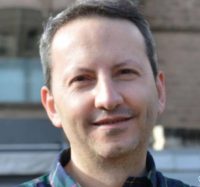
Around the world, shock and outrage has been the reaction to the news that Iran is preparing to execute Swedish-Iranian emergency medicine specialist Dr Ahmadreza Djalali. In a call from Evin Prison on 24 November, Ahmadreza told his wife Vida, who lives in Sweden, that he believed he may be executed in less than a week. He has been transferred into solitary confinement and it has been reported that he will shortly be sent to Rajai Shahr Prison where this draconian death sentence would be delivered.

Dr Djalali has been used as a bargaining chip as part of Iran’s hostage diplomacy. A dual national, illegally detained in solitary confinement with no access to a lawyer before being sentenced to death in October 2017. The court based their sentence for “corruption on earth” on “confessions” elicited after torture, threats to kill Ahmadreza Djalali’s wife and two young children, solitary confinement and his prolonged ill treatment.

The UN, EU, Council of Europe, European governments, worldwide academic institutions, civil society and thousands of individuals have all called for Dr Djalali’s release.

UN experts Javaid Rehman, Special Rapporteur on the situation of human rights in the Islamic Republic of Iran and Agnes Callamard, Special Rapporteur on extrajudicial, summary or arbitrary executions issued a statement saying: “We are horrified by the reports that Mr. Djalali is soon to be executed by the Islamic Republic of Iran. His torture, arbitrary detention, death sentence and now reported imminent execution are unconscionable acts that should be condemned by the international community in the strongest terms. We urge the Iranian authorities to take immediate action to reverse this decision before it is too late.

Amnesty International’s Deputy Director for the Middle East and North Africa, Diana Eltahawy, said:

“We call on members of the international community to immediately intervene, including through their embassies in Tehran, to save Ahmadreza Djalali’s life before it is too late.”

Valerie Peay, Director of the International Observatory of Human Rights said: “We stand in support of Dr Djalali and his family. Ahmadreza has already suffered gross injustice, pain and the cruel separation from his wife and two children. For three years he has faced a baseless death sentence while Iran has used him as a bargaining chip and sought to gain leverage with the international community by unjustly incarcerating Dr Djalali and other dual nationals. Now is the moment for the Islamic Republic to act to cease this action to execute Dr Djalali and instead, release him to return his life in Sweden with his family.

https://researchprofessionalnews.com/rr-news-europe-universities-2020-11-academic-groups-sound-alarm-over-djalali-death-sentence/embed/#?secret=xEX33rLMOr

Loujain al-Hathloul’s trial: Judge transfers her case to even worse court

November 26, 2020

Following up on my post from yesterday [https://humanrightsdefenders.blog/2020/11/25/loujain-al-hathloul-to-stand-trial-in-saudi-arabia-today/] Amnesty International reported on 25 November 2020 that a Saudi Arabian judge has decided to transfer human rights defender Loujain al-Hathloul’s case to Saudi Arabia’s Specialized Criminal Court (SCC), an institution used to silence dissent and notorious for issuing lengthy prison sentences following seriously flawed trials

https://www.amnesty.org/en/latest/news/2020/11/saudi-arabia-loujain-alhathlouls-trial-exposes-hypocrisy-on-womens-empowerment/

Loujain al-Hathloul to stand trial in Saudi Arabia today

November 25, 2020

As I have been following the case of Loujain al-Hathloul regularly [see https://humanrightsdefenders.blog/tag/loujain-al-hathloul/] I think it is important to report that she will appear in a Saudi court today Wednesday 25 November 2020, more than two years after she was first detained in a crackdown on human rights defenders.

al-monitor Lina al-Hathloul, whose sister Loujain is being held by Saudi authorities, speaks at the 10th Anniversary Women In The World Summit at David H. Koch Theater at Lincoln Center on April 10, 2019, in New York City. Photo by Photo by Mike Coppola/Getty Images.
We were just announced that @LoujainHathloul has a trial tomorrow,” her sister, Lina al-Hathloul, tweeted Tuesday.

The conservative Gulf kingdom insists that Hathloul and the others are detained over national security concerns. Saudi Minister of State for Foreign Affairs Adel Jubeir told CNN last week that Hathloul’s fate “was up to the courts.” 

The idea that she and her friends were detained because they advocated women’s driving is preposterous,” said Jubeir. 

Hathloul’s court date was scheduled for March but was postponed indefinitely amid what Saudi officials said were coronavirus concerns. On Oct. 26, she began a hunger strike to protest her treatment in prison and lack of regular contact with her parents. 

Amnesty International urged Riyadh to allow diplomats and journalists to attend the trial. The rights group also called for Hathloul to be given access to her parents, and to a lawyer so she can prepare an adequate defense. 

In light of the women rights activists reporting having been tortured or otherwise ill-treated in detention, we also have concerns about the admissibility of any ‘evidence’ that might be submitted in court tomorrow,” Lynn Maalouf, Amnesty’s deputy Middle East and North Africa director, said in a statement. 

The only just outcome for this trial would be the immediate and unconditional release of Loujain al-Hathloul,” Maalouf said.  

On Tuesday, a group of 29 organizations issued a letter to the president of Saudi Arabia’s Human Rights Commission, Awwad Al-Awwad, expressing their concern over the “continued arbitrary detention of women’s rights defenders.” 

Hathloul’s expected court appearance comes days after Saudi Arabia wrapped up its hosting duties for this year’s Group of 20 summit, of which women’s empowerment was a theme. Ahead of the virtual gathering, a coalition of human rights organizations sought to draw attention to what they say is an increase in repression under Crown Prince Mohammed bin Salman. 

https://www.al-monitor.com/pulse/originals/2020/11/loujain-al-hathloul-saudi-arabia-trial-jailed-women-activist.html

In reprisal for talking to diplomats Egypt arrests human rights defender Mohamed Basheern

November 18, 2020

On 16 November 2020, Amnesty International denounces the arbitrary arrest of Mohamed Basheer, the Administrative Manager at the Egyptian Initiative for Personal Rights (EIPR), over bogus charges.

By arresting Mohamed Basheer, a member of staff at one of Egypt’s most prominent independent human rights organizations, the Egyptian authorities have yet again shown their intolerance of any scrutiny of their abysmal human rights record, sending a chilling message to the embattled human rights community in Egypt that they remain at risk.” said Philip Luther, Amnesty International’s Middle East and North Africa Research and Advocacy Director.

Amnesty International strongly condemns Basheer’s arrest and detention and believes he is being targeted solely for his organization’s legitimate human rights work, including for meeting with Western diplomats. Members of the international community, and especially the states whose representatives were part of that visit, must now show that they won’t accept this reprisal and urge the Egyptian authorities to immediately and unconditionally release Basheer, drop all charges against him, and end the persecution of Egyptian civil society and human rights defenders. ” 

EIPR is an independent human rights organization whose work covers a variety of political, civil, economic and social rights in Egypt. According to Gasser Abdel-Razek, the Executive Director of EIPR, plainclothes security forces raided Basheer’s home in the early hours of 15 November. They took him to a National Security Agency building, where they detained him for more than 12 hours and questioned him without a lawyer present about the visit on 3 November by Western ambassadors and diplomats to the EIPR’s office. He was then taken to the Supreme State Security Prosecution (SSSP), where a lawyer who attended his questioning by prosecutors there, said the questions had focused on EIPR’s publications and legal assistance to victims of human rights violations.

Mohamed Basheer was added to Case No. 855/2020 Supreme State Security, which involves investigations over unfounded terrorism-related charges against prominent detained human rights defenders and journalists, including Mahienour el-Masry, Mohamed el-Baqer, Solafa Magdy and Esraa Abdelfattah. Amnesty International has extensively documented how the SSSP use prolonged pre-trial detention over unfounded terrorism related charges to imprison opponents, critics and human rights defenders for months and years without trial. [see also: https://humanrightsdefenders.blog/2020/10/09/un-expresses-deep-concern-over-egypt-using-special-terror-courts-to-silence-human-rights-defenders/]

EIPR researcher Patrick George Zaki remains detained pending investigations by the SSSP over unfounded “terrorism”-related charges since his arrest in February 2020. 

See also: https://www.egyptindependent.com/egypt-rebuffs-frances-concerns-over-arrest-of-egyptian-activist-mohamed-bashir/

And on 18 November the authorities arrested another staff member of the Egyptian Initiative for Personal Rights, Karim Ennarah, director of criminal justice initiatives Mada Masr reported [https://www.al-monitor.com/pulse/originals/2020/11/egypt-arrest-rights-group-karim-ennarah.html]


Read more: https://www.al-monitor.com/pulse/originals/2020/11/egypt-arrest-rights-group-karim-ennarah.html#ixzz6eHaFxm3G

and https://www.al-monitor.com/pulse/originals/2020/11/egypt-arrest-human-rights-condemn-eu-un.html

https://www.amnesty.org/en/latest/news/2020/11/egypt-authorities-arrest-staff-member-of-prominent-rights-group-in-reprisal-for-a-meeting-with-diplomats/

Amnesty International’s Write for Rights campaign 2020 launched

November 9, 2020

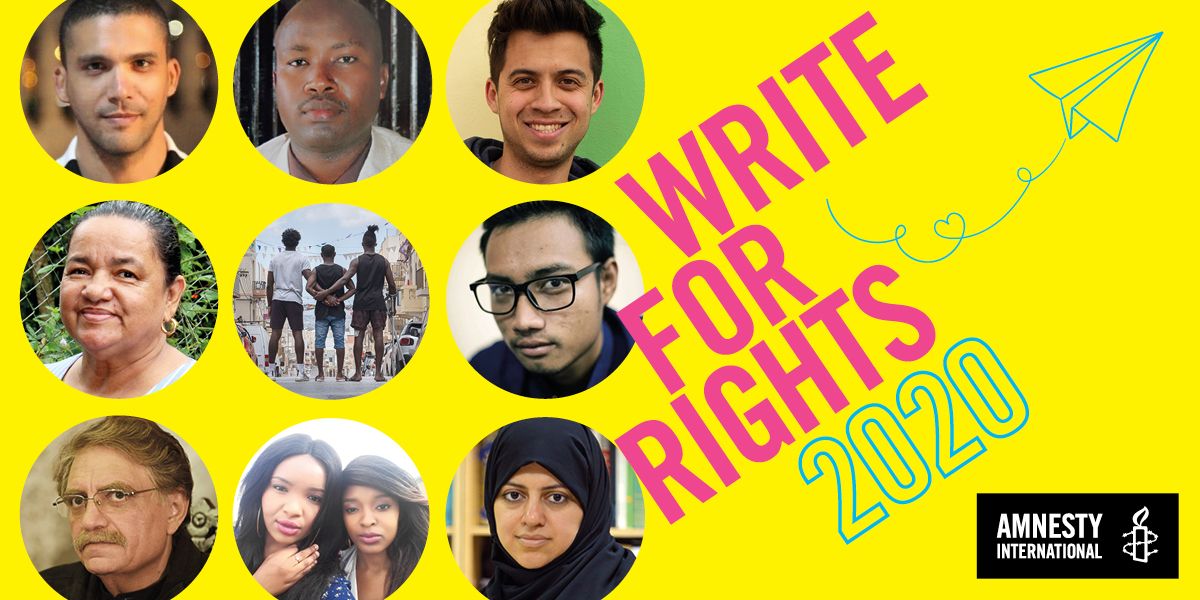
On 2 November 2020 Amnesty International has launched its flagship annual letter-writing campaign, Write for Rights, to help change the lives of people around the world who have been attacked, jailed, harassed or disappeared for standing up for their rights.

During Write for Rights – which takes place between November and December each year – people around the world will send millions of cards, emails and tweets of solidarity to individuals or groups of people whose freedoms are being denied, or write letters putting pressure on those in power to stop the abuses being committed against them. 

This year, the campaign will support ten individuals who are suffering abuses, including:

Write for Rights goes back to the very roots of Amnesty International, which was founded in 1961, with Amnesty’s early campaigners writing letters of support to those affected by human rights abuses, as well as letters of concern to governments around the world.

For last year, see: https://humanrightsdefenders.blog/2019/11/18/amnestys-write-for-rights-campaign-2019-launched-today-focuses-on-youth-activists/

https://www.amnesty.org.uk/press-releases/millions-letters-texts-and-tweets-sent-free-ten-individuals-human-rights-abuses

‘Amnesty Academy’ launched to educate young human rights defenders

October 30, 2020

On 29 October 2020, Amnesty International launched Amnesty Academy, a free human rights learning app which aims to educate the next generation of human rights defenders on a host of topics including freedom of expression, digital security, and Indigenous Peoples’ rights.

Learners around the world will be able to access courses ranging from 15 minutes to 15 hours in over 20 languages, including Urdu, Bangla, Hungarian, Korean, Russian, Thai, Czech and Turkish. All courses can be downloaded within the app, which is available on iOS and Android devices, allowing for offline learning.

This app has been designed to empower and encourage everyone everywhere to learn about human rights. Sharing knowledge is a vital way to help us stand up for our own and for each other’s rights, and to struggle for justice and equality all over the world,” said Julie Verhaar, Amnesty International’s Acting Secretary General. This app has been designed to empower and encourage everyone everywhere to learn about human rights. Sharing knowledge is a vital way to help us stand up for our own and for each other’s rights, and to struggle for justice and equality all over the world.

Among Amnesty Academy’s key features is a flexible self-paced approach to learning, allowing users to start courses as and when it suits them. Learners who complete some of the longer courses will be awarded an official certificate signed by Amnesty International’s Secretary General.

The courses available on Amnesty Academy have been developed and fine-tuned over the past three years as part of Amnesty International’s human rights learning website. They have now been optimized for mobile use, making human rights learning more accessible than ever.

Human rights education is the foundation of Amnesty’s work. Our overall goal is to ensure that people worldwide know and can claim their human rights. The Amnesty Academy app brings us closer to this goal by providing a simple and accessible platform for millions of people to access quality human rights education,” said Krittika Vishwanath, Head of Human Rights Education at Amnesty International.

Amnesty Academy will be regularly updated to accommodate learning in many more languages and with new course offerings in the months and years to come.

https://www.amnesty.org/en/latest/news/2020/10/amnesty-launches-human-rights-learning-app-to-equip-next-generation-of-activists/

ALERT: IF true, unbelievable: Trump to declare Amnesty, HRW and other NGOs as antisemitic!

October 22, 2020

The normally reliable Jerusalem (By SARAH CHEMLA) reports on 22 Ocrtober 2020 that US President Donald Trump may declare major international Human Rights NGO’s Amnesty International, Human Rights Watch and Oxfam as antisemitic in a soon-to-be released State Department declaration, voicing that governments should not support them any longer. If the declaration happens, it is likely to cause an uproar among civil society groups and might incite litigation. Critics of the possible move also worry it could lead other governments to further crack down on such groups, according to Politico.

T’ruah, a rabbinic human rights organization that represents over 2,000 rabbis, responded to the allegation on Wednesday, saying that “any US government declaration that these groups are antisemitic for criticizing the Israeli government is ridiculous, and contributes to the silencing of Israel’s human rights defenders.” It continued, adding that “the Trump administration’s smear of these three human rights organizations is yet one more example of this administration’s disregard for democracy and human rights at home and abroad.” “In casting aspersion on longtime respected human rights organizations, the Trump administration joins an ignoble list of autocratic governments that have discredited, smeared and even banned their own internal human rights organizations,” T’ruah said.”Actions such as these damage US democracy by threatening the transparency necessary to protect human rights. Human rights and civil society groups play a prophetic role, even if their words may not be ones governments want to hear.”Israel is a state bound by international human rights law, like all other members of the United Nations, and like other countries can be criticized when it fails to live up to these commitments,” it said.”By falsely smearing human rights organizations as antisemitic, the Trump administration only makes it harder to counter actual acts of antisemitism when they happen, while simultaneously harming these organizations’ effectiveness in reporting on all countries’ human rights abuses – including those of the United States.” 

ACCORDING TO Politico, the declaration is expected to take the form of a report from the office of Elan Carr, the US special envoy to monitor and combat antisemitism. It would declare that it is US policy not to support such groups, including financially (NOTE: AI and HRW do not accept government funding as a matter of policy!) , and urge other governments to cease their support.The report would cite such groups’ alleged or perceived support for the Boycott, Divestment and Sanctions movement, which has targeted Israel over its construction of settlements on land Palestinians claim for a future state. The declaration is also expected to point to reports and press statements such groups have released about the impact of Israeli settlements, as well as their involvement or perceived support for a United Nations database of businesses that operate in disputed territories, Politico said. Contacted by Politico, the organizations named in the report denied any allegations that they are antisemitic. 
[In 2019, David Collier released a report into the work of Amnesty International after monitoring dozens of social media accounts maintained by the NGO and people who work for it, and concluded that the amount of hatred Israel receives is beyond any proportion, to a level that is, he said, antisemitic.“Targets are not chosen for their actions, but rather for their identity,” wrote Collier. “Persecuted Christians are blatantly ignored.”[see also: https://electronicintifada.net/blogs/asa-winstanley/how-racist-blogger-david-collier-infiltrated-labour-party]

However, some differ, see e.g.: https://www.jns.org/opinion/time-to-call-out-human-rights-groups-for-their-anti-semitism/

https://www.jpost.com/diaspora/antisemitism/trump-administration-to-declare-amnesty-human-rights-watch-oxfam-antisemitic-646535

https://www.hrw.org/news/2020/10/23/us-seeks-discredit-human-rights-groups

Amnesty documents continued undermining of regional human rights mechanisms in Africa

October 21, 2020

For a second consecutive year, Amnesty International has documented how African governments are grossly undermining regional human rights bodies by failing to comply with their decisions, ignoring their urgent appeals, neglecting to report to them on national human rights situations and starving them of resources they desperately need for operations. Governments also neglected the rights of people with disabilities and older persons by failing to ratify treaties relating to their protection.

In the second edition of The State of African Regional Human Rights Bodies and Mechanisms 2019-2020released on the African Human Rights Day, Amnesty International said the mechanisms established to safeguard human rights across the continent are facing enormous challenges, and at least one is facing an existential threat. [for last year’s see: https://humanrightsdefenders.blog/2019/10/21/the-state-of-the-african-regional-human-rights-bodies-and-mechanisms/]

Given the magnitude of gross human rights violations across the continent, regional human rights bodies play a critical role in providing justice and accountability,” said Netsanet Belay, Amnesty International’s Director for Research and Advocacy.

“These mechanisms must be protected and fully supported. They serve as vital alternative channels for people to seek justice and effective remedies when national systems are compromised or inadequate.” 

Amnesty International’s report reviews and analyses the performance of Africa’s human rights treaty bodies:  the African Commission on Human and Peoples’ Rights (African Commission); the African Committee of Experts on the Rights and Welfare of the Child (African Children’s Committee); and the African Court on Human and Peoples’ Rights (African Court).

Existential crisis for African human rights court 

The report raises alarm that future of the African Court on Human and Peoples’ Rights is in jeopardy following decisions by three governments – Benin, Côte d’Ivoire and Tanzania – to withdraw the right of individuals and NGOs to directly file cases before the court. Rwanda withdrew this right in 2016 bringing to four the number of countries that are now restricting access to this vital pathway to justice.

Amnesty International found that Benin, Côte d’Ivoire and Tanzania withdrew this right in response to decisions they perceived as unfavorable, and amid rising intolerance towards human rights defenders and a general deterioration of human rights conditions nationally…..

—–

https://www.amnestyusa.org/press-releases/regional-human-rights-bodies-struggle-to-uphold-rights-amid-political-headwinds-in-africa/