Archive for the 'human rights' Category

Former climate change chief Christiana Figueres awarded Sydney Peace Gold Medal for Human Rights

March 3, 2020

The Sydney Peace Foundation said that it had decided to recognise Figueres for her efforts as a climate change diplomat, recognising both the success of facilitating a new global agreement, as well as the pressing international issue of climate change and its relevance to global human rights. For more on this award, see: http://www.trueheroesfilms.org/thedigest/awards/sydney-peace-foundations-gold-medal-for-human-rights.

“Figueres is one of the world’s top negotiators having done what many said was impossible, she brought the world to the table to sign the Paris Agreement. She is now challenging governments, business and civil society to work together to stop the climate from rising to catastrophic levels,” Sydney Peace Foundation director Susan Biggs said.

Figueres recently criticised the Australian government’s response to climate change, saying that Australia had to demonstrate leadership in reducing emissions if it expected other countries to act on climate change. “Australia needs all other countries to help in solving what is a global problem, not a national problem. If Australia doesn’t put a firm foot forward, it stands in no position to actually ask all other countries to also put their best foot forward,” Figueres said in an interview with Triple J Hack.

Former UN climate chief receives human rights award from Sydney Peace Foundation

Jackie Smith sees a world that prioritizes people over economic growth

March 3, 2020

Jackie Smith, a professor of sociology at the University of Pittsburgh and the editor of the Journal of World Systems Research, published a piece called “Human rights, not corporate rights” in Open Democracy of 26 February 2020. It is an excerpt of an essay published as part of a series by the Great Transition Initiative. To view the full series, click here. Jackie Smith argues that human rights offer a powerful framework for challenging corporate hegemony and creating a more just and sustainable world.

The growth and concentration of corporate power is one that deserves far more attention and critical analysis than it has received in academic and policy circles.

Capitalist globalization policies over recent decades have helped corporations grow and consolidate wealth on a global scale, which they have used to further concentrate market and political influence. The number of transnational corporations in the top 100 economic entities – including both corporations and governments – jumped to 69 in 2015 from around 50 at the turn of the twenty-first century. National governments are no longer the most powerful entities, and their position is continuing to slide as corporations grow. Alarmingly, among the leading industries are those most in need of governance for the sake of the common good: namely, those dependent on the perpetuation of our carbon-intensive economy, financial speculation, wasteful consumption, and the commodification of health care.

While corporate power has grown, the power of workers and communities has been steadily eroded by neoliberal globalization. The decline of trade unions and the growth of precarious work, fueled by the evangelization of neoliberal principles by economists and political leaders in governments and global institutions like the World Bank, have reduced the ability of people and communities to come together to advance a different vision of how the world could be organized. Cities have been hamstrung by budget constraints as they contend with effects of neoliberal globalization such as rising housing costs, effects of climate change, and social polarization. At the same time, critics of corporate globalization in the academy have been neutralized by the corporatization of universities and the polarization and commodification of political and media discourses. Indeed, we might say that today, global hegemony is exercised not by a national state or collection of states, but by the owners and managers of global corporations.

It is imperative, then, that scholars and activists do far more to focus on this critical issue and help find ways to challenge more directly the role of corporations in society today. Corporate concentration and market monopolization – enabled by US international economic policies, weak antitrust laws and implementation, corporate taxation, campaign financing, and other – undermine human rights in cities and communities worldwide.

By supporting human rights globalization as a counter-movement to corporate globalization, we can advance people-centered policies and build upon earlier work of transformative movements worldwide.

The United Nation’s Universal Periodic Review (UPR) process gives local human rights defenders one way of fighting back. US human rights defenders have recently challenged predatory corporate practices in a report to the United Nations. The report highlighted the impacts of corporations on local human rights, democratic political participation, housing, health, and racial and gender equity. It documented at great length the extent to which corporate practices violate government commitments in both national and international legal instruments.

While the UN process is limited in its ability to change behaviors of recalcitrant governments, what is powerful about international human rights treaties and institutional processes like the UPR is their ability to help social movements come together across various divides and promote a shared vision of the world we wish to see. Paraphrasing Frederick Douglass, human rights activists like to remind skeptics that those in power have never ceded power without popular pressure: “Human rights don’t trickle down, they rise up!”

The process of compiling UPR reports and then working to follow up with them helps groups and activists articulate shared priorities and visions of justice that account for global and historical omissions in local and national discourses. The UPR does not simply track violations but centers concrete remedies in the formal reports it makes to national governments. It is here that local activists have found opportunities to forge alliances with local government officials, who see value in using the international stage to amplify their pleas for federal funding to support social welfare needs. Thus, the UPR process helps build new community collaborations and foster public discourse and consciousness-raising around human rights as an alternative framework.

Corporate hegemony has constrained the political discourse and the political imagination we need to envision and fight for a world that prioritizes people and communities over economic growth and endless consumption. Although the odds seem daunting, global ideals and institutions that have been slowly and steadily advanced by human rights advocates over centuries may provide tools for advancing new projects and strategies that can realize human-centered policies and a more just and sustainable world.

https://www.opendemocracy.net/en/oureconomy/human-rights-not-corporate-rights/

Egyptian writer Ahdaf Soueif shines spotlight on human rights at UAE’s inaugural Hay festival

February 29, 2020
Egyptian novelist Ahdaf Soueif brought up the cases of Egyptian and Emirati political prisoners during her talk at the Hay festival in Abu Dhabi on 26 February (Facebook/@AhdafSoueif)

A letter signed by the festival’s president Stephen Fry, and more than 40 public figures and organisations castigated Emirati authorities for continuing to incarcerate citizens for expressing their views. See: https://humanrightsdefenders.blog/2020/02/26/hay-festival-in-emirates-promotes-freedom-of-expression-but-not-for-its-citizens/.

https://www.middleeasteye.net/news/ahdaf-soueif-declares-solidarity-political-prisoners-uae-cultural-festival

Call for nominations for Samir Kassir Award for Freedom of the Press goes ahead in MENA region

February 28, 2020
The European Union launched a call for nominations for the “Samir Kassir Award for Freedom of the Press” at the Delegation of the European Union to Lebanon. During the press conference, Ambassador Ralph Tarraf reaffirmed the European Union’s commitment to pursue Samir Kassir’s struggle for free speech and an independent free press. [for more on this and many other awards relating to freedom of the press, see: http://www.trueheroesfilms.org/thedigest/awards/samir-kassir-award-for-freedom-of-the-press]
The contest is open to candidates from North Africa, the Middle East, and the Gulf until 1 April, 2020, and three awards will be granted for: the best opinion article, investigative article, and audiovisual news report. The contributions must be centered on subjects relating to rule of law, human rights, good governance, fight against corruption, freedom of expression, democratic development and citizen participation. The jury will be composed of seven voting members from Arab and European media and one observer representing the European Union. The names of the jury members will be communicated during the prize-awarding ceremony, which will take place on 2 June 2020 in Beirut, marking the 15th memorial of Samir Kassir’s assassination.

https://en.annahar.com/article/1131572-european-union-launches-the-15th-editionon-of-the-samir-kassir-award-for-freedom

Right livelihood awards nominations close by 4 March

February 28, 2020

Just a reminder that the deadline for nominations for the 2020 Right Livelihood Awards is 4 March.  For more information see: https://humanrightsdefenders.blog/2020/01/16/call-for-nominations-for-the-2020-right-livelihood-awards/

Women human rights defenders in focus at 43rd Human Rights Council

February 27, 2020

UN High Commissioner for Human Rights, Bachelet, taking part in a panel discussion, held at the UN Human Rights Council on Tuesday 25 February 2020, said that the Beijing Declaration should be celebrated but noted that the Plan of Action agreed at the event is still unfinished. According to Ms. Bachelet, the risks of setbacks to women’s rights are real, and growing. ….”Women’s rights are threatened and attacked” on many fronts, she warned, adding that there over this period there has been “a backlash and the resurgence of gender inequality narratives based on age-old discrimination”. Ms. Bachelet also welcomed the speech delivered to the Human Rights Council by UN Secretary-General António Guterres on Monday. As part of his Call to Action for human rights [see https://humanrightsdefenders.blog/2020/02/25/43rd-session-hrc-un-secretary-general-launches-call-to-action-on-human-rights/], He called on every country to “support policies and legislation that promote gender equality, to repeal discriminatory laws, to end violence against women and girls and to strive for equal representation and participation of women in all areas”.

Against this backdrop the NGO side eventWomen human rights defenders radically transforming a world in crisis” is most timely.

Wednesday 4 March 2020, 11:00 – 12:00, Room XXVII Palais des Nations, Geneva. This event is co-hosted by ISHR, Amnesty International, Global Fund for Women, Urgent Action Fund, Mesoamerican Initiative of women human rights defenders, and Just Associates (JASS).

Panellists:

  • Michel Forst, UN Special Rapporteur on the situation of Human Rights Defenders
  • Nazik Awad, Sudan
  • Aurelia Martin Arzu Rochez, Honduras
  • Luz Mary Rosero Garces, Colombia
  • Fatima Bentaleb, France
  • Hasmida Karim, Indonesia

Moderator:

  • Zephanie Repollo, Just Associates (JASS)

Human Rights Defenders issues on the agenda of 43rd Human Rights Council

February 24, 2020

On 17 February 2020 the International Service for Human Rights (ISHR) published – as usual – its excellent “HRC43 | Key issues on agenda of March 2020 session”. Here some excerpts that relate directly to human rights defenders in the 43rd session of the UN Human Rights Council, which runs from 24 February to 20 March 2020.  If you want to stay up-to-date: with all issues follow @ISHRglobal and #HRC43 on Twitter.

Here are some highlights of the session’s thematic discussions

Protection of human rights defenders including women human rights defenders. The Council will consider a resolution, presented by Norway, to renew the mandate of the Special Rapporteur on the situation of human rights defenders. The mandate gathers and responds to information on the situation of defenders around the world, engages constructively with governments and non-State actors and provides recommendations to promote the effective implementation of the Declaration on human rights defenders. In 2019, the Council and the General Assembly unanimously affirmed the vital work defenders play. The Council recognised the critical role of environmental human rights defenders in protecting vital ecosystems, addressing climate change, attaining the sustainable development goals (SDGs). The General Assembly passed by consensus a resolution focusing on implementation of the Declaration and some key elements of protection policy; the resolution also attracted a record number of co-sponsors. The Special Rapporteur on the situation of human rights defenders will present his report on human rights defenders operating in conflict and post-conflict situations on 4 March, and country visits to Colombia and Mongolia.

Reports of cases of intimidation and reprisal against those cooperating or seeking to cooperate with the UN not only continue, but grow. Intimidation and reprisals violate the rights of the individuals concerned, they constitute violations of international human rights law and undermine the UN human rights system. [for some of my ealrier posts on reprisals, see: https://humanrightsdefenders.blog/tag/reprisals/]. During the 42nd session, the Council adopted a resolution which listed key trends such as the patterns of reprisals, increasing self-censorship, the use of national security arguments and counter-terrorism strategies by States as justification for blocking access to the UN. The resolution also acknowledged the specific risks to individuals in vulnerable situations or belonging to marginalised groups, and called on the UN to implement gender-responsive policies to end reprisals. The Council called on States to combat impunity and to report back to it on how they are preventing reprisals, both online and offline. [see also: https://humanrightsdefenders.blog/2019/11/08/michel-forst-in-last-address-to-general-assembly-pleads-to-fight-reprisals/]. Item 5 of the Human Rights Council’s agenda provides a key opportunity for States to raise concerns about reprisals, and for governments involved in existing cases to provide an update to the Council on any investigation or action taken toward accountability to be carried out.

At this 43rd session, the Council will discuss a range of economic, social and cultural rights in depth through dedicated debates with mandate holders alongside the annual report of the Secretary-General on the realisation of economic, social and cultural rights globally. These include interactive dialogues with the following:

  • The Special Rapporteur on the right to adequate housing on her annual report and country visits reports to Nigeria and France.
  • The Special Rapporteur in the field of cultural rights on her annual report on cultural rights defenders and country visit report to the Maldives and Poland.
  • The Special Rapporteur on human rights and the environment on his annual report and country visits to Fiji and Norway.

The Council will discuss a range of civil and political rights through dedicated debates with the mandate holders, including interactive dialogues with:

  • The Special Rapporteur on torture on his annual report and visit to Comoros.
  • The Special Rapporteur on freedom of religion or belief on his annual report and visits to the Netherlands and Sri Lanka.
  • The Special Rapporteur on the promotion and protection of human rights while countering terrorism on her annual report and visit to Kazakhstan.
  • The Special Rapporteur on the right to privacy on his annual report.

Country-specific developments

China Confronted with mounting evidence of serious human rights violations in China, specifically the mass internment, ‘re-education’, surveillance and harassment of Turkic Muslims in the western province of  Xinjiang, the view of many parts of the UN is incontrovertible. Beginning with a major UN review in August 2018, the UN High Commissioner has pressed for access, while the Special Procedures have expressed serious concerns about protection of freedom of religious belief, the impacts of counter-terrorism and counter-extremism measures, and the imposition of the death penalty in at least one case, that of university president Tashpolat Tiyip. In light of these concerns and the continued deterioration of the situation for human rights lawyers and defenders; the attacks on cultural rights and other freedoms in Tibet; and criminalisation of peaceful assembly and excessive use of police force in Hong Kong, it is high time for the Council to act. Member States should take concrete steps to call for independent, expert monitoring and reporting on the situation in Xinjiang, including access to the region, and urge accountability for actions by public authorities. [see also: https://humanrightsdefenders.blog/2019/07/12/joint-letter-by-22-states-to-human-rights-council-re-chinas-uighurs/ and https://humanrightsdefenders.blog/2019/07/20/china-coalition-anti-human-rights-un/]

Saudi Arabia The Council’s action on Saudi Arabia has contributed to the provisional release of at least seven women’s rights activists from detention. However, they are still facing trial and many remain in detention. Recent revelations of phone hacking, surveillance and possible blackmail and extortion of the owner of the Washington Post demonstrate the measures that the State is prepared to take to silence any form of criticism or dissent. The joint statement delivered by Australia in September sets out benchmarks for the Saudi government to take to demonstrate its willingness to improve the human rights situation. These benchmarks have not been met. States should ensure that Council scrutiny is maintained and in particular establish a monitoring and reporting mechanism over the situation. [for other posts on Saudi Arabia, see: https://humanrightsdefenders.blog/tag/saudi-arabia/]

Egypt The lack of action by the international community has emboldened the Egyptian government to continue to violate fundamental rights of its citizens. Special Procedures have rung the alarm bell regarding the pattern of reprisals against individuals and groups who sought to or engaged with the UN. In the last quarter of 2019 alone, more than 3,000 people were arbitrarily arrested and prosecuted under counter-terrorism laws in a nationwide crackdown against all forms of peaceful expression. The Committee against Torture has found that torture in Egypt is widespread and systematic and the situation meets all of the objective criteria for situations requiring the Council’s attention. States should initiate Council action on the situation before it further deteriorates. [see also: https://humanrightsdefenders.blog/tag/egypt/ ]

India The High Commissioner expressed concern over India’s Citizenship (Amendment) Act 2019 (CAA) for being ‘fundamentally discriminatory’ as it fails to extend protections to Muslim asylum seekers. Nationwide demonstrations and protests have been met with police brutality and arbitrary detentions. Vigilante groups allegedly affiliated with right-wing Hindu nationalist groups close to the government have physically attacked student protestors. Human rights defenders involved in organising peaceful assemblies have been detained and faced online harassment. ISHR calls on States to raise these concerns in their national statements including during the high level segment. [See also: https://humanrightsdefenders.blog/2019/06/27/ngos-come-out-in-support-of-indias-lawyers-collective/]

Burundi. At the last Council session, the Council renewed the mandate of the Commission of Inquiry on Burundi, which will present its oral briefing on 10 March at 10:00. ISHR remains highly concerned about the human rights situation in Burundi and its refusal to cooperate with the Council’s mechanisms. For more information on the situation of human rights defenders in Burundi, check ISHR Briefing Paper for the UPR here. See also: https://humanrightsdefenders.blog/2019/03/29/ngo-statement-condemns-new-irregularities-in-the-case-of-germain-rukuki-burundi/

Sri Lanka. Civil society groups are concerned over the backsliding on the commitments made by Sri Lanka in Human Rights Council Resolution 30/1. The recently elected president, Gotabaya Rajapaksa, along with his brother Mahinda Rajapaksa, who has been appointed prime minister, have been implicated in war crimes and numerous human rights violations when they were defence secretary and president respectively from 2005 to 2015. The new Government has made clear its intention to walk away from the Council process on Sri Lanka, a process that is currently the only hope for victims of human rights violations that truth, justice, reparations, and guarantees of non-recurrence are possible. [see https://www.nwaonline.com/news/2020/feb/23/sri-lanka-details-un-case-pullout/] Meanwhile, the relatively open climate for human rights defenders and journalists of the past few years seems to be rapidly closing. More than a dozen human rights and media organisations have received intimidating visits by members of law enforcement and intelligence agencies, while death threats against journalists have resumed. ISHR calls on States to urge for continued cooperation of the Government of Sri Lanka with OHCHR and the Special Procedures. The Council should reiterate the reference in Resolution 40/1 to “the adoption of a time-bound implementation strategy” for implementation of all elements of Resolution 30/1. [see also: https://humanrightsdefenders.blog/2020/01/22/sri-lankan-government-accused-of-embarking-on-process-to-silence-critics/]

Other country situations:

    • Interactive dialogue with the High Commissioner on the Occupied Palestinian Territories
    • Interactive dialogue with the Special Rapporteur on Eritrea
    • Interactive dialogue with the Special Rapporteur on Myanmar
    • Interactive dialogue with the Special Rapporteur on the Democratic People’s Republic of Korea
    • Interactive dialogue with the High Commissioner on Libya
    • High-level interactive dialogue on the Central African Republic
    • Interactive dialogue with the Commission on human rights on South Sudan
    • Interactive dialogue with the Special Rapporteur on Iran
    • Interactive dialogue with the Commission of Inquiry on Syria
    • Enhanced interactive dialogue on the High Commissioner’s report on the Democratic Republic of Congo
    • Interactive dialogue with the Independent Expert on Mali 
    • Interactive dialogue on the High Commissioner’s oral report on Ukraine
    • High Commissioner briefings on the following countries: Guatemala, Honduras, Colombia, Nicaragua, Yemen, Venezuela, Myanmar, Cyprus, Sri Lanka, Iran, Eritrea, Afghanistan

During this session, the Council will adopt the UPR working group reports on Italy, El Salvador, the Gambia, Bolivia, Fiji, San Marino, Kazakhstan, Angola, Iran, Madagascar, Iraq, Slovenia, Egypt and Bosnia and Herzegovina. This session of the Council will provide an opportunity for Angola, Egypt and Fiji  to to accept recommendations made in relation to human rights defenders, as proposed in ISHR’s briefing papers.

Council programme, appointments and resolutions

The President of the Human Rights Council will propose candidates for the following mandates:

  1. Two members of the Expert Mechanism on the Rights of Indigenous Peoples (one from Asia and one from the Arctic);
  2. Independent Expert on the situation of human rights in Somalia;
  3. Special Rapporteur on adequate housing as a component of the right to an adequate standard of living, and on the right to non-discrimination in this context;
  4. Special Rapporteur on contemporary forms of slavery, including its causes and its consequences;
  5. Special Rapporteur on the rights of indigenous peoples;
  6. Special Rapporteur on the sale and sexual exploitation of children, including child prostitution, child pornography and other child sexual abuse material;
  7. Special Rapporteur on the situation of human rights defenders;
  8. Special Rapporteur on the situation of human rights in Myanmar.

Some resolutions werealready announced (States leading the resolution in brackets):

  1. Prevention of genocide (Armenia)
  2. Special Rapporteur on Torture, mandate renewal (Denmark)
  3. Freedom of religion or belief (EU)
  4. Situation of human rights in Myanmar (EU)
  5. Situation of human rights in the Democratic People’s Republic of Korea, mandate renewal (EU)
  6. Mandate renewal of the Special Rapporteur on the human rights of migrants (Mexico)
  7. Protecting the rights of human rights defenders, mandate renewal (Norway)
  8. Technical assistance and capacity-building to improve human rights in Libya (African Group)
  9. Combating intolerance, negative stereotyping and stigmatization of and discrimination, incitement to violence and violence against persons based on religion or belief (Pakistan on behalf of the OIC)
  10. The human rights situation in the Syrian Arab Republic (France, Germany, Italy, Jordan, Kuwait, Morocco, Netherlands, Qatar, Turkey, United Kingdom of Great Britain and Northern Ireland)
  11. Situation of human rights in South Sudan, mandate renewal (Albania, Norway, United Kingdom of Great Britain and Northern Ireland)
  12. Situation of human rights in the Islamic Republic of Iran, mandate renewal (North Macedonia, Republic of Moldova, Sweden, United Kingdom of Great Britain and Northern Ireland)
  13. Freedom of Expression, mandate renewal (Netherlands, Canada)

Officers of the Human Rights Council

Newly appointed members of the Bureau for the 14th cycle comprises of the following Ambassadors:

  • Ms. Elisabeth Tichy-Fisslberger (Austria), President of the Human Rights Council
  • Mr. Yackoley Kokou Johnson (Togo), Vice-President and Rapporteur
  • Mr. Nasir Ahmad Andisha (Afghanistan), Vice-President
  • Ms. Socorro Flores Liera (Mexico), Vice-President
  • Mr. Juraj Podhorský (Slovakia), Vice-President

Panel discussions

During each Council session, panel discussions are held to provide member States and NGOs with opportunities to hear from subject-matter experts and raise questions. All panel discussions will be broadcast live and archived on http://webtv.un.org. Four panel discussions are scheduled for this upcoming session:

  1. Annual high-level panel discussion on human rights mainstreaming titled “Thirty years of implementation of the Convention on the Rights of the Child: challenges and opportunities” will take place on 24 February at 16:00
  2. High-level panel discussion commemorating the twenty-fifth anniversary of the Beijing Declaration and Platform for Action with a particular focus on their implementation will take place on 25 February at 09:00
  3. Annual interactive debate on the rights of persons with disabilities, titled “Article 8 of the Convention on the Rights of Persons with Disabilities, on awareness-raising”, will take place on 6 March at 16:00
  4. Debate on the midterm review of the International Decade for People of African Descent will take place on 13 March at 16:00.

NOTE: The UN’s liquidity crisis is having a serious impact on this session and the next one (44th in June) and ISHR – jointly with 26 other NGOs – have expressed their concerns to the UNSG that in light of the special emergency measures and ongoing budget constraints, further measures may be imposed to restrict civil society participation at the Council. Despite the adoption of a number of measures by the Council over the years to address the budgetary constraints faced by the United Nations Office at Geneva (UNOG), the Director General of UNOG informed the Council’s President that the Council may not be able to carry out all its mandated activities in 2020. This is due to the special emergency measures instituted by the UNSG to respond to the UN’s liquidity crisis which prohibit all lunch-time meetings, thus making it impossible for UNOG to provide conference services to all the Council’s required meetings. The President of the Council requested the UNSG to issue an exemption of these measures to ensure that the Council can hold all its meetings. The UNSG issued an exemption for meetings during the High-level Segment and voting on resolutions, but not for other meetings in the March session. [see also: https://humanrightsdefenders.blog/2019/05/20/lack-of-funds-forces-lack-of-oversight-by-un/]

For more information contact: Salma El Hosseiny at s.hosseinyATishr.ch 

For a survey of the 42nd session, see: https://humanrightsdefenders.blog/2019/10/02/result-of-the-42nd-session-of-the-un-human-rights-council/

See also CIVICUS advisory on this Council session: https://www.civicus.org/index.php/media-resources/news/united-nations/geneva/4282-advocacy-priorities-at-43rd-session-of-un-human-rights-council

https://www.ishr.ch/news/hrc43-key-issues-agenda-march-2020-session

Changes in the governance of the Martin Ennals Foundation

February 23, 2020

Martin Ennals Award for Human Rights Defenders

Having just reported on the laureate of the Martin Ennals Award 2020 [ https://humanrightsdefenders.blog/2020/02/22/huda-al-sarari-is-the-laureate-of-the-2020-martin-ennals-award-for-human-rights-defenders/], I should add that the Martin Ennals Foundation has undergone several changes in its managment. A new Chairman, Philippe Currat, a well-known Geneva lawyer (see: https://www.martinennalsaward.org/boards/philippe-currat/), takes over from Dick Oosting (Oosting is a former Amnesty International staff member who worked closely with Martin Ennals himself as deputy SG). At the same time a new vice-chair was appointed: Barbara Lochbihler, a prominent human rights expert from Germany who last year completed ten years in the European Parliament and is now a member of the UN Committee on Enforced Disappearances. Since last summer, Isabel de Sola is the new director (see: https://www.martinennalsaward.org/boards/isabel-de-sola/). Together with a new team at the Ville de Genève, good progress was made to redesign the award ceremony of 19 February. This year’s finalists are offered so-called ‘residencies’ to benefit from their presence in Geneva and Switzerland as well as to be able to share their experiences more widely. First steps were taken to open up local educational activities. Communications have been significantly upgraded.

Dick Oosting said that the hand-over marks a broader process of change in the way that the foundation operates. In sharpened its strategy in several ways: by developing activities and profile in Geneva; by exploring the scope for more sustained work with past laureates and finalists; by working more closely with the jury organizations; and by strengthening overall communications.

Philippe Curat was present at the press conference of this year and stated: “The Martin Ennals Foundation is particularly proud to honour and support three resilient women human rights defenders this year, our laureate Huda Al-Sarari, as well as our two finalists Sizani Ngubane and Norma Librada Ledezma for their achievements. We hope that the award will shed a light on their achievements, and strengthen protection mechanisms around them”.

About us


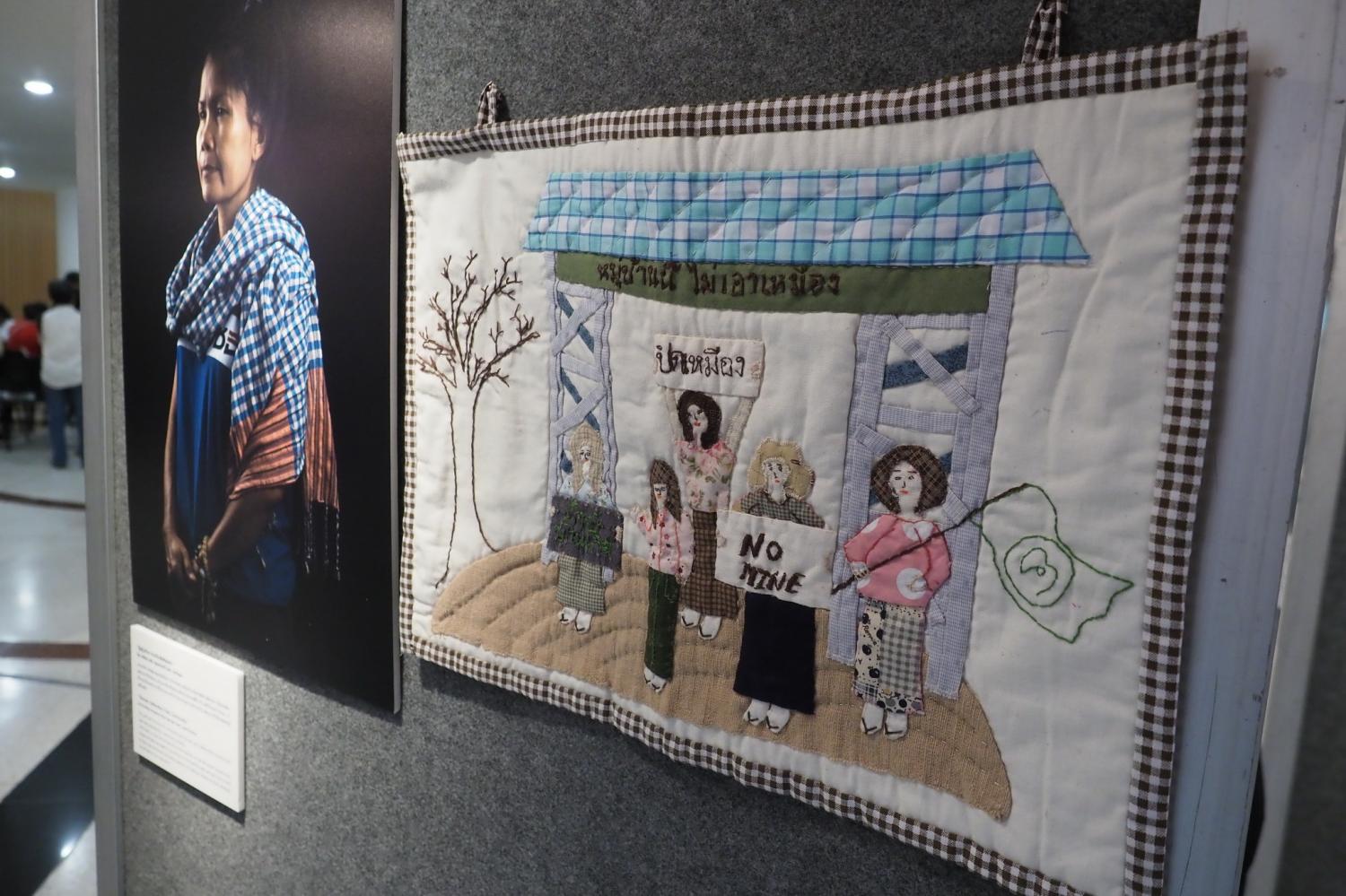
Arpilleras making a come back as’ blankets that protect’

February 22, 2020
The success of ‘Art For Resistance: Quilts Of Women Human Rights Defenders’ was a wake up call to do everything in our power to protect the human rights of women. (Photos courtesy of Protection International)

Under the title “The blanket that protects Yvonne Bohwongprasert in the Bangkok Post of 19 February 2020 writes about these quilts as an art form to address human rights and encourage society to stand up and collectively fight for a social cause that impacts people from all walks of life.

Art For Resistance: Quilts Of Women Human Rights Defenders” was one such event with a powerful social message: “Have I done anything today to protect the rights of women?” The social-awareness event, which was launched in 2018, had a record 54 participants — two of whom happened to be men — sharing their personal stories of fighting for human rights in various sectors of society on colourful quilts they stitched together on their own. Besides the exhibition, there was a panel discussion on the situation of women human-rights defenders in a pseudo-democratic Thailand.

The idea of quilts to raise awareness on the issue came from the colourful quilt squares Chilean women used to tell their stories of life under the Pinochet dictatorship, which routinely violated human rights. Despite the lives of these women having been darkened by poverty and oppression, their vibrant and visually captivating denouncements were a strong tool of resistance. See: https://en.wikipedia.org/wiki/Arpilleras/

Protection International (PI) Thailand and the Canadian embassy in Thailand, played a vital role in staging this year’s event. PI representative Pranom Somwong said: “Each quilt tells a story of injustice and the fire in each woman to overcome her struggles by acquiring a relentless spirit to seek justice for their families and communities“.


A quilt inspired by Buku FC, a Deep South female football club made largely of Muslim women and a few men and LGBT individuals. Rumman Waeteh, left, and Suhaida Kutha, right, created the work. YVONNE BOHWONGPRASERT

Huda Al-Sarari is the laureate of the 2020 Martin Ennals Award for human rights defenders

February 22, 2020

On 19 February 2020 the Martin Ennals Foundation announced that is has granted Huda Al-Sarari, Yemeni lawyer and human rights defender, the 2020 Martin Ennals Award. Huda was among three women human rights defenders selected as finalists for the Award by a jury of ten of the world’s leading human rights organizations, along with Sizani Ngubane, South Africa, and Norma Librada Ledezma, Mexico. [see https://humanrightsdefenders.blog/2019/11/26/breaking-news-mea-has-3-women-hrds-as-finalists-for-2020/]

The 2020 Martin Ennals Award ceremony, co-hosted with the City of Geneva, was held on Wednesday 19 February, and for the first time in the history of the Award, all three finalists are women. “Women human rights defenders (WHRDs) are subject to the same risks as every human rights defender, but as women, they also face certain forms of violence and violations due to their gender. WHRDs are often stigmatized and ostracized by community leaders, faith-based groups and even family members”, said the Mayor of the City of Geneva, Sandrine Salerno.

Huda Al-Sarari is a Yemeni lawyer and human rights defender who graduated from Aden University. She also holds a masters in Women’s Studies and Development from the Women’s Centre at Aden University. Since 2015, Huda investigated, exposed and challenged the enforced disappearances that occurred as a result of secret prisons run by foreign governments in Southern Yemen where thousands of men and boys have suffered from arbitrary detention, torture and extrajudicial killings. She collected evidence on more than 250 cases of the abuse taking place within those prisons and succeeded in convincing international organisations such as Amnesty International and Human Rights Watch to take up the cause. “Being a human rights defender in Yemen is extremely challenging, and being a woman makes this even more difficult. In a male-dominated society, I have to prove myself maybe ten times more than a man”, explains Huda. Despite the threats, defamation campaigns and sacrifices she and her family endured, Huda continues to stand alongside the families of those who have disappeared.

Receiving the 2020 Martin Ennals Award for human rights defenders means the world to me. It gives me great strength and emboldens me to continue this fight for justice”, she says. “I believe the Award will be incredibly important in drawing attention to the continual plight of victims of arbitrary detention, abuse and torture in Yemen”, she concluded.

As Chair of the Martin Ennals Award Jury, I myself added that “We commend Huda for the work that she conducted, not only against the backdrop of the ongoing Yemeni civil war, but also, in a country where women still struggle to express their political and civil rights. Huda’s legacy is crucial as her thorough investigations and search for accountability will serve to bring justice for human rights violations occurred during the conflict.

For more on this and other awards for human rights defenders see: http://www.trueheroesfilms.org/thedigest/awards/martin-ennals-award-for-human-rights-defenders. The Martin Ennals Jury is composed of 10 of the world’s leading human rights organisations. See: https://www.martinennalsaward.org/about-us-about-the-martin-ennals-award/