Archive for the 'human rights' Category
November 5, 2012
In Greece there is a frequently heard ‘complaint’ that international human rights groups – in particular AI – have the same agenda as the USA. At a recent meeting with friends in Chania, AI’s position on Pussy Riot was quoted as evidence.
I countered by pointing out that AI on many occasions has taken a stand that seems to go against US policy, from the death penalty to Guantanamo Bay and the Israeli occupied territories. A recent video referred to here makes that clear again in the case of Israel. Perhaps even more shocking are some of the comments that seems to confirm the existence of an orchestrated response [by whom?] to equal any criticism of Israel to anti-Semitism.
Every Friday since December 2009 residents of al-Nabi Saleh and solidarity activists gather around noon in the village centre and march peacefully towards the spring. They have been met repeatedly with unnecessary and excessive force by the Israeli army including the use of stun grenades, pepper spray, batons and guns. Demonstrations are dispersed as soon as they begin and are usually not allowed to reach the spring. The Israeli army raids the village regularly, usually during the night, and conducts house searches and arrests, including the arrest of children under the age of 15.
Israeli military laws in place in the West Bank impose sweeping and arbitrary restrictions on freedom of expression and peaceful assembly, requiring people to obtain advance permission from the Israeli military for any proposed gathering of 10 or more persons “for a political purpose of for a matter that could be interpreted as political”. Nariman Tamimi told Amnesty International that in al-Nabi Saleh and all areas where there is popular resistance, police use extreme violence, noting that “there is nothing [to the protests] except that you chant and express your opinion.” As one of the organizers of the al-Nabi Salneh protests and a coordinator of the village’s popular committee, Bassem Tamimi and his family have been the target of harsh treatment by the Israeli army. For more see the excellent film:
AI video on Palestinian protest
Posted in films, human rights, Human Rights Defenders | Leave a Comment »
Tags: al-Nabi Saleh, Amnesty International, Antisemitism, Criticism of the Israeli government, Greece, human rights, Israel, Israeli-occupied territories, Nariman Tamimi, Palestinian people, peaceful protest, United States, West Bank
November 2, 2012
A small Berlin based NGO has brought out a 8 mn video that is very basic but also very clear. I think it could be especially useful for educators in at the secondary school level or as introduction for a basic class in human rights. The first part (focusing on history and civil and political rights) exists in several languages. I am interested to see what they come up with when dealing with social and economic rights and collective rights.
OOPS there was a link to alternative energy – also important but not what I meant: better go to edeos animated video on human rights part 1 in YOU TUBE
iframe width=”640″ height=”360″ src=”http://www.youtube.com/embed/3L4r47WiqMw” frameborder=”0″ allowfullscreen></iframe
Posted in films, human rights | 1 Comment »
Tags: Advocacy Organizations, animation, Berlin, Edeos, human rights, Human Rights and Liberties, human rights education, Non-governmental organization, video, You Tube
November 2, 2012

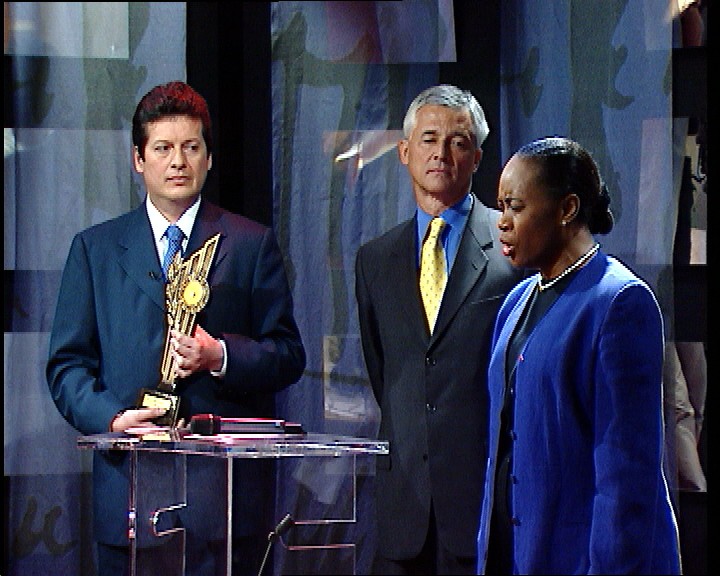
Barbara Hendricks at MEA ceremony 2003 with late Sergio Vieira de Mello and Alirio Uribe Munoz
The trigger to write about this very special person is that she has just been celebrated as UNHCR’s Goodwill ambassador for 25 years.
“You are really the princess of the humanitarian and human rights world,” High Commissioner for Refugees António Guterres said at a special UNHCR staff ceremony in Geneva. “The authority of your voice is a precious instrument for our fight,” he added. “Twenty-five years – it’s a long time and the cause of refugees has been a part of my life since my first mission,” said Hendricks, adding that it had been an honour to work for UNHCR. She praised the refugees who inspire her and the UNHCR staff who help them. “Thank you so much. It has been a fantastic journey and I look forward to continuing for as long as I can.”
What many people do not know is that Barbara Hendricks has not only been a dedicated and outspoken advocate for refugees for the past 25 years, but also been a strong supporter of other causes including human rights, e.g. as a Patron of the Martin Ennals Award for Human Rights Defenders or in giving her support to creating the True Heroes Foundation, Films for Human Rights Defenders in 2007.
The American-born Swedish citizen was inspired by the struggle for civil rights in the USA as a child and never let off. The human rights world needs celebrities but even more it needs celebrities with real and long-term commitment. This is what makes Barbara Hendricks a Human Rights Defender in her own name! Thanks.
Posted in human rights | 1 Comment »
Tags: Barbara Hendricks, Geneva, human rights, Human rights defender, Martin Ennals Award, Martin Ennals Award for Human Rights Defenders, Sergio Vieira de Mello, True Heroes Foundation, UNHCR
November 1, 2012
|
Official Blasts West’s Double-Standard Policies on Human Rights in Iran
TEHRAN (FNA)- Secretary of Iran’s Human Rights Council Mohammad Javad Larijani rapped the West’s double-standard policies and stances on human rights issues, saying that western states shelter terrorist groups like the anti-Iran terrorist Mojahedin-e Khalq Organization (MKO) and award them in the name of defending human rights.
|
 |
|
|
“Our people are familiar with the West’s discriminatory and hostile attitude towards the Islamic Republic of Iran,” Larijani said in a meeting with Head of Iran-Germany Parliamentary Friendship Group Bijan Jirsarayee in Tehran on Wednesday.
Larijani rapped the double-standard polices and behavior of the western states towards the human rights issues in Iran.
On one hand, the western states shelter and support terrorist groups like the MKO … and cooperate with the US in imposing unilateral sanctions against Iran which have inflicted great losses on the Iranian people and is a blatant violation of human rights, and on the other hand, they suddenly emerge as advocates of human rights and grant awards to culprits in Iran as if they are defenders of human rights, he added.
The European Parliament announced that this year’s winners of the Sakharov Prize for Freedom of Thought are two Iranian culprits (!ed), lawyer Nasrin Sotoudeh and film director Jafar Panahi. Sotoudeh is now imprisoned in Iran for security crimes and Panahi is a fugitive living outside Iran.“
The rest of the article is one long rambling statement against the MKO and the support it gets from the West (read for yourself if you want to) but with the marvelously inconsistent quotation of …Human Rights Watch, one of the NGO regularly denounced as a stooge of the same West..
“A May 2005 Human Rights Watch report accused the MKO of running prison camps in Iraq and committing human rights violations. According to the Human Rights Watch report, the outlawed group puts defectors under torture and jail terms.”
|
Fars News Agency :: Official Blasts Wests Double-Standard Policies on Human Rights in Iran.
Posted in human rights, Human Rights Defenders | Leave a Comment »
Tags: award, Human Rights Defenders, Human Rights Watch, Iran, Javad Larijani, MKO, Nasrin Sotoudeh
October 30, 2012
The Moscow Times reports today that the Swedish government has awarded a Russian human rights lawyer from Dagestan with the Per Anger Prize for defending victims of human rights violations. Memorial, a Moscow-based human rights center, said in comments carried by Interfax that Magomedova had defended victims of torture, kidnappings, extrajudicial killings and sex-based violence in Dagestan.
Sapiyat Magomedova was nominated by Swedish NGO Civil Rights Defenders for possessing “the best qualities that define a true human rights defender,” according to a statementposted on the NGO’s website.
The 33 year-old lawyer is known for taking up difficult cases that others have rejected for security reasons. Magomedova was herself a victim of violence in 2010, when she was brutally beaten at a local police station in the city of Khasavyurt.
Established in 2004, the Per Anger Prize supports human rights and democracy initiatives and is named after Swedish diplomat Per Anger, who helped rescue Hungarian Jews during World War II.
Sweden Honors Russian Rights Lawyer | News | The Moscow Times.
Posted in human rights, Human Rights Defenders | 1 Comment »
Tags: award, Civil Rights Defenders, Dagestan, Memorial, Per Anger Prize, Russian Federation, Sapiyat Magomedova, Sweden
October 30, 2012
I am referring to this blog post by Dr Jocalyn Clark because it is so good to see that the medical community comes out to support a Human Rights Defender in DRC and considers the attack on him as “another wake-up call for us all”.
“Last Thursday evening, as many of you will have seen via media reports, a true hero of women and human rights Dr Denis Mukwege narrowly escaped death during an assassination attempt on his life that killed his security guard. Amnesty International is now rightly calling for a full investigation and asking whether his recent criticisms of the Congolese government played a role. Attacks against human rights defenders and humanitarian workers are said to be increasing in DRC, where conflict has raged for years. Denis Mukwege, winner of many international accolades including the UN Human Rights Award, has long championed the rights of women and highlighted to the world the extent and the brutality of systemic rape against women in the conflict zones of DRC…”
Threats against women’s rights advocate Denis Mukwege are another wake-up call for us all | Speaking of Medicine.
Posted in human rights, Human Rights Defenders | Leave a Comment »
Tags: AI, conflict, Democratic Republic of Congo, Denis Mukwege, DRC, human rights, Human Rights Defenders, Jocalyn Clark, medical, rape, Women Human Rights
October 26, 2012

Nasrin Sotoudeh and Jafar Panahi (Photo credit: European Parliament)
Two Iranian activists, lawyer Nasrin Sotoudeh and film director Jafar Panahi, are this year’s joint winners of the European Parliament Sakharov Prize for Freedom of Thought. They were chosen by President Schulz and political group leaders on Friday morning.
“The award of the Sakharov Prize for Freedom of Thought to the Iranians Nasrin Sotoudeh and Jafar Panahi is a message of solidarity and recognition to a woman and a man who have not been bowed by fear and intimidation and who have decided to put the fate of their country before their own. I sincerely hope they will be able to come in person to Strasbourg to the European Parliament to collect their prize in December”, said President Schulz, announcing the winner after the meeting. He underlined that the unanimity this year was exceptional.
Nasrin Sotoudeh
Nasrin Sotoudeh, born in 1963, is an Iranian lawyer and human rights advocate. She has represented opposition activists imprisoned following Iran’s disputed June 2009 presidential elections, juveniles facing the death penalty, women and prisoners of conscience. She was arrested in September 2010 on charges of spreading propaganda and conspiring to harm state security and has been held in solitary confinement. She was one the 3 nominees of the Martin Ennals Award 2012. Sotoudeh has two children. She recently started a hunger strike in protest against the state’s harassment of her family.
Jafar Panahi
Jafar Panahi, born in 1960, is an Iranian film director, screenwriter and film editor. He first achieved international recognition with his film The White Balloon that won the Caméra d’Or at the 1995 Cannes Film Festival. His films often focus on the hardships faced by children, the impoverished and women in Iran. Mr Panahi was arrested in March 2010 and later sentenced to six years in jail and a 20-year ban on directing any movies or leaving the country. His latest film “This Is Not a Film” was smuggled from Iran to the 2011 Cannes Film Festival on a USB stick hidden inside a cake.
(The two other finalists were Ales Bialiatski and Pussy Riot)
Posted in human rights | Leave a Comment »
Tags: awards, European Parliament, Iran, Jafar Panahi, MEA, Nasrin Sotoudeh, Sakharov Prize
October 26, 2012
On 14 October 2012, TV channel LTR broadcast a program in which human rights defender Ms Tolekan Ismailova was depicted as spreading propaganda for homosexuality in Kyrgyzstan and being destructive to Kyrgyz values. Similar accusations were published in several Kyrgyz-language newspapers. Ms Tolekan Ismailova is the director of Human Rights Centre ‘Citizens Against Corruption’. These accusations refer to the documentary ‘I Am Gay and Muslim’, which was part of the human rights film festival Bir Duyno – Kyrgyzstan (One World Kyrgyzstan), organised annually in Bishkek. The documentary was scheduled to be shown on 28 September 2012 in Bishkek. The film explores the problematic issue of gay rights in the Islamic world, taking the example of Moroccan young men who speak about their sexual and religious identity.
On 26 September 2012, the organisers of the festival had received phone calls and text messages threatening them with physical harm while the director of the cinema was threatened that the building would be set on fire unless the film’s screening was cancelled. Dublin-based Front Line Defenders condemns the smear campaign and threats against Ms Tolekan Ismailova and the other organisers of the human rights festival, and is concerned for their physical and psychological integrity and security.
For actions see: https://www.frontlinedefenders.org/node/20249/action
This information was received through the International Secretariat of Women Human Rights Defenders International Coalition.
Posted in human rights | Leave a Comment »
Tags: Bishkek, Citizens Against Corruption, film festival, Front Line (NGO), human rights, Human Rights Defenders, Kyrgyzstan, LGBT rights, Tolekan Ismailova, women human rights defenders
October 26, 2012
An Arab blogger, Sultan Sooud Al-Qassemi, posted on 25 October a relevant article in AL-Monitor. It poses the always tricky question of the ‘definition’ of a Human Rights Defender, but even more the valid question of human rights policy. Why would the international community put priority or energy into defending those whose human rights credentials are below par? Not speaking Arabic myself, I cannot refute the many examples given by the author. Anybody who can is welcome to enlighten us. In the meantime it is not more than fair to put on record the detailed accusations in the long article, including writings and tweets by Hassan Al Diqqi. Why the author does not give similar examples from other islamists is a good question. Also there is the weakness that the article does not give examples of those activists in the UAE that the author would consider real human Rights defenders, which makes the article look like a apology for the UAE’s govenrment. I just have to mention the cases of Ahmed Mansoor, blogger and member of ANHRI’s (Arab Network for Human Rights Information); Nasser bin Ghaith, an economist, university lecturer and advocate of political reform; and three online activists Fahad Salim Dalk, Ahmed Abdul Khaleq and Hassan Ali al-Khamis, which featured in my blog on 18 July.
The article itself has some strong language:
“For almost two years, the UAE’s political Islamists have been referred to in the West as human rights activists. No doubt, they are indeed activists with an agenda but there is also no doubt that they are not our version of Nelson Mandela, nor is their vision for the country that of the Magna Carta. I have been following their rhetoric — in Arabic — over the past few months on social media with great concern. I have found it to be xenophobic; anti-Semitic; sectarian; exclusionary; racist toward Asians, Africans and other Arabs and overall repugnant.
Nothing exposes the ignorance of non-Arabic-speaking writers than when they comment on the current events in the UAE without taking the time to read what is written. Referring to the political Islamists as “human rights defenders” is an insult to human rights activists all over the world and the equivalent of calling Greece’s Golden Dawn, Holland’s Freedom Party led by Geert Wilders or Hungary’s Jobbik Party as human rights platforms. If outsiders want to champion the UAE’s political Islamists, they should at the very least refer to them as they truly are: right-wing, exclusionary political movements. Vote for Geert Wilders if you like, just don’t call him a human rights defender.“
see full piece: UAE Political Islamists Are Not Human Rights Defenders – Al-Monitor: the Pulse of the Middle East.
Posted in human rights, Human Rights Defenders | Leave a Comment »
Tags: Al-Monitor, definition, Emirates, HRDs, human rights, Human Rights Defenders, Sultan Sooud Al-Qassemi, UAE, United Arab Emirates
October 26, 2012
CIVICUS (a worldwide civil society alliance) wrote on 17 October 2012 a letter to the UN Special Rapporteur on Human Rights Defenders, Mrs. Margaret Sekaggya. Triggered by the recent shooting of the girl Malala Yousafzai, the letter details other such attacks on women HRDs in Pakistan.
for the full text go to:
CIVICUS Letter to the Special Rapporteur on Human Rights Defenders.
Posted in human rights, Human Rights Defenders | Leave a Comment »
Tags: CIVICUS, Civil society, Human Rights Defenders, Malala Yousafzai, Margaret Sekaggya, Pakistan, United Nations Special Rapporteur, women human rights defenders
 Hans Thoolen on Human Rights Defenders and their awards