Archive for the 'human rights' Category

Arms sales to human rights violating regimes? – the UK and Arab world

November 10, 2012

In a letter to the editor of the Guardian of 8 November 2012, Andrew Lovatt puts the question very clearly:

Countries that sell arms to states that have repeatedly violated the human rights of their people should receive universal condemnation from their own citizens for the role they play in furthering the misery and bloodshed around the globe, and Britain’s sale of fighter jets to Saudi Arabia and the UAE should be no exception. Human Rights Watch has reported numerous human rights abuses conducted by both states, which have included the assault and intimidation of nonviolent human rights defenders, political activists and civil society actors in an attempt to suppress freedom of expression and protect the regimes from democratic change.

Britain’s long-standing international support for democracy and human rights has already been undermined by the sale of 72 Typhoons to Saudi Arabia. Should Britain prop up these oppressive states further by putting an extra £6bn worth of military hardware into their hands, its position will rightly be viewed as hypocritical by the rest of the world.
Andrew Lovatt
Market Drayton, Shropshire


Luon Sovath speaks out on Radio Free Asia

November 10, 2012

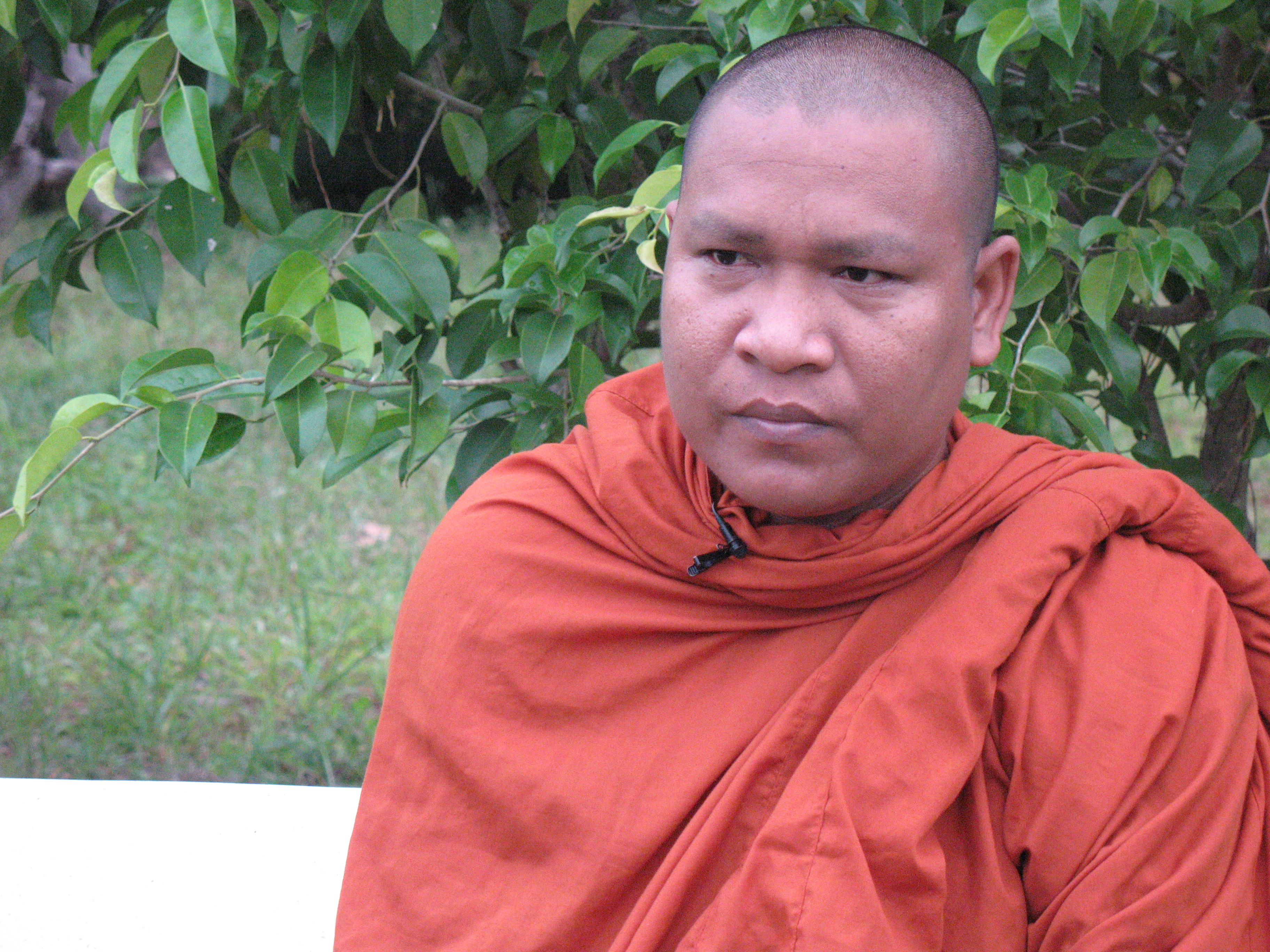
On 7 November the activist monk Luon Sovath, MEA Laureate of 2012, spoke to Radio Free Asia about his work.

As the interview is quite interesting I copied here in in full:

Fresh from receiving the “Nobel Prize for Human Rights,” Cambodia’s technology-savvy activist monk Loun Sovath has called on authorities in his country to end the use of violence in land eviction cases, vowing to continue his struggle to protect victims of land grabs. He also said he would not be cowed by government harassment and called on his fellow monks, often respected as figures of moral authority in Cambodia, to join in the struggle to defend villagers who have become victims of forced evictions. Loun Sovath was the first Southeast Asian to be presented with the 2012 Martin Ennals Award for Human Rights Defenders as he was selected for documenting the struggle of land rights activists and ordinary citizens evicted from their homes in his impoverished country. The monk collected the award—viewed by many as the Nobel Prize for Human Rights—in Geneva last month.

“The Buddha advised people to do good deeds both physically and mentally,” he told RFA’s Khmer service during an interview in Washington on Wednesday. “Respecting human rights is a good deed which will lead to peace and prosperity for this world and in the next. So for monks to become rights defenders is nothing against Buddhism, but can lead to enlightenment and peace.” “Monks play a vital role in society. I appeal to monks to rise up to follow in the Buddha’s footsteps,” he said. Loun Sovath  said the Cambodian people must also rise up to demand their rights, highlighting land disputes as the one of the biggest issues facing the public in the country.

“The authorities must stop using violence against innocent villagers who are the victims of land grabbing,” he said. Research by Cambodian rights group LICADHO shows that some 2.1 million hectares of land has been given to private companies in the form of land concessions over the last two decades. The massive transfer has led to countless forced evictions and affected over 400,000 people in the 12 provinces that LICADHO monitors since 2003 alone, the group said.

Sovath is currently touring the U.S., meeting with the Cambodian community and addressing various nongovernmental organizations on the human rights situation in his country. He began his nearly two-month visit last week in New York, traveled to Washington, and arrived in Chicago Thursday. Sovath said he was honored to receive the Martin Ennals Award.

“I was given the award because I have worked as a rights defender and a protector of social justice involved with land issues, forced evictions, and the protection of natural resources and wildlife,” he said. In June 2011, the New York-based Human Rights Watch awarded Loun Sovath with the Hellman/Hammett grant for his work supporting communities facing forced evictions and land-grabbing in Cambodia.

Luon Sovath by Dovana

Years of activism Sovath first became involved in human rights work in 2009, when members of his family were injured during a police shootout at unarmed villagers in a land eviction case. The monk’s brother and nephew were wounded in the standoff, which he documented in a video. He is known for his extensive use of video to inform the world about his confrontations with authorities, earning him the nickname “multimedia monk.” The monk is rarely seen without a mobile phone or tablet. He also uses songs and art to spread his non-violent message of defending human rights. Loun Sovath said he strove to protect human rights in the interest of his country. “I have a desire to help build Cambodia,” he said. In June, Loun Sovath was briefly detained by Cambodian authorities and accused of “causing instability” after he joined protests against the jailing of 13 women over a long-running forced land eviction case in the capital Phnom Penh. Municipal monk officials threatened to have him defrocked as a monk, but released him after he put his thumbprint on a statement assuring that he will not join future protests. Loun Sovath had been banned in April from entering pagodas in Phnom Penh after he participated in land protests.

Sovath, who has since participated in various protests, said he would not stop his activism even though he was concerned about his personal safety. “The authorities have tried to prevent me from doing good things and from helping the country and [the Buddhist] religion,” Sovath said. “I can’t accept this because I have done nothing wrong,” he said. “As long as human rights violations continue to exist in Cambodia, I will continue to do my work.”

Reported by Samean Yun for RFA’s Khmer service. Translated by Samean Yun. Written in English by Joshua Lipes.

Copyright © 1998-2011 Radio Free Asia. All rights reserved.

HRD Sayed Yusuf arrested in Bahrain

November 8, 2012

Many organizations have called on the Bahraini authorities to immediately release the human rights activist Sayed Yusuf al-Muhafadha and drop all “illegal gathering” charges against him. On October 30, 2012, the government issued an indefinite ban on public protests. Security forces arrested al-Muhafadha, acting vice president of the Bahrain Center for Human Rights (BCHR), in al-Diraz, west of Manama, on November 2. Al-Muhafadha was taken into custody after he tried to photograph an injured protester at a protest against the ban. Earlier in the day he had tweeted photos of security forces attacking protesters with teargas in the village of Bilad al-Qadeem, the Washington Post reported. The day after he was arrested, the public prosecutor decided to hold him in detention for a week pending investigation on charges of  “illegal gathering of more than five people.”

Sayed Yusuf al-Muhafadha is acting vice president of the Bahrain Center for Human Rights (BCHR) and represented them at the MEA ceremony on 2 October in Geneva. For images see the website: http://www.martinennalsaward.org, summary of the 2012 ceremony.

“Carrying the Ideal” film on women HRDs in Nepal

November 8, 2012

Women human rights defenders in Dhanusha, a district in Nepal’s southern Terai region, are often subjected to threats and attacks due to their work. In the summer of 2010, Peace Brigades International, a non-governental organization working for the protection of Nepalese human rights defenders since 2006, visited Dhanusha to profile their struggles, as well as to bring to light the special needs of women human rights defenders across Nepal.
“Carrying the Ideal: Women Human Rights Defenders” documents the courageous and often dangerous work of women defenders carried out in a climate of impunity and injustice and in a social strata supportive of caste and gender discrimination.

via “Carrying the Ideal” English on Vimeo.

Human Rights First gives Obama its agenda for human rights

November 8, 2012
Official photographic portrait of US President...

(Photo credit: Wikipedia)


Human Rights First (HRF), a New York based international NGO and member on the Jury of the Martin Ennals Award, reacted with speed to Obama’s reelection and issued a statement of what it thinks is ready for bi-partisan action on human rights:


1. Champion Women’s Rights. A record number of women will serve in the U.S. Senate in January. And Republicans and Democrats—men and women—agree on the importance of protecting women’s rights around the world. The Obama administration and Congress should work together to make sure that women’s rights are enshrined in the Egyptian constitution and that women in the region who stood side by side with men in demanding their freedom are fully represented in public life, including in elected legislatures, and not forced out of the public square.


2. Support Freedom. Last night, President Obama said, “We can never forget that as we speak people in distant nations are risking their lives right now just for a chance to argue about the issues that matter.” The United States should stand with those people. That means pressing our allies—like Bahrain—to stop cracking down on dissent. It means working effectively with the international community to bring an end to the human rights crisis in Syria. And it means supporting activists in repressive societies like Russia, China, and Cuba.


3. Protect Freedom of Religion. As the recent furor over the anti-Islam film showed, the second Obama administration will have to navigate difficult issues at the intersection of religion and foreign policy. In his second term, the President should push back against efforts to impose an international standard outlawing “defamation of religions,” which would be used, like national blasphemy laws in countries like Pakistan, to persecute religious minorities and restrict freedom of speech, and which would fuel sectarian violence and empower extremists.


4. Protect Gay and Lesbian People from Violence. Voters in Maryland, Maine, and Washington voted to legalize same-sex marriage-the first time gay marriage won at the ballot box. Wisconsin elected the first openly gay U.S. Senator. But while the tide of public opinion on gay rights has rapidly turned here, around the world, gay and lesbian people face discrimination and violence. In his second term, President Obama should build on the work of his first to provide protection for gay and lesbian people, including those forced to flee for their safety.


5. Provide Safe Haven for Refugees. Washington may finally be poised to tackle comprehensive immigration reform. While this issue has been politically challenging, there is broad bipartisan support for keeping America’s promise to be a refuge for those fleeing oppression. For starters, that means reforming the policies that land those seeking freedom in jail.


6. Close Guantanamo. Before it became a political football, national security experts and elected officials from both parties agreed that Guantanamo needed to close. President George W. Bush said he wanted to close it. Senator John McCain campaigned on it. And on his second full day in office, President Obama, flanked by retired Admirals and Generals, promised to do it. He doubled down on the Daily Show right before the election. Now it’s time to get it done. This is a legacy issue.


http://actions.humanrightsfirst.org/p/dia/action3/common/public/?action_KEY=6824


Is internet access a human right? Baku again on a tightrope.

November 6, 2012

Radio Netherlands reports today, 6 November, that a three-day UN-sponsored internet talking shop has kicked off in Baku, the capital of Azerbaijan. The Internet Governance Forum (IGF) brings together 1,500 delegates from around the world to discuss issues such as identity protection online, how content can be controlled and the role of governments in managing the internet. At the same time, Azeri activists and human rights organisations are using  the gathering to draw attention to the lack of freedom in the host country itself. 

Dutch Europarliamentarian Marietje Schaake, who has been awarded the title of ‘Most Wired’ MEP, said at a preparatory event: “An open and free internet is an enormous chance for everyone in the world. “We shouldn’t look at internet freedom in terms of nations, but in terms of values.”

………..


Azeri journalists jailed
Just as they did in May of this year during the Eurovision Song Contest, Azeri activists are seizing on increased international media attention to point out human rights breaches in their home country. In a report issued last week, Human Rights Watch stated that “the government of Azerbaijan has a poor and worsening record on freedom of expression, online and offline”.

Several political activists, human rights defenders and journalists have been jailed, and last week the Azeri parliament adopted amendments increasing fines up to thousands of euros for ‘unsanctioned public gatherings’.  In an open letter to the Azerbaijani government published in British newspaper The Independent, activist Emin Milli says, “you once suggested in a speech that the internet is free in Azerbaijan. I am sure you will repeat this message at this global forum. It is true that people in Azerbaijan are free to use the internet, but it is also a fact that they can be severely punished afterwards for doing so.”

Uncensored internet: a human right? | Radio Netherlands Worldwide.

Information request by UN High Commissioner for Human Rights on peaceful protest

November 6, 2012
sorry text disappeared from post:


Civil society organisations are requested to submit information for a report being prepared by the Office of the High Commissioner for Human Rights, on ‘effective measures and best practices to ensure the promotion and protection of human rights in the context of peaceful protests’. The deadline for these submissions is 15 November. They should be provided in electronic format to registry@ohchr.org and a copy to rhusbands@ohchr.orgClick here to read a letter on this subject.

The report is being prepared prior to the 22nd session of the Human Rights Council, in accordance with Resolution 19/35.


New international training institute for online tactics for HRDs being set up in Florence

November 6, 2012

Normally I would not feel that BBC news (5 November – by Sean Coughlan, BBC News education correspondent) needs to be repeated in my blog but this story is so specifically linked to Human Rights Defenders and so much ‘hidden’ in the education/business section that I want to alert you all anyway. This is a shortened version.

An international training institute to teach online tactics for human rights campaigners is being set up in the Italian city of Florence. The first students, starting in the new year, will be drawn from human rights activists around the world – with the aim of arming them with the latest tools for digital dissent. There is a dangerous, high-stakes, hi-tech game of cat and mouse being played – with protesters needing to balance their secrecy and safety with their need to achieve the maximum public impact.

This training centre, being set up by the European wing of the US-based Robert Kennedy Center for Justice and Human Rights, wants to combine academic study with practical skills and training. With a good dose of irony, the training institute is based in a former prison building, donated by the city of Florence.

Murate, FlorenceFederico Moro, the director of the project, says the intention is to use “technology to promote democracy, human rights and justice”. “The idea is that with social media you can achieve change,” he says. He says campaigners might have passion and belief in their struggles, but they also need practical knowledge. These students will be blog writers and campaigners, who will be able to study in Florence on scholarships provided by the Robert Kennedy Center. Recruiting will be complicated by the need to protect the privacy of people who might be put at risk even by applying.

As well as teaching individuals, the institute wants to provide information for organisations and businesses, advising on areas such as human rights legislation and ethical investment. But what does a digital activist – or a so-called “smart dissident” – need to know? Chris Michael, from the Brooklyn-based human rights group Witness, describes the practical steps that protesters are using to stay ahead.

There are websites that allow for anonymous internet access, allowing people to organise without revealing identities. There are also means of circumventing censors’ attempts at blocking websites. The Tor project software, an unexpected spin-off from military technology, is favoured by human rights campaigners. Mr Michael says there are also “work arounds” to make online video and phone calls more secure from surveillance.

Another practical development is software that can easily pixellate faces in video footage, protecting bystanders who might be put at risk by identification. In terms of posting videos of protests or repression, Witness is working with YouTube on a dedicated human rights channel. It’s already hosting hundreds of user-generated videos from a wide number of countries, at the moment including Syria, Pakistan, Libya, Burma, Chile, Spain, Russia, China and the United States. There’s a daily update of video reports which include anything from student protests to forcible evictions. Selecting and showcasing the most relevant videos is important to make an impact on YouTube’s global audience, Mr Michael says. “Very few people are going to watch for hours. You might be able to get their attention for 45 seconds, that’s the world people live in,” he says.

The spread of mobile phones means there is an unprecedented ability for recording and distributing evidence of violence against citizens. We’re living in a global goldfish bowl. But is this making the world a safer place? Can cheap video and social networking defrost dictatorships? To put it bluntly, could Hitler and Stalin have been exposed at an earlier stage by Twitter and YouTube?

Facebook poster in Cairo protestThe Arab Spring saw social networking becoming a forum for protest. But the question remains whether Facebook really enabled Arab revolutions, or whether it enabled the rest of the world to find out more about a revolution that was going to happen anyway. Stephen Bradberry, a community activist in New Orleans in the wake of Hurricane Katrina, uses the word “slacktivism” – as a caution for the idea that clicking on a “like” button is a sufficient alternative to grassroots organisation. He also makes the point that while the internet makes so much information accessible, the power to find it is handed over to the search engines and their algorithms.

Rana Husseini, a Jordanian activist and journalist who uncovered stories about honour killings, says the internet has given a voice to public opinion. She also shares concerns that digital technology can be used as tools for surveillance and control as well as openness and investigation. But she speaks passionately about the way that ordinary people risk their lives to record video clips on their mobile phones in conflicts such as Syria. “This couldn’t have happened in the past – and probably this person will vanish.”

But the act of documenting is an important statement in its own right, she says. The idea of so many individuals making their own video history in this way is “something new and important”.

As an educational project, the human rights training institute project in Florence is an unlikely collision of influences. It’s a highly individual project. Stephen Bradberry warns of the risk of relying on online campaigns instead of grassroots protests. Inside the sturdy medieval prison walls, in the birthplace of the European renaissance, there is this hi-tech centre for online civil rights, awaiting students from around the world. Into this mix is added the legacy of Robert Kennedy’s 1960s idealism. The foundation was set up in memory of the assassinated senator and is now headed by his daughter, Kerry Kennedy.

The article finishes with a good question “Does online technology help to protect the rights of the individual?” and a range of reactions. Read it and participate.

 

Human rights defender of the month: Sapiyat Magomedova from Dagestan

November 6, 2012

The North Caucasian republic of Dagestan is one of the most dangerous places for lawyers today in Russia. In this region Sapiyat Magomedova defends victims of grave human rights violations like enforced disappearances, extra judicial killings and torture. She has taken on cases that many lawyers would reject due to security reasons, and although it is considered almost impossible, she has won several of them. She was chosen by Stockholm-based Civil Rights Defenders as its HRD of the month. Last week I reported that she had received an important award from Sweden.

When asked about everyday life in Dagestan, local human rights lawyer Sapiyat Magomedova answers straight: ”I would not call it life.” The conflict in Dagestan is bridging on civil war. During the last two years Dagestan is considered to be the most violent region in the North Caucasus, followed by Chechnya. Local human rights defenders constantly face harassment, assaults and threats to their life.

Portrait Sapiyat Magomedova Photo: Private

In 2010 Sapiyat Magomedova was severely beaten by police officers when visiting one of her clients. When pressing charges, she was herself charged with using violence against state officials and insulting police officers on duty. Sapiyat Magomedova had already in 2009 been subjected to an unfounded criminal case for allegedly offending an Investigator from the Prosecutor’s Office. She believes that the case was a form of retaliation for her standing up to law enforcement agencies and fighting impunity. “The criminal case against me was opened to put pressure on me, to force me to retract my statement against the police officers”, Sapiyat Magomedova later said in an interview.

Sapiyat Magomedova represents victims in very sensitive cases, such as allegations that the police have tortured individuals suspected of involvement with the insurgency, and cases of sexual- and gender based violence. Normally, cases of sexual- and gender based violence go unreported in Dagestan. Sexual violence is a taboo subject in a region where honour killings, bride kidnapping, and child marriage occur. There is an absence of debate on the political level on these issues. Women’s rights are not high on the political agenda and gender based violence and other kind of abuses against women occur on a regular basis.

In 2011, Sapiyat Magomedova defended a 13-year-old girl who had been kidnapped and raped for three days by five young men. Two of the suspected rapists were sons of police officers. After strong pressure on the girl and her family, she succumbed and changed her statement. The case, however, got rather great resonance in society and might lead to inspiring other victims to dare press charges. Sapiyat Magomedova further highlighted the case on one of the first conferences on women’s rights in the region. At the conference she spoke about the problem with impunity in cases of sexual- and gender based violence.

Being a woman, Sapiyat Magomedova must also exert much effort just to be taken seriously in her legal profession. Caucasian women are commonly housewives and that “leaves its mark”, as Sapiyat Magomedova puts it. Woman lawyers have a lot of misconceptions to fight against.

Human rights defenders constantly face harassment and threats to their life in Dagestan. Since 2010, Dagestan is considered to be the most violent region in the North Caucasus, followed by Chechnya. The conflict nearly approach the level of civil war. Russian law enforcement bodies are reluctant to investigate cases of human rights abuses. Even though Russia has been convicted approximately 210 times for violations linked to North Caucasus, by the European Court of Human Rights, not even one perpetrator has been put to justice.

In many cases, violations are committed by those who are supposed to uphold the rule of law, under the pretext of fighting terrorism. In order to keep up statistics in terror crimes, it frequently occurs that law enforcement bodies fabricate evidence against innocent people and extract a confession by using torture. This in turn nurtures the insurgency that has been on the rise in the past years. A decade of failure to stabilize the region and deal with the rampant impunity has created an environment where ordinary people live in fear and have almost nowhere to turn to seek justice.

The Russian government invests enormous sums of money each year to dampen the conflicts throughout the North Caucasus. The number of dead terrorists is used as evidence that the Russian government’s initiative leads to results. Military and security forces, and the Police are being rewarded for each person that can be added to the toll of terrorists. This has led to civilians being accused of joining the separatists. Kidnappings, torture and extrajudicial executions are common.

Read more in Civil Rights Defenders country report: Human rights in Russia

South Sudan: UN Condemns Expulsion of Its Human Rights Investigator

November 6, 2012

On 4 November, All Africa reports that the United Nations Mission in South Sudan (UNMISS) condemns the expulsion of its human rights officer who carried out investigations into human rights situations in the young nation. The Head of the UN office in Juba described it as a “breach of legal obligations” of the country.   (The expelled official, identified as Sandra Beidas, was reportedly given 48 hours by South Sudan’s Ministry of Foreign Affairs and International Cooperation to leave the country.) Her expulsion is probably linked to a UN report of August, which accused South Sudan army (SPLA) of incidents of torture, rape, killings and abducting civilians during the civilian disarmament campaign in South Sudan’s Jonglei State.

….

In recent months, similar reports from Amnesty International and locally-based civil human rights group in the country have accused South Sudan’s security forces of human rights violations in the country, allegations the government has repeatedly denied. However, already in August last year the former head of the United Nations human rights division in South Sudan, Benedict Sannoh, was badly beaten and taken from his hotel room by 10 South Sudanese police officers. The police left the UN official at a hospital after he was beaten, kicked and punched him while he was “in a sustained fashion while he was in a fetal position on the floor” the UN said at the time.

allAfrica.com: South Sudan: UN Condemns Expulsion of Its Human Rights Investigator Page 1 of 2.