Archive for the 'human rights' Category

Bahaa Nasr teaches cyber security to Syrian opposition against their digital enemies

February 10, 2015

Forbes of 2 February 2015 carries an interesting piece by Thomas Fox-Brewster about Bahaa Nasr, a man who “Is Teaching Syrians To Defend Themselves Against Their Many Digital Enemies“.

After a description of recent attacks on opposition forces of the Syrian regime, the article – which does not distinguish a lot between human rights defenders and armed opposition – states that those under attack are in need of better cyber awareness. “That’s where Bahaa Nasr comes in. He runs Cyber Arabs, which provides digital security training not only for Syrians but for activists, human rights defenders and journalists across the Arab world.

Bahaa Nasr of Cyber Arabs - AP Photo/Bilal Hussein

Syria, of course, has been a strong focus of our work in the past years due to the multitude of risks CSO [civil society organization) activists are facing there. While originally the main threat came from the regime and from groups like the SEA, now there is more and more concern about extremist groups like ISIS also resorting to cyber attacks,” he tells me over encrypted email.

He notes one of the most common techniques is social engineering, as the opposition has come to realise. But there are also targeted malware attacks, such as those allegedly launched by ISIS.

Then there are cruder methods at play in Syria’s information war. “Checkpoints are also a problem in many places where they often confiscate computers and mobile phones and thus gain access to data and accounts and new entry points for social engineering attacks,” Nasr adds.

He claims Cyber Arabs has helped around 500 activists, journalists, human rights defenders and citizen journalists from 17 Arab countries. At least 200 were from Syria. Training takes place in person and online, covering general digital hygiene: recognising and avoiding phishing attacks or social engineering attempts, good password practices, learning about different kinds of malware and how to improve the security of social media accounts. Cyber Arabs also teaches use of tools tailored for people’s needs, including secure email and instant messaging, and encryption. There’s an Android app to help stay up to date on the latest threats in the region too.

Nasr has been working closely with a range of influential groups, including Citizen Lab, a research collective based in Toronto, which focuses on digital attacks on activists. John Scott Railton, a member of Citizen Lab, described Cyber Arabs’ work as simply “amazing”. With such help available to Syrians, it’s hoped they won’t suffer from smart online offensives on their systems as they try to bring an end to a horrific, protracted war.”

This Man Is Teaching Syrians To Defend Themselves Against Their Many Digital Enemies.

Russia: The Supreme Court rejects a lawsuit filed against “Memorial”

February 9, 2015

On  6 February 2015, the Observatory for the Protection of Human Rights Defenders, an OMCT-FIDH joint programme, welcomed the decision of 28 January of the Russian Supreme Court to reject the complaint filed by the Ministry of Justice against the Society “Memorial”.

[Since its foundation in the final years of the Soviet Union, the network “Memorial”, consisting in a number of independent NGOs under the same society, is known for exposing Soviet-era repression, commemorating victims of violations and monitoring the current human rights situation in the Russian Federation and other post-Soviet countries.]

The complaint filed by the Justice Ministry, was a clear attempt to harass and discredit the Society “Memorial”, undermine its tremendous human rights work and expeditiously lead to its closure. It followed years of harassment, in the form of defamation through slandering media campaigns and acts of vandalism targeting the group’s headquarters in Moscow.Russian civil society organisations are facing a deep and systematic clampdownsaid OMCT Secretary General Gerald Staberock.OMCT-LOGO

[Human Rights Center “Memorial” is currently fighting a separate battle against an official move to label it a “foreign agent” under the controversial law targeting NGOs that receive foreign funding. Moreover, under a newly proposed piece of legislation, currently debated in the State Duma of the Russian Federation, foreign organisations would face being labelled as “undesirable” and closure and local NGOs engaged in cooperation with such bodies would face criminal charges.]

While the decision of the Supreme Court dismissing the complaint against the Society “Memorial” should be welcomed, we remain deeply concerned by the constant threats to human rights defenders in the Russian Federation in the context of an ever increasing repressive legal framework and frequent attacks targeting human rights defenders”, said FIDH President Karim Lahidji.

logo FIDH_seul


The Observatory recalls in this context the recent brutal attack on lawyer Mourad Magomedov, who works with the Human Rights Centre Memorial in Daghestan, by five unknown men in Makhachkala, Dagestan.

Russian Federation: The Supreme Court rejects the lawsuit filed against the renowned Historical, Educational, Human Rights and Charitable Society “Memorial” (Society “Memorial”) / February 6, 2015 / Statements / Human rights defenders / OMCT.

Nawaf Al Hendal: portrait of a human rights defender from Kuwait

February 9, 2015

“I recognise that I may never be granted these fundamental rights in my life time, but I want more for our children. We should promise them that.”

On 30 January 2015 the ISHR Bulletin did a good write-up on Nawaf Al Hendal, a Human rights defender from Kuwait.

The Universal Periodic Review of Kuwait took place at the Human Rights Council in Geneva on 28 January 2015. Prominent human rights defender, Nawaf Al Hendal, who travelled to Geneva for the review of Kuwait’s human rights record, was advised that an arrest warrant awaits him on return to Kuwait in connection with allegations of damaging foreign relations and using Twitter to insult lateSaudi King Abdullah. Nawaf discussed the situation for human rights defenders in Kuwait and the on-going threat of reprisals with ISHR.

Nawaf Al Hendal, the founder of Kuwait Watch, has been an active human rights defender in Kuwait since 2004. Nawaf’s drive to become a human rights defender initially arose when he witnessed his colleagues being subject to unfair work standards imposed by his employer at the time. Nawaf could not allow his colleagues’ rights to be eroded without any resistance. For this reason, when his colleagues felt unable to do so, Nawaf decided to fight for the protection of their rights.

‘I love my country and its people. I believe that every person in Kuwait should have access to fundamental and equal rights.’

When Nawaf realised he was able to have an impact in the protection of his colleagues’ rights, his focus extended to the protection of people’s rights more generally in Kuwait.

Nawaf is well known for his work defending the rights of stateless persons, including the Bedouin community who are deprived of the right to employment, education and healthcare in Kuwait. Nawaf, now through Kuwait Watch, is active in engaging with the UN human rights system, including making submissions to the UPR, various treaty bodies and States active in the human rights system, as well as international NGOs. Kuwait Watch also actively engages in grass roots advocacy, including organising peaceful protests and consulting with employers and medical practitioners to gain employment and medical care for Bedouin people.

Nawaf is adamant about the importance of social media in the work of human rights defenders.

‘We use social media to demonstrate the restrictions on fundamental freedoms placed on people in Kuwait to the rest of the world. We also use social media to make it clear to the Kuwaiti authorities that we will continue to defend the rights of all people in Kuwait.’

Overall, Nawaf considers that his work thus far has not gone unnoticed by the Kuwaiti authorities. Despite the troubling implications for Nawaf as an individual, he considers that the fact that a warrant for his arrest was issued simultaneously with his travel to Geneva for the periodic review of Kuwait is indicative of the Kuwaiti Government’s concern in relation to the increasing influence of Kuwaiti human rights defenders.

Nawaf explains that his advocacy is not politically driven, it is rights driven. He emphasised that Kuwait Watch is not seeking a political transformation in government but simply the development of legal protections for people in Kuwait.

‘We [Kuwait Watch] commended the Kuwaiti Government’s decision to make primary and intermediate education free and compulsory for children and prohibit children under the age of 15 years from working.’

The prosecution of human rights defenders, opposition activists and bloggers for allegedly undermining the status of the emir of Kuwait is widespread in the country. Lese-majeste, national security and ‘national unity’ laws have recently been used to prosecute activists who are critical of the human rights records of heads of state with which Kuwait has diplomatic relations, including Saudi Arabia and Egypt. According to Nawaf, the Public Gatherings Law, the Penal Code, national security legislation, press regulations, and lese-majeste and blasphemy laws, are all used and abused to criminalise free speech in the country.

‘As a human rights defender in Kuwait you are always at risk. In an attempt to silence dissenting voices, human rights defenders are often imprisoned for unrelated, and often fabricated, offences.’

Nawaf tells the story of his arrest in 2013 on his return to Bahrain, where he had been studying at Delmon University for Science & Technology since 2008. Nawaf was advised that he could no longer enter Bahrain as the Kuwaiti authorities intended to arrest him in connection with terrorist activities.

‘Since my arrest in 2013, I have not been able to return to Bahrain and my five years of study in Bahrain have not been recognised.’

Nawaf explained that in an additional attempt to silence dissenting voices, national newspapers and television channels have been known to print articles in an attempt to invalidate the work of human rights defenders.

‘In addition to legislation restricting fundamental rights of people living in Kuwait and the independence of human rights institutions, the legislative framework limits the number of human rights organisations to one’

Given the restriction on the number of human rights organisations in Kuwait, Kuwait Watch is registered in the United Kingdom.

‘We engage with the UN human rights system in the hope that the UN will require the Kuwait Government to enact and reform legislation to protect human rights defenders as well of the rights of all people in Kuwait.’

Nawaf emphasises the importance he places on ensuring that the next generation will have the fundamental rights they are entitled to.

‘I recognise that I may never be granted these fundamental rights in my life time, but I want more for our children. We should promise them that.’


Nawaf Al Hendal: Human rights defender from Kuwait | ISHR.

Webinar on Haiti with Author Fran Quigley and Mario Joseph on 12 February

February 6, 2015
Mario Joseph, Final Nominee MEA 2013, will be able to join the webinar, si Dye vle. on Thursday, 12 February at 8pm EST with author Fran Quigley and IJDH Director Brian Concannon. Fran published How Human Rights Can Build Haiti: Activists, Lawyers, and the Grassroots Campaign in September 2014. The book profiles Brian, BAI’s Managing Attorney Mario Joseph, and many other human rights defenders in their fight for justice in Haiti.


Webinar with Author Fran Quigley — by IJDH Boston.

Conference on Human Rights and Counter-terrorism, 16-17 February in Geneva

February 6, 2015

An international conference on Human Rights and Counter-terrorism is being convened in Geneva on 16-17 February by The Global Network for Rights and Development (GNRD) headquartered in Stavanger, Norway. Reported by Business Wire on 4 February. The main topic of discussion will be the draft of the International Convention on Balancing Counter-terrorism and Human Rights, as well as an introduction of the International Initiative on Human Rights and Counter-Terrorism, coordinated by GNRD.

Read the rest of this entry »

Another passionate plea by UN High Commissioner for better education and global leadership

February 6, 2015


High Commissioner Zeid Ra’ad Al Hussein delivers his speech at the United States Holocaust Memorial Museum. Credit: U.S. Holocaust Memorial Museum | Photo: Miriam Lomaskin

In an impressive speech on 5 February 2015 at the Holocaust Memorial Museum in Washington, D.C. – one week after the 70th anniversary of the liberation of Auschwitz – Mr. Zeid Ra’ad Al Hussein emphasized that education devoid of a strong universal human rights component can be next to worthless, especially in a crisis. “What good was it to humanity that…eight out of 15 people who planned the Holocaust at Wannsee in 1942 held PhDs?” he asked. “In the years after the Holocaust, specific treaties were negotiated to cement into law obligations to protect human rights. Countries the world over accepted them – and now alas, all too frequently, they ignore them in practice.” While it has been 70 years since the liberation of Auschwitz extermination camp, some of the processes used by the Nazis to carry out humanity’s largest organized destruction are being implemented again today by Islamic State of Iraq and the Levant (ISIL), explained Mr. Zeid.

This logic is abundant around the world today: I torture because a war justifies it. I spy on my citizens because terrorism, repulsive as it is, requires it. I don’t want new immigrants, or I discriminate against minorities, because our communal identity or my way of life is being threatened as never before. I kill others, because others will kill me – and so it goes, on and on.

Since the world cannot afford “sinking into a state of paralyzing shock…the task is to strengthen our ethics, clarity, openness of thought, and moral courage,” calling for new battle lines to combat extremism – based on the struggle for minds.

Children need to learn what bigotry and chauvinism are…they need to learn that blind obedience can be exploited by authority figures for wicked ends. They should learn that they are not an exception because of where they were born, how they look, what passport they carry, or the social class, caste or creed of their parents; they should learn that no one is intrinsically superior to her or his fellow human beings,” said Mr. Zeid.

The world needs “profound and inspiring” leaders who fully observe human rights and humanitarian law and all the treaties drafted to end discrimination, poverty, war, “with no excuses.”

It is obvious, Mr. Zeid continued, that forceful reprisals against atrocities – including “the savage burning of my compatriot the pilot Mu’ath al Kassassbeh” by ISIL – have had limited impact. Leaders must adopt a “battle-line based on ideas,” to speak out against Takfiri ideology (when one believer apostasies another believer and condemns them as impure). The movement to end that dangerous ideology must be waged by Muslim leaders and Muslim countries, he said.

Just bombing them or choking off their financing has clearly not worked…for these groups have only proliferated and grown in strength,” he said. “The space for dissent in many countries is collapsing under the weight of either poorly-thought out, or indeed, exploitative, counter-terrorism strategies.”

Few crises erupt without warning, he continued. Extremist ideas and violence manifest from years of tyranny, inequalities, fear and bad governance. They build up over years – even decades – of human rights grievances and the denial of basic economic and social rights. He insisted that atrocities can be prevented and extremism curbed through better, human rights-based global leadership and a fundamental rethink of education. “Surely we now know, from bitter experience, that human rights are the only meaningful rampart against barbarity.”

United Nations News Centre – In Washington, UN rights chief says atrocities can be prevented through better global leadership.

Homegrown African decision promotes press freedom and protects human rights defenders

February 5, 2015
A court has ruled that criminal defamation laws cannot include custodial sentences or sanctions that are disproportionate, such as excessive fines. (Gallo)

Simon Delaney, a media lawyer and advisor to the Decriminalisation of Expression Campaign, in The Guardian of 4 February reports on an important judgement by the African Court on Human and Peoples’ Rights on press freedom by ruling that criminal defamation laws cannot include custodial sentences or sanctions that are disproportionate, such as excessive fines.

[In 2012, Lohé Issa Konaté, the editor of a weekly newspaper in Burkina Faso, was found guilty of criminal defamation and sentenced to 12 months in prison after he published two articles accusing a public prosecutor of abusing his power. Konaté‘s paper was shut down for six months and he was ordered to pay an exorbitant fine, plus compensation and costs. Konaté argued that he was wrongfully punished for legitimate investigative journalism and his rights to freedom of expression were violated. A coalition of 18 media and human rights organisations added that criminal defamation laws undermine the democratic rights of the media and citizens to hold their governments to account. The court found that, although the Burkinabé law served the legitimate objective to protect the honour and reputation of public officials, the penalty of imprisonment was a disproportionate interference in the exercise of freedom of expression by Konaté and journalists in general. The court ordered Burkina Faso to change its criminal defamation laws and pay compensation to Konaté.]

The judgment is significant not so much because of the content of the decision (which is in line with international standards] but because it is homegrown ‘African’ decision.

The judgment, which is binding on African Union member states, gives impetus to the continent-wide campaign to decriminalise defamation. It also paves the way for the decriminalisation of ubiquitous laws prohibiting “the publication of matter with intent to bring the president into hatred, ridicule or contempt” and “the publication of false news with intent to cause fear and alarm to the public”.

Homegrown African decision promotes press freedom | Opinion | Analysis | Mail & Guardian.

Nominations for Sergio Vieira de Mello Award extended til 30 April

February 1, 2015

The Sergio Vieira de Mello Foundation is extending its call for nominations for the 2015 Award till 30 April 2015. This prize rewards an individual, a group or an organisation whose original and daring initiatives have brought people in conflict in war-torn societies towards reconciliation. For more information on the award see: http://www.brandsaviors.com/thedigest/award/sergio-vieira-de-mello-prize

Nominations should use the form on the website and submit it by email to info[at]sergiovdmfoundation.org, or by post : Sergio Vieira de Mello Foundation, 29 rue des Allobroges, 1227 Carouges, Geneva, Switzerland.

Sergio Vieira de Mello Foundation.

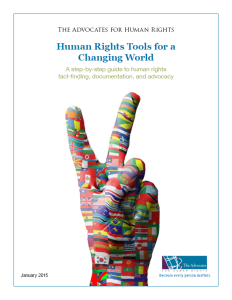
Human Rights Tools for a Changing World

January 30, 2015

Without necessarily endorsing the Manual “Human Rights Tools for a Changing World ” as the only or best guide, there is a lot of useful material in here:

Jennifer Prestholdt's avatarThe Human Rights Warrior

Change the World front cover

Originally published on The Advocates Post

The Advocates for Human Rights’ Executive Director Robin Phillips is in London today speaking about The Advocates’ human rights monitoring work at the International Bar Association’s colloquium on “Rule of Law Fact-Finding by NGOs: Monitoring Standards and Maximising Impact”.

This international convening to explore the standards and impact of non-governmental organization (NGO) fact-finding on human rights violations is also an appropriate setting to introduce The Advocates’ latest publication:

        Human Rights Tools for a Changing World:  A Step-by-Step Guide to Human Rights Fact-finding, Documentation and Advocacy 

Human rights advocacy takes many forms, and human rights activists can be found in every corner of the world.  Human Rights Tools for a Changing World was created with the express purpose of providing advocates of all backgrounds and experiences a full range of tools and resources to promote human rights in a changing…

View original post 604 more words

Call for Nominations Right Livelihood Award until 1 March

January 30, 2015

Right Livelihood logoNominations for the Right Livelihood Award 2015 can now be submitted. For more information on the Award see: http://www.brandsaviors.com/thedigest/award/right-livelihood-awards.

To nominate before 1 March go to:  http://www.rightlivelihood.org/guidelines_english.html