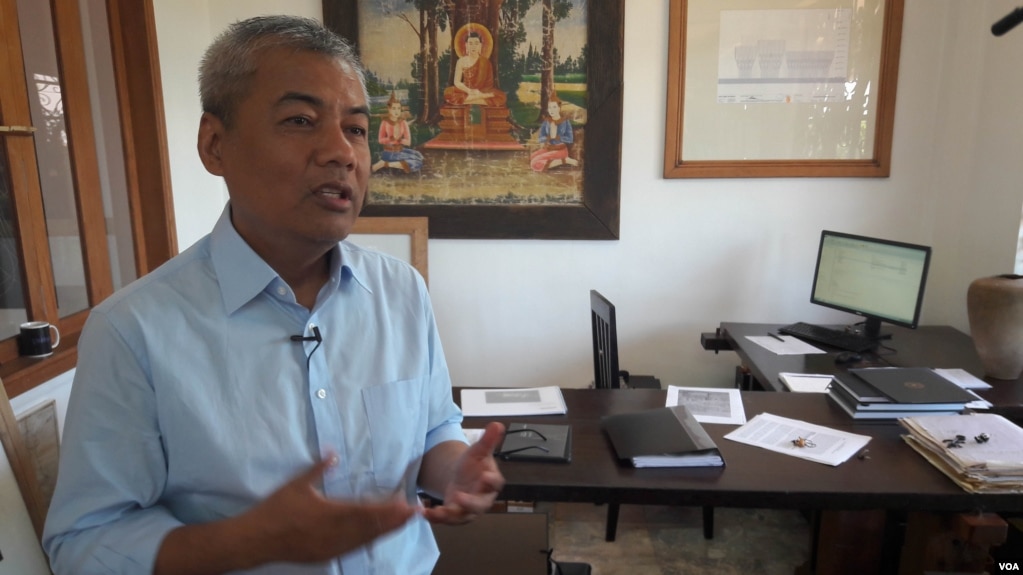
Chhang Youk, director of DC-Cam, talks to VOA Khmer about national reconciliation at his office in Phnom Penh, Cambodia, August 08th, 2016. (Neou Vannarin/VOA Khmer)
Chhang was a survivor of the Khmer Rouge regime. He fled to the United States as a refugee, but memories of the suffering he endured brought him back to his homeland in the early 1990s. He founded DC-Cam and has led the organization since 1995, creating a national genocide education program. Nushin Sarkarati, a senior attorney at CJA, said that without Chhang’s dedication there would be little justice for the victims and survivors.
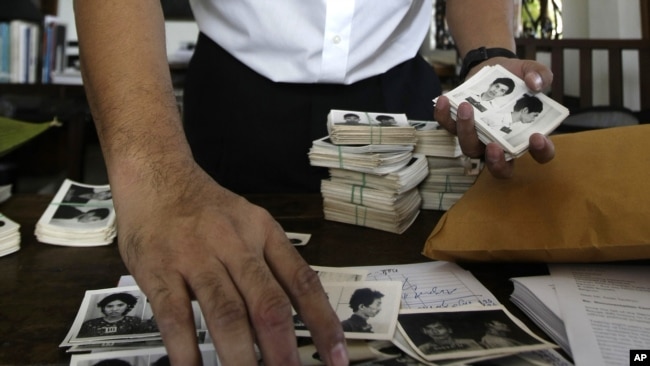
In this photo taken on Aug. 20, 2012, Director of Documentation Center of Cambodia, Youk Chhang arranges photos, a part of about a thousand of newly-discovered photo collection of detainees at the former Khmer Rouge main prison S-21, in his office in Phnom Penh, Cambodia.
Beth Van Schaack, a Stanford law professor who advises DC-Cam, said the group’s orientation towards victims made Chhang a natural choice for the award. “What CJA really admires about DC-Cam is it also has a very victim centered approach, working-hard to help Cambodian victims, experience justice before the ECCC [Extraordinary Chambers in the Courts of Cambodia] and DC-Cam has become in many ways a model for other documentation centers around the world that are collecting information that can be submitted to justice processes where human rights are concerned,” she said.
Nate Thayer, a journalist who has reported on Cambodia for some three decades, said without Chhang’s work, the Khmer Rouge perpetrators would have gotten away with their crimes. “Youk Chhang was a one-man army fighting for justice for those who suffered in Cambodia and his personal passion and devotion bringing those who responsible for mass murder to justice, to face the music, to answer for their crime.”
Peter Maguire, a law professor and an author of “Facing Death in Cambodia,” called Chhang a “Cambodian national treasure” whose efforts bring more truth and reconciliation to the Cambodian people than the combined efforts of the United Nations and ECCC.
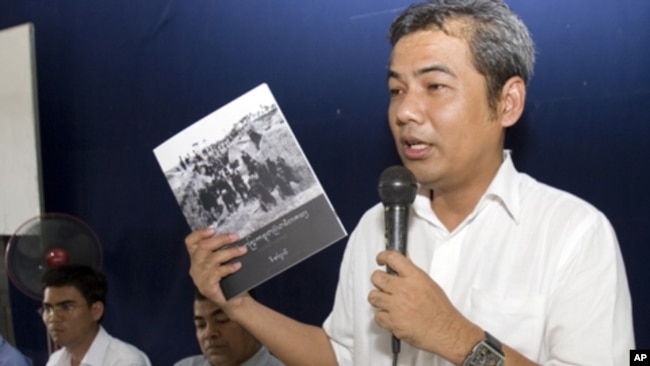
Youk Chhang, a leading Cambodian genocide researcher, shows a copy of the Cambodian version of a Khmer Rouge history textbook to teachers in Takeo province, July 3, 2012.
Neth Pheaktra, ECCC spokesman, told VOA Khmer that DC-Cam deserved the award as it had uncovered valuable evidence that could be used at the court. “The work that DC-Cam has done helps the ECCC save time in finding evidence by ourselves, and it shows us the way, brings us information as well as some historical documents we needed for the trials.”
Chhang is currently working on developing the Sleuk Rith Institute, a permanent hub for genocide studies in Asia based in Phnom Penh.
On 4 April 2017 Nils Muižnieks, the Council of Europe’s Human Rights Commissioner, wrote about “The Shrinking Space for Human Rights Organisations“. The new EU ‘alert site I referred to yesterday [see: https://humanrightsdefenders.blog/2017/04/03/protectdefenders-eu-launches-new-alert-website-but-no-single-stop-yet/] showed in 2016 some 86 reported violations in the European (and Central Asian) region, mostly detention and judicial harassment. Also the recent CIVICUS findings of the narrowing space for civil society points in this direction. An example could be Hungary as illustrated by reports of Human Rights Watch (2016), Human Rights First (2017) and Amnesty International (2016/17); the issue of academic freedom is not directly related but part of the restrictive trend [see links below].
On 30 March ProtectDefenders.eu, the European Union Human Rights Defenders mechanism implemented by international civil society, launched its Index of attacks and threats against Human Rights Defenders, featuring a monitoring of alerts concerning violations perpetrated against individuals promoting Human Rights around the globe. The Index of attacks and threats against Human Rights Defenders is available on: ProtectDefenders.eu website.
It could be a most useful tool as quite a few key information providers coöperate (but not AI, HRW?). However, to be really useful as a single stop for this kind of information it is paramount that the site is as complete as possible (otherwise one would still have to go back to the websites of the individual organizations cooperating in the project). This is apparently not yet the case (or maybe definitions still differ from NGO to NGO). Front Linee.g. in its 2017 report (covering 2016) states that 281 HRDs were killed around the world [https://hrdmemorial.org/front-line-defenders-017-annual-report-highlights-killing-of-281-hrds-in-2016/], while a search on the new site shows only 39 killed in 2016 [https://protectdefenders.eu/en/stats.php?yearFilter=2016®ionFilter=&countryFilter=#mf]. That is 242 killings missing (without checking the annual reports of other cooperating partners) ! This issue is important as the announcement claims that the site wants to become “a source of reliable and updated information that should allow the identification of worrying trends and encourage the coordination of adequate responses by decision-makers and authorities to counter the violations faced by defenders”. Read the rest of this entry »
The Jury has selected human rights defenders from Ukraine, Nicaragua, Vietnam, South Africa and Kuwait as finalists for the 2017 Front Line Defenders Award for Human Rights Defenders at Risk:
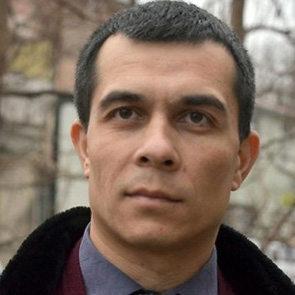
Emil Kurbedinov, Crimea/Ukraine
Emil Kurbedinov is a Crimean Tatar and human rights lawyer. Since the occupation of Crimea by the Russian Federation, Emil has been defending the persecuted Crimean Tatar minority, civil society activists and journalists. He also provides emergency response and documentation of rights violations during raids and searches of activists’ homes. In January 2017, masked representatives from Crimea’s Centre for Counteracting Extremism detained Emil and took him to a local directorate of the Russian Federal Security Service (FSB) for interrogation. A district court found him guilty of “propagandizing for extremist organisations” and sentenced him to ten days in detention.
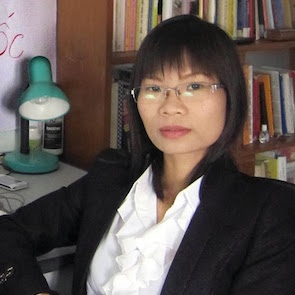
Pham Thanh Nghien, Vietnam
Vietnamese blogger Pham Thanh Nghien spent four years in prison for her work publicising violations against and defending the rights of relatives of fishermen killed by Chinese patrols. Following her release, she was kept under house arrest, during which time she spearheaded numerous human rights campaigns and co-founded the renowned Vietnamese Bloggers’ Network. Nghien has had her home raided, been blocked from attending medical appointments, had a padlock placed on her door from the outside, and been refused a marriage certificate. Nghien has also survived numerous physical assaults aimed at stopping her powerful, peaceful work uncovering and publicising human rights violations in Vietnam.
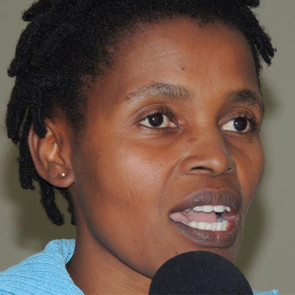
Nonhle Mbuthuma, South Africa
Nonhle Mbuthuma has persisted in her struggle for land and environmental rights in South Africa’s Eastern Cape despite assassination attempts, ongoing death threats and the murder of her colleague. She is a founder and current member of the Executive Committee of the Amadiba Crisis Committee, formed to unite community members in five villages of the Amadiba Tribal Authority region opposing destructive mining projects. In July 2016, Nonhle and other activists successfully forced the biggest shareholder in a titanium mining project to withdraw, but threats to activists continue as the community now fears the project will continue with funding from local “front” companies.
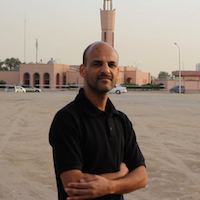
Abdulhakim Al Fadhli, Kuwait
Abdulhakim Al Fadhli is currently imprisoned for his peaceful activism on behalf of Kuwait‘s stateless Bedoon and other minority communities in Kuwait. The term Bedoon, meaning “without” in Arabic, refers to the community of stateless persons, native to Kuwait, who are prohibited from obtaining any official state documents including, but not limited to, birth, death and marriage certificates. Abdulhakim is currently serving a one-year prison sentence and faces deportation upon release. Throughout his imprisonment, he has protested and staged hunger strikes against the inhumane and unsanitary conditions in the Anbar 4 prison facility, where he has also been subjected to solitary confinement. [see also https://humanrightsdefenders.blog/2014/02/27/car-chase-in-kuwait-bedoun-human-rights-defender-the-target/]
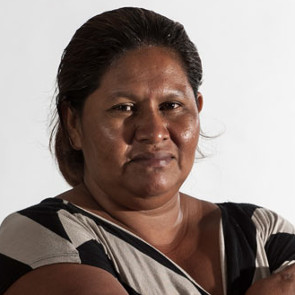
Francisca Ramírez Torres, Nicaragua
Human rights defender Francisca Ramírez Torres‘ children were attacked in attempt to stop her powerful work advocating against a destructive inter-oceanic canal in Nicaragua. Francisca is the coordinator of the Council for the Defence of Land, Lake and Sovereignty, which educates communities on their rights, campaigns for the repeal of laws allowing land-grabbing. The proposed canal would displace thousands of small farmers and indigenous peoples, without respecting their right to free, prior and informed consent. Francisca has been detained, harassed, and had her home and family attacked for her peaceful resistance to this destructive canal project.
The annual Front Line Defenders Award seeks to focus international attention on the human rights defender’s work, thus contributing to the recipient’s personal security, and a cash prize of €15,000 is awarded to the Award recipient and his/her organisation in an effort to support the continuation of this important work.
After my post on Civitas Maxima[https://humanrightsdefenders.blog/2017/03/21/new-magazine-global-geneva-puts-civitas-maxima-in-the-limelight/] I feel that I should complete the picture with a reference to “Make Way for Justice #3” which argues that universal jurisdiction has gathered unprecedented momentum in 2016. In this annual report, ECCHR and its partners FIBGAR, FIDH, REDRESS and TRIAL Internationallook back on its application through 47 recent cases. Five years of conflict, hundreds of thousands of dead. In Syria, large-scale war crimes are committed in all impunity. Effective prosecution has been repeatedly impeded at the international level, yet justice has found a way forward: universal jurisdiction. Thanks to this principle, States can prosecute criminals regardless of their nationality or where the crime was committed. The interest of such procedures for lawless regions is obvious.
2016 alone, five States have brought charges for alleged crimes in Syria. Investigations are ongoing in three others. For victims, these proceedings may be their only chance to obtain justice. Universal jurisdiction has proved a significant tool against impunity in Syria, but it also applies to many more situations: Rwanda, Nepal, Guatemala and Iraq, to name but a few.
To illustrate this breadth, ECCHR, FIBGAR, FIDH, REDRESS and TRIAL International released their annual report on universal jurisdiction, Make way for Justice #3. In 2016 alone, 13 States have made use of this principle in 47 cases – an unprecedented success.
Middle East Eye reported on 31 March 2017 that the Emirates (UAE) had sentenced human rights defender Nasser Bin Ghaith to 10 years for ‘offensive online posts‘ (i.e. that criticised Egypt).
Dr Nasser bin Ghaith speaking at a conference (ADHRB)
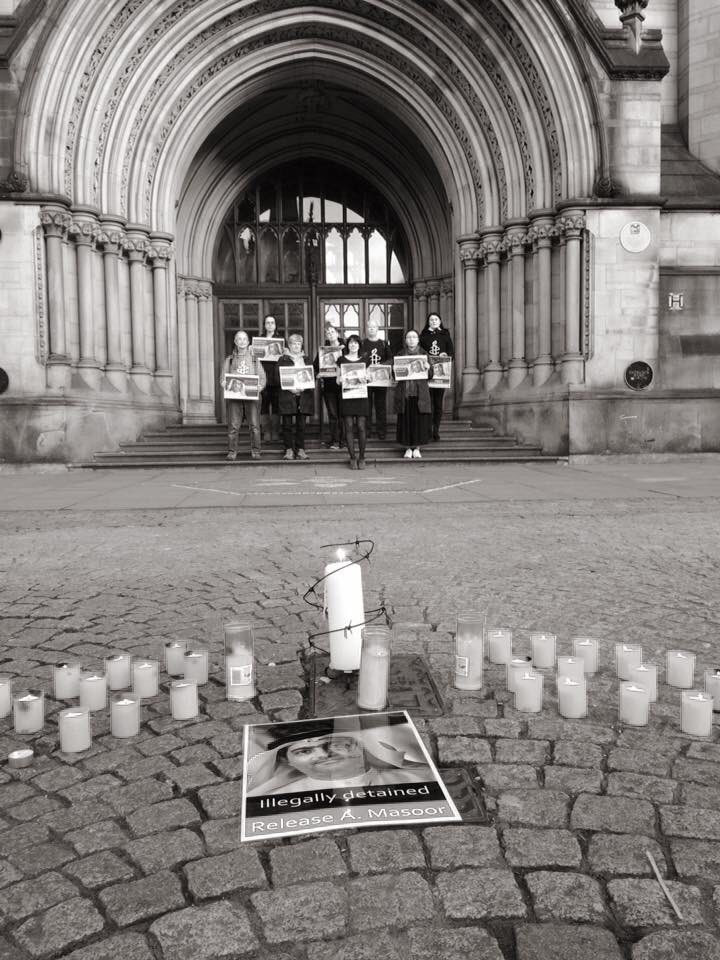
After all the attention on the recent arrest of MEA Laureate, Ahmed Mansoor [https://humanrightsdefenders.blog/tag/ahmed-mansoor/], it is good to point out that he is not the only one being silenced in the UAE. On Wednesday Nasser Bin Ghaith was sentenced to 10 years in jail. Ghaith told the court he had been beaten and deprived of sleep for up to a week at a time by prison guards. The court did not specify which social media posts the charge related to or what they said. The authorities said he had published “photos and articles that are offensive to the state’s symbols and values, its internal and foreign policies and its relations with an Arab state,” which is understood to refer to Egypt. Ghaith is an Emirati economist who has lectured at the Abu Dhabi campus of the Paris-based Sorbonne University. He also worked as an economic and legal consultant to the UAE army.”By imposing this ludicrous sentence in response to his peaceful tweets, the authorities have left no room for doubt: those who dare to speak their minds freely in the UAE today risk grave punishment,” declared Lynn Maalouf, deputy director for research at Amnesty International. Amnesty called Ghaith “a prisoner of conscience, imprisoned for the peaceful expression of his conscientiously held beliefs.” See also: https://humanrightsdefenders.blog/2016/05/18/uae-emirates-human-rights-defender-nasser-bin-ghaith-ngos-censorship/
In view of the link between Manchester and UAE airlines (Emirates and Ethiad) it is specially interesting to note that AI Manchester has joined the campaign to free Ahmed Mansoor:
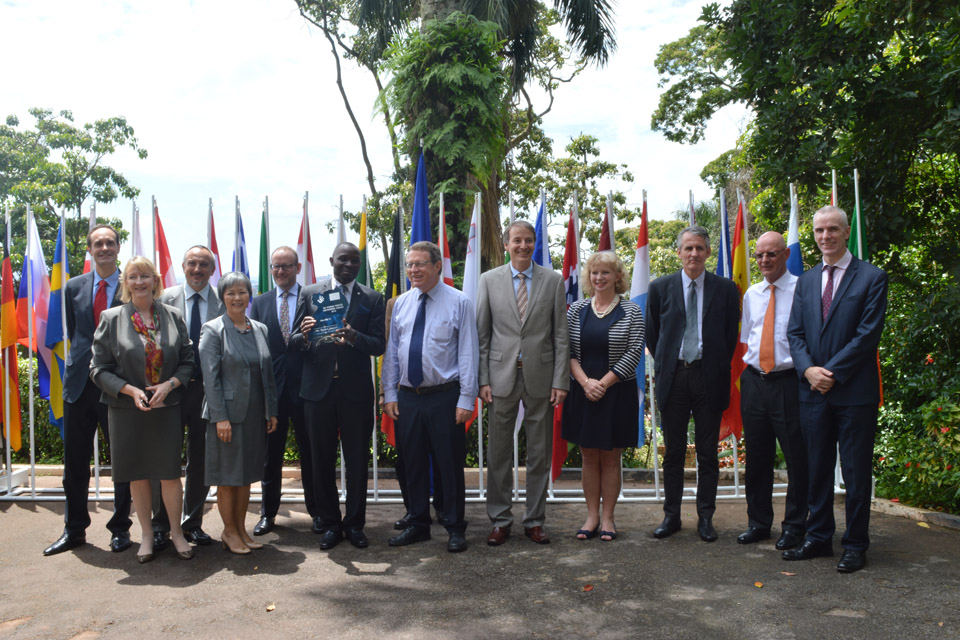
Interesting example of how governments (here the EU) can work together to protect human rights defenders in a specific country (here Uganda). Since a few years there is an annual EU HRD Award to recognise and honour the achievements of an individual Human Rights Defender active in Uganda.
EU Heads of mission with the 2016 EU Human Rights Defender Award recipient, Robert Sempala in May 2016.
Now the British High Commission in Kampala, together with other European Union member states represented in Uganda, is inviting nominations for the 2017 EU Human Rights Defenders Award. The broad range of activities carried out by HRDs can include the following:
documenting human rights violations;
seeking remedies for victims of human rights violations through the provision of legal, psychological, medical or other support;
combating the culture of impunity which can hide systematic and repeated breaches of human rights and fundamental freedoms;
mainstreaming a human rights culture, and transmitting information about HRDs at the national, regional and international levels;
advocacy for the respect of human rights.
Nominations should be sent by e-mail to: Kampala.Reception@fco.gov.uk. Nominations should be a maximum of one page in length, and should use the following nomination form (MS Word Document, 51.5KB). The deadline for nominations is 14 April 2017. The winner will be announced on 25 May 2017 at a ceremony hosted by the Embassy of the Kingdom of the Netherlands in Uganda.
The press statement by the UN (see below) explains that there was quite a bit of wrangling on wording, but in the end the draft resolution (A/HRC/34/L.5) on the mandate of the Special Rapporteur on the situation of human rights defenders, Michael Forst, was adopted without a vote as orally revised, in the same terms as provided for by the Human Rights Council in its resolution 16/5. It urges again all States to cooperate with and assist the Special Rapporteur in the performance of his tasks, to provide all information and to respond to the communications transmitted to them by the Special Rapporteur without undue delay; and calls upon States to give serious consideration to responding favourably to the requests of the Special Rapporteur to visit their countries.
(here the detailed report on the failed efforts – mainly by Russia and China – to weaken the text:) Read the rest of this entry »





 Hans Thoolen on Human Rights Defenders and their awards