Archive for the 'human rights' Category

Profile of human rights defender Linda RM Baumann from Namibia

May 26, 2019

ISHR published on 25 Octpber 2018 this interview with Namibian women’s rights defender Linda RM BaumannWe carry out the universal responsibility to insure that all people are protected” affirms Linda RM Baumann in her interview with ISHR. Linda is strategic coordinator for Namibia’s Diverse Women Association (NDWA) and she advocates for LBT’s women rights.

Profile of Sri Lankan Marini de Livera: a lawyer and a ‘Woman Of Courage’

May 23, 2019

REBECCA ELLIS published a profile of Marini de Livera under the title “She’s A Lawyer … A Thespian … And Now A State Department ‘Woman Of Courage‘”

Marini de Livera’s plays are not for the faint of heart. In her home country of Sri Lanka, the pro bono lawyer has found that crimes against women and children often take place behind closed doors — in homes, orphanages and schools. With her traveling theater group, de Livera seeks to shed light on the human rights abuses in her country by putting the violence on stage, front and center. “There are beautiful laws in the law books,” she says. “But when I went out to the slums, to the rural areas, to conflict-ridden areas, I found what is in the law books is not a practical reality.”

A pro bono attorney with a degree in speech and drama from Trinity College London, de Livera has spent her career using theater to ensure that the lofty lessons she learned in law school can be used to assist Sri Lankans who are unlikely to ever see an attorney. Her dedication to helping women and child victims of crime has made her one of the 10 recipients of the 2019 International Women of Courage award [see https://humanrightsdefenders.blog/2019/03/11/international-women-of-courage-awards-2019-given-out-at-the-us-state-department/ and https://humanrightsdefenders.blog/2019/03/12/one-journalist-who-did-not-get-the-women-of-courage-award-but-almost/].

De Livera has served as the chairperson of Sri Lanka’s child welfare agency, the National Child Protection Authority, and now runs Sisters at Law, an advocacy group for impoverished women and children. She spoke with NPR about her creative approach to addressing human rights in her country, and why she’s focusing on using her theater training to better the situation of children in Sri Lanka’s orphanages.

What are some of the legal issues that women and children in Sri Lanka need help with?

Women and children are denied justice if they’re uneducated, and if they live in rural areas. They don’t enjoy the same basket of human rights that privileged people have because they don’t have access to lawyers.

What needs to happen to accomplish that?

There has to be legal literacy. These women and children have to know what the laws in the country are and what their human rights are. If they are educated about their rights, they can go to court and demand them.

You’ve often used theater to promote this legal literacy in Sri Lanka. Can you give me an example of how this works?

One of my favorite plays I put on was about corporal punishment. I went to a Catholic school where a priest was hitting boys every day. I explained to the school that there are different forms of violence – cultural violence, psychological violence, physical violence. Then I asked the boys to make a play about their experiences with violence. And one of the boys reenacted what the priest had done to him. [It helped] these boys find an outlet to say, “We don’t want to kneel down when we come late to school. We don’t want to be beaten by a cane.”

How did you come to see theater as a way to educate the public on their legal rights?

I had been a lecturer in law [in Sri Lanka], and one of the things I had to teach was U.K. law principles. And the students were bored to death. So I said, these are the books, you read, then you tell me what the rule of law and separation of powers are through a performance. I realized if I could use this in the classroom, why not in the village to simplify the law?

What is your theater group working on now?

I’m working on a street theater [program] to create awareness for parents [and encourage them] not to send their children to orphanages. I’m going to show that family is the place for the child. In Sri Lanka, we have a lot of “social orphans” where they have both parents, but the children are suffering in orphanages.

Past reports have found that over 80 percent of the 20,000 children in Sri Lanka’s child-care institutions, including orphanages, have at least one parent. These parents are often unable to provide for their children or the child has a disability and requires extra care. And sometimes the children are sent to such an institution because of a criminal offense.

Orphanages should be the last resort. So I’m promoting alternative care. Some of the mothers are capable of looking after their children, but they’ve handed over their child to an overcrowded orphanage. I’m thinking of giving parenting skills training to these mothers and economically empowering them, finding them a nice home and settling the children with them.

You mentioned earlier that this prize is the first time in your life you felt appreciated for “walking in the opposite direction” from others in the law profession. Do you have hopes other attorneys will follow in your path?

I’m very unhappy to say each time I go to court people come up to me like a swarm of flies and say, “We don’t have a lawyer to appear on behalf of us.” I want to take all the country’s young attorneys and train them to be another Marini – to clone myself. Because I have to hand this on to the younger generation.

https://www.npr.org/sections/goatsandsoda/2019/03/08/701212104/shes-a-lawyer-a-thespian-and-now-a-state-department-woman-of-courage

Plea to see labour rights defenders as human rights defenders

May 21, 2019

Appropriately on  Labour Day, 1 May 2019, Ana Zbona and Sanyu Awori (at the Business & Human Rights Resource Centre). wrote in Open Global Rights “When space closes for labour rights defenders, the situation is far worse for those at the margins. Labour rights are human rights and must be protected“.

Photo: SolidarityCentre/Flickr


…..Several recent examples of human rights movements that have been led and supported by labour rights groups include: coalitions to rebuild democracy in Honduras after a coup; the mobilizing of workers in Tunisia, Egypt and Bahrain during the Arab uprisings; and the pro-democracy movement in Zimbabwe, led by the country’s labour federation…

Distinctions are often made between labour rights defenders and human rights defenders, but as former UN Special Rapporteur on Freedom of Assembly and Association Maina Kiai expressed: these distinctions are artificial. Labour rights are human rights, and any person or organisation defending them is a human rights defender.. As Sharan Burrow, the Secretary General of the ITUC, put it: “Workers and their unions are the defenders of rights and freedoms.” We must be vigilant to any distinctions that try to separate our struggles”.

Labour rights defenders regularly experience violence and restrictions on their rights in various ways, including clamp downs on unions where governments and employers obstruct them from functioning freely and independently, laws that limit collective bargaining, and dismissals. In the past year, the International Trade Union Confederation reported an increase in violence, especially to prevent unionizing, and the safety of trade union leaders remains precarious. In Colombia, 19 trade unionists were killed in 2017; in Cambodia, trade union leaders are criminalized; and in Zimbabwe trade union leaders are regularly harassed by government authorities. With respect to laws that limit labour rights, 81% of countries deny some or all workers the right to collective bargaining and 65% of countries exclude some groups of workers from labour law, such as domestic, agricultural and contract workers, up 5% from 2017. Peaceful protests by workers are often met with heavy handed policy or army responses. In addition, the most common reprisal workers face for speaking up about violations are dismissals, a tactic used by employers to stifle civic action. As one example, over 12,000 garment factory workers in Bangladesh were fired for their protests in December 2018 and January 2019 over wages.

The Business & Human Rights Resource documents attacks against defenders working on corporate accountability, and our database shows that agriculture, food and beverage, and apparel are the most dangerous sectors for labour rights defenders. The most common forms of violence against individual union leaders and workers are arbitrary detentions and lawsuits, followed by intimidation and threats, and killings.

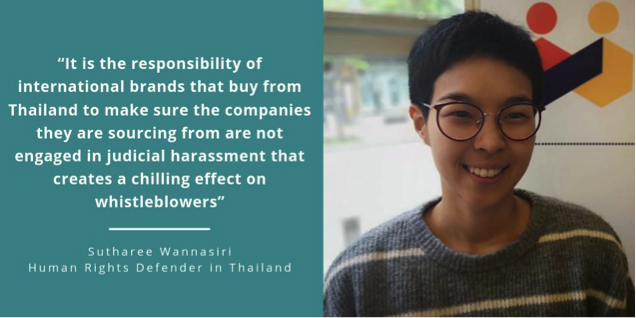
A particularly concerning trend is the use of defamation lawsuits to silence labour rights defenders. As one example, since 2016, Thammakaset Company Limited, a Thai-owned poultry company, filed more than 13 civil and criminal lawsuits against former workers who denounced labour rights violations, as well as against the activists and journalists supporting them. Governments and companies, including international brands, need to ensure such judicial attacks do not happen. As Sutharee Wanasiri, a labour rights defender from Thailand, and one of the people sued by Thammakaset, said: “It is also the responsibility of international brands that buy from Thailand to make sure the companies they are sourcing from are not engaged in judicial harassment that creates a chilling effect on whistle blowers and other defenders. They should establish mechanisms that allow workers and defenders to communicate with the brands directly and ensure that they are protected from any retaliation from suppliers during the investigation. The results should be made public and bring accountability for the abuses.

With long and fragmented supply chains, it is particularly important to ensure that we hear workers’ voices, especially those of the most marginalized at the bottom of economic hierarchies, and guarantee dignified and decent work. This includes people working in the informal economy. Workers and civil society organizations are currently focusing on redefining legal employment terms, and reconsidering union strategy in light of changing labour relations, especially in the gig economy, in which non-conventional workers are not afforded adequate legal protection—either because they do not fall within the definition of a “regular employee” under national laws, or because of gaps in legislation when it comes to regulating new forms of employment. The lack of an applicable legal protection and collectively agreed terms of employment hinders the ability to exercise work-related rights, including the right to organise and collectively bargain.

……..

Labour rights defenders should be seen as critical allies in building equitable and sustainable societies. Several businesses are also beginning to recognise that the protection of human rights defenders and the ability for them to do their work is in their interest, and that an attack on defenders is an attack on responsible business. This is encouraging, as now more than ever we need to be brokering connections and building solidarities across movements and sectors to counter threats to the shared space we all depend upon.

https://www.openglobalrights.org/rising-restrictions-on-labour-rights-threaten-the-heart-of-social-justice/

Possibility to apply for the African School on Internet Governance scholarships

May 21, 2019

Objectives of AfriSIG. AfriSIG’s primary goal is to give Africans from multiple sectors and stakeholder groups the opportunity to gain knowledge that will enable them to participate confidently and effectively in national, regional and global internet governance processes and debates. AfriSIG seeks also to give fellows the opportunity to participate actively at the AfIGF as speakers, moderators, and rapporteurs. The dates and location of this year’s AfIGF are still to be confirmed.

Curriculum

The School will run throughout six days, and will be structured to include intensive learning and knowledge sharing that covers: An overview of internet governance concepts, issues and institutions; Internet architecture, infrastructure, standards and protocols and management of internet names and numbers; Internet governance and social issues: gender, human rights and development; Cybersecurity, multistakeholder approaches and emerging issues in internet governance such as algorithms and the “internet of things”; The highlight of the school is a practicum in which participants have to tackle an actual internet-related policy challenge and come up with an agreed solution or statement.

Eligibility

The School will accept applications from a wide range of professionals including human rights defenders and NGO leaders.

Costs and Scholarships

Applicants can apply for a scholarship to attend the school. However, given the limited number of scholarships, self-funded and sponsored applicants are encouraged to apply. The full course fee, which covers accommodation, meals, course material, and tuition, is USD 2,000. This excludes travel. Scholarships will cover air travel, shared accommodation and meal costs for the duration of the School. Successful applicants have the option of staying in a single room, but they would need to cover the additional cost themselves. The deadline for applications is Saturday, 1 June 2019.

For more information, visit the AfriSIG website

To apply please complete the form here

Apply for the African School on Internet Governance scholarships

Profile of Alfred Brownell, Liberian human rights defender for more than 20 years

May 20, 2019

Under the title “This Liberian lawyer has withstood presidents, multinationals and militias” Front Page Africa on Line published on 3 May 2019 an extensive profile of Alfred Brownell.

Twenty-two years ago Alfred Brownell could see a problem. The government of his country, Liberia, was awarding contracts for the exploitation of natural resources without consulting local communities; forest and mineral resources were being taken away with no questions asked. “It was at a time when a very notorious company called OTC and many other companies were cutting down the forest for timber and no benefit was going back to the people,” Brownell says.

Then a law student in the capital, Monrovia, Brownell challenged President Charles Taylor and his government on the operations of OTC – the Oriental Timber Company. The company was later found to be involved in arms smuggling, Taylor is in prison for war crimes and crimes against humanity – and Alfred Brownell has just been awarded the African Goldman Environmental Prize for 2019 at a ceremony in San Francisco. see: https://humanrightsdefenders.blog/2019/05/13/winners-of-the-2019-goldman-environmental-prize/]. Brownell’s organisation, Green Advocates, has become a household name in Liberia as a champion of customary rights to land and natural resources for indigenous communities. He is helping thousands of people around the country to fight multinational companies and regain their rights.

Sowing seeds

In 2003 when the war to oust Taylor was raging in Monrovia, Brownell had just graduated with a degree in Environmental Law from Tulane Law School in New Orleans, Louisiana, the previous year. Green Advocates was still an idea and Brownell had no money – only a vision.. The Fund for Global Human Rights gave Green Advocates its first seed money in 2003 of $10,000 after Brownell returned to Liberia following the ouster of Taylor and Green Advocates began operations from a tiny office in Monrovia. “We did not have a bank account; we were not a formal organisation,” recalls Brownell.

“The Fund for Global Human Rights had a lot of confidence in me. They awarded me the grant even without a formal structure in place.” John Kabia works for The Fund for Global Human Rights as programme officer for thematic initiatives. He has worked closely with Green Advocates over the years and says that the lack of a track record meant that the Fund was taking a risk, but it was a risk worth taking. “We feel at the Fund that our very reason for being is taking those smart risks, because that is the only way you can identify and support new and emerging actors and new ideas,” he says.

He says it is convenient for international donor organisations to support groups they already know. The threshold for approving support is set very high, making it difficult for small and emerging groups like Green Advocates to gain recognition and support to advance their work. However, seed funding can provide an organisation the necessary credibility and opportunities it needs to attract support from other funders and partners. “Often times if people are given the opportunity and investment to turn their ideas into reality, you’d be amazed by what they can do. I think the example is Alfred and Green Advocates,” he says. “Seeing how Alfred and the communities have mobilised and successfully pushed for major policy and legal reform is impressive. I think that type of smart risk-taking is what many other donors and development partners should be taking on.”

But for such risks to be sustainable, Kabia noted that it is critical for seed funding not to be a one-off, short-term support. “Change doesn’t happen overnight,” he says. “Long-term and capacity-building support needs to accompany an initial seed grant in order for promising organisations to thrive and reach their full potential.”

Big concessions, big government

Back in 2003, Liberia was just emerging from conflict and Brownell knew that the country lacked expertise on land and natural resources governance.

“It was sad to see a country with a natural-resource-endowed economy [where] its lawyers were not learning anything about natural resources or environmental laws,” says Brownell. “I said we have to use the law to help our people.”

“When I graduated, we worked to set up Green Advocates to provide support to the poor, marginalised, vulnerable, who had no voice. To focus our effort on creating policies to protect people through advocacy and campaigning for regulations.”

In 2005, Brownell partnered with over a dozen other local organisations and took on the transitional government of Liberia headed by the late Charles Gyude Bryant. It was the first post-war challenge to the government of Liberia by rights groups. The government had awarded contracts to a Chinese company for the shipment of iron ore from the port of Buchanan against the wishes of the citizens. A subpoena was issued by the Supreme Court of Liberia to stop it, but the government defied the court and shipped the ore anyway.

After successfully challenging a government contract to ship iron ore from the port of Buchanan against the wishes of local people, Brownell and Green Advocates began to expand their work. Both the government and the companies that profited from concessions to exploit Liberia’s natural resources began to see them as a threat. Green Advocates was involved in massive public sensitisation about land rights across the country, and started taking on companies as huge as the US tyre and rubber multinational Firestone, the Malaysian palm oil giant Sime Darby and Golden Agri-Resources, the world’s largest oil palm conglomerate – not to mention the government of Liberia itself.

One of the biggest cases involved Firestone, Liberia’s largest and oldest rubber concession-holder. For 75 years it had dumped all its waste into the Farmington River in the community of Owens Grove. That blatantly violated Liberian laws prohibiting the discharge of waste into the water system. Green Advocates filed complaints that led Firestone to create a waste treatment facility after almost a century of operations. The organisation also partnered with other rights groups in a US lawsuit that accused Firestone of using child labour. After six years of litigation Firestone won that case, but significantly the judge ruled that companies can be sued in the US for human rights abuses outside the country. In addition, Firestone was forced to introduce reforms that addressed the root causes of child labour in its plantation. This included reducing the quotas for workers, to prevent them having to bring their children to work, and building more schools within its concession area.

Doing it for the people

By this time Brownell was at odds with Ellen Johnson Sirleaf, who had become president in 2006. As Africa’s first elected female head of state she had won admirers around the world; in 2011 she shared the Nobel Peace Prize. But her international eulogists turned a blind eye to some dubious actions at home: by 2010 her government had awarded massive amounts of land to agriculture companies through a ‘backdoor’ scheme, despite agreeing to landmark land reform.

“You’re talking about 300,000 hectares of forest land without consulting the people” says Brownell. “There was no mapping or surveying to know where the land was, who grew what on the land or what the cultural impact was on the people.”

Brownell says that Green Advocates’ first grant from the Fund for Global Human Rights, and the organisation’s ongoing support over 16 years, has given other funders confidence to provide revenue that has supported other projects. For instance, Green Advocates has also gone on to establish the Alliance for Rural Democracy and the Natural Resources Women Platform, and was key to the formation of the Mano River Union Civil Society Natural Resource Rights and Governance Platform, which now covers eight west African countries.

The fight gets real

As Brownell was fighting to help communities understand their rights to the land and push companies to reform and make policies that would benefit the local population in the concession areas, he also faced a battle of his own. A battle for personal safety.

Brownell and his staff came near death on several occasions while on their many trips in rural areas. On one occasion, in Tarjuwon, Sinoe County, people had complained that Golden Veroleum Liberia had decided to construct an oil mill on a site that was used for annual religious worship. They resisted and Green Advocates was called in to help. Brownell and his colleagues went to Sinoe to see what was happening. On their way to the area, the team came under attack from militia that Brownell believes were working for the company.

The men, dressed in company security uniforms, had set up a roadblock. They were ex-combatants armed with machetes and sticks, according to Brownell. Brownell and his colleagues resigned themselves to death – until the intervention of the town chief.

“I had given up and was just praying to God. I had no idea how we were going to get out of there because we were completely surrounded by these men,” he says.

“We knew that the attack against us in Tarjuwon was not just the company. We think the government was also very complicit in those attacks to try to eliminate us,” he says. Brownell says the Liberian government has been behind several attacks, and felt his organisation was standing in the way of its development objectives. The government did not take kindly to Green Advocates trying to enlighten people on their right to the land and natural resources.

Francis Colee is head of programmes at Green Advocates and has worked on several court cases on land rights issues brought against the Liberian government. He says the government sometimes brands the organisation as anti-development, but its focus is to ensure good investment that protects the rights of people and not alter their livelihood.

“We have argued that it is good that we have investment, but we have also argued that we need to ensure a delicate balance between the protection of human rights, the environment and the investment,” says Colee.

“In most cases, what we have seen is that the project-targeted communities end up becoming worse off than they were before the coming of the investment.”

In 2016, the government accused Brownell of refusing to help give testimony in the trial of the Dutch businessman Guus Kouwenhoven, the former head of the Oriental Timber Corporation – Brownell’s first case. The Green Advocates office in Monrovia was raided and ransacked by plain-clothes police officers. Some of the staff were arrested. The police even went to his home and arrested his uncle when Brownell himself could not be found.

“It was a ploy to get me. They use the criminal justice system to threaten people,” he says.

“They made Liberia very unsafe for me when they started threatening me and so I was forced to flee with my family to come [to the US]. President Sirleaf has directly threatened me, in my face, ‘I will charge you with sedition’.”

In a strongly worded letter to the president of Liberia, the Observatory for the Protection of Human Rights Defenders condemned the attacks on Brownell, and through the support of the Fund for Global Human Rights and other groups he fled the country with his wife and children. He now serves as an associate research professor at Northeastern University School of Law in Boston. Green Advocates’ work in Liberia continues, even with Brownell in the US, through support from a team of dedicated local activists and Green Advocates staff.

Land rights at last

Despite the challenges, Green Advocates has helped ensure Liberia passed sweeping land reform legislation in 2018. Local communities now have the exclusive right to possess and use land for different purposes, and to lease it.

But there is still a long way to go in terms of actual impact on land rights despite these reforms, says Simpson Snoh, who represents the Alliance for Rural Democracy, a Liberian non-governmental body working closely with Green Advocates. Green Advocates is in the process of taking the message to the people, and helping to translate laws into action.

“After years of securing rights for its community partners,” says Brownell, “Green Advocates is currently exploring options for translating these rights into economic opportunities to address not just the bread-and-butter issues these communities face, but a business and development model that can co-exist with nature.”

Snoh says that with funding, local organisations can move quickly to help communities that are facing serious human rights abuses from multinational companies and governments. This is because community-based groups best understand the needs of the communities more and what the issues are.

Brownell echoes Snoh’s sentiments. He believes that international funders should be able to bet their money on local organisations like Green Advocates, just as The Fund for Global Human Rights did when the organisation was still just an idea. He feels Green Advocates has been able to enlighten the people on their basic human right – the right to own land.

“The government’s perception that there was free land or open spaces where they could give concessions to companies was a complete false assumption. All these years the government had lied,” he says.

“The future of Liberia is never ever going to be with massive foreign investment through transnational corporations coming to Liberia. Liberia’s future comes from its own people.”

This article is part of an editorial partnership with the Fund for Global Human Rights.

This Liberian lawyer has withstood presidents, multinationals and militias


Aachen Peace Prize to Ukrainian journalist Kotsaba severely contested

May 19, 2019

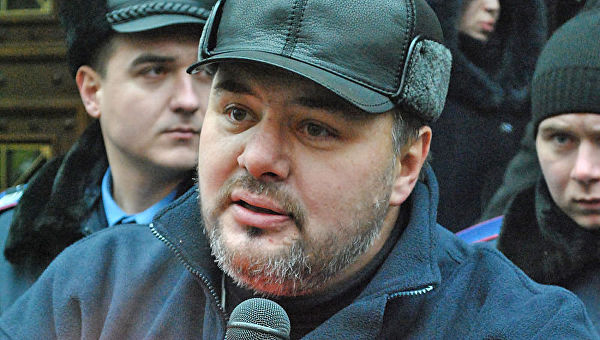
Ruslan Kotsaba Photo Mykola Vasylechko, RIA Novosti

This piece express grave doubt on the decision to award the 2019 Aachen Peace Prize to Ukrainian journalist and  blogger Ruslan Kotsaba because of a shocking anti-Semitic video posted by Kotsaba in 2011. People interested should judge for themselves, so here the full article:

The video certainly contains deeply offensive hate speech, yet it is by no means the only reason why the choice of Kotsaba seems bafflingly inappropriate. The award might possibly have seemed a little more understandable had it been given back in 2015, shortly after Kotsaba was arrested on ‘state treason’ charges.  His claim to a peace prize would still have been doubted by those familiar with his highly misleading reports on the war in Donbas, however his unwarranted prosecution and 14 months’ imprisonment  were over a video opposing mobilization.

It seems he was first nominated in 2015, but was not chosen.  In 2019, however, the Aachen Peace Prize general assembly decided that Kotsaba was an appropriate laureate for a prize given to a person or group “who campaigns for peace and a civic resolution of conflict”.

According to Lea Heuser, a member of the Peace Prize Executive Committee, Kotsaba was nominated by one of its members “who is familiar with the situation in Ukraine”.  This was almost certainly Andrej Hunko, a Bundestag deputy from the Linke Party, known for his ‘humanitarian mission’ to the self-proclaimed  ‘Donetsk people’s republic’ and very one-sided statements about the conflict in Donbas. Hunko also campaigns actively for closer German relations with Russia and for recognition of Crimea as ‘Russian’.

Heuser explained that Kotsaba was first nominated on the basis of his claim to have become a pacifist after what he saw at the front (in Donbas).  She asserts that “he does not take one side in the conflict and advocates for concessions and dialogue”. It is also claimed on the peace prize’s website that Kotsaba “unlike most of his colleagues tried to objectively cover events in the east of Ukraine which he has called “a civic war and fratricidal”.

This has been the standard line taken by Hunko and other politicians, from various European far-right or left-wing parties, when visiting the so-called Donbas ‘republics’ or Russian-occupied Crimea.   Such visits are invariably used by their official hosts and by Russia as propaganda.  This is unsurprising since their guests can be relied upon to only criticize the Ukrainian Armed Forces and Kyiv.

While Kotsaba’s position is more complex, it would be very hard to describe his presentation of events in Donbas, Odesa, Crimea or in Ukraine in general as objective.

In some cases, he pushes toxic lies which are known to have prompted young men to go and fight in Donbas.  He invariably follows Russia’s lead in claiming that the people who died in the Trade Union building fire in Odesa on 2 May 2014 were deliberately burned to death by “Ukrainian radicals”.  Russia has repeatedly demonstrated that it is aware of the substantial research refuting such claims carried out by the 2 May Group, a respected bipartisan initiative formed by journalists, scientists and civic activists, and presented here in RussianEnglish and in German, as well as by the Council of Europe’s International Advisory Panel.  It is impossible to believe that Kotsaba is not aware that he is presenting a story that has been debunked.

Kotsaba’s coverage of the war in Donbas is equally one-sided.  He is certainly entitled to his own opinion on the conflict, however his claim that he is objectively presenting two sides of the story is simply untrue.

One of the most contentious areas is, of course, Kotsaba’s repeated assertion (for example, here)  that the conflict in Donbas is a civil war, and denial of Russia’s and Russians’ active role. Speaking on the Russian state-controlled Rossiya 24 channel on 27 June 2014,  Kotsaba claimed that he had not seen any Chechen fighters and assumes there are none. He does stress that he personally did not see any and this cannot be either proven nor refuted.  The problem is that, by the time he was saying this, there was ample video footage and witness accounts making it quite clear that there were a suspiciously large number of Chechens and other Russian citizens fighting in this alleged ‘civil war’.  Kotsaba has also chosen to ignore the fact that the war essentially began after heavily armed and trained fighters seized control of Sloviansk on 12 April 2014 under the leadership of (officially) former Russian military intelligence officer Igor Girkin.  He later admitted that his men had provoked the conflict in Donbas.  “The first shots, albeit in the air, were from the rebels, carried out by our unit”.  Girkin and the leader of ‘DPR’ were only hurriedly replaced by Ukrainians after the downing of Malaysian airliner MH17 by a Russian BUK missile on 17 July 2014.

Kotsaba’s claim to Rossiya 24 that he had been invited by a local Luhansk television channel which was trying to follow journalist standards, sounds admirable but deviates seriously from the truth.  The first thing that happened when militants seized control of an area was that all Ukrainian channels were replaced by Russian, or pro-Russian channels.   Later in the interview, Kotsaba was asked why other Ukrainian journalists were not in these areas.  He claimed that this was that they still needed to develop to reach world standards and “tell the truth”.   Although some of the many journalists seized, tortured and / or imprisoned by the militants (Yehor Vorobyov; Dmytro Potekhin; Serhiy Sakadynskyv;  Nastya Stanko; Maria Varfolomeyeva and many others) post-dated this interview, there were already multiple accounts of other abductions, such as that of Viacheslav Bondarenko and Maxim Osovsky.  Two journalists Stanislav Aseyev and Oleh Halaziuk remained imprisoned now in ‘DPR’ precisely because they wrote the truth about life in the supposed ‘republic’.  Kotsaba is silent about them, as he is about other people held hostage.

Unlike Kotsaba, there are very many journalists and activists who have repeatedly given the lie to Kotsaba’s claim that the conflict in Donbas is a civil war.  These are only a few of the many indications of Russia’s major involvement that Kotsaba never addresses.

In August 2014, Wojciech Bojanowski from the Polish TVN 24 posted huge amounts of footage in Russia’s Rostov oblast, close to the militants-controlled part of the border with Ukraine. It clearly shows Russian armed personnel carriers, artillery and anti-aircraft weapons turning onto a road leading to the border.  Artyleria, wozy opancerzone i broń przeciwlotnicza. Ruchy Rosjan przed kamerą TVN24  (four separate clips)

Bojanowski acknowledges that there are no photos of the actual crossing, however there is a steady flow of vehicles to the border and shots taken by the militants where you can see, for example, a BTR-80a transporter which the Ukrainian military do not have.  The next day, Aug 19 Bojanowski reported further movement towards the border, with many trucks this time carrying tanks.  On Aug 22, NATO reported  that the Russian military had moved artillery units manned by Russian personnel inside Ukrainian territory and had been using them to fire at Ukrainian forces.

In 2018, the OSCE’s Monitoring Mission in Ukraine reported multiple examples of Russian military equipment being transported into Ukraine by night on dirt roads away from any border crossing (details here and in the links provided).

It was just days after the TV24 footage in August 2014 that the Russian newspaper Vedomosti asked: “Is Russia fighting in Ukraine, and if so, on what grounds?  If not, then who is lying in the freshly-dug graves, and who is giving testimony to the Ukrainian Security Service?”

More information about those first Russian military deaths here.  It is believed that an entire Russian paratrooper regiment from Pskov was probably killed in late August.

While Moscow has always denied this, young Russian soldiers have preferred to be imprisoned for having gone absent without leave rather than agree to fight in Donbas.

The amount of evidence confirming Russia’s decisive military role in the war is overwhelming.  Dr Igor Sutyagin, in a briefing paper for the Royal United Services Institute [RUSI] on Russian forces in Ukraine writes that the “first phase of large-scale incursions by regular Russian troops commenced on 11 August 2014 and has involved a substantial array of forces (see Table 1)”.  He put the figure for direct Russian military personnel as up to “10 thousand at the peak of direct Russian involvement in the middle of December 2014.”  All of this is on another country’s territory without any declaration of war.

Considerable evidence of shelling from Russia is mentioned by Sutyagin, and has since been set out in a report by the International Partnership for Human Rights, and also by Bellingcat in a report entitled ‘Putin’s undeclared war’.

Kotsaba does not mention or try to challenge any of the above-mentioned facts.  His narrative about civil war and the need for ‘dialogue’ is, accordingly, based on manipulation and deceit.

German peace prize to Ukrainian journalist Kotsaba is discredited by the Russian lies he parrots, not just his anti-Semitism

https://en.wikipedia.org/wiki/StopFake

Debate in Kenya: are human rights defenders always credible?

May 17, 2019

In Kenya (and other countries) there have been efforts in the media to cast doubt on credibility of human rights defenders, sometimes implying that they are just ‘guns for hire’, seek advantages for themselves or are bought to demonstrate. On 15 May2019  the Star in Kenya run an article on the topic:

Activists protest outside Kibos Sugar and Allied Industries over pollution

Activists protest outside Kibos Sugar and Allied Industries over pollution  Image: MAURICE ALAL

…However, sector players told the Star that while there are a few elements doing activism with ulterior motives and pursuing self-gratification, the movement in the country is sound, focused, selfless and professional. Popular activist Boniface Mwangi told the Star that “Kenyans suffer from Stockholm syndrome, falling in love with their oppressors and attacking those that fight for them”. “I find the notion of celebrity activism, mostly thrown at me, very offensive. I’m a pretty young person who is a photojournalist. I have been shot at, beaten, tortured and harassed many times while doing activism for causes that I don’t even benefit from,” he said on phone. He added, “In my latest arrest, the National Intelligence Service tracked me using my phone. That means they have all the information about me, including that of my alleged sponsors. They could have unleashed all this. All serious people who caused impact through their activism like Martin Luther King and Wangari Maathai were denigrated but praised later.”

Ndung’u Wainaina, a veteran human rights and governance activist, told the Star that rights activism in the country in the modern times is largely not based on foundational philosophy as was the case in the 80s and 90s. “It is true there are briefcase entities and individuals in the human rights defence world whose actions are not based on any value system or persuasion. They are out for self-gain,” Wainaina said. “There is a need for strong visionaries grounded on firm principles for effective activism,” he said. For example, he said, Prof Wangari Maathai became renowned as a crusader for environmental justice because of her consistency and ability to carve a niche for herself in that area.

But Al Amin Kimathi acknowledged that a pocket of dubious activism exists “but they are fringe, in a minority.” He said there are countless genuine activists pursuing issues that improve people’s lives at great personal cost. “Most of us earn our living doing all sorts of other things and put the earnings in our activism. That’s my situation. I work far away from media most of the time, giving myself as an example of so many colleagues,” he said, adding that the notion of celebrity activism is “a creation of the media obsessed with the stars.”

Hussein Khalid, the executive director of Haki Africa, a Coast-based human rights organisation, told the Star that the majority of activists in the country are driven by a passion for justice to the helpless rather than money and fame. “As a lawyer, I could make much more money and be more famous taking up big, high-profile cases. But I choose to remain at Haki Africa to serve the meek and poor in society,” he said. He dismissed the notion that most activists are shallow with a huge appetite for money and media attention.

Kenya National Coalition of Human Rights Defenders chairman Kamau Ngugi told the Star that like every sector, there are always rogue elements but “who are very few“. He said there has been a systematic agenda targeted at denigrating and criminalising the place of human rights activism and journalists in the country.

Demas Kiprono, campaign manager at Amnesty International, told the Star that genuine activism has been the cog for positive change and reforms in the country “which detractors are not happy about”. “The celebrity narrative is a counter-narrative created by those opposed to human rights in order to de-legitimise human rights work. They conveniently leave out the fact that activists have secured justice, dignity and a voice for the downtrodden in society,” he said.

https://www.the-star.co.ke/news/2019-05-15-celebrity-activists-tainting-image-say-human-rights-defenders/

European governments should stop treating solidarity and compassion as a crime

May 15, 2019

Two recent cases of criminalization of human rights defenders in Europe helping people at sea:

Iuventa crew
Iuventa crew

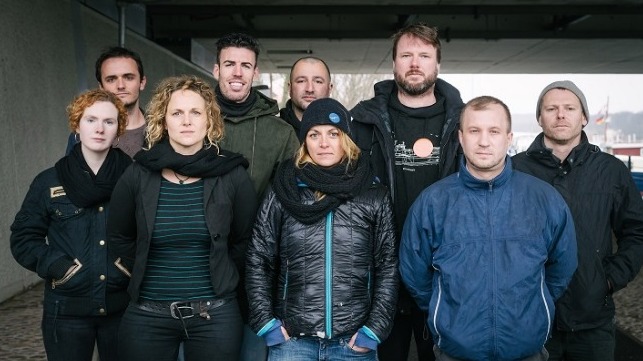
On 13 May 2019 MarEx  reported that the crew of the rescue ship Iuventa operated by the German NGO Jugend Rettet has received the Swiss Paul Grüninger human rights award for saving the lives of around 14,000 of men, women and children in the central Mediterranean. For more on this award, see: http://www.trueheroesfilms.org/thedigest/awards/paul-grueninger-award

The award is seen as a statement against the criminalization of those helping people at sea and comes whilst the crew is under criminal investigations in Italy for “aiding and abetting illegal immigration.” They face up to 20 years in prison and fines of 15,000 Euro ($16,900) per saved person. The prize money of 50,000 Swiss francs contributes to the defense.

The Iuventa was the first rescue vessel seized in Italy in August 2017. Captain Dariush was master of the Iuventa for three voyages off the Libyan coast: “We’re being charged for saving lives. This is absurd,” he said. “It is European politicians who block any safe way for people in need, so we had to act.

The crew says: “Although we have to stand trial, it is us who accuses Europe. We accuse European politicians of turning their backs on people in need. We accuse the E.U. of collaborating with regimes who violate human rights.” The Italian public prosecutor’s office has been investigating the crew for almost two years. Covert investigators claim to have observed the Iuventa crew cooperating with smugglers. However, the NGO claims that scientists at Goldsmiths, University of London have said there is no evidence for this. “They have compared the accusations of the Italian police with all available data, meteorological measurements, logbooks and recordings of the Reuters agency. In their study for Forensic Architecture, they conclude that the allegations are false.” The trial is expected to begin in autumn, and it is expected that charges will be brought against the 10 crew members. It is a precedent for Europe, says lead lawyer Nicola Canestrini: “This trial will show whether Europe can continue to stand for fundamental rights and solidarity in the world.

——–

Tom Ciotkowski is facing up to five years in prison and a fine of up to 7,500 Euros on trumped up charges. In July 2018, he was observing French riot police preventing volunteers from distributing food to migrants and refugees in Calais. He was charged with contempt and assault after he challenged the violent actions of a policeman against another volunteer. “Tom Ciotkowski is a compassionate young volunteer who was taking action to support migrants and refugees when he was arrested. He has committed no crime and is being unjustly targeted for documenting the abusive behaviour of the police in Calais,” said Amnesty International’s Senior Campaigner on Migration Maria Serrano.

Tom’s case is sadly emblematic of the harassment, intimidation and attacks that human rights defenders supporting migrants and refugees face at the hands of police in Calais. His case also reflects a wider European trend of criminalizing acts of solidarity, as a way of discouraging others from standing up for human rights. We need courageous, compassionate people like Tom more than ever

[BACKGROUND At the end of July 2018, Tom Ciotkowski was observing French riot police ID-checking volunteers who were trying to distribute food to migrants and refugees. He recorded on his mobile phone an official pushing and kicking a volunteer. When Tom complained about the behaviour of the police, an officer approached him and another female volunteer, who he hit with a baton. When Tom asked the officer for his identification number and told the policeman not to hit women, he was pushed hard by an officer and fell backwards over a metal barrier separating the pavement from the road. As Tom fell backwards, a passing lorry narrowly missed him. He was then arrested, put in custody for 36 hours and charged with contempt and assault (“outrage et violence”). In May 2019, Tom filed a complaint against the police officer who pushed him and against other officers who provided reports stating false facts against Tom to support his arrest and prosecution.]

See also: https://humanrightsdefenders.blog/2018/12/02/un-experts-consider-human-rights-defenders-in-italy-under-threat/

George Clooney: one man shows also carry risks..

May 14, 2019

I mentioned in a positive way George Clooney’s action in the human rights area, recently re Brunei [https://humanrightsdefenders.blog/2019/04/04/brunei-back-to-the-middle-ages-will-hotel-boycott-work/]. I believe his ‘instincts’ are good but there is always a danger with basically a ‘one-person’ outfit that there is insuffcient networking/research and that individual words trump wise statements. Michael Taylor for Reuters reports on 14 May 2019 that “George Clooney misfires among LGBT+ activists over ‘warning shot’ to Brunei neighbours“.  The key issue is that some Indonesian and Malaysian human rights defenders think that their countries – which have a modicum of democratic process compared to Brunei – should not be tarred with the same brush.

Oscar-winning actor George Clooney was criticised by LGBT+ activists after he called a boycott of luxury hotels owned by Brunei a “warning shot” to Indonesia and Malaysia should they consider introducing similar anti-gay laws.  “It sends a warning shot over to countries like Indonesia and Malaysia – who are also considering these laws – that the business people, the big banks, those guys are going to say ‘don’t even get into that business’.

But Clooney’s remarks sparked an online backlash as critics and regional LGBT+ activists pointed out major differences between Brunei and its Islamic neighbours. “I call on George Clooney and Hollywood to listen and work together with local activists and human rights defenders on the ground,” Numan Afifi, president of the LGBT+ advocacy PELANGI Campaign in Malaysia, told the Thomson Reuters Foundation. “Local activists have been putting their lives at risk on the ground working, for years,” Afifi said. “His statement, while well-meaning, might also be counterproductive for our case.”

Dede Oetomo, one of Indonesia’s most prominent LGBT+ activists and founder of LGBT+ rights group GAYa NUSANTARA, also questioned Clooney’s comments. “Malaysia and Indonesia are larger entities and have some democratic processes that although not perfect, they work,” Oetomo said. “Pressure from within is more possible in both countries, though it is frustratingly slow and protracted.”

http://news.trust.org//item/20190514105512-1ox5t/


Beyond WhatsApp and NSO – how human rights defenders are targeted by cyberattacks

May 14, 2019
Several reports have shown Israeli technology being used by Gulf states against their own citizens (AFP/File photo)

NSO Group has been under increased scrutiny after a series of reports about the ways in which its spyware programme has been used against prominent human rights activists. Last year, a report by CitizenLab, a group at the University of Toronto, showed that human rights defenders in Saudi Arabia, the United Arab Emirates and Bahrain were targeted with the software.

In October, US whistleblower Edward Snowden said Pegasus had been used by the Saudi authorities to surveil journalist Jamal Khashoggi before his death. “They are the worst of the worst,” Snowden said of the firm. Amnesty International said in August that a staffer’s phone was infected with the Pegasus software via a WhatsApp message.

——-

Friedhelm Weinberg‘s piece of 1 May is almost prescient and contains good, broader advice:

When activists open their inboxes, they find more than the standard spam messages telling them they’ve finally won the lottery. Instead, they receive highly sophisticated emails that look like they are real, purport to be from friends and invite them to meetings that are actually happening. The catch is: at one point the emails will attempt to trick them.

1. Phishing for accounts, not compliments

In 2017, the Citizen Lab at the University of Toronto and the Egyptian Initiative for Personal Rights, documented what they called the “Nile Phish” campaign, a set of emails luring activists into giving access to their most sensitive accounts – email and file-sharing tools in the cloud. The Seoul-based Transitional Justice Working Group recently warned on its Facebook page about a very similar campaign. As attacks like these have mounted in recent years, civil society activists have come together to defend themselves, support each other and document what is happening. The Rarenet is a global group of individuals and organizations that provides emergency support for activists – but together it also works to educate civil society actors to dodge attacks before damage is done. The Internet Freedom Festival is a gathering dedicated to supporting people at risk online, bringing together more than 1,000 people from across the globe. The emails from campaigns like Nile Phish may be cunning and carefully crafted to target individual activists.. – they are not cutting-edge technology. Protection is stunningly simple: do nothing. Simply don’t click the link and enter information – as hard as it is when you are promised something in return.

Often digital security is about being calm and controlled as much as it is about being savvy in the digital sphere. And that is precisely what makes it difficult for passionate and stressed activists!

2. The million-dollar virus

Unfortunately, calm is not always enough. Activists have also been targeted with sophisticated spyware that is incredibly expensive to procure and difficult to spot. Ahmed Mansoor, a human-rights defender from the United Arab Emirates, received messages with malware (commonly known as computer viruses) that cost one million dollars on the grey market, where unethical hackers and spyware firms meet. See also: https://humanrightsdefenders.blog/2016/08/29/apple-tackles-iphone-one-tap-spyware-flaws-after-mea-laureate-discovers-hacking-attempt/]

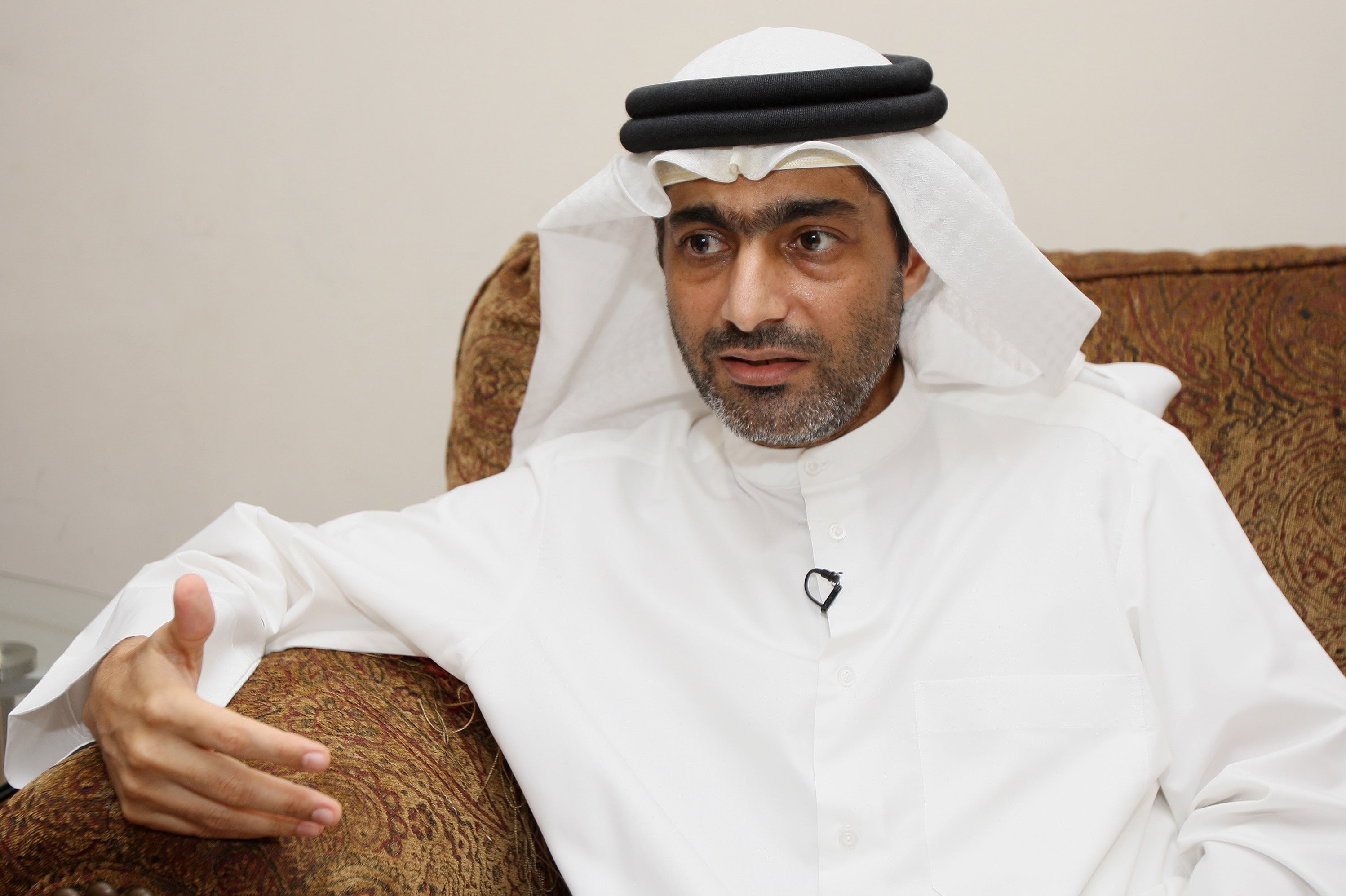
Rights defender Ahmed Mansoor in Dubai in 2011, a day after he was pardoned following a conviction for insulting UAE leaders. He is now in prison once more.

Rights defender Ahmed Mansoor in Dubai in 2011. Image: Reuters/Nikhil Monteiro

3. Shutting down real news with fake readers

Both phishing and malware are attacks directed against the messengers, but there are also attacks against the message itself. This is typically achieved by directing hordes of fake readers to the real news – that is, by sending so many requests through bot visitors to websites that the servers break down under the load. Commonly referred to as “denial of service” attacks, these bot armies have also earned their own response from civil society. Specialised packages from Virtual Road or Deflect sort fake visitors from real ones to make sure the message stays up.


A chart showing how distributed denial of service (DDoS) attacks have grown over time.

How distributed denial of service (DDoS) attacks have grown. Image: Kinsta.com; data from EasyDNS

Recently, these companies also started investigating who is behind these attacks– a notoriously difficult task, because it is so easy to hide traces online. Interestingly, whenever Virtual Road were so confident in their findings that they publicly named attackers, the attacks stopped. Immediately. Online, as offline, one of the most effective ways to ensure that attacks end is to name the offenders, whether they are cocky kids or governments seeking to stiffle dissent. But more important than shaming attackers is supporting civil society’s resilience and capacity to weather the storms. For this, digital leadership, trusted networks and creative collaborations between technologists and governments will pave the way to an internet where the vulnerable are protected and spaces for activism are thriving.

——–