On August 15, 2022, the Attorney General’s Office formally notified the Justice Ministry’s Department of Special Investigation (DSI) of its decision to indict four park officials accused of abducting and murdering Porlajee “Billy” Rakchongcharoen in April 2014. The charges include illegal confinement, premeditated murder, and concealing the victim’s body.
“Thai officials have long hindered justice for Billy through cover-ups and exploitation of legal loopholes,” said Elaine Pearson, acting Asia director at Human Rights Watch. “The authorities can right this wrong by ensuring that the attorney general’s decision to indict four officials moves promptly to an effective and fair prosecution.”
Billy was last seen on April 17, 2014, in the custody of Chaiwat Limlikitaksorn, then-head of Kaeng Krachan National Park in Phetchaburi province, and his staff. The park officials said they released him after questioning him briefly and had no information regarding his whereabouts. On September 3, 2019, DSI officials announced that his remains had been found in Kaeng Krachan National Park. Chaiwit was among the four indicted.
Pinnapa Prueksapan, Billy’s wife, told Human Rights Watch that she hoped there would be answers to basic questions, such as who had abducted and killed her husband, and who had obstructed justice.
Thailand is obligated under international human rights treaties to which it is a party to investigate and appropriately prosecute enforced disappearance, torture, custodial deaths, and other alleged human rights violations. In addition, in September 2019, Prime Minister Gen. Prayut Chan-ocha ordered the Department of Special Investigation to ensure that the case was watertight so the culprits could be brought to justice, regardless of their rank or position.
However, the investigation has suffered from a cover-up, Human Rights Watch said. Despite a long list of allegations against Chaiwat for serious abuses and misconduct during his tenure as head of Kaeng Krachan National Park, he has never been held to account.
In addition, Thai law does yet not recognize enforced disappearances as a crime. Human Rights Watch has repeatedly urged Prime Minister Prayut and his government to ratify the International Convention for the Protection of All Persons from Enforced Disappearance, which Thailand signed in 2012, and make enforced disappearance a criminal offense.
Chaiwat and his staff arrested Billy on April 17, 2014, for alleged illegal possession of a wild bee honeycomb and six bottles of honey.
At the time of his enforced disappearance, he was traveling to meet with ethnic Karen villagers and activists in preparation for an upcoming court hearing in the villagers’ lawsuit against Chaiwat and the National Park, Wildlife, and Plant Conservation Department of the Ministry of Natural Resources and Environment.
The villagers alleged in the lawsuit that, in July 2011, park authorities had burned and destroyed the houses and property of more than 20 Karen families in the Bangkloy Bon village. Billy was also preparing to submit a petition about this case to Thailand’s monarch. When he was arrested, he was carrying case files and related documents with him. Those files have never been recovered.
In September 2014, Police Region 7 officers filed malfeasance charges under article 157 of the penal code against Chaiwat and three other park officials for unlawfully detaining him. The other suspects named in the case are Boontaen Bussarakham, Thanaseth or Pitoon Chaemthes, and Krissanapong Jitthes. The DSI found traces of human blood in a vehicle belonging to the park office, but was not able to verify if the blood belonged to Billy because the vehicle was cleaned before forensic experts could examine it.
On September 3, 2019, the DSI announced that his remains had been found in Kaeng Krachan National Park, where he was last seen in custody of the park officials. The investigation team found an oil barrel, its lid, two steel rods, a burned wooden piece, and two bones at the bottom of the reservoir on April 26, 2019.
The Central Institute of Forensic Science subsequently confirmed the genetic trace of one of the bones found inside the barrel matched Billy’s mother. The investigation team then concluded it was part of his remains. The condition of this piece of human skull, which was burned, cracked, and shrunk due to exposure to heat of 200 to 300 degrees Celsius, suggests the killers burned his body to conceal the crime.
“The indictment of Chaiwat and other park officials is an important step for justice for Billy and all those whom Thai government officials have forcibly disappeared and killed,” Pearson said. “Thai authorities should recognize that they can’t escape being held accountable for the most heinous crimes.”
An astonishing 128 organisations joined Forum Asia on 18 August 2022 in signing the joint letter in support of the Mongolian human rights defender Sukhgerel Dugersuren which strongly condemns the criminalization and smear campaigns against her,
They call on all the international institutions and actors active in the country – including development banks, UN bodies and experts, EU member states and institutions, international embassies, international investors or private companies – to publicly speak out in support of Sukhgerel, use their leverage to strongly condemn reprisals, and take any action they can to ensure Sukhgerel can continue to safely carry out her work.
Who is Sukhgerel Dugersuren?
Sukhgerel Dugersuren is an internationally renowned human rights defender and the Executive Director of the Mongolian organizations Oyu Tolgoi Watch and Rivers without Boundaries Mongolia. She has a long trajectory of exposing human rights abuses and defending the rights of herder and rural communities in Mongolia. Her courageous and inspirational work is admired by scores of international and local civil society organizations, as well as UN Special Rapporteurs and experts, who have closely worked with her.
In the past decades, Sukhgerel has supported dozens of communities negatively affected by large-scale projects, such as mines and hydropower dams. She has helped these communities in denouncing the harmful impacts of these activities and bringing their grievances to the attention of the Mongolian government, development banks, and international organizations. For example, she supported complaints to the independent accountability mechanisms of the World Bank, International Finance Corporation, European Bank for Reconstruction and Development and the Asian Development Bank.
What happened and why is she being criminalized?
According to Front Line Defenders, on 2 August 2022, Mongolia’s General Intelligence Agency informed Sukhgerel that she is under investigation for committing crimes under the Mongolian Criminal Code Article 19.4, which prohibits the “illegal cooperation with foreign intelligence agency, agent.” Although no other details around the investigations have been shared, we fear Sukhgerel might be at risk of imminent arrest and we are deeply concerned for her safety.
Sukhgerel is being subject to a clear criminalisation process, where the law is used to limit civic freedoms and punish human rights defenders. The undersigned human rights organizations consider these accusations false and baseless, as they appear to be related to Sukhgerel’s support to the communities impacted by the Erdeneburen hydropower plant, funded by China’s EXIM Bank, and her legitimate requests for access to environmental information, public participation in environmental decision-making and transparency.
On 3 August 2022, during a government briefing, Mongolia’s Minister of Justice and Internal Affairs, H. Nyambaatar, stated that the construction of the Erdeneburen hydro plant had been suspended for two years, as a result of a letter from the local communities to the Chinese authorities. He also said that when development projects are interrupted by a civil society organization or person, then a task force should be established to investigate these cases as ‘sabotage’ under Criminal Code Article 19.6 and that the government could claim compensation for the lost economic opportunity. This concerning statement was shared just a few days before the visit by China’s Foreign Minister Wang Yi, to Ulan Bator on 7 and 8 August to discuss economic cooperation between the two countries and who specifically mentioned the Erdeneburen hydropower plant in his remarks.
The Mongolian Minister’s statement could be construed as a direct threat of reprisal against human rights defenders like Sukhgerel. It also sends a very chilling message to all individuals and communities peacefully raising concerns or opposing harmful projects, especially in a context where several environmental activists have already been threatened and criminalized.
Sukhgerel is also facing a worrying and orchestrated smear campaign in online media and social media. We are deeply worried about the criminalization and smear campaign against Sukhgerel, which puts her at additional risk and constitutes a threat to all human rights defenders and civil society groups in the country.
They call on the government and other relevant authorities in Mongolia to:
Immediately investigate and unconditionally cease all attempts to target and criminalize Sukhgerel Dugersuren, as well as other human rights defenders and individuals expressing their opinion or raising concerns about development projects in the country;
Guarantee in all circumstances that all human rights defenders in Mongolia are able to carry out their human rights activities without fear of reprisals and free of all restrictions, in line with Mongolia’s international human rights obligations and commitments, including its recently approved law on human rights defenders;
Publicly recognise the importance of freedom of expression, meaningful participation, unimpeded access to information on development projects and environmental impacts, and a safe environment for human rights defenders, to help ensure development projects are truly sustainable for Mongolia.
On 8 August 2022 Human Rights First announced that Angelo Karlo Guillen, a human rights lawyer in the Philippines, is the winner of the 2022 Roger N. Baldwin Medal of Liberty. The Baldwin Medal will be presented to Guillen in person at an event in the United States later this year.
Michael Breen, President and CEO of Human Rights First said “Angelo Guillen is a courageous and effective advocate whose work has made a difference in the lives of his fellow Filipinos and put a spotlight on abuses and calling for accountability.”
Guillen is a prominent human rights defender and a leader in the National Union of Peoples’ Lawyers (NUPL). He lives and works primarily on the island of Panay, and his legal practice has included a focus on helping document human rights violations and educating farmers and indigenous communities on their human rights under domestic and international law.
In March 2021, after years of being followed, surveilled, and vilified for his work, Guillen survived a brutal stabbing by unknown assailants. The attack followed repeated attempts by government officials and others to depict him and other NUPL lawyers as “terrorists.” Three other NUPL lawyers have been murdered in previous years.
“I am honored to accept the Baldwin Medal, which I do on behalf of all Filipino human rights lawyers and defenders,” said Guillen. “This award will encourage us even more, to continue our work defending human rights and civil liberties in the Philippines, even in these difficult times.
“I am especially glad this award could be announced on the International Day of the World’s Indigenous Peoples, which is also National Indigenous Peoples Day in the Philippines. Indigenous peoples, like the Tumandok community, as well as farmers, labor leaders, and activists, have borne the brunt of unjust arrests, extrajudicial killings, and other human rights violations committed by state security forces that, to this day, still take place throughout the country. Their rights must be protected, and we hope that this recognition will help bring attention to their plight.”
Special Rapporteur on the situation of human rights defenders, Mary Lawlor, conducted an official visit to Greece from 13 to 22 June 2022, to assess the government’s efforts towards creating an enabling environment for those seeking to protect and promote human rights.
Human rights defenders in Greece, particularly those working on migration, operate in an environment of pervasive fear and insecurity, concluded Mary Lawlor. “I am concerned about the increasing criminalization of humanitarian assistance in Greece. Solidarity should never be punished and compassion should never be put on trial,” she said while presenting her preliminary findings at the end of a 10-day mission in the country.
The UN expert noted that human rights defenders not only face criminal sanctions for their activities, but are operating in an increasingly hostile environment where the general public is influenced by negative rhetoric from high-ranking officials and their unfavorable portrayal in the media, which often conflates their activities with traffickers and criminal networks.
Greece fell 38 positions within a year in Reporters Without Borders’ 2022 report on the Press Freedom Index, with the organization marking it the lowest-ranked European Union country for press freedom. “Journalists who counter the government’s narrative on the management of migration flows are often under pressure and lack access to mainstream media outlets.… Journalists reporting on corruption are sometimes facing threats and even charges,” Lawlor said. She noted that journalists have very limited or no access to facilities where migrants, refugees, and asylum seekers are being held, further contributing to a general lack of transparency regarding the government’s policies in this area.
Lawlor will present a detailed report with her findings at the March 2023 session of the UN Human Rights Council. The government should listen to what the UN expert has to say and champion human rights defenders. The European Commission, which noted in July last year the narrowing space in Greece for groups working with migrants and asylum seekers, should step up its engagement on the issue and press Greece to stop harassing civil society groups and activists.
The court found in Kavala v. Türkiye, a case brought by the Council of Europe’s Committee of Ministers, that Turkey failed to fulfil its obligation under Article 46(1) of the European Convention on Human Rights to comply with its judgment issued on December 10, 2019. The judgment is an important step toward accountability for Turkey’s systemic disregard for the convention system and as recognition of the urgency of implementing the court’s order to release Kavala.
“This is the only second time, after Mammadov v. Azerbaijan, that the ECtHR has ever conducted infringement proceedings and determined that a member state has not complied with a European Court judgment,” said Helen Duffy of the Turkey Litigation Support Project.
“It is an acknowledgement of Turkey’s ever-deepening rule of law crisis, which has involved seriously undermining the Convention system and the escalating use of criminal law for political purposes.”
In its new judgment, the court held that “Türkiye has failed to fulfil its obligation under article 46§1 to abide by the Kavala v. Türkiye judgment of 10 December 2019.”
The European Court underlined that:
Its finding of a violation of Article 18 taken together with Article 5 in the Kavala judgment had vitiated any action resulting from the charges related to the Gezi Park events and the attempted coup. It is nonetheless clear that the domestic proceedings subsequent to the above judgment, which resulted first in an acquittal and then a conviction, have not made it possible to remedy the problems identified in the Kavala judgment (para. 172).
The Grand Chamber judgment addresses these practices of the Turkish authorities by stating that “the measures indicated by Türkiye do not permit it to conclude that the State Party acted in ‘good faith,’ in a manner compatible with the ‘conclusions and spirit’ of the Kavala judgment, or in a way that would make practical and effective the protection of the Convention rights which the Court found to have been violated in that judgment” (para. 173).
Aisling Reidy, senior legal adviser at Human Rights Watch said: “As the European Court has now confirmed Turkey’s failure to execute the 2019 Kavala judgment, the Committee of Ministers needs urgently to take all feasible measures to ensure the judgement is respected and Kavala released“.
The Committee of Ministers is expected to resume its supervision process and take more robust steps to discharge its mandate of ensuring the necessary individual and general measures are taken by Turkey to implement the court’s ruling.
Now, it is up to the Committee of Ministers, which oversees the implementation of the ECtHR rulings, what measures to take against Turkey after the country failed to comply with the court’s ruling. This could lead to Turkey’s suspension from the Council of Europe. In anticipation, the Foreign Ministry of Turkey said they expected the Committee of Ministers “to act without bias and with common sense” in a statement.
On 22 July 2022 Brian Dooley and Quinn Fulton wrote for Human Rights First a post: “Ten Years But Still Counting – UAE Fails To Release Jailed Activist Al-Roken“
Human Rights First has covered their cases and others for many years, and urged a succession of U.S. administrations to use the influence they have accrued – not least through supplying the Emirates with billions of dollars of weapons – to push for the release of jailed human rights activists there.
The U.S. government knows exactly who Al-Roken is and what he stands for. He has been featured in a succession of U.S. reports describing him as “a human rights activist” (2007), “a lawyer…reportedly held incommunicado and without charge for unknown reasons” (2012), and a “lawyer, academic and human rights defender” (2021).
In 2015, Human Rights First wrote about his wrongful imprisonment, and noted in a report that year on human rights in the Emirates that “Former heads of the Jurists Association are now political prisoners, including renowned constitutional scholar Dr. Mohammed Al-Roken. He is one of dozens serving long prison sentences after being convicted in mass trials.”
We have continued to raise cases through the media of human rights defenders wrongfully detained in the Emirates, and we successfully campaigned for the release of American citizens Mohammed and Kamal Al Darat when they were tortured and detained in the Emirates for over a year.
When calling for Al-Roken’s release, the UN Special Rapporteur on Human Rights Defenders noted that he was jailed on charges of “plotting against the government,” and “subjected to intermittent periods in solitary confinement, allegedly without justification or explanation.” The UN Working Group on Arbitrary Detention said Al-Roken “is reportedly well known for defending victims of human rights violations in the United Arab Emirates,” and deemed his detention as arbitrary.
We know that getting people who have been wrongfully detained in the Emirates out of prison is difficult, but it sometimes can be done if there is substantial international public pressure – as with the Al Darats and the British academic Matthew Hedges.
That’s why it’s important that the Biden administration speaks out publicly about Al-Roken. Our years of advocacy experience tells us that behind-the-scenes diplomacy is unlikely to work..
Michelle Langrand wrote in Geneva Solutions of 20 July 2022 that the “Michel Forst was elected special rapporteur for environmental defenders in June by the Aarhus Convention on environmental information.”
The newly appointed special rapporteur on environmental defenders Michel Forst will be able to intervene when environmentalists in the pan-European region are at risk of being attacked or penalised.
Defending the planet’s health can be a dangerous line of work – at times deadly. Two thirds of defenders murdered worldwide are environmental advocates, with 227 killings reported in 2020. While attacks in Europe and Central Asia are not as frequent as in other parts of the world, industries and governments publicly exposed for polluting or turning a blind eye to environmental crimes have been known to retaliate with harassment, legal action and even violence.
Environmental defenders in Ukraine documenting the impacts of the war or campaigners in Switzerland practising civil disobedience to alert the public about the climate threat can now turn to a UN expert to rapidly intervene on their behalf.
The French 71-year-old was UN special rapporteur on human rights defenders from 2014 to 2020.
Forst’s plans for the next four years are still being concocted. “It’s a very new mandate,” he told Geneva Solutions. To develop the tools and mechanisms he’ll be using throughout his term, he won’t have to look very far.
“I’ll be looking at how the working methods developed by the Office of High Commissioner of Human Rights could be implemented in this mandate, for instance, receiving complaints, sending communications to states when we know that rights have been violated and issuing public statements as well,” he said.
The complaints system will be one of Forst’s flagship measures and a chance to take it one step further. When UN experts under the Human Rights Council receive a complaint and write to a state asking for an explanation, the government has 60 days to reply, rendering it ineffective when a person’s life or security is at risk, he noted.
“We need to understand how it could be made effective because rapid response means that the special rapporteur has the possibility to intervene immediately by different means.”
The expert will also resort to what he calls “quiet diplomacy”, meeting with ambassadors both in Geneva and abroad, where there might be “systemic attacks against defenders”.s
Forst was elected by consensus by the parties to the Aarhus convention – an encouraging start for the expert. But not all governments will be easy to approach when they’re the ones in the hot seat. The most notable one is Belarus, sanctioned last year by fellow party members for closing down an anti-nuclear NGO that was collaborating with an expert body of the Convention. The country has deployed one of the most severe crackdowns in recent years in the region against civil society, and is on Forst’s to-do list. The country did not support the idea of creating a mechanism in the beginning, according to observers, although it did not oppose the proposal during the formal adoption last year. Last week, it was a no-show for the French expert’s nomination.
“Belarus is one of the last countries that I visited as special rapporteur on human rights defenders and on that occasion I met with a number of environmental defenders. I also had lengthy discussions with both the minister for foreign affairs and the minister of justice about the cases and to look at how my mandate at that time could help support government efforts to convict the perpetrators of attacks against defenders,” he said.
“Security forces employed by companies are the main perpetrators against environmental defenders. Part of the mandate is not only to speak to states, but also to companies and to draw attention to them, and to the countries in which they have their seat, over cases of maladministration, corruption or acts against defenders,” Forst said.
His efforts could add pressure on European countries to toughen corporate responsibility laws that could help protect defenders in countries beyond the convention’s jurisdiction. Within the country borders of the agreement, campaigners would also like to see Forst tackle legal abuses against environmental defenders that fall in a grey zone.
Yves Lador, Geneva representative for EarthJustice, told Geneva Solutions: “We see a worrying trend in democratic countries of targeting environmental activists directly through laws through different levels.
As a universal language that transcends cultural barriers, music is a medium where people and artists alike can have their voices heard in a manner that words alone cannot. Music has often been used to showcase pressing political and societal issues, including the promotion and protection of human rights. These 15 artists are listed in a post by Human Rights Carreers as examples of those who have used their musical talent and platform to share awareness of human rights issues across the world and bring a voice to marginalized members of society. Many readers will have their own preferences.
Pete Townshend is an English musician, songwriter and vocalist of “the Who” rock band, one of the most influential rock ensembles during the 1960s and 1970s. Alongside his career in the rock music industry, Townshend has a long history of charity and philanthropic work for human rights issues, advocating for greater drug rehabilitation and activism for children’s rights. In 1979, Townshend was the first musician to perform for Amnesty International’s Human Rights Concerts and inspired other renowned rock musicians to support the human rights cause. Townshend is quoted saying, “Amnesty does things that I can’t do in my work. It deals with the specifics of injustice… It makes them public. It was 1979 that I appeared at ‘The Secret Policeman’s Ball’… It was amazing subsequently to see what ‘The Secret Policeman’s Ball’ triggered. Quite big names got involved in supporting Amnesty. And it became apparent that big names in music and Amnesty melded very well. It’s good to see that what I did kicked that off…”
Sting
Performing under the stage name, “Sting”, Gordon Sumner is a Grammy-Award winning guitarist, vocalist and songwriter who is renowned for his work as both a solo musician and an ensemble musician with the rock band “the Police” between 1977 – 1984. Sting is heavily involved in human rights activism, having written songs inspired by his concern for world hunger and oppressive political regimes, and has also extended his activism beyond music by writing an open letter for the decriminalization of drug possession in the United Kingdom in 2011. He has also signed several petitions against the death penalty in Belarus and has cancelled concerts in response to human rights issues in several countries. Sting’s humanitarian activism has been recognized by Amnesty International and he has performed for the NGO’s Human Rights Concerts on several occasions.
Bono
Described as the world’s best known philanthropic performers and most politically effective celebrity of all time by the National Journal, Bono (Paul Hewson) has worked extensively as a rock musician in the band U2, a philanthropist and human rights activist. Focusing much of his efforts into advocating the fight against AIDS and extreme poverty in Africa, Bono has lobbied governmental entities to adopt human rights-based policies under his positions as the co-founder of ONE, a global movement campaigning to end extreme poverty. More recently, Bono raised awareness of vaccination against COVID-19 and vaccine inequality around the world and in April 2022, Bono recorded an acoustic rendition of “Walk On” by his band, U2, for the Global Citizen’s Stand Up for Ukraine livestream, urging global leaders to support Ukrainian refugees. Bono was also invited by Ukrainian president Volodymyr Zelenskyy to perform in a metro station in Kyiv, showing his solidarity to Ukraine under invasion from Russia. See also: https://www.trueheroesfilms.org/thedigest/laureates/292E53F2-AE54-E5BA-BE5B-17ACD95D9B40
Awarded “The Ambassador of Conscience Award” by Amnesty International in 2016, Angélique Kidjo is a Beninese singer-songwriter renowned for her creative music videos and unique musical style that integrates Afropop, Congolese rumba, jazz and Latin music genres. Within her 30-year musical career, Kidjo has been a prominent advocate for the expression of freedom, the education of girls in Africa and has expressed concerns regarding female genital mutilation and has worked as a UNICEF Goodwill Ambassador since 2002. Alongside her major ambassador roles, Kidjo is the founder of The Batonga Foundation, a non-profit organization that empowers women in Benin and upskills these women for socio-economic mobility. See also: https://www.trueheroesfilms.org/thedigest/laureates/B3AF6E27-B7AD-8D1D-C09E-B7EAA953F3C3
Lang Lang
Described as one of the most exciting and accomplished classical musicians in the world, classical pianist Lang Lang has not only revolutionized the classical music industry but has also used his music as a way to advocate for human rights globally. Appointed as a UNICEF Goodwill Ambassador and a Messenger of Peace, Lang Lang primarily advocates for children’s rights and access to education through concerts that raise funds for UNICEF and other humanitarian crises.
Buffy Sainte-Marie
As an Indigenous Canadian singer-song writer and composer, Buffy Sainte-Marie’s music primarily revolves around the issues faced by the Indigenous peoples of Canada and the United States. Buffy began her advocacy efforts for the protection of Indigenous artists, performers and their intellectual property by establishing the Nihewan Foundation for Native American Education in 1966 and has moved on to founding The Creative Native Project, an initiative which seeks to empower Indigenous youth in the performing arts. More recently, Buffy was awarded the Allan Slaight Humanitarian Spirit Award and was invited to the Canadian Music Week in 2020.
Maxim Vengerov
Hailed as one of the most talented violinists in the 21st century, Maxim Vengerov was the first classical musician to be appointed as a UNICEF Goodwill Ambassador in 1997. Alongside his musical accomplishments, Vengerov has focused much of his advocacy on the promotion of children’s education and rights and has visited countries such as Turkey, Uganda and Bosnia and Herzegovina representing UNICEF. Vengerov has also performed at #EndViolence events in Bucharest, Romania for UNICEF Romania.
Bruce Springsteen
Bruce Springsteen is an American singer-song writer, known as one of the original founders of the heartland rock genre, which combines elements of mainstream rock music with narratives of the American working class. Throughout his musical career, Springsteen has been a long advocate for LGBT rights, the empowerment of women and democracy, using his international platform to raise awareness of social issues. Springsteen was first invited to perform for Amnesty International in 1988 and has since continued his advocacy of human rights through his music.
Nadya Tolokonnikova
As the leader of the Russian feminist punk band Pussy Riot, Nadya Tolokonnikova uses her musical platform to spread awareness of human rights issues through her music. As a passionate feminist, Tolokonnikova delved into themes of sexism and rape culture in her newest EP, Panic Attack, and has agreed to donate a portion of the proceeds from her EP to a shelter for domestic violence in Russia. Tolokonnikova herself was recognized by a political prisoner by the Union of Solidarity with Political Prisoners and Amnesty International described her as a “prisoner of conscience” due to the “severity of the response of Russian authorities.”
Piera Van de Wiel
Piera Van de Wiel is a British singer and composer who uses her music as a platform for her human rights advocacy. During the COVID-19 pandemic, Van de Wiel released a single, “Used”, to raise awareness of the increase in domestic violence and abuse against women during the pandemic with the support of the United Nations Spotlight Initiative. Alongside her musical pursuits, Van de Wiel is the founder of the non-profit organization, Stronger With Music, a movement that works towards achieving the UN Sustainable Development Goals.
Evan Greer
Evan Greer is a trans/genderqueer artist based in Boston who composes acoustic songs that advocate technological security, LGBTQ rights and movements for justice and liberation. Alongside their musical accomplishments, Greer is the founder of a non-profit organization called Fight for the Future, which aims to secure digital rights and banning unethical technological practices.
Max Richter
German-British composer and pianist Max Richter is one of the most prominent composers of the 21st century, boasting over a billion streams of his music and a million album sales throughout his 25-year musical career. Richter has previously responded to the Iraq War, the 2005 London terrorist attacks and the Kosovo War through his music and his most recent album, “Voices” takes inspiration from the United Nations Declaration of Human Rights. All ten of the tracks (except for the final song) incorporate text from the 1948 UNDHR document and Richter himself has stated that the album is a response to the human rights abuses around the world and the need for social justice and equality of humans around the world. See: https://humanrightsdefenders.blog/2020/12/09/max-richters-voices-to-be-broadcast-for-human-rights-day-by-34-countries/
Hans Zimmer
Composer of award-winning films such as The Dark Night, The Lion King and The Rock, Hollywood composer Hans Zimmer has established himself as one of the most eminent film composers in history. Zimmer was invited to compose an anthem to celebrate Amnesty International’s 50th anniversary, titled “One More Voice for Freedom” in commemoration for International Human Rights Day. Zimmer himself is quoted saying “it was a privilege to create this piece of music for a cause which is so close to our hearts” and that it is my “hope that the anthem will inspire people to support Amnesty’s vision of a world where fundamental rights are protected for everyone. We should all join Amnesty in standing up for justice, freedom and human rights”.
Alicia Keys
Dubbed as the “Queen of R&B”, American singer-song writer Alicia Keys has intertwined her passion for music with human rights activism through her extensive philanthropic work in her musical career. Keys is the co-founder of the non-profit organization, Keep a Child Alive, that provides treatment and social support to children and families affected by HIV in Africa and India. As part of her work in Keep a Child Alive, Keys host an annual fundraising gala called the Black Ball, where she invites major musical artists to perform at the event to raise funds for HIV and AIDS activism. See: https://www.trueheroesfilms.org/thedigest/laureates/e062efc4-e1ca-47c7-b53d-ec1a018d3bb9
The Dutch Ministry of Foreign Affairs has opened their call for nominations for the 2022 Human Rights Tulip award.
The Human Rights Tulip comes with €100,000 in prize money, which the winner can use to further develop or expand the scale of their work for human rights. The nomination period will close on 2 August 2022.
The Human Rights Tulip is an award presented by the Dutch government for human rights defenders who promote and support human rights in innovative ways. Please see https://www.trueheroesfilms.org/thedigest/awards/D749DB0F-1B84-4BE1-938B-0230D4E22144 for further information on the award and its laureates. With the nomination form (available in 5 languages) you can nominate organisations and individuals who you consider worthy of this award.
Ruth Schöffl reported from Vienna, on 08 July 2022 how a Syrian refugee game developer, an Austrian company and UNHCR teamed up to create a video game that reveals the life-or-death decisions that refugees face.
Jack Gutmann was never one of those children whose parents badgered him to limit his screen time and go outside and play. On the contrary, they encouraged Jack and his four brothers to spend as much time as possible absorbed in computer games so they would stay indoors, safe from the conflict raging on the streets outside their home.
“I was scared, and I tried to escape reality,” says Jack, named Abdullah at birth and brought up in Hama, Syria’s fourth-largest city. “I didn’t want to see the war and I did not want to hear it.” When there was electricity, he played video games. When the electricity went out, he played on his laptop. When the laptop battery died, he designed on paper.
He never dreamed that years later – safe in Austria – his passion for computer design would equip him to produce an award-winning video game. A teaching edition of Path Out was re-launched by UNHCR for World Refugee Day (20 June 2022) this year to help schoolchildren in Austria and elsewhere stand in the shoes of a refugee, making life-and-death decisions along a hazardous journey to safety.
Jack, who took a new name when he forged a new life in Austria, began drawing and colouring digitally as a child and mastered the graphics programme Photoshop by the time he was fourteen.
“Digital art and computer games were the window to the world for me, out of my room in Syria, away from the war into a diverse world with very different people,” he says, reflecting on the crisis that broke out in March 2011, the same month he turned 15.
Since the start of the crisis in 2011, millions of Syrians have been forced to flee their homes. Today some 6.8 million Syrians have fled abroad as refugees, and almost as many – 6.9 million – are displaced within the country.
At 18, facing the danger of being drafted into the army, Jack fled his homeland – a dangerous and circuitous journey to Turkey and then across a number of countries until he reached Austria in the heart of Europe. This was the first place he truly felt safe.
“I didn’t plan to stay in Austria,” he freely admits. “But when I arrived here with my brother, we were really shocked because so many people helped us – positively shocked.”
Shortly after arriving, Jack met Georg Hobmeier, head of Causa Creations, a Vienna-based game-design company that sees video games not only as entertainment but, in the words of its website, as “meaningful, enriching experiences that can connect us, challenge our perceptions, and give insights into the world around us.” They’ve worked on issues such as migration, climate change and nuclear energy.
Jack, eager to turn his passion into a profession, teamed up with Causa Creations on a joint project. The result was Path Out, in which the player replicates Jack’s surreptitious trek from Syria, sometimes in the hands of people smugglers.
“We decided that Jack himself would be the main character of the game,” says Georg, adding that it was particularly important to show that behind every refugee statistic there are complex stories and complex personalities.
In the Japanese game style they chose, the cute characters contrast with the harsh reality of the journey. Jack – the designer and the character – are dressed throughout in the yellow shirt he actually wore on his odyssey, which now has sentimental value to him.
From a box in the corner of the screen, real Jack comments on the players’ moves in Youtuber style, often with humour. “You just killed me, man,” he exclaims when the player makes the wrong move. “In reality I wasn’t as clumsy as you.”
Originally released as a two-hour game in 2017, Path Out has won international and Austrian awards for “its effort to shed light on a serious issue.”
The new version Causa and UNHCR developed for schools takes no longer than one lesson and helps pupils who might never meet real refugees learn that Jack led a life much like theirs until his world was turned upside down and he had to leave everything behind. It was rolled out in German and English for World Refugee Day; other language versions are to follow.
Jack the designer is still writing his own happy ending. He felt safe as soon as he reached Austria, but it took time for the country to become his true artistic and emotional home.
“It took five years until I felt my journey was over, until I really felt relieved,” he says. Now 26, he speaks nearly flawless German and English. He completed vocational training, worked for a few years in a game development company, and now is training further in 3D modelling and animation to become an even better game developer and designer.
He met an Austrian woman who also plays video games – though not by profession – and they married last year.
And he maintains his sense of humour, a trait he considers essential both in real life and in his game, Path Out. “The story of flight and war is bad enough; one needs humour to be able to cope with it,” he says. Since the game reflects his reality, “it’s funny at the same time. After all, computer games are supposed to be fun.”



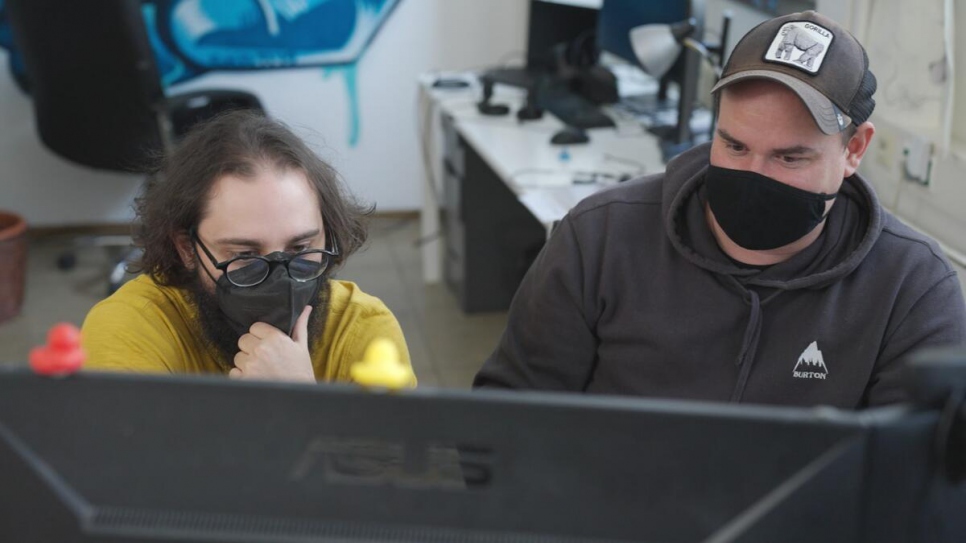 Game designer Jack Gutmann (left) sits alongside Georg Hobmeier, head of Causa Creations, at their offices in Vienna, Austria. © UNHCR/Simon Casetti
