On 5 December 2023, Mary Lawlor, the UN Special Rapporteur on the situation of human rights defenders concluded her visit to Algeria with the observation: “While I welcome the evident reforms which have taken place over the past four years and the new emphasis on public consultation, I regret that some human rights defenders who work on sensitive issues face continued restrictions”.
The UN expert observed four main patterns of violations used to suppress human rights defenders: ongoing judicial harassment, dissolution of key human rights organisations, limitations on freedom of movement and intimidation and surveillance leading to severely negative impacts on their mental health and that of their families.
“I was saddened that a handful of human rights defenders who attempted to travel to Tizi Ouzou, where I was holding meetings, were prevented from doing so and detained for 10 hours,” Lawlor said.
“Given Algeria’s recent history, robust laws relating to terrorism are clearly necessary,” the expert said. “However, it is disappointing that laws designed to prevent terrorism are instilling terror in human rights defenders through overly broad and vague definitions of what constitutes terrorism in the Penal Code.”
The Special Rapporteur noted that Article 87 bis of the Penal Code was one of the most frequently cited laws used to prosecute human rights defenders.
Despite this, the expert said there were many people working to protect and promote human rights with the full support of the government and the newly created consultative bodies in areas including women’s rights, children’s rights, healthcare, poverty relief and political participation. Based on this collaboration and experience, the Special Rapporteur believes the government is now better equipped to reach out to human rights defenders working on sensitive issues.
Lawlor welcomed the acquittal of three human rights defenders, Jamila Loukil, Kaddour Chouicha and Said Boudour, of terrorism charges in Dar El Baida court on Sunday.
“I hope this acquittal will kickstart a review process of Article 87 bis, and I stand ready to assist the Algerian government in any way I can in this regard,” she said.
11 human rights NGOs had publicly expressed their wish that this visit be an opportunity to free imprisoned activists and for reforms to see the light of day.
On 6 December, following the public report of this visit, NGOs support the main measures recommended by the Special Rapporteur, namely that: • The Algerian government must view Human Rights Defenders as allies and opportunities within society, not as threats. The signatories call for the repeal of all repressive laws and legislative provisions relating to the rights to freedom of association and peaceful assembly, and the adoption, on the basis of broad consultation with Algerian society, a regulatory framework complies with international standards notably respect for human rights in Algeria. • Many civil society organizations are in danger of disappearing. This is already the case of the Algerian League for the Defense of Human Rights (LADDH) and the Rassemblement Actions Jeunesse (RAJ). Civil society organizations must have the freedom to adequately play their role. • Several articles of law must also be reformed in accordance with international standards. This is the case of articles 79 and 87 bis of the Penal Code, relating to the attack on the integrity of the national territory and the fight against terrorism which are abusively used to imprison activists. The same goes for the Ban on Exiting the National Territory (ISTN) which is today used in a punitive manner to restrict the movement of human rights defenders in Algeria.
The signatories finally call on the Algerian government to release all prisoners of conscience and human rights defenders currently in prison
From right, jailed Hong Kong barrister Chow Hang-tung and Chinese rights attorneys Xu Zhiyong and Ding Jiaxi were honored with human rights awards by the Council of Bars and Law Societies of Europe. Credit: Reuters, AP, Reuters
Three jailed attorneys from Hong Kong and China have been honoured with Council of Bars and Law Societies of Europe human rights awards, as a Chinese court rejected appeals from two of them, upholding their original sentences for “subversion.”
The ceremony in Athens took place on Friday 24 November, the same day that a court in the eastern province of Shandong rejected appeals from Ding and Xu, who are currently serving 12- and 14-year jail terms handed down by the Linshu County People’s Court for “subversion of state power,” respectively.
“The dignity of our profession … it is bound up with the dignity of the law, with whether the law reflects our autonomy or denies it,” wrote Chow, who organized now-banned annual vigils commemorating the 1989 Tiananmen massacre.
“In that sense the building of democratic institutions that alone can safeguard the law’s dignity is also a lawyer’s duty, which is why all three of us receiving this prize today are jailed for working for democracy in China, a fight that may seem unrelated to our profession but is in fact, central to it,” said Chow.
She is currently awaiting trial under a security law on charges of “subversion” amid an ongoing crackdown on dissent in Hong Kong.
“It is a fight we cannot waver from, even when knowing that the laws we served would likely condemn us,” she said, describing the fight as “the highest service a lawyer can offer her fellow men.”
Rights activist Patrick Poon said the fact that Chow was honored alongside Xu and Ding shows how little difference there is now between the judicial systems in Hong Kong and mainland China, following a years-long crackdown on political opposition and public dissent in the wake of the 2019 protest movement.
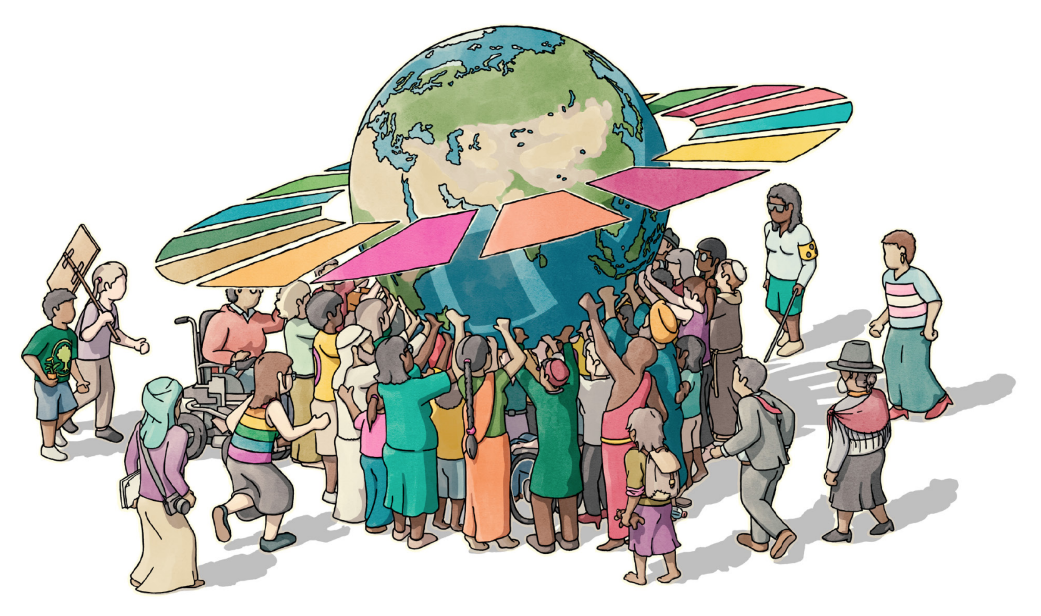
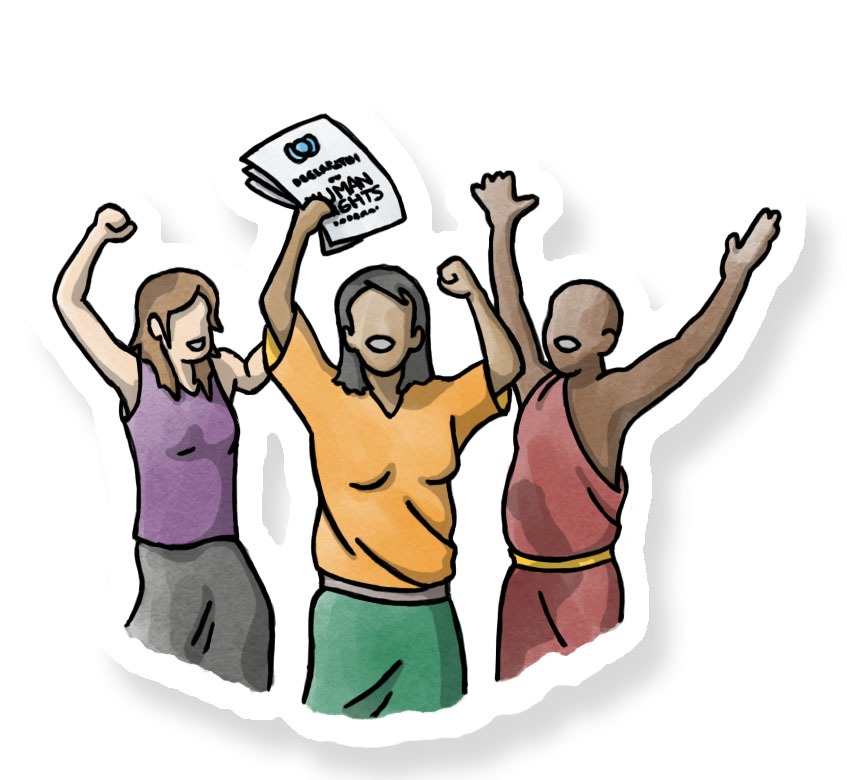
25 years ago, the United Nations adopted the Declaration on Human Rights Defenders. The declaration has been essential to protect those who defend human rights. It’s time to celebrate the Declaration, human rights defenders and all the contributions they have brought to our societies.
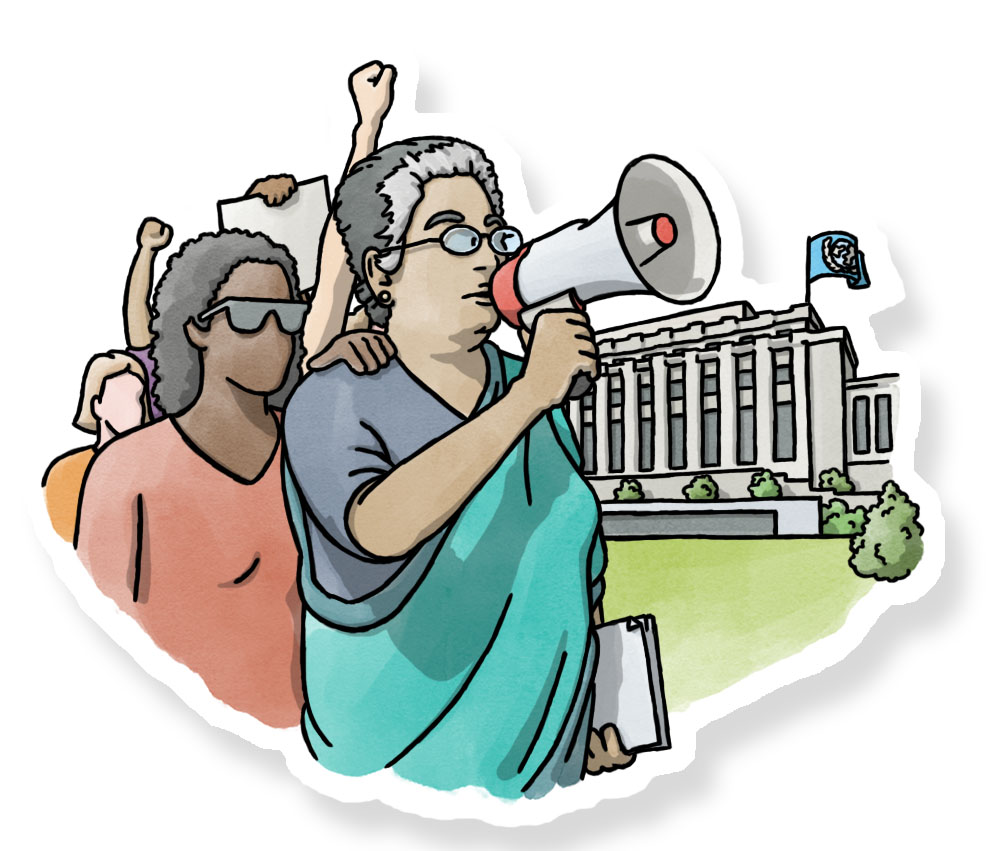
The Declaration is a landmark document that sets out the rights and responsibilities of States, human rights defenders, and all actors in society in ensuring a safe environment where defenders are recognised, valued, and encouraged to work for the promotion and protection of human rights.
As part of this celebration, Amnesty International, CIVICUS, Defend Defenders, FIDH, Forum Asia, Front line Defenders, Gulf Centre for Human Rights, ICNL, ILGA World, IM Defensoras, ISHR, MENA WHRD Coalition, OMCT, Peace Brigades International , Protect Defenders, Protection International and RFK Human Rights launched a collaborative project to analyse the contributions of the Declaration to defenders’ lives and work, as well as progress in international human rights law on the protection of defenders.
What do we want to achieve?
This project seeks to enhance the awareness of the Declaration and encourage greater dialogue on the protection needs of defenders
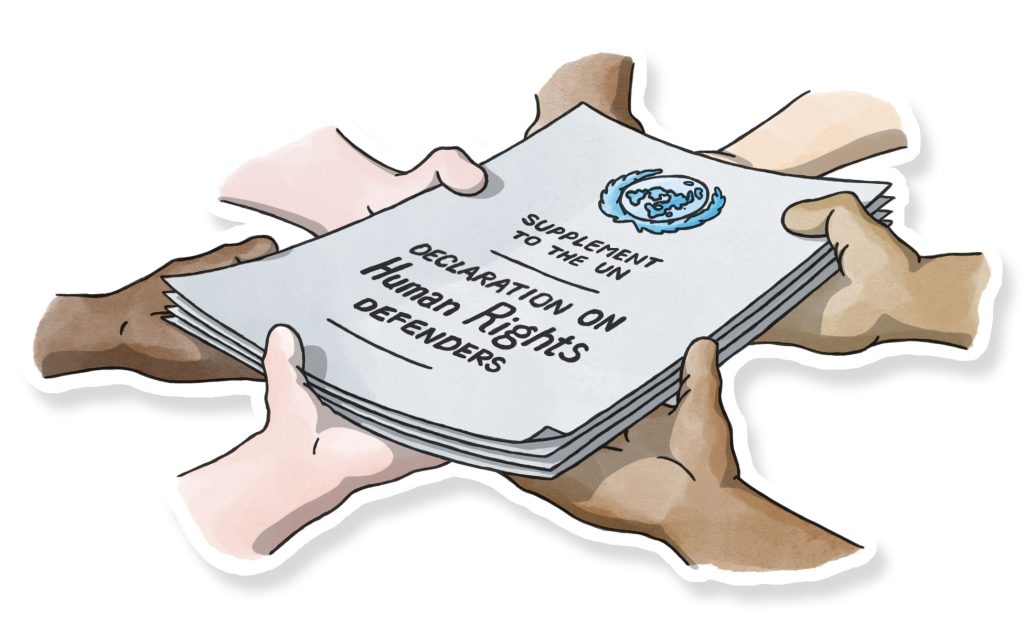
One of the outcomes of the project will be the creation of a supplement to the Declaration that will be a civil society-led document taking into account developments in international and regional jurisprudence relating to defenders over the past 25 years and evolutions of human rights movements, addressing key gaps and limitations in the Declaration, and reflecting defenders’ lived experiences and needs.
This supplement will guide change on the ground in the next 25 years, and beyond!
We need the input and voices from human rights defenders everywhere!
What can you do?
We are consulting online and offline with human rights defenders across the globe on changes in national, regional and global contexts in which they work, evolutions of human rights movements and activism, and defenders’ lived experiences and protection needs. We are also reviewing how international and regional jurisprudence in relation to human rights defenders has developed over the last 25 years.
1. Add your voice
By sharing your experiences, insights, and recommendations, you can help shape the future of human rights and contribute to the protection and promotion of defenders’ rights.
Are you a human rights defender and want to contribute to the project?
Help us raise awareness about the UN Declaration on human rights defenders. Join the #Right2DefendRights social media campaign.
Join the social media campaign!
Discover our #Right2DefendRights social media kit and post the content on your networks. Download the kit
3. Learn more about the Declaration
Learn more about the Declaration on Human Rights Defenders, its importance, content and application. Visit our online e-learning platform and take our 30 minutes course.
Take the e-course
Visit our online e-learning platform and learn more about the Declaration.Learn more
4. Get in touch!
Let us know if there are convening of HRDs happening anywhere that we could do consultations around. Drop an email to Tess Mcevoy: t.mcevoy@ishr.ch
—————
And on Monday 11 December (10:00 – 12:00 EST) there will be an event “UDHR75 + HRDS25 = 100% HUMAN RIGHTS” at Ford Foundation Center for Social Justice, New York with HRDs speaking about their lived experiences, with: Sukhgerel Dugersuren, OT Watch, Mongolia Karina Sánchez, IM Defensoras, Mesoamerican Intiative of Women Human Rights Defenders, LAC Sirley Muñoz, Somos Defensores, Colombia Brenda Kugonza, Women Human Rights Defenders Network Uganda Edita Burgos, Karapatan, Philippines Moderation: Tess McEvoy, International Service for Human Rights
On 5 December 2023 Amnesty International launched its global website as an .onion site on the Tor network, giving users greater access to its work exposing and documenting human rights violations in areas where government censorship and digital surveillance are rife.
In recent years, a number of countries including Algeria, China, Iran, Russia and Viet Nam have blocked Amnesty International websites.
“By making Amnesty International’s website available as a secure .onion site on Tor, more people will be able to read our human rights research and engage with the vital work of speaking truth to power, and defending human rights.”Donncha Ó Cearbhaill, Head of Security Lab at Amnesty Tech.
However, audiences accessing the Amnesty.org website through Tor will be able to bypass attempts at censorship.
An .onion site is a website that is only accessible through Tor, a volunteer-run network of servers which encrypt and route internet traffic through multiple servers around the world, providing users with an added layer of privacy and anonymity.
“The onion site provides a means for individuals around the world to exercise their rights to privacy, freedom of expression, freedom of peaceful assembly, and freedom of association in a safe and secure online environment,” said Donncha Ó Cearbhaill, Head of Security Lab at Amnesty Tech.
The Tor Project has a version of the Tor Browser for many common platforms, including Windows, Mac, Linux, and Android. Onion sites can also be accessed on iPhone through the Onion Browser app. In countries where the Tor network is blocked, visitors will also need to configure Tor bridges which help bypass attempts to block connections to the network.
Amnesty International is also making language-specific content published in Chinese, Farsi and Russian available on the Amnesty International Tor onion website.
“We are thrilled that one of the most recognized human rights organizations has adopted an onion service to provide greater online protections for those seeking information, support and advocacy. Amnesty International’s choice to offer an onion version of their website underlines the critical role of this open-source privacy technology as an important tool in our shared work of advancing human rights,” said Isabela Fernandes, Executive Director, the Tor Project.
What are .onion sites?
Onion services never leave the Tor network. Their location and IP addresses are hidden, making it difficult to censor them or identify their operators. In addition, all traffic between users and onion services is end-to-end encrypted. As a result, users leave no metadata trail making it impossible for their identity or internet activity to be tracked.
Both Tor and virtual private networks (VPNs) can help internet users bypass website blocking and censorship.
Tor routes connection through a number of volunteer run and randomly assigned servers preventing anyone individual or organization from being able to track both the identity and internet activity of users while a VPN connects through a single privately owned server.
The Tor software was first released more than 20 years ago and is now developed and maintained by the Tor Project, a US-registered not-for-profit organization which is focused on advancing human rights and freedoms by creating and deploying free and open-source anonymity software and privacy technologies.
On 4 December 2023 he Middle East Monitor published this rare event: Palestinian and Israeli peace activists share hope for peace and better future
Speaking at an interfaith peace vigil organised by Together for Humanity at Downing Street in London, UK, Palestinian peace activist Hamza Awad and Israeli peace activist Magen Inon emphasised the crucial importance of promoting peace and mourning the lives lost. In an interview with BBC News, they shared the success of the event in bringing people together during challenging times, and said they hope for a better future where their children could grow up not hating or fearing anyone.
On 1 December, 2023, at about 4 p.m., four or more unidentified men abducted Diallo, the secretary-general of the Collective Against Impunity and Stigmatization of Communities (Collectif contre l’Impunité et la Stigmatisation des Communautés, CISC) in Burkina Faso’s capital, Ouagadougou. Diallo had just left the government’s passport office after a meeting with officers to renew his passport. The CISC issued a statement the same day saying that men in civilian clothes pushed Diallo into a vehicle and drove off. His whereabouts remain unknown.
On December 2, the United Nations special rapporteur on human rights defenders, Mary Lawlor, raised serious concerns about Diallo’s abduction. In a December 3 statement, The People’s Coalition for the Sahel, an alliance of civil society organizations, said that “the abduction of a prominent activist in broad daylight […] demands an immediate government response,” and called on the military authorities to take action.
“Burkina Faso authorities should urgently and impartially investigate the abduction of Daouda Diallo and release him if he is in government custody,” said Ilaria Allegrozzi, senior Sahel researcher at Human Rights Watch. “We are deeply concerned for Diallo’s safety and the safety of everyone working to improve respect for human rights in Burkina Faso.”
Since it took power in an October 2022 coup, Burkina Faso’s military junta has increasingly cracked down on peaceful dissent and the media, shrinking the civic space in the country. National and international journalists, as well as civil society members, face increasing harassment, threats, and arbitrary arrests. On December 2, the military authorities announced the suspension of “all distribution methods” of the French newspaper Le Monde daily, claiming an article published on Le Monde’s website on December 1 about a deadly attack by an Islamist armed group on a military base in Djibo, Sahel region, on November 26, was “biased.”
On 4 December the Martin Ennals Foundation and several other NGOs addressed an urgent letter to the Représentant Permanent de Burkina Faso at the UN in Geneva.
First: war. One quarter of humanity is living today in places affected by conflict. At the end of last year, the Peace Institute in Oslo, which works closely with my Office, found that the intensity, length and number of conflicts worldwide are at their highest levels since the Cold War: 55 conflicts, lasting on average between 8 and 11 years.
In Ukraine, in Sudan, in Ethiopia, in Myanmar and across the Sahel – to take just a few examples – the level of atrocities and suffering is devastating. The armed conflict in the Occupied Palestinian Territory and Israel, after just five weeks, has seen over 11,500 people killed, including more than 4500 children – and I want to emphasise that the Gaza Ministry of Health has not been lable to update those numbers since 15 November. The war has lit a firestorm of hate speech across the Middle East and the entire world. The level of Antisemitic and Islamophobic attacks, in real life and online, is deeply shocking….
Time and again, we look back and see that conflict could have been prevented. In the Occupied Palestinian Territory, for example, my Office has repeatedly issued reports that recommend practical, feasible steps towards de-escalation of tensions and overcoming human rights violations. Injustice; discrimination; oppression; extreme inequalities; a lack of accountability for human rights violations: these are among the factors that will sadly make violence more likely.
Before I took up my mandate as the UN’s High Commissioner for Human Rights, I worked for 30 years in situations of failed prevention. I was working with and for refugees –in places where conflict had erupted, with dramatic impact on civilians; or where long years of discrimination metastasized into ethnic cleansing; or where deprivation had become so overwhelming that people were massively compelled to flee. Now, I feel my utmost priority has to be prevention – and solutions. Because that is what human rights bring. They state clearly what every human being is entitled to – a life that is free from fear and from the deprivation of certain essential resources – and in advancing those rights, they bring solutions to the root causes of preventable suffering…
Harsh restriction of civic space is the Achilles heel – the fatal weakness – of governance. If there is one message that I deliver again and again to Ambassadors and Heads of State or Government, it is this: ensuring that people can speak freely – and critically – and that they can fully and meaningfully participate in decisions will build more effective policy…
These are all measures that help to prevent conflict. They are also among the steps that can de-escalate conflict, by resolving some of its root causes; and they contribute to making a peace that is real and which can endure, with development that is sustainable because it is inclusive.
They are also key guidelines for addressing challenges as crucial and complex as climate change, runaway pollution and the obliteration of biodiversity. Acting to limit the triple planetary crisis, and upholding our right to a clean, healthy and sustainable environment, are the defining struggles of our generation.
This spiralling damage is a human rights emergency. Worldwide, climate change is pushing millions of people into hunger. It is destroying hopes, opportunities, homes and lives. In the Sahel region, a recent report by my Office outlines the profound impact of climate change-related soil degradation and declining food production on income, health, resource competition, conflict, and displacement – a vicious cycle that now spins deeper with every planting season. Temperatures in the Sahel are rising much faster than the global average; even if the global temperature rise is kept to an unlikely 1.5 degrees, the impact on the people of the Sahel will be permanent and devastating.
Across the Sahel, we can see very clearly how climate change, conflict, poverty, discrimination and lack of accountability feed into each other – creating a vast knot of issues that strangle the lives and rights of people. But this is the case everywhere, as the climate crisis continues to generate profound and increasing threats to human rights. The dignity and the very survival of communities, of nations – and ultimately, all of humanity – is at stake.
So, again, how do we prevent this? Where are the solutions?
Notably, of course, we need global solutions. The governments and people of the Sahel, and many other regions that are experiencing extreme harm, did not contribute significantly to climate change.
In a few days, global climate negotiations will resume in Dubai. It is absolutely essential that they lead to decisive and equitable action to prevent the worst impacts of climate change, and to remedy the impacts that can no longer be prevented. We have to ensure that Governments, businesses and individuals prioritise the interests of humanity over their short-term, narrowly defined self-interest. The fact is, the COP talks have to date fallen far short of what is needed to stop climate change and remedy its worst impacts. The world is dangerously off-track to meet the promises made in the Paris Agreement. Recent discussions on loss and damage are an example of this. The climate justice movement, and many of the countries most vulnerable to climate change, struggled for years for an agreement to establish a new loss and damage fund, finally achieving this objective at COP27. But the recommendations that have been sent to COP28 for operationalization of that fund do not satisfy the demands of those most affected by climate change.
A strong governance framework that is grounded in human rights. Environmental and social safeguards. An inclusive and participatory Board. And a fair funding mechanism. These should be viewed as essentials – not a point of contention, or of trade-offs in negotiation.
Point one: We must protect civic space.
On the climate and environmental issues that affect us all, key decisions continue to be made behind closed doors – and are often influenced by fossil fuel lobbies. Environmental human rights defenders working to protect communities and land from environmental harm are often vilified, attacked and even killed. Their rights to participation, freedom of expression, and access to information and to justice must be secured. We must ensure the free, meaningful and safe participation in all climate discussions of all those most affected by climate change, including women and Indigenous Peoples.
Point two: climate action must advance equality and equity.
Adaptation strategies and all other measures need to prioritize the situation of people most affected by climate change. Funding must go first to the people who need it most.
Point three: We need to ensure access to effective remedy, and accountability, for climate-related harm.
Point four: we need resources for a rapid and just transition that advances human rights, including the right to a healthy environment...
In every country, we also need to see full participation and consultation on environmental laws and measures – notably for those who are most at risk – and protection of people who raise concerns about environmental harm and the policies that produce them. Bashing climate protests; designing laws that unfairly restrict activities that call the public’s attention to climate harms; and allowing attacks on activists to go unpunished: these are tactics that ultimately harm all States and all human beings. We need to fix this urgently. [see also: https://humanrightsdefenders.blog/2023/10/15/climate-human-rights-defenders-increasingly-seen-as-eco-terrorists/]
So: Conflict. Discrimination. Poverty. The suffocation of civic space. The triple planetary crisis. These are five immense challenges that threaten our rights and our world, and they fuel each other. We face the compounding effects of all of them – while also confronting a surge of new human rights challenges, notably in the digital realm, including artificial intelligence and surveillance.
……
Over the past 75 years, the Universal Declaration of Human Rights has guided tremendous progress in countries across the world. It has inspired vibrant, creative, powerful activism and solidarity, empowering people to claim their rights and to engage actively in their communities and societies.
How could such a simple text guide such profound transformation? Because “recognition of the inherent dignity and of the equal and inalienable rights of all members of the human family is the foundation of freedom, justice and peace.” Greater respect for human rights – all human rights, building on each other – constructs more sustainable development. More enduring peace. A safer future.
This is an extraordinarily powerful truth…
Economies and societies that are inclusive and participative; in which opportunities, resources and services are equitably shared; and where governance is accountable, deliver justice, opportunities and hope…
And it is precisely in our era of rising storms that the 75th anniversary of the Universal Declaration of Human Rights can help us navigate to safety. Its essential values, which connect all of humanity, were set out to ward off horror and destruction, and they have been tried and tested. They embody the power of unity of purpose and the potential for transformative action – both within societies, and globally.
It is absolutely critical, now – precisely in this time of terrible crisis – that we rekindle the spirit, impulse and vitality that led to the adoption of the Universal Declaration of Human Rights, so that we can rebuild trust in each other, and move forward, united.
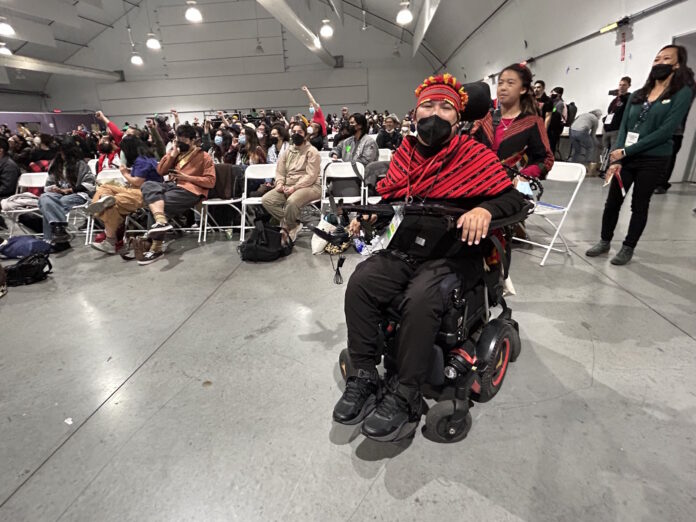
Brandon Lee and his daughter Jesse Jane at the People’s Counter Summit of the No To APEC Coalition, Nov. 11, 2023. Photo by Jia H. Jung
Jia Jung wrote on 20 November, 2023 about Chinese American Bay Area native Brandon Lee who gave the keynote speech at the No to APEC People’s Counter Summit, “People Over Profit and Plunder,” at San Francisco State University on Saturday, Nov. 11, 2023.
Lee was living with his wife and daughter in the Philippines and working as a human rights advocate, land defender, and journalist for the Northern Dispatch when he was shot by Philippine armed forces on Aug. 6, 2019. He survived – as a quadriplegic who remains steadfast in his international activism. Lee said, inter alia:
In high school, I was voted most shyest. I always preferred to work behind the scenes behind the camera, never in front. I was working security during rallies or painting posters the day before.
…In 2003, I transferred to this campus and joined the League of Filipino students at San Francisco State University. That’s where I learned that our country, the United States, continues to dominate and stagnate the Philippine economy, politics, and culture.
Around this time, I also started volunteering for the Chinese Progressive Association. That’s where I learned about the conditions and struggles of immigrant Chinese workers, and tenants. It was at that time I met Pam Tau Lee, the founder of the Chinese Progressive Association.
She was one of my mentors. And that’s where I learned that in the late nineties, San Francisco had 20,000 garment workers. But in less than 10 years, many of the immigrant monolinguistic women workers lost their jobs, with 88% of the workers being offshored to countries with weaker labor protection. It was during these years that I learned how interconnected our struggles are, and I became an internationalist and an anti-imperialist.
In 2007, I went on a life changing exposure trip to the Philippines. I met Youth and Students who are now movement leaders. I joined with workers boycotting Nestlé on their picket line. Ka Fort [Diasdado Fortuna], the chair of their union, was killed in cold blood by state agents. Ka Fort was dearly, dearly loved by the Nestlé workers for his leadership in building the union and his ultimate sacrifice.
So workers also launched a public campaign – “there’s blood in your coffee” – to draw international attention against Nestlé. Nestlé believes that water is a corporate right and not a human right. In this same trip, we visited many sectors, including the most oppressed majority and largest class – the peasants – as well as the Igorot Indigenous people in the northern part of the Philippines.
The Igorots, who live on resource-rich lands, are considered squatters on their own land because the Philippine government considers any land with a slope of 18 degrees Philippine land. The Igorots have been fighting against foreign occupation and colonization for hundreds of years.
And until now, they have continued their fight against government neglect and development aggression, militarization, and for the recognition for the right to ancestral land and self-determination.
On that exposure trip, our group also attended the one-year death anniversary of Alyce Claver, the wife of Chandu [Constancio]Claver, who was the provincial chair of the progressive party, Bayan Muna, and the president of the Red Cross. Chandu and Alyce were driving their kids to school when a motorcycle pulled up and shot at their car. Alyce shielded her husband and was riddled with two dozen bullets. Chandu made it out alive and is now in Canada with his kids after filing for political asylum, but the family today continues to be traumatized.
During this trip, we joined a medical and fact-finding mission to a remotevillage, and thankfully, the military had pulled out. The Indigenous peasants taught us about how the soldiers had blindfoldedthem and pointed a gun to their nape. The soldiers accused the farmers of supporting the land defenders and the resistance fighters known as the New People’s Army. The Philippine militarypretended to have a fake medical mission, giving out expired medicine to the local Indigenous people.
This trip, 16 years ago, changed the direction of my life.
I believe that we are shaped by our experiences, and this exposure program gave me new direction. It fortified my commitment to serving the fight for the Philippine liberation from U.S. imperialism. And to this day, the stories and sacrifices of Alyce Claver, Ka Fort, and so many others continue to fuel my commitment.
Two years later in 2009, I decided to deepen my commitment and decided to do a three-month integration in a remote area deep in the mountains. When I returned, I learned about Melissa Roxas, who was also from the U.S. and was abducted by the Armed Forces of the Philippines. She was conducting a medical mission. After a week, her captors released her as long as she promised to shut up.
She didn’t, though – she didn’t shut up. As she was she was released, she told the world what happened. As a health worker, Melissa diagnosed the Philippines’ societal problems and saw the illness of neoliberal policies from living among the poor. Melissa was brave. Her journey back from the trauma perpetuated by the Philippine military would soon follow for me.
The year following, 2010, I went all in and decided to live and serve the Igorot Indigenous people. I married my girlfriend, who is an Indigenous Ifugao, and we had a daughter, Jesse Jane, who is here with us today. I lived nine years with Indigenous people in the northern part of the Philippines, and I learned how they defended their land rights and lives in the resource-rich area known as the Cordillera region.
I saw firsthand how neoliberal policies promoted by APEC, such as the Philippine Mining Act of 1995, liberalize the mining industry, allowing foreign mining companies to reap 100% profit from the plundering of Indigenous people’s lands, unbridled large-scale destructive mining, dams, energy and other foreign projects, masquerading as development projects, and destroy the environment and forcibly displace Indigenous people who have been living there for generations.
Now, 13 years later, I’m speaking in front of you, a survivor of state violence and war that is spread by APEC and neoliberalism. They say APEC will promote sustainability. The Indigenous community say no. They are robbed of their life, land, culture, and worse, their future. Despite decades of people’s resistance, the plunder the natural resources, of indigenous – of ancestral – domains, continues. The region is blanketed with 176 large-scale mining and more than 100 energy projects, such as hydropower and geothermal projects awarded to private corporations.
One such energy project is the Chevron geothermal power project, which covers a large area in Kalinga. If left unchallenged and unopposed, all these could mean the ethnocide of the Igorots and the massive destruction of the ecosystem in the Cordillera region…
Indigenous communities were militarized, bombed, and strafed with artillery shelling, but they did not cower and they did not back down. They remained steadfast. They took care of each other. And they continued to hold the line.
They say APEC is innovative and will solve our problems. Hell, no.
Because I protested alongside the Indigenous communities, and, as a journalist, wrote about the daily attacks they face, I was also threatened and harassed. I was placed under surveillance. Tailed. Followed. They watched our office. They took pictures of us at our office and homes, as well as the tricycle, jeep, and bus terminal. I was red-tagged and politically vilified as a terrorist. I experienced death threats in the form of the burial blanket for the dead. I was detained and had my bag illegally searched at a military checkpoint the week before members of the 54th Infantry Battalion of the Philippine Army shot me in front of my daughter in front of my home on August 6th, 2018.
They had visited me at my house and office looking for me. They said they wanted to partner with my organization, the Ifugao Peasant Movement, but we refused. I told them two names – William Bugatti and Ricardo Mayumi – on why we do not want to partner with them.
While their assassination attempt against me was unsuccessful, I am permanently scarred and paralyzed. I am now quadriplegic, unable to use my hands and legs. I am considered one of the lucky ones. But I live with trauma every day. [see also: SF human rights activist fights for his life after being shot in the Philippines]
I know firsthand that the backdoor trade deals handled by APEC will not benefit the people; they only benefit the corporations and imperialist countries like the United States. That is why the United States sends its military around the world, finance schools, support fascist governments – to open up industries.
In fact, I have no doubt that the bullets lodged in my body today are paid by our taxpayer dollars.
Although I am paralyzed physically, they have failed to shut me up.
Today, I am proud to be standing with you, metaphorically speaking, in fighting back against APEC. Against state and political repression. Against corporate greed and power. Against the wealthy elite. Against the plunder of our planet. Against foreign domination of our peoples.
The Indigenous communities are resilient also. Like millions of people in the Global South, they are fighting back. They continue to protest despite being attacked. They have successfully barricaded several mines, rejecting countless mining and dam projects.
They have been on the frontlines of fighting the WTO [World Trade Organization], dismantling the Chico Dam equipment during the late dictator Marcos, which launched a coordinated people’s response that brought the Indigenous people to the national liberation struggle.
They are also on the frontlines of fighting APEC; a fight has led thousands to take up armed struggle as an appropriate response to defending their land, which is their life.
One of their martyr freedom fighter, Arnold “Ka Mando” Jaramillo, favorite expression ispayt latta! It means fight to the end, or continue to fight, and it’s today emulated by the Cordillera mass movement. Payt latta.
I will continue to fight as long as I breathe. Take a look around – my story is just one of many. There are a thousand people here today, diverse and multigenerational, coming from across the world, each with their own journey, own experiences, and reason for being here. But what unites us all is our opposition to APEC and neoliberal policies. We have so much in common – so much we can unite and rage against. A common enemy – APEC – and the neoliberal policies that prioritize profit and plunder over people and planet.
We will not go gently into that night. Rage. Rage! We will fight!
We will fight for a better future for all. Let us continue to talk, to build and work together, now and after APEC. For now, are you ready? Are you ready to shut down APEC?
On 21 November, 2023 the Martin Ennals Foundation, joined by HRW and the ISHR, issued the following statement:
The Martin Ennals Foundation condemns the harassment of Soltan Achilova and her daughter by government authorities at Ashgabat airport and calls for Turkmen authorities to stop their reprisals against journalists for their human rights work.
In the early hours of November 18th, 2023, Mrs. Soltan Achilova and her daughter were stopped by Turkmen government officials from boarding their flight for Switzerland. A customs official took their passports, wet them with a damp rag and declared the passports to be ruined, effectively obstructing Soltan from traveling to Geneva where she would feature as a keynote speaker at the University of Geneva’s Human Rights Week 2023.
This act of harassment and denial of freedom of movement is particularly reprehensible in that it comes only a few days after Turkmenistan’s 4th Universal Periodic Review, during which high-level government representatives expressed their “support for …the promotion and protection of fundamental freedoms and human rights“, giving multiple examples of their progress in terms of respect for freedom of expression.
Soltan Achilova believes she was not allowed to leave the country because of the authorities’ fear that negative information might be heard during the Human Rights week in Geneva. Yet, the obstruction from travel of an internationally recognized human rights defender is more striking evidence of the lack of freedoms in the country and the bad faith with which the Turkmenistan government engages with the Human Rights Council.
Turkmenistan is one of the most repressive and isolated countries in the world, ranking 176th out of 180 countries in terms of press freedom and working conditions for journalists. Soltan has been reporting about her country for more than a decade. Her pictures of daily life are one of the few sources of documentation of human rights violations occurring in this most secretive nation. In 2021, Soltan was recognized by the Martin Ennals Award for her documentation of land grabs and forced evictions of ordinary citizens in Ashgabat.
Soltan has not been allowed to travel freely outside of her country on several occasions. She is under constant surveillance by Turkmen authorities and has suffered numerous incidents of harassment, intimidation, and threats. Despite the challenges, Soltan persists in her human rights work, regularly sending information and pictures outside of the country so that government authorities are held to account.
We renew calls for Turkmenistan to fully implement their human rights obligations, including, inter alia, allowing human rights defenders and journalists to conduct their work peacefully. We invite Member States accompanying the 4th Universal Periodic Review of Turkmenistan to strongly sanction the silencing of Soltan Achilova and other Turkmen journalists.