At the 2015 Oslo Freedom Forum, on 27 May 2015, Tunisian human rights defender Amira Yahyaoui talks about the global youth as an underrepresented force in many governments. She draws attention to the fact that while the world’s citizenry is increasingly young, the global leadership remains old. She criticizes the lack of representation of women and youth by reminding us that these so-called “minorities” are, in fact, majorities in the world population. If we don’t fix this problem, she argues, more and more young people will be driven to extremist groups like the Islamic State where they are given the opportunity to lead.
For World Refugee Day 2015 (20 June) the United Nations High Commissioner for Refugees [UNHCR] has released several films featuring celebrity supporters that tell the human side of the refugee plight. This years’ campaign aims to bring the public closer to the story, showing refugees as ordinary people living in extraordinary circumstances. World Refugee Day 2015 is marked against a backdrop of multiple conflicts, growing numbers of forcibly displaced people and a rising tide of intolerance and xenophobia in many parts of the world.
The films feature UNHCR Goodwill Ambassador and best-selling author, Khaled Hosseini, photographer and supermodel Helena Christensen, singer/songwriter Maher Zain and actor Jung Woo-Sung . The films were recorded during recent field visits. Each supporter introduces an individual refugee and their story. These films and other refugee stories can be found on UNHCR’s Campaign website: www.refugeeday.org.
UNHCR offices in some 120 countries are planning various events including the film première of Salam Neighbor in Washington D.C.
The site www.refugeeday.org features stories from refugees who describe in their own words their own passions and interests; cooking, music, poetry, or sports. Through their testimonials UNHCR aims to show that these are ordinary people living through extraordinary times.
Canadian-born Libyan activist Alaa Murabit speaking at 2015 Oslo Freedom Forum (26 May) shows how ongoing conflict has affected daily life in Libya. She stresses the importance of acknowledging and integrating local communities in peaceful solutions, and focuses on the key role women in particular should play in peacebuilding. Murabit shares how her organization, the Voice of Libyan Women, organized the largest grassroots campaign in the country to address security issues, the cycle of violence, and the rights of women. She emphasizes that by creating cohesive and cooperative societies, rather than ones divided into factions, Libya can achieve peace and stability.
Rayma Suprani, one of the few female cartoonists in Venezuela, spoke at the 2015 Oslo Freedom Forum on 26 May about the role that humor plays in resisting tyranny, and how cartoons are the thermometers by which we measure freedom. She believes that critical drawings are crucial to testing the strengths of a democracy. Suprani worked at El Universal, one of Venezuela’s largest newspapers, for 19 years before she was fired last year after publishing a cartoon that mocked the legacy of Hugo Chávez and the state of the Venezuelan health care system. She remains defiant, and reminds us that humor is the key to ending repression: we should teach our children to wield pens, not guns.
Another speaker at the Oslo Freedom Forum (OFF) 2015 was Charlie Hebdo columnist, Zineb El Rhazoui, who paid tribute to her colleagues slain in the January 2015 attacks [she was at the time of the attack abroad] and describes her own experience facing thousands of death threats. In her passionate defense of free speech, El Rhazoui argues that criticism of religion should be encouraged, not avoided. The personal touch in her presentation is moving.
The 2015 Oslo Freedom Forum which was held this week featured more than 30 speakers from around the world, mostly human rights defenders with a story to tell. I will include over the coming days a selection of their videos. The first is: “My Impossible Escape from North Korea” A talk by North Korean defector Ji Seong-ho describing his extraordinary 6,000 mile journey to freedom. Ji survived being struck by a coal train and losing his hand and foot to a grueling amputation, and now helps other defectors escape.
It may not be news to the readers of this blog but it is good to heart the Office of the Un High Commissioner for G+Human Rights say it: “Movies are powerful” said Elena Ippoliti, Human Rights Officer for the UN Human Rights Office. “Sometimes, young people can open their eyes more through an eight-minute film, than through a two-hour lecture.”
For a decade the Office has partnered with the International Film Festival and Forum on Human Rights (FIFDH) in carrying out an educational programme, which takes place during the annual film festival. It provides screenings and discussions of a selection of human rights films for students mainly attending the secondary schools in Geneva. The festival was getting good audiences, but films were being seen by people who were already familiar with the issues. He said reaching out to schools seemed a natural fit.
Ippoliti said the education programme is also a chance for the Office to work at a local level in the headquarters host city of Geneva: “We, OHCHR Geneva, work at the global level. But by working with schools here, we also reach out to the local level,”.
An example of how (making) film can teach young people to become human rights defenders. This comes Essex county in the USA.
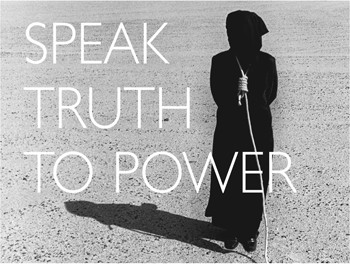
The Speak Truth To Power student video competition encourages school students to become engaged in human rights. The video contest is sponsored by New York State United Teachers and the Robert F. Kennedy Center for Justice and Human Rights and is based on Kerry Kennedy’s book Speak Truth To Power. Students who participate in the contest must choose one of the individuals identified by the RFK Center Human Rights and create a three- to five-minute short film. The contest is looking for student films that utilize creative storytelling to teach others about a human rights issue. The format is open to documentary, stop motion, narrative, digital photo essay or other innovative explorations that involve filmmaking components.
Two Bloomfield Tech students, Christopher A. Rodriguez and Julio Villegas, won the first place in the video contest with a five-minute film about genocide and focused on Holocaust survivor and human rights activist Elie Wiesel. This feat was proudly reported in the local media on 21 April:
“Essex County Executive Joseph N. DiVincenzo, Jr. and the Essex County Vocational Technical School District …… are all very proud of Chris and Julio for winning the top prize in the RFK Human Rights Center’s student film contest. ……..It was important to share their film with our Essex County audience to raise awareness of this emotional issue and to highlight the exceptional work of our students”.
The first public premiere of the film was made Tuesday, April 21st during the afternoon celebration in Newark. In addition, the will be shown at the Tribeca Film Festival in New York City on Thursday, April 23rd.
Elected and school officials shared their pride about the students’ accomplishment:
“I want to thank our students for their courage and their hard work,” Essex County Vocational Technical School Board President Father Edwin Leahy said. “Every time you speak the truth, you don’t get a crowd like this. You have to continue to do what is right even if you don’t have a lot of support”.
“Today is an amazing celebration of education,” said Bloomfield Tech Social Studies Teacher Jennifer DaSilva, who gave the students’ the assignment. “Both students have flourished in our Diaspora class. Their film is extraordinary and helps raise awareness about the tragedies taking place in the world today”.
Also sharing words of encouragement were Assemblywoman Sheila Oliver, Freeholder Patricia Sebold, Sheriff Armando Fontoura and Chief of Staff Phil Alagia.
The Hollywood Reporter (THR) of 20 April 2015 contains an interesting and detailed piece by Paul Bond who went with the Human Rights Foundation on a trip to South Korea, to see how defector send films, television shows, books, and offline versions of Wikipedia into North Korea. The experience inspired nine articles, all of them published on THR’s website, but the centerpiece is this one: ‘The Interview’ Sequel: Inside the Frightening Battle Raging on the North Korean Border’. The articles all together give an interesting picture of the powerful role that film can play in the case of closed societies where there is hardly any internet (here North Korean), but also how the South Korean authorities out of fear for retaliation limit the human rights defenders’ actions.
Left: U.S. resident Thor Halvorssen filled bags with The Interview,leaflets and American music to be ballooned into North Korea but was stopped April 9 by South Korean police. Right: Lee Min Bok prepared a balloon with Interview,Zero Dark Thirtyand U.S. dollars but was prevented from launching it by two guards.
To trick North Korean authorities, Interview begins with state propaganda clips before switching abruptly to a 12-minute subtitled edit of Interview — a bit from the beginning, middle and end, with the more vulgar parts removed.
The conference “Defending the defenders!”, hosted by the six women Nobel Peace Prize Laureates, will bring together 100 women human rights defenders and organizations working to support them in order to advance the global agenda to protect women’s human rights defenders. During two days, participants will examine trends of threats that women all over the world face, and the strategies they employ to address these threats.
The conference is designed for maximum interaction, learning from each other, open dialogue and strategizing. It will include panels, participant-led discussions, skill-related workshops and strategy sessions. Participants will be able to showcase their work, including relevant films and documentaries, and have time to socialize and reconnect with each other. Invited participants will be women who are:
• Civil society activists and women human rights defenders from at least 20 different countries
• Academics
• Government officials
• Corporates
• Donor organizations and philanthropists
• Media (including journalists, filmmakers, writers and social media experts)
From 24-26 April 2015 in Duin & Kruidberg, Netherlands


 Hans Thoolen on Human Rights Defenders and their awards