Archive for the 'books' Category

Prominent UK lawyers: Suspend Saudi Arabia from UN Human Rights Council

February 2, 2018

In July 2016 two major NGOs (HRW and AI) teamed up to try and get Saudi Arabia suspended from the UN Human Rights Council (https://humanrightsdefenders.blog/2016/07/05/amnesty-and-hrw-trying-to-get-saudi-arabia-suspended-from-the-un-human-rights-council/). Now Al-Jazeera reports that British lawyers have called for Saudi Arabia to be removed from the United Nations Human Rights Council, stating that the kingdom detains political and free speech activists without charge.

In a report released on Wednesday 31 January 2018 in London, Rodney Dixon QC and Lord Kenneth Donald John Macdonald said more than 60 individuals were detained in September last year, “many of whom are believed to be human rights defenders or political activists”.

“Our main recommendation is that steps should be taken by the General Assembly to suspend the government of Saudi Arabia from the [UN] Human Rights Council,” Dixon told Al Jazeera. It is “completely contradictory and ironic for a government with systemic patterns of abuse – as we have highlighted in the report – to be sitting on the council, and in fact previously to have chaired the council….That suspension will act as a major lever for the government to clean up their act and make a proper new start.”

The report, titled Shrouded in secrecy: the human rights situation in Saudi Arabia following arrests in September 2017, was commissioned by the relatives of detainees and will be forwarded to Saudi authorities. “Those detained have not been charged with any offence, and the information about the reasons for their arrests and circumstances of their imprisonment are very limited,” the report said. “There is cause for serious concern about the treatment of many of those detained, including Mr Salman Al-Awda who has recently been hospitalised and others who are, effectively, disappeared.” Awda is one of Saudi’s most popular Muslim leaders with almost 150 million followers on Twitter. He was recently hospitalised after five months of solitary confinement. It remains unclear why he was arrested..

Saudi Arabia’s membership in the United Nations Human Rights Council expires in 2019. “The suspension of membership rights is not simply a hypothetical possibility,” the report said.In February 2011, the council called for Libya to be suspended as the government of Muammar Gaddafi was being accused of human rights violations against civilians during the uprising. A month later, the General Assembly voted for the suspension of Libya’s membership – marking the first time it has used its power to revoke a country’s membership.

http://www.aljazeera.com/news/2018/01/uk-lawyers-remove-saudi-human-rights-council-180131114753148.html

FIDH looks back at 2017 with its annual comic strip

February 1, 2018

On 30 January 2018, FIDH publishes the comic strip version of its Annual Report created by graphic artist Romain Ronzeau and the graphic artists from Cartooning for Peace. Illustrating some of the victories and battles of 2017, the artists eloquently convey the essential: in times of crises, defending human rights is more necessary than ever. [for last year’s see: https://humanrightsdefenders.blog/2017/03/28/fidh-looks-back-at-2016-in-comic-strip/]. Good to see that the tradition is being kept up!

On the occasion of the comic strip Annual Report’s release, FIDH reaffirms its support for all graphic artists and caricaturists who are subjected to threats and attacks on a daily basis.


for the full version see: https://www.fidh.org/en/impacts/fidh-looks-back-at-2017-in-our-traditional-comic-strip

Human Rights NGOs in Europe no longer the standard to follow!

January 27, 2018

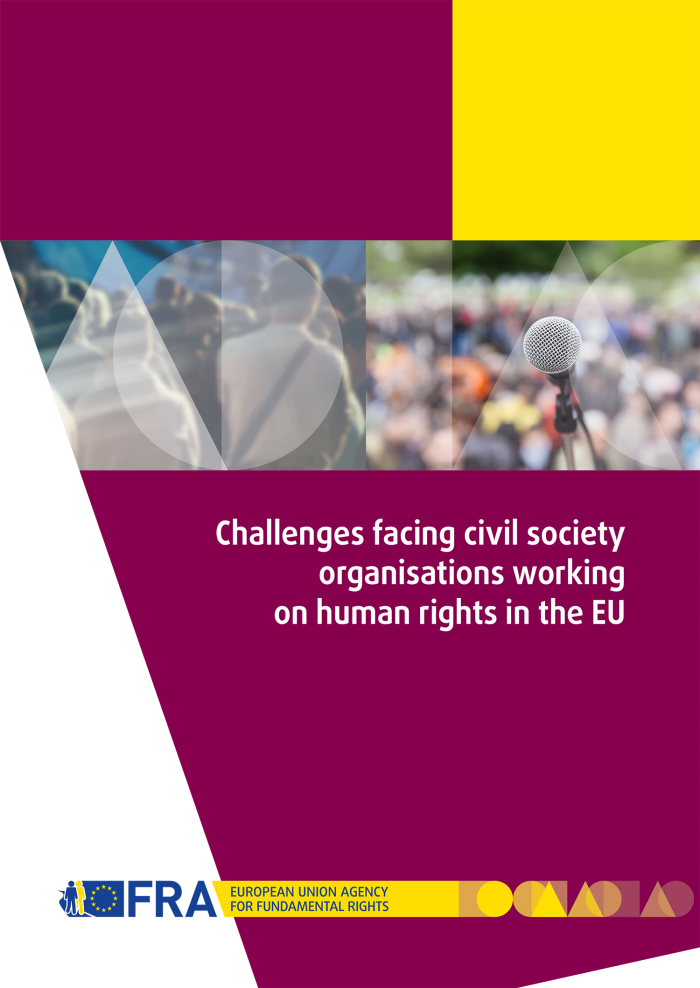
In January 2018 the EU Fundamental Rights Agcncy (FRA) published a Report “Challenges facing civil society organisations working on human rights in the EU“. Its conclusion is that the situation is getting more difficult. Also, on 26 January 2018, the Thomson Reuters Foundation published an interview with Michel Forst, the U.N. Special Rapporteur on human rights defenders said that the EU are setting a bad example by allowing some of its members to stifle human rights groups, which is encouraging crackdowns elsewhere in the world.

In the interview done by Umberto Bacchi, Michel Forst said that the EU has historically done a good job supporting and protecting rights advocates worldwide but the bloc’s authority is now being undermined from within. Officials in Burundi, Democratic Republic of Congo, Israel and other countries pointed at recent laws in Hungary and Poland to justify their own regulations which may curb the independence of non-governmental organisations.

There is a need for European countries to be more coherent … not to teach human rights outside of Europe and then not respecting human rights inside Europe,” said Forst, the U.N. Special Rapporteur on human rights defenders. Charities in dozens of countries, from Angola to India and Tajikistan have faced restrictions targeting their funding and operations over the past two years, according to an EU report. The trend is part of a global backlash on civil society that has seen rights activists in some parts of the world criminalised or branded as troublemakers, Forst stated.

Last year, Hungary introduced a measure requiring NGOs that get money from abroad to register with the state, a bill that NGOs say stigmatizes them and is intended to stifle independent voices. [see also: https://humanrightsdefenders.blog/2014/06/13/human-rights-defenders-in-hungary-not-yet-foreign-agents-but-getting-close/]. Poland instead introduced legislation to set up a centralised authority controlling charities’ funding. [see also: https://humanrightsdefenders.blog/2017/03/02/backsliding-on-civic-space-in-democracies-important-side-event-on-3-march-in-geneva/%5D. As countermeasure, the EU should boost direct funding of rights groups operating within its borders, Forst said. “What is absurd for me is that the EU is funding organisations in Latin America, in Africa – which is good – but there is no more funding for EU NGOs,” he said. Money should be allocated from a dedicated fund and not channelled through governments, he said.

Besides Europe, Forst also singled out Australia for its treatment of asylum seekers held in offshore camps, adding it was “not a safe place” for human rights defenders due to pressure from the government. A December report by Pro Bono Australia and the Human Rights Law Centre, two rights groups, found Australian NGOs were often pressured into “self-silencing” their advocacy work fearing funding cuts and political retribution.

(Global civil society) space is shrinking because it is shrinking in Europe, because it is shrinking in the Americas, in Australia,” said Forst.

—-

The FRA’s report finds that civil society organisations in the European Union play a crucial role in promoting fundamental rights, but it has become harder for them to do so – due to both legal and practical restrictions. This report looks at the different types and patterns of challenges faced by civil society organisations working on human rights in the EU. While challenges exist in all EU Member States, their exact nature and extent vary. Data and research on this issue – including comparative research – are generally lacking. The report also highlights promising practices that can counteract these worrying patterns.

First quantitative analysis of 16 years outgoing ‘communications’ by Special Rapporteurs on Human Rights Defenders

January 26, 2018

On 24 January 2018 an important study was made public about the work of the UN Rapporteurs on Human Rights Defenders. It concerns the study “Chasing Shadows: A Quantitative Analysis of the Scope and Impact of UN Communications on Human Rights Defenders (2000–2016)” by Janika Spannagel and published by the Global Public Policy Institute. At the bottom of this post there is link to downloading the full report. [see also: https://humanrightsdefenders.blog/2017/12/11/good-introduction-to-the-anniversary-of-the-un-declaration-on-hrds-in-2018/].

Each year, the United Nations Special Rapporteur on human rights defenders receives a large number of submissions regarding individual cases of concern. Only a fraction of these cases are addressed by the rapporteur’s communications procedure. Unlike outgoing communications, incoming cases are not publicly reported or even systematically registered by the UN. Furthermore, the criteria for the selection of cases (beyond basic eligibility) remain largely undefined. The consequences of case selection, whether according to explicitly stated rules or implicitly applied criteria, are quite significant. Currently, only 550 individual cases can be addressed by the mandate each year. [there are tremendous constraints in terms of staff.] Given this reality, the case selection process defines which types of defenders under pressure receive the UN’s attention and legitimization – and which do not. Nobody can determine with certainty how many cases have fallen through the cracks over the 17 years the mandate has been in existence, or who tends to benefit from the UN’s attention and who is often overlooked.

Based on extensive empirical research, this policy paper provides the first systematic analysis of all communications sent out to date. It finds credible indications that outgoing communications have a positive impact, but also demonstrates that there is room for improvement. In particular, a more deliberate prioritization of cases is required to ensure that the mandate can serve its protective purpose more effectively under the constraints of very limited resources.

The policy paper advocates an approach that aims to maximize the potential impact on the individual defender while systematically striving for a balanced documentation of cases. It makes an evidence-based argument for a number of adjustments and offers actionable recommendations to the mandate as well as to the Office of the High Commissioner for Human Rights, to states, and to civil society actors regarding how to enhance the effectiveness of UN efforts to protect threatened human rights defenders around the world.

Among others, the paper recommends that the use of joint special procedures communications should be the exception rather than the rule, that states’ replies to cases should be systematically monitored and the respective data publicly released, and that more concerted international action should be taken with regards to ‘softer’ forms of repression.

preview

Download PDF (679.81 KB)

see also: https://humanrightsdefenders.blog/2017/06/08/news-from-the-hrc34-mandate-of-the-special-rapporteur-on-human-rights-defenders-extended/

http://www.gppi.net/publications/human-rights/article/chasing-shadows/

More annual reports 2017: Freedom House

January 19, 2018

Having just blogged about the annual report of HRW and AI USA (see links below), I hasten to say that there are several other annual reports referring to President Trump’s damaging effect on human rights and democracy. Freedom House, for instance, issued its annual report 2017 which pointed out that Trump’s penchant for attacking civil society groups, the media, and even the courts have a tangible, negative impact, stating that, “the administration’s statements and actions could ultimately leave them weakened, with serious consequences for the health of U.S. democracy and America’s role in the world.” The report noted that under Trump, the United States has seen the sharpest drop in political rights and civil liberties in over 40 years.

Key Findings:

  • With populist and nationalist forces making significant gains in democratic states, 2016 marked the 11th consecutive year of decline in global freedom.
  • There were setbacks in political rights, civil liberties, or both, in a number of countries rated “Free” by the report, including Brazil, the Czech Republic, Denmark, France, Hungary, Poland, Serbia, South Africa, South Korea, Spain, Tunisia, and the United States.
  • Of the 195 countries assessed, 87 (45 percent) were rated Free, 59 (30 percent) Partly Free, and 49 (25 percent) Not Free.
  • The Middle East and North Africa region had the worst ratings in the world in 2016, followed closely by Eurasia.

https://humanrightsdefenders.blog/2018/01/19/human-rights-watch-and-kenneth-roth-take-a-stand-against-trumps-dictator-friendly-policies/

and https://humanrightsdefenders.blog/2018/01/19/ai-welcomes-resistance-to-trumps-human-rights-policies/

——

https://freedomhouse.org/report/freedom-world/freedom-world-2017

AI welcomes resistance to Trump’s human rights policies

January 19, 2018

Having just posted about HRW’s annual report [https://humanrightsdefenders.blog/2018/01/19/human-rights-watch-and-kenneth-roth-take-a-stand-against-trumps-dictator-friendly-policies/], I wanted to share also the assessment by AI USA on 19 January 2018: “USA: ‘resistance’ to Trump hailed after year of human rights violations”.

President Trump’s regressive policies have led to an upsurge in human rights activism © Amnesty International

Ahead of the one-year anniversary (20 January) of the inauguration of US President Donald Trump, Margaret Huang, executive director of Amnesty International USA, said:

“While the policies of the Trump administration presented daunting challenges over the past year, we also saw the rise of a fierce and determined movement of people across the country and around the world standing up to defend human rights.

“Starting with the throngs of people braving the January cold to fill the streets on the very first day of his presidency and continuing throughout the year, we have taken heart in the galvanising spirit of resistance that has swept the world. 

“We have marched alongside both seasoned activists standing up for women’s rights and we have welcomed those who have never actively protested before in denouncing Trump’s discriminatory Muslim ban. 

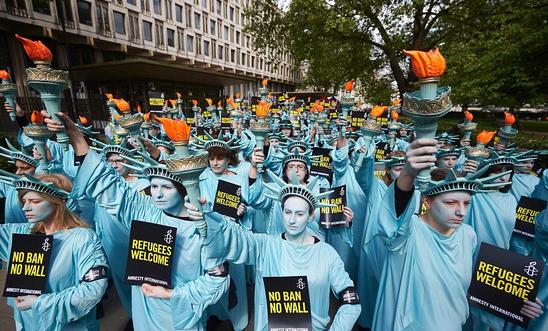
“We have placed welcome mats for refugees at the foot of Trump Tower, and filled London’s Grosvenor Square with 100 sombre Statues of Liberty standing in silent protest at the US Embassy.  

“From Sydney to Madrid, human rights defenders have made it known that the politics of hate and fear have no place in the world we wish to build for ourselves and our children.

A year of human rights violationsAmong other things in the past year, Amnesty has strongly criticised the Trump administration’s plan (reported earlier this week) to consider using nuclear weapons in response to a cyber-attack in the USA; the ending of “Temporary Protected Status” for over 250,000 people from El Salvador in the USA; the decision to recognise Jerusalem as the capital of Israel, its insistence on pushing ahead with a revised multi-country travel ban; an executive order affecting the Mexico-USA border which allows for the forcible return of people to life-threatening situations;  the withdrawal from the Paris Agreement on climate change; the reinstatement of the “global gag rule”affecting funding for international women’s health programmes; its continued sale of military equipment to countries with poor human rights records; and the decision to continue the construction of the Dakota pipeline despite environmental and cultural concerns. 

Human Rights Watch and Kenneth Roth take a stand against Trump’s dictator friendly policies

January 19, 2018

In its annual report on the state of human rights around the world for 2017, Human Rights Watch (HRW) said growing intolerance in states like the US represented “an enormous threat” to minority groups in those countries. Donald Trump‘s public admiration for strongman leaders and breaking of “taboos against racism and xenophobia” have encouraged oppression around the world.

Its executive director, Kenneth Roth, struck out at the US President who he said “displays a disturbing fondness for rights-trampling strongmen”. He cited Russian President Vladimir Putin and Rodrigo Duterte, of the Philippines, as examples, saying: “This makes it much more difficult to stigmatise these authoritarian leaders when Trump says these are great guys.”

Mr Roth added in a post accompanying HRW’s 2018 world report that in the past year, ”Secretary of State Rex Tillerson largely rejected the promotion of human rights as an element of US foreign policy while more broadly reducing the role of the US abroad by presiding over an unprecedented dismantling of the State Department.” “He refused to fill many senior posts, dismissed several veteran diplomats, slashed the budget, and let the department drift. Many career diplomats and mid-level officials resigned in despair,” .

The report urges democratic governments to address the problems that allowed populism to prosper in 2017, such as income inequality, fears of terrorism and growing migration. HRW hailed Emmanuel Macron’s victory in France’s elections as a “turning point”, saying he had “openly embraced democratic principles” on his way to defeating the far-right Marine Le Pen.  HRW also criticised the “hesitancy” of the EU to intervene in specific cases of rights abuse: “President Recep Tayyip Erdoğan decimated Turkey’s democratic system as the EU focused largely instead on enlisting his help to stem the flight of refugees to Europe and security cooperation. President Abdel Fattah al-Sisi crushed public dissent in Egypt with little interference from the US or the EU, which accepted his claim that he was providing stability.

In the USA, HRW’s report said, “civic groups, journalists, lawyers, judges, many members of the public, and sometimes even elected members of Trump’s own party” had reacted against what it called the President’s “regressive” outlook.

(The Trump administration did make interventions in support of human rights in a limited number of countries such as Iran and Cambodia.)

Helas, the HRW report confirms what many feared earlier in 2017, see e.g.: https://humanrightsdefenders.blog/2017/02/24/2017-10-need-to-reset-for-human-rights-movement/.

———-

http://www.independent.co.uk/news/world/donald-trump-human-rights-watch-world-report-hrw-oppression-encourage-news-media-a8165381.html

http://fp-reg.onecount.net/onecount/redirects/index.php?action=get-tokens&js=1&sid=b8ofn3rfd1a65vca5imc12g270&return=http%3A%2F%2Fforeignpolicy.com%2F2018%2F01%2F18%2Fhow-to-stand-up-for-human-rights-in-the-age-of-trump%2F

More on “residential surveillance in a designated location” (RSDL) in China

January 10, 2018

The People’s Republic of the Disappeared documents the experiences of Chinese activists (and one Swede) placed into “residential surveillance at a designated location” (RSDL). Several of those who wrote about their experiences for the book say their time in RSDL was worse than any previous treatment they had experienced, whether in legal detention centers or illegal “black jails.” What about RSDL makes it the most feared type of detention in China?

Enjoying this article? Click here to subscribe for full access. Just $5 a month.Under Xi Jinping, China’s assault on the human rights community has escalated to extremes not seen since the 1989 Pro-Democracy crackdown, while technological advancements, not to mention certain complicit foreign companies, have allowed for unprecedented increases in police capacity and state control. Add to that an effort by the Party to weaponize the law through legislation whose only purpose is to mask its authoritarian objectives behind false talk of rule of law. The revised Criminal Procedure Law, in which RSDL is codified in Article 73, is case in point, as it grants agents of the state effectively unfettered power, often in violation of fundamental international law, to act in the preservation of national security, which is synonymous with the preservation of Party supremacy.

RSDL is so feared, arguably, because it is so quintessentially totalitarian, right down to the ubiquity of black hoods and midnight raids, evoking scenes from V for Vendetta. Little is known, but that is slowly changing, about what it means to disappear in China. Even a few years after it came into effect, in 2016 many people were still misled by the euphemistic title, the residential in RSDL. Torture is common. RSDL is a tool of repression, designed to terrorize and demonstrate power. It is so feared because it was designed to be feared.

One thing that can be done to address this fear is just to spread knowledge about RSDL. Indeed, many frontline human rights defenders have spoken about the protective quality of reading or hearing stories about others’ experiences in detention, such as the pamphlet a Guide to Drinking Tea by Wu Gan, who was recently sentenced to eight years in prison for his rights defense, or Hua Ze’s book In the Shadow of the Rising Dragon, which was a big inspiration for The People’s Republic of the Disappeared. Indeed, one of the goals of this book was to provide some protection for at risk human rights defenders, to mitigate their fears with the stories of others so they would at least be a little better prepared for what to expect.

Is the use of RSDL, as compared to other forms of detention (legal and not), reserved for a particular type of person? Those who contributed their stories for the book are lawyers and rights defenders; who else might find themselves “disappeared” into RSDL in China?

According to Article 73 of the Criminal Procedure Law, residential surveillance may be enforced at a designated location — in other words in secret and outside the protection of the law — in cases involving endangering national security, terrorism, or serious bribery, and when enforcement in the individual’s actual residence may “impede the investigation.” Of course, the police are also able to deny access to the state prosecutor if it “impedes the investigation” so this notion rings hollow. Based on this, we see at least three vaguely defined categories of people who may find themselves disappeared into RSDL. The connotations of these categories generally refer to human rights defenders who are common targets of RSDL, ethnic minorities and predominantly Uyghurs for whom another system for disappearances is widespread, and elites or political opponents, for whom yet another system for enforced disappearances, shuang gui, exists. If you look closely, China maintains several distinct systems for disappearance, each one generally targeting one demographic or another.

Why do you think the Chinese government made the effort to legally define RSDL, granting it a legitimate status, only to disregard any and all legal safeguards while actually holding detainees? 

China cares about image. The Party wouldn’t harass and detain its critics if it didn’t care. It recognizes the international community places importance on the rule of law, at least rhetorically; indeed there are plenty of other offenders. But China, and as we are seeing with more countries in the region, has perfected the weaponization of the law. Legislation is passed to fit a particular template for good governance and the rule of law, trials are convened, and judgments are passed, “in the spirit of the law” or “based on relevant domestic regulations” or within its “judicial sovereignty.” Absurdly politicized, and yet successful. Some recent examples of China’s success with this strategy are Apple cravenly withdrawing VPN access for Chinese iTunes Store users and Springer Nature agreeing to censor political journals, both out of supposed deference to domestic regulations. Passing legislation such as the Criminal Procedure Law and additional regulations on RSDL, for example, allows the government to hide its normalization of enforced disappearances, and other serious rights violations including torture, behind the veneer of the rule of law.

But China fails. Firstly, international law is clear that enforced disappearances are a grave human rights violation and crime, without any exception or circumstance, including state of war or emergency or national security. This is customary international law, binding upon all countries regardless of treaty ratification. Secondly, China’s rhetoric of the rule of law falls apart against international standards that the law be accessible, predictable, equitable, and accountable. None of these features are effectively present, especially with RSDL. China may try to convince the world that it is a country based on the rule of law but this is actually the rule by law, or legalist authoritarianism.

Obviously numbers are impossible to come by, thanks to the secretive nature of the practice. But do you have an estimate for the number of people held in RSDL, or the number of “disappeared” overall in China?

As I point out in the chapter on RSDL and international law, because enforced disappearances are so heinous they may rise to the level of a crime against humanity if, put simply, they are part of a widespread or systematic attack on a civilian population, and in the last chapter I go into more detail about what this means.

I would like to add that while the book focuses mainly on human rights defenders, by far the largest demographic of disappeared in China are Uyghurs, who starting after the 2009 Urumqi riots and accelerating under Xinjiang Party Secretary Chen Quanguo since 2016 have disappeared in waves, with many never heard from again. Like RSDL, the state has many euphemisms for its systems to disappear Uyghurs, the most widespread being “political education.”

In terms of the book, human rights defenders are a major targeted demographic for disappearances under RSDL. By most estimates the number of victims of RSDL range from the hundreds to the thousands. These are those who are placed under RSDL for a few days to those who are kept for the full six months, to those who are subjected to even lengthier and wholly illegal disappearances following RSDL such as with lawyer Wang Quanzhang. An old friend, the book is in fact dedicated to Wang Quanzhang, who remains missing now after nearly two and a half years.

When conceiving the numbers of victims, we should bear in mind that international law also recognizes the family members of the disappeared as victims of enforced disappearance, and as such Li Wenzu, Wang’s wife, and the many other spouses, parents, and children of the disappeared must also be counted among the victims of disappearance in China.

Part of the reason why it is so difficult to know the precise numbers of disappeared under RSDL or other mechanisms for disappearance in China is that they are by definition secretive. Furthermore, the same condition that calls RSDL into existence, a claim of national security, allows for the refusal to acknowledge details. For example, while the Supreme People’s Court maintains a database on all cases and includes cases that involve RSDL, many known cases are left out of the database due to national security exceptions on listing case information. Confronting this lack of quantifiable information is precisely why it is so important to engage in monitoring and analyzing China’s use of enforced disappearances, such as the undertaking of the recently launched RSDLmonitor.

At the same time, while it is important to develop a fuller picture of how widespread disappearances are under RSDL, arguably what matters more is how systematic the state has been in its legislation and implementation of disappearances. There is already enough evidence to see that RSDL is systematized and organized enforced disappearances as a Party policy.

The narratives in the book paint the picture of human rights defenders under siege — many of the chapters describe actively preparing to be taken away by the state, after having watched friends and allies suffer the same fate. Over a year after the “709 crackdown,” what is the state of the Chinese activist community? To phrase the question another way, has the authorities’ brutal suppression campaign worked?

The Chinese rights defenders who I have been honored to meet or work in support of are the most resilient and courageous group imaginable. Here is a community struggling for the rights and interests of their fellow citizens, intimidated, brutalized, disappeared, imprisoned by their government and yet they continue. Wang Quanzhang, the last remaining disappeared human rights lawyer of the 709 Crackdown, is case in point. His bravery is an inspiration. For all his attempts to terrorize, Xi Jinping cannot sap the human rights community of its vitality. This campaign, despite its severity and sophistication, like its predecessors, will just lead to new voices, new leaders, new tactics, and new pillars of support. As long as the Chinese Communist Party tramples on the rights of its citizens, there will be a human rights community, and that is because, if I may quote Foucault, “Where there is power, there is resistance.”

How can the international community effectively respond to Chinese human rights violations like RSDL and the torture of detainees?

As I write in the conclusion, it is not easy to confront China, which wields what scholars describe as sharp power and economic statecraft to intimidate and influence, while at the same time either manipulating international law and organizations to its own design, such as with Interpol, or hollowing them of their legitimacy, such as with China’s seat on the United Nations Human Rights Council. But, just as the global race to the bottom for trade and production that rushed to exploit China’s low-paid labor surplus decades ago contributed to its economic transformation, giving rise to its present day economic statecraft used to influence the global order, so too has the international community’s acquiescence to China’s rhetoric of rule of law and judicial sovereignty allowed its war on human rights to continue without consequence. Enough is enough.

The international community needs to stop pretending it is held hostage by China as an excuse for its inaction. One good example is the recent decision by the United States to sanction former Beijing police chief Gao Yan, who through command responsibility was culpable for the death in custody of human rights defender Cao Shunli in 2014. We need more strategic, targeted, follow through.

https://thediplomat.com/2018/01/michael-caster-on-chinas-forced-disappearances/

Good introduction to the Anniversary of the UN Declaration on HRDs in 2018

December 11, 2017

COMMENTARY 05 December 2017

In “Defending Rights, Fighting Fatalism Janika Spannagel makes the point that we should take a long-term view in assessing human rights progress.  I plead guilty by having started 2017 with a series of ten posts on the indeed gloomy outlook for human rights (e.g. https://humanrightsdefenders.blog/2017/02/24/2017-10-need-to-reset-for-human-rights-movement/). Perhaps it is fitting to end the year with a bit more ‘optimistic’ long term view:

In 2017, both activists and political pundits embraced a rhetoric of doom and gloom about the global state of human rights. But faced with a world painted in ever darker colors, we risk losing sight of the bigger picture. This month marks 19 years since the UN Declaration on Human Rights Defenders was adopted. Its troubled story can teach us something about the long arc of history when it comes to the advancement of human rights worldwide.

There is no doubt that human rights defenders are under attack today. But that is not new. Defending human rights is and always has been a highly political and often dangerous undertaking. People who have raised their voices against injustice, from totalitarianism and colonial oppression to capitalist exploitation, have been persecuted and silenced throughout human history. Repressive regimes and groups in power seem just as quick and clever in adapting methods of control as their opponents are in carving out new spaces.

However, rather than giving in to fatalism we should learn from history that counter-discourse and pushback is an inevitable part of the human rights success story. On December 9, 1998, the United Nations (UN) member states unanimously declared that everyone has a right to defend human rights. This consensus in the UN General Assembly, however, did not mean that states were in wide agreement. Born out of a context of intense persecution of dissidents in the late 1970s, the lengthy negotiation process for what eventually became the Declaration on Human Rights Defenders was at the verge of collapsing time and again over surprisingly topical issues like foreign funding, supremacy of domestic law, or national security.

Stories like that of the Declaration illustrate how writing human rights history requires both perseverance and the prompt use of political windows of opportunity. These stories teach us not to submit to pessimistic rhetoric that can easily cloud our judgment, but to remain committed to multilateral cooperation on rights issues, particularly during challenging times. 

To learn more about how the Declaration on Human Rights Defenders was adopted against all odds, what difference it has made and why the term “human rights defenders” was omitted from the document, see my recent analysis of the 1998 Declaration on Human Rights Defenders. (http://www.geschichte-menschenrechte.de/en/schluesseltexte/erklaerung-zu-menschenrechtsverteidigern-1998/ in english, in spite of title)

With the 20th anniversary of the UN Declaration on Human Rights Defenders coming up on 9 December 2018 [https://humanrightsdefenders.blog/2017/11/01/20th-anniversary-of-un-declaration-on-human-rights-defenders-starts-with-crucial-draft-resolution-in-the-ga/], the article above makes good reading.

———-

http://www.gppi.net/publications/human-rights/article/defending-rights-fighting-fatalism/

The will of the people or ‘democracy under the rule of law’ in Europe ?

December 9, 2017

It is not often that I recommend the reading of long ‘governmental’ documents, but this time it do without hesitation. The Dutch Advisory Council on International Affairs published on 4 October 2017 its 104th thoughtful report, entitled: “The will of the people? The erosion of democracy under the rule of law in Europe”. Below I reproduce the Conclusions and recommendations, but reading only these you miss out on gems such as the section on Media page 27:

“Until the end of the twentieth century the media landscape was dominated by newspapers, radio and television. However, the advent of the internet in the early 1990s and social media in the early 2000s brought about a radical change. The low cost of accessing the internet means that everyone is now, in principle, able to generate journalistic content (through blogs, websites, YouTube videos, live streaming, etc.). This has resulted in democratisation of the media and diversification of the media landscape, but has also had negative effects.

The independence of the media is crucial for the credibility of reporting. But on the internet this seems to be largely immaterial: media that focus on a specific political or ideological niche are highly successful online. Besides the role of the internet, another factor instrumental in undermining media independence is the concentration of media ownership in the hands of just a few companies..The income of the traditional news media is being squeezed by greater competition.


Online media are often funded from advertising revenue. Consequently, the facts are no longer necessarily central; what counts is attracting as many visitors as possible to the site, relying on the speed of posting news online, sensational content and the ideological message. This undermines the reliability of the media. As everyone is now potentially able to generate news and the quantity of media content has risen explosively, it is becoming ever more difficult to check the content, sender and sources. So it is easy, for example, for populist movements to claim that the traditional media, especially newspapers, are biased and mendacious. This problem is exacerbated by the phenomenon of ‘fake news’, which is disinformation generally intended to substantiate one’s own political positions or undermine the positions and reputation of political opponents.

Whereas at the time of the Arab Spring there was much praise for the positive impact of social media (Facebook, Twitter, Instagram, etc.) on the democratic process, there is now greater awareness of its darker side.61 First, social media contributes to the formation of ‘ lter bubbles’. Informational bubbles of this kind are created by the user personally (self-selection) and strengthened by search and personalisation algorithms (pre-selection). This hyperpersonalisation of news and opinion has created a situation in which people are shielded from conflicting positions and isolated from people who think differently. In addition, social media tends to polarise social debate. Although social media undeniably facilitates and intensifies political debate and discussion, the nature of reactions on social media (fast, brief, simplistic, one-sided and often anonymous) has made the tone of the social debate considerably more strident. Finally, social media makes individuals more transparent. Connections, posts and likes help to create a more complete picture of individuals, who they are and what they think, believe and want. Within a democracy under the rule of law this picture can be used, for example, to microtarget voters with a view to influencing their political choice. But social media is also a powerful tool for monitoring individuals and identifying political opponents.”

—————————–

Conclusions and recommendations

‘The rule of law is not a peaceful property, a house in which we can sleep serenely.’160

This statement, made by the late senator Willem Witteveen in a parliamentary debate on the rule of law in 2014, remains as relevant as ever. Democracy under the rule of law needs constant maintenance, in Europe as elsewhere. Since the turn of the millennium, the increasingly apparent alienation between the institutions of democracy under the rule of law and sections of the population whose circumstances and prospects have become precarious and/or who feel that the nation’s cultural identity is under threat, has created an environment fraught with risk. In several European states, movements with varying degrees of influence have emerged that want to use democratically acquired power to limit the political status and legal safeguards of other population groups. This indicates that, to a large extent, they do not feel that constitutional democracy, i.e. democracy under the rule of law, is in everyone’s interest, including their own.

As pointed out in the introduction to this advisory report, it is an essential but delicate task, when standing up for the rule of law in the international arena, to respect the democratic character of the states concerned and enhance their democratic quality. As societies become ever more complex, rights, obligations and diverse social interests must constantly be weighed against one another and conflicts resolved. This means that all levels of government need to strike a balance between catering to the public’s wishes and making an independent assessment based on the general interest. Due to a large number of developments and factors, which have been described in this report, this balance has gradually been disturbed in recent decades. Many people across Europe now feel that the institutions of democracy under the rule of law mainly benefit others, including ‘the establishment’ or minority groups. This dissatisfaction is fuelling alternative political movements that promise more consultation and more effective government.

In Europe, a broad effort is required to restore and strengthen public support for democracy under the rule of law. It should be clear to all that the rule of law does not hamper democracy but rather bolsters it. There needs to be greater awareness that democracy only benefits all citizens if it is accompanied by rule-of-law safeguards. Citizens also need to know that their voices are being heard at international level. EU institutions must serve the public visibly and tangibly. That is not sufficiently the case at present.

All member states of the Council of Europe and the European Union are responsible for maintaining democracy under the rule of law in Europe. The fact that national governments working together in the EU appear unwilling to call one another to account for the erosion of democracy, the rule of law and human rights does nothing to enhance the EU’s credibility in the eyes of its own citizens. It merely confirms the widespread perception that the EU promises human dignity but does not effectively protect it.

This does not just undermine norms and values that are a key part of the European identity; the stability of Europe, too, is at stake. If the protection of individual rights and minorities is eroded, this rapidly generates domestic tensions, bilateral conflicts and, inevitably, migratory flows that can sometimes assume unmanageable proportions.

And if the erosion of democracy under the rule of law goes hand in hand with the undermining of common EU institutions, as is often the case, those institutions will increasingly be incapable of taking effective action to resolve such crises.

Even if no large-scale escalation occurs, the erosion of democracy under the rule of law eats away at the foundations of interstate cooperation that are important in Europe. Police cooperation, the European arrest warrant, the transfer of asylum seekers under the Dublin system – all these forms of cooperation are based on mutual trust in the quality of legal systems and the protection of the core values of the rule of law. But if the factual basis for that mutual trust disappears, mutual recognition and solidarity will sooner or later also be put in jeopardy.161

In addition to these considerations, a deficient democracy under the rule of law creates an unattractive investment climate. Confidence in constitutional stability and in the fair and effective public administration of justice is, after all, essential. Without such confidence, investors will be forced to resort to arbitration and other forms of investment protection; they will then have to contend with both increasingly critical public opinion and legal objections.162

Recommendations

Below the AIV will make a number of policy recommendations concerning how the Netherlands can work in the appropriate international bodies and bilaterally to preserve the constitutional structures of democracy under the rule of law from (further) erosion. The Netherlands must be prepared to swim against the tide and continue its engagement on this issue, with a view to preventing the operation of the democratic system from eroding its own principles.

It needs to be completely clear, of course, that such efforts should support states’ democratic functioning – taking account of their historically acquired characteristics; a democracy’s procedural and substantive features must not be further torn apart, but rather woven together in a more convincing manner. This requires respect for the diversity that can exist among the member states of the Council of Europe and the European Union. Alignment should constantly be sought with the common fundamental values of democracy and the rule of law as accepted by all the nations concerned. The recommendations made here therefore build on what has been agreed with and by the other states.

There is a need for caution here. For various reasons, there is bound to be some discrepancy between the complexity of the problems described in this report and the recommendations presented below. First, there is no magic bullet that will halt the erosion of democracy under the rule of law in Europe in a simple manner, because numerous complex factors are involved (see chapter II). What is needed is a differentiated approach at various levels: national, international, governmental, societal, etc. Second, a society can only achieve democracy under the rule of law from within. Individuals and organisations from other countries can merely play a supporting role. It stands to reason that the Dutch government – to which many of the recommendations relate – can mainly offer support in the realm of social developments and their anchoring in the rule of law. Third, the political balance of forces in Europe, especially in the European Union, currently offers limited scope for voicing a powerful counter-message. Only a limited number of European countries are firmly committed to defending the principles of the rule of law. Finally, account must be taken of the increased public scepticism towards EU cooperation that has developed in the Netherlands, as in other countries.

1. Increasing institutional responsiveness

Council of Europe

The Council of Europe is the most important organisation in Europe when it comes to setting standards for human rights and monitoring how they are reflected in member states’ legislation, policy and practices. Nevertheless, there appears to be little awareness in Europe of the Council’s importance in this regard. The Netherlands could take the lead in a political re-evaluation of the Council’s importance. This could be done in the following ways:

  1. Working with like-minded countries to secure a greater political role for the Committee of Ministers in monitoring the implementation of judgments of the European Court of Human Rights in the member states. The Committee of Ministers should not restrain the Council of Europe’s independent institutions (the European Court of Human Rights and the European Committee of Social Rights), but support and encourage them.
     
  2. Promoting the implementation of the Brussels Declaration and the Plan of Action on Strengthening Judicial Independence and Impartiality by entering into a twinning relationship with certain countries and helping them to increase knowledge about the Council of Europe and the European Court of Human Rights within government and the judiciary, and among the legal profession and NGOs, to expand national parliaments’ role in implementing judgments by the European Court of Human Rights in the member states and to create an independent national human rights institute.
     
  3. Taking the initiative to expand the Committee of Ministers’ traditional focus on civil and political human rights to include the social rights laid down in the European Social Charter. The Netherlands could highlight this by providing extra support for the HELP programme.
     
  4. At set times, the government should provide the Permanent Parliamentary Committees on Foreign Affairs and Justice with confidential information about the deliberations in the Committee of Ministers, especially as regards the implementation of judgments by the European Court of Human Rights.
     
  5. The Netherlands can support reciprocity within the Council of Europe by asking the Venice Commission for advice on Dutch legislation in the event of dilemmas like those concerning the judicial review of legislation and the consequences of referendums.

European Union

  1. Within the EU, the Netherlands must continue its efforts to strengthen the annual rule of law dialogue, as a stepping stone towards a peer review mechanism,163 for which there is still insufficient support in the Union.
     
  2. The Netherlands can join with like-minded countries to form a (possibly informal) group of ‘trailblazers’ that launches a peer review. Such a group can set a positive example of European cooperation for EU citizens, including people in countries that do not yet want to participate. It will show them that ideas on the rule of law can be exchanged in an atmosphere of openness and mutual trust.
     
  3. Some EU member states, notably Poland and Hungary, are currently firmly opposed to the notion that membership of the Union entails certain responsibilities in terms of democracy and the rule of law. At the same time, these countries receive substantial amounts in EU subsidies. In the upcoming negotiations on the EU budget (multiannual financial framework) and how to reform it, the Netherlands should seek to link receipts from the cohesion and structural funds to success in satisfying the original Copenhagen criteria for EU accession.
     
  4. The Netherlands can express support for the European Parliament’s proposal for an    EU Pact for Democracy, the Rule of Law and Fundamental Rights.
     
  5. The Senate and the House of Representatives can play a constructive role in promoting the principles of democracy under the rule of law in Europe by raising this issue with other European national parliaments. Consideration could be given to creating a parliamentary network focusing on practical cooperation and knowledgesharing on linking democracy and the rule of law. This could be done bilaterally, but also, for example, by setting up a trilateral partnership among a number of parliaments. In addition, like-minded leaders of European political parties should enter into a dialogue in their own political group in the European Parliament with those parties that approve measures at national level that undermine democracy under the rule of law.
     
  6. Dialogue should always be preferred over confrontation in international diplomacy. The same applies when addressing the issues of democracy, the rule of law and human rights. Where dialogue repeatedly fails, however, the international community should be willing, as a last resort, to draw a line in the sand. In concrete terms, this means that the Netherlands and its EU partners should make clear that there can be no room for Turkey in the Council of Europe and the European Union if it decides to reintroduce the death penalty.
     
  7. Legislation like Russia’s ‘foreign agent’ law and its abuse of general legislation in respect of NGOs should consistently be condemned by the Netherlands, both bilaterally and internationally, in cooperation with like-minded countries.

OSCE

The Netherlands could in the near future consider launching a candidacy for the Chairmanship of the Organization for Security and Co-operation in Europe (OSCE). This would give it the opportunity to put democratisation and the principles of the rule of law more emphatically on the organisation’s agenda, including in the field of human rights.

G20/OECD

The Netherlands is currently taking part in the G20 at the invitation of Germany, which now holds the Presidency. The Netherlands should strive for ongoing participation in this forum, which is ideally suited for working with like-minded countries to address the adverse consequences of globalisation. As in the OECD, a discussion on this subject should focus not only on trade, investment and development but also on socioeconomic rights, environmental rights and the relationship between government and citizens. The Sustainable Development Goals could provide a useful tool for this purpose.

2. Social diplomacy

The above recommendations are aimed mainly at governments and multilateral institutions. Earlier in this report, however, the AIV stated that international political pressure by governments, however essential, is not sufficient to safeguard democracy, the rule of law and human rights in Europe. Above all, there should be broad support in society for these values, and the public should have confidence in the institutions of democracy under the rule of law. This requires a long-term dialogue with civil society organisations, opposition movements and institutions that can translate international human rights to the national level. The AIV would make the following recommendations for this purpose.

  1. As part of its human rights policy, the Ministry of Foreign Affairs should set up a democracy and rule of law programme that focuses on the member states of the Council of Europe where democracy under the rule of law is in danger. It should also draw on the expertise of other relevant ministries (e.g. the Ministries of Education, of Security and Justice, and of Economic Affairs).

    To support this programme, a rule of law fund should be created. During the next government’s term of office, around €2.5 million per year should be set aside for this purpose in the Ministry of Foreign Affairs budget. The existing MATRA programme, which focuses exclusively on strengthening democracy and the rule of law in candidate and potential candidate countries of the EU and the countries of the Eastern Partnership, can be integrated into this broader rule of law fund. The MATRA programme budget is set to decline from €13.7 million in 2017 to €9.1 million in 2018 and 2019. The AIV recommends that, at the very least, this reduction should be reversed.

    The rule of law fund will support civil society organisations with a regional focus on areas such as the following:

    • People-to-people and profession-to-profession contacts. Through placements and exchanges, knowledge and experience can be shared between socially relevant professional bodies, like the judiciary and legal profession, the ombudsman, educational, knowledge and cultural institutions and the media.
    • Raising public awareness of the value and importance of democracy under the rule of law. This can be achieved, for example, by promoting education in citizenship, democracy and human rights, especially among young people. The expertise of the Council of Europe’s Directorate of Democratic Citizenship and Participation can be used for this purpose.
    • Supporting citizen and other initiatives aimed at research and quality journalism in vulnerable democracies.
     

  2. In international forums dealing with internet freedom and governance (e.g. the World Summit on the Information Society/Internet Governance Forum and the Freedom Online Coalition), the Ministry of Foreign Affairs can devote more attention to the internet’s potential role in strengthening the principles of democracy under the rule of law where they are under threat.
     
  3. The Ministry of Foreign Affairs can work with the private sector (e.g. via major social media platforms and the Global Network Initiative) and NGOs in organising projects on digital citizenship, democracy and human rights. A concrete example is the organisation of a Democracy Hackathon, where European software programmers and website developers work together on ICT products (e.g. an app) that can improve trust between citizens and government (both local and national). This ‘hackathon’ could focus on a different theme every year, such as the internet and privacy, social media etiquette, fake news and fact-checking, as well as services provided by local and national government, migration and election observation.

3. Strengthening the capacity of the Ministry of Foreign Affairs and its missions

  1. The AIV strongly recommends that the policy capacity of the Ministry of Foreign Affairs and Dutch missions in Council of Europe member states be evaluated and, where necessary, expanded with local knowledge. This will enable the ministry and missions to identify and respond quickly to local initiatives and opposition movements in the fields of democracy, the rule of law and human rights. Missions will need to have sufficient funds at their disposal for this purpose.164
     
  2. In its strategic secondment policy, the Ministry of Foreign Affairs could focus more explicitly on both non-governmental and multilateral organisations that exert influence, directly or indirectly, on democratisation and the principles of the rule of law, for example the G20, the OECD and the World Summit on the Information Society/Internet Governance Forum and the Freedom Online Coalition.

__________________________________________________

160 From senator Willem Witteveen’s contribution to the debate on the rule of law, Proceedings of the Senate 2013-2014, 22-5-1 (March 2014).
161 For example, Germany will no longer be able to avoid the decision not to send asylum seekers back to Hungary. See Politico, 11 April 2017, ‘Germany suspends migrant returns to Hungary – Hungary’s been criticized for detaining migrants in camps on its border with Serbia’, <http://www.politico.eu/article/ germany-suspends-migrant-returns-to-hungary/>.
162 See case C-284/16 (Achmea), now pending before the EU Court of Justice, which, among other things, revolves around the question of whether the Dutch-Czech arbitration agreement is compatible with EU law.
163 See the earlier recommendation for a peer review in AIV advisory report no. 87, The Rule of Law: Safeguard for European Citizens and Foundation of European Cooperation, The Hague, January 2014, pp. 35-37.
164 See also AIV advisory letter no. 32, Representing the Netherlands Throughout the World, The Hague, May 2017.