Archive for the 'books' Category

The State of the African Regional Human Rights Bodies and Mechanisms

October 21, 2019

African rights bodies are frustrated at every turn by the lack of cooperation and support from African Union (AU) member states who desperately try to undermine their independence and autonomy, according to a new report published by Amnesty International. The new report, The State of African Regional Human Rights Bodies and Mechanisms, found that the continent’s rights bodies are working in harsh conditions whereby their decisions are blatantly ignored and their pleas for proper funding and human resources persistently fall on deaf ears.

[see also: https://humanrightsdefenders.blog/2019/10/11/the-ngo-forum-and-the-65th-session-of-the-african-commission-on-human-and-peoples-rights/]

Africa’s human rights bodies are being wilfully subverted. The African Union’s Executive Council must resist these efforts and take its responsibility to monitor and enforce compliance with the decisions of the human rights mechanisms seriously,” said Netsanet Belay, Amnesty International’s Director for Research and Advocacy.

The report offers an assessment of the performance of three of Africa’s regional human rights institutions between January 2018 and June 2019: the African Commission on Human and Peoples’ Rights (African Commission); the African Child Rights Committee; and the African Court.

It found that out of the continent’s 54 countries, five (Comoros, Equatorial Guinea, Guinea Bissau, Sao Tome and Principe and Somalia) have not submitted a single report on the human rights situation in their countries since they ratified the Africa Charter for Human and People’s Rights. Many countries that submitted their human rights reports to the African Commission during the reporting period did so after delays in excess of a decade. Gambia and Eritrea set records by submitting their reports 21 and 19 years late respectively.

In the timeframe in review, the African Commission sent 83 urgent appeals to states over concerns of human rights violations. Of these only 26 (31 percent) received a written response. The African Commission further requested 27 country visits, of which only 13 were authorized in principle, and just five materialized.

Despite facing many stubborn challenges, African human rights bodies registered a relatively impressive record in developing new norms and standards including developing a draft treaty on the rights to social protection and social security. The African Commission also published seminal studies on transitional justice and on human rights in conflicts. The African Court on Human and Peoples’ Rights (African Court) issued 25 decisions. However, only Burkina Faso had fully complied with the court’s decisions by the end of the reporting period. Some countries, including Tanzania, partially complied, while Cote d’Ivoire, Kenya, Libya and Rwanda didn’t comply at all.

Both the African Commission and the African Court face a chronic backlog problem because of a slow pace in determining cases. They must urgently develop plans to speed up determinations and ensure strict adherence to time limits for parties, especially state parties,” said Netsanet Belay.

The report also highlights an onslaught on human rights defenders in Africa. Between January 2018 and June 2019, appeals for protection of HRDs accounted for 71 percent of all appeals issued to state parties by the African Commission. HRDs in the Democratic Republic of Congo (DRC) and Egypt were the worst hit, the Africa Commission issuing 11 and 10 urgent appeals respectively to their governments. These were closely followed by Burundi with seven urgent appeals, Cameroon and Algeria each with six, and Uganda and Sudan, each with five appeals.

It is extremely alarming that governments across Africa have singled out human rights defenders to try to silence them and bring an end to their activism through brutal attacks, harassment, unlawful arrest and detention. Attacks on human rights defenders are an attack on the rights of all the people whose freedoms they are fighting for.
Netsanet Belay, Amnesty International’s Director for Research and Advocacy

—–

https://www.amnesty.org/en/latest/news/2019/10/africa-states-frustrate-continental-rights-bodies-efforts-to-uphold-human-rights/

AIV report on Sustainable Development Goals and Human Rights

October 16, 2019


Being a Dutchman I should be a bit modest about government reports, but this one by the independent Advisory Council  on International Affairs about “Sustainable Development Goals and Human Rights” is worth a read. It was published on 19 August 2019.

Seventy years ago – on 10 December 1948 – the member states of the United Nations adopted the Universal Declaration of Human Rights. It was the first document in which the international community recognised and affirmed the ‘inherent dignity and […] the equal and inalienable rights of all members of the human family’. The Universal Declaration is not a binding treaty, but it is universally accepted as a moral and legal standard for human rights.

The foundations of the Universal Declaration had been laid seven years before by President Franklin D. Roosevelt. His ‘Four Freedoms’ speech outlined his vision of a world in which everyone could rely on freedom of speech, freedom of religion, freedom from want and the freedom from fear. Roosevelt was keenly aware that these four freedoms were inseparable. Without basic needs such as food and security, freedom of speech is of limited value. Freedom of expression is in turn necessary in order to demand social and economic justice. This understanding found expression after the end of the Second World War in the Universal Declaration, which laid down both civil and political rights (art. 1-21) and social, economic and cultural rights (art. 22-27).

The Universal Declaration of Human Rights is the source of a network of legally binding human rights treaties to which all countries in the world have committed themselves in one way or another. Together they form the multilateral human rights system, whose significance should not be underestimated. Human rights treaties and the national laws based on them have made the rights and freedoms of hundreds of millions of people all over the world visible and tangible, helping them to speak out for better living conditions, and to be and develop themselves. This global achievement must be cherished and defended, if necessary in the face of opposition.

At the same time, unremitting poverty, hunger, economic inequality, environmental degradation, war and violence compellingly expose the fallacy that human dignity can be achieved simply by signing legally enforceable national and international agreements. True universality of human rights also requires sustained and popular support for development processes, both at home and abroad. Development is a precondition for the achievement of human rights, and human rights are necessary for development.

Human rights and development cooperation have long been seen – wrongly – as separate policy fields. Moreover, Western governments and human rights organisations in particular have traditionally prioritised the promotion of civil and political rights. Social, economic and cultural rights are also part of the treaty-based human rights system, but they have not always received the attention they deserve. Human rights, including environmental rights, are inherently inseparable. Interaction between development and human rights organisations did not commence until the 1980s, and it remains an ongoing challenge. Major multilateral actors such as the World Bank still seem reticent about making human rights a central focus of their programmes.

The Netherlands’ foreign policy is not yet truly integrated either. Its human rights policy focuses on traditional civil rights, while its development policy prioritises the creation of social, economic and environmental conditions conducive to development. In the AIV’s opinion, this compartmentalised approach is understandable from a historical perspective but it weakens the impact of policy and is counterproductive. The AIV welcomes the initiatives the Minister of Foreign Affairs and the Minister for Foreign Trade and Development Cooperation have taken to foster harmonisation, but the relationship between the two policy fields, as set out in the Human Rights Report 2017 and the policy document Investing in Global Prospects: For the World, For the Netherlands, rests, on balance, on weak foundations.

The AIV believes the 2030 Agenda for Sustainable Development provides a practicable worldwide framework for a coherent (integrated) approach to sustainable development and human rights. The Sustainable Development Goals (SDGs) are concrete social, economic and environmental goals, and achieving them can also deliver many human rights goals in these fields. The 2030 Agenda also recognises that the Universal Declaration of Human Rights and international human rights treaties are the framework in which the SDGs must be achieved. The SDGs therefore recapitulate and reaffirm the reciprocal relationship between human rights and sustainable development, as originally articulated by President Roosevelt. The 2030 Agenda and the SDGs therefore provide a unique opportunity to realise this close association, both in theory and in policy and practice. The Netherlands must not miss this opportunity. Overcoming the major social, economic and climate-related challenges facing the world requires urgent action at a time when international solidarity is coming under heavy pressure.

The acceptance of the SDGs, including by the Kingdom of the Netherlands, makes it easier to implement the traditional foreign policy priority of promoting human rights. The AIV believes the SDGs and human rights can strengthen each other in a variety of areas.

Opening for dialogue

The SDGs provide an opportunity for the Netherlands to engage with countries that are reticent about, or even dismissive of, the traditional human rights dialogue, which tends to be narrowly legalistic and sometimes cursory and ritualised. The goal of human dignity is a good starting point, as it is a universally recognised and widely held ambition. Both sustainable development and human rights are aimed at achieving human dignity. The SDGs, moreover, stress the overarching principle of ‘leaving no one behind’. They also require a discussion of issues that are directly related to social, economic and environmental rights, such as good healthcare, education, clean drinking water, food security, gender equality, good working conditions and housing. Human rights in many of these areas are already laid down in international treaties. Talks can be held on how they can be achieved in tandem with the SDGs.

Support

The leaders of the UN member states adopted the 2030 Agenda unanimously. The SDGs’ legitimacy is also founded on the willingness of many countries to report voluntarily to the High-level Political Forum that oversees the SDGs’ progress. Support for the multilateral human rights system can be strengthened, with the help of the SDGs, by giving human rights greater prominence. With hundreds of millions of people facing inequality, suffering extreme poverty and living in fear, it is no surprise that they rarely make a priority of pressing for their other human rights. By means of an integrated rights approach to the social, economic and environmental dimensions of sustainable development, it can be made clear that human rights make a tangible contribution to improving the daily living conditions of citizens. This can create and foster public support for human rights.

Oversight and monitoring

Both the SDG process and the human rights tools are aimed at measuring and assessing the action taken and results achieved, as well as collecting information and data. Currently, however, these processes often occur separately from each other. Knowledge and insight would probably be enhanced if more information were shared and used jointly. Integration of SDG and human rights data would also lighten the burden of the many international reporting requirements imposed by the 2030 Agenda and human rights treaties. The requirements are particularly onerous for countries with less well developed civil services. The data and reporting requirements, however, create a source of basic information that governments need to pursue meaningful and effective policy. The integration of SDG and human rights data and reports would therefore have a welcome multiplier effect and could significantly improve national problem analysis, planning and policy.

In view of the above, the AIV has drawn up the following policy recommendations. For each one, a number of suggestions are included on how foreign policy could be made operational.

1. INTEGRATE DEVELOPMENT, HUMAN RIGHTS AND ENVIRONMENTAL POLICY.

Dutch foreign policy should consistently promote and invoke sustainable development as a necessary condition for human rights, and human rights as a condition for development. Achieving the SDGs requires a comprehensive, rights-based approach to the social, economic and environmental dimensions of development processes. The close substantive relationship and interaction between these dimensions cannot be ignored.

The AIV believes that the Netherlands’ development, human rights and environmental policies can be strengthened by increasing their coherence. The 2030 Agenda and the SDGs provide a good framework for deepening this integration. Policy on foreign trade and development cooperation is already explicitly situated in the 2030 Agenda framework, but the human rights dimension of the policy should be better elaborated. Conversely, the annual Human Rights Report could explain how various priority issues contribute to the SDGs. A human rights-based approach to sustainable development must be established and made binding at intraministerial and interministerial level. Ideally, there should be just one overarching policy framework.

The indivisibility of human rights requires foreign policy to focus more consistently on both political and civil rights on the one hand and social, economic, cultural and environmental rights – both individual and collective – on the other. An important step to strengthen coherence with domestic human rights policy would be ratification of the optional Protocol to the International Covenant on Economic, Social and Cultural Rights.

Priority 4 of the Netherlands’ human rights policy – support for human rights defenders – must provide sufficient scope to support advocates of social, economic, cultural and environmental rights.

In its capacity as a donor, the Netherlands can urge multilateral development organisations such as the World Bank to put human rights at the heart of their development programmes.

The AIV recommends that both the Minister for Foreign Trade and Development Cooperation and the Minister of Foreign Affairs take part in parliamentary debates on human rights policy.

2. USE AGENDA 2030 TO STRENGTHEN THE MULTILATERAL HUMAN RIGHTS SYSTEM.

There is a risk that some countries will use the SDGs, with their emphasis on collective social, economic and environmental rights, to undermine the legal obligations laid down in international human rights treaties. This requires vigilance from the Netherlands during international consultations. In bilateral and multilateral talks it must consistently emphasise that, when it comes to achieving the SDGs, human rights – with their established international minimum standards – are the cornerstones of countries’ explicit and enforceable obligations.

In the UN Human Rights Council, international financial institutions, the European Union, the Council of Europe and elsewhere, the Netherlands must consistently draw attention to the indivisible relationship between respect for human rights and the achievement of the 2030 Agenda’s Sustainable Development Goals.

As the UN Convention on the Rights of the Child and the UN Convention on the Rights of Persons with Disabilities show, binding treaties can be effective instruments to establish and implement specific human rights. Other instruments include UN declarations (e.g. on human rights defenders), resolutions (e.g. the 2030 Agenda), Global Compacts (e.g. on business and on migration) and the UN Guiding Principles on Business and Human Rights. The AIV recommends that the Netherlands determine whether one or more specific socioeconomic rights, such as the right to clean drinking water and the right to a healthy environment, can be further elaborated with the aid of these human rights instruments.

3. IMPROVE SUPERVISION OF AND ACCOUNTABILITY FOR THE IMPLEMENTATION OF THE 2030 AGENDA AND ESTABLISH A LINK WITH INTERNATIONALLY RECOGNISED HUMAN RIGHTS INSTRUMENTS.

To make a success of the 2030 Agenda, a transparent and straightforward system of verifiable supervision and accountability is needed. There is still a great deal to be achieved in this area, and the Netherlands could play a leading role. The Netherlands should ask the UN Secretary-General to make proposals to streamline and lighten the burden of reporting to the High-level Political Forum and the UN Human Rights Council. The Netherlands can highlight the intertwined nature of human rights and the SDGs by consistently referring to the 2030 Agenda in its own recommendations for the Universal Periodic Review.

The Netherlands can ask the UN Human Rights Council’s Advisory Committee to identify ways to enhance the SDGs’ international policy coherence. It should also urge signatories of human rights treaties to address the SDGs in the national reports that they are required to issue.

The Netherlands could also mobilise financial and human resources to help less developed countries build capacity to collect and interpret data and prepare SDG and human rights reports. Moreover, the Netherlands could also help national human rights bodies and civil society organisations improve national reporting obligations.

Within the Inter-agency and Expert Group on SDG Indicators (IAEG-SDGs), the Netherlands could make proposals for the further refinement and operationalisation of the SDG indicators. To that end, it could use human rights indicators developed to measure, for instance, inclusion, gender and other forms of equality, and non-discrimination, drawing on the expertise of the Office of the UN High Commissioner for Human Rights and the EU Agency for Fundamental Rights.

The AIV welcomes the involvement of the Netherlands Institute for Human Rights in the preparation of the third SDG report to be submitted to the House of Representatives. The Institute should be permanently involved in both the SDG report and the Voluntary National Reviews that the Kingdom of the Netherlands submits to the High-level Political Forum.

4. MAKE TACKLING INEQUALITY WITHIN AND BETWEEN COUNTRIES A STANDARD TOPIC IN INTERNATIONAL CONSULTATIONS.

The AIV recommends that the Netherlands draw attention to inequality in various international forums. At the High-level Political Forum at the level of heads of state and government in September 2019, the Netherlands could organise a prominent side event on income and capital inequality and its relationship with the SDGs, working in a broadbased partnership with one or more like-minded countries (North and South), multilateral organisations (World Bank, ILO), non-governmental organisations (Oxfam, Transparency International) and multinational businesses and banks. The Netherlands could subsequently organise similar side events during, for instance, the UN General Assembly and the annual World Economic Forum in Davos.

5. PROMOTE THE REFORM OF GLOBAL GOVERNANCE.

In the AIV’s opinion, the Netherlands, with its exceptionally open economy and strong international orientation, should actively promote international policy coherence and global governance. The global partnership necessary to achieve the SDGs can only work on the basis of equality. The Netherlands must work internationally to give emerging and developing countries a stronger voice in multilateral organisations and partnerships216 This applies particularly to their say in the composition of the executive boards of the main international financial institutions. Global governance also includes the network of SDG partners.

6. MAINTAIN THE NETHERLANDS’ LEADING ROLE ON BUSINESS AND HUMAN RIGHTS.

The Netherlands should pursue a stronger relationship between business, human rights and the SDG agenda. Eliminating ‘business and human rights’ as a human rights policy priority must not be allowed to diminish the Netherlands’ international prominence in this area. Cooperation with the business community on achieving the SDGs should be strengthened in both human rights policy and foreign trade and development policy.

If the private sector is to play a major part in achieving human rights and the SDGs (for example those in the area of climate change and the environment), government must actively oversee how business fulfils that role. The AIV recommends that the government prepare a second national action plan on business and human rights in order to clarify the relationship between human rights, business and the SDGs, further flesh out states’ duty to protect against human rights abuses by third parties, and identify instruments that encourage businesses to help achieve the SDGs while respecting human rights.

In addition to encouraging businesses to self-regulate (through international responsible business conduct agreements), the Netherlands should retain the option of binding regulations as a policy tool to deal with companies that lag behind on human rights. It should make an active, constructively critical contribution to the exploratory talks on a business and human rights treaty currently being held in the UN Human Rights Council. After all, international agreements help create a level playing field for national and multinational businesses alike.

7. MAKE COMBATING ‘SHRINKING CIVIC SPACE’ AN INTEGRAL PART OF HUMAN RIGHTS AND DEVELOPMENT POLICY.

Civil society organisations play an indispensable role in the SDG partnership. That is why the Netherlands’ human rights and development policy should include targeted activities to prevent deliberate government action, either political or financial, to shrink civic space. The Netherlands should publicly highlight the importance of independent civil society organisations and human rights defenders more often. The European Commission should be urged to do the same.

Measures should therefore be taken to strengthen the embassies’ knowledge and capacity regarding human rights and attacks on civil society. Dutch embassies in countries where human rights organisations are under fire should implement the EU directives on human rights defenders, which are based on the UN Declaration on Human Rights Defenders (1998).

The Ministry of Foreign Affairs’ support for civil society organisations should be strategic and flexible, preferably using long-term core financing (rather than short-term project financing). The Netherlands should not support civil society organisations established by repressive governments.

8. ACTIVELY INVOLVE YOUNG PEOPLE IN IMPLEMENTING THE 2030 AGENDA.

The Netherlands should press for a special representative in the UN system to focus attention on the interests of future generations. Acting on a proposal by the UN Secretary-General (see chapter I), the Netherlands could encourage the High-level Political Forum for the 2030 Agenda to make the rights of future generations a standard item on its agenda.

The annual SDG report submitted to the House of Representatives includes a section on young people written by the National Youth Council. This is undoubtedly a positive move by the Ministry of Foreign Affairs. However, the AIV believes the Dutch government should make far more use of young people’s ability to promote action on the SDGs. It should be standard practice for youth organisations to be involved in Dutch policymaking on the 2030 Agenda and have a say in related policy fields, such as education, climate change and sustainable development, health and equality. By guaranteeing young people a seat at the table, including at line ministries and in local government, government would increase knowledge and awareness of human rights and sustainable development among new generations.

9. STRENGTHEN THE COORDINATION AND COHERENCE OF NATIONAL AND INTERNATIONAL ACTION ON THE SDGS.

Responsibility for coordinating internal and external SDG policy rests with the Minister for Foreign Trade and Development Cooperation. This can create the impression that the Netherlands’ primary focus in implementing the 2030 Agenda lies abroad. But the 2030 Agenda must be implemented in every country, including the Netherlands. The Netherlands’ international efforts on the SDGs will be convincing only if it puts its own house in order. This is a responsibility of the government as a whole.

The annual SDG progress report submitted to the House of Representatives should include a standard section on SDG efforts, including human rights, in the Caribbean Netherlands (Bonaire, St Eustatius and Saba). Although the islands of the Caribbean Netherlands are an integral part of the Netherlands, their specific development and human rights challenges do not receive the attention they deserve from the European Netherlands. The annual SDG report should also consider the coordination of SDG policy between the four countries that make up the Kingdom of the Netherlands (the Netherlands, Aruba, Curaçao and St Maarten).

Given the overwhelming importance of the 2030 Agenda to society as a whole, the AIV calls on the prime minister to accentuate the Netherlands’ European and international profile on the SDGs and human rights in the run up to the High-level Political Forum at the level of heads of state and government in September 2019, for example by hosting the side events referred to in recommendation 4.

 

https://aiv-advice.nl/b08

NGOs call Canada’s revised guidelines on human rights defenders a step in the right direction

September 1, 2019

With human rights defenders increasingly under attack around the world, civil society organizations in June 2019 welcomed the Government of Canada’s revised guidelines aimed at strengthening its approach to ensuring the safety and security of these courageous activists. In 2016 [see https://humanrightsdefenders.blog/2016/12/13/canada-joins-select-group-of-governments-with-guidelines-on-human-rights-defenders/] they were first made public. After input from civil society, the government now has revised and updated the guidelines.

.. The groups welcome Canada’s acknowledgement that human rights defenders put themselves at great risk—along with their families, communities and the movements they represent—as they work to promote human rights and strengthen the rule of law. Women and LGBTI human rights defenders, for example, face high-levels of sexual and other forms of gender-based violence because of their gender and the rights they are advocating for. “In many parts of the world, human rights defenders are at risk as a result of their courageous work and their willingness to speak truth to power. Canada and the international community need to be strong supporters of these brave individuals. Human rights defenders must be able to act freely and without any interference, intimidation, abuse, threats, violence or reprisal. We are committed to speaking out against violations, standing up for human rights defenders and striving for a world where the rights and freedoms of all people are respected,” said Foreign Affairs Minister Chrystia Freeland on 17 June in Ottawa at a human rights event where the guidelines were announced.

For Canada’s new guidelines to be effective in helping to protect and support human rights defenders, they will need to be accompanied by a comprehensive implementation plan and increased Canadian funding going directly to human rights defenders and the movements they represent.  Canada also needs to take a stronger approach to support human rights defenders advocating for corporate accountability, for instance, by enabling robust investigations when defenders face heightened risks linked to private sector investments.  It will also be critically important that Canada create an advisory body that includes the participation of human rights defenders with experience and first-hand knowledge of the threats facing human rights defenders….

Importantly, the new guidelines call for Canadian diplomats working abroad at overseas missions or at Global Affairs Canada headquarters in Ottawa to take a more feminist and intersectional approach to promoting the rights of defenders. The document notes that many human rights defenders have multiple and “overlapping” identities, and often work on multiple issues.  Human rights defenders may belong to one or more groups facing discrimination, including women, LGBTI people, Indigenous people, land and environment defenders, people with disabilities, journalists, and those seeking greater freedom of religion or beliefs.  Human rights defenders in conflict and post-conflict countries face unique risks posed by high levels of militarization.

Quotes from Canada’s Voices at Risk: Canada’s Guidelines on Supporting Human Rights Defenders

Canada recognizes the key role played by human right defenders in protecting and promoting human rights and strengthening the rule of law, often at great risk to themselves, their families and communities, and to the organizations and movements they often represent.

Canada’s guidelines on supporting human rights defenders is a clear statement of Canada’s commitment to supporting the vital work of HRDs.”

Endorsed by:
  • Amnesty International Canada
  • The MATCH International Women’s Fund
  • Nobel Women’s Initiative
  • Oxfam Canada
  • United Church of Canada

https://www.oxfam.ca/news/canadas-new-guidelines-to-support-human-rights-defenders-a-step-in-the-right-direction/

750 NGOs in Geneva: dynamic ecosystem for international governance work

August 29, 2019

On 29 August 2019, the Département présidentiel (PRE) of the Ville de Genève published “Un écosystème dynamique de plus de 750 ONG à Genève” in which – for the first time – researchers of the University of Geneva have made a survey of the NGO world in Geneva.  The study – in French – has some fascinating key findings:

Read the rest of this entry »

Environmental Human Rights Defenders: “More Deadly Than Being a Soldier in a War Zone”

August 6, 2019

The number of environmental human rights defenders murdered across the world has doubled over the past 15 years, climbing above the number of soldiers killed in some conflict zones, research has revealed. Between 2002 and 2017, as many as 1,558 people across 50 countries were killed while defending the environment, according to a study published in the journal Nature Sustainability,  The supply chain of violence”.

That is more than double the number of U.K. and Australian armed service personnel killed while on active duty in war zones during the same period, the researchers emphasized. Since 2004, the recorded number of environmental defenders dying has risen from two per week to four per week. Most were killed due to conflict over natural resources….

“Environmental defenders currently face a wave of violence that includes threats of physical harm, intimidation and criminalization,” the authors wrote. “Deaths represent the ‘tip of the iceberg’ of the violence that environmental defenders face.”

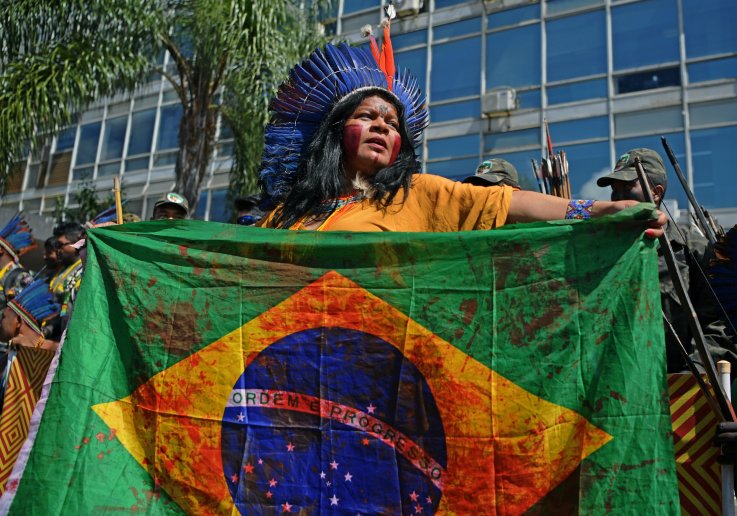
indigenous woman, Brazil, protest, getty, Brasilia
An indigenous woman holds a Brazilian national flag stained in red representing blood during a march in Brasilia on April 26, 2019, on the last day of a protest to defend indigenous land and rights. CARL DE SOUZA/AFP/Getty Images

In 2017, at least 185 activists were killed, with Indigenous peoples making up the biggest portion at around 30 percent, down from 40 percent in 2015 and 2016. At 36 percent, most deaths happened in Central America, followed by South American at 32 percent, and Asia at 31 percent. The most indigenous peoples died in the Philippines and Colombia between 2015 and 2017, with 36 and 22 deaths respectively. In 2017, 56 environmental defenders were killed in Brazil and 47 in the Philippines.

And the loved ones of victims struggle to seek justice, the authors said. Just over 10 percent of murders result lead to a conviction each year. This is likely due to corrupt police and authorities, who are sometimes involved in environmental devastation, and because murders are often carried out in remote areas. For instance, military and civil police are the main suspects after 10 land rights activists were killed in the city of Pau D’Arco, Brazil.

The researchers said the elections of populist leaders Jair Bolsonaro of Brazil and Rodrigo Duterte of the Philippines are a further cause for concern. Bolsonaro has called activists terrorists, and plans to relax gun and environmental protection laws, while the Philippines’ president “has taken a violent stance toward human rights defenders, Indigenous peoples, environmentalists, women, drug users and others,” the authors wrote.

..

Companies and consumers also have a responsibility to “investigate the sources of products, publish the results and commit to eliminating violence from supply chains,” the authors said. Co-author Dr. Nathalie Butt, a researcher fellow at the University of Queensland, Australia, School of Biological Sciences commented in a statement: “The number of reported deaths of environmental defenders has increased, as well as the number of countries where they occur.” Butt told Newsweek she was surprised that corruption was the key driver of the deaths, rather than the resources themselves. “As a lot of the resource demand is driven by international markets, consumers in countries in the Global North need to make sure they are aware of where their products come from, and how they were obtained, and demand (through pressure on supply companies) ethical and transparent supply chain processes,” she said.

Butt continued: “In many cases they [environmental defenders] are trying to protect environments that are important for everyone on the planet such as the Amazon, which is critical in terms of buffering climate change and carbon emissions.”

….Christopher Jeffords, associate professor in the department of economics at the Indiana University of Pennsylvania, told Newsweek: “These studies help shine a light on known instances of extreme violence committed against environmental defenders and thus help illuminate the notion that there are likely many cases which go unreported.” Eve Bratman, adjunct professorial lecturer at the American University Washington, D.C., School of International Service, told Newsweek: “The study tells us that the most important driving forces behind human rights abuses and the killings of environmental defenders are corruption and rule of law; when governments become more accountable, the benefits will likely be seen across the board. “In Brazil and several other countries, there is reasonable cause for concern that rates of violence will spike even higher given the dangers of today’s political climate.”

https://www.newsweek.com/more-deadly-being-soldier-war-zone-environmental-activists-killed-defending-planet-have-1452277

For the study mentioned see: https://www.nature.com/articles/s41893-019-0349-4

LWF rolls out Advocacy Handbook in Central America

August 5, 2019
Participants at the LWF advocacy training workshop in San José, Costa Rica, 14-16 July. Photo: LWF/F. Wilches

The persecution and killing of human rights defenders in Central America, as well as obstacles to the exercise of religious freedom in the region were under the spotlight at an advocacy training workshop in San José, Costa Rica, 14 -16 July.  The Lutheran World Federation (LWF) event was attended by 21 participants from six of the communion’s member churches in Central America and North America and from the World Service regional program.

The training facilitated by the LWF Office for International Affairs and Human Rights was an important opportunity for participants to share experiences of advocacy in their local and national contexts, hear about good practices and learn basic guidelines for effective advocacy work from a rights-based approach including gender analysis. The main tool used was the recently published LWF Advocacy Handbook, which is available in English, French and Spanish.

Participants talked about their concerns for the plight of human rights’ defenders who risk their lives on a daily basis in pursuit of justice and peace in their countries. They also discussed other human rights issues including limitations to freedom of expression and peaceful assembly, the rights of indigenous peoples, the challenges facing those living with HIV and  the importance of a critical approach to the role of the churches in the public space. “What makes this handbook special is its attempt to equip human rights defenders with a wide range of practical strategies that link local and global advocacy actions for meaningful impact at grass roots level” stated Dr Ojot Miru Ojulu, LWF Assistant General Secretary for International Affairs and Human Rights

The training is expected to be replicated in the other LWF regions over the coming years with the goal of helping the member churches, country programs and communities to strengthen their capacity to work on advocacy and human rights. See also: https://humanrightsdefenders.blog/2019/05/29/three-award-winning-colombian-human-rights-defenders-on-a-european-tour-to-raise-awareness/

LWF Advocacy Handbook

https://www.lutheranworld.org/news/lwf-rolls-out-advocacy-handbook-central-america

In 2018 three murders per week among environmental human rights defenders

July 30, 2019
Taking a stand for environmental justice and protecting natural resources is a dangerous pursuit. A new report from the UK-based NGO Global Witness showed that 164 environmental human rights defenders worldwide were killed for their activism in 2018. That averages to just over three murders per week. And that’s an underestimation.

Global Witness said the true number was likely “much higher, because cases are often not documented and rarely investigated. Reliable evidence is hard to find or verify“. Also, murder is not the only way to quash dissent. Global Witness said, although killings are at a disturbing level, companies and governments were increasingly using other tactics like criminalization, non-lethal violence, harassment and threats, as the Guardian reported. One common tactic is for governments to label activists as terrorists. “Deaths were down last year, but violence and widespread criminalization of people defending their land and our environment were still rife around the world,” said Alice Harrison, a senior campaigner at Global Witness, as the HuffPost reported.

“The drop in killings masks another gruesome reality, ” said Harrison. “Our partners in Brazil and many other countries have noted a spike in other forms of non-lethal attacks against defenders — often attacks so brutal they’re just shy of murder.” [See also: https://humanrightsdefenders.blog/2019/01/09/global-witness-report-2018-on-environmental-defenders-bad-but-2017-was-worse/]

The bulk of the murders took place in Asia or Central and South America. In fact, more than half were in Latin America and most of the victims were indigenous or rural campaigners standing up for their communities against mining, hydrocarbon development, damming and agribusiness. The mining sector was responsible for one-fourth of the murders.

The Philippines replaced Brazil as the most murderous country, with 30 victims, followed by Colombia with 24, India with 23 and then Brazil with 20. It’s the first time since the annual list began in 2012 that Brazil did not top the list, according to the Guardian. The number of reported murders there dropped from 57 the year before to 20 in 2018.

Guatemala had one of the highest numbers per capita and the sharpest increase with a five-fold increase, bringing the total number to 16 deaths in 2018, which Global Witness attributed to new investments in plantations, mining and energy projects, according to US News and World Report. “In general, the surge in killings is because Guatemala is witnessing a major setback with regard to democracy and human rights,” said Jorge Santos, executive director of the non-profit Unit for the Protection of Human Rights Defenders in Guatemala, to Al Jazeera. His group has documented machete attacks and armed militias opening fire on indigenous people campaigning for land rights in areas that are home to mining operations, oil palm plantations and displacement of the Maya Q’eqchi’ community.

For the role of international financial institutions in al lthis see my post of roday: https://humanrightsdefenders.blog/2019/07/30/uncalculated-risks-attacks-on-human-rights-defenders-in-name-of-development/

https://www.globalwitness.org/en/press-releases/spotlight-criminalisation-land-and-environmental-defenders/

https://www.ecowatch.com/environmental-activists-killed-2639511189.html?rebelltitem=3#rebelltitem3

https://www.euronews.com/2019/07/30/more-than-160-people-killed-for-defending-the-environment-campaign-group

https://timesofoman.com/article/1694919/World/Asia/Philippines-authorities-respond-to-Global-Witness-report

See also: Download the full report: Enemies of the State? (PDF, 3.8MB)

Uncalculated Risks: attacks on human rights defenders in name of development

July 30, 2019

The Campaign is made up of defenders and those who work with them on issues of development and human rights – community organizations, human rights and environmental groups, defender security organizations, transparency and accountability NGOs, and indigenous peoples and women’s networks. It is hosted by the Coalition for Human Rights in Development. You can find the Campaign Declaration and list of participant organizations here. In June, the Coalition for Human Rights in Development (CHRD) launched a landmark report with the Defenders in Development Campaign, exposing the risks of mega-infrastructure  and other ill-planned development projects on human rights defenders (HRDs). The report laid out 25 case studies demonstrating that HRDs are facing increasing threats and attacks in the context of their resistance to activities undertaken in the name of development, including harassment, physical violence, criminalisation, arbitrary detention and murder.

The Findings:

  • Threats and attacks against human rights defenders in the context of development activities are widespread.
  • Though they take many different forms, the threats and attacks often start with the labeling of communities, groups, and individuals as “anti-development.”
  • The imposition of development activities without the consent or meaningful consultation of local communities and marginalized groups is one of the key root causes of threats for defenders in development.
  • Development finance institutions have a duty to respect human rights and to ensure that their investments are not putting people at risk.
  • Yet too often, development interventions exacerbate risks for defenders due to lack of adequate attention to the rights and interests of local communities and marginalized populations, and to the contextual risks and power imbalances that may cause them to bear negative impacts or to be made vulnerable.
  • Early warning signs of potential threats to defenders are often missed or ignored.
  • DFIs have a wide range of resources and influence that can be utilized to change the risk equation for defenders under threat, but often fail to proactively develop this leverage or are reluctant to utilize the leverage they have.
  • DFIs often remain silent in the face of threats and attacks, or responses come too little, too late and defenders and communities are left without protection or remedy for harm.
  • Several DFIs are beginning to grapple with threats to defenders in development, but much more is needed.

Effectively addressing the shrinking space for participation in development processes and the growing threats to defenders will require not only a change in policy and practice, but a fundamental shift that places human rights and local communities at the center of how development is conceived and implemented.

Landmark report finds attacks on human rights defenders in name of ‘development’ on the rise

https://rightsindevelopment.org/uncalculatedrisks/

UK joins small group of countries with specific guidelines on human rights defenders

July 19, 2019

The United Kingdom has recently published guidelines for the protection and support of rights defenders around the world. It joins a small group of countries such as Norway, the Netherlands, Ireland, Switzerland, Austria and Canada (although they differ – see the websites of these countries). There are also some mulitlateral ones such as the EU Guidelines.[https://humanrightsdefenders.blog/2012/01/13/quick-reminder-of-the-eu-guidelines-on-human-rights-defenders/] and those of the OSCE.

See also: https://humanrightsdefenders.blog/2016/12/13/canada-joins-select-group-of-governments-with-guidelines-on-human-rights-defenders/ and https://humanrightsdefenders.blog/2014/11/02/swiss-guidelines-on-human-rights-defenders-analyzed-by-civil-society/.

In the foreword to the publication Lord (Tariq) Ahmad of Wimbledon, Minister for Human Rights, states: To demonstrate our commitment of continued support of human rights defenders globally, this document sets out why human rights defenders are important to us and acknowledges the risks they face in the pursuit of universal human rights. We hope it will give human rights defenders encouragement to know how we may be able to support them, including through our network of embassies and high commissions overseas. Whilst every situation may be different depending on local context, our values and commitments in providing support remain the same

Human Rights Watch was not impressed: While welcome, real support requires a willingness to speak out even when it carries political costs. The new guidelines praise the courageous work of human rights defenders in the face of risks including threats, intimidation, harassment, and detention. The guidelines rightly identify groups which are in greater danger, such as journalists, women, and LGBT activists, and express the UK’s commitment to support them “wherever they are in the world.” But when it comes to actually standing up for human rights defenders, the UK’s record is patchy. While it sometimes speaks out in private, it remains reluctant to do so publicly, even though doing so would raise the cost to states that seek to silence those who speak truth to power. The UK government has so far done very little about credible reports of the torture, sexual harassment, and assault of Saudi women activists currently on trial for defending human rights in their country. It has failed to hold Hungary to account for its efforts to clamp down on human rights groups and rule of law. And it has failed to criticize United Arab Emirates authorities for the unjust imprisonment of Emirati activist Ahmed Mansoor on his peaceful calls for reform. The UK hopes that by publishing these guidelines, defenders might be encouraged to understand that the British government might be able to support them. But if the UK is really serious about this, it should be willing to speak out publicly on their behalf when they are in trouble, including when their safety is at risk in countries that are UK allies. In short, the UK’s new Prime Minister should make it a priority to protect and support human rights defenders no matter where they are in the world.

https://www.hrw.org/news/2019/07/19/will-next-uk-government-stand-human-rights-defenders

Click to access UK-Support-for-Human-Rights-Defenders.pdf

FIGHT THROUGH CARTOONS – ZUNAR

July 18, 2019

Zunar’s latest book (July 2019), entitled Fight through Cartoons: My Story of Harassment, Intimidation & Jail (Singapore: Marshall Cavendish Editions, 2019) is a stark departure from his previous books. Indeed, this is not a collection of cartoons, but a narration of his creative process, a reflection on the impact of his cartoons, as well as a contemplation of his journey as a political cartoonist in Malaysia, particularly during the critical political era between 2009 and 2019. [see also: https://humanrightsdefenders.blog/2019/04/04/satire-as-a-weapon-malaysian-cartoonists-showed-the-way/]

Organized in a chronological manner, this book presents the development of the artist’s works on the background of the important events, issues and political crises that have influenced his creativity.. threats, intimidation and imprisonment, for himself and his assistants; arrests; the confiscation of his books; the rummaging of his office by the authorities; pressure placed on his publisher and printer; as well as the mental and physical attacks led by supporters of the previous government on his exhibitions, his works and his person.

Starting with an introductory chapter about Malaysian politics by Sukhbir Cheema, the writer, cartoonist and co-founder of Eksentrika who helped Zunar to publish this book, readers are exposed to important issues in Malaysia such as the history of government, laws related to the media and publication, such as the Printing Presses and Publication Act and the Sedition Act, self-censorship as well as the Malaysian political background as the context of Zunar’s works and its impact on freedom of speech in this country…

In the following chapters, Zunar describes his creative process in detail by focusing on the publication of several political cartoon magazines with his cartoonist friends, such as Gedung Kartun (2009); Perak Darul Kartun (2009);and Isu Dalam Kartun (2010)as well as his major books 1 Funny Malaysia (2009); Cartoon-O-Phobia (2010); Even My Pen Has A Stand! (2011); Pirates of the Carry-BN (2012); The Conspiracy to Imprison Anwar (2014); Lawak & Lawan (2012); Ini-Kartun’Lah(2013); Ros in Kangkong Land (2015); Wasabi (2016); Sapuman: Man of Steal (2015); and his most popular book to date,  Ketawa Pink Pink (2018) Beforehand, he briefly mentions his previous jobs, revealing that he once worked as a construction labourer, a factory worker and a laboratory assistant in a government hospital before finding success as a political cartoonist.

……the book describes in detail how each of his cartoons and books became controversial as a result of actions taken by the authorities, who stopped their distribution and their sale, despite early titles such as Gedung Kartun (2009) having received permission to be published by the Home Ministry. His other books have received the same treatment, because his cartoons expose the corruption scandals that are rampant in the country, involving in particular former Prime Minister Najib Razak and his extravagantly rich wife Rosmah Mansor. They also touched on critical issues such as the mysterious death of opposition activist Teoh Beng Hock; Anwar Ibrahim’s imprisonment; the murder of Altantuya, and the 1MDB scandal. Zunar’s cartoons have been considered a threat to public order. They were therefore declared illegal and he was dragged to the police station, detained, sentenced in court and thrown into jail. All of this is described carefully by Zunar in this book…Just as he is detailed and systematic in his creative process, Zunar also adopts the same attitude to overcome all the threats and obstacles he and his assistants had to face as a result of his cartoons. Just as he prepared his cartoons carefully, he also prepared his strategy and faced each arrest with calm, contacting his friends in the media in order to publicize his arrests, especially through the Internet and the social media. Zunar’s case shows the importance and power of the Internet and social media to influence the new political scenario in a global world, and in this country. Zunar’s strategy can serve as a guide for any cartoonists, writers or artists facing similar threats and situations.

Zunar’s philosophy is captured in the sentence: “How can I be neutral?  Even my pen has a stand”…..Zunar’s book also shows that he is not alone in his fight. His assistants, his friends, his supportive wife, his lawyers, the media, international cartoonist associations and his faithful supporters from all around the world have all contributed to Zunar’s success and played a role in his “fight through cartoons”.

The book can be purchased here.

https://www.zunar.my/news/fight-through-cartoons-a-book-with-historical-fight-and-smartly-cartooning-strategy/