Archive for the 'awards' Category
Oleg Sentsov received the Magnitsky Human Rights Award in person
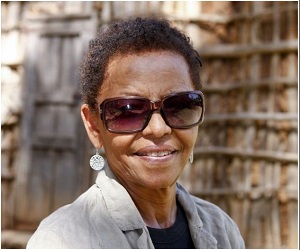
November 18, 2019Ethiopian human rights defender Bogaletch Gebre has passed away
November 13, 2019Ezega.com reported on 6 November 2019 the deatch of the highly-awarded woman human rights defender Bogaletch Gebre, founder of KMG Ethiopia (Kembatti Menotti Gezzima-Tope).
Bogaletch Gebre was a victim of female genital mutilation at the age of 12 and was forbidden from joining formal education, which forced her to sneak out of her home to attend a missionary school that paved the way for her to be what she became. Following her elementary years at the Missionary school, Bogalech Gebre attended various local schools as well as some prestigious Higher Education Institutions abroad.
In an interview with ETV, she said the trauma of FGM took her years to recuperate and she suffered complications from it years later. It wasn’t during her youth years Bogaletch Gebre learned more about what had happened to her and her family because of FGM. At the time Bogalech was a graduate student in the United States. When Bogaletch Gebre found out that FGM was needless and harmful practice, she became incensed. She eventually left her PhD program in epidemiology at the University of California, Los Angeles, and in 1995 she returned to Kembata Tembaro, her hometown in Ethiopia.
In 1997 she and her younger sister started KMG, an indigenous Resident Charity Organization with the goal of helping to create an environment where the values and rights of women are recognized and where their talents and wisdom are nurtured. The organization was founded with the two sister’s belief that if women are empowered and their talents nurtured, the lives of both men and women would improve.
Bogalech Gebre along with her sister began implementing their plans in the region of Kembatta – Tembaro. The organization they founded is now diversified its scope and operates in additional 24 of Southern Nations Nationalities and People’s Regional State (SNNPRS) and Oromia district, reaching out to more than 481,289 direct and 2,859,500 indirect beneficiaries, 70% of whom are women.
The realization of their effort has protected many girls from going through lasting complications. Bogalech Gebere believed and spoke about the need for a change and bringing together all communities, women, and men to make informed decisions.
In 2010, the Independent newspaper characterized her as “the woman who began the rebellion of Ethiopian women.” In particular, the Independent report praised her for KMG’s strong commitment to reduce the rate of bridal abductions in Kembatta and FGM. Bogalech Gebre was awarded the 2005 North-South Prize, in 2007 the Jonathan Mann Award for Global Health and Human Rights and in 2013 both the Bruno Kreisky Award and he King Baudouin International Development Prize.
Nicaraguan journalist Luis Sequeira wins Rory Peck Award
November 12, 2019
France 24 reported on 8 November 2019 that the Nicaraguan journalist Luis Sequeira won the Rory Peck Award, which honours freelance photo and video reporters, for his AFP coverage of recent violence that has gripped his homeland. Sequeira was lauded at the annual ceremony in London for his shockingly raw footage of the violent crackdown against protesters in Nicaragua that began last year and continued into 2019.
His work showed demonstrators’ arrests and clashes with security forces after protests erupted on April 18, 2018, in response to President Daniel Ortega’s social security reforms. The resulting bloodshed has seen 325 people killed, from both the opposition and security forces, another 2,000 injured while 60,000 inhabitants have fled into exile, according to human rights groups. “This award is for the Nicaraguan people who have fought for democracy,” Sequeira said after being handed the award by Nicaraguan rights activist Bianca Jagger.
Sequeira, 25, started shooting video at the age of 17 and has worked for Telemundo, RCN, HBO, Reuters and Rutly. He has covered events across the Americas, in Europe and Asia, as well as in the Middle East. His work has included reporting on the plight of the Kurdish people, the jihadist attacks in Paris in 2015 and the terrorist attacks in Orlando, Florida in 2016. Sequeira has been working for AFP since 2018.
This is the fourth time in six years that an AFP journalist has won the prize. It was launched in 1995 in memory of the independent videographer Rory Peck, who was killed in Moscow two years earlier. The award recognises the best independent news cameramen, and the ceremony is one of the main ways that the Rory Peck Trust, which administers the prize, raises funds to assist freelance journalists.
See also: https://humanrightsdefenders.blog/2013/11/27/friend-of-journalists-award-goes-to-azeri-president/
https://www.france24.com/en/20191108-nicaraguan-journalist-luis-sequeira-wins-rory-peck-award
Guatemalan human rights defender Abelino Chub Caal wins Trócaire human rights award
November 8, 2019
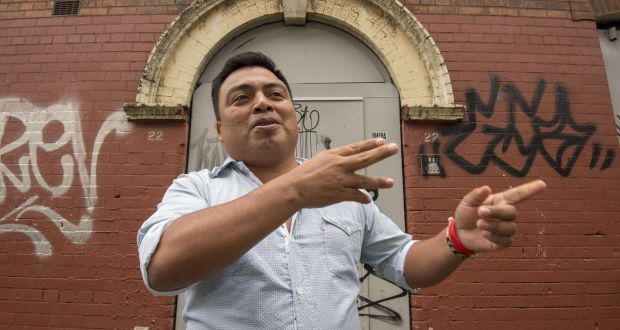
Abelino Chib Caal from Guatemala in Dublin after he was awarded the Romero International Award by Trócaire. Photograph: Dave Meehan
On 26 April, 2019 Abelino Chub Caal walked free after spending 813 days in prison. Less than six months later, the Guatemalan human rights defender stood before a large Irish audience at the Riddel Hall in Belfast to accept the Trocaire Romero Award. This was the second edition of the award [see: http://www.trueheroesfilms.org/thedigest/awards/trocaire-romero-award]. The inaugural award in 2018 went to Sr Bridget Tighe in recognition of her humanitarian work in Gaza and the Middle East (for more on her click here)
The following week Sorcha Pollak of the Irish Times sat in a small meeting room in the Irish Times building with the Guatemalan teacher who has dedicated his life to fighting for the environmental and cultural rights of the indigenous people of his home country. A few days later, the 35-year-old flew back to Guatemala, unsure of the reception he will receive in a country which has an extremely poor international reputation for its treatment of community leaders who call for greater equality and recognition of human rights.
“This has been the struggle of the indigenous people throughout our lives,” explains Caal in Spanish. “We’ve been completely rejected by the state. On the one hand the government says we’re the pride of Guatemala and they get millions of dollars in tourist money but at the same time we’re being repressed. They criminalise and persecute us; they send people to their deaths. They harass men and women who raise their voices against the injustice.”
Caal first became involved in the campaign for equal land rights aged 14 when his family’s community, in the department of Izabal in eastern Guatemala, was suddenly taken over by the cattle farm of a French woman operating in the area. “She had about 1,000 cattle just roaming around the community. They slept under our roof and ate all our crops.” He was deeply shocked when a community leader, who had come to the town to educate locals about their rights and the international treaties they could cite as protection, was thrown in jail for eight years.
After school, having graduated with a diploma in sustainable tourism, Caal began working for the Guillermo Toriello foundation which promotes local development. He also trained as a teacher but never got the chance to use his qualification. “I’ve dedicated myself to the community struggle and to becoming a mediator between state institutions and communities on land issues. It’s a legitimate and true struggle, the land for us is like our mother.”
The mining industry along with the rapidly growing production of palm oil, fruit, sugar cane and rubber by multinational companies is being carried out at the expense of local communities, says Caal. “They’ve accumulated all the land they can. All areas of flat land have been declared private property for palm plantations but not for the production of food.
“The state’s intention is to dispossess and exterminate the life of the indigenous communities. The communities are being expelled from their land and left without any alternatives. They just treat them as if they were toys.”
Caal cites examples of fellow human rights activists who were jailed for their work defending local communities, including Bernardo Caal Xol who was sentenced to eight years for his efforts to halt the development of a hydroelectric project along the Cahabon river by the Spanish ACS construction group which is chaired by Real Madrid president Florentino Pérez.
In February 2017, Caal was arrested and charged for alleged aggravated land grabbing, arson, coercion, illicit association and belonging to illicit armed groups. He spent the following two years in prison in Guatemala city.
While former government officials, locked up on corruption charges, made his life in prison difficult, he was surprised by the reception from gang members. “They were actually really respectful to me and called me profe [teacher]. They said I didn’t deserve to be there.”
During his two years behind bars, Caal witnessed hitmen inside the jail killing other prisoners and frequently worried for his safety. Despite being released earlier this year, after he was absolved of all charges, he knows that many other land rights defenders continue to face similar treatment. “The president is attacking human rights defenders, insinuating they have connections to drug trafficking. I wasn’t the first person to go to prison and I certainly won’t be the last. Our economic powers, they either send you to prison or send you to the grave.”
Upon his release, Caal spent one month in a safe house in Guatemala city and another three months in Costa Rica before travelling to Ireland to accept the Romero International Award presented by Irish NGO, Trócaire. He hopes his time in Ireland will raise awareness around the daily struggles faced by indigenous people across Guatemala in their attempts to hold on to their land. “We have been completely rejected by the state, we can’t be at peace. We just ask that people continue to show their solidarity with us.”
Caal is conscious that the Guatemalan public prosecutor’s office has not accepted his release and is appealing the decision. We part with uncertainty as to what will happen when he arrives home.
Gary Walsh of Trócaire says the voices of land rights defenders like Caal should put pressure on countries worldwide, including Ireland, to sign an international treaty on business and human rights which would help protect indigenous peoples around the globe.
“Land grabs, environmental damage and violent attacks, including murder, are all too common features of how big business interacts with communities in the developing world,” says Walsh. “This has been facilitated by the absence of any global framework governing how businesses impact the human rights of the communities they engage with.” A binding international treaty is needed to ensure businesses operating outside the EU respect human rights, and that vulnerable people are protected, says Walsh. Recent negotiations held in Geneva around the revised draft of a legally binding treaty showed some progress despite insufficient engagement from EU member states including Ireland, said a spokeswoman for Trócaire
Right Livelihood Award brings 2019 laureates to Geneva on 28 November
November 7, 2019
The 2019 Laureates of the Right Livelihood Award, widely known as the ‘Alternative Nobel Prize’, [for more see:https://humanrightsdefenders.blog/2019/09/26/right-livelihood-award-2019-lauds-practical-visionaries/]are:
- Aminatou Haidar (Western Sahara): for her steadfast nonviolent action, despite imprisonment and torture, in pursuit of justice and self-determination for the people of Western Sahara.
- Guo Jianmei (China): for her pioneering and persistent work in securing women’s rights in China.
- Greta Thunberg (Sweden): for inspiring and amplifying political demands for urgent climate action reflecting scientific facts (in lieu of Greta Thunberg, remarks from climate activists).
- Davi Kopenawa / Hutukara Yanomami Association (Brazil): for their courageous determination to protect the forests and biodiversity of the Amazon, and the lands and culture of its indigenous peoples.
The Graduate Institute, Geneva, and the Right Livelihood Award Foundation organise a celebratory event, which will include musical interludes, on Thursday 28 November 2019 from 18:00 – 19:45 in the Auditorium Ivan Pictet in the Maison de la Paix, Geneva.
To register: HERE
Highly awarded Sadako Ogata – former UN refugee chief – dies at 92
October 29, 2019
Sadako Ogata the first woman to head the UN High Commissioner for Refugees has died at the age of 92 on 22 October 2019. I served under her for many years and have the greatest admiration for her. Sadako Ogata worked on some of the largest crises of the decade during her time in service from 1991 to 2000, including the Kurdish refugees fleeing from Iraq after the 1991 Gulf War, the Balkans War and the Great Lakes region of Africa. Before joining the UN, she was an academic – serving as dean of the faculty of foreign studies at Sophia University in Tokyo in 1989, where she had been a professor since 1980. She was well respected by UN staff and world leaders alike, and was described by her colleagues as a “five-foot giant” for her formidable negotiating skills and ability to confront hostile factions. From 2003 to 2012, Ogata was the head of the Japan International Cooperation Agency, overseeing efforts to provide assistance to those in developing countries.
Back in Japan, she also criticised her country’s low acceptance of refugees. “Japan has to set up a situation to welcome people… those who are in need, in serious need… I think we should be open to bringing them in,” she said in a Reuters interview in 2015. “[To say] Japan does not have resources, that’s nonsense.”
She rightly received a lot of recognition while alive, including:
1994 Franklin Roosevelt Four Freedoms Award
1994 Prize for Freedom (Liberal Int’l)
1994 International Human Rights Law Group Award
1995 Liberty Medal
1995 Freedom Award (refugees)
1997 Ramon Magsaysay Award for Community Leadership
2001 Indira Gandhi Prize
2015 In Pursuit of Peace Awards.
Universal human rights apply to Ilham Tohti? China and EU: disagree
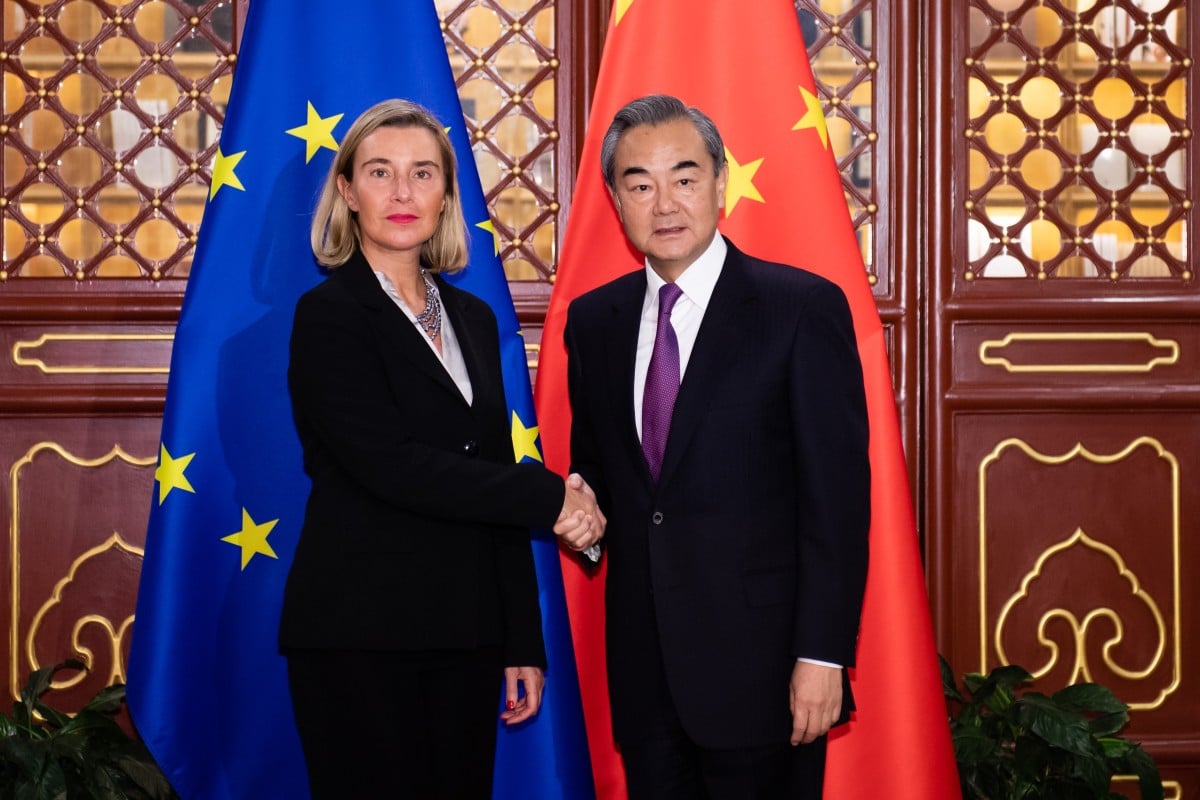
October 26, 2019Chinese Foreign Minister Wang Yi met his EU counterpart Federica Mogherini in Beijing on Tuesday. Photo: Xinhua
Keegan Elmer in the South China Morning Post of 25/26 October 2019 reports that Chinese officials have told their European counterparts that human rights should be measured by the people’s well-being and rejected the EU’s support for the “universal” values enshrined in the United Nations Charter. The statements issued by both sides after a meeting between the EU’s foreign affairs chief and Chinese foreign minister Wang Yi underlined their disagreements on human rights by recording their discussions on the topic in markedly different ways. While the Europeans focused on Mogherini’s support for “universality”, the Chinese statement emphasised her call for mutual respect and comments that there were “different approaches” to the issue.
According China, Mogherini had acknowledged that there are “different approaches to safeguarding and promoting human rights” and accepted that there were “problems with the human rights situation in European countries”. It continued that she had agreed to continue cooperation and exchanges with China “on the basis of mutual respect”, adding: “The EU does not intend to act as the ‘teacher’ of other countries on human rights issues.”
But the EU’s account of the meeting did not refer to Wang’s comments and said Mogherini had “underlined to the Chinese leadership that the EU will continue to stand up for the universality, interdependence and indivisibility of human rights based on the UN Charter and standards”.
China extraordinary sensitivity to ‘interference’ of any level into what it considers its domestic affairs is well-known. I touched upon this ‘hot’ topic’ in my own 2011 article “The international human rights movement: not perfect, but a lot better than many governments think” in the book ‘NGOs in China and Europe’ (exceptionally also published in Chinese!): Yuwen Li (ed), Ashgate, 2011, pp 287-304 (ISBN: 978-1-4094-1959-4).
On the same day that the pair met in Beijing, the European Parliament awarded its 2019 Sakharov Human Rights Prize to human rights defender Ilham Tohti, who is serving a life sentence. The statement announcing the award called for his immediate release and said “for over two decades, he has worked tirelessly to foster dialogue and understanding between Uygurs and other Chinese people”. [see: https://humanrightsdefenders.blog/2019/10/24/lham-tohti-now-also-awarded-the-2019-sakharov-prize/]. Predictably, during a press conference on Friday, Chinese foreign ministry spokesman Hua Chunying said the parliament had “given a prize to a criminal”. “I don’t know how much meaning, value or influence [the prize] has,” said Hua. “I only know Tohti is a criminal that has been sentenced by a Chinese court.”
Neither the Chinese nor the EU have said whether Tohti’s case or the situation in Xinjiang – where Beijing is accused of detaining a million mainly Uygur Muslims in re-education camps – had been discussed.
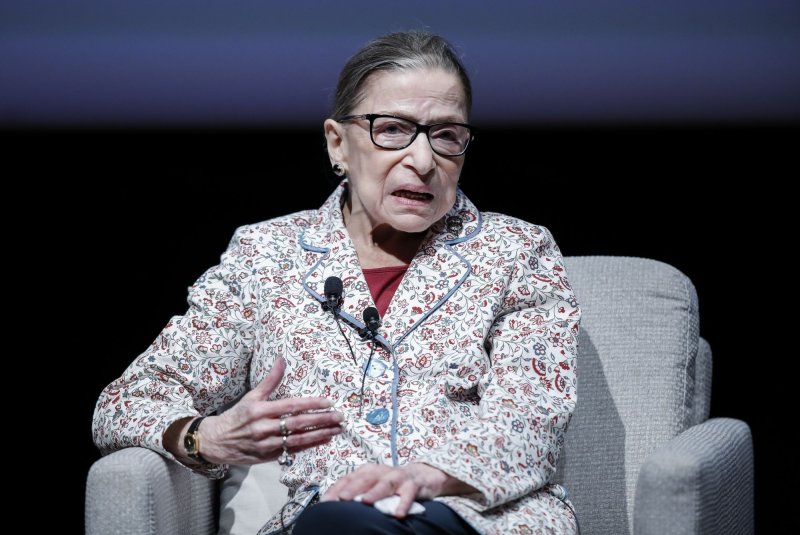
1 million $ Berggruen Prize for Justice Ginsberg for her human rights stance
October 25, 2019The Berggruen Prize for Philosophy & Culture is given each year to someone who has contributed to self-understanding and advancement in the world. Ginsburg chose to donate her winnings to a charity or non-profit organization she has not revealed.
lham Tohti now also awarded the EU’s 2019 Sakharov Prize
October 24, 2019
Ilham Tohti, renowned Uyghur economist fighting for rights of China’s Uyghur minority, awarded 2019 Sakharov Prize © AP Images/Andy WONG
It was just accounced that Uyghur human rights defender Ilham Tohti has been awarded this year’s European Parliament Sakharov Prize for Freedom of Thought. European Parliament President David Sassoli announced the laureate in the Strasbourg chamber at noon on Thursday, following an earlier decision by the Conference of Presidents: “I am very pleased to announce that the European Parliament has chosen Ilham Tohti as the winner of the 2019 Sakharov Prize for Freedom of Thought. Tohti has dedicated his life to advocating for the rights of the Uyghur minority in China. Despite being a voice of moderation and reconciliation, he was sentenced to life in prison following a show trial in 2014. By awarding this prize, we strongly urge the Chinese government to release Tohti and we call for the respect of minority rights in China”. The Sakharov award ceremony will be held in the European Parliament’s hemicycle in Strasbourg on 18 December. For more on the Sakharov Prize for Freedom of Thought and similar awards, see: http://www.trueheroesfilms.org/thedigest/awards/sakharov-prize-for-freedom-of-thought.
2014 Freedom to Write Award (PEN)
2016 Martin Ennals Award for Human Rights Defenders
2017 Prize for Freedom (Liberal Int’l)
2017 Weimar Human Rights Award
2019 Vaclav Havel Prize for Human Rights (PACE)
2019 Sakharov Prize for Freedom of Thought
It will be interesting to see how the Chinese government is going to react as it tends to be very sensitive on awards for its human rights defenders, think of the Nobel Peace Prize for Liu Xiaobo on 2010 or the reaction of the Chiane government against the former UN High Commissioner for Human Rights giving the MEA in 2016 [https://www.reuters.com/article/us-china-rights-un-idUSKCN12C0X2]. Another example is: https://humanrightsdefenders.blog/2017/11/11/cyber-attacks-on-city-of-weimar-for-awarding-ilham-tohti/
For the finalists of this year see: https://humanrightsdefenders.blog/2019/10/09/the-eu-lists-3-finalists-for-the-2019-sakharov-prize-for-freedom-of-thought/
For more on Tohti see: https://humanrightsdefenders.blog/2018/01/15/today-ilham-tohti-completes-his-fourth-year-in-chinese-detention/.
Indonesian human rights defender Veronica Koman receives Sir Ronald Wilson Human Rights Award
October 24, 2019The Australian Council for International Development (ACFID) has awarded the Sir Ronald Wilson Human Rights Award to Indonesian lawyer and human rights defender Veronica Koman for her courageous work in exposing human rights violations in the Indonesian Provinces of Papua and West Papua. [https://humanrightsdefenders.blog/2019/09/17/un-experts-urge-indonesia-to-protect-human-rights-defender-veronica-koman/]
ACFID CEO, Marc Purcell, said: “We call on the Government of Australia to provide Ms Koman the protection to which she is entitled as a human rights defender. In line with recommendations from the UN Office of the High Commission of Human Rights, the Australian Government should also encourage Indonesia to drop all charges against Ms Koman and to protect the freedom of expression of all people reporting on the protests in West Papua.”
For the Sir Ronald Wilson Human Rights Award see: http://www.trueheroesfilms.org/thedigest/awards/sir-ronald-wilson-human-rights-award