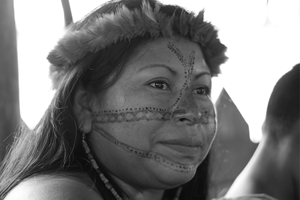
Robert F. Kennedy Human Rights has named Alessandra Korap Munduruku the winner of its 2020 Human Rights Award for her work defending the culture, livelihoods, and rights of Indigenous peoples in Brazil.
Indigenous peoples, including Alessandra’s Munduruku community, have faced tremendous challenges in Brazil in recent years—from gold miners and loggers illegally invading and exploiting Indigenous territories; to widespread fires in the Amazon; and an increased risk to the coronavirus; not to mention a combative president who’s proactively removed protections for Indigenous tribes and insulted them on numerous occasions.
As one of the key leaders and organizers of the Munduruku people, Alessandra has fought to stop construction projects and illegal mining that are infringing upon Munduruku territory, garnering international attention and support. She’s advocated for the demarcation of Indigenous lands and for Indigenous communities to be consulted on decisions that affect their territories. Alessandra has also played an important role in advancing the leadership of women in the Munduruku community and among other Indigenous tribes in Brazil through her involvement in the Wakoborûn Indigenous Women’s Association and the Pariri Indigenous Association.
“I’m humbled to be this year’s Robert F. Kennedy Human Rights Award winner,” said Alessandra Korap Munduruku. “To have the additional backing and support of Kerry Kennedy and her entire organization, especially during the pandemic, will make all the difference as we continue to fight for our rights, including the demarcation of our lands to ensure that Indigenous peoples have their autonomy, and for the fight of women who are also the strength of the resistance.”
“Throughout history, Indigenous peoples, including the Munduruku, have repeatedly been oppressed, silenced, and subjected to horrific human rights abuses,” said Kerry Kennedy, president of Robert F. Kennedy Human Rights. “Alessandra has heroically faced intimidation and violence for defending Indigenous rights across Brazil—including the ability to oppose projects and developments that affect her peoples and their livelihoods. She is a champion of women’s rights, Indigenous rights, and the foundational right of all human rights—civic space. Civic space protects the right to dissent, to advocate and to defend human rights, free of government reprisal. It is the keystone of a functioning democracy.”
Alessandra will be honored at a virtual ceremony on Thursday, October 22, at 6:00pm EDT. The event is free and open to the public. You can register here.
Kerry Kennedy will present the award, followed by a keynote address from former U.S. Secretary of State John Kerry on the countless threats and challenges Indigenous peoples face around the world. Andrew Revkin, director of Columbia University’s Earth Institute, will then moderate a discussion on the pathways forward for Indigenous peoples in Brazil with an esteemed panel of experts:
Juarez Saw Munduruku, Chief of the Sawré Muybu village in Brazil
Maria Leusa Cosme Kaba, a Munduruku women’s leader
Francisco Calí Tzay, UN Special Rapporteur on the Rights of Indigenous Peoples
Through these panels, we wish to discuss the challenges and potentials ahead of the human rights movement, in light of both the ongoing erosion in democratic/civic spaces and the disruptions of the Covid-19 pandemic. In each panel we will couple one human rights defender from Turkey with one from abroad.
In the first panel of the series, we hope to start with a hopeful perspective on how we can re-open spaces in times Covid-19. We also wish to put forth a conceptual and comparative understanding on concepts such as shrinking civic spaces, authoritarianism and populism. The title of this first panel is “Re-Opening Civic Spaces in Times of Covid-19”.
We will welcome legal scholar, sociologist and human rights advocate César Rodríguez Garavitofor this event. Murat Çelikkan, co-director of Hafiza Merkezi, will host the event as co-speaker.
Some of the specific issues and questions we want to focus are as follows;
How do concepts such as closing democratic/civic spaces relate to populism, authoritarianism, etc.
How has the situation evolved in recent years in terms of these processes?
What has been the impact of Covid-19 on top of all this?
During Covid times, what are the trends and practices in the global human rights movement that have the potential to push back against the populist tide?
How should we frame the debates about the future of human rights?
The first panel will take place on October 15th at 17.00-18.30 (GMT+3) and will be livestreamed to registered participants. Please register from here.
English-Turkish simultaneous translation will be provided during the event.
About speakers
César Rodríguez Garavito’s research focuses on the transformation of law and politics in the context of globalization. He is co-director of the Center for Human Rights and Global Justice in New York University School of Law. César is the founder of JustLabs and the Editor-in-Chief of OpenGlobalRights. He has been a visiting professor at New York University, Stanford University, Brown University, the University of Melbourne, the University of Pretoria (South Africa), the European University Institute, American University in Cairo and the Getulio Vargas Foundation (Brazil). He is a board member of WITNESS, the Business & Human Rights Resource Center, the Annual Review of Law and Social Science, and the Business and Human Rights Journal. César is obsessed with inter-disciplinary research, social innovation, systems thinking, and anything that can get human rights and social justice practitioners to respond more strategically and effectively to complex challenges such as technological disruption, the climate crisis and populist authoritarianism. He has conducted research and advocacy in various regions of the world and has published widely on human rights, environmental justice, globalization and social movements.
Murat Çelikkan has worked as a journalist for 35 years in various positions such as reporter, editor, columnist and chief executive editor. Çelikkan has been an active member of the Turkish Human Rights Movement. He was a founding member and has been on the boards of the Human Rights Association, Human Rights Foundation of Turkey, Citizens Assembly and Amnesty International Turkey. He has worked on projects related to the Kurdish problem and media ethics, freedom of speech and assembly, refugees, identity politics and peace. Çelikkan is a graduate of Middle East Technical University. He is currently the Co-Director of Truth Justice Memory Center in İstanbul. He is also the producer of two feature films and the documentary Buka Barane. He has received the Civil Rights Defender of the Year 2018 Award and the 2018 International Hrant Dink Award.
The resolution recently adopted by the United Nations Human Rights Council (UNHRC) failed to take concrete action against the summary killings in the country, detained Senator Leila de Lima said Saturday 10 October 2020. On Wednesday, the UNHRC adopted a resolution asking UN human rights chief Michelle Bachelet to support the Philippines in fulfilling its international human rights obligations—not really an independent probe.
De Lima lamented that the resolution that could have strengthened human rights and accountability mechanisms in the country was instead “tantamount to absolving a murderous regime of its crimes against humanity.”…..
“Do we really expect this regime to stop the carnage and submit to technical cooperation and capacity building programs to promote the rights that it has been blatantly violating? No, we cannot tame a rabid mass murderer that is Duterte,” she said.
“We need to be more vigilant and well-informed in order not to be swayed by the deceptions and lies of government operators who curry favor with Duterte for selfish political interests. We vigorously assert our call for an independent international probe into the human rights crisis that continues to wreak havoc in our country,” she said.
Stan Swamy and the adivasis he supports in an impossible battle for their own ancestral lands are pawns pitted against mammoth mining companies. Falsely branding activists as Maoists is the easiest way to condemn to enable vested interests to finish them off.
A file photo of human rights activist Stan Swamy. Photo: PTI
Mari Marcel Thekaekara wrote in the Indian Wire of 10 October 2020 a detailed and personal piece about “The Indomitable Spirit of Father Stan Swamy”
“No, it’s not possible,” were my first thoughts when I heard that Father Stan Swamy, an 83-year-old Jesuit priest and activist had been arrested – for the second time. His crime? He defended the rights of adivasis being exploited in their homeland Jharkhand.
Father Swamy has been accused of having links to a Maoist plot connected to the Bhima Koregaon case and was arrested by the National Investigation Agency on Thursday night. The rights activist is one of the gentlest and kindest men I have ever met. So the entire premise – for anyone who knows him – is entirely ludicrous. Funny even, if it were not so tragic. He has Parkinson’s disease. His hand shakes when he raises a cup of tea to his lips. He speaks so softly, you have to strain to hear him.
Social activists hold a protest after the arrest of Father Stan Swamy by the NIA in the Bhima Koregaon case, in Ranchi, October 9, 2020. Photo: PTI
He assures his interrogators that he has no connection with Maoists. He believes in peaceful, non-violent protest. I believe him. Because I know that his integrity is above reproach.
I heard of Father Stan Swamy in the early seventies, because he was among the first people I knew who advocated living with the adivasi community in Jharkhand to understand their lives and their problems; to help find solutions and a way forward. I went there in the early seventies while still in college to write a story for our student magazine.
On a more personal note, Stan Swamy, introduced my husband, also named Stan, to the adivasi world. He shared Father Swamy’s hut in a Ho village in Jharkhand. My husband always told young activists:
“Gandhiji’s non violence was not merely moral or religious. It was strategic. Gandhi was a brilliant general. Oxymoronic though that sounds. He understood that the fight for freedom could not be won by violence because mere ordinary Indians, even if they poured out on the streets with justice on their side, with God on their side, could never win. Even if there were thousands or lakhs of people marching in protest, they could never match the might of the state. Before 1947, the British could bring out the artillery and finish us off. One wrong step could have changed the course of our history. But the entire world watched India’s non violent battle for independence, open mouthed. Non violence was a new word, a new tactic, made in India. The world sympathised and empathised. Gandhi’s strategic non violence was the most brilliant weapon in our war for Independence’
The same scenario is playing out today. And the average activist understands that putting ordinary villagers, adivasis, Dalits or women in the line of fire is counterproductive and unfair. We learnt this strategy from Gandhi and Jayaprakash Narayan.
In recent times, it has become the norm to equate the word activist with ‘anti-national’. But who is an activist? What do they do?
It’s quite simple. All over India, there are thousands of people who took up the cause of fighting for social justice for the poor, the marginalised and the voiceless. These people were inspired by the brightest and best minds in our country – from Gandhiji to Vinobha Bhave to JP.
Post Independence, when the battle for freedom was won, Gandhi urged his followers to go out and continue the fight for freedom. This time, it was to free the poorest from hunger and poverty, to teach and educate, to weave and spin, to spread harmony and peace. Thousands rallied to his call and Gandhi ashrams were filled with people determined to continue the freedom struggle on a new battlefield – India’s villages.
The sixties saw the rise of the Dalit movement. New leaders emerged. Gandhi raised the question of untouchability in the early days of the Independence movement, but his ‘Harijan’ epithet was subsequently dismissed by Dalits as patronising. Dalit power became a clarion call, drawing inspiration from the African-American Black Panther movement. Dr B.R. Ambedkar showed the way.
The term activist gained popularity during the JP movement and during the fight against the Emergency in the mid seventies. After the Emergency, thousands of young patriots, drawing their inspiration from JPs charisma, accepted his challenge to go out and organise the poor, the under privileged and the vulnerable; to fight for their rights. This period saw a proliferation of human rights defenders, though the term was not used till later.
Women and men dedicated their lives to fighting for Dalit rights, adivasi rights, womens’ rights, farmers’ unions and fisherfolk movements. These activists evolved in their understanding of rights based movements. They often lived with the communities they worked with. They identified with the people and though many were middle class, they tried to live simpler lives than their parents, than the backgrounds and privileged upbringing they had been born into. They were pleased to be branded activists and wore the badge with pride.
From the fifties and sixties, when Gandhians prevailed, we moved into the seventies where a sea change took place. Global thinking wafted across the world to India. The 1968 student movement in France, Latin American thinking, Marxist ideology – all these gained ground and influenced grass roots workers. The focus changed from the passive Gandhian way – the giving of food, clothes, free education and medicine to changing unjust situations at the base. ’Daan’ or mere giving was now passe. Activists were trained to encourage people to ask who was cheating them and why? So if people were encroaching on adivasi or Dalit land, it was time to establish basic human rights; time to equip people to defend themselves, to fight injustice – non-violently, the Gandhian way, and the strategic way.
Soon, womens’ groups began to take action against dowry deaths and acid attacks, and took to the streets and courts to protest and demand justice. Dalit groups found lawyers willing to fight caste atrocity cases in court. Adivasis had activists urging them to defend their ancestral millennia old homelands from dominant caste landlords who shamelessly cheated them and usurped their lands. Environmentalists and eco-warriors hugged trees and stopped forests from being denuded. A huge green movement began. The protest movements grew from strength to strength.
In reality, these people are defending human rights and saving the Earth for future generations. When it comes to central India and defending tribal land from powerful mining companies, the battle assumes David versus Goliath proportions.
Stan Swamy and the adivasis he supports in an impossible battle for their own ancestral lands are tiny pawns pitted against mammoth mining companies. Falsely branding activists as Maoists is the easiest way to condemn them and to enable vested interests to finish them off.
The frail 83-year-old has trumped up charges levelled against him. Yet he has a core of steel, an indomitable strength that comes with moral conviction and a commitment to truth and to the powerless. As they took him to prison, Stan Swamy announced he would begin a fast. His fellow Jesuits who rushed to the prison with his medicines, say he has refused even a sip of water.
I kept asking why, they would arrest this gentle, kind man. Father Cedric Prakash, who is also a Jesuit and activist, said in a TV interview, “It’s to create a fear psychosis. If they can imprison an 83-year-old who has spent his life committed to the poor, who is safe?”
Asianet phoned to interview my husband Stan. People cautioned him, “You will draw attention to yourself. It can boomerang and have repercussions on your work in the Nilgiris.”
Book Launch: A Practical Anatomy of the Human Rights Council authored by one of the persons who knows best this institution: Eric Tistounet, Chief of the #HRC Branch at #OHCHR. This book is the outcome of a six-month #researchfellowship at the Geneva Academy. Tuesday, October 20, 2020 at 12:30 PM UTC+02 Online and at Villa Moynier (120B Rue de Lausanne, Geneva)
Cairo accused of ‘gravely endangering’ activists and infringing on their fundamental rights by imprisoning them during pandemic
Egypt has jailed more than 60,000 dissidents (AFP/File photo) By MEE staff
The Middle East Eye of 8 October 2020 reported that the UN Human Rights Council said in a statement on Friday that Cairo was treating free speech as terrorism.
“Terrorism charges and exceptional courts are being used to target legitimate human rights activities, and have a profound chilling effect on civil society as a whole,” according to 10 international specialists, including the UN rapporteurs on counter-terrorism and extrajudicial killings.
“The use of terrorism courts to target and harass civil society is inconsistent with the rule of law.“
The statement came days after Egypt executed 15 political prisoners who had been in detention since 2014.
The UN experts slammed the terrorism courts, saying that they undermine defendants’ basic legal rights, including the presumption of innocence. The special courts were created in 2013 after a Sisi-led coup overthrew the elected government of then-president Mohamed Morsi.
“Defendants do not enjoy the right to confer safely and confidentially with their lawyer,” said the experts.
“In addition, when the accused are put on trial from behind glass or inside metal cages, sometimes cut off from proceedings at the discretion of the presiding judge, they cannot effectively use their right to be present at their own trial.”
Egypt has embarked on a brutal crackdown on dissent since 2013, jailing more than 60,000 activists and imposing strict censorship measures on public discourse.
Sisi has consistently denied that there are political prisoners in Egypt, framing the crackdown as part of the fight against terrorism. After coming to power, he outlawed Morsi’s Muslim Brotherhood and blacklisted it as a terror group.
“It is an act of reprisal, seemingly punishing [him] for his cooperation with the United Nations,” the statement said.
“The exercise of free speech and human rights work are being treated as terrorism, and it appears that the Terrorism Circuit Court is being used to retaliate against human rights activity protected by international law.”
“Carola Rackete, the former captain of the rescue vessel Sea-Watch 3, and the ‘Iuventa 10’ crew members are human rights defenders and not criminals,” said Mary Lawlor, the UN Special Rapporteur on the situation of human rights defenders on 8 October 2020.
“I regret that the criminal proceedings against them are still open and they continue to face stigmatization in connection with their human rights work protecting the human rights of migrants and asylum seekers at risk in the Mediterranean Sea.“
In September 2016, a criminal investigation was opened against some crew members of the Iuventa rescue ship. Charges against them included aiding and abetting in the commission of a crime of illegal immigration, an offence that carries a jail term of between five and 20 years, and a fine of 15,000 euros. On 18 June 2019, a motion for the dismissal of the preliminary criminal investigation against the ‘Iuventa 10’ crew members was filed, but a formal decision is still pending. See also: https://humanrightsdefenders.blog/2020/07/31/absurd-prosecution-of-the-crew-of-the-ship-iuventa-continues-in-italy/
Ms. Rackete was arrested by Italian authorities on 29 June 2019 for docking her rescue ship, with 53 migrants on board, without permission. At the beginning of this year, acting upon appeal, the Italian Supreme Court ruled that she should not have been arrested. Despite this, Ms. Rackete continues to face charges, including aiding and abetting in the commission of a crime of illegal immigration. She risks up to 20 years of imprisonment , and various fines of up to 50,000 euros.
Since 2014, at least 16,000 migrants have lost their lives in the Mediterranean, according to the IOM’s ‘Missing Migrants’ project. “The Italian Government must publicly recognise the important role of human rights defenders in protecting the right to life of migrants and asylum seekers at risk in the Mediterranean and must end the criminalization of those who defend their human rights,” Lawlor said.
The expert’s call has been endorsed by: Independent Expert on human rights and international solidarity, Mr. Obiora Okafor, Felipe González Morales, Special Rapporteur on the human rights of migrants; Dubravka Šimonovic, Special Rapporteur on violence against women, its causes and consequences; Elizabeth Broderick, Chair-Rapporteur of the Working Group on discrimination against women and girls.
The same day Human Rights Watch came out with an initial assessment by civil society of the legislative and non-legislative proposals contained in European Commission’s Pact on Migration and Asylum.: The commitment to a more human approach to protection and the emphasis on the fact that migration is needed and positive for Europe with which the European Commission launched the Pact on Migration and Asylum is welcome. However, this rhetoric is reflected only sparsely in the related proposals. Instead of breaking with the fallacies of the EU’s previous approach and offering a fresh start, the Pact risks exacerbating the focus on externalisation, deterrence, containment and return.
Joe Parkin Daniels in Bogotá Colombia reports for the Guardian of 8 October 2020 on the latest Amnesty International study entitled “Why Do They Want To Kill Us?” and published on Thursday. It identified four areas of the country as particularly dangerous for activists: Buenaventura; the Amazonian province of Putumayo; the war-torn Catatumbo region on the Venezuelan border; and the Kubeo-Sikuani indigenous settlement in the eastern planes
Activists in Colombia have warned that they continue to face extermination despite the coronavirus pandemic, as Amnesty International accused the country’s government of doing little to protect them.
At least 223 social leaders – community activists defending human, environmental, and land rights – have been murdered this year, according to local watchdog Indepaz.
“We are being massacred, drop by drop,” said Danelly Estupiñán, who leads the Black Community’s Process (or PCN), an activist group dedicated to Afro-Colombian rights, in Buenaventura, an Afro-Colombian port city on the Pacific coast. Estupiñán has received countless death threats, been followed by suspicious men, and had her house broken into in recent months
“For years, Colombia has been one of the world’s most dangerous countries for people who are defending human rights, territory, and natural resources,” Erika Guevara-Rosas, Americas director at Amnesty, said in a statement to media on Thursday.
“Defenders will continue to die until the government effectively addresses structural issues such as the deep inequality and marginalization suffered by communities, ownership and control of the land, substitution of illicit crops, and justice,” Guevara-Rosas went on to say.
Human rights defenders across the country told Amnesty International’s researchers that the Covid-19 outbreak has also prompted authorities to reduce the protection arrangements – including state-provided bodyguards and armoured vehicles.
A historic 2016 peace deal between the Colombian government and what was then Latin America’s largest rebel group, the Revolutionary Armed Forces of Colombia (or Farc), was supposed to end decades of the bloodshed.
But though the accord formally ended five decades of civil war that killed 260,000 and displaced over 7 million, only a small fraction of its provisions have been implemented, while violence continues to rattle the countryside as Farc dissidents, other rebel militias, and cartels jostle for control.
Living in Greece as I do, I can only warmly endorse the reactions of the international human rights community (here Human Rights Watch): In a momentous ruling today, an Athens appeals court found that the far-right neo-Nazi Golden Dawn party was operating as a criminal organization. The court also found that members of the group orchestrated or colluded in the 2013 murder of 34-year-old antifascist activist and rapper Pavlos Fyssas, the 2013 murder of 27-year-old Pakistani national Shehzad Luqman, and numerous brutal attacks against migrants, trade unionists, and human rights defenders.
It’s a landmark victory for the victims, their families, and civil society says HRW. An estimated 20,000 people who gathered in downtown Athens erupted in cheers when they heard the verdict. Magda Fyssa cried out, “You did it, my son!” perhaps finally finding some meaning in the otherwise senseless loss of her son Pavlos.
It has been a long time coming. Back in 2010-2013, when Golden Dawn flourished, Greece saw an epidemic of violence. In 2011-2012, we documented dozens of attacks on foreigners, who had been beaten, kicked, and chased down the streets of Athens by gangs of Greeks linked to Golden Dawn. Victims included migrants and asylum seekers, pregnant women, and children. Many attacks went unpunished, with police doing little to intervene and courts to hold perpetrators to account.
In January 2012, Golden Dawn leader Nikolaos Michaloliakos sat across a table from us and denied any involvement in violence. Now he and seven other former lawmakers are facing sentences of up to 15 years in jail for leading a violent, criminal organization. Many others await sentencing for membership.
Talking about Golden Dawn, Michaloliakos said to us, “We want Greece to belong to the Greeks … if that makes us racist, then yes we are.”
Today’s verdict, along with the massive crowd outside the courtroom, sends the clear message that these hateful ideas, and the violence that Golden Dawn spawned, are not welcome in Greek society anymore.
Trang, a 42-year-old former journalist-turned-activist, was arrested at her home in Ho Chi Minh City on Tuesday night, and charged with “conducting anti-state propaganda”, an offence that carries a jail term of long as 20 years, Defending the Defenders said in a statement.
So far this year, Vietnam has arrested at least 25 activists as well as 29 land petitioners, bringing the total number of prisoners of conscience to 258, the rights group added. Phil Robertson, Human Rights Watch’s Asia deputy director, said Vietnam was taking a “scorched-earth response” to political dissent.
“Despite suffering years of systemic government harassment, including severe physical attacks, Trang has remained faithful to her principles of peaceful advocacy for human rights and democracy,” Robertson said. “Her thoughtful approach to reforms and demands for people’s real participation in their governance are messages the Vietnam government should listen to and respect, not repress.”
Trang’s writing covers a wide range of issues including LGBTQ rights, women’s rights, the environment, and democratic activism. Most of her work is published clandestinely including the best-selling Politics for the Common People, which is akin to a guide for fledgeling activists.
She is also known for her on-the-ground activism, taking part in rallies in support of imprisoned dissidents, the environment and in response to China’s maritime claims in the South China Sea.
Trang has been on the radar of the security forces for more than 10 years and has been detained and harassed a number of times, including while she was on her way to a meeting with then-US President Barack Obama in 2016, and, a year later, after she met a European Union delegation on a fact-finding mission ahead of its annual human rights dialogue with Vietnam.
Her latest arrest came only a few hours after Vietnam had wrapped up its annual human rights dialogue with the US. The US State Department said in a statement that the virtual meeting lasted three hours and covered a range of rights issues including “continued progress and bilateral cooperation on the rule of law, freedom of expression and association, religious freedom and labor rights”.



![Prominent Vietnamese activist Pham Doan Trang was arrested on the night of October 6 [File: Adam Bemma/Al Jazeera]](https://www.aljazeera.com/wp-content/uploads/2020/01/263bac0ab4684742b687c74619062a2c_18.jpeg?resize=770%2C513)
 Hans Thoolen on Human Rights Defenders and their awards