Design and organise trainings on security and protection for human rights defenders within our Shelter City programme;
Support defenders throughout their stay in the Netherlands with your knowledge of safety and security in the human rights field;
Support Shelter City alumni by building and coordinating the online community with creative and innovative activities and ideas;
Support the programme with relevant project management tasks (project development, evaluation, reporting, etc.);
Organise a broad range of events as part of the Shelter City programme, such as outreach events throughout the Netherlands and the annual International Shelter City Workshop;
Stay informed about the latest developments regarding security and protection in the field of human rights, and more specifically human rights defenders.
Your profile:
Having worked in the Global South in the field of human rights, you have a thorough understanding of the security challenges human rights defenders face and how to mitigate risks. Your enthusiasm for human rights issues translates into a hands-on and creative approach. You like to take initiative and are not afraid to try new things, engaging and mobilising people. You are a natural organiser who can work independently but also thrives in a team and you enjoy working with people from different cultural backgrounds.
Requirements:
You have an academic or University of Applied Sciences level education in a relevant field, such as international human rights, international relations, political science, or international law;
You have at least 3-5 years of relevant work experience in the field of human rights, of which a considerable part international field experience;
You have experience working on security and protection within the human rights field, preferably related to human rights defenders;
You have experience organising events, workshops and trainings (both online and offline) and online community building;
You are proficient in English. Additional languages such as French, Spanish, Russian, Swahili or Arabic are an asset.
What we offer:
Stimulating work environment in a small and dedicated team, where working hard and having fun go hand-in-hand.
Good and competitive working conditions.
Full reimbursement of travel expenses to our office building (2nd class public transport).
A part-time workplace at our office in The Hague city centre.
Justice and Peace is an equal opportunities employer and encourages applications from people who may bring diversity to our team.
Send a motivation letter and CV before 10 August 2021 to Suzan Goes, programme coordinator: vacature[at]justiceandpeace.nl, citing ‘Programme Officer Human Rights Defenders Team’. For more information you can e-mail the above address.
For almost seven years, Team 29 (Komanda 29), a group of independent lawyers, attorneys, advocacy experts and journalists, has fought for the rights of Russian activists, political prisoners, and other citizens. On July 19, the group announced it was shutting down its operations in order to protect its staff and clients from possible criminal prosecution. See also: https://humanrightsdefenders.blog/2019/09/13/russian-human-rights-defenders-try-technology-and-gaming-innovations/
The decision to suspend their work comes after Russia’s internet regulator Roskomnadzor blocked Team 29’s website—allegedly, for publishing content produced by Spolecnost Svobody Informace (Freedom of Information Society), a Prague-based non-profit organisation which the Russian state had labelled as an “undesirable organisation” earlier in June 2021.
In a July 18 post on their Telegram channel, Team 29 said the Russian prosecutors had “conflated” the group with the Czech NGO (implying they were the same organisation), a charge that Team 29 denies.
While its lawyers plan to appeal the allegations as “arbitrary and contrived”, the group decided to act swiftly out of an abundance of caution to prevent further criminal charges against its staff, collaborators and supporters.
Under these circumstances, the continued activity of Team 29 poses a direct and obvious threat to the safety of many people, and we cannot ignore this risk. We are making the difficult decision to suspend the activity of Team 29. The attorneys and lawyers will continue to work on their client’s cases in a purely private capacity, unless the defendants refuse their services given the current situation.
We are closing all of the Team 29 media projects and purging the archive: all (!) texts, guides, reports, investigations, legal explainers, stories of political prisoners, court documents, interviews, podcasts, our literary project, our social media posts—the existence of this content online can be construed as “disseminating materials of an undesirable organisation” according to the logic that was used to block our website.
In their Telegram statement, the group also implored its supporters to delete any direct links or reposts of their content, as these could be interpreted as participating in the activity of an “undesirable organisation”. However, mentioning the organisation or sharing opinions about the situation was not illegal, according to the team.
Additionally, Team 29 said it was shutting down its crowdfunding efforts, and would refund subscribers for any funds that were unspent.
The founder of Team 29, Saint Petersburg-based lawyer Ivan Pavlov, is himself currently under investigation and facing felony charges for his work defending Russian journalist Ivan Safronov who is accused of treason. Though he now heads Team 29, Pavlov was previously the inaugural president of the Czech NGO, but hasn’t been involved with the Freedom of Information Society in any official capacity for the past five years.
Though it’s their digital footprint that is facing pressure from the authorities, Team 29 is best known for their legal support and human rights work in Russia. Writing on his own Telegram channel, Ivan Pavlov argued that it was this work on the ground, defending Russian citizens, that got Team 29 in trouble:
Our authorities have done everything to criminalize the activity and even our very name, Team 29. This is a peculiar sort of recognition of the effectiveness of our work and a compliment from our procedural opponents, who once again have been exhibiting unsportsmanlike behavior.
Founded in 2014 by Ivan Pavlov, a lawyer and freedom of information advocate, Team 29 has long been a thorn in Kremlin’s side. After authorities blacklisted Pavlov’s previous organisation, Institute for the Development of the Freedom of Information, as a “foreign agent”, Team 29 was born.
Since then, the group of defense lawyers, attorneys and reporters has taken on some of the most high-profile political cases in the country, including the trial of scientist Viktor Kudryavtsev on treason charges, the court battle around the designation of Alexey Navalny’s political movement and anti-corruption organisation as “extremist,” and the case of Karina Tsurkan, a former energy executive who was sentenced to 15 years in prison on espionage charges in December 2020.
In an interview to independent Russian news website Meduza, Evgeny Smirnov, a lawyer formerly with Team 29, said that the latest events were likely “a cumulative effect” of all of their high-profile work. He said both he and Pavlov have received threats implying they were “like a bone in the throat not only for investigators, but also other people and state agencies”, so “that is why the decision was made to bomb us with everything they have”.
Despite the closure of their website, the group said its individual group members would continue their ongoing legal defense work as private individuals. According to Ivan Pavlov‘s Telegram post, Team 29 was “never a formal organisation, but rather a collective of like-minded people” and that “as long as there are people, there will be new ideas and new projects”.
After successfully completing his mission to space, Bezos announced a new initiative titled the Courage and Civility Award to honour “leaders who aim high, pursue solutions with courage, and always do so with civility.”
“We live in a world where sometimes instead of disagreeing with someone’s ideas, we question their character or their motives,” Bezos said. “What we should always be doing is questioning ideas, not the person. We need unifiers and not vilifiers.”
The Courage and Civility Award is a $100 million award for a person to give to charities and non-profit organizations of their choice or keep it for their organization. “It’s easy to be courageous but also mean. Try being courageous and civil. Try being courageous and a unifier. That’s harder and way better and makes the world better,” said Bezos.
Jones was present at the event in Van Horn, Texas to accept the award. He thanked Bezos, and stated: “Sometimes dreams come true and the headline around the world should be anything is possible if you believe,”.
Jones, the founder of Dream Corps, spoke about the importance of dismantling oppressive systems and giving everyone access to opportunities like the one Bezos experienced in space.
Dream Corps is an organization that strives to close prisons and open doors of opportunity by bringing people together across racial, social and partisan lines. Its programs focusing on criminal justice reform, building a green economy and creating equity in the technology industry.
“If this small group of people can make miracles happen in outer space, a bigger group of people can make miracles happen down here, and we’re gonna do it,” Jones said.
On July 21, 2021, Project Syndicate 2020 published his piece called” The Fight for Open Societies Begins Again”:
Democracy is back on policymakers’ minds. US President Joe Biden plans to host a summit on the theme, and invitations to a host of events on democracy and human rights fill my inbox.
This renewed focus is not good news. Rather, it reflects the erosion of both democracy and respect for human rights in recent years.
Freedom House reports that less than 20% of the world’s population now live in what it categorizes as fully free societies, the lowest share in more than a quarter-century. Many countries are drifting steadily toward authoritarianism.
Freedom is in trouble for well-known reasons. In many countries, increasing inequality and marginalization of different groups has fueled an embrace of right-wing (and in some cases left-wing) authoritarianism.
As the world grapples with rapid technological change and economic restructuring, many are far from convinced that democracies have the edge in terms of adaptation and forward-looking policymaking. The pandemic – which many democracies mishandled – deepened these doubts.
These are difficult times for those of us who profoundly believe that the absolute, non-negotiable basis of good government is a free, democratically empowered citizenry protected equally under law.
In 1980s Eastern Europe, the problem was sclerotic, aging communist governments that could no longer deliver for their people. Today’s situation is more complicated.
I am president of the largest private philanthropy in this domain. If we are honest with ourselves, we know that our traditional models of advancing democratic values and institutions are struggling.
The Open Society Foundations (OSF) was founded in the 1980s on the assumption that there was an urgent global public demand for freedom, and that a growing number of governments around the world were embracing its rules and norms.
That allowed us (in partnership with local activists) to use a mixture of shaming and encouragement to persuade governments to adopt and respect human-rights laws and democratic procedures.
Whether our work concerned the Roma in Central and Eastern Europe, LGBTQI communities in Africa, ethnic minorities in South and East Asia, women’s rights in Latin America, or worldwide migrant and refugee protection, it seemed that we were pursuing a historic mission. And one day, that pursuit might lead to all individuals enjoying full and equal rights and opportunities.
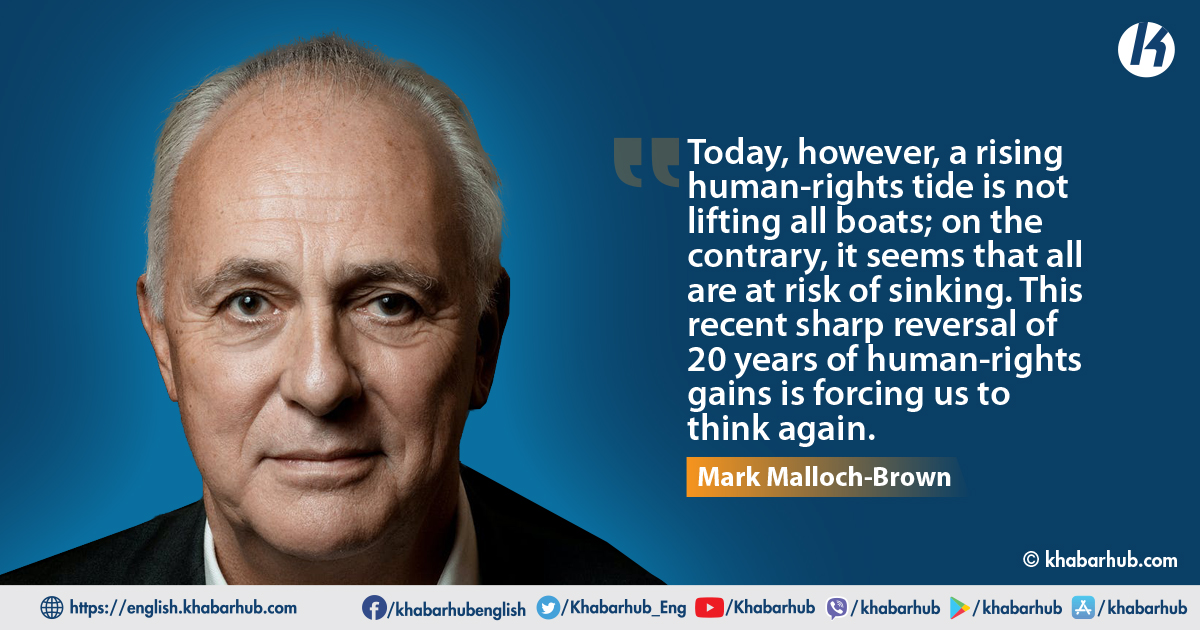
Today, however, a rising human-rights tide is not lifting all boats; on the contrary, it seems that all are at risk of sinking. This recent sharp reversal of 20 years of human-rights gains is forcing us to think again.
As a foundation chaired to this day by its founder, George Soros – a survivor of Nazism and a refugee from communism in his native Hungary – we will not move on to less challenging issues.
After all, Soros started the foundation when prospects for human-rights advances looked as difficult as they do today.
Presidents stole additional terms, official corruption surged, and agreements between states brushed aside people’s rights. Nowadays, human-rights defenders and those who support them are not welcome in much of the world.
So, the mission is non-negotiable. But we must revisit our approach. We must ask how to recover public support for democratic and human-rights norms, while also identifying more clearly the enemies of open societies and what will lead them, even grudgingly, to respect their obligations again.
In 1980s Eastern Europe, the problem was sclerotic, aging communist governments that could no longer deliver for their people. Today’s situation is more complicated.
True, a bipolar world again threatens freedom. Biden’s forthcoming Summit for Democracy is in part an effort to rally like-minded governments but also the wider world against Chinese President Xi Jinping’s authoritarianism. That may mean democracies have some uncomfortable bedfellows as pragmatism risks trumping values.
A dense web of trade, investment, education, and technology links mean China is tied to the West, and vice versa, in ways that the Soviet Union never was.
A relationship that is more economic than military gives democracies an array of options – from governmental and consumer boycotts to a more coherent international containment and engagement strategy – for pressing Xi’s regime to accept norms of good behavior at home and abroad.
Leaders on both sides will frame this contest primarily in terms of economics, but human rights can also be a big winner – or a big loser.
Soros has always called OSF’s work “political philanthropy.” What he means is that we need to engage with the wider dynamics of change and find entry points to champion our issues.
Whereas strong states were the sole or leading human-rights violators during the Cold War, today’s world is one of multidimensional human-rights menaces. Inequalities exacerbated by unregulated transnational financial and corporate power, together with dramatic shifts in individual states’ fortunes, are creating an ever more challenging landscape. The world is becoming more unequal – and angrier.
Many view the renewed attention to deep-seated institutional racism in the United States and around the world – and the recognition that marginalization based on race, gender, religion, and class is often mutually reinforcing – as exposing the limits of a human-rights agenda.
That anger is amplified (and fueled) by social-media platforms where polarization, abuse, and lies undermine trust in institutions. A technology that many saw just a few years ago as an enabler of citizens’ rights has become in many cases a tool for manipulating minds and closing societies.
The insidious copycat behavior that Donald Trump’s four-year presidency allowed and encouraged in regimes around the world accelerated a crisis of respect for the rule of law and human rights.
Presidents stole additional terms, official corruption surged, and agreements between states brushed aside people’s rights. Nowadays, human-rights defenders and those who support them are not welcome in much of the world.
Yet malign governments and globalization, with its unintended financial and corporate consequences, are only half the problem.
Many view the renewed attention to deep-seated institutional racism in the United States and around the world – and the recognition that marginalization based on race, gender, religion, and class is often mutually reinforcing – as exposing the limits of a human-rights agenda. Human-rights remedies, victims argue, have scratched the surface, not reached the roots.
Human-rights work needs to become more political: tougher and smarter in its attacks on oppressors, and clearer about being on the side of the oppressed.
We need to address the challenges people actually face, looking beyond narrow political rights to address the deeper causes of economic and social exclusion.
On 21 July 2021 FIDH and many other NGOs addressed an open letter to the Government of Eswatini and the international community:
We, the undersigned 69 civil society organisations, are deeply concerned about the eruption of state violence in Eswatini. We stand in solidarity with the people of Eswatini in condemning the government’s violent repression of mass protests demanding democracy and economic justice.
We support the UN Human Rights Commissioner’s call urging the authorities to fully adhere to human rights principles and reminding them that peaceful protests are protected under international human rights law. We call on the Government of Eswatini to immediately cease its brutal crackdown against civilians, restore and maintain internet access, and engage in inclusive dialogue with pro-democracy groups and politicians.
We call on the international community, including the United Nations, African Union, Southern African Development Community, and individual governments, to demand that the Government of Eswatini respect human rights, allow a thorough, independent investigation of who authorised violence against protesters, including shoot to kill orders, and support a peaceful transition to a democratic form of government.
Reports out of Eswatini indicate that, since late June, the army and police forces have killed dozens of unarmed civilians and injured around 1,000 people, including by shooting indiscriminately at and wounding protesters. The government has reportedly imprisoned hundreds of people, many of them young people, and shut down internet access across the country for several weeks, which Amnesty International calls “a brazen violation of the rights to freedom of expression and information.” Reports further indicate that security forces have sought to intimidate human rights defenders and activists with unlawful surveillance, imposed a curfew, and restricted public gatherings and petition deliveries to the government. This political crisis caused by state-sponsored violence risks creating a humanitarian crisis, as hospitals struggle to treat the influx of people injured by security forces, food and fuel supplies become limited, and people’s movement and ability to conduct basic commerce is restricted.
Specifically, we lend our support to the demands of civil society organisations, political organisations, and people’s movements within Eswatini calling for a long-term resolution to the current political crisis through an inclusive political dialogue, the total unbanning of political parties, a transitional authority, new democratic Constitution, and a multiparty democratic dispensation.In the immediate term, we join democracy defenders in Eswatini in the following demands, calling for action from the Government of Eswatini to cease violence, restore and maintain communications services, and provide urgently needed humanitarian support:
● The immediate cessation of the killing of civilians and the return of the army to the barracks;
● The immediate restoration of civic services such as the rapid issuing of death certificates for those killed in the past days;
● Mandatory independent pathologists to conduct post-mortems on the deceased;
● Urgent humanitarian support to the affected families, workers and citizens who need basic necessities such as food, sanitary towels, baby food, etc.
● The provision of direct financial support to resuscitate affected small and medium enterprises;
● The full and permanent restoration of internet and communication services and peoples’ right to freedom of expression; and
● The urgent availability of vaccines to all emaSwati and the end of unnecessary lockdowns.
As the Government of Eswatini, Africa’s only remaining absolute monarchy, violates the human rights of residents, suppresses freedom of speech and assembly, and jails young people for demanding a brighter future, the international community cannot remain silent.
We call on partners in international civil society, regional governmental bodies, and diplomats to join us in amplifying the demands of the Eswatini people and seeking the protection of people’s human rights.
The government needs our bodies for political power, while the detention industry needs us to fuel its money-making torture machine. But what has Australia truly gained?
Kurdish-Iranian born journalist and refugee Behrouz Boochani spent six years in Australian-run detention on Manus Island in Papua New Guinea. He now lives in Christchurch, New Zealand. Photograph: Martin Hunter/AAPWed 21 Jul 2021 03.14 BST
Eight years have passed since the Australian government mandated offshore detention for all asylum seekers who arrive by boat, which led to the banishing of more than 3,000 refugees to Nauru as well as Manus Island in Papua New Guinea.
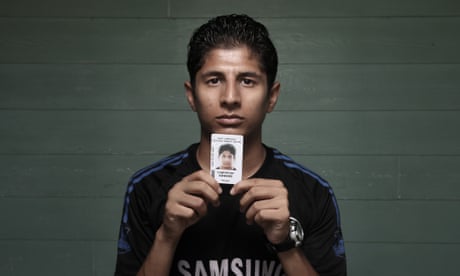
When I think about the stories of these refugees, including myself, the first thought that springs to mind is the abduction of human beings on the sea. We were kidnapped and forcibly transferred to an island we had never heard of. We were robbed of our identity. We turned into a string of numbers through a carefully planned process of dehumanisation. We were led into an evil system which was designed to diminish our identity.
The offshore detention policy was a form of official hostage-taking. For years, the Australian government refused to accept us, while preventing us from being transferred elsewhere. Even when it succumbed to public pressure by signing a resettlement deal with the United States, the government prolongated the transfer process. After all these years, many refugees are still held in indefinite detention.
The offshore detention policy is a combination of hostage-taking, deception, secrecy, corruption, populist propaganda and systematic torture
In addition to being a form of official hostage-taking, the policy provided a platform for the spread of populist ideas and false claims. Kevin Rudd, for example, announced this policy just before the 2013 federal election, while Scott Morrison went to the Christmas Island detention centre alongside a dozen reporters in 2019 and posed heroically against the backdrop of the sea.
They deceivedthe public into believing that the offshore detention policy was like a building that would collapse if one brick were to be removed from it. They warned against the invasion of boats on Australian shores, but no boats arrived. What boats anyway? They returned every single one to Indonesia.
This is a key point, because whenever the public has put pressure on the government since 2013, officials have highlighted the risks of opening up the borders. This turned out to be an outright lie. What the government has done is create unjustified fear while hiding behind the notion of national security.Advertisement
The reality is they needed our bodies for retaining their political power. Along the way, they created a $12bn detention industry which has greatly benefited politicians as well as certain security and medical companies. The contracts signed with Paladin is the only instance leaked to the media, but I believe that is just the tip of the iceberg.
The Australian government has made every effort to preserve its detention industry. When thousands of refugees were transferred to the US, the government brought in a group of New Zealanders previously held in Australia. At the end of the day, human bodies are fuel to this money-making torture machine.
The offshore detention policy is a combination of hostage-taking, deception, secrecy, corruption, populist propaganda, and of course, systematic torture. It is sadistic, costly, and unnecessary. After all these years, Australians need to find the courage to look in the mirror and ask themselves, “What have we gained? What have we lost?” These are crucial questions.
It is time to challenge the foundations of this deceitful policy. In the last eight years, human values have been undermined, more than $12bn has been spent and the international reputation of Australia has suffered immensely. The key question to ask right now is: “Who has benefited from this policy?”
Claims made this week that the Israeli company’s Pegasus spyware technology has been used to surveil 50,000 phones – belonging to heads of state, journalists, human rights defenders, political opponents and more – may be the highest-profile accusations against the firm, but they are not the first.
Pegasus, which infects phones with spyware through various means, has proven to be a boon to digital authoritarians wanting to track anyone perceived as critical of their rule. It has also been the subject of numerous lawsuits and legal complaints.
Geneva experts on cybersecurity and digital governance tell Geneva Solutions what citizens must do to stem the erosion of our right to privacy.
U.N. High Commissioner for Human Rights Michelle Bachelet, in a statement, said that the revelations “are extremely alarming, and seem to confirm some of the worst fears about the potential misuse of surveillance technology to illegally undermine people’s human rights.” See statement by @UNHumanRights Chief @mbachelet: https://ohchr.org/EN/NewsEvents/
On 16 July 2021 Reuters reported that Canada is establishing a dedicated refugee stream for “human rights defenders,” including journalists, who may need to seek asylum to escape persecution in their country,
The stream – the first of its kind in the world, according to the UN refugee agency – will accommodate 250 people a year, plus their families, and focus on people at heightened risk, such as women, journalists and LGBTQ2 rights advocates.
“We must not overlook those who bear witness to these human tragedies, who are active through demonstration and reporting so the rest of us can be informed. But in doing so they risk persecution, arrest, torture and even death,” Immigration, Refugees and Citizenship Minister Marco Mendicino said on Friday in a virtual news conference from Toronto.
One example a spokesperson gave of a person eligible under this program is an activist against the regime in Belarus who had fled to Poland but needed permanent refuge.
Canada aims to resettle 36,000 refugees this year, almost four times its total of 9,200 resettled in 2020. But by the end of April, only 1,630 resettled refugees had arrived in Canada, according to government figures.
Nominations can be made by filling out Nomination form for the Human Rights Tulip 2021. Please note that human rights defenders and organisations cannot nominate themselves. The nomination form is available in English, French, Spanish, Russian and Arabic.
Selection procedure: To decide who should win, all the submitted nominations are reviewed using agreed selection criteria. A certain weight is given to each criterion.
The selection criteria are as follows:
Working to peacefully promote and/or protect human rights, especially in one of the following fields:
freedom of expression (including online);
freedom of religion or belief;
equal rights for LGBTI persons;
equal rights for women and girls;
fight against impunity and accountability for international crimes.
Level of repression and risks faced as a result of the human rights work.
Level of innovation and creativity in the approach to promote and protect human rights.
Ability to achieve impact and to reach and improve the life of (marginalised) beneficiaries through the human rights work.
Working with and involving relevant partner organizations and/or communities.
Sustainability of the project and the possibility to scale up the approach or project.
A panel of 5 human rights experts pre-selects the top ten candidates with the highest scores as well as three ‘wild cards’, so that strong candidates who don’t score well on every single point still have a chance of winning. This list of 13 candidates is then submitted to an independent jury with 6 members. The jury discusses the profiles of these candidates and selects three candidates most eligible for the Human Rights Tulip award. The names of these three candidates are given to the Minister of Foreign Affairs, who picks the winner of Human Rights Tulip.
Shawn Utley reports in the Madison Leader Gazette of July 14, 2021 on a Freedom House “webinar” about the alleged Iranian plot to kidnap Iranian-American journalist Masih Alinejad.
A newly released Justice Department indictment charging four Iranian intelligence operatives with plotting to kidnap a New York-based journalist who had criticized the Iranian regime, dramatically underscores how transnational abductions are becoming the new “normal” for repressive regimes around the world, two human rights activists said Wednesday.
“It’s a horrific attempt to silence dissent,” Saudi activist Lina Alhathloul said during a Freedom House “webinar” about the alleged Iranian plot to lure Iranian-American journalist Masih Alinejad to a third country so she could be forcibly rendered to Iran.
Her sister, prominent women’s rights activist Loujain Alhathloul, was abducted in Dubai in 2018 and flown to Saudi Arabia, where she was thrown in prison and tortured under the direction of a top aide to Saudi Crown Prince Mohammed bin Salman, or MBS, according to U.S. officials and the accounts from the Alhathloul family.
“This is very much a moment when we see this phenomenon is becoming mainstream,” added Nate Schenkkan, director of research strategy at Freedom House, “It’s becoming something that dozens of governments around the world use to control exiles and diaspora members. Countries do it because they can get away with it and because the consequences are not there.”
The comments came during a Freedom House-sponsored panel dedicated to the growing threat of the transnational repression trend, as detailed in a recent report and video from the group, and to the new season of Yahoo News “Conspiracy land” an eight-episode podcast that uncovered new details about the brutal murder of Saudi journalist Jamal Khashoggi inside the Saudi consulate in Istanbul in October 2018.
As was noted in the panel discussion, there are striking parallels between the Saudi plot to assassinate Khashoggi and the alleged Iranian plot to kidnap Alinejad. Both targeted journalists who, after criticizing their governments, had moved to the United States to live in exile. Khashoggi had excoriated the harsh crackdowns by MBS, including the detention of Loujain Alhathloul. Alinejad had criticized the corruption and repressive measures of former Iranian President Mahmoud Ahmadinejad.
Jamal Khashoggi. (Getty Images)
Both plots involved extensive surveillance on U.S. soil. In Khashoggi’s case, Saudi operatives recruited spies inside Twitter to steal personal data about regime critics and later used sophisticated spyware to hack the phones of one of those critics who was in extensive contact with the Saudi journalist. In Alinejad’s case, Iranian intelligence operatives used private investigators to follow, photograph and video-record the Iranian-American journalist and members of her family in Brooklyn, according to federal prosecutors in Brooklyn, who on Tuesday brought the indictment against the Iranian operatives, all of whom reside in Iran..


 Hans Thoolen on Human Rights Defenders and their awards