Since I published my post about MEA Laureate Pierre Claver Mbonimpatwo days ago (https://thoolen.wordpress.com/2015/11/10/burundi-what-more-early-warning-does-one-need/) the situation has not improved and the hope is that the UN will find the muscle to impose itself. In the meantime, the Huffington Post of 12 November carries a long piece on Mbonimpa and his Burundi by Charlotte Alfred under the title “Burundi’s Human Rights Legend Urges Hope After His Son’s Killing“.
Pierre Claver Mbonimpa founder and president of the APRODH in Burundi (CARL DE SOUZA/AFP/GETTY IMAGES)
Pierre Claver Mbonimpa wasn’t able to attend his son’s funeral. Instead, he sent a message from Belgium, which was read out at the funeral of his son, Welly Nzitonda, on Tuesday, according to independent journalist network SOS Médias Burundi: “Do not lose courage … The tragedies we face will end with a resolution of the conflict in Burundi.”
……..
“The problem that plagues the country is not ethnicity, but politics,” Mbonimpa told the Oslo Freedom Forum in 2010. “It is politicians who manipulate the population in pursuit of power.”
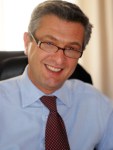
On 11 November 2015 the Secretary-General of the United Nations, following consultations with the regional groups, announced that Filippo Grandi of Italy is to be the new United Nations High Commissioner for Refugees (UNHCR).
This is good news for the organization and the millions of refugees as Filippo brings enormous humanitarian experience with him: He was Commissioner-General of the United Nations Relief and Works Agency for Palestine Refugees in the Near East (UNRWA) from 2010 to 2014 and it’s Deputy Commissioner-General from 2005 until 2010. He served as the Secretary-General’s Deputy Special Representative with the United Nations Assistance Mission in Afghanistan (UNAMA) and has a long-standing career with UNHCR (1988-2004), notably as Chief of Mission in Afghanistan and Chief of Staff in the High Commissioner’s Executive Office. His vast field experience includes various positions in Sudan, Syria, Turkey and Iraq, having also led emergency operations in Kenya, Benin, Ghana, Liberia, the Great Lakes region of Central Africa, Democratic Republic of Congo and Yemen.
Filippo Grandi was born in Milan in 1957. He has a bachelor’s degree in philosophy from the State Universities of Venice and Milan, and from the Gregorian University in Rome.
The UN Special Rapporteur on Human Rights Defenders, Michel Forst, has taken the initiative to set up a website devoted to his mandate. Check out: https://www.protecting-defenders.org.
You can subscribe to a newsletter to be kept informed.
Martine Anstett (born on 15 March 1969) was a French human rights defender who worked for a variety of organizations. For NGOs such as APT and AI, for the UN and the French diplomatic service. Her last post was with the Organisation Internationale de la Francophonie. She died at a young age on 29 April, 2015
Friends of hers decided to create an association to remember Martine and honor her memory so that her outstanding commitment should not be lost. The main activity of the association is to award every year – on 29 April – a remarkable human rights defender who deserves to be noticed and supported with the Martine Anstett Prize. The award comes with a prize of a minimum 1,500 euros. The website http://www.prixmartineanstett.org/En-PrixModeEmploi.html gives ample instructions on how to apply and on the life and work of Martine Anstett.
The second case concerning children of human rights defenders is a more general category as described by Rebecca Sheff in a blog on Human Rights First: “Reprisals Against Children of Human Rights Defenders in UAE“.
She reports that on 8 October 2015, the U.N. Committee on the Rights of the Child released a report expressing “concern” about the United Arab Emirates’ treatment of human rights defenders andtheir families. It noted that the government has been persecuting the children of defenders, restricting their “rights to education, identity documents, to freedom of movement and to keep contact with their detained parents.” The Convention on the Rights of the Child requires the UAE to protect children against discrimination or punishment on the basis of the status, activities, expressed opinions, or beliefs of their parents. The UAE’s acts of intimidation violate children’s fundamental rights and inhibit the work of defenders. Dozens of political prisoners in the UAE are serving long prison sentences after being convicted in a mass unfair trial in 2013. ….The Committee on the Rights of the Child also expressed concern “about the reported continuous harassment of human rights defenders in the State party, which greatly undermines the emergence of a vibrant civil society as well as the protection and promotion of children’s rights.” The lack of a robust civil society in the UAE means that children’s rights issues are neglected and violations go unaddressed. Ahmed Mansoor, a prominent human rights defender in the UAE, recently received the 2015 Martin Ennals Award for Human Rights Defenders.
Indeed one of the most moving scenes in the film on the work of MEA Laureate Mansoor was when he told how his own child did not recognize him after a stay in detention: (minutes 5.20)
But she does not just live quietly in exile in Paris. She continues fight for her rights, lodged a complaint to the UN Human Rights Committee in 2012 and this body found on 6 October 2015 that there had been “multiple violations” of her rights, according to a press release issued by three human rights NGOs on 8 October (the Fiery Hearts Club, Redress and FIDH). Read the rest of this entry »
BACKGROUND:
The UN Commission on the Status of Women (CSW) each year provides a global platform for exchange and networking for women’s organizations working on furthering women’s rights all across the world, but this year’s session (March) was also the occasion to present the ‘Future organization and methods of work of the CSW which provides less space to NGOs to influence the outcomes of the session, through increasingly limited access to official negotiations and space to contribute to outcome documents. It seems that governments are intent limiting the (sometimes) robust participation of non-governmental organizations, restrict recognition of the human rights of women and girls and the norm-setting role of the CSW in this regard and skirt responsibility for implementing the Sustainable Development Goals.
The statement says: “It seems they are intent on discussing everything about us, without us….Let us be clear: we do not come to the CSW to attend side events. We come to the CSW to hold our governments to account to the commitments they have made to guarantee gender equality, eliminate all forms of discrimination and violence against us and achieve the full realization of all of our human rights. We come to the CSW to advance progressive policies that, if implemented, will make a meaningful difference in our lives. If the CSW no longer provides us with a forum for policy change and accountability that fully involves us, we will stay at home.”
Where possible I like to extend coverage to countries that normally do not figure highly in the news. This press statement of 22 May 2015 from the UN Human Rights Office provides the occasion to zoom in on the Pacific island of Nauru.
Voicing concern over recent amendments to the Criminal Code in Nauru which “unduly restrict” freedom of expression, a United Nations expert on the issue today urged the Government to revoke such measures to fulfil its human rights obligations. “These new laws could be used to muzzle dissenting opinions and deter human rights defenders, academics, journalists, students, politicians and civil society members”, David Kaye, the UN Special Rapporteur on freedom of opinion and expression, warned.
Ambiguous and imposing harsh penalties, the amended Criminal Code also includes up to seven years in prison for a wide range of legitimate expression, according to Mr. Kaye. Nauru has also curtailed the freedom of press. It imposed a prohibitive $6,500 fee for a single entry visa for foreign journalists in 2014.
“Nauru should allow free space for expression without fear of criminal prosecution,” he said, adding that “it should lift all restrictions to access internet and social media, and facilitate access to the media in the country.” Since April, the authorities have blocked access to social media and internet to prevent pornography and “cyberbullying” and to protect the national culture. These restrictions, however, are “designed to prevent asylum seekers and refugees in the country from sharing information on their situation,” stressed the independent expert.
Whether one believes in sainthood or not, it is not difficult to rejoice with Pax Christi International about the 23 May beatification of Salvadoran Archbishop Oscar Arnulfo Romerowho became known for his persistent search for truth, justice and reconciliation in the late seventies in conflict-torn El Salvador. He was shot dead while celebrating mass on 24 March 1980. The assassin has never been identified, but it is widely believed that the assassins were members of a death squad led by former Major Roberto D’Aubuisson. Read the rest of this entry »
Zhu Junqing, writing in the Shanghai Daily of 13 May 2015, is the prime example of how distorted the Chinese government’s view of the international human rights regime is. Under the title: “U.S. needs to work on own human rights record first before blaming others“, the author quite rightly points to the UN Human Rights Council findings on 11 May and the comments by UN High Commissioner for Human Rights, Zeid Ra’ad Al Hussein, which conclude that there a lot of human right problems remain unresolved in the USA (including excessive use of force by law enforcement agencies, racial, religious and sex discrimination, Guantanamo Bay detention, migrant rights, environmental issues and counterterrorism practices). Also he recalls correctly that the United States is one of the two countries in the world that have not ratified the UN Convention on the Rights of the Child, and is reluctant on other international instruments.
But then the article draws exactly the wrong conclusion. Instead of appreciating the UN’s courage to tackle a superpower, it call the USA the “ultimate human rights judge” (why??) and concludes that this “self-proclaimed human rights watchdog, needs to examine itself critically and improve its own human rights record before [!] blaming other countries for their violations”. Since “no country is perfect in its human rights record,” as Chinese Foreign Ministry Spokesperson Hua Chunying put it, “any country with human rights defects should work hard to resolve its own problems and improve its own human rights record before casting the first stone”.
China’s own extraordinary sensitivity to ‘interference’ of any level into what it considers its domestic affairs is well-known. I touched upon this ‘hot’ topic’in my own 2011 article “The international human rights movement: not perfect, but a lot better than many governments think” in the book ‘NGOs in China and Europe’(exceptionally also published in Chinese!): Yuwen Li (ed), Ashgate, 2011, pp 287-304 (ISBN: 978-1-4094-1959-4).



 Hans Thoolen on Human Rights Defenders and their awards