Posts Tagged ‘UN High Commissioner for Human Rights’

UN High Commissioner for Human Rights warns of ‘preventable calamities’ worldwide

June 14, 2016

In a wide-ranging opening speech to the United Nations Human Rights Council in Geneva, on 13 June 2016, the UN rights chief sheds a light on “ calamities” and worrying trends around the world, including detailed concerns about the situation in more than 50 countries.

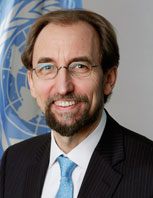
High Commissioner for Human Rights Zeid Ra’ad Al Hussein. UN Photo/Pierre Albouy

Hate is becoming mainstreamed,” warned the UN High Commissioner for Human Rights, Zeid Ra’ad Al Hussein, speaking at the opening of the Council’s 32nd session.

Walls – which tormented previous generations, and have never yielded any sustainable solution to any problem – are returning. Barriers of suspicion are rising, snaking through and between our societies – and they are killers. Clampdowns on public freedoms, and crackdowns on civil society activists and human rights defenders, are hacking away at the forces which uphold the healthy functioning of societies. Judicial institutions which act as checks on executive power are being dismantled. Towering inequalities are hollowing out the sense that there are common goods,” Mr. Zeid stressed. He said these trends “bleed nations of their innate resilience,” and do not make them safe; instead, they make them weaker. “Piece by piece, these mutually reinforcing trends are shearing off the protections that maintain respect, enable development, and provide the only fragile basis for world peace. They are attacks on sanity. And they can be reversed”

Meanwhile, he told Member States that he very much regrets the refusal by some countries to permit the staff of the his Office (OHCHR) to have access in order to monitor and report on events. “I must emphasise that non-cooperation by Governments will not result in my Office remaining silent. On the contrary, it creates a presumption of major violations, and may deprive local and national actors of the opportunity to explain and provide information about events,” he stressed, adding that when he updates the Council at the September session, he may list a number of countries where engagement with or access for his Office is impeded.

‘Very pressing human rights concerns’ around the globe

Today, Mr. Zeid said his goal was to outline “some very pressing human rights concerns, which could have been prevented – and must now be redressed.”

Speaking of the situation in Europe, Mr. Zeid underlined that globally, many countries have distinguished themselves “by their principled welcome to large numbers of desperate, often terrified and poverty-stricken migrants and refugees.” However, he said many other countries have not done so, and their failure to take in a fair share of the world’s most vulnerable is undermining the efforts of more responsible States.

Turning to the Middle East and North Africa, he warned that “the life-forces of society – which are the freedom and hopes of the people – are crushed by repression, conflict or violent anarchy.” The antidote to the savagery of violent extremism is greater rule of law,” he stressed. “The best way to fight terrorism, and to stabilize the region, is to push back against discrimination; corruption; poor governance; failures of policing and justice; inequality; the denial of public freedoms, and other drivers of radicalization.”

In relation to other challenges on the African continent, Mr. Zeid’s remarks included concerns about new waves of attacks by violent extremists; killings, disappearances and arbitrary arrests by agents of the State or associated militia; some signs of stable countries “backsliding into violence; and some showing a reduction in “democratic space.

Similarly in Asia, terrorist groups are claiming responsibility for many deadly incidents against men, women, and children; there has reportedly been a dramatic increase in the number of brutal murders against freethinkers, liberals, religious minorities and activists for lesbian, gay, bisexual and transgender (LGBT) rights; longstanding protests have also continued and escalated with police using excessive force.

Meanwhile, the UN rights chief shared his concern about the situation across the Americas regarding the very high incidence of gun violence and gun-related deaths. According to the UN Office on Drugs and Crime (UNODC), the Americas have by far the highest rate of intentional homicide of any region in the world.


Source: United Nations News Centre – UN rights chief warns of ‘preventable calamities’ and ‘worrying’ trends in more than 50 countries

Preview of the upcoming session of the UN Human Rights Council

February 25, 2016

The UN Human Rights Council will hold its 31st regular session at Palais des Nations in Geneva from 29 February to 24 March 2016 (it also marks the 10th anniversary of the Human Rights Council). The International Service for Human Rights (see link at the bottom of the post) has published an Alert full of details, but I highlight here the elements that concern human rights defenders most directly:ISHR-logo-colour-high

Human rights defenders:  The Special Rapporteur on the situation of human rights defenders, Michel Forst, will present his annual report to the Council on 3 March. The report focuses on good practices to promote and protect the rights of human rights defenders. Presentation of the report will be followed by a dialogue. Of significance this session is a substantive resolution that will be presented by Norway on the situation of human rights defenders. The resolution at this session of the Council follows on the heels of the resolution on human rights defenders presented at the General Assembly in November 2015. The General Assembly resolution included a number of new, important and substantive provisions, including on the vital role of advocacy and the work of defenders in contributing to sustainable development and the realisation of economic, social and cultural rights, and the responsibilities of business enterprises with respect to engaging, consulting and protecting defenders. [see also: https://thoolen.wordpress.com/2015/12/18/un-general-assembly-adopts-resolution-on-human-rights-defenders-with-increased-majority/] This latest resolution provides an opportunity to recognise the critically important work of economic, social and cultural rights defenders, and the cross-cutting challenges they face, including restrictions not only on their rights to health, food, housing, social security and work, but also on their rights to freedom of expression, association, assembly and life itself. Economic, social and cultural rights activists have been identified by current and previous Special Rapporteurs on the situation of human rights defenders as among the most isolated and stigmatised defenders. It is integral that the resolution recognises the role of both State and non-State actors in the protection of human rights defenders, and enjoys broad State support for strong language demanding their protection.  (On 7 March, ISHR will facilitate a side event on this topic which will be the subject of a separate post) Read the rest of this entry »

Reprisals against Human Rights Defenders continue says UN report

September 17, 2015

Reprisals against human rights defenders continue and the UN High Commissioner for Human Rights (fortunately) continues to give it prominence. A newly released United Nations report names 20 nations that have taken action against rights defenders and activists over the past year. Here the version of the New York Times (Nick Cumming) of 15 September 2015:

Those who give evidence to United Nations human rights investigators are facing increasingly severe reprisals, the United Nations Human Rights Council said Tuesday in a report naming 20 countries that took action against rights defenders and activists in the past year. The instances included intimidation and reprisals against the council’s commissions of inquiry on Eritrea and the 2014 war in Gaza, as well as people cooperating with United Nations investigators and staff monitoring human rights developments, the council’s president, Joachim Rücker, reported. “The types of acts reported seem to have become more varied and severe over time, targeting not only the individuals or groups concerned, but also their families, legal representatives, nongovernmental organizations and anyone linked to them,” he said in the report, which covers events in the year up to the end of May. The penalties it cited ranged from threats and travel bans to imprisonment, torture, sexual violence and disappearance. The list was not exhaustive, leaving out cases where naming individuals might endanger them.

In a statement to the council, Zeid Ra’ad al-Hussein, the United Nations’ High Commissioner for human rights, expressed concern on Monday about China’s detention of more than 100 lawyers and Russia’s stigmatization of nongovernment organizations getting overseas funding, but the report includes only one example of intimidation in each country.

It describes the torture of Sadriddin Toshev, a prisoner in Tajikistan, beaten in front of other inmates by prison officials who cited his interaction with a United Nations investigator on torture. Mr. Toshev was later charged with fraud, accused of deliberately wounding himself to discredit prison officials and of distributing false information, the report said.

Among other cases, the report cites a five-year prison sentence which it says was imposed in Iran on Mohammad Ali Taheri for cooperating with the United Nations expert monitoring human rights there. It also describes the violent arrest of a human rights defender in Myanmar by 10 plainclothes security men as he was on his way to provide evidence to the council-appointed expert assessing developments there.

“Such acts not only show a complete disregard for the functioning of the United Nations as a whole but also highlight the fact that, despite repeated calls for action by states to end all such violations, impunity continues to surround them,” the report said.

Having written so often about this topic, a link to previous posts is all this is needed: https://thoolen.wordpress.com/tag/reprisals/ 

Source: Retribution Increases Against Those Aiding Human Rights Inquiries – The New York Times

Human Rights Defenders in Azerbaijan: Human Rights Council last hope?

September 15, 2015


In Azerbaijan, space for independent civil society has disappeared, following a crackdown since the presidential election in October 2013. Ahead of the parliamentary elections in November 2015, all leading civil society actors are either in prison or have fled the country. On 8 September 2015, the UN High Commissioner condemned the ongoing crackdown on civil society and independent voices in Azerbaijan. On 20 August 2015, six UN Special Rapporteurs issued a joint statement condemning the conviction of human rights defenders as “manifestly politically motivated” in a trial that “fell short of international norms and standards.” On 11 September 2015, the OSCE Office for Democratic Institutions and Human Rights (ODIHR) cancelled its election monitoring in the country due to restrictions imposed by the Azerbaijani authorities. See also: https://thoolen.wordpress.com/tag/azerbaijan/

Clearly time for the Human Rights Council to step in!

Several NGOs, led by the Human Rights House Foundation, are organizing a side event in Geneva on Wednesday 16 September, from 17:00 – 18:00. Palais des Nations Room XXIV. English / Russian translation is provided.HRHFlogo

SPEAKERS

DINARA YUNUS Institute for Peace and Democracy & Daughter of political prisoners Leyla Yunus and Arif Yunus

SERGHEI OSTAF Resource Centre for Human Rights Moldova; Observer of many of the hearings this summer of various human rights defenders imprisoned in Azerbaijan

EMIN HUSEYNOV Institute for Reporter’s Freedom and Safety

Moderation: FLORIAN IRMINGER


High Commissioner leaves Burundi and the repression goes up…

April 29, 2015

High Commissioner for Human Rights Zeid Ra’ad Al Hussein (second left) at a roundtable discussion during his mission to Burundi.Photo: UN Electoral Observation Mission in Burundi (MENUB)
The UN High Commissioner for Human Rights left Burundi on 15 April with a final exhortation that “Burundian parties must choose the path to democracy and the rule of law“. Only a week later the authorities increased their crackdown on dissent to silence those who oppose a third term for the President.
This is a critical moment in Burundi’s history,” said UN High Commissioner for Human Rights Zeid Ra’ad Al Hussein during his mission to Burundi. “Its future may well depend on which path is chosen by individual politicians and their supporters, as well as various key authorities, over the next few weeks.”… “And history – and possibly national or international courts – will judge those who kill, bribe or intimidate their way to power.

He pointed out that recent events were of great concern, with tensions rising sharply over the past few months as the elections approach, reportedly stoked by an increase in politically motivated harassment, intimidation and acts of violence, as well as a reported rise in hate speech. He pointed to “extreme examples of hate speech” heard at a pro-Government political rally in Bujumbura and several examples of attacks on and intimidation of journalists, human rights defenders and opposition politicians.

“I will put it bluntly,” he said “As I prepared for this mission, I talked to many knowledgeable people, within and outside the UN, in Geneva and New York. They were all, without exception, alarmed about the direction the country appears to be taking. The Secretary-General has signalled his concerns, and so has the Security Council.”

He cited the main cause for concern as the pro-Government militia called the Imbonerakure, which he said appeared to be operating increasingly aggressively and with total impunity. People were fleeing the country, with up to 1,000 people per day crossing into Rwanda, and many of those leaving telling UN officials that their reason for leaving is fear of the Imbonerakure.

Mr. Zeid said the Government needed to send a clear message that extremism and impunity would no longer prevail and he added that all political demonstrations needed to be treated equally and in accordance with international laws and standards relating to freedom of assembly. Opposition politicians needed to play a part, too, refraining from inflation or exaggeration of facts to whip up anti-Government support and feed a climate of fear. They also needed to ensure that their supporters protest peacefully, and do not indulge in hate speech or react violently to perceived provocations. He said he had held several meetings since arriving in Burundi on Sunday, including with the country’s top officials, as well as civil society organizations, the National Human Rights Institution (CNIDH), foreign diplomats, opposition politicians, and key State institutions such as the Truth and Reconciliation Commission, the Independent National Electoral Commission, and the President of the Constitutional Court. “During the course of these meetings and discussions, it was very clear that many people here are also extremely worried,” …. “Ultimately, it is the authorities who have the obligation to protect all citizens and residents from intimidation and violence committed by any individual or group. They must also accept that criticism is a vital element of democracy, not a threat that must be crushed.”

A week later Front Line Defenders and the African defenders network EHAHRDP reported inter alia:

  • a clampdown on human rights defenders and journalists by Burundian authorities in connection with ongoing protests against President Nkurunziza’s bid for a third term widely deemed unconstitutional by Burundi’s civil society (with AP reporting 6 people killed at demonstrations over the weekend)
  • on 27 April 2015, human rights defender Pierre Claver Mbonimpa was arrested and released a day later without charge after being held in police custody approximately 48 hours [Pierre Claver Mbonimpa, Laureate of the MEA 2007, is the President of the Burundi Association for the Promotion of Human Rights (APRODH). He is also a member of the coalition “Halt to Nkurunziza’s third term”, a peaceful campaign which was launched in January 2015 by several civil organisations to oppose a third presidential term].  In May 2014, Pierre Claver Mbonimpa was also arrested and much later released [https://thoolen.wordpress.com/2014/09/30/news-from-burundi-release-of-human-rights-defender-pierre-claver-mbonimpa/].
  • an arrest warrant seems also to have been issued against human rights defenders Messrs Pacifique Nininahazwe and Vital Nshimirimana from the Forum for the Strenghtening of Civil Society (FORSC), who are perceived as leading organisers of the campaign against the Nkurunziza’s third term.
  • state authorities forcibly closed the Bujumbura and Ngozi offices of the African Public Radio (Radio Publique Africaine – RPA), a private radio station of Burundi known for dealing with human rights-related issues
  • 0n Monday morning, police forcibly closed the Media Synergy Press Conference that was taking place at Maison de la Presse in Bujumbura.

The risks facing human rights defenders in Burundi, as well as the wider civilian population, are now at critical proportions,” said EHAHRDP’s director Hassan Shire.

https://thoolen.wordpress.com/2014/11/25/special-rapporteur-in-burundi-respect-the-work-of-human-rights-defenders-like-mbonimpa/

http://www.defenddefenders.org/2015/04/burundi-unprecedented-state-assault-on-human-rights-defenders-and-journalists/

United Nations News Centre – UN rights chief urges Burundi’s politicians to pick right path at ‘critical moment’ in country’s history.

UN Human Rights Commissioner speaks out over Katie Hopkins ‘cockroaches’ column in the Sun

April 27, 2015

I hope that this reaction by the UN High Commissioner for Human Rights was widely disseminated. For those who missed it – and to illustrate why an independent Office is needed [https://thoolen.wordpress.com/2015/04/07/joint-inspection-unit-on-human-rights-not-so-innocent-as-it-sounds/] – here is how Zeid Ra’ad Al Hussein has criticised the UK tabloid Sun for allowing Katie Hopkins to describe migrants as ‘cockroaches‘ in a recent column. Read the rest of this entry »

Another memorable speech by the High Commissioner for Human Rights

March 5, 2015

High Commissioner for Human Rights Zeid Ra’ad Al Hussein. UN Photo/Jean-Marc Ferré

On 5 March 2015 the United Nations High Commissioner for Human Rights urged Member States to uphold the human rights principles underlying their communities in their fight against radicalism.

Speaking to the UN Human Rights Council earlier he warned of the “real danger” that opinion-leaders and decision-makers would “lose their grasp” of the values that States built 70 years ago “to ward off the horror of war.”

The fight against terror is a struggle to uphold the values of democracy and human rights – not undermine them,” Mr. Zeid declared. “Counter-terrorist operations that are non-specific, disproportionate, brutal and inadequately supervised violate the very norms that we seek to defend. They also risk handing the terrorists a propaganda tool – thus making our societies neither free nor safe.”

At the same time, the UN human rights chief said he was “appalled” by the “rising tide of attacks” around the world targeting people on account of their beliefs. Such “horrific acts of racial and religious hatred,” he said, spanned countries in Western Europe and North America, where “unfair policing, daily insults, and exclusion” affected large swathes of the population. Meanwhile, he added, “the tentacles of the extremist takfiri movement” – an ideology where one believer apostasies another and then condemns them as impure – had reached into a wide range of countries, from Iraq and Syria to Nigeria, Yemen, Libya and Somalia.

Against that backdrop, Mr. Zeid voiced deep concern at the tendency of States to clamp down on the most basic of human rights, including the adoption of measures that restrict freedom of expression and democratic space.

When powerful leaders feel threatened by a tweet, a blog, or a high-school student’s speech, this speaks of profound underlying weakness,” he continued. “And when writers are abducted, jailed, whipped, or put to death; when journalists are assaulted, subjected to sexual violence, tortured and killed; when peaceful protestors are gunned down by thugs; when human rights lawyers, human rights defenders and land activists are arrested and jailed on spurious charges of sedition; when newspapers are attacked or shut down – such cases attack and undermine the foundations of stable governance.”

It is the people who sustain government, create prosperity, heal and educate others and pay for governmental and other services with their labour,” Mr. Zeid concluded. “It is their struggles that have created and sustain States. Governments exist to serve the people – not the other way round.

United Nations News Centre – Member States must enforce human rights amid rising tide of extremism – UN rights chief.

Another passionate plea by UN High Commissioner for better education and global leadership

February 6, 2015


High Commissioner Zeid Ra’ad Al Hussein delivers his speech at the United States Holocaust Memorial Museum. Credit: U.S. Holocaust Memorial Museum | Photo: Miriam Lomaskin

In an impressive speech on 5 February 2015 at the Holocaust Memorial Museum in Washington, D.C. – one week after the 70th anniversary of the liberation of Auschwitz – Mr. Zeid Ra’ad Al Hussein emphasized that education devoid of a strong universal human rights component can be next to worthless, especially in a crisis. “What good was it to humanity that…eight out of 15 people who planned the Holocaust at Wannsee in 1942 held PhDs?” he asked. “In the years after the Holocaust, specific treaties were negotiated to cement into law obligations to protect human rights. Countries the world over accepted them – and now alas, all too frequently, they ignore them in practice.” While it has been 70 years since the liberation of Auschwitz extermination camp, some of the processes used by the Nazis to carry out humanity’s largest organized destruction are being implemented again today by Islamic State of Iraq and the Levant (ISIL), explained Mr. Zeid.

This logic is abundant around the world today: I torture because a war justifies it. I spy on my citizens because terrorism, repulsive as it is, requires it. I don’t want new immigrants, or I discriminate against minorities, because our communal identity or my way of life is being threatened as never before. I kill others, because others will kill me – and so it goes, on and on.

Since the world cannot afford “sinking into a state of paralyzing shock…the task is to strengthen our ethics, clarity, openness of thought, and moral courage,” calling for new battle lines to combat extremism – based on the struggle for minds.

Children need to learn what bigotry and chauvinism are…they need to learn that blind obedience can be exploited by authority figures for wicked ends. They should learn that they are not an exception because of where they were born, how they look, what passport they carry, or the social class, caste or creed of their parents; they should learn that no one is intrinsically superior to her or his fellow human beings,” said Mr. Zeid.

The world needs “profound and inspiring” leaders who fully observe human rights and humanitarian law and all the treaties drafted to end discrimination, poverty, war, “with no excuses.”

It is obvious, Mr. Zeid continued, that forceful reprisals against atrocities – including “the savage burning of my compatriot the pilot Mu’ath al Kassassbeh” by ISIL – have had limited impact. Leaders must adopt a “battle-line based on ideas,” to speak out against Takfiri ideology (when one believer apostasies another believer and condemns them as impure). The movement to end that dangerous ideology must be waged by Muslim leaders and Muslim countries, he said.

Just bombing them or choking off their financing has clearly not worked…for these groups have only proliferated and grown in strength,” he said. “The space for dissent in many countries is collapsing under the weight of either poorly-thought out, or indeed, exploitative, counter-terrorism strategies.”

Few crises erupt without warning, he continued. Extremist ideas and violence manifest from years of tyranny, inequalities, fear and bad governance. They build up over years – even decades – of human rights grievances and the denial of basic economic and social rights. He insisted that atrocities can be prevented and extremism curbed through better, human rights-based global leadership and a fundamental rethink of education. “Surely we now know, from bitter experience, that human rights are the only meaningful rampart against barbarity.”

United Nations News Centre – In Washington, UN rights chief says atrocities can be prevented through better global leadership.

UN High Commissioner for Human Rights writes about Women’s Human Rights Defenders

December 8, 2014
UN HCHR Al Hussein

On 5 December 2014, Zeid Ra’ad Al Hussein, United Nations High Commissioner for Human Rights, wrote a piece in the Huffington Post in which he eloquently calls on all to ‘Stand in Solidarity With Courageous Women’s Human Rights Defenders’. 

In the article he explains that his Office has decided to launch a campaign to pay tribute to women and men who defy stereotypes and fight for women’s human rights. The campaign runs from Human Rights Day, December 10 this year, to International Women’s Day, March 8, 2015. We encourage everyone to join the ranks of these strong and inspiring advocates, on social media (#reflect2protect) and on the ground. Below the text in full:


Almost two decades ago, in Beijing, 189 countries made a commitment to achieve equality for women, in practice and in law, so that all women could at last fully enjoy their rights and freedoms as equal human beings.

They adopted a comprehensive and ambitious plan to guarantee women the same rights as men to be educated and develop their potential. The same rights as men to choose their profession. The same rights to lead communities and nations and make choices about their own lives without fear of violence or reprisal. No longer would hundreds of thousands of women die every year in childbirth because of health care policies and systems that neglected their care. No longer would women earn considerably less than men. No longer would discriminatory laws govern marriage, land, property and inheritance.

In the years that followed, the world has witnessed tremendous progress: the number of women in the work force has increased; there is almost gender parity in schooling at the primary level; the maternal mortality ratio declined by almost 50 percent; and more women are in leadership positions. Importantly, governments talk about women’s rights as human rights, and women’s rights and gender equality are acknowledged as legitimate and indispensable goals.

However, the world is still far from the vision articulated in Beijing. Approximately 1 in 3 women throughout the world will experience physical and/or sexual violence in their lifetime. Less than a quarter of parliamentarians in the world are women. In over 50 countries there is no legal protection for women against domestic violence. Almost 300,000 women and girls died in 2013 from causes related to pregnancy and childbirth. Approximately 1 in 3 married women aged 20 to 24 were child brides. In many parts of the world, women and girls cannot make decisions on their most private matters — sexuality, marriage, children. Girls and women who pursue their own life choices are still murdered by their own families in the dishonorable practice of so-called honor killings. All of our societies remain affected by stereotypes based on the inferiority of women, which often denigrate, humiliate and sexualize them.

Today we have the responsibility to protect the progress made in the past 20 years and address the remaining challenges. In doing so, we must recognize the vital role of women who defend human rights, often at great risk to themselves and their families precisely because they are viewed as stepping outside socially prescriptive gender stereotypes. We must recognize the role of all people, women and men, who publicly call for gender equality and often, as a result, find themselves the victim of archaic and patriarchal, but powerful, threats to their reputations, their work and even their lives. These extraordinary individuals — women’s human rights defenders — operate in hostile environments, where arguments of cultural relativism are common and often against the background of the rise of extremist, misogynistic groups, which threaten to dismantle the gains of the past.

Attacks against women who stand up to demand their human rights and individuals who advocate for gender equality are often designed to keep women in their “place.” In some areas of the world, women who participate in public demonstrations are told to go home to take care of their children. Consider the recent example of a newspaper publishing naked photos of a woman, claiming she was a well-known activist — an attack designed to shame this defender into silence. In other places, when women claim their right to affordable modern methods of contraception, they are labelled as prostitutes in smear campaigns seeking to undermine their credibility. Online attacks against those who speak for women’s human rights and gender equality by so-called “trolls” — who threaten heinous crimes — are increasingly reported.

These attacks have a common thread — they rely on gender stereotypes and deeply entrenched discriminatory social norms in an attempt to silence those who challenge the age-old system of gender inequality. However, these defenders will not be silenced, and we must stand in solidarity with them against these cowardly attacks.

This is why my Office has decided to launch a campaign to pay tribute to women and men who defy stereotypes and fight for women’s human rights. The campaign runs from Human Rights Day, December 10 this year, to International Women’s Day, March 8, 2015. We encourage everyone to join the ranks of these strong and inspiring advocates, on social media and on the ground.

As we approach the 20-year anniversary of Beijing, discrimination and violence against women, and the stereotypes that confine them into narrowly fixed roles must end. Women have the right to make their own decisions about their lives and their bodies. Guaranteeing and implementing these rights are non-negotiable obligations of all States. Women human rights defenders were instrumental in securing the ambitious program laid out in Beijing. Their work, their activism and their courage deserve our recognition, our support and our respect.”

Stand in Solidarity With Courageous Womens Human Rights Defenders | UN Women.

Mexican laureate MEA, Alejandra Ancheita, pictured with UN High Commissioner

October 15, 2014

I have written about this wonderful woman, the Laureate 2014 of the MEA, before but did not yet have this nice picture with the UN High Commissioner for Human Rights Zeid [https://thoolen.wordpress.com/2014/10/10/dont-miss-the-high-commissioners-words-at-mea-2014-ceremony/]


See more at: http://www.ohchr.org/EN/NewsEvents/Pages/MartinEnnals2014.aspx#sthash.Y5CTi7Ug.dpuf

Mexican attorney receives top human rights defender award.