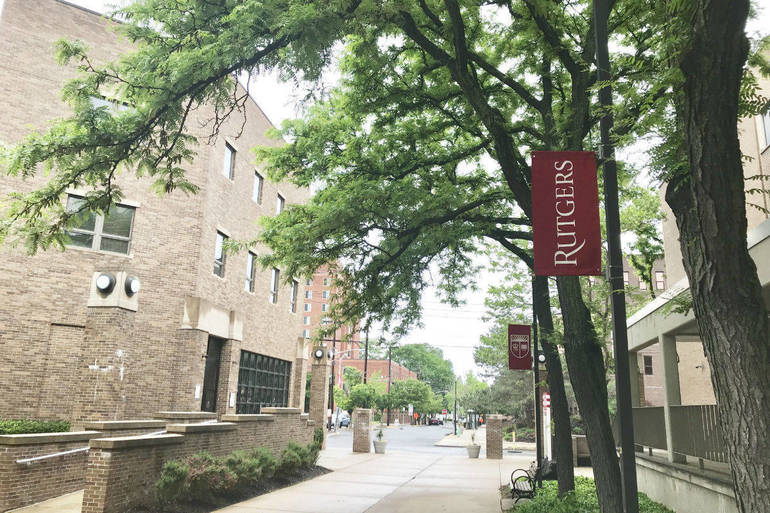
On 3 April 2019 former United Nations High Commissioner for Human Rights Zeid Ra’ad Al Hussein received the Justice William J. Brennan Jr. Human Rights Award from Rutgers Law School in Camden. Named in honor of the late U.S. Supreme Court justice, the Brennan Award is presented by Rutgers Law School to a foreign lawyer or judge who has made a notable contribution toward establishing or defending human rights and the rule of law.
In his remarks upon receiving the award, Zeid Ra’ad Al Hussein discussed the history of international politics and cautioned against nationalization, noting that the human rights violations of today are the conflicts of tomorrow. “I worry, like so many others, that what we are seeing now is the decomposition of the international order,” said Ra’ad Al Hussein. “The rules and institutions that uphold international human rights law, international humanitarian law, and international refugee law are under immense pressure.” He shared that he has faith in the efforts of human rights defenders and the human rights movements around the world, “We cannot depend now on much of the leadership at the highest levels. We have to depend on ourselves and we have to have the courage to speak out and say what needs to be said.”
In Resolution 30/1 adopted in 2015, Sri Lanka (which cosponsored it!) committed itself to a range of measures on human rights, accountability and reconciliation. Sri Lanka’s progress in fulfilling its commitments will be discussed on March 20, 2019, at the 40th session of the UNHRC. It is interesting to contrast two reactions:
One at the political level: On 17 March it was reported that a Sri Lankan parliamentarian – who will be a member of a delegation to be sent to the UN Human Rights Council next week – has slammed the UN High Commissioner for Human Rights report on his island, calling it “an atrocious piece of writing containing lies, half lies and highly contestable statements”. Sarath Amunugama, a senior former minister said the Sri Lankan delegation would be meeting with the UN High Commissioner for Human Rights to take up their complaints in person.
The report, released last week, said Sri Lanka had made “virtually no progress” on the investigation of war crimes, and also raised several other issues, including concerns over on-going reports of abduction, torture and sexual violence, institutional failures within the criminal justice system, ongoing harassment of human rights defenders since 2015 and the military’s continued occupation of civilian land. Amunugama though claimed the report was “methodologically incorrect” and contained “totally unwarranted statements”.
His comments come after less than a day after Sri Lanka’s ministry of foreign affairs agreed to the co-sponsoring of a roll-over UN resolution, the president Maithripala Sirisena said he wanted it stopped. Sirisena also said that the delegation he would be sending to Geneva would argue that Sri Lanka should be allowed to ‘solve its own problems’.
—–
And the other more ‘scientific’,fact-based approach of Verité Research which is engaged in a four-part series on government progress in fulfilling commitments in Resolution 30/1.
Since 2016, Verité Research has annually assessed government progress in fulfilling all 36 actionable commitments in Resolution 30/1. According to Verité’s latest assessment, the government has fulfilled 6 out of 36 commitments as at March 2019. This concerns only Part II: Rights, the Rule of Law & International Engagement
Figure 1: Government progress on Rights and Rule of Law
Rights and Rule of Law: 2/15 completed
The government made fifteen commitments on rights and the rule of law. These include reviewing, repealing and replacing the Prevention of Terrorism Act (PTA), criminalising enforced disappearance, and investigating attacks on journalists, human rights defenders, religious minorities and civil society. As at March 2019, two of the fifteen commitments in this category have been fulfilled (See figure 1).
Sri Lanka criminalised enforced disappearance by enacting the International Convention for the Protection of All Persons from Enforced Disappearance Act, No. 5 of 2018. This law also introduced new procedural safeguards for persons taken into custody, such as the right to legal counsel and to contact a family member. There has also been some progress in issuing certificates of absence. A certificate of absence is issued to relatives of missing persons and affirms the status of victims as ‘missing’. The measure offers an alternative to receiving a death certificate for missing and disappeared persons. By April 2018, the Registrar General had issued 616 certificates out of 827 applications.
There has been limited progress in investigations and prosecutions pertaining to violence against journalists and religious minorities. Some of these cases have been subject to interference from the security and political establishment, thus impeding their progress. For instance, the military is reported to have withheld key evidence relating to the 2010 disappearance of cartoonist Prageeth Ekneligoda.
Progress in preventing new attacks has also been limited. In February 2019, journalist Nadarajah Kugarajah was reportedly attacked by policemen in Kokuvil, Jaffna. There were fresh outbreaks of violence against Muslims, first in Ginthota, Galle in November 2017, and thereafter in the Ampara and Kandy districts in early 2018. In response to the 2018 violence, the government declared a state of emergency under the Public Security Ordinance (PSO). The PSO grants the president extraordinary powers during a state of emergency, such as calling out the Armed Forces and imposing a state curfew. Resolution 30/1 contains a commitment to review the PSO, but the government is yet to announce clear plans to do so.
Progress in repealing the PTA remains slow. The Counter-Terrorism Bill slated to replace the PTA is currently under further deliberations in Parliament, following a Supreme Court ruling that certain clauses in the Bill was inconsistent with the Constitution.
International Engagement: 2/3 completed
The government made three commitments on international engagement: to continue engaging the Office of the United Nations High Commissioner for Human Rights (OHCHR), to cooperate with UN special procedure mandate holders, and to implement specific recommendations made in the report of the OHCHR’s investigation on Sri Lanka (See figure 2).
Sri Lanka continues to engage the OHCHR, and has extended invitations to UN special procedure mandate holders. Visits by special rapporteurs have been made in the past four years, with more scheduled for 2019. However, there has been ‘poor progress’ in implementing the recommendations of the OHCHR Report. For example, there has been no progress in enacting new modes of criminal liability, or in criminalising war crimes, crimes against humanity, and genocide. There has also been no review of convictions under the PTA, including those secured through confessions made to police officers during custody. There has also been limited progress in releasing detainees held under the PTA.
Conclusion
Over the past year, progress was achieved in fulfilling two of the commitments under the theme rights and rule of law: criminalising enforced disappearance and issuing certificates of absence. Progress in repealing and replacing the PTA, and investigations of attacks on journalists, religious minorities, and civil society has remained ‘partial’. The government continues to engage the OHCHR, but in 2018, did not make any significant improvements in implementing the recommendations of the OHCHR Report.
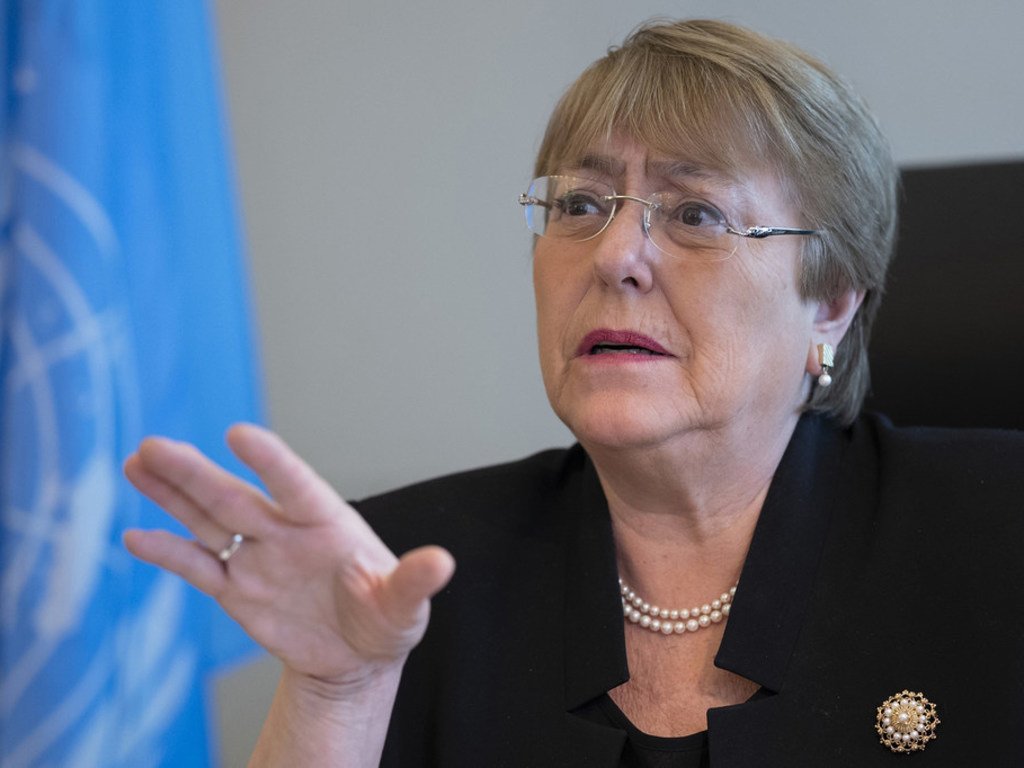
UN High Commissioner for Human Rights Michelle Bachelet. – UN Photo/Jean-Marc Ferre
High Commissioner for Human Rights, Michelle Bachelet, said on Thursday 25 October that comments made by Burundi’s UN ambassador the previous day, were “deeply regrettable in both tone and substance” and demanded that it “immediately retracts” its threat to try and prosecute members of a UN Commission of Inquiry into rights abuses in the central African nation.
She also raised concern over the Burundian Government’s “complete failure” to address the very serious findings of the Commission of Inquiry. On Wednesday, the Ambassador and Permanent Representative of Burundi to the UN, Albert Shingiro, had attacked this independent international inquiry team, threatening to prosecute its members and compared Commission Chair, Doudou Diène, to a participant in the slave trade [SIC].
“I urge the Government of Burundi to issue an immediate retraction of this inflammatory statement and to offer a full apology to Mr. Diène and the other Commissioners, as well as to the Human Rights Council, which created the Commission, and its President who selected and appointed the three Commissioners,” she said.
In a briefing paper for the new UN High Commissioner for Human Rights, Michelle Bachelet, ISHR has set out ten concrete and practical ways in which the High Commissioner and her Office can contribute to protecting human rights defenders and promoting a safe and enabling environment for their work at the international and national-levels.
‘Supporting and empowering these defenders – and protecting them against those governments, corporations and fundamentalists whose currency is prejudice, profit or privilege – should be the new High Commissioner’s highest priority. She should consult closely with defenders, speak out and pursue accountability when they are attacked, push for laws and mechanisms to protect them at the national level, and ensure that the UN human rights system is safe, accessible and effective for them,‘ ISHR Director Phil Lynch said.
Recommendations for the High Commissioner to support human rights defenders
Be proactive in regularly consulting and working in partnership with human rights defenders and other independent civil society actors.
Make clear and regular statements on the essential role played by human rights defenders and the need to ensure they can work in a safe and enabling environment without fear or hindrance, acknowledging the protection needs of particular groups of defenders.
Speak out and demand accountability on cases of threats, attacks and reprisals against human rights defenders, including by calling for and supporting impartial investigations, prosecution of perpetrators, and effective remedies for victims.
Push and work with States to fulfil the commitments laid out in the UN Declaration on Human Rights Defenders, including through repealing restrictive legislation and developing specific laws, policies and mechanisms to protect defenders.
Establish a comprehensive set of indicators to assess State fulfilment of human rights obligations related to human rights defenders, which could be used as an evidentiary basis for assessing compliance.
Build strategic alliances with States, civil society, academics, business enterprises and other actors with a shared interest in human rights, ensuring an enabling environment for civil society and respect for the rule of law.
Define an operating procedure at OHCHR to ensure that all offices establish and apply minimum standards in regard to their work on and with human rights defenders.
Encourage the Secretary General to carry out a full audit of UN work on human rights defenders and to develop an organisation-wide policy on supporting and protecting defenders. More generally, work closely with the Secretary-General to ensure that all UN agencies contribute to, and coordinate on, the protection of defenders and ensuring an enabling environment for their work.
Encourage the development and implementation of an effective UN-wide policy on preventing and addressing reprisals and strongly support continuation and adequate resourcing of the mandate of the UN Senior Official on reprisals.
Work to ensure that UN human rights bodies and mechanisms are accessible, effective and protective for human rights defenders, in particular by ensuring that any reform efforts are informed by the full and meaningful participation of civil society. Strong leadership from the High Commissioner is essential to ensure that the process to strengthen the Treaty Bodies in 2020, and the General Assembly mandated status review of the Human Rights Council in 2021, are underpinned by these principles.
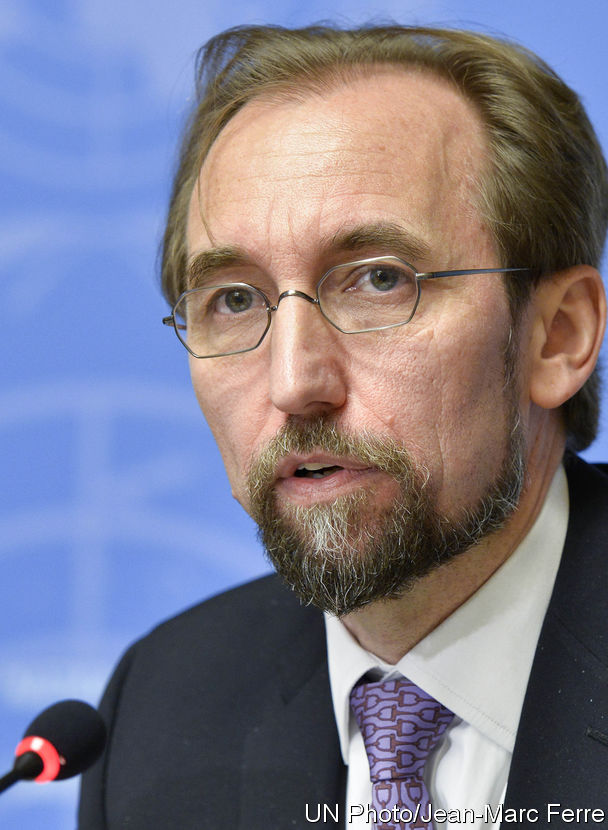
Zeid Ra’ad Al Hussein, the UN High Commissioner for Human Rights, who steps down on 1 September wrote a long and hard-hitting piece under the title “Grassroots leaders provide the best hope to a troubled world” in the Economist of 30 August 2018. Just some excerpts here, please read the whole thing:
…………….Now look at today’s politicians. First, those who occupy so much of the news media’s attention: the Trumps, the Orbans, the Salvinis. Keen to be viewed as the virile leaders of their respective countries; eager to inflate their image by harming migrants and refugees, the most vulnerable in society. If there is courage in that, I fail to see it. Authoritarian leaders, or elected leaders inclined toward it, are bullies, deceivers, selfish cowards.
If they are growing in number it is because (with exceptions) many other politicians are mediocre. They, too, are focused on their own image, the vanities associated with protocol and re-election. Too busy with themselves, or too afraid to stand up to the demagogues and for others, they seem to shelter in the safety of silence and shuffled papers. Only when they leave public office do some speak up, discovering their courage rather belatedly. Many come and go; no one really notices.
In consequence, too many summits and conferences held between states are tortured affairs that lack profundity but are full of jargon and tiresome clichés that are, in a word, meaningless. What is absent is a sincere will to work together, though all will claim—again, under the lights and on camera—that they are wholly committed to doing so. The systems for states to act collectively at higher levels in pursuit of solutions are decomposing. There are signs of it everywhere we care to look.
….
I believe it is only a matter of time, for example, before we see a Takfiri confrontation with Buddhist extremism in Asia. Where this is likely to occur, geographically, and who is likely to be involved, can already be surmised. The how and the when are, as always, indeterminate. It will depend on the outcome of regional presidential elections and how the situations in Cox’s Bazaar and Myanmar play out. The current signs are not encouraging. What is clear is that our systems for fixing this are broken.
When Myanmar inflicts enormous suffering on the Rohingya—burns them in their homes, cuts the throats of their children, rapes and terrorises, sends 700,000 people fleeing to Bangladesh in only three weeks—and the government pays no penalty for this—what are we saying to the perpetrators? Or to the victims? And to other potential perpetrators across the globe? Xi Jinping openly backs the government of Myanmar and, unusually for the US, given the extent of the horrors, President Trump did not even mention Rakhine when he addressed the UN General Assembly in September 2017. Strong evidence indicates the Burmese military and others may have committed acts of genocide. How much more cruel can humanity be, and how much chaos and pain are we fomenting?
….
And when multiple stress fractures already exist—the result of decades of mediocre leadership—all that’s required is a tripwire. To heal those fractures, whether in the Middle East or elsewhere, we must think differently, think more about human rights, and do this with some urgency.
A fracture within society is often shorthand for human suffering or the existence of burning grievances. Before conflicts begin, suffering stems from three types of human rights violations. One is the denial of fundamental freedoms, such as of opinion, expression and peaceful assembly, creating a situation where life and fear of the state become inseparable. A second is the deprivation of basic services, such as legal and social protections or rights to education and healthcare, which often only confirms the hold of political elites over others. And third, feeding the first two, discrimination, structural and deep, propped up by racism, chauvinism and bigotry.
When multiple stress fractures already exist—the result of decades of mediocre leadership—all that’s required is a tripwire
…If we do not change course quickly, we will inevitably encounter an incident where that first domino is tipped—triggering a sequence of unstoppable events that will mark the end of our time on this tiny planet. Can we swerve in time?
My hope lies in a set of people not widely known internationally, but familiar to those in the human rights community. Unlike the self-promoters—the elected xenophobes and charlatans—these people do have courage. They have no state power to hide behind: instead, they step forward. They are the leaders of communities and social movements, big and small, who are willing to forfeit everything—including their lives—in defence of human rights. Their valour is unalloyed; it is selfless. There is no discretion or weakness here. They represent the best of us, and I have had the privilege of knowing some of them personally, while others are well known to my office.
Suffering reflects a massive dereliction of the duty to serve, by those who exercise sovereignty on behalf of their people
This is what true leaders look like. Bertha Zuniga Caceres from Honduras, the young daughter of the murdered environmental activist, Bertha Caceres, who has bravely continued her mother’s struggle. Dr Sima Samar in Afghanistan, who leads the country’s independent human rights commission and is utterly fearless, even when threats to her personal safety abound. The same could be said of Senator Leila de Lima in the Philippines, who has now been arbitrarily imprisoned without trial for 18 months. Pierre Claver Mbonimpa from Burundi, a gentle yet principled soul, undeterred even after his son was murdered and he himself survived repeated attacks.
I have also been deeply impressed by the dignity and courage of Denis Mukwege from the Democratic Republic of Congo, an extraordinary human being by any measure. Likewise, I have been humbled by the determination of Angkhana Neelapaijit from Thailand, whose husband, a lawyer, disappeared in 2004 leaving her to become a most courageous activist, fighting against enforced disappearances.
There are others too, from Bahrain for example: the Khawaja family, Nabeel Rajab, Maytham Al Salman and Ebtisam Al Sayegh, who have all have shown extraordinary courage in the face of considerable adversity. Hatoon Ajwad Al Fassi and Samar Badawi in Saudi Arabia: courageous leading voices for the rights of Saudi women, both currently in detention. Amal Fathy in Egypt and Radhya Al Mutawakel in Yemen are also two brave individuals who have put their own safety at risk as they have spoken out against injustice and on behalf of victims of human-rights violations.
Likewise, Ludmila Popovici, an activist against torture in Moldova. In Poland, Barbara Nowacka has been active in organising protests against measures to pull back women’s rights. Sonia Viveros Padilla in Ecuador is fighting for the rights of people of African descent. Close by, in El Salvador, Karla Avelar, the courageous transgender activist, deserves high praise—as does the Peruvian Maxima Acuna, a well-known environmental human rights defender.
I could continue. There are grassroots leaders of movements against discrimination and inequalities in every region. These names are just a sample of the real store of moral courage and leadership that exists among us today.
While some speak from an individual vantage point, fighting specific battles on behalf of their local communities, others lead broader social movements. World-wide, they are not coordinated. But what if they were? What would happen if all the movements supported each other, openly and actively?
There are grassroots leaders of movements against discrimination and inequalities in every region…the real store of moral courage and leadership among us.
……What if this coordinated, focused, human-rights movement had the backing of business leaders? There are business leaders who are also real leaders, and who have thought seriously about human rights; people like Barbara Novick of Blackrock, Paul Polman of Unilever, Microsoft’s Brad Smith and Deepmind’s Mustafa Suleyman. This has never been done before; but if we did do it, it might just deliver a sort of shock therapy to those dangerous or useless politicians who now threaten humanity. Maybe, just maybe, it would be enough to stop the rot, so that when a fool tips that first domino or strikes the tripwire they hurt no one but themselves, and we can hope that the injury is only a slight one.
I leave you with that thought. This is my parting note: one of courage and defiance, and a longing for the leadership of the just.
The United Nations high commissioner for human rights, Zeid Ra’ad al-Hussein, left, is not seeking a second term.CreditSalvatore Di Nolfi/Keystone, via Associated Press
The United Nations High Commissioner for Human Rights, Zeid Ra’ad al-Hussein, has made the unusual decision to not seek a second four-year term. The decision was conveyed in a short statement that was emailed to his staff early this Wednesday and shared with some media. “Next year will be the last of my mandate”.. “After reflection, I have decided not to seek a second four-year term. To do so, in the current geopolitical context, might involve bending a knee in supplication; muting a statement of advocacy; lessening the independence and integrity of my voice — which is your voice.” “There are many months ahead of us: months of struggle, perhaps, and even grief — because although the past year has been arduous for us, it has been appalling for many of the people we serve” .
While most high level United Nations officials serve as long as their mandate allows, no single Human Rights Commissioner has served a full four-year second term. Zeid’s four-year term expires next September. It has been clear for months that some of the five veto-wielding permanent members of the United Nations Security Council would use their influence to block it. Mr. Zeid al-Hussein – to his credit – has been critical of all of them.
He has been outspoken about the Russian-backed government of Syria. He has warned of the prospects of genocide by the Chinese-backed government of Myanmar. And he has called out the Trump administration several times, most pointedly on the travel ban against citizens of Muslim-majority countries and after the demonstrations by white supremacists in Charlottesville. Mr. al-Hussein’s willingness to take on the powerful by name, along with what he has described as the “eye-watering stupidity” of abusive governments, made him few friends. Mr. al-Hussein proved confounding to many by defying classification: the first human rights chief from the Middle East but a sharp critic of violations by Arab governments; a Muslim who condemned Islamic militants; and a Jordanian prince who discarded his title to take the job and become an advocate for victims.
Nikki Haley, the US ambassador to the UN, with Liu Jieyi, China’s ambassador, before the April 18 Security Council meeting. Rick Bajornas/UN Photo
The United States led on Tuesday 18 April what it (and not many others) dubbed a ‘historic‘ U.N. Security Council meeting on the link between rights abuses and conflict, but it had to drop a push for the broad issue of human rights to become a fixed item of the Security Council’s agenda when it appeared that at least six members would oppose it [Russia, China, Egypt, Ethiopia, Kazakhstan and Bolivia were against the move and Senegal’s support was uncertain]. The United States, council president for April, did not risk the measure being put to a rare procedural vote, which requires nine in favour, and vetoes cannot be used. The opposing council members say rights discussion should be confined to the Geneva-based Human Rights Council – which Washington accuses of being anti-Israel and has threatened to quit – and the 193-member U.N. General Assembly third committee. Here is some of the analysis:
Zeid Ra’ad Al Hussein, UN High Commissioner for Human Rights, in his statement at the 33rd session of the Human Rights Council, said he was “concerned by harassment and arrests of human rights defenders and political activists, and legislation which enables revocation of citizenship without due process” in Bahrain. The UAE’s Permanent Representative to the United Nations, Obaid Salem Al Zaabi said that the emirates shares the high commissioner’s concerns about several human rights issues in different parts of the world. He even gave careful endorsement of the HC’s statement on interference by saying: “The current experience shows that there is still a misunderstanding in the areas related to enhancing human rights at the national levels, which led the nations to deem them as interference in their respective internal affairs and a violation of their sovereignty,” Al Zaabi said, according to news agency WAM.
But then he had to add that he regretted that the High Commissioner ignored in his update the efforts made by Bahrain to provide a rapprochement ground for all parties to overcome this difficult stage. “Concentrating only on the negative aspects can create a wrong impression that others may exploit to further complicate the situation in Bahrain,” Al Zaabi said. He said the only way to resolve the situation in Bahrain is through objective and constructive dialogue, not confrontational and tense language.
Readers are forgiven for not remembering that in the 1980’s it was forbidden for UN officials to name and shame countries by name (with a few exceptions) and those that did usually paid a price for that (e.g. Theo van Boven in 1982 and the curtailing of terms for some High Commissioners). Now, in the span of one week the current High Commissioner for Human Rights, Zeid Ra’ad Al Hussein, has first named and shamed some politicians as dangerous demagogues (6 September 2016 in the Hague): Mr. Wilders. Mr. Trump, Mr. Orban, Mr. Zeman, Mr. Hofer, Mr. Fico, Madame Le Pen, and Mr. Farage. He followed this up in his opening statement at the 33rd session of the UN Human Rights Council on 13 September 2016 with a forceful attack on countries that refuses to cooperate with his Office or other UN procedures: foremost Syria but also Venezuela, Turkey, Ethiopia, Israel, North Korea, India, Pakistan, Mozambique, USA, Gambia, China, Nepal, Uzbekistan, Armenia, Dominican Republic, Belarus, Eritrea, Iran, and Burundi. The non-cooperation by those in control of areas such asAbkhazia,South Ossetia, Crimea, and Nagorno-Karabakh was also singled out.
The part that underpins the ‘legitimacy’ of his interference is of special relevance: “Under international law, wrongful “intervention” – as prohibited in Article 2(7) of the UN Charter – is by nature coercive. And it should be obvious that my Office has no coercive power. No activity that we undertake can possibly be considered constitutive of a prohibited “intervention”. …We request access so we can better work to help bring your laws and practices in line with international agreements which you, the States drafted and ratified – and to assist you to comply with recommendations which you have publicly, and often fulsomely, accepted….Are human rights exclusively a national issue? Governments have the responsibility to uphold their human rights obligations and to respect the standards. But the human rights of all people, in all countries, also require – unquestionably – our collective attention. The Vienna Declaration, adopted unanimously 23 years ago, confirmed this..”
“Human rights violations will not disappear if a government blocks access to international observers and then invests in a public relations campaign to offset any unwanted publicity. On the contrary, efforts to duck or refuse legitimate scrutiny raise an obvious question: what, precisely, are you hiding from us? I classify as refusals of access all unreasonable delays, elaborately ritualised and unreasonably prolonged negotiations, and responses to specific requests which seem to seek to fob us off with inadequate alternatives to real, fact-based assessment. Access delayed is access denied: two weeks is surely amply sufficient to secure a decision from all relevant officials. Claims that insecure conditions make it impossible to give my staff access are also less than acceptable. My staff work with great courage in some of the world’s most severely threatened communities, and will continue to do so when called upon – or at least, we could be the judge of that.
States may shut my Office out – but they will not shut us up; neither will they blind us. If access is refused, we will assume the worst, and yet do our utmost to nonetheless report as accurately as we can on serious allegations. Our remote monitoring is likely to involve witness testimony, credible third-party reports and use of satellite imagery, among other techniques. Certainly, remote monitoring is a poor substitute for in-person observation by expert analysts. It makes it more difficult to verify and confirm the competing allegations of any party – including the Government. I regret that imprecision, and encourage all States to assist us to correct it, by permitting my teams unhindered access to events on the ground when requested.“
The two texts follow below in toto; summarizing them would not do justice to the elaborate and courageous words of this High Commissioner, who seems not to be concerned about securing a second term. Moreover, the one in the Hague stands out by its eloquence!





 Hans Thoolen on Human Rights Defenders and their awards