Posts Tagged ‘Tiananmen Square’

35th anniversary of Tiananmen Square: 14 still in prison

June 4, 2024

While China is systematically erasing the memory of the brutal repression of student protests on 4 June 1989, 14 prominent participants of that movement are still behind bars, rearrested for their struggle for democracy. Chinese Human Rights Defenders issued an appeal for their release.
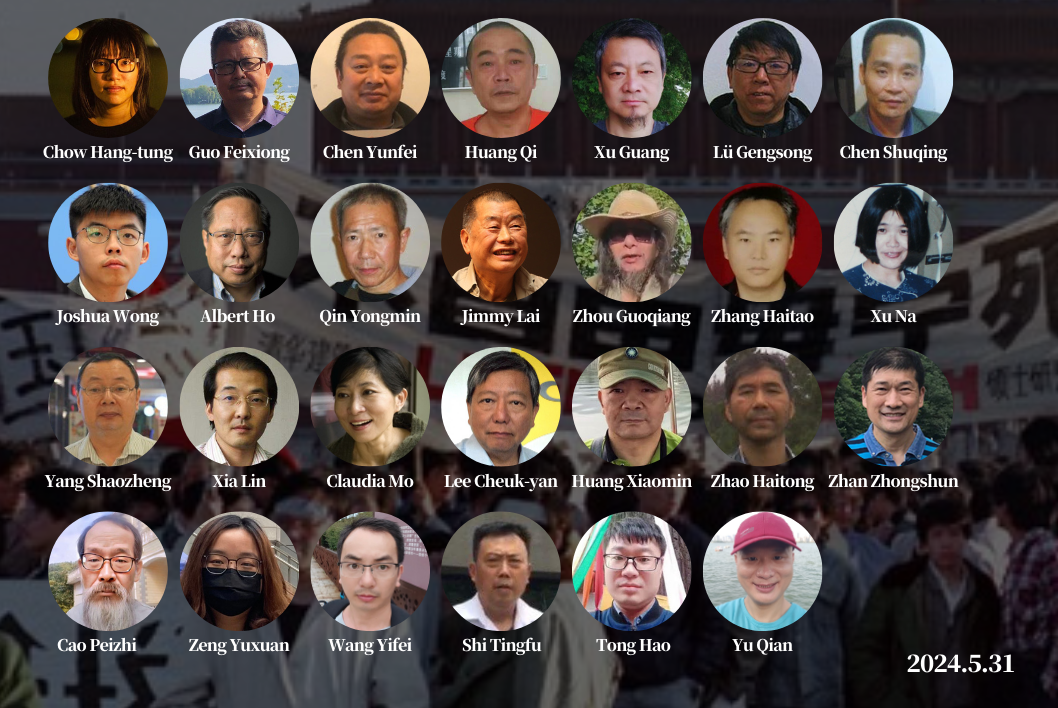
Chinese Human Rights Defenders (CHRD), an international NGO supporting Chinese dissidents, issued an appeal last week to mark the 35th anniversary of the Tiananmen Square massacre. [see also: https://humanrightsdefenders.blog/2014/06/13/25-years-tiananmen-celebrated-with-over-100-detentions/]

For 35 years, all top Chinese leaders, from Li Peng to Xi Jinping, have been fixated on erasing memories of June 4 by persecuting those who peacefully seek accountability,” reads the CHRD statement. “Everyone who cares about justice should call on Beijing to immediately and unconditionally release these and all other prisoners of conscience in China.”

The appeal includes a list of 27 people who, for various reasons, are still in prison in relation to the Tiananmen Square movement. “[F]ar from being complete, [. . .] it is a window to the severity, scale, and persistence of reprisals by the Chinese government over the past 35 years,” the statement reads. In particular, 14 names belong to people who participated directly in the events of 35 years ago and are currently in prison after they were rearrested for promoting democracy in China.

Zhou Guoqiang (周国强) was imprisoned for organising a strike in support of student protests in Beijing in 1989, and served four years in a re-education camp. He was arrested again for online comments in October 2023. His current whereabouts and charges remain unknown.

Guangdong activist Guo Feixiong (郭飞雄), who took part in the 1989 movement as a student in Shanghai, has been serving a six-year sentence since 2015 for his human rights activism.

Another university student from that time, Chen Shuqing (陈树庆) from Hangzhou, has been serving a 10-and-a-half-year sentence since 2016 for pro-democracy activism.

Lü Gengsong (吕耿松), a teacher fired in 1993 for supporting the pro-democracy movement, has been serving an 11-year sentence since 2016 for his pro-democracy work.

Beijing-based lawyer Xia Lin (夏霖) has been serving an 11-year sentence since 2016 for his professional work as a lawyer; he participated in the 1989 movement as a student at the Southwest Institute of Political Science and Law in Chongqing.

Xinjiang activist Zhao Haitong (赵海通) has been serving a 14-year sentence since 2014 for his activities as a human rights defender. He, too, had been imprisoned in the aftermath of the 1989 massacre.

Xu Na (许那), artist, poet, and a Falun Gong follower, took part in the hunger strike in Tiananmen Square. She was arrested in 2020 and sentenced to eight years in prison for “using an evil cult to disrupt law enforcement.”

Sichuan activist Chen Yunfei (陈云飞) served a four-year sentence from 2015 to 2019, in part for organising a commemoration for the victims of 4 June. He had participated in the 1989 movement as a student at the China Agricultural University in Beijing.

Another member of the student movements at the time, Xu Guang (徐光), was arrested in 2022 and is serving a four-year sentence on charges of “picking quarrels and provoking trouble” in Hangzhou, Zhejiang province.

Huang Xiaomin (黄晓敏), who was arrested in Sichuan province in 2021, suffered th same fate, and was sentenced to four years, while Cao Peizhi (曹培植) was arrested in 2022 and sentenced to 2.2 years in Henan province.

Zhang Zhongshun (张忠顺), another student who participated in the 1989 protests, was reported to police in 2007 for talking to his students about the events of 4 June. He was jailed for three years and is now in jail for continuing to support activism and faces charges of subversion in Shandong province.

Wang Yifei (王一飞) disappeared into police custody after he was detained in 2021. Before his arrest in 2018, he had been demanding justice for the victims of 1989 for several years.

Shi Tingfu (史庭福), already convicted of organiing a public vigil in Nanjing in 2017 and giving a speech in memory of the victims of Tiananmen, was rearrested in January 2024 and is awaiting trial on several charges, including “spreading false information, and inciting terrorism and extremism in the Xinjiang Uyghur Autonomous Region.”

The other 13 names belong to people who were not directly involved in the events of 1989 in Beijing, but fought in mainland China and Hong Kong to keep alive the memory of what happened.

This second list includes Tong Hao (仝浩), a young doctor born in 1987, who was jailed for 1.5 years for publishing a post on 4 June 2020. He was arrested in August 2023 and has been in police custody in Jiangsu province ever since.

Some of the jailed are dissidents in Hong Kong, like Lee Cheuk-yan, Albert Ho, and Chow Hang-tung; the latter, a lawyer, was recently issued a new arrest warrant in prison together with seven other people (including her mother) for commemorating the Tainanmen massacre online.

As Chinese Human Rights Defenders note, three witnesses to events in Tianamen Square have died in prison in the past 35 years. The most prominent is Nobel Peace Prize laureate Liu Xiaobo (刘晓波), who died in July 2017 from liver cancer in police custody while serving an 11-year sentence since 2009 for his role as a leader in the Charter 08 campaign. A university lecturer in 1989, he was jailed for 18 months for taking part in the 1989 movement.

Jiangsu writer Yang Tongyan (杨同彦) died a few months after Liu, in November 2017, from a brain tumor. He was serving a 12-year sentence imposed in 2006 for his political activism. He had already spent 10 years in prison for taking part in the 1989 movement.

Last but not least, we must remember labour activist Li Wangyang (李旺阳), who died under suspicious circumstances on 6 June 2012 while in a hospital guarded by police in Shaoyang, Hunan province. Li, leader of the 1989 pro-democracy movement, was sentenced to a total of 23 years in prison. Chinese authorities claimed he committed suicide by hanging himself in his hospital room, a claim his family has disputed since Li was blind and deaf from torture and would not have been physically able to hang himself. Against the wishes of Li’s family, Hunan authorities conducted their own autopsy and then cremated the body.

https://www.asianews.it/news-en/Still-in-prison-35-years-after-Tiananmen-Square-60873.html
https://www.usnews.com/opinion/articles/2024-06-04/china-is-erasing-the-memory-of-the-tiananmen-massacre-we-cant-let-them

Today: Tiananmen Square 30 years ago was ‘correct’ but singing about it still not allowed

June 4, 2019

As many news outlets report today it is 30 years ago that China cracked down on Tiananmen Square. China tries mostly to forget about it and make others forget it about it too. Still, it recenty came out to defend it as the “correct policy”. “That incident was a political turbulence and the central government took measures to stop the turbulence which is a correct policy” Defence minister Wi Fenghe Wei told a regional security forum in Singapore. “The 30 years have proven that China has undergone major changes,” he said, adding that because of the government’s action at that time “China has enjoyed stability and development“. On the other hand Wu Qian, a spokesman for the defence ministry, decried the use of the word “suppression” to describe the crackdown.

But it does cover Chinese rock musician Li Zhi, who has been outspoken and sung songs about social issues including the Tiananmen Square crackdown, and has not been seen for three months. The South China Morning Post of 2 June has a detailed piece on what happened to this singer: His upcoming tour has been cancelled and his social media accounts taken down. Then his music was removed from all of China’s major streaming sites – as if his career had never existed at all. “Now this square is my grave,” Li sang. “Everything is just a dream.”

The disappearance of Li, the musician, has left fans searching for answers. On February 20, the official Weibo social media account for the 40-year-old’s concert tour posted a photograph of its team in front of a truck about to embark on scheduled performances in Sichuan province in China’s southwest. Just two days later, however, the account posted an image of a hand wearing what appeared to be a hospital wrist band and the words: “Very sorry.” The next post, published the same day, announced without explanation that the tour was cancelled and that ticket purchasers would shortly receive a refund. Fans flooded the comment section with wishes for a speedy recovery.

But the suggestion that a health issue was behind the cancellations was later thrown into doubt. A statement published in April by Sichuan’s culture department said it had “urgently halted” concert plans for a “well-known singer with improper conduct” who was previously slated for 23 performances – the same number of concerts which Li had scheduled in the province. It said 18,000 tickets were fully refunded.

..Li’s presence on the Chinese internet was completely erased. An April 21 central government directive ordered all websites to delete any audio or video content relating to five of Li’s songs, according to China Digital Times, an organisation that publishes leaked censorship instructions. The authenticity of the directive could not be independently verified.

“There’s pretty much a consensus” among those working in the industry that Li’s disappearance from public view is due to the sensitive anniversary, said a music industry professional who spoke on condition of anonymity because of fear of government retribution. “He did a number of songs that were considered politically risky, making references to June 4, 1989, and so he’s been out of the picture,” the industry professional said.

Li’s current whereabouts could not be confirmed. His company and record label did not respond to repeated interview requests. Li’s songs alluding to the Tiananmen Square protests – The Square, The Spring of 1990 and The Goddess, in honour of the Goddess of Democracy that students erected – were part of his earlier works. In recent years, the bespectacled singer has avoided making public political statements, focusing more on promoting his performances. In 2015, state-run China Daily newspaper published a profile of Li, describing him as a performer who easily sells out concerts. After years of working as an independent artist, he signed last autumn with Taihe Music Group, a major Chinese record label. Fans who knew Li as a largely apolitical entertainer expressed bewilderment online about his disappearance. Others made veiled references to China’s internet censorship. On Zhihu, a question-and-answer website similar to Quora, one user wrote that people posed questions every day about what might have happened to Li, but these posts always disappeared the next morning “as if nothing had happened at all”.

Another user said: “I don’t dare to say it, nor do I dare to ask.” A fan who has been sharing Li’s music on his personal account spoke on condition of anonymity because he feared his employers would punish him for discussing the subject. “Everyone knows the reason for Li Zhi’s disappearance,” the fan said. “But I’m sorry, I can’t tell you, because I follow China’s laws and also hope that Li Zhi can return.” Quoting one of Li’s lyrics, the fan added: “The world will be all right.” Fans continue to circulate videos of Li’s performances online. His complete discography has been uploaded onto file-sharing websites, with back-up links in case the original ones are shuttered. Some users shared tribute art, including a black T-shirt with the words “improper conduct”. A few years ago, in a performance in Taiwan, Li bounced around on stage, strumming his guitar and repeating a chorus in apparent tribute to the spirit of Chinese propaganda.

Foreign companies are not immune. Apple Music has removed from its Chinese streaming service a song by Hong Kong singer Jacky Cheung Hok-yau that references the Tiananmen crackdown. Tat Ming Pair, a Hong Kong duo, have been deleted entirely from the app. They released a song this month called Remembering is a Crime in memory of the protests.

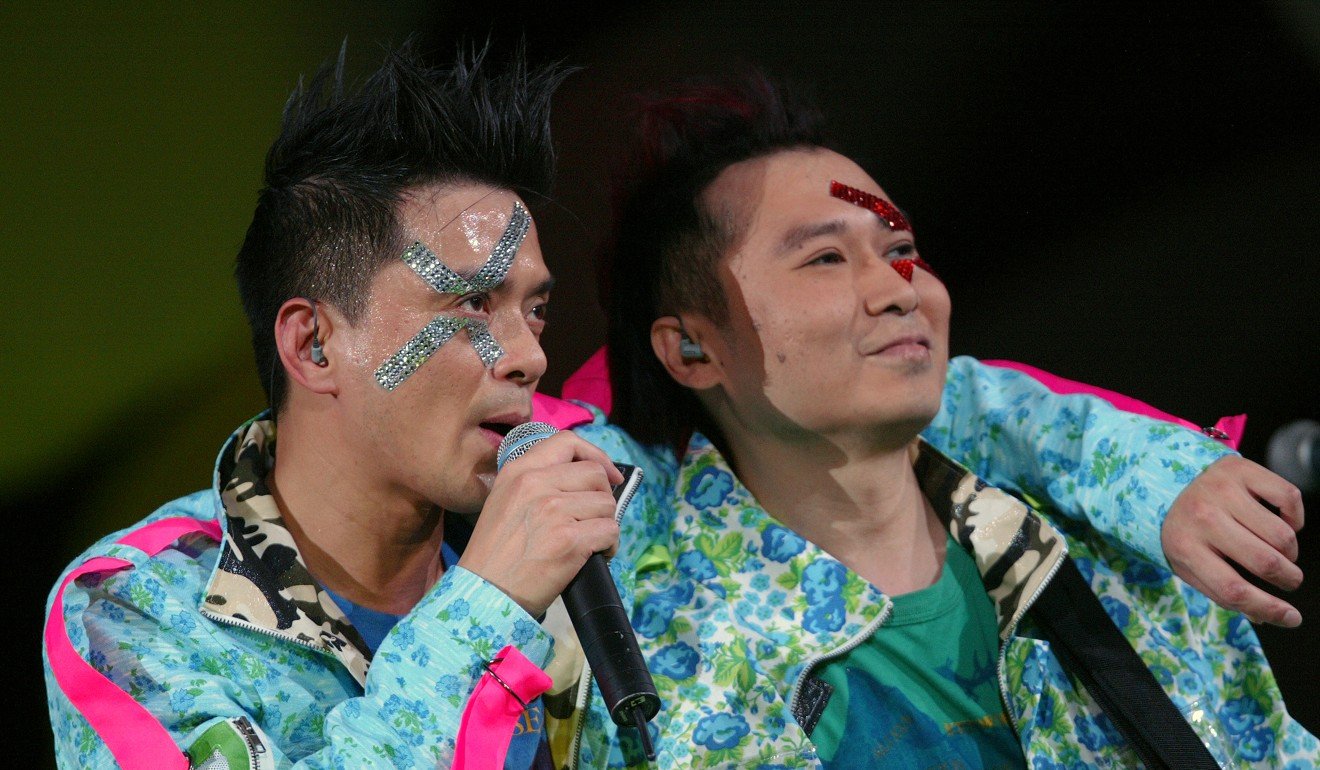
Music by Tat Ming Pair – Anthony Wong Yiu-ming (left) and Tats Lau Yi-tat – has been deleted from the Apple Music app. Photo: K.Y. Cheng

Wikipedia also announced this month that the online encyclopaedia is no longer accessible in China. While the Chinese-language version has been blocked since 2015, most other languages could previously be viewed, Wikipedia said.

The Human Rights Foundation publised this video about China’s Million Person Muslim Prison Camps:

For the 25th anniversary see: https://humanrightsdefenders.blog/2014/06/13/25-years-tiananmen-celebrated-with-over-100-detentions/

See also: https://humanrightsdefenders.blog/2019/05/31/on-4-june-streets-around-chinese-embassy-to-be-renamed-tiananmen-square/

https://uk.news.yahoo.com/china-says-tiananmen-square-crackdown-1989-correct-policy-093500064.html

https://www.scmp.com/news/china/politics/article/3012782/outspoken-folk-rock-singer-li-zhi-disappears-china-tightens

On 4 June streets around Chinese embassy to be ‘renamed’ Tiananmen Square

May 31, 2019

Dr Shao Jiang

I have always liked the symbolic act of renaming streets after human rights defenders [see e.g. https://humanrightsdefenders.blog/2018/06/07/ahmed-mansoor-ten-years-jail-for-tweeting-and-a-street-named-after-you/]. Amnesty International activists will ‘rename’ the streets surrounding the Chinese Embassy in London next week to mark the 30th anniversary of the notorious Tiananmen Square crackdown. On Tuesday 4 June (10h00 am), a total of 30 authentic-looking ‘Tiananmen Square’ street signs will be displayed in the streets around the embassy in central London to mark the anniversary. Amnesty UK Director Kate Allen and Shao Jiang – one of the original student protest leaders who was in Tiananmen Square on the night of 4 June – will place a ‘Tiananmen Square’ sign immediately outside the Chinese Embassy building.

https://www.amnesty.org.uk/press-releases/london-streets-around-chinese-embassy-be-renamed-tiananmen-square-anniversary

LinkedIn reverses censorship position re Zhou Fengsuo’s profile

January 7, 2019

Zhou Fengsuo –  Getty Images

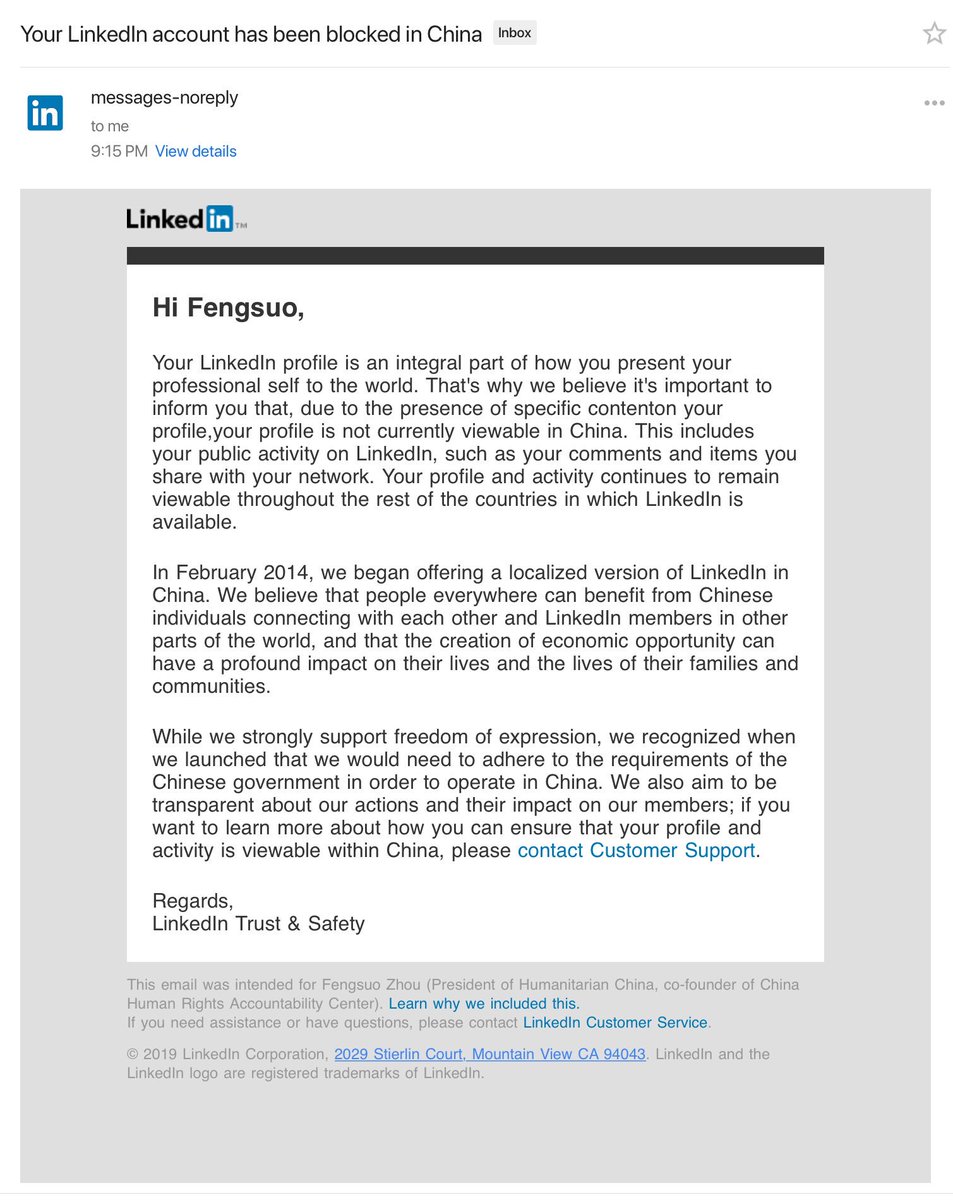
On 3 January, LinkedIn sent Zhou a message saying his profile and activities would not be viewable to users in China because of “specific content on your profile” (without saying which content!). Hours later, Microsoft-owned LinkedIn reversed its decision, apparently after South China Morning Post reporter Owen Churchill brought attention to the case. See the exchange below:

————-

China continues harsh line on dissent but one jailed HRD smuggles out video

August 11, 2013

Reuters reports that China has arrested an activist on a charge of subversion and the latest sign that the authorities are hardening their stance toward dissent. Yang Lin, 45, Read the rest of this entry »

Tiananmen remembrance doesn’t stop in spite of Government’s efforts

June 5, 2013

Twenty-four years after the bloodshed of Tiananmen, China’s Communist Party is exercising its traditional response to the unwelcome anniversary: detaining and silencing dissidents and blocking bereaved families who hope to observe the day with mourning from the graveyards; mobilizing extra police officers to ensure that no protests break out around Tiananmen Square; and scrubbing Chinese Internet sites of any references and images that refer to or even hint at the upheavals of 1989.

English: Tiananmen (front) 1901 中文: 1901年的天安门(正面)

(Photo credit: Wikipedia)

On 4 June the police in China blocked the gate of a cemetery housing victims of the Tiananmen crackdown on its 24th anniversary. More than a dozen security officials deployed outside the stone gate at the Wanan graveyard near the hills of western Beijing, which mothers of the victims visit each year, and told AFP journalists to leave the area. Read the rest of this entry »