Posts Tagged ‘Surveillance’

Q&A: Transnational Repression

June 14, 2024

On 12 June 2024, Human Rights Watch published a useful, short “questions-and-answers” document which outlines key questions on the global trend of transnational repression. 
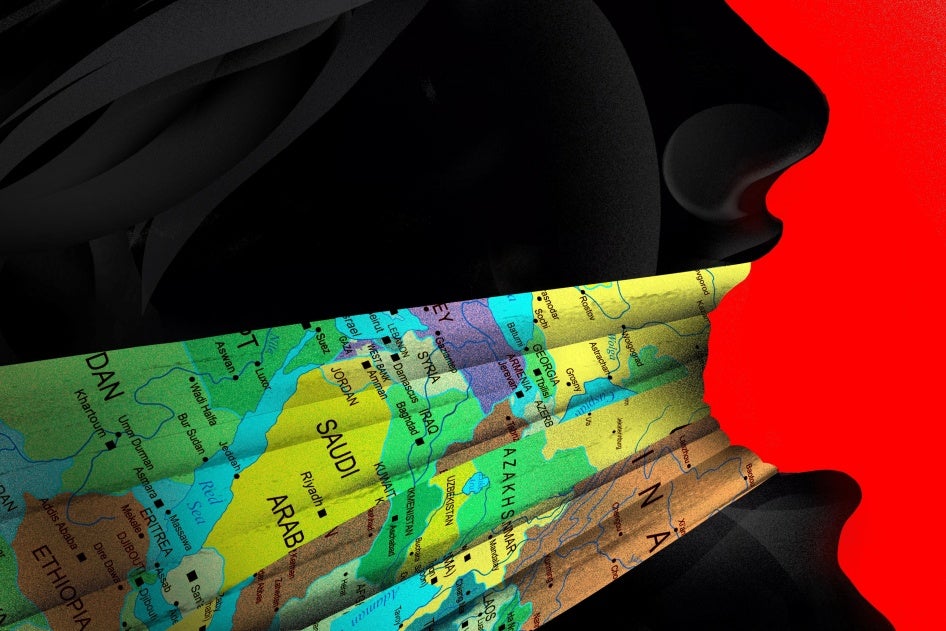
Illustration of a map being used to bind someone's mouth
© 2024 Brian Stauffer for Human Rights Watch
  1. What is transnational repression?
  2. What tactics are used?
  3. Is transnational repression a new phenomenon?  
  4. Where is transnational repression happening? 
  5. Do only “repressive” states commit transnational repression?
  6. Are steps being taken to recognize and address transnational repression? 
  7. What should be done? 

What is transnational repression?

The term “transnational repression” is increasingly used to refer to state actors reaching beyond their borders to suppress or stifle dissent by targeting human rights defenders, journalists, government critics and opposition activists, academics and others, in violation of their human rights. Particularly vulnerable are nationals or former nationals, members of diaspora communities and those living in exile. Many are asylum seekers or refugees in their place of exile, while others may be at risk of extradition or forced return. Back home, a person’s family members and friends may also be targeted, by way of retribution and with the aim of silencing a relative in exile or forcing their return.

Transnational repression can have far-reaching consequences, including a chilling effect on the rights to freedom of expression and association. While there is no formal legal definition, the framing of transnational repression, which encompasses a wide range of rights abuses, allows us to better understand it and propose victim-centered responses.

What tactics are used?

Documented tactics of transnational repression include killings, abductions, enforced disappearances, unlawful removals, online harassment, the use of digital surveillance including spyware, targeting of relatives, and the abuse of consular services.  Interpol’s Red Notice system has also been used as a tool of transnational repression, to facilitate unlawful extraditions. Interpol has made advances in improving its vetting systems, yet governments continue to abuse the Red Notice system by publishing unlawful notices seeking citizens who have fled abroad on spurious charges. This leaves targets vulnerable to arrest and return to their country of origin to be mistreated, even after they have fled to seek safety abroad.

Is transnational repression a new phenomenon?

No, the practice of governments violating human rights beyond their borders is not new. Civil society organizations have been documenting such abuses for decades. What is new, however, is the growing recognition of transnational repression as more than a collection of grave incidents, but also as an increasing phenomenon of global concern, requiring global responses. What is also new is the increasing access to and use of sophisticated technology to harass, threaten, surveil and track people no matter where they are. This makes the reach of transnational repression even more pervasive. 

Where is transnational repression happening? 

Transnational repression is a global phenomenon. Cases have been documented in countries and regions around the world. The use of technology such as spyware increases the reach of transnational repression, essentially turning an infected device, such as a mobile phone, into a portable surveillance tool, allowing targeted individuals to be spied on and tracked around the world. 

Do only “repressive” states commit transnational repression?

While many authoritarian states resort to repressive tactics beyond their own borders, any government that seeks to silence dissent by targeting critics abroad is committing transnational repression. Democratic governments have also contributed to cases of transnational repression, for example through the provision of spyware, collaborating with repressive governments to deny visas or facilitate returns, or relying upon flawed Interpol Red Notices that expose targeted individuals to risk.

Are steps being taken to recognize and address transnational repression? 

Increasingly, human rights organizations, UN experts and states are documenting and taking steps to address transnational repression.

For example, Freedom House has published several reports on transnational repression and maintains an online resource documenting incidents globally. Human Rights Watch has published reports, including one outlining cases of transnational repression globally and another focusing on Southeast Asia. Amnesty International has published a report on transnational repression in Europe. Many other nongovernmental organizations are increasingly producing research and reports on the issue. In her report on journalists in exile, the UN Special Rapporteur on freedom of expression dedicated a chapter to transnational repression. The UN High Commissioner for Human Rights used the term in a June 2024 statement.

Certain governments are increasingly aware of the harms posed by transnational repression. Some are passing legislation to address the problem, while others are signing joint statements or raising transnational repression in international forums. However, government responses are often piecemeal, and a more cohesive and coordinated approach is needed. 

What should be done? 

Governments should speak out and condemn all cases of transnational repression, including by their friends and allies. They should take tangible steps to address transnational repression, including by adopting rights-respecting legal frameworks and policies to address it. Governments should put victims at the forefront of their response to these forms of repression. They should be particularly mindful of the risks and fears experienced by refugee and asylum communities. They should investigate and appropriately prosecute those responsible. Interpol should continue to improve vetting process by subjecting governments with a poor human rights record to more scrutiny when they submit Red Notices. Interpol should be transparent on which governments are continually abusing the Red Notice system, and limit their access to the database.  

At the international level, more can be done to integrate transnational repression within existing human rights reporting, and to mandate dedicated reporting on cases of transnational repression, trends, and steps needed to address it.

see also: https://humanrightsdefenders.blog/2024/03/19/transnational-repression-human-rights-watch-and-other-reports/

https://www.hrw.org/news/2024/06/12/qa-transnational-repression

Inter-American Court of Human Rights: Historic Victory for CAJAR in Colombia

April 10, 2024

In a landmark ruling for fundamental freedoms in Colombia, the Inter-American Court of Human Rights found that for over two decades the state government harassed, surveilled, and persecuted members of a lawyer’s group that defends human rights defenders, activists, and indigenous people, putting the attorneys’ lives at risk. 

The ruling is a major victory for civil rights in Colombia, which has a long history of abuse and violence against human rights defenders, including murders and death threats. The case involved the unlawful and arbitrary surveillance of members of the Jose Alvear Restrepo Lawyers Collective (CAJAR), a Colombian human rights organization defending victims of political persecution and community activists for over 40 years.

The court found that since at least 1999, Colombian authorities carried out a constant campaign of pervasive secret surveillance of CAJAR members and their families. That state violated their rights to life, personal integrity, private life, freedom of expression and association, and more, the Court said. It noted the particular impact experienced by women defenders and those who had to leave the country amid threat, attacks, and harassment for representing victims.  

The decision is the first by the Inter-American Court to find a State responsible for violating the right to defend human rights. The court is a human rights tribunal that interprets and applies the American Convention on Human Rights, an international treaty ratified by over 20 states in Latin America and the Caribbean. 

In 2022, EFF, Article 19, Fundación Karisma, and Privacy International, represented by Berkeley Law’s International Human Rights Law Clinic, filed an amicus brief in the case. EFF and partners urged the court to rule that Colombia’s legal framework regulating intelligence activity and the surveillance of CAJAR and their families violated a constellation of human rights and forced them to limit their activities, change homes, and go into exile to avoid violence, threats, and harassment. 

Colombia’s intelligence network was behind abusive surveillance practices in violation of the American Convention and did not prevent authorities from unlawfully surveilling, harassing, and attacking CAJAR members, EFF told the court. Even after Colombia enacted a new intelligence law, authorities continued to carry out unlawful communications surveillance against CAJAR members, using an expansive and invasive spying system to target and disrupt the work of not just CAJAR but other human rights defenders and journalists

In examining Colombia’s intelligence law and surveillance actions, the court elaborated on key Inter-American and other international human rights standards, and advanced significant conclusions for the protection of privacy, freedom of expression, and the right to defend human rights. 

The court delved into criteria for intelligence gathering powers, limitations, and controls. It highlighted the need for independent oversight of intelligence activities and effective remedies against arbitrary actions. It also elaborated on standards for the collection, management, and access to personal data held by intelligence agencies, and recognized the protection of informational self-determination by the American Convention.

For more details see: https://www.eff.org/deeplinks/2024/04/historic-victory-human-rights-colombia-inter-american-court-finds-state-agencies

Norway’s NGOs furious about Telenor’s data ending up in the hands of Myanmar’s junta

March 31, 2022
Former Minister of Trade and Industry Monica Mæland visiting Myanmar in 2014. Photo: Trond Viken, Ministry of Trade and Industry

On 25 March, Telenor announced that the telecom giant had transferred the operational activities of Telenor Myanmar to M1 Group. [see: https://humanrightsdefenders.blog/2021/10/26/norways-telenor-in-myanmar-should-do-more-than-pull-out-it-should-not-hand-sensitive-data-to-the-regime/] In a release following the announcement, the Norwegian Forum for Development and Environment (ForUM) condemns the sale, and Kathrine Sund-Henriksen, ForUM’s general manager calls it a dark day for Telenor and for Norway as a human rights nation.

ForUM is a network of 50 Norwegian organizations within the development, environment, peace, and human rights with a vision of a democratic and peaceful world based on fair distribution, solidarity, human rights, and sustainability. ForUM writes that together with transferring the operational activities of Telenor Myanmar to M1 Group, Telenor also sells sensitive personal data of 18 million former Telenor customers, and there is an imminent danger that this information will soon be in the hands of the country’s brutal military dictatorship. ForUM is furious at the news that the sale has been completed.

Ever since the sale was announced last summer, we have worked to prevent it because there is a big risk that the military junta will have access to sensitive personal information and use it to persecute, torture, and kill regime critics. Incredibly, Telenor is going through with a sale that has been criticized by human rights experts, civil society, Myanmar’s government in exile, and even their own employees in the country,” says Kathrine Sund-Henriksen.

Telenor has admitted that since October last year they have known that the junta uses the M1 Group as an intermediary and that the data will soon end up in the hands of Shwe Byain Phy Group, a local conglomerate with close ties to the junta. Kathrine Sund-Henriksen believes it is only a matter of time before the sale has tragic consequences for human rights activists in the country.

When metadata is transferred, the junta will be able to know who a user has called, how long the call has lasted, and where the call was made. All of this can be used to expose activist groups operating in secret for the junta. According to the UN, the junta has killed more than 1,600 people and more than 12,000 have been arrested since last year’s coup. Those numbers will continue to increase, and Telenor has given the junta all the information they need to expose human rights defenders,” Kathrine Sund-Henriksen says.

https://www.forumfor.no/nyheter/2022/forum-for-utvikling-og-miljo-fordommer-salget-av-telenor-myanmar

Snowden claims his Haven is safe

December 28, 2017

US whistle-blower Edward Snowden has helped create an Android app designed to protect the possessions of journalists and human rights defenders. The software uses sensors – including a phone’s camera, microphone, gyroscope and accelerometer – to detect intruders tampering with someone’s possessions. It is open source, meaning its code can be inspected. It is designed to be used on a “second” smartphone that can be left with the possessions a user wishes to monitor. The app was created as a joint venture between The Guardian Project and Freedom of the Press Foundation, of which Edward Snowden is board president.

Haven turns any spare android phone into a safe room that fits in your pocket,” claims Edward Snowden. In an age where our digital security is at more risk than our physical security, Snowden claims that Haven will change the game of cyber surveillance.

Here’s how it works: once you install the app, it uses the smartphone’s in-built equipment, like cameras, light sensor and microphones, to monitor for any motion, sound or disturbance of the phone. As explained by WIRED: “Leave the app running in your hotel room, for instance, and it can capture photos and audio of anyone entering the room while you’re out, whether an innocent housekeeper or an intelligence agent trying to use his alone time with your laptop to install spyware on it.” Alerts can be sent to your phone, via SMS, Signal or to a Tor-based website.

You shouldn’t have to be saving the world to benefit from Haven,said Snowden, though the app’s primary users are meant to be investigative journalists, human rights defenders, and other people at risk of forced disappearance.

see also: https://humanrightsdefenders.blog/2016/09/29/edward-snowden-can-still-not-collect-his-awards/

——-

https://video.scroll.in/862821/watch-nsa-whistleblower-edward-snowdens-app-turns-your-phone-into-a-physical-security-system

https://www.thequint.com/tech-and-auto/tech-news/edward-snowden-data-privacy-haven-app-android-released

http://www.bbc.co.uk/news/technology-42493028

MI5 spying on Martin Ennals: what’s new?

August 21, 2015

On Friday, 21 August, the Guardian reported on MI5 spying on Dorris Lessing but also on Martin Ennals. [“The files released on Friday reveal that MI5 also kept a close watch on prominent figures of the left who were never members of the Communist party. They include the brothers David and Martin Ennals..the latter became general secretary of the National Council of Civil Liberties, a founder member of the Anti-Apartheid Movement and secretary general of Amnesty International…. [Shortly after the end of the second world war] MI5 replied that its files on the Ennals brothers had been “in great demand recently”. MI5 was concerned that UN groups, in which it said both brothers were involved, might be infiltrated by the Communist party. MI5 noted that Martin was “well known to Special Branch for his activities in the Anti-Apartheid Movement”.

However, nine months ago (25/26 October, 2014) the Daily Mail had already referred to this issue under the title: “Revealed: How Special Branch spied on leading anti-apartheid activist“.

The Government is facing calls to reveal the truth about a spying operation on one of Britain’s most respected human rights activists. Previously secret documents show the late Martin Ennals was put under years of surveillance by Special Branch. He was a key figure at Amnesty International and the National Council for Civil Liberties – now known as Liberty – and a leading campaigner against apartheid. Details of his marriage, family and holiday destinations were recorded. His luggage was also regularly searched as he made trips to and from Britain. But the files, released by the Metropolitan Police under the Freedom of Information Act, have been heavily redacted.

His son Marc, who is mentioned in the files, added: ‘If they were doing this to him, they must have been doing this to millions of others who were essentially much more of a threat. He was just fighting for human rights.’” Marc Ennals said it was ‘frustrating’ that so much material from the files had been redacted and the freedom of expression group Article 19, which Martin Ennals helped found in the 1980s, called on the Government to ‘come clean’.

Whether that is now the case I cannot judge, but as founder of the Martin Ennals Award for Human Rights and a close personal friend of Martin Ennals, I can hardly be surprised by the ‘revelations’. Martin told me from the first day we met that I would alway have to assume that conversations and documents would be overheard or read. That he was accused of communist sympathies was also not a secret as he had taken a very public anti-McArthy stand in UNESCO as explained in the biography I wrote for the Encyclopedia of Human Rights, OUP, 2009, Vol 2, pp 135-138 (ed. David P. Forsythe). Perhaps the most ‘shocking’ is the normalcy of the assumption that anti-apartheid activities are (were) a valid source of concern!

http://www.martinennalsaward.org/index.php?option=com_content&view=article&id=98&Itemid=74&lang=en

http://www.dailymail.co.uk/news/article-2807885/How-Special-Branch-spied-leading-anti-apartheid-activist.html

MI5 spied on Doris Lessing for 20 years, declassified documents reveal | Books | The Guardian.

Mexico and human rights defenders: shoot the messenger

December 9, 2014

Vidulfo Rosales (Center)

(Vidulfo Rosales (Center) | Photo: Clayton Conn/ teleSUR)
A lengthy report entitled: “Ficha Cisen a abogado de normalistas” written in the electronic investigative journal, Reporte Indigo, shows that Mexico’s Intelligence Agency (CISEN) has opened dossiers on human rights defenders from the Human Rights Center of the Mountain “Tlachinollan” calling them “dangerous to governance.” The report details that Vidulfo Rosales, lawyer and representative of the 43 families of the Ayotzinapa students as well as Tlachinollan’s director, Abel Barrera are “elements” that pose a “threat” to the government and that the two participate in “subversive” activities.   Telesur of 8 December refers to a public letter signed by over a dozen reputable human rights organizations: “It is outrageous that public resources are used to weaken the human rights movement instead of using intelligence capabilities to combat infiltration and corruption by narco-governments and guarantee that serious human rights violations do not go unpunished”.

Mexico Intelligence Agency Investigates Rights Defenders | News | teleSUR.

Ugandan Human Rights Defenders Accuse Government of Illegal On-line Surveillance

December 3, 2013

PC Tech Magazine of 3 December carries a story from the Ugandan Daily Monitor about human rights defenders in the country accusing the government of allegedly recruiting two foreign firms to secretly carry out surveillance on individuals’ private digital equipment such as computers and mobile telephones in a move they say infringes on citizens’ right to privacy. The activists allege that the two firms are doing voice and data surveillance without permission from the telecommunication providers. “We are aware that the surveillance companies operate without permission from the telecommunication providers but have access to do surveillance. This is dangerous because people cannot have quality conversations and yet the government is supposed to protect people’s rights to privacy,” said Mr Geoffrey Ssebaggala, the chief executive officer of the Unwanted Witness- Uganda [UW-U]. He was speaking at the closure of a training workshop for journalists and business operators on the risks involved while using internet in Kampala. Mr Ssebaggala added: “Our preliminary inquiry shows that these companies send surveillance Malware to individual citizens’ computers as long as they have their Internet Protocol address to track peoples’ activities on computer and their telephones,” he said, revealing that UW-U in partnership with the Parliamentary Committee on ICT have started formulating a law to protect privacy. However, the executive director of the Uganda Media Centre, Mr Ofwono Opondo, said he was not aware of the recruitment of the said companies but insisted that whatever is done by the government is within the law. He explained that the move seeks to protect the public from terrorism and other criminal acts such as money laundering.

via Unwanted Witness – Uganda Accuses Government of Illegal Online Surveillance | PC Tech Magazine.

Human rights defenders describe lack of freedom of expression in Africa

November 2, 2013

A three-day Forum on the participation of African NGOs at the 54th Ordinary Session of the African Commission on Human and People’s Rights [ACHPR] and also the 28th African Human Rights Book Fair concluded on Sunday, 20th October, 2013 in Kololi. The forum brought together stakeholders dealing with various human rights issues from different parts of Africa. Various reports were presented that touched on media freedom and freedom of expression as well as on laws and principles governing media practice such as defamation, sedition and other draconian laws that prevail in many African countries. Kebba Jeffang reports in the Foroyaa newspaper of 21 October on the results:

Read the rest of this entry »

State surveillance and freedom of expression as seen by UN Rapporteur Frank La Rue

June 7, 2013

United Nations Human Rights Council logo.

For those who missed it or did not want to read the whole report, Carly Nyst wrote on 4 June 2013 an excellent summary of the recent landmark report by the Special Rapporteur on Freedom of Expression and the Right to Privacy, Frank la Rue.

Read the rest of this entry »