Posts Tagged ‘speech’

Global Alliance of National Human Rights Institutions – annual meeting 2025

March 21, 2025

Οn 12 March 2025 the United Nations High Commissioner for Human Rights Volker Türk addressed the Annual Meeting of the Global Alliance of National Human Rights Institutions

…Our partnership is especially crucial today, when the international system and the global consensus on human rights are under tremendous pressure. Across all regions, we see attempts to ignore, undermine and redefine human rights, to pit one right against another.

Women’s rights are one such example. 

The history of women’s rights has always been one of ebbs and flows. There have been incredibly important advances – universal suffrage, the right to work, property, inheritance, and economic rights – followed by setbacks. 

It has never been a straight path, but there has been progress overall. And the setbacks are temporary, because you cannot turn back the clock on gender equality and on the rights of women and girls. Even if there are those who loudly will try do so, you cannot. 

What is clear is that we cannot take anything for granted and must never be complacent.

Today, among other examples, the challenges include online and offline violence against women and girls, arbitrary limits to sexual and reproductive health and rights, resurgent toxic ideas about masculinity, especially among young men. 

Then there are the extreme cases of oppression and persecution of women such as in Afghanistan and parts of Yemen. 

Amidst all of this, against tremendous odds, and at great personal cost, women human rights defenders have remained steadfast in pushing for gender equality for women everywhere. 

More broadly, despite progress over decades, women still go unrecognized and ignored in many areas of life. 

In a world largely built by men, for men, the gender data gap persists. We need to address the invisibility of women on the data front. For example, women are still largely overlooked when it comes to science, healthcare, and the development of new technologies. According to Harvard University, 70 percent of the people impacted by chronic pain are women. And yet, 80 percent of pain studies are conducted on male mice, or on men.

For women with disabilities, women of African descent, indigenous women and other minorities, the disparities are even greater. For example, there is a 2:1 gender gap in internet access in favour of men with disabilities compared to women with disabilities.

Nearly 60 percent of women’s employment globally is in the informal economy, but the value of that work is often excluded from economic indicators. Women’s productivity and contributions are not captured or valued. And the COVID-19 pandemic made it clear that economies depend on women’s unpaid care work. 

There is a high risk that women will continue to be invisible as an overwhelmingly male generation of engineers develop AI systems and other new technologies.

Women and girls face entrenched discrimination, perpetuated by harmful power dynamics that subjugate and oppress half the world’s population.

Unless we dismantle structural inequalities piece by piece; and until we have full gender parity and equality, women’s rights will be vulnerable to fierce pushback and even manipulation.

The primary duty to promote and protect the rights of women and girls rests with States, in line with international human rights law.

But everyone in society – companies, including social media companies, civil society organisations, and national human rights institutions – has a role to play, and a stake in this issue. 

So much of the progress on women’s rights has been due to mobilisation at the national level. You are the best examples of that.

For example, painstaking advocacy by women human rights defenders led to the adoption of laws and policies on violence against women in a number of countries.

The private sector is working in collaboration with Governments to help to close the gender pay gap in a number of other countries.

These examples of success can inspire communities in other regions, inform international standards and improve the situation for women everywhere. 

As national human rights institutions, your role in promoting and protecting human rights is key. You are uniquely placed as advocates of international law and experts on the national context. 

Human rights are about facts. That is why our work to monitor and report on gender equality at the national level is crucial for legal and policy reform. You can also come up with creative new ideas on how to make women visible in data. 

Human rights are about the law. The right of women, in all their diversity, to have an equal say in all decisions that shape their societies, economies, and futures, is non-negotiable. Your advocacy for full gender parity across all policy areas, from economics to climate, from the design and roll-out of digital technologies to peace negotiations, can help make that law a lived reality on the ground. There are myriad examples within your own work of how to do that.

Within your institutions, you can lead by example by setting a high standard of gender parity and ensuring gender equality in staffing at all levels.

And human rights are about compassion – the glue that unites us in our common humanity. With our societies so divided, we need urgently open spaces for dialogue and joint action by different constituencies who may not always agree: Governments, companies, civil society, religious and faith leaders.  You are uniquely placed to build that space and bring various communities together in a public space for open debate and dialogue.

—-

The UNDP Administrator Achim Steiner participated via videolink.

https://www.ohchr.org/en/statements-and-speeches/2025/03/hc-turk-addresses-global-alliance-national-human-rights

https://www.undp.org/speeches/statement-high-level-opening-ganhri-annual-conference-2025

Türk in Wilton Park: Human rights defenders are key to conflict resolution

January 15, 2025
Volker Türk, UN High Commissioner for Human Rights, addressing a General Assembly meeting. (file)

UN Photo/Eskinder Debebe

The UN High Commissioner for Human Rights Volker Türk highlighted the critical role of human rights defenders in today’s tumultuous global landscape in a speech on 13 January 2025 to Wilton Park, the executive agency of the United Kingdom’s Foreign office.  

For many workers, defending human rights is not just a job, but a calling. As he noted, many “work out of a deep sense of service to others, and a desire to make a meaningful impact.”

From conflict zones to post-war societies, they provide crucial support to detainees and victims of torture, deliver emergency relief, document violations and expose the root causes of conflict. 

Human rights defenders are key to conflict resolution. They are the messengers of dignity, justice and peace,” said Mr. Türk.

However, despite their invaluable work, human rights defenders face “unacceptably high” threats, with some attacks amounting to war crimes.

For journalists and humanitarian workers, being killed, kidnapped, harassed or detained has become an increasingly likely reality.

Women are particularly vulnerable, often targeted by sexual violence, online threats and risks to their family.

Mr. Türk cited the criminalisation of dissent, the forceful suppression of peaceful protests and restrictions on non-governmental organisations as alarming developments. 

These events often force human rights defenders to operate in exile, exposing them to new forms of persecution and repression, including online surveillance.

“The full impact of digital technologies on the work and safety of human rights defenders is not yet known,” he warned, underlining the urgency of addressing these modern threats.

Mr. Türk urged governments to take decisive action, including establishing well-resourced national protection systems and supporting civil society networks that provide cross-border protection. He also noted the importance of reacting swiftly to emerging threats.

“The risks of this work must not be shouldered by the defenders alone,” he said, emphasising the need to support NGOs at risk and to push back against the labelling of defenders as terrorists, foreign agents or traitors.

“We must do everything we can to make sure [defenders] can operate safely wherever they are,” he concluded.  

For other of Turk’s statements see: https://humanrightsdefenders.blog/tag/volker-turk/

https://news.un.org/en/story/2025/01/1158961

IFEX at Canadian parliament: do more to protect human rights defenders

April 4, 2022

IFEX Deputy Executive Director Rachael Kay delivered a presentation on the situation of human rights defenders, journalists, and media organisations to the Canadian House of Commons Subcommittee on International Human Rights.

…Like everyone, we see the expansion of authoritarianism in all its forms. Information is being weaponized in ways that has a profound impact on people and is creating a kind of information chaos. In our network alone, we’ve seen how misuse of access to information legislation, internet shutdowns, misinformation, attacks on media and of course the murder of journalists is becoming routine. When those targeted directly with online disinformation and smear campaigns are women, the form the attacks take is usually gendered and often results in self-censorship.

The aim is to silence these voices, and it is doing just that.

We can see this played out in the current context. Immediate action is required in the most urgent situations, Ukraine/Russia, Afghanistan, Belarus, Ethiopia, Myanmar, Nicaragua and Sudan, just to name a few. It is imperative that coordinated systems of emergency support for journalists at risk and their families are created, something where we see Canada is already moving in the right direction. But we must continue to increase our effectiveness.

And to be effective, these systems should include providing emergency visas that have simple and secure methods of submission and, in the absence of such, they must expedite the processing of visas for journalists and their families, as well as ensure safe passage. Key to the success of any intervention is effective coordination with local and international civil society organisations working to protect and evacuate journalists.

We see that media freedom has never been more crucial. Democracies cannot survive and flourish without free, independent and pluralistic media. We need to reverse engineer the current branding of the media as fake news and the enemy of the people as normal. It has been the lexicon adopted around the world – language mimicked and acted upon that includes continued verbal and physical attacks on the media with total impunity. This has had a profound impact on press freedom and journalists in particular. And be sure, no country, including Canada, is exempt from this trend.

The narrative needs to be countered forcefully with words and actions. Outside of intervening in urgent situations, the government must play a significant, ongoing role in reinforcing the need for press freedom and respect for journalists in its own national context.

There is also the need for accountability. The criminalisation of journalism and abuse of law by state actors has to end and we call on multilateral relationships and institutions to ensure that those who attack the media face real consequences for their actions – otherwise attacks against the press will continue to escalate and any standards championed by Canada will remain empty.

…..

At IFEX our network of over 100 member organisations in more than 70 countries actively advocate for freedom of expression and information as a fundamental human right – many do so in very dangerous circumstances. The targeted repression of press freedom advocates and journalists, and attacks on communities and institutions, see accepted norms being increasingly undermined and weakened.

We have been called on to do more direct support for our members, across all regions, who find themselves increasingly under attack by authoritarian states focused on shutting down the voices of civil society and threatening dissent at any price.

Organisations whose offices and staff are targeted and harassed with no other aim but closure and erasure need to be supported, funded and engaged with – because these are the voices that call for accountability and if these voices are shuttered it will leave a vacuum for democracy.

We know these issues are complex. IFEX’s members and allies around the world have been working on them, doing grassroots advocacy, publishing reports, indexes and offering solutions and campaigning for years. They are a rich pool of knowledge that could inform Canada’s policies and discussions with nuance and a national and global perspective. As part of your efforts in focusing on press freedom we would welcome being a conduit to these sources.

Governments and civil society groups need to continue to find ways to collaborate, to be at the table together.

Children as Human Rights Defenders: UN Committee has discussion

September 29, 2018

On 28 September the United Nations’ Committee on the Rights of the Child held a Day of General Discussion on the topic “Children as Human Rights Defenders”. United Nations Deputy High Commissioner for Human Rights, Kate Gilmore, gave the opening speech; here some excerpts:

….It is my great pleasure to join in welcoming you all to this Day of General Discussion on Children Human Rights Defenders..I am most excited of course to be welcoming the members of the Child Advisory Team. You make this such a very special moment for us all – for us personally who work here and for the human rights work we try to do here. This year is the 20th birthday of the UN Human Rights Defenders Declaration and the 70th birthday of the UDHR. ….

Today, we will talk with you, about you. We will listen to you, …….

….We older people have failed you – have failed children. In so many places, in so many ways – older people are still failing children…….

Yet, the strange thing about this, is that it was older people – even older people – including some working 70 years ago – who made those laws and standards that recognise you have those rights, and yet it is older people who are breaking those promises.

……………If young age is no barrier to experiencing the worst consequences of older people’s decisions, then why use young age as an excuse to leave you out, to lock you out, from the places where those decisions could be changed. As human rights defenders, you know far better than I do why it is so important that we rethink the power relationship between older and young people.  If we would just change how we older people relate to children, make more room for you, listen to you more respectfully, value your experiences more, keep our promises to you then maybe we too would grow up and with you, just get on with changing the world for better.

https://www.ohchr.org/EN/NewsEvents/Pages/DisplayNews.aspx?NewsID=23654&LangID=E


Assistant Secretary-General for Human Rights, Andrew Gilmour, speaks very freely at the United Nations Association of the USA

June 21, 2017

In a little-noted speech at the Leadership Summit of the United Nations Association of the USA (Washington, D.C., 12 June 2017) Assistant Secretary-General for Human Rights, Andrew Gilmour, tackles populism and does not mince his words.  After viewing a Chaeli video [see e.g. https://www.worldofchildren.org/honoree/michaela-chaeli-mycroft/] to illustrate the message that “we can all make a difference for human rights. Every day, everywhere, at school or the workplace, commuting, or on holiday. It starts with each of us taking concrete steps to exercise our rights and our responsibility to protect and defend the rights of others“, Gilmour describes how after 3 decades of progress for human rights we have come up against a serious backlash, one that takes many forms but all of them counter to the values of rights, freedoms and tolerance. The text is worth reproducing as a whole: Read the rest of this entry »

US Ambassador Nikki Haley on what has to change in the UN Human Rights Council

June 7, 2017
On 6 June 2017 the U.S. Permanent Representative to the United Nations,  Nikki Haley, made a speech at the the Graduate Institute of Geneva on “A Place for Conscience: the Future of the United States in the Human Rights Council”.  The full text you can find in the link below. Here some of the most relevant parts concerning changes desired by the USA ……
When the Human Rights Council has acted with clarity and integrity, it has advanced the cause of human rights. It has brought the names of prisoners of conscience to international prominence and given voice to the voiceless. At times, the Council has placed a spotlight on individual country violators and spurred action, including convening emergency sessions to address the war crimes being committed by the Assad regime in Syria. The Council’s Commission of Inquiry on North Korea led to the Security Council action on human rights abuses there. The Council is at its best when it is calling out human rights violators and abuses, and provoking positive action. It changes lives. It pushes back against the tide of cynicism that is building in our world. And it reassures us that it deserves our continued investment of time and treasure.

But there is a truth that must be acknowledged by anyone who cares about human rights: When the Council fails to act properly – when it fails to act at all – it undermines its own credibility and the cause of human rights. ……These problems were supposed to have been fixed when the new Council was formed. Sadly, the case against the Human Rights Council today looks an awful lot like the case against the discredited Human Rights Commission over a decade ago. Once again, over half the current member countries fail to meet basic human rights standards as measured by Freedom House. Countries like Venezuela, Cuba, China, Burundi, and Saudi Arabia occupy positions that obligate them to, in the words of the resolution that created the Human Rights Council, “uphold the highest standards” of human rights. They clearly do not uphold those highest standards.

…….

I dedicated the U.S. presidency of the Security Council in April to making the connection between human rights and peace and security. [see also https://humanrightsdefenders.blog/2017/04/20/us-pushes-for-historic-human-rights-debate-at-security-council-but-achieves-little/]

This is a cause that is bigger than any one organization. If the Human Rights Council is going to be an organization we entrust to protect and promote human rights, it must change. If it fails to change, then we must pursue the advancement of human rights outside of the Council.America does not seek to leave the Human Rights Council. We seek to reestablish the Council’s legitimacy.

There are a couple of critically necessary changes.

First, the UN must act to keep the worst human rights abusers from obtaining seats on the Council. As it stands, elections for membership to the Council are over before the voting even begins. Regional blocs nominate slates of pre-determined candidates that never face any competition for votes……Selection of members must occur out in the open for all to see. The secret ballot must be replaced with open voting. Countries that are willing to support human rights violators to serve on the Human Rights Council must be willing to show their faces. They know who they are. It’s time for the world to know who they are.

Second, the Council’s Agenda Item Seven must be removed. This, of course, is the scandalous provision that singles out Israel for automatic criticism. There is no legitimate human rights reason for this agenda item to exist….Since its creation, the Council has passed more than 70 resolutions targeting Israel. It has passed just seven on Iran. ….Getting rid of Agenda Item Seven would not give Israel preferential treatment. Claims against Israel could still be brought under Agenda Item Four, just as claims can be brought there against any other country. Rather, removal of Item Seven would put all countries on equal footing.

These changes are the minimum necessary to resuscitate the Council as a respected advocate of universal human rights……

Source: Ambassador Nikki Haley: Remarks at the Graduate Institute of Geneva » US Mission Geneva

Another memorable speech by the High Commissioner for Human Rights

March 5, 2015

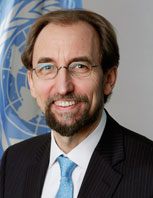
High Commissioner for Human Rights Zeid Ra’ad Al Hussein. UN Photo/Jean-Marc Ferré

On 5 March 2015 the United Nations High Commissioner for Human Rights urged Member States to uphold the human rights principles underlying their communities in their fight against radicalism.

Speaking to the UN Human Rights Council earlier he warned of the “real danger” that opinion-leaders and decision-makers would “lose their grasp” of the values that States built 70 years ago “to ward off the horror of war.”

The fight against terror is a struggle to uphold the values of democracy and human rights – not undermine them,” Mr. Zeid declared. “Counter-terrorist operations that are non-specific, disproportionate, brutal and inadequately supervised violate the very norms that we seek to defend. They also risk handing the terrorists a propaganda tool – thus making our societies neither free nor safe.”

At the same time, the UN human rights chief said he was “appalled” by the “rising tide of attacks” around the world targeting people on account of their beliefs. Such “horrific acts of racial and religious hatred,” he said, spanned countries in Western Europe and North America, where “unfair policing, daily insults, and exclusion” affected large swathes of the population. Meanwhile, he added, “the tentacles of the extremist takfiri movement” – an ideology where one believer apostasies another and then condemns them as impure – had reached into a wide range of countries, from Iraq and Syria to Nigeria, Yemen, Libya and Somalia.

Against that backdrop, Mr. Zeid voiced deep concern at the tendency of States to clamp down on the most basic of human rights, including the adoption of measures that restrict freedom of expression and democratic space.

When powerful leaders feel threatened by a tweet, a blog, or a high-school student’s speech, this speaks of profound underlying weakness,” he continued. “And when writers are abducted, jailed, whipped, or put to death; when journalists are assaulted, subjected to sexual violence, tortured and killed; when peaceful protestors are gunned down by thugs; when human rights lawyers, human rights defenders and land activists are arrested and jailed on spurious charges of sedition; when newspapers are attacked or shut down – such cases attack and undermine the foundations of stable governance.”

It is the people who sustain government, create prosperity, heal and educate others and pay for governmental and other services with their labour,” Mr. Zeid concluded. “It is their struggles that have created and sustain States. Governments exist to serve the people – not the other way round.

United Nations News Centre – Member States must enforce human rights amid rising tide of extremism – UN rights chief.

Another passionate plea by UN High Commissioner for better education and global leadership

February 6, 2015


High Commissioner Zeid Ra’ad Al Hussein delivers his speech at the United States Holocaust Memorial Museum. Credit: U.S. Holocaust Memorial Museum | Photo: Miriam Lomaskin

In an impressive speech on 5 February 2015 at the Holocaust Memorial Museum in Washington, D.C. – one week after the 70th anniversary of the liberation of Auschwitz – Mr. Zeid Ra’ad Al Hussein emphasized that education devoid of a strong universal human rights component can be next to worthless, especially in a crisis. “What good was it to humanity that…eight out of 15 people who planned the Holocaust at Wannsee in 1942 held PhDs?” he asked. “In the years after the Holocaust, specific treaties were negotiated to cement into law obligations to protect human rights. Countries the world over accepted them – and now alas, all too frequently, they ignore them in practice.” While it has been 70 years since the liberation of Auschwitz extermination camp, some of the processes used by the Nazis to carry out humanity’s largest organized destruction are being implemented again today by Islamic State of Iraq and the Levant (ISIL), explained Mr. Zeid.

This logic is abundant around the world today: I torture because a war justifies it. I spy on my citizens because terrorism, repulsive as it is, requires it. I don’t want new immigrants, or I discriminate against minorities, because our communal identity or my way of life is being threatened as never before. I kill others, because others will kill me – and so it goes, on and on.

Since the world cannot afford “sinking into a state of paralyzing shock…the task is to strengthen our ethics, clarity, openness of thought, and moral courage,” calling for new battle lines to combat extremism – based on the struggle for minds.

Children need to learn what bigotry and chauvinism are…they need to learn that blind obedience can be exploited by authority figures for wicked ends. They should learn that they are not an exception because of where they were born, how they look, what passport they carry, or the social class, caste or creed of their parents; they should learn that no one is intrinsically superior to her or his fellow human beings,” said Mr. Zeid.

The world needs “profound and inspiring” leaders who fully observe human rights and humanitarian law and all the treaties drafted to end discrimination, poverty, war, “with no excuses.”

It is obvious, Mr. Zeid continued, that forceful reprisals against atrocities – including “the savage burning of my compatriot the pilot Mu’ath al Kassassbeh” by ISIL – have had limited impact. Leaders must adopt a “battle-line based on ideas,” to speak out against Takfiri ideology (when one believer apostasies another believer and condemns them as impure). The movement to end that dangerous ideology must be waged by Muslim leaders and Muslim countries, he said.

Just bombing them or choking off their financing has clearly not worked…for these groups have only proliferated and grown in strength,” he said. “The space for dissent in many countries is collapsing under the weight of either poorly-thought out, or indeed, exploitative, counter-terrorism strategies.”

Few crises erupt without warning, he continued. Extremist ideas and violence manifest from years of tyranny, inequalities, fear and bad governance. They build up over years – even decades – of human rights grievances and the denial of basic economic and social rights. He insisted that atrocities can be prevented and extremism curbed through better, human rights-based global leadership and a fundamental rethink of education. “Surely we now know, from bitter experience, that human rights are the only meaningful rampart against barbarity.”

United Nations News Centre – In Washington, UN rights chief says atrocities can be prevented through better global leadership.

Don’t miss the High Commissioner’s words at MEA 2014 ceremony

October 10, 2014

The ceremony of the Martin Ennals Award 2014 is over (7 October 2014). It was again very impressive to hear and see 3 courageous Human Rights Defenders being honored. Some 450 people (my estimate) gave standing ovations to the 3 nominees whose work was shown in impressive films produced for the occasion. The film portraits are already available on the website: http://www.martinennalsaward.org where there is also a short summary of the whole evening.

Martin Ennals Award for Human Rights Defenders

Martin Ennals Award for Human Rights Defenders

Especially the film on Chinese HRD Cao Shunli is a masterpiece given that the film makers had almost no images to work with due to the modesty of the human rights defender as well as her untimely death in detention only 2 days after her nomination in March 2014.

The internet has buzzed with congratulations and encouragements to the other two nominees, Adilur from Bangladesh and Alejandra Ancheita from Mexico. The latter became ultimately the Laureate [see https://thoolen.wordpress.com/2014/10/07/breaking-news-alejandra-ancheita-is-the-2014-mea-laureate/#more-5648 ].

One of the nicest surprises was the address by Zeid Ra’ad Al Hussein, the United Nations High Commissioner for Human Rights at one of his first public appearances outside the UN. UN HCHR Al Hussein The High Commissioner gave a moving and almost poetic description of the sorry state of affairs left to human rights defenders to correct: He said inter alia: Read the rest of this entry »