Posts Tagged ‘Saudi Arabia’

Nicki Minaj did the right thing and cancelled her performance in Saudi Arabia

July 10, 2019

Yesterday I reported on Nicki Minaj’s scheduled performance in Saudi Arabia [https://humanrightsdefenders.blog/2019/07/09/nicki-minaj-asked-by-human-rights-group-to-refuse-saudi-money/] and just now media (here the BBC) report that she has cancelled, citing her support for the rights of women and the LGBT community.

So congratulations to her and the Human Rights Foundation. Shaming works sometimes.

After careful reflection I have decided to no longer move forward with my scheduled concert at Jeddah World Fest,” the singer said in a statement. “While I want nothing more than to bring my show to fans in Saudi Arabia, after better educating myself on the issues, I believe it is important for me to make clear my support for the rights of women, the LGBTQ community and freedom of expression.

Other celebrities can learn from this, e.g. Mariah Carey who earllier this year defied calls from human rights activists to cancel her performance in Saudi Arabia.

{One of the women in prison is Loujain al-Hathloul and her sister, Alia, had criticised Mariah Carey for playing a concert the King Abdullah Economic City. She said: “My own baby sister said she is being whipped, beaten, electrocuted and harassed on a frequent basis.” She stated: “Remember, thanks to my sister @LoujainHathloul, you r able to perform in Saudi Arabia. I wish she can attend your concert. But she’s locked behind bars because she tried to improve women’s condition. Don’t forget to thank her on stage,” she wrote to Carey on Twitter. But Mariah Carey is an old hand when it comes to selling her soul: see e.g. https://humanrightsdefenders.blog/2013/12/19/mariah-carey-needs-better-informed-staff-and-donate-her-1-million-fee-to-human-rights-defenders-in-angola/].}

But will Liam Payne follow the good example?

https://hrf.org/press_posts/hrf-urges-liam-payne-to-follow-nicki-minaj-cancel-performance-in-saudi-arabia/?utm_source=HRF+Master+List&utm_campaign=6500e05e81-EMAIL_CAMPAIGN_2019_07_10_06_51&utm_medium=email&utm_term=0_2d05ae8b4f-6500e05e81-77996831

https://www.bbc.co.uk/news/world-middle-east-48930029

Nicki Minaj asked by human rights group to refuse Saudi money

July 9, 2019

The Human Rights Foundation sent a letter to the rapper Nicki Minaj asking her to cancel her performance on 18 july 2019 at a Saudi Arabia music festival being funded by controversial Crown Prince Mohammed bin Salman. The organization said it “considers the Saudi regime to be one of the world’s worst human rights violators” and urged the singer, known for her provocative performances and racy lyrics “to cancel her performance, refuse the regime’s money and instead use her global influence to issue a statement demanding the release of the Saudi women activists who are currently in prison.

2018 MTV Video Music Awards - Photo Room - Radio City Music Hall, New York, U.S., August 20, 2018. - Rapper Nicki Minaj poses backstage with her Best Hip-Hop Video award for "Chun-Li." REUTERS/Carlo Allegri
Nicki Minaj, at the 2018 MTV Video Music Awards. (Photo: REUTERS/Carlo Allegri)

This blog has referred to the tension between star power and human rights on ealrier occasions, see e.g. https://humanrightsdefenders.blog/2017/11/10/helen-hunt-joins-list-of-celebrities-that-show-insensitivity-on-human-rights/, and https://humanrightsdefenders.blog/2014/02/10/star-power-and-human-rights-a-difficult-but-doable-mix/

The letter also discusses the country’s abuse of its LGBTQ citizens, including how at least five men were beheaded in April for admitting to sexual relations with other men. It connected that to Minaj taking part “in World Pride festivities in her hometown of New York City” last month, pointing out the hypocrisy. Toward the end of the letter, the human rights group wrote, “If you move forward with this performance for a festival sponsored by the Crown Prince, you will be in league with the people who respond to freedom of expression and thought with murder.

The organization said it sent the letter weeks ahead of the show so that Minaj can’t claim she is unaware. It noted that in 2015, the organization condemned the singer for signing on to perform “for the dictatorial regime of former president José Eduardo dos Santos and his family in Angola” for $2 million. “She performed anyway — and later claimed she was ‘high’ when she made the decision to perform. This time, Minaj and her team have been briefed about MBS two weeks in advance of her scheduled performance and therefore she cannot claim ignorance.” Minaj has not publicly commented on the letter. [see: https://humanrightsdefenders.blog/2015/12/18/merry-christmas-in-angola-nicki-minaj-performs-but-not-for-human-rights-defenders/]

Liam Payne and Steve Aoki are also part of the Jeddah World Fest, which was touted in a Saudi newspaper as the “largest musical festival of its kind in the region.”

https://hrf.org/press_posts/hrf-to-nicki-minaj-cancel-show-in-saudi-arabia/?utm_source=HRF+Master+List&utm_campaign=e651a6a2bf-EMAIL_CAMPAIGN_2019_07_05_03_34&utm_medium=email&utm_term=0_2d05ae8b4f-e651a6a2bf-77996831

https://www.yahoo.com/entertainment/nicki-minaj-asked-by-human-rights-group-to-pull-out-of-saudi-arabia-concert-refuse-the-regimes-money-192928036.html?guccounter=1&guce_referrer=aHR0cHM6Ly93d3cuZ29vZ2xlLmNvbS8&guce_referrer_sig=AQAAALmfCLG92BT-v0iexBEYcxb_V_UClFIzMnnbsRT7NRT0gRQfdtYIxwIgPt6jtm9UYlo8tuWYoyocH7Z3F5z-IOAvRDcz-2pG38apDfDZacqxsMI7bhVxNo9C9X-aXtZU-InwRYf9JJTgjcnXLaurbWdhHi2jaKLe4M1pO8bLazHg

41st session Human Rights Council: Opening statement by High Commissioner Michelle Bachelet

June 25, 2019

On 24 June, 2019, the 41st session of the Human Rights Council started with an opening statement by UN High Commissioner for Human Rights Michelle Bachelet. I refer to the guide to human rights defenders issues published earlier: https://humanrightsdefenders.blog/2019/06/14/guide-to-human-rights-defenders-issues-at-the-41st-human-rights-council-starting-on-24-june/

The High Commissioner’s speech contained many topics including these:

……
I regret Saudi Arabia‘s dismissal of last week’s report by the Special Rapporteur on extrajudicial, summary or arbitrary executions. I also reiterate my strong condemnation of the mass execution of 37 men in April. Some were children when the alleged crimes occurred.

Iran continues to sentence children to death. I was appalled that the authorities sentenced and executed two boys under the age of 18 in April. I remain particularly concerned about the high number of child offenders on death row – possibly more than 85 individuals – with some at risk of imminent execution.

I take this opportunity to note and commend global progress with respect to the death penalty in this year, which marks the 30th anniversary of the Second Optional Protocol to the International Covenant on Civil and Political Rights, aiming at the abolition of the death penalty. The advances include recent ratifications by Gambia and State of Palestine; removal of the death penalty from the penal codes of Benin and Burkina Faso; and declarations of moratoria in Malaysia and the State of California.

..The inspiring and peaceful popular uprising in Sudan, with its call for democratic governance and justice, has been met with a brutal crackdown by the security forces this month. I regret that the Government has not responded to our request for access to investigate allegations of serious human rights violations by the joint security forces during the crackdown. They include reports that more than 100 protestors were killed, and many more injured, during and following the assault by security forces on a peaceful sit-in on 3 June. In addition, hospitals and clinics were reportedly raided, and medical staff assaulted. We have received allegations of rape and sexual abuse of both women and men during the crackdown, as well as information alleging that hundreds of protestors may be missing. I urge Sudan to grant access to my Office; to put an end to the repression of the people’s human rights; and to immediately end the Internet shutdown. The Sudanese people are entitled to express their opinions, and – like people everywhere – they have a right to live in freedom and at peace, enjoying the rule of law and the conditions necessary to dignity.

In Myanmar, evidence indicates continuing persecution of the remaining Rohingya people in northern Rakhine State, with little or no effort by the authorities to create conditions for the voluntary, safe and sustainable return of refugees. Although restrictions on humanitarian and media access in both Rakhine and in Chin State limit our access to information, the ongoing conflict there has included use of heavy weaponry, airstrikes and helicopter gunships by the military, with significant loss of life on all sides and severe impact on civilians. Based on allegations received, we fear that the conflict is being used as a pretext to carry out attacks against Rohingya civilians, and to cause further displacement. Some 35,000 ethnic Rakhine, Rohingya, Mro, Daignet and Khamee civilians have been internally displaced by fighting. The suspension of humanitarian aid by the government means at least 95,000 people have been cut off from life-saving assistance.

….
My Office is following the situation of human rights in the Philippines very closely. The extraordinarily high number of deaths – and persistent reports of extrajudicial killings – in the context of campaigns against drug use continue. Even the officially confirmed number of 5425 deaths would be a matter of most serious concern for any country. I welcome the recent statement by Special Rapporteurs calling for action by the Council. There should also be comprehensive and transparent information from the authorities on the circumstances around the deaths, and investigations related to allegations of violations. These could dispel any false allegations and help regain trust for the authorities.Human rights defenders, including activists for land rights and the rights of indigenous peoples; journalists; lawyers; members of the Catholic clergy; and others who have spoken out – notably the Special Rapporteur on the rights of indigenous peoples – have received threats, sometimes publicly, from senior Government officials. This creates a very real risk of violence against them, and undermines rule of law, as well as the right to freedom of expression.

In Portugal, where I attended an encouraging conference on drug policies and harm reduction, I also benefited from informative discussions on migration. Portugal’s open and forward-looking migrant policy aims to offer migrants easy access to social and legal assistance and encourages migrants to access the labour market. I visited a centre in Lisbon which offered free pre-school classes, alongside training courses and other support to migrant women aiming to set up their own companies. Ensuring that migrants are included and integrated brings many benefits for host communities, including net financial contributions: Portugal’s High Commissioner for Migration informed me that in 2017, migrants contributed 510 million euros more to the social security system than they took out. I invite all countries to consider learning from this example. Despite extensive disinformation campaigns regarding the supposedly damaging impact of migration on destination countries, close attention to the facts indicates that when their dignity and rights are respected, migrants can be strong drivers of successful economies and societies. We should recognize and cherish these contributions.

Instead, I observe a deeply unfortunate trend towards the criminalisation of basic human compassion for migrants, including those in situations of great vulnerability. The NGO Open Democracy reported last month that over 100 ordinary people in Europe have been arrested or prosecuted this year for acts such as feeding hungry migrants; helping them find shelter; or even assisting a pregnant woman to get to hospital to give birth. Similar prosecutions of ordinary people seeking to help individuals in distress have also taken place in the United States and elsewhere. Moreover, in several countries, new legal measures aim to penalise NGOs which rescue people drowning at sea.

Measures such as these clearly put the lives of children, women and men at risk. But they also put our societies at risk. They violate ancient and precious values that are common to us all, by penalizing compassion. Those who seek to help people in need should be honoured, not prosecuted. Caring should not be considered a crime, and this criminalisation of acts of basic human decency must be resisted. We have, all of us, a right – and even a duty – to help each other.

https://ohchr.org/EN/NewsEvents/Pages/DisplayNews.aspx?LangID=E&NewsID=24724

NEWS: UN expert, Agnes Callamard, says Saudi Arabia is responsible for ‘extrajudicial’ killing of Khashoggi and calls it ‘international crime’.

June 19, 2019
The UN rapporteur believes that the killing of Khashoggi constitutes an international crime [File: Sedad Suna/EPA-EFE]

Saudi journalist Jamal Khashoggi was killed by Saudi agents inside the Saudi consulate in Istanbul on 2 October 2018 says UN extrajudicial executions investigator Agnes Callamard in her report which was released on Wednesday 19 June 2019. She said Khashoggi’s death “constituted an extrajudicial killing for which the State of the Kingdom of Saudi Arabia is responsible”. Al Jazeera published the Executive Summary (see below), while Rob Berschinski of Human Rights First calls on Congress to pursue accountability for his murder. “Callamard’s report underscores that there will be no justice for Jamal Khashoggi unless Congress steps up. Saudi leaders have made it clear that they intend to get away with murder. President Trump has made it clear that he values arms sales over the killing and dismemberment of a U.S. resident. Congress must make it clear that it will not let this stand,”. He added that “the Senate has passed aunanimous resolution that found, based on U.S. intelligence, that Crown Prince Mohammed bin Salman is responsible for Khashoggi’s murder. Republican and Democratic House leaders have called for accountability. Now is the time for action, not words.”

See also: https://humanrightsdefenders.blog/2019/03/18/jamal-khashoggi-murder-the-plot-thickens/

——–

Executive summary

State Responsibilities

1.   Mr. Khashoggi’s killing constituted an extrajudicial killing for which the State of the Kingdom of Saudi Arabia is responsible. His attempted kidnapping would also constitute a violation under international human rights law. From the perspective of international human rights law, State responsibility is not a question of, for example, which of the State officials ordered Mr. Khashoggi’s death; whether one or more ordered a kidnapping that was botched and then became an accidental killing; or whether the officers acted on their own initiative or ultra vires.

2.   The killing of Mr. Khashoggi further constituted a violation of the Vienna Convention on Consular Relations (thereafter VCCR) and of the prohibition against the extra-territorial use of force in time of peace (customary law and UN Charter). In killing a journalist, the State of Saudi Arabia also committed an act inconsistent with a core tenet of the United Nations, the protection of freedom of expression.  As such, it can be credibly argued that it used force extra-territorially in a manner “inconsistent with the Purposes of the United Nations.”

3.   Further, the circumstances of the killing of Mr. Khashoggi may constitute an act of torture under the terms of the Convention Against Torture, ratified by Saudi Arabia. Finally, the killing of Mr. Khashoggi may also constitute to this date an enforced disappearance since the location of his remains has not been established.

Individual liability

4.   The Special Rapporteur has determined that there is credible evidence, warranting further investigation of high-level Saudi Officials’ individual liability, including the Crown Prince’s.  She warns against a disproportionate emphasis on identifying who ordered the crime, pointing out that the search for justice and accountability is not singularly dependent on finding a smoking gun and the person holding it. The search is also, if not primarily, about identifying those who, in the context of the commission of a violation, have abused, or failed to fulfill, the responsibilities of their positions of authority. 

Duty to investigate and consular immunity

5.   The Special Rapporteur has found that both the investigations conducted by Saudi Arabia and Turkey failed to meet international standards regarding the investigation into unlawful deaths.

6.   Saudi officials were present in the Saudi consulate and residence in Istanbul from 6 to 15 October during which time they presumably investigated the killing. However, the Special Rapporteur was not provided with any information regarding the evidence they may have collected during this period. The Saudi Public Prosecution made public a few of their findings on 15 November but the statement was light on details, limiting itself to a few general allegations. Other statements regarding the actions and responsibilities of specific individuals were a welcomed step. However, the Special Rapporteur notes that some of the individuals allegedly referenced in these statements and the identity of 11 perpetrators currently on trial do not match. Further, the Saudi authorities have yet to disclose the whereabouts of the remains of Mr. Khashoggi.

7.   The Special Rapporteur found that under the terms of the VCCR, Saudi authorities were under no legal obligation to grant access to the Consular premises to the Turkish investigators. However, Saudi Arabia was under an international obligation to cooperate with the Turkish authorities in the investigation of the killing of Mr. Khashoggi. Such cooperation necessarily demanded that they gave access to the consulate to the Turkish authorities in a prompt and effective fashion and in good faith. Consular immunity was never intended to enable impunity. 

8.   The Special Rapporteur found credible evidence pointing to the crime scenes having been thoroughly, even forensically, cleaned. These indicate that the Saudi investigation was not conducted in good faith, and that it may amount to obstructing justice. 

9.   Turkish investigators, accompanied by Saudi investigators, only had access to the Consulate on the 15th October for 6 hours and to the Consul’ residence on 17th October for around thirteen hours, where they also had to search the whole consular vehicle fleet. Their scientific and forensic inquiries were limited to “swabbing” and they were not allowed to drain a well located in the residence. The limitations imposed by Saudi Arabia on the Turkish investigation cannot be justified by the need to protect Consular operations.

10.  Turkish investigators decided not to search the Saudi Consulate without proper authorization from the Saudi authorities. The Special Rapporteur found that this was the appropriate way to proceed: creating an exception to the VCCR grounded inviolability of the Saudi Consular premises for the purpose of an investigation would have been unnecessary and disproportionate.

11.   She also found that Turkey’s fear over an escalation of the situation and retribution meant that the consular residences or consular cars were also not searched without permission even though they are not protected by the VCCR.

12.   The Special Rapporteur regrets that it appears no international body or other State came forward with an offer to “mediate” between the two parties to negotiate prompt and effective access to the crime scene.  This could have been done to also help de-escalate the crisis, protect equally the VCCR and human rights, and address as well the fear of retaliation. Instead, it appears that other Member States pondered rather only their own national and strategic interests. The United Nations either considered it had no evident means of intervention or elected not to intervene. In retrospect, it is evident that the ultimate casualty of these considerations was justice and accountability for Jamal Khashoggi.

Duty to protect and to warn

13.   On the basis of credible information at her disposal, the Special Rapporteur has concluded that there is insufficient evidence to suggest that either Turkey or the United States knew, or ought to have known, of a real and imminent or foreseeable threat to Mr. Khashoggi’s life. There was credible evidence to suggest that, had Mr. Khashoggi returned to Saudi Arabia, or been lured there, he would have been detained, possibly disappeared, and harmed. These risks were not linked to his life or presence in his countries of residence, namely the US or Turkey.  She did not secure credible evidence that US authorities had intercepted the Saudi Crown Prince’s communications or that such intercepts had been assessed before the time of the killing of Mr. Khashoggi.

14.   The killing of Mr. Khashoggi has highlighted the vulnerabilities of dissidents living abroad, and the risks they are facing of covert actions by the authorities of their countries of origin or non-State actors associated to them. The States of the countries where they have found residence or exile are under an obligation to respect their human rights, and protect them against violence by the States of the countries they have escaped from.  This obligation should entail, namely:

(a)   The duty to protect is triggered whenever Governments know or ought to know of a real and immediate threat or risk to someone’s life;

(b)   Such an obligation to protect includes, but is not limited to, a duty to warn the individual of an imminent threat to their life

(c)   The obligation to protect, including the duty to warn, is imposed on all Governments agencies and institutions, and thus includes Intelligence Agencies

(d)   The obligation to protect applies regardless of the status of citizen or alien on the territories of the State.

(e)   The obligation to protect, including the duty to warn, demands that risks assessment take into account whether some individuals may be particularly at risk because of their identity or activities, such as journalists or human rights defenders.

(f)    The obligation to protect, including the duty to warn, may be triggered extra-territorially, whenever States exercise power or effective control over individual’s enjoyment of the right to life.

Duty to prosecute and reparations

15.  The Kingdom of Saudi Arabia has taken timid steps towards addressing its State responsibilities in terms of prosecution and reparation. But these stop short of what is required under international law. The accountability gap is all the more worrying given that it concerns a crime that has received an unprecedented level of attention and outcry internationally, including official public condemnation the world over.

16.  The on-going trial in Saudi Arabia of 11 suspects in the killing of Mr. Khashoggi, while an important step towards accountability, fails to meet procedural and substantive standards. The trial is held behind closed doors; the identity of those charged has not been released nor is the identity of those facing the death penalty. At the time of writing, at least one of those identified as responsible for the planning and organizing of the execution of Mr. Khashoggi has not been charged. 

17.  The Government of Saudi Arabia has invited representatives of Turkey and of the permanent members of the Security Council to attend at least some of the hearings.  However, the Special Rapporteur has been told that this trial observation was conditional upon agreement to not disclose its details. Trial observation under those conditions cannot provide credible validation of the proceedings or of the investigation itself. It is particularly concerning that, given the identity of the observers, the institution of the UN Security Council itself has been made complicit in what may well amount to a miscarriage of justice. 

18.  In view of her concerns regarding the trial of the 11 suspects in Saudi Arabia, the Special Rapporteur calls for the suspension of the trial.

19.  To date the Saudi State has failed to offer public recognition of its responsibility for the killing of Mr. Khashoggi and it has failed to offer an apology to Mr. Khashoggi’s family, friends and colleagues for his death and for the manner in which he was killed. The Special Rapporteur obtained information regarding a financial package offered to the children of Mr. Jamal Khashoggi but it is questionable whether such package amounts to compensation under international human rights law. 

20.  The restructuring of the Intelligence Services announced by King Salman is insufficient. There has been no subsequent information elaborating on the impact of the restructuring (or any other measures) on the decision-making, training, and codes of ethics of the Security Agencies, to name a few issues of concern.  Instead, one would expect the Kingdom of Saudi Arabia to demonstrate non-repetition including by releasing all individuals imprisoned for the peaceful expression of their opinion and belief; investigating all allegations of torture and lethal use of force in formal and informal places of detention; investigating all allegations of enforced disappearances and making public the whereabouts of individuals disappeared. It should also undertake an in-depth assessment of the actors, institutions and circumstances that made it possible for the execution of Mr. Khashoggi to be carried forward and identify the reforms required to ensure non-repetition.

Universal jurisdiction

21.  The Special Rapporteur believes that the killing of Mr Kashoggi constitutes an international crime over which States should claim universal jurisdiction. The killing of Mr. Khashoggi is a violation of a jus cogen norm. It violates the VCCR and the prohibition against the extraterritorial use of force in times of peace. The circumstances of the execution may amount to an act of torture under the Convention Against Torture. It is a continuing case of enforced disappearance since the remains of Mr. Khashoggi have not been located. It concerns a journalist in self-imposed exile. His execution has an enduring international impact.

Accountability

22.  The Special Rapporteur is concerned that legal accountability for the execution of Mr. Khashoggi is being made difficult to obtain. The trial underway in Saudi Arabia will not deliver credible accountability. Turkey has not initiated proceedings yet and hopes for credible accountability are weak in a country with such a track record of imprisonment of journalists. Jurisdictional challenges and the impossibility of conducting a trial in absentia mean that a trial in the US will face many challenges. The Special Rapporteur makes a number of proposals for how some of these issues may be addressed while warning that no one proposal on its own will deliver credible accountability.

23.  The Special Rapporteur emphasizes that the search for accountability and justice should include other means, including political, diplomatic, financial, symbolic. Actions to celebrate and recall the life of Jamal Khashoggi have an important part to play in ensuring public accountability for his execution.


https://www.humanrightsfirst.org/press-release/un-khashoggi-report-call-action

https://www.aljazeera.com/news/2019/06/khashoggi-executive-summary-callamard-report-190619105102019.html

Guide to Human Rights Defenders issues at the 41st Human Rights Council starting on 24 June

June 14, 2019

Thanks to the – as always very complete and timely – “Alert to the Human Rights Council’s 41st session” (from 24 June to 12 July 2019) issued by the International Service for Human Rights. I am able to give a short guide to the main items that relate to human rights defenders. To Read the full Alert to the session online click here and stay up-to-date with @ISHRglobal and #HRC41 on Twitter.

Thematic areas of interest:

Sexual orientation and gender identity: The interactive dialogue with the Independent Expert on protection against violence and discrimination on the basis of sexual orientation and gender identity (SOGI) will be held on Monday 24 June at 11:00. The Council will consider the new thematic report of the mandate holder as well as the report of the country visits he made to Georgia and Mozambique. The Council will also consider the renewal of the mandate.

Business and human rights: The Council will hold an interactive dialogue with and consider several reports of the Working Group on the issue of human rights and transnational corporations and other business enterprises on 26 June. The Working Group will present a report on the gender dimensions of the Guiding Principles on Business and Human Rights and the reports of country visits to Thailand and Kenya. The Working Group’s report on the gender dimensions of the Guiding Principles integrates clear recognition that women human rights defenders play a vital role in challenging business-related human rights abuses as well as in promoting and protecting human rights in relation to business activity, including the right to an effective remedy. As a result of this work, women human rights defenders often face gender-specific risks including sexual violence, misogynist public shaming and online harassment. Among its recommendations, the Working Group calls on business enterprises to ensure the meaningful participation of women’s organisations, women human rights defenders and gender experts in all stages of human rights due diligence.

Women human rights defenders and women’s rights: The annual full day discussion on the human rights of women will take place on 27 and  28 June. The discussions will focus this year on violence against women in the world of work, the rights of older women and their economic empowerment. A panel focused on women’s rights and climate change will also be organised, focusing on climate action, best practices and lessons learned. States should place due consideration on the role of women human rights defenders and social movements in this regard, in line with the Human Rights Council resolution focused on environmental human rights defenders adopted in March 2019…
The Council will also hold an interactive dialogue with the Working Group on the issue of discrimination against women in law and in practice which focuses on women deprived of liberty (including women human rights defenders in detention, facing travel bans, among other situations), and will consider their reports including a report on the country visits to Honduras and Poland. The Council will hold an interactive dialogue with the Special Rapporteur on violence against women, its causes and consequences on 27 June and will consider her report including the report of her visits to Canada and Nepal.

Reprisals:  In spite of a number of measures, reprisals not only continue, but grow. Item 5 of the Human Rights Council’s agenda provides a key opportunity for States to raise concerns about reprisals, including specific cases, and for relevant governments to provide updates on cases to the Council on any investigation or action taken toward accountability. During the organisational meeting held on 7 June, the President of the Council stressed the importance of ensuring the safety of those participating in the Council’s work, and the obligation of States to prevent intimidation or reprisals. In line with previous calls, ISHR expects the President of the Human Rights Council to publicly identify and denounce specific instances of reprisals by issuing formal statements, conducting press-briefings, corresponding directly with the State concerned, publicly releasing such correspondence, and insisting on undertakings from the State concerned to investigate, hold the perpetrators accountable and report back to the Council on action taken. [see also: https://humanrightsdefenders.blog/2019/05/13/ishr-on-reprisals-un-and-states-must-do-more-to-address-reprisals/]

Other key thematic reports: The Council will hold dedicated debates and consider reports of several mandates relating to civil, political, economic, social and cultural rights, and the role of human rights defenders in that work area, in some instances involving the renewal of the mandate:

  • The Special Rapporteur on independence of judges and lawyers and on the right to health (including country visits report to Canada and Kyrgyzstan) on 24 June
  • The Special Rapporteur on the rights to freedom of peaceful assembly and association (mandate renewal, reports include country visits to Tunisia and Armenia) on 25 June
  • The Special Rapporteur on extrajudicial, summary or arbitrary executions and right to education on 26 June
  • The Special Rapporteur on freedom of opinion and expression (including thematic report on surveillance companies and country visit report to Ecuador) on 25 June
  • The Special Rapporteur on extreme poverty and human rights (including country visits reports to the UK and Laos) on 28 June

In addition, the Council will hold dedicated debates on rights of specific groups including with:

  • The Special Rapporteur on the human rights of migrants (and country visit report to Niger) on 24 June
  • The Special Rapporteur on the human rights of internally displaced persons on 28 June (mandate renewal)
  • The Special Rapporteur on trafficking in persons (and country visit to Nigeria) on 27 June
  • The Special Rapporteur on the elimination of discrimination against persons affected by leprosy and their family members on 24 June

Country-specific developments:

China: For more than a year, the international community has had access to credible reports and first-hand testimony of the harassment, surveillance, and mass detention of more than one million Uyghurs and other Turkic Muslims in Xinjiang. Despite the consistent work of the UN human rights mechanisms to review China, ask questions, and make recommendations, there has been no serious or effective response. The Council should take urgent action to seek access, monitoring and reporting of the situation to inform future actions. ..ISHR urges States to act collectively to advance a resolution calling for China to allow access to the region to independent human rights experts and to end country-wide the arbitrary detention of individuals based on their religious beliefs or political opinions.

Sudan: In response to the gross and systematic human rights violations occurring in Sudan, ISHR andother NGOs have urged Council Member States to urgently hold a Special Session on the human rights situation in Sudan. The Council should urgently establish an international fact-finding mission to document violations, identify perpetrators and push for accountability, in line with calls made by a group of Special Procedures including the Independent Expert on Sudan. Since 3 June, Rapid Security Forces, riot police and national security officers violently dispersed peaceful protesters in Khartoum as well as in different cities across Sudan. The MENA Women Human Rights Defenders’ Coalition reported that at least 113 people have died including women human rights defenders. Civil society documented cases of rape, attacks on hospitals, with hundreds injured and missing.  The Transitional Military Council is enforcing a ban on communication causing an internet black out. The High Commissioner has deplored the killings and proposed ‘the rapid deployment of a UN human rights monitoring team’ to Sudan.

Saudi Arabia: The June session provides an important opportunity for the Council to follow up on the joint statement delivered on behalf of 36 States [see: https://humanrightsdefenders.blog/2019/03/08/saudi-arabia-for-first-time-openly-criticized-in-un-human-rights-council/] .. Seven women’s rights activists have been provisionally released, but they are still facing trial, and other women human rights defenders are still in detention, with the human rights situation on the ground deteriorating markedly on other fronts, including through increased use of the death penalty and the authorities’ continuing crackdown on freedom of expression.  [see also: https://humanrightsdefenders.blog/2019/03/28/3-saudi-women-human-rights-defenders-released-but-for-how-long-and-what-about-the-others/]
The Special Rapporteur on extrajudicial, summary or arbitrary executions will present her findings of the investigation into the killing of Khashoggi. [see: https://humanrightsdefenders.blog/2019/01/26/other-members-of-the-uns-khashoggi-investigation-team-named/%5D…..ISHR calls on States to advance a Human Rights Council resolution establishing a monitoring mechanism over the human rights violations in the country and calling explicitly for the immediate and unconditional release of all human rights defenders including the detained women human rights defenders and to drop all charges against them, including those provisionally released. ISHR considers the March joint statement as a first step towards more sustained and dedicated review by the Council in its efforts to hold its members accountable.

The Philippines: The Philippines is one of the most dangerous countries for human rights defenders. Several NGOs callied on the Council to advance accountability for human rights violations by adopting a resolution establishing an independent international investigation into extrajudicial killings and this call was strongly endorsed by a group of independent UN experts who condemned a ‘sharp deterioration in the situation of human rights across the country, including sustained attacks on people and institutions defending human rights.’ [see also: https://humanrightsdefenders.blog/2019/06/07/philippines-labour-rights-defender-dennis-sequena-shot-dead-while-meeting-with-workers/]

Egypt: Despite the Egyptian government’s assurances to the African Commission civil society faced restrictions, reprisals and intimidation for engaging or seeking to engage with the Commission. These restrictions and reprisals happened in a context where the Government of Egypt crushes dissent, discourages public participation in public affairs and punishes people who dare to claim basic human rights. Individuals and communities who engaged with the Special Rapporteur on the right to housing during her visit in September 2018 faced systematic reprisals. All other scheduled visits by the Special Procedures have been postponed as a result. [see: https://humanrightsdefenders.blog/2018/12/07/egypt-denounced-for-reprisals-against-human-rights-defenders-who-talked-to-visiting-un-delegation/ and https://humanrightsdefenders.blog/2019/05/12/reprisal-against-egyptian-human-rights-defender-mohamed-soltan/]. ISHR calls on States to condemn the acts of intimidation and reprisals for civil society engaging with the African Commission and with the Special Procedures, and recall Egypt’s obligations to prevent acts of intimidation and reprisals, investigate the allegations and provide victims with effective remedy.

Burundi: The Commission of Inquiry on Burundi will present its oral briefing on 2 July. The closing of the office of the High Commissioner for Human Rights is regrettable and worrying. In addition, ISHR remains seriously concerned over the breaches to due process observed in all of human rights defender Germain Rukuki’s legal proceedings since his arrest without warrant on 13 July 2017. [See: https://humanrightsdefenders.blog/2019/03/29/ngo-statement-condemns-new-irregularities-in-the-case-of-germain-rukuki-burundi/]. For more information on the situation of human rights defenders in Burundi, check ISHR Briefing Paper for the UPR here.

Other country situations: The High Commissioner will present her oral update to the Council on 24 June. The Council will hear reports on and is expected to consider resolutions addressing a range of country situations, in some instances involving the renewal of the relevant expert mandates. These include:

  • Interactive dialogue with the Special Rapporteur on the human rights situation in Belarus (mandate renewal) on 1 July
  • Interactive dialogue with the Special Rapporteur on the human rights situation in Eritrea (mandate renewal) on 2 July
  • Interactive dialogue with the Commission of Inquiry on Syria, the Commission of Inquiry on Burundi and the Special Rapporteur on Myanmar on 2 July
  • Enhanced interactive dialogue with the government of Sudan and OHCHR on 9 July
  • Enhanced interactive dialogue on the situation in the Democratic Republic of Congo and interactive dialogue with the team of experts on the situation in the Kasai region on 9 July
  • Interactive dialogue with the High Commissioner on the situation in Ukraine on 10 July
  • Interactive dialogue with the Independent Expert on the Central African Republic on 10 July
  • Enhanced interactive dialogue on the report of the High Commissioner on Venezuela on 10 July
  • Interactive dialogue with the High Commissioner on the situation of Rohingya Muslims and other minorities in Myanmar on 10 July
  • First oral update and enhanced interactive dialogue on the report of the High Commissioner on Nicaragua on 11 July
  • Oral update by the High Commissioner on cooperation with Georgia on 11 July

Adoption of Universal Periodic Review (UPR) reports: During this session, the Council will adopt the UPR working group reports on New Zealand, Afghanistan, Chile, Viet Nam, Uruguay, Yemen, Vanuatu, North Macedonia, Comoros, Slovakia, Eritrea, Cyprus, Dominican Republic and Cambodia.

Resolutions to be presented to the Council’s 41st session: At the organisational meeting resolutions were announced (States sponsoring the resolution in brackets); it is possible that more resolutions could be presented at this session. These include:

  • The human rights situation in Belarus (European Union)
  • Human rights of internally displaced persons (Austria, Honduras, Uganda)
  • Human rights and climate change (Bangladesh, Philippines, Viet Nam)
  • Human rights, sexual orientation and gender identity (Argentina, Brazil, Chile, Colombia, Costa Rica, Mexico, Uruguay).
  • Elimination of discrimination against women and girls (Colombia, Mexico)
  • Rights to freedom of peaceful assembly and of association (Czech Republic, Indonesia, Lithuania, Maldives, Mexico)
  • New and emerging and digital technologies and human rights (Republic of Korea, Austria, Brazil, Denmark, Morocco, Singapore)
  • Accelerating efforts to eliminate all forms of violence against women(Canada)
  • The human rights situation in Syria (France, Germany, Italy, Jordan, Kuwait, Morocco, Netherlands, Qatar, Turkey, United Kingdom of Great Britain and Northern Ireland)

There wil be again many side events at the Council, on which I will report separately.

Read here the three year programme of work of the Council with supplementary information.
Read here ISHR’s recommendations on the the key issues that are or should be on the agenda of the UN Human Rights Council in 2019.

Human rights cities movement or network?

June 2, 2019

The third edition of the #RightsCity conference will be held on June 3 2019 in Montreal, Canada. For more on the background of the Human Rights Cities movement, see: https://en.wikipedia.or/wiki/Human_Rights_City#History_of_the_Human_Rights_Cities_movement. However, how it relates to the human rights cities network I referred to earlier [https://humanrightsdefenders.blog/2018/12/14/the-human-rights-cities-network-the-beginning/], is not totally clear!

This year, particular emphasis has been placed on the role of prominent human rights defenders, journalists and global human rights leaders, and of Canada as well. The conference brings together some of the world’s human rights leaders and thinkers, including: Saudi activist Omar Abdulaziz; Canadian retired lieutenant-general and senator Roméo Dallaire; Iranian women’s rights leader Shaparak Shajarizadeh; Chinese dissident and former political prisoner Yang Jianli; and former special adviser to the UN Secretary-General on the Responsibility to Protect, Jennifer Welsh.

The event is hosted by the Montreal Institute for Genocide and Human Rights Studies at Concordia University, in partnership with the Raoul Wallenberg Centre for Human Rights, Amnesty International, the Canadian International Council and the Centre for International Peace and Security Studies. (The event is expected to be livestreamed via CPAC.)

Here, some of those involved with the event shed light on the human rights issues they believe are most important to address in order to ensure global stability.

1. Where’s our defence of the global institutions and mechanisms to protect human rights? Kyle Matthews, executive director of the Montreal Institute for Genocide and Human Rights Studies
2. Crimes against humanity have been committed in Cameroon. Let’s not turn away. Pearl Eliadis, Canadian lawyer and senior fellow of the Raoul Wallenberg Centre for Human Rights
3. A call for a new generation of Canadian human rights promotion. Arthur Graham, Canadian lawyer and head of the rule of law and human rights department at the OSCE Mission to Serbia
4. Do not underestimate the importance, and fragility, of multinational democracy.  Michael J. Abramowitz, president of Freedom House
5. Above all, the common thread — and need — is fairness. Jeremy Kinsman, Canada’s former ambassador to the European Union and High Commissioner to Britain


Andrew Anderson: “The Dangerous Game of Sportswashing”

May 22, 2019
On 26 April 2019 Andrew Anderson of Front Line Defenders did – rightly – not mince his words in a piece drawing attention to the growing phenomenon of sports washing. In February 2019 I drew already attention to this in a post: https://humanrightsdefenders.blog/2019/02/01/sports-and-human-rights-focus-on-sports-washing-big-names-play-for-big-money/.

Anderson’s “Gloss, Not Glory: The Dangerous Game of Sportswashing” says it more eloquently:

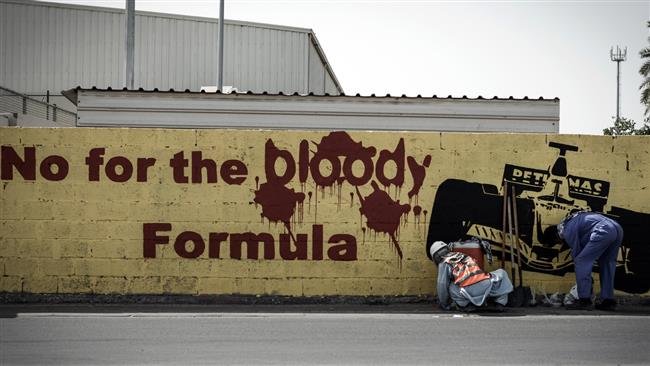
Brutal and corrupt dictatorships trying to use sport to improve their image is nothing new, as The Guardian noted in February when it compared club ownership and the Champions League to Mussolini and the 1934 World Cup. However, the absurd news that the Dakar Rally will take place in Saudi Arabia in 2020 – compounded by reports that an offer is under consideration to bring the Spanish Super Cup to the same country in a €30 million per year, 6-year deal- brings blood drenched sportswashing to new depths.


Protest graffitti against the Formula One race in Bahrain.

As the International Federation for Human Rights reported the Dakar Rally announcement comes not only in the wake of the murder of journalist Jamal Kashoggi and amidst Saudi war crimes in Yemen, but as women human rights defenders are being tortured in detention for campaigning, amongst other things, for the right of women to drive. The same Saudi rulers who order the killings and torture are seeking to buy positive coverage through sport. “The same Saudi rulers who order the killings and torture are seeking to buy positive coverage through sport.”

As someone who was at Wembley in 1992 to see Barcelona lift their first European Cup, it is particularly galling to contemplate the Cruyff-inspired masters of the beautiful game being dragged into the sportswashing of Mohammad bin Salman. The Barcelona slogan is “More Than a Club” and is explicitly linked to both values and social change. It is difficult to reconcile these noble aspirations with a PR exercise for a misogynist regime, itself the antithesis of those values.

We are, of course, already far down the slippery slope. The rulers of the UAE have also long-used sport as part of their self-promotion. The owners of Manchester City and the sponsors of Real Madrid are similarly involved in war crimes in Yemen, and routinely detain and torture those who dare to speak out for human rights. Ahmed Mansoor, winner of the Martin Ennals Prize in 2015 for his peaceful work for human rights, is currently on hunger strike in protest against prison conditions and his sentencing to 10 years in prison after an unfair trial. Front Line Defenders is gravely concerned for his health and is calling for his release.

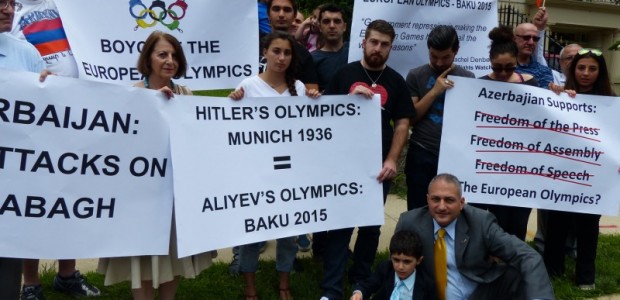
Sunday, 28th April, Formula One will hold the Azerbaijan Grand Prix in Baku. The Azeri dictator, Ilham Aliyev, who routinely detains human rights defenders and journalists, is also President of the country’s Olympic committee. He has embraced sportswashing enthusiastically. Azerbaijan hosted the European Games in 2015 under the auspices of the European Olympic Committees. The 2019 European Games are to be in Belarus. The Formula One calendar also includes Bahrain, Abu Dhabi (UAE) and China, all countries where Front Line Defenders is campaigning for the release of unjustly detained human rights defenders.


Protest against first European Games in Baku in 2015.

Many sports fans will shrug their shoulders and say that money is awash in international sport, and what can you do? The International Olympic Committee and football’s world governing body FIFA have been mired in corruption scandals and the use of international sporting events and national Olympic committees have long been seen by dictators, authoritarians and fascists as tools for advancing propaganda. But it is surely time to draw a line in the sand, and where better to do it than Saudi Arabia? The Dakar Rally should not take place there while women human rights defenders like Lujain Al-Hathloul are detained and tortured. And the Spanish Football authorities must reject the proposed Saudi deal in spite of the vast sums of money on the table.

Sportswashing is more than a game, it is a corrupt exercise of cover-up and repression. And sport must reject the tyrants.

https://www.frontlinedefenders.org/en/blog/post/gloss-not-glory-dangerous-game-sportswashing

3 Saudi women human rights defenders released but for how long? And what about the others?

March 28, 2019
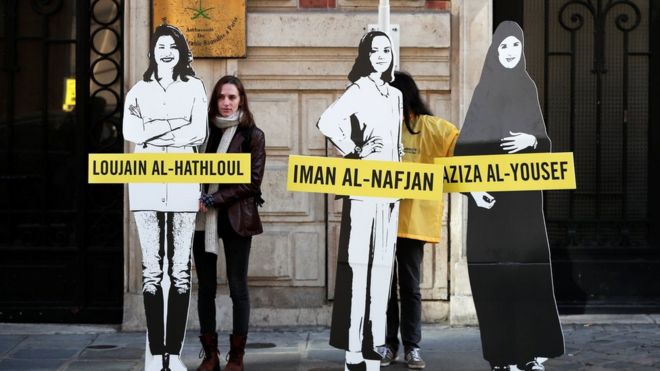
Amnesty International urges Saudi authorities to release activists Loujain al-Hathloul, Eman al-Nafjan and Aziza al-Yousef, outside the Saudi Arabian embassy in Paris, March 8, 2019
Protesters called for the female activists’ release at the Saudi embassy in Paris last month – copyright REUTERS

Media just reported that Saudi Arabia has temporarily released three female human rights defenders facing charges related to human rights work and contacting foreigners. Two sources told Reuters that three women had been released, and more would be freed on Sunday.[see: https://humanrightsdefenders.blog/2019/03/13/saudi-arabia-persist-with-trial-for-women-human-rights-defenders/]

Amnesty International and UK-based Saudi rights organisation, ALQST, named the women as Eman al-Nafjan, Aziza al-Yousef and Roqaya al-Mohareb. Saudi state media said the releases were only provisional. Lynn Maalouf from Amnesty welcomed the releases but said it should not be on a temporary basis. “They have been locked up, separated from their loved ones, subjected to torture and threats for simply peacefully calling for women’s rights and expressing their views,” she said.

https://www.bbc.co.uk/news/world-middle-east-47731946

The NGOs summarize the results of the 40th session of the Human Rights Council

March 25, 2019

On 22 March 2019 a group of important international NGOs (Amnesty International, ARTICLE 19, FORUM-ASIA, DefendDefenders, Center for Reproductive Rights, Human Rights House Foundation, Human Rights Watch, International Commission of Jurists, and the FIDH) published a joint assessment of the main result of the 40th session of the UN Human Rights Council including the adoption by consensus of the resolution on environmental human rights defenders, continued Council scrutiny over Sri Lanka, Myanmar, South Sudan, Syria and Iran, as well as initiation of Council action on Nicaragua and several joint statements on Saudi Arabia, Chechnya and Cameroon.

Ten leading human rights organisations* welcomed significant Council outcomes at the 40th session such as a strong consensus resolution recognising the critical role of environmental human rights defenders [see: https://humanrightsdefenders.blog/2019/03/23/human-rights-council-recognises-vital-role-of-environmental-human-rights-defenders/] and the continued and increased scrutiny by the Council over a range of situations of rights violations across the globe. The organisations also expressed their concerns over the Council’s failure to hold the Philippines, Egypt, Libya and China accountable and urged States to take action at upcoming Council sessions.

We welcome the positive step the Council has taken in the direction to effectively protect environmental human rights defenders (EHRDs). By adopting the resolution by consensus, the Council has collectively and explicitly recognized the vital role of EHRDs, including in attaining the SDGs sustainable development goals and ensuring that no-one is left behind, and called for their protection. ……..

We welcome South Africa’s leadership to put on the Council’s agenda emerging human rights issues, in bringing attention to the multiple and intersecting forms of discrimination that women and girls face in the field of sports, especially on the basis of race and gender…

While we welcome the extension of Council attention on Sri Lanka for another two years, a concrete, transparent, and time-bound action plan is urgently needed to implement its commitments under resolution 30/1 in collaboration with OHCHR. Given the lack of progress and political will to implement these commitments, in the absence of immediate progress, the Council should consider additional measures or mechanisms for ensuring victims’ rights to truth, justice and reparations. Individual States need not wait to exercise universal jurisdiction.

We welcome the resolution on Myanmar and its strong focus on ending impunity and ensuring accountability, and we call for the swift operationalisation of the Independent Investigative Mechanism (IIM). We welcome steps taken to review the UN’s involvement in Myanmar. We urge the UN Secretary-General to ensure that it is independent and transparent, and present the findings and recommendations at the Council’s 43rd session.

We welcome the renewal of the mandate of the Commission on Human Rights in South Sudan, a vital mechanism for human rights reporting and evidence gathering. It sends the right message to the government and all parties to the conflict: There can be no lasting peace without justice…

By adopting a resolution on Nicaragua, the Council sent a signal to victims of the current crisis that the international community will not allow impunity for the serious ongoing violations to prevail. We look forward to robust reporting from the OHCHR and we urge the Nicaraguan government to fully engage with the Office to ensure the victims’ rights to truth, justice and reparation.

The Council sent a strong message of support to human rights defenders in Saudi Arabia [see: https://humanrightsdefenders.blog/2019/03/08/saudi-arabia-for-first-time-openly-criticized-in-un-human-rights-council/]……

..We welcome the joint statement on Chechnya delivered by more than 30 States and join the call on the Russian authorities for the persecution to stop: for the immediate and unconditional release of all detained for their actual or perceived sexual orientation or gender identity, and for swift, thorough, and impartial investigations.

We welcome the Cameroon joint statement which advances both Council membership standards and its prevention mandate, and urge the Council to keep the matter under scrutiny.

While we have welcomed the Council’s attention to several situations of gross rights violations, we remain concerned about the lack of consistent and principled leadership by States, in particular by Council members.

We are disappointed that even though the demands of several EU and WEOG States to move the resolution on accountability for crimes committed in the Occupied Palestinian Territories from item 7 to item 2 was met, they still failed to support the resolution. This suggests that no matter the item number, some WEOG members continue in failing to protect the human rights of Palestinians, effectively shielding Israel from accountability.

We regret that States have yet again failed to initiate Council action on the Philippines amidst continued unlawful killings in the government’s so-called war on drugs, and increased targeting of independent media, civil society organisations, and human rights defenders. ……….

We are deeply disappointed that the resolution adopted on Libya again lacks any meaningful accountability mechanism or mandate, despite the impunity for the widespread and systematic violations of international humanitarian and human rights law that prevail there.

We deplore that despite credible reports of the detention of up to 1 million Uyghurs and other Turkic Muslims in western China, the Council has yet again given a pass to China, permitting impunity for widespread and severe human rights violations. The efforts China has made to keep States silent, exemplified by intimidation and threats on the one hand and whitewashing the situation on the other, demonstrate the degree to which Council action could have had meaningful results if States had instead called clearly and collectively for an independent, unrestricted fact-finding mission.

…….We applaud Mexico and other States’ resolve to safeguard the independence of the mandate of the Special Rapporteur on the promotion and protection of human rights while countering terrorism and to resist any attempts to dilute, distract or distort its essential focus, ensuring that the Rapporteur can continue to have positive impacts both in preventing and responding to human rights violations committed in the name of countering terrorism and in relation to the human rights of victims of terrorism. We urge States to remain vigilant to resist future attempts to undermine the Special Procedures system – the eyes and ears of the Council.

We welcome the Council’s renewal of the mandates of the Special Rapporteur on Iran and the Commission of Inquiry on Syria, so that both can continue to perform their vital work fulfilling their respective mandates and addressing the dire human rights situations in both countries.  We urge the Iranian and Syrian authorities to change their posture of noncooperation with the respective mandate .

Several of our organisations have urged the UN High Commissioner to publish the database on businesses in Israeli settlements and were alarmed at its further delay.  We urge the High Commissioner to release the database with all due haste.

We welcome the renewal of the Special Rapporteur on freedom of religion or belief mandate, and the maintenance of consensus on the Council resolution 16/18 framework for addressing religious intolerance . Rising intolerance and hate is a global concern, and States must move beyond rhetoric to action in implementing these standards.

The High Commissioner’s update on Venezuela during this session reflected the dire human rights situation in Venezuela. We urge all States to consider what more the Council can do to address the worsening human rights crisis in the country and to support all victims.

We note the highly disturbing report by the Special Rapporteur on adequate housing concerning grave reprisals by the Egyptian government against those who cooperated with her during her recent visit to the country and urge this Council to take action to address these attacks.

We welcome the passage of the resolution on Georgia and the continued attention devoted to the importance of full and unimpeded access for the Office of the High Commissioner and international and regional human rights mechanisms.

The full statement can be found via the link below:

http://www.ishr.ch/news/hrc40-civil-society-presents-key-takeaways-human-rights-council

https://www.unog.ch/unog/website/news_media.nsf/(httpNewsByYear_en)/F8666286FD4F67E7C12583C5006579ED?OpenDocument

Jamal Khashoggi murder: the plot thickens

March 18, 2019

On 17 March 2019, the New York Times reported that the Crown Prince (MBS) authorised a clandestine campaign against Saudi dissenters and human rights defenders well before Jamal Khashoggi’s murder.

The Rapid Intervention Group was authorised by Crown Prince Mohammed bin Salman and overseen by Saud al-Qahtani, a royal court insider, US officials told the NYT [File: Reuters]
The Rapid Intervention Group was authorised by Crown Prince Mohammed bin Salman US officials told the NYT [File: Reuters]

More than a year before the killing of journalist Jamal Khashoggi, Saudi Arabia’s powerful Crown Prince Mohammed bin Salman, also known as MBS, approved a secret campaign to silence dissenters, the New York Times has reported. The campaign included surveillance, kidnapping, detention and torture of Saudis, said the report published on Sunday citing the US officials who have read classified intelligence reports about the effort. American officials referred to it as the Saudi Rapid Intervention Group, the Times said. [see also: https://humanrightsdefenders.blog/2019/03/08/saudi-arabia-for-first-time-openly-criticized-in-un-human-rights-council/]

…..At least some of the clandestine missions were carried out by the members of the team that killed and dismembered Khashoggi in October at the Saudi consulate in Istanbul, suggesting his murder was part of a wider campaign against dissidents, the report said, citing the US officials and associates of some Saudi victims. These members were involved in at least a dozen operations beginning in 2017, the officials said, including forcibly repatriating Saudis from other Arab countries.

According to the New York-based newspaper, the Rapid Intervention Group has been involved in the harassment of arrested prominent human rights activists and women’s rights defenders, including Loujain al-Hathloul, Aziza al-Yousef and Iman al-Najfan.

Alia al-Hathloul says that al-Qahtani attended several such sessions to torture her sister. He also threatened to kill Loujain and throw her body into the sewers, Alia says. According to the newspaper, the women were beaten, subjected to electric shocks, waterboarding, and threatened with death and rape during the interrogations. Loujain’s sister says that at first the Saudi authorities did not send the arrested women to jail, but in a secret location in the Red Sea city of Jeddah. According to US intelligence assessment, the brutal interrogations prompted university professor al-Najfan to attempt suicide. [see also: https://humanrightsdefenders.blog/2019/03/13/saudi-arabia-persist-with-trial-for-women-human-rights-defenders/]

Saudi officials declined to confirm or deny that such a team existed, or answer questions from the Times about its work.

https://www.aljazeera.com/news/2019/03/mbs-approved-intervention-dissidents-nyt-report-190318075621971.html