The Monitor of the ISHR reports that in the Third Committee there was a serious setback in establishing an high-level ‘anti-reprisals focal point’ in the UN. In an unprecedented move, a group of States, led by Gabon and joined by others such as China and Russia, was successful in securing the passage of a resolution in the Third Committee of the UN General Assembly to defer the appointment of such a senior UN official despite Read the rest of this entry »
Posts Tagged ‘Russia’
Retaliation against HRDs: GA Third Committee takes a step back – will General Assembly rectify?
December 4, 2013Write for Rights – Amnesty International’s main campaign starts on 6 December
December 2, 2013
“Write for Rights” is one of Amnesty International’s major global campaigns. AI is capable of getting its own outreach and does not need my blog but I want to refer to it anyway as it is such a quintessential human rights action model. Read the rest of this entry »
UN resolution on women’s rights defenders passed General Assembly Committee but..
November 28, 2013A UN General Assembly committee has agreed a landmark first resolution on women human rights defenders, but compromise forced some weakening of the text. A Norwegian-led coalition, which prepared the resolution, had to delete language that condemned “all forms of violence against women” to get the text passed by consensus late Wednesday 27 November. Read the rest of this entry »
Human rights defenders in Russia should be proud to be ‘Foreign Agents’
November 22, 2013
This blog has on several occasions made mention of the dangerous developments in Russia where the ‘foreign agents’ law is being used to delegitimize human rights defenders. Front Line just came with an update showing that the legal aspect of this issue (is the law legally permissible under the Russian Constitution or the European Convention Human Rights?) is coming under scrutiny. On 18 November 2013, the Zamoskvoretsky District Court in Moscow heard the cases of 3 NGOs – Human Rights Centre ‘Memorial’, GOLOS, and the Public Verdict Foundation – which challenge the ‘Foreign Agents’ law. Following the presentation of their arguments, the court accepted their request to postpone the hearings until 4 February 2014. Significant, as it was taken in order to await for the rulings of the European Court on Human Rights (ECtHR) or the Russian Constitutional Court, whichever comes first:
- On 6 February 2013, eleven Russian NGOs lodged a complaint with the ECtHR alleging that the ‘Foreign Agents’ law violates four articles of the European Convention on Human Rights, namely Article 10 (Freedom of Expression), Article 11 (Freedom of Association and Assembly), Article 14 (Prohibition of Discrimination), and Article 18 (Limitations on Rights).
- On 13 August 2013, Kostroma Centre for Civic Initiatives Support lodged a complaint with the Russian Constitutional Court arguing that the ‘Foreign Agent’ law violates five articles of the Russian Constitution, namely Article 19 (Equality before the law), Article 29 (Freedom of ideas and speech), Article 30 (Right of Association), Article 32 (Right to participate in managing state affairs), and Article 51 (right not to give incriminating evidence against oneself).
- On 30 August 2013, the Russian Human Rights Ombudsman, Vladimir Lukin, also lodged a complaint with the Constitutional Court against certain provisions of the ‘Foreign Agents’ law. In particular, the Ombudsman argued that the definition of terms ‘foreign agent’ and ‘political activities’, as provided by the law, are politically and legally incorrect.
Still, one wonders whether the battle should not be fought also in the public domain as the ‘foreign agent campaign’ by the authorities is clearly not about financial control (there is enough of that already to satisfy any suspicious prosecutor) or political control (in which case registration as simple lobbyist would suffice) but about ‘framing’ the human rights defenders as traitors, unpatriotic people. The requirement to identify oneself as foreign agent on every paper or poster is a clear indication of what the Government wants to achieve. This kind of action by governments (not just Russia) is a deliberate (mis)information effort that should be fought in the same arena of public perception. Admittedly far from easy and costly but there are things that COULD be done, I think:
- bumper stickers and T-shirts with “I am a foreign agent” (in Russian of course, but supporters abroad could have it in English)
- well-known Russian celebrities could make statements such as: “IF …is a foreign agent ,in that case I am also one!”
- production of video clips that poke fun at the idea, etc
As a concrete example: on 21 November 2013, a year after the law came into effect, Amnesty International Norway, LLH (the Norwegian LGBT Organisation) and the Norwegian Helsinki Committee called themselves for one day foreign agents in solidarity with Russian organisations who struggle to keep their work going (see also in Norwegian: http://www.amnesty.no/agent). Of course, people on the ground know best what will work, but I think some form of ‘counter-defamation’ should be tried. It would benefit Russia and could de-motivate the authorities in other countries watching what happens in Russia.
Related articles
- Civil proceedings against ‘Memorial’ under Russia’s Foreign Agents Law continue (thoolen.wordpress.com)
- We are Foreign Agents! (invisibilityproject.wordpress.com)
Civil proceedings against ‘Memorial’ under Russia’s Foreign Agents Law continue
November 17, 2013On 11 November the Prosecutor’s Office brought a civil lawsuit against Memorial before the Leninsky District Court of St Petersburg after administrative charges against the same organisation ‘ for failing to register as a ‘foreign agent‘ were dismissed by the same court. The Prosecutor’s Office initiated the civil suit on the basis that its failure to register as a ‘foreign agent’ would violate the interests ‘of an undefined group of persons’. Frontline Defenders follows this and other cases in which the ‘foreign agent’ harassment of NGOs in Russia continues. The details of the case are illuminating, including the involvement of a preposterous ‘expert“: Read the rest of this entry »
Human Rights Defenders Demonstrate at Coca-Cola Headquarters in Atlanta
October 31, 2013In an effort to solicit a response from the longtime Olympic partner Coca Cola, New York-based NGO ‘All Out’ dispatched three mobile billboards to Coca-Cola headquarters in Atlanta. The billboards bore messages: “Don’t Stay Bottled Up,” and “Speak Out Against Russia’s Anti-Gay Laws.” Trucks carrying the messages circled the company’s campus as All Out supporters displayed posters across the street from the main gates.

(trucks roll by Coca-Cola headquarters – ATR)
“150,000 people have sent messages to Coca-Cola asking them to speak up and speak out against Russia’s anti-gay laws,” says Wesley Adams, COO of All Out. “Coca-Cola’s been a strong supporter of gay and lesbian people in the United States. We’re asking them to extend that commitment to Russia as a Top Olympic Sponsor.”
 (A protester holds a sign across from the company’s main gate – ATR)
“We’ve asked for three things,” he says. “One is to speak out against Russia’s anti-gay laws. Two is to financially support Russian human rights defenders who are working on the ground there and three is to ask the IOC to change their rules so that future Olympics will only go to countries that respect human rights.”
Written and reported by Nick Devlin in Atlanta On-the-Scene — Human Rights Group Demonstrates at Coca-Cola HQ
.
HIGHLIGHTS OF THE 2013 CEREMONY OF THE MEA ALREADY ON VIMEO
October 10, 201324 hours after the event, those who missed the 2013 ceremony of the Martin Ennals Award for Human Rights Defenders can already see the highlights on Vimeo. Gives absolutely good impression of the impressive evening.
Related articles
- BREAKING NEWS: LAUREATE MEA 2013 JUST ANNOUNCED: JOINT MOBILE GROUP, Russia (thoolen.wordpress.com)
20th MEA ceremony broadcast live on 8 October 18h00
October 5, 2013The 20th Ceremony of the Martin Ennals Award for Human Rights Defenders will take place on Tuesday 8 October and can be followed live on www.martinennalsaward.org as from 18h00 Central European (Geneva) time. The moment of the announcement of the laureate will be approximately 18:30.
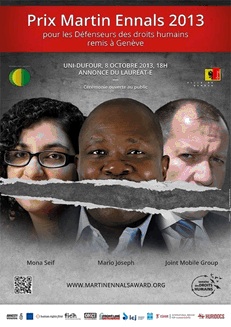
As a reminder, the 3 Final Nominees are: Read the rest of this entry »
Russia: Unprecedented level of harassment against Memorial as “foreign agent”
October 3, 2013The Observatory for the Protection of Human Rights Defenders, a joint programme of the International Federation for Human Rights (FIDH) and the World Organisation Against Torture (OMCT), reports on 2 October 2013 on the ongoing judicial proceedings against the Anti-Discrimination Centre “Memorial” (ADC Memorial), which has now become the first NGO in Russia facing both administrative and civil proceedings for the same “offence” on the basis of the law on so-called “foreign agents”. Read the rest of this entry »
Kyrgyz President says no need for ‘foreign agent law’
September 19, 2013Further to my earlier blog post about Kyrgyzstan following the bad example of Russia in trying to create a ‘foreign agents’ obstacle for human rights defenders, I am happy to refer to Front Line latest update of 19 September 2013 which says that during a press interview on the outcomes of his working visit to Brussels on 17 September 2013, Kyrgyz President Almazbek Atambaev stated to journalists that Kyrgyzstan does not need a “foreign agent” law, a draft bill of which was opened for public discussion on 6 September 2013.
On 16 September 2013, ahead of President Atambaev’s visit to Brussels, Front Line Defenders and Human Rights Watch published a joint letter to the European Union urging EU leaders to raise concerns about human rights abuses in Kyrgyzstan and getting specific commitments from President Atambaev to address them. The letter also contained an appeal to the EU to press the Kyrgyz President for the immediate release of the wrongfully imprisoned human rights defender Azimjan Askarov http://www.hrw.org/news/2010/09/15/kyrgyzstan-free-human-rights-defender-ensure-fair-retrial as well as on the draft bill http://www.frontlinedefenders.org/node/23774. 
Related articles
- Kyrgyzstan follows bad example set by Russia: foreign agents (thoolen.wordpress.com)

