Posts Tagged ‘Reporters without Borders’

African Cartoonists work under pressure

March 30, 2026
Cartoonists under pressure

Laurent Soucaille wrote on 2 March 2026 for the New African Magazine that “African press cartoonists are making greater use of social media. While this allows them to escape certain forms of censorship, they are still subject to threats.

These are difficult times for cartoonists and press caricaturists concludes a report published on 2 March 2026 under the authority of UNESCO and compiled by various press freedom organisations, including Cartooning for Peace and Reporters Without Borders. The report highlights violations of the right to caricature, even in countries that were previously considered ‘free’, foremost among them the United States. Of course, the most serious violations are found in the Middle East, Russia and China, not to mention the specific cases of Gaza and Ukraine. The situation has deteriorated particularly badly in Turkey and India, the authors lament.

In Africa, the situation is more mixed: a multitude of online media outlets have emerged in recent years, opening up new space for cartoonists, while opportunities are becoming scarcer in the traditional press. ‘In addition, many cartoonists have been able to use social media as a means of dissemination, notably by creating memes,’ notes Kenyan journalist Patrick Gathara, himself a cartoonist.

However, he acknowledges that over the past two years, the situation for African cartoonists has become tense, particularly in East and Southern Africa. In Kenya, in December 2024, the mysterious disappearance of Kibet Bull, who was released a month later, ‘marked a dangerous escalation in the state’s response to online reaction’. The case of the cartoonist, who was admittedly not very complimentary towards President William Ruto, ‘fits into a broader context of abductions targeting online influencers during a period of heightened political tension’.

Other cases are symptomatic, such as that of Jimmy Spire, known as ‘Ssentongo’, in Uganda. The cartoonist echoed a campaign denouncing the deterioration of public services in Kampala, attracting both the hostility of the authorities and the support of human rights defenders in his country and in the West. The cartoonist became both an influential civil society actor and a journalist vulnerable to pressure and threats.

The report also mentions Congolese cartoonist Kayene, who died in Rwanda in 2024. ‘His case highlights the precarious situation of cartoonists working across borders in a region where protection frameworks for artists at risk remain weak, informal and unreliable,’ comments Patrick Gathara.

In South Africa, legal and institutional pressures are the main threat. In a country where freedom of expression is protected, cartoonists are less exposed to violence but remain vulnerable to defamation lawsuits, political intimidation, editorial caution or ‘fabricated public outrage’.

This phenomenon affects many countries around the world, where the intended effect of cartoons aimed at a select readership is exaggerated and distorted on social media. ‘It takes a lot of determination to be a satirical cartoonist today. It’s no longer enough to have talent and ideas, you also need the energy to defend them and endure being insulted and vilified by thousands of internet users,’ says Riss, editor-in-chief of Charlie Hebdo, the French satirical weekly magazine.

With regard to North Africa, it is not surprising that the report expresses concern about threats to press freedom, and therefore to cartoonists, in Egypt. ‘Pre-trial detention is becoming a new weapon for the regime to silence those who inform and debate, through the abuse of anti-terrorism laws,’ the report states indignantly.

Across the continent, the document – which does not claim to be exhaustive – summarises three major trends that characterise a ‘rapidly changing’ landscape. First, cartoonists are increasingly seen as political actors. From Kenya to Nigeria to Zimbabwe, ‘the majority of political elites view visual satire as a form of mobilisation rather than commentary’.

As online youth movements organise, cartoons often become ‘symbols of rallying, making cartoonists early and visible targets of repression,’ the report summarises.

Secondly, it notes that ‘soft censorship’ is developing more rapidly than open violence; while kidnappings and threats persist, governments and institutions are increasingly turning to bureaucratic or reputation-damaging tools. These threats relate to accreditations, take the form of investigations by professional bodies, bans and suspensions of newspapers, defamation lawsuits and online smear campaigns. Not to mention very broad interpretations of laws relating to ‘insults’ or ‘cybercrime’. As a result, “these more discreet control mechanisms create a climate of fear and self-censorship while avoiding the scrutiny of the rest of the world, which is more sensitive to physical repression.

Thirdly, the report points out, digital platforms have both increased the reach and the risks. Most African cartoonists now publish mainly on social media. While this allows them to bypass traditional editorial filters, it also exposes them to direct state surveillance, harassment by bots and political control. In this context, ‘virality promotes influence, but also vulnerability’ for press cartoonists.

By publishing mainly on social media, African cartoonists bypass traditional editorial filters, but are nonetheless exposed to direct state surveillance, harassment by bots and political control.

For earlier posts re cartoonists see: https://humanrightsdefenders.blog/tag/cartoons/

Human rights defenders in Greece, my adopted country: not doing well

July 28, 2022
OHCHR | Ms Mary Lawlor

Special Rapporteur on the situation of human rights defenders, Mary Lawlor, conducted an official visit to Greece from 13 to 22 June 2022, to assess the government’s efforts towards creating an enabling environment for those seeking to protect and promote human rights.

Human rights defenders in Greece, particularly those working on migration, operate in an environment of pervasive fear and insecurity, concluded Mary Lawlor. “I am concerned about the increasing criminalization of humanitarian assistance in Greece. Solidarity should never be punished and compassion should never be put on trial,” she said while presenting her preliminary findings at the end of a 10-day mission in the country.

With Greece facing intense international criticism over unlawful pushbacks of migrants at its borders and wider human rights concerns related to migration and asylum, the Greek government has moved to silence groups and individuals documenting these abuses. While acknowledging Greece’s migration challenges and government efforts to address them, Lawlor criticized burdensome rules for the registration of nongovernmental organizations working on migration, introduced in 2019, calling them discriminatory and in violation of Greece’s international human rights obligations. See my earlier: https://humanrightsdefenders.blog/2021/11/17/greeces-mistaken-deterrence-migrants-and-aid-workers-facing-heavy-prison-sentences/

The UN expert noted that human rights defenders not only face criminal sanctions for their activities, but are operating in an increasingly hostile environment where the general public is influenced by negative rhetoric from high-ranking officials and their unfavorable portrayal in the media, which often conflates their activities with traffickers and criminal networks.

Greece fell 38 positions within a year in Reporters Without Borders’ 2022 report on the Press Freedom Index, with the organization marking it the lowest-ranked European Union country for press freedom. “Journalists who counter the government’s narrative on the management of migration flows are often under pressure and lack access to mainstream media outlets.… Journalists reporting on corruption are sometimes facing threats and even charges,” Lawlor said. She noted that journalists have very limited or no access to facilities where migrants, refugees, and asylum seekers are being held, further contributing to a general lack of transparency regarding the government’s policies in this area.

See also: https://humanrightsdefenders.blog/2022/02/18/greek-court-fails-human-rights-defenders-on-antisemitism/

Lawlor will present a detailed report with her findings at the March 2023 session of the UN Human Rights Council. The government should listen to what the UN expert has to say and champion human rights defenders. The European Commission, which noted in July last year the narrowing space in Greece for groups working with migrants and asylum seekers, should step up its engagement on the issue and press Greece to stop harassing civil society groups and activists.

https://www.ohchr.org/en/media-advisories/2022/06/un-human-rights-expert-visit-greece-assess-situation-human-rights

https://www.ohchr.org/en/press-releases/2022/06/greece-migration-policy-having-suffocating-effect-human-rights-defenders

https://www.amnesty.org/en/location/europe-and-central-asia/greece/report-greece/

see also later:

https://www.theguardian.com/world/2022/aug/31/greece-should-face-more-checks-over-asylum-seeker-treatment-eu-official

https://www.theguardian.com/world/2022/aug/31/i-was-close-to-death-syrian-man-tells-how-greek-officials-pushed-refugees-back-out-to-sea

And on 7 November : https://www.hrw.org/news/2022/11/07/greeces-surveillance-scandal-puts-rights-risk

and then: https://www.hrw.org/news/2023/03/16/un-expert-slams-greece-over-civil-society-curbs

3 May 2022 – World Press Freedom Day: a lot to report

May 7, 2022

This day is one on which the world stands still to think about press freedom and journalists who are persecuted. I want to start with some quotes from an excellent piece in the Economist on 2 May by Indian reporter Rana Ayyub who wonders whether plaudits such as “brave” normalise their persecution:

When a journalist is killed or incarcerated or assassinated, obituaries scream bravado, editorials claim courage. Have such plaudits normalised the persecution of journalists? Why does a journalist have to be brave to report facts as they are? Why does she need to be persecuted for her story to reach the world? Consider Gauri Lankesh, Daphne Caruana Galizia and Jamal Khashoggi—all journalists with a profile, all brazenly killed in broad daylight. Their murders dominated the front pages of international publications. But their killers, men in power, remain unquestioned not just by the authorities but often by publishers and editors who develop a comfortable amnesia when meeting those in power. They do not want to lose access to them.

“Journalists are the new enemy of the state; we are going through one of the toughest phases in the history of the profession. We document the truth at a time marked both by a voracious demand for news and by the persecution of minorities, genocide and war crimes. We witness savage attacks on minorities in India, Myanmar, China, Palestine or Ukraine even as bumbling editors still frame arguments and narratives through the prism of “‘both sides”. For example attacks on Palestinians, even during Ramadan, are often referred to as “clashes”. Despite one side having grenades thrown at them, and pelting stones in defence, the lens of the mainstream media remains firmly aligned with the oppressor. In India attacks on Muslims by Hindu nationalists often are reported as “riots” or “clashes”, too. The distinction between oppressor and oppressed can be blurred as convenient“….

Journalism was never a nine-to-five profession. We knew it was an unconventional calling, and one where we might not leave the office for days, or where our families might have no communication from us as we report on crucial investigations, wars and undercover operations. Journalism schools taught us the ethics of our profession, but they did not warn us about nervous breakdowns, or about spending more time in courtrooms than newsrooms. We owe it to the next generation of journalists to create a safer environment in which to work. They should fear only the distortion of truth, never reporting the truth itself.

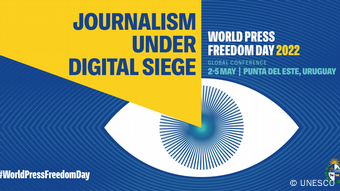
At the Global Conference for World Press Freedom Day, May 2-5 in Uruguay, DW Akademie hosted a panel on digital authoritarianism. International media experts (Nanjala Nyabola, Laís Martins, Vladimir Cortés Roshdestvensky and Annie Zaman) discussed fighting disinformation and censorship.

Digital authoritarianism – when governments assert power and control information using digital tools and the internet – disrupts journalism and can endanger reporters and human rights defenders.

 UNESCO Logo World Press Freedom Day Conference 2022, Uruguay

Regardless of recognition of press freedom under international legislations and under state constitutional provisions, the attack on journalists and ultimately on access to information remains a growing concern. According to the UN, 55 journalists were killed in 2021, while 62 of them were killed in 2020. A number of global networks of journalists have led the work of advocating press freedom and provide a platform for journalists to fight such state and non-state actors in unison.

Mid-day.com lists some of the major networks: https://www.mid-day.com/amp/lifestyle/culture/article/press-freedom-day-five-global-journalist-networks-that-advocate-press-freedom-23225560

Network of Women in Media, India (NWMI)

The NWMI is a network of over 600 women journalists across India providing a space or a forum for women in Indian media to come together and share information, exchange ideas, discuss media ethics and promote gender equality in media. The collective aims to provide a holistic system to support women journalists in terms of space, resources and access to justice in case of rights violations. It also works for getting recognition, fair pay and decent working conditions for women independent journalists in the country. https://nwmindia.org/

International Federation of Journalists (IFJ)

IFJ is a Paris-based organisation representing as many as 6,00,000 media professionals across 140 countries. The collective works to strengthen labour rights of journalists and advocates for their fair pay, decent working conditions and gender equality in media recruitment at a global level. One can access records and data documented by IFJ through their campaigns focusing on violence against journalists, impunity to the perpetrators and countries where media freedom is curbed through state laws or private entities.

https://www.ifj.org/who/about-ifj.html

Reporters Sans Frontiers or Reporters without Borders (RSF)

With 115 correspondents across the world, RWB is a non-profit organisation started by four journalists and headquartered in Paris. RWB is known for its annual Press Freedom Index, one of the most credible indicators of the status of media freedom in over 180 countries of the world. In addition to this, RWB also tracks censorship activities and various kinds of abuse that journalists are subjected to and communicates the information in five different languages. RWB works in cooperation with international rights based organisations to further recommendations to the state in order to provide legal and material resources for journalists and advocate their safety as media personnel.

https://rsf.org/en/who-are-we

Committee to Protect Journalists (CPJ)

CPJ is known for its Global Impunity Index analysing the state impunity provided to murderers of journalists in democracies as well as in war-torn countries. As an independent and non-profit organisation based in New York City, CPJ documents attacks on journalists and the subsequent press freedom violations and works with the state actors to provide rapid response assistance, legal support and other resources to journalists in danger.

https://cpj.org/news/

Article 19

Article 19 mainly works to improve access to information, protect the civic spaces to discuss and dissent and strengthen human rights in the digital space too. Its key areas of work include information, censorship, gender and sexuality, freedom of religion and belief, equality and hate speech and media freedom among others. In line with its objectives to create a safe space for free flow of information, the organisation channelises its resources for the protection of journalists and human rights defenders. Article 19’s annual Global Expression Report and GxR metric provides a detailed picture of the condition of freedom of expression across the world. https://www.article19.org/about-us/

Media Defence

Media Defence’s focus lies on providing legal advice, support and resources to journalists, independent journalists and citizen journalists, who are under threat for their reportage and enable them to carry out reporting on issues of larger public interest. An international human rights organisation, in addition to documenting cases, it also intervenes to provide legal recourse to the journalists undergoing trial. https://www.mediadefence.org/legal-resources/

And of course – marking World Press Freedom Day, Reporters Without Borders (RSF) published their 2022 World Press Freedom Index that indicates a two-fold increase in polarization exacerbated by information disorder — that is, media polarization fuelling divisions within countries, as well as polarization between countries at the international level. See: https://rsf.org/en/index

Within democratic societies, divisions are growing as a result of the spread of opinion media following the ‘Fox News model’ and the spread of disinformation circuits that are amplified by the way social media functions,” the watchdog said in a statement.

At the same time, the disparity between open societies and autocratic governments that dominate their media and online platforms while waging propaganda campaigns against democracies is eroding democratic institutions around the world. Therefore, the polarization on different levels is fuelling increased tensions, according to RSF.

Assessing the state of journalism in 180 countries and territories worldwide, the World Press Freedom Index showed how the crisis in the world reflects on the media.

See also: https://humanrightsdefenders.blog/2020/05/03/world-press-freedom-day-2020-a-small-selection-of-cases/ and https://humanrightsdefenders.blog/2020/05/04/world-press-freedom-day-2020-a-few-more-links/

https://www.economist.com/by-invitation/2022/05/02/rana-ayyub-says-we-should-stop-calling-journalists-brave

https://www.dw.com/en/world-press-freedom-day-panel-how-to-counter-digital-authoritarianism/a-61554434

https://www.mid-day.com/amp/lifestyle/culture/article/press-freedom-day-five-global-journalist-networks-that-advocate-press-freedom-23225560

https://www.occrp.org/en/daily/16279-2022-world-press-freedom-index-warns-on-news-chaos-media-polarization

NGOs demand EU to impose sanctions on NSO Group

December 7, 2021

Dozens of rights groups are urging the European Union to impose sanctions on the Israeli NSO Group to ban the company’s Pegasus surveillance technology. The letter sent to the EU was signed by 86 rights groups and independent experts, including Reporters Without Borders, Amnesty International, Human Rights Watch, the Electronic Frontier Foundation and Privacy International, among others. A consortium of media revealed that this powerful spyware was used extensively by several governments to spy on lawyers, journalists, political opponents and human rights activists.

Several victims of illegal surveillance have been identified in Hungary, where the government initially denied being a client of NSO Group, before admitting to having purchased the software. See also: https://humanrightsdefenders.blog/2021/11/10/palestinian-ngos-dubbed-terrorist-were-hacked-with-pegasus-spyware/

A good resource is here: https://www.haaretz.com/israel-news/MAGAZINE-nso-pegasus-spyware-file-complete-list-of-individuals-targeted-1.10549510

Several victims of illegal surveillance have been identified in Hungary, where the government initially denied being a client of NSO Group, before admitting to having purchased the software. See also:

There is overwhelming evidence that Pegasus spyware has been repeatedly used by abusive governments to clamp down on peaceful human rights defenders, activists and perceived critics,” Deborah Brown, senior digital rights researcher and advocate at Human Rights Watch, said in a statement. “The EU should immediately sanction NSO Group and ban any use of its technologies.”

The EU’s global human rights sanctions would allow the EU to adopt “ “targeted sanctions against entities deemed responsible for violations or abuses that are “of serious concern as regards the objectives of the common foreign and security policy”, including violations or abuses of freedom of peaceful assembly and of association, or of freedom of opinion and expression,” the letter read.

According to Human Rights Watch, these rights have been “repeatedly violated using NSO technology,” and, as highlighted by the UN Special Rapporteur on freedom of opinion and expression, “the use of spyware by abusive governments can also facilitate extrajudicial, summary or arbitrary executions and killings, or enforced disappearance of persons.” See also: https://humanrightsdefenders.blog/2021/10/04/big-coalition-urges-un-to-denounce-abuses-facilitated-by-spyware-technologies/

NSO Group was blacklisted by the US State Department at the beginning of November, and slapped with a sanction that drastically limited the business relationships the US company had with US customers or suppliers, according to the French newspaper Le Monde. “The EU should unequivocally close its doors to business with NSO Group,” Brown said.

“Targeted sanctions are necessary to that end, and to add to growing international pressure against the company and the out-of-control spyware industry.”

In Europe, several investigations are ongoing, but no sanctions have been formally imposed on the company. In addition to Hungary, several other countries are, or have been, customers of NSO Group – although this does not mean that all these countries have made illegal use of Pegasus.

In addition to Germany, several EU countries have purchased access to the software, according to Le Monde.

See also: https://www.haaretz.com/israel-news/tech-news/.premium.HIGHLIGHT.MAGAZINE-citizen-lab-vs-nso-the-institute-taking-down-israel-s-mercenary-spyware-firms-1.10536773

https://slate.com/technology/2021/12/apple-lawsuit-nso-group-q-cyber-pegasus.html

https://www.euronews.com/next/2021/12/03/pegasus-spyware-ngos-urge-the-eu-to-sanction-israeli-group-nso

And the latest: https://marketresearchtelecast.com/spyware-sale-at-nso-group-the-end-of-pegasus/226205/

as well as

https://www.irishtimes.com/news/ireland/irish-news/concern-activist-s-phone-infected-with-spyware-during-dublin-conference-1.4778962

in 2022 the following items can be added:

https://www.hrw.org/news/2022/01/26/human-rights-watch-among-pegasus-spyware-targets

https://thewire.in/tech/nso-chairman-quits-says-departure-unrelated-to-recent-scandals

World Press Freedom Index 2021 is out

April 24, 2021

The 2021 World Press Freedom Index compiled by Reporters Without Borders (RSF) shows that journalism, the main vaccine against disinformation, is completely or partly blocked in 73% of the 180 countries ranked by the organisation.

This year’s Index, which evaluates the press freedom situation in 180 countries and territories annually, shows that journalism, which is arguably the best vaccine against the virus of disinformation, is totally blocked or seriously impeded in 73 countries and constrained in 59 others, which together represent 73% of the countries evaluated. These countries are classified as having “very bad,” “bad” or “problematic” environments for press freedom, and are identified accordingly in black, red or orange on the World Press Freedom map. To compare with last year, see: https://humanrightsdefenders.blog/2020/04/21/2020-world-press-freedom-index-is-out/

The Index data reflect a dramatic deterioration in people’s access to information and an increase in obstacles to news coverage. The coronavirus pandemic has been used as grounds to block journalists’ access to information sources and reporting in the field. Will this access be restored when the pandemic is over? The data shows that journalists are finding it increasingly hard to investigate and report sensitive stories, especially in Asia, the Middle East and Europe.

The 2021 Edelman Trust barometer reveals a disturbing level of public mistrust of journalists, with 59% of respondents in 28 countries saying that journalists deliberately try to mislead the public by reporting information they know to be false. In reality, journalistic pluralism and rigorous reporting serve to combat disinformation and “infodemics”, including false and misleading information.

Journalism is the best vaccine against disinformation,” RSF secretary-general Christophe Deloire said. “Unfortunately, its production and distribution are too often blocked by political, economic, technological and, sometimes, even cultural factors. In response to the virality of disinformation across borders, on digital platforms and via social media, journalism provides the most effective means of ensuring  that  public debate is based on a diverse range of established facts.”

For example, President Jair Bolsonaro of Brazil (down 4 at 111th) and President Nicolás Maduro of Venezuela (down 1 at 148th) promoted medically unproven Covid-19 remedies. Their false claims were debunked by investigative journalists at media outlets such as Brazil’s Agência Pública and in-depth reporting by Venezuela’s few remaining independent publications. In Iran (down 1 at 174th), the authorities tightened their control over news coverage and stepped up trials of journalists in order to weaken the media’s ability to scrutinise the country’s Covid-19 death toll. In Egypt (166th), President Abdel Fattah Al-Sisi’s government simply banned the publication of any pandemic statistics that didn’t come from the Ministry of Health. In Zimbabwe (down 4 at 130th), the investigative reporter Hopewell Chin’ono was arrested shortly after helping to expose the overbilling practices of a medical equipment supply company.

Biggest movements in the Index

Norway is ranked first in the Index for the fifth year running even though its media have complained of a lack of access to state-held information about the pandemic. Finland maintained its position in second place while Sweden (up 1 at 3rd) recovered its third place ranking, which it had yielded to Denmark (down 1 at 4th) last year. The 2021 Index demonstrates the success of these Nordic nations’ approach towards upholding press freedom.

The World Press Freedom map has not had so few countries coloured white – indicating a country situation that is at least good if not optimal – since 2013, when the current evaluation method was adopted. This year, only 12 of the Index’s 180 countries (7%) can claim to offer a favourable environment for journalism, as opposed to 13 countries (8%) last year. The country to have been stripped of its “good” classification is Germany (down 2 at 13th). Dozens of its journalists were attacked by supporters of extremist and conspiracy theory believers  during protests against pandemic restriction….The country that fell the furthest in 2021 was Malaysia (down 18 at 119th), where the problems include a recent “anti-fake news” decree allowing the government to impose its own version of the truth. Big descents were also registered by Comoros (down 9 at 84th) and El Salvador (down 8 at 82nd), where journalists have struggled to obtain state-held information about the government’s handling of the pandemic.

https://rsf.org/en/2021-world-press-freedom-index-journalism-vaccine-against-disinformation-blocked-more-130-countries

Worries about RSF Laureate Pham Doan Trang jailed in Vietnam

April 8, 2021

Reporters without Borders (RSF) learned of the arrest exactly six months ago of Pham Doan Trang, a well-known Vietnamese journalist, was arrested at her Ho Chi Minh City home by plain-clothes policemen last October. There’s been no news of her since then. She’s not been allowed to talk to a lawyer or her family and she is facing up to 20 years in prison on a charge of “anti-state propaganda.”

Pham Doan Trang has been awarded the RSF Press Freedom Prize in 2019 and the Homo Homini award in 2017 [see: https://www.trueheroesfilms.org/thedigest/laureates/fe8bf320-1d78-11e8-aacf-35c4dd34b7ba]
 
As she completed her sixth month in detention, several RSF Press Freedom Prize  laureates recorded video messages expressing their support for her in order to help draw international attention to her fate. All of them called for her immediate and unconditional release by the Vietnamese authorities. She continues to be held by the Vietnamese authorities and is exposed to the possibility of further acts of torture. We now fear the worst for her and we urge you to sign the #FreePhamDoanTrang petition demanding her release. Let’s save one of Vietnam’s most respected journalists. Every signature counts: SIGN THE PETITION

https://mailchi.mp/rsf.org/phamdoantrang-6months?e=2f43be35bd

RSF publishes end of year round-up of journalists detained, held hostage and missing in 2020

December 15, 2020

The number of detained journalists is still at a historically high level. Worldwide, a total of 387 journalists were held in connection with the provision of news and information at the start of December 2020, compared with 389 at the start of December 2019. This lack of variation follows a 12% rise in 2019. Overall, the number of detained (professional and non-professional) journalists has risen 17% in the past five years (from 328 in 2015).

3 journalists remain missing including Ibraimo Mbaruco, a reporter for Rádio Comunitária de Palma, a community radio station in Palma, a remote coastal town in northeastern Mozambique’s Cabo Delgado province, who has has been missing since 7 April 2020. In his last message, he said he was “surrounded by military.” His family has not seen or heard from him since then and nothing has been said by the Mozambican authorities, who try to prevent any media coverage of the attacks by Islamist insurgents that are common in that part of the province.

See also: https://humanrightsdefenders.blog/2020/04/21/2020-world-press-freedom-index-is-out/

Four Yemeni journalists under Houthi death sentence

July 21, 2020

As four Yemeni journalists continue to wonder when or whether the Houthi authorities will execute the death sentences they received in April on spying charges, Reporters Without Borders (RSF) calls for international pressure to make the Houthis understand that they will suffer international opprobrium if they do not overturn the sentences.

Before being abducted by the Houthis in 2015, the four journalists played leading roles in a Sanaa-based network of media outlets and Facebook, Twitter, YouTube, Telegram and WhatsApp pages linked to Al-Islah, the Yemeni branch of the Muslim Brotherhood and ruling party in regions controlled by Yemen’s internationally recognized government.

Abdul Khaleq Amran edited the Al-Islah Online website and ran Yemen Revolution Press, a news agency created from several media outlets in 2011. His staff covered the Yemeni civil war, documented crimes committed by the Houthis and interviewed the Houthis’ opponents.

Akram Al-Walidi supervised the staff of the Alrabie-ye.net news website and the government news agency SABA. He gathered information about developments in the fighting from the Al-Islah side, on the basis of reliable sources and with the help of a network of senior political and administrative officials then based in Ma’rib, which was established as the new capital after the Houthi rebels seized Sanaa.

Hareth Humaid, the head of news at Yemen Revolution Press, covered Houthi human rights violations, including abductions and bombardments of civilians. He produced a daily news bulletin with the latest violations. Its last issue was No. 54.

Tawfiq Al-Mansouri worked for the daily newspaper Al-Masdar until it stopped publishing when the Arab coalition intervened in 2015. He then joined Yemen Revolution Press doing layout and graphic design and helping to give form to the various media outlets linked to the agency.

After their abduction in 2015, the four journalists were secretly moved from one prison to another in Sanaa and were subjected to violent interrogations. Torture and repeated blows left all of them with severe physical and psychological aftereffects, according to the Association of Abductees’ Mothers. Amran has a slipped disc. Humaid has suffered loss of vision and has constant migraines. Walidi has chronic digestive problems.

“Every year the world moves one step closer to the universal abolition of the death penalty, but these four veteran journalists are facing the worst of all sentences just for doing their job,” RSF secretary-general Christophe Deloire said.

“Efforts are urgently needed to end their nightmarish plight and return to humanitarian principles in a country where journalists have already paid a heavy price in the war. The Houthis must overturn this decision or face international opprobrium. We ask all those who may have any influence, direct or indirect, on the Houthis to use it to help bring this madness to an end.”

The four were among a total of ten journalists abducted by the Houthis in Sanaa in 2015 on the absurd grounds that they could potentially provide the Arab coalition with information for use in its air strikes. Accused of “collaborating with the enemy,” they were tried by a Houthi Special Criminal Court that is not recognized by the international community.

In its latest annual round-up, RSF reported that a total of 15 journalists were being held hostage in Yemen, most of them by the Houthis. The others were either being held in provinces controlled by the so-called “legitimate government” (such as Muhammad Ali Al-Moqri) on in areas controlled by separatists (such as Saleh Musawa, who has since been released).

As RSF also reported in the 2019 round-up, the conditions in Yemen are nowadays so bad that many journalists have abandoned journalism and have switched to other forms of work. Yemen is ranked 167th out of 180 countries in RSF’s 2020 World Press Freedom Index. See also: https://humanrightsdefenders.blog/2020/05/04/world-press-freedom-day-2020-a-few-more-links/

https://rsf.org/en/news/who-are-four-yemeni-journalists-under-houthi-death-sentence

#HoldTheLine Coalition comes out for Maria Ressa

July 11, 2020

On behalf of the #HoldTheLine Coalition, Reporters Without Borders (RSF), the Committee to Protect Journalists (CPJ), and the International Center for Journalists (ICFJ) are calling for public support for Maria Ressa and independent media in the Philippines.

On 15 June 2020, Ressa was convicted of “cyber-libel,” alongside former Rappler colleague Reynaldo Santos Jr — a criminal charge for which they face up to six years in prison. [see: https://humanrightsdefenders.blog/2020/06/15/ressas-cyber-libel-conviction-in-the-philippines-shocks/

Ressa and Santos could be imprisoned if the cyber-libel case is not overturned on appeal.  Ressa is facing at least six other cases and charges. Guilty verdicts in all of these cases could result in her spending nearly a century in jail.  

Rappler is also implicated in most of these cases, with several involving criminal charges related to libel, foreign ownership, and taxes.  For independent media in the Philippines, these targeted attacks and legal threats pose a clear and present danger to press freedom.

As a matter of urgency, please sign this petition calling on the Philippine government to drop all cases against Ressa, Santos, and Rappler and cease attacks on independent media in the country. Share this appeal using the #HoldTheLine hashtag!

Credit image : Maria TAN / AFP

I sign the petition

https://rsf.org/en/free-mariaressa

World Press Freedom Day 2020 – a few more links

May 4, 2020

Yesterday’s post [https://humanrightsdefenders.blog/2020/05/03/world-press-freedom-day-2020-a-small-selection-of-cases/ ] is already in need of updating. Here a few more examples of what happened on World Press Freedom Day:

—-

Reporters Without Borders (RSF) published exclusive interviews by Philippine journalist Maria Ressa with Washington Post columnist Rana Ayyub, whistleblower Edward Snowden, Nobel economy laureate Joseph Stiglitz and RSF secretary-general Christophe Deloire on the subject of “Journalism in crisis: a decisive decade.”
—-

Deutsche Welle’s Freedom of Speech Award honors journalists persecuted for coronavirus reporting

Deutsche Welle is presenting journalists from four continents with this year’s Freedom of Speech Award for their coverage of the coronavirus crisis. The recipients are being honored on behalf of all media professionals around the world who are publishing independent information about the coronavirus pandemic while working under difficult conditions. [see also: https://humanrightsdefenders.blog/2016/06/10/dw-freedom-of-speech-award-goes-to-turkish-%e2%80%b2hurriyet%e2%80%b2-journalist-sedat-ergin/#more-8152]

At a moment of a global health emergency, journalism serves a crucial function, and each journalist bears great responsibility,” DW Director General Peter Limbourg said while announcing the award winners in Berlin. “Citizens of any country have the right of access to fact-based information and critical findings,” he said. “Any form of censorship may result in casualties and any attempts to criminalize coverage of the current situation clearly violate the freedom of expression.” For a list of this year’s laureates, see: https://www.dw.com/en/deutsche-welle-freedom-of-speech-award-17-laureates-from-14-countries/a-53306033

Michelle Bachelet, the UN high commissioner for human rights, said in a video message to the journalists honored that the general public needs “full and accurate information about the pandemic, and to be involved in the decisions that are being made on our behalf.” The International Press Institute documented more than 150 violations of press freedom worldwide through the end of April. The IPI has tracked cases of censorship and restrictions on access to information — but the greatest number of violations of press freedom have been arrests of journalists and verbal or physical attacks on them. (https://www.dw.com/en/un-commissioner-michelle-bachelet-honors-journalists/av-53297637)

——

SNHROn the occasion of World Press Day, the Syrian Network for Human Rights (SNHR) issued a report demanding the release of 422 citizen journalists in Syria, most of whom are detained by the Syrian regime, and are now threatened by the COVID-19 pandemic. The report notes that 707 citizen journalists have been killed since March 2011 to date, 78% of them by Syrian Regime forces. The 20-page report shows how the Syrian regime has been well aware of the danger posed by press freedom to its tyrannical rule for decades, abolishing all independent newspapers, and allowing only three official newspapers to be published, which are simply Syrian regime mouthpieces, dedicated to promoting, defending and justifying the regime’s actions. As the report further notes, it’s no exaggeration but simply a statement of fact to say that there is no such thing as a free press under the Syrian regime…..The report distributes the total death toll according to the main parties to the conflict, with the Syrian regime being responsible for the deaths of 551 citizen journalists, including five children, one woman, five foreign journalists, and 47 other citizen journalists due to torture in detention centers, while Russian forces were responsible for the deaths of 22 citizen journalists, and ISIS killed 64, including one child, two women, three foreign journalists, and three under torture. Hay’at Tahrir al Sham also killed eight, including two who died due to torture. Factions of the Armed Opposition were responsible for the deaths of 25 citizen journalists, including one child and three women.

View full Report