Posts Tagged ‘Philippines’

Filipino nun wins Weimar human rights award 2015 for fight against mining excesses

August 11, 2015

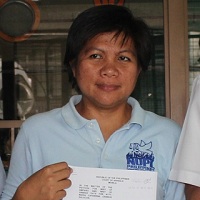
<p>Sister Stella Matutina explains the threats of large-scale mining in Mindanao during a conference in Manila in early August. (Photo by Leon Dulce)</p>

Sister Stella Matutina explains the threats of large-scale mining in Mindanao during a conference in early August (Photo by Leon Dulce)

A Benedictine nun, Stella Matutina, is the recipient of Germany’s “Weimar Award for Human Rights” 2015 for her anti-mining advocacy in the southern Philippine region of Mindanao.

Sister Stella Matutina has been recognized for “[engaging] herself extraordinarily for the rights of the native population, despite being exposed to permanent threats to her safety due to her engagements”. “This highlights the situation of Mindanao and the Philippines in general where the poor, the farmers, the indigenous peoples, the human rights activists and defenders of the environment endure harassment and face risks and death,” the 47-year-old nun told ucanews.com (Jefry Tupas, 7 August 2015) . More than a personal recognition, Matutina said the award acknowledges the “collective sacrifices” of freedom and environment defenders in the face of a “systematic effort to limit democratic space and security threats”.

Matutina has been a vocal opponent of attempts to convert the farmlands in Mindanao to plantation crops like palm oil, pineapples, and bananas. She has also led a campaign against the entry of large-scale mining companies in tribal communities in Mindanao. In 2012, the Philippine military labeled Matutina a “fake nun” and accused her of being a communist New People’s Army guerrilla. In 2009, soldiers detained Matutina and two other anti-mining activists in the town of Cateel in Mindanao for giving a lecture on environmental awareness to residents of an upland village. Early this year, authorities charged Matutina, other Church leaders and human rights activists with kidnapping, human trafficking, and illegal detention for taking care of displaced tribal people in the provinces of Davao del Norte and Bukidnon.

These are proof that helping the oppressed, the poor, the abused comes with great risks,” said Matutina, chairwoman of the Sisters Association of Mindanao and secretary-general of the environment protection group Panalipdan.

Since 1995, the Weimar Award has honored individuals or groups engaged in the fight for freedom and equality, the prevention and condemnation of genocide, the right to free speech, and the respect and preservation of political, ethnic, cultural and religious rights of minorities, among others. The award comes with a 2500,00 Euro stipend.

The same Weimar Human Rights Award went in 2000 to Father Shay Cullen of the Peoples Recovery Empowerment Development Assistance (PREDA) Foundation for his work defending the rights of children and women, victims of human trafficking, sexual abuse and exploitation in the Philippines.

via Filipino nun wins German human rights award ucanews.com.

worth noticing also is the language of Radio Vatican used in its own announcement:

http://en.radiovaticana.va/news/2015/08/07/philippine_nun_honoured_with_german_human_rights_award/1163662

Woman human rights defender Mary Jane Real from the Philippines

May 14, 2015

As part of the series “THE WOMEN WHO DEFEND HUMAN RIGHTS”, published by Protection International, here is Mary Jane Real from the Philippines:

DSC_0060 - Copy

PI: Can you tell us a bit about how you have become a woman human rights defender?

MJR: I´ve been active in defense of human rights and women´s rights since I was a student… Around 2005, I started working with women human rights defenders (WHRDs) and became familiar with the term. At the time, Hina Jilani [former UN Special Rapporteur on human rights defenders] helped to create the Women Human Rights Defenders International Coalition (WHRD IC) of which I became the coordinator. That’s how I formally transitioned into a WHRD. You can call yourself any name, but I personally find it strategic to call myself a human rights defender. Rather than talk about human rights in relation to people you advocate for or the communities you work with, the term ‘defender’ acknowledges that as an activist you also have rights that you can claim and assert for. I believe that’s critical, especially in the face of political repression and other challenges that are faced by defenders.

PI: What is the added value of having the word ‘woman’ in the term ‘woman human rights defender’?

MJR: I think, for myself, it’s important to claim that label. Gender inequality is structural and therefore, even within the human rights movement, you cannot take it for granted that women’s rights are already implicated in the term ‘human rights defender.’

One major challenge for WHRDs is dealing with lack of recognition. Even if women hold leadership positions, they still struggle to be acknowledged in the public space as critical actors. Linked to this lack of recognition is the issue of the protection that you need to do your work. To be acknowledged as a defender implies that you deserve protection and support. Unless a woman defender is recognised as a legitimate activist and defender of human rights, protection and support will always be one step remote from the risks that she faces. So, to add the word ‘woman’ to the term ‘woman human rights defender’ helps to ensure that protection of and support for women human rights defenders is in place.

PI: What are the main challenges that you and other women human rights defenders from the Philippines have to deal with? 

MJR: The Philippines is still a predominantly Catholic country with a government that is towing the line of the Catholic Church. One of the main issues that women human rights defenders are working on in the country is the issue of reproductive rights. If a country would value reproductive rights as part of women’s rights, there would not be a pressing need for WHRDs to work on the issue. However, today we still see stigmatisation and defamation (for example, publicly calling these women bad mothers and many other defamatory labels to try to ruin their reputation) as two common violations of the rights of WHRDs in the Philippines due to resistance from the Catholic Church.

I have noticed that the level of threats received by women defenders in the Philippines is not as high in, say, Latin America. The risks might not be as alarming as being arrested or getting killed. As a consequence, the public doesn’t realise that what happens in the Philippines are actually human rights violations and that the issue needs to be addressed.

LM: How should this issue be addressed? 

MJR: Well, one consideration in addressing the violations of the rights of women defenders should be the psychological implications. The psychological impact of these violations are not picked up in any of the urgent appeals or other documentation. Yet, if you talk to these women, they often talk about being burned out, about desperately trying to see family, about their struggle to balance their personal life and their wish to defend their rights. These psychological implications are not addressed at all.

PI: What would different forms of protection include?

MJR: Firstly, we cannot say that one can only be a human rights defender when they’re at risk. Secondly, when we respond to their risk, when can’t just focus on physical forms of risks and threats. The psychological aspects have just as much of an impact on the defenders and we need to respond to this aspect as well.

I think a better form of protection would look at all these different aspects of risks, physical and psychological, reactive and preventive, and protection for the short and the long term. For many of the women defenders, this also means protection for their families. In their case, often they’re expected to take care of the children.

PI: Do you think there is a role for the government in protection of women human rights defenders? Through a public policy, for example? 

MJR: Definitely, but I also think there is still a long way to go before we get there, particularly in Southeast Asia. The ASEAN Intergovernmental Commission on Human Rights (AICHR) is more focused on promotion of human rights than on protection of human rights. This translates into a policy of non-intervention among member states.

It is therefore not surprising that the AICHR has not issued any statement on human rights issues involving states and that they have been reluctant in developing protection and redress mechanisms for human rights violations. As an intergovernmental body, AICHR reflects the human rights culture of the governments in Southeast Asia. That culture is not yet as robust and vibrant as in countries in Europe. There is an important role for civil society to advocate for governments to make protection part of state accountability.

PI: Is there anything that you would like to see changed for the next generation defenders?

MJR: I wouldn’t want the next generation to experience the same level of inequality that I have experienced in my lifetime, and my mother has experienced in her lifetime. I don’t want them to inherit those forms of discrimination and be apologetic about the fact that they are women defending human rights. I want them to be proud of the fact that they defend human rights and claim that space as a woman human rights defender.

The Women Who Defend Human Rights – Mary Jane RealProtection International.

Human Rights Defenders in the Philippine embrace info-tech for human rights

January 27, 2015

Human rights defenders in the Philippines have been using information technology to advance their advocacy work.  Launched in 2011, the human rights website http://www.hronlineph.com started by Egay Cabalitan and Jerbert Briola is used by human rights defenders for updates on most recent social issues in the country. The website has produced a video featuring testimonies from various advocacy groups – medical, anti-mining, human rights defenders, and international support NGOs – on the usefulness of the website.

Recently HRonlinePH launched two videos about human rights and internet rights now shared on social media outlets.

https://www.youtube.com/watch?v=gu_E0C2bPDQ
https://www.youtube.com/watch?v=FPslUqomztU

Human rights defenders fully realize the potential of video to bring about change, And this video, a groundbreaking information tool for the HRonlinePH, is a supportive infrastructure how we can harness the power of technology and to help realize our shared interests in promoting and defending human rights, offline and online,” Human Rights Online Philippines said.

Featured in one of the videos are human rights defenders from Alyansa Tigil Mina (ATM), Asian Forum for Human Rights and Development (FORUM ASIA), Coalition Against Trafficking in Women, Asia-Pacific (CATW-AP), Medical Action Group (MAG), Partido ng Manggagawa (PM), Philippine Alliance of Human Rights Advocates (PAHRA) and Philippine Movement for Climate Justice (PMCJ).

Group takes a ride on info-tech for human rights advocacy | SciTech | GMA News Online.

Human rights lawyers and indigenous people in the Philippines endangered

January 24, 2015

Human rights lawyers and their clients stage a picket at the Supreme Court to mark the ‘Day of the Endangered Lawyer’ (photo courtesy of NUPL)

Human rights lawyers in the Philippines on Friday 23 January 2015 protested publicly against the growing death toll within their ranks as they marked the “Day of the Endangered Lawyer” by trooping to the Supreme Court. The protest spearheaded by the National Union of Peoples’ Lawyers [NUPL] and joined by the Integrated Bar of the Philippines was joined by lawyers’ and support groups that staged pickets or held dialogues at Philippine embassies and consulates in 23 cities in 11 European countries.

Figures show that, since attacks on legal professionals began being recorded in 1977, “100 lawyers have been attacked (57 since 2001) while 50 lawyers have been killed (41 since 2001).” “Nineteen judges have been murdered, 18 since 2001”

Government must simply do its job: protect its citizens, categorically condemn these attacks on lawyers as human rights defenders; seriously and credibly investigate, prosecute and punish the perpetrators; and uphold human rights because the attacks on lawyers is not only an attack on the individual lawyer, it is an attack on the legal profession, and most fundamentally — in the context of the targeted assaults on human rights and public interest lawyers — an attack itself on the rights and interests of the mostly poor and oppressed in our country” 

http://www.interaksyon.com/article/103685/a-deadly-profession–human-rights-lawyers-count-the-costs-on-day-of-the-endangered-lawyer

A petition <http://www.advocatenvooradvocaten.nl/wp-content/uploads/Petition-Day-of-Endangerd-Lawyer-2015.pdf> signed by lawyers organizations from Asia, Canada Europe and the United States  calls on the Aquino government  to prevent extrajudicial killings and all forms of harassment of lawyers and to end impunity by prosecuting perpetrators of rights violations. The petition also calls on the Aquino government  to protect the safety of lawyers as provided for in the Basic Principles on the Role of Lawyers adopted by the General Assembly of the United Nations in 1990.  Underlying causes for extrajudicial killings. The practice of labeling (classifying victims as ‘enemies of the state’), the involvement of the military in politics, the proliferation of private armies and vigilante groups and the culture of impunity have been identified by national and international fact-finding bodies as the main root causes for the alarming rate of extrajudicial killings, including the extrajudicial killings of lawyers, in the Philippines.

Away from the capital human rights violations against indigenous people and their human rights defenders also continue as demonstrated in 2 film documentaries:

Gikan sa Ngitngit nga Kinailadman” (From the Dark Depths) records grave rights violations using interviews and recollections of the survivors and witnesses. The cases featured in the film remains unresolved; the perpetrators waiting for the next human rights defender to hunt. The film shows the atrocities of the military and paramilitary troops, including the armed agents of the agro-industrial corporations in the hinterlands of Mindanao.

-The first case presented in the film is the assassination of Gilbert Paborada—a Higaonon farmer in Bagocboc, Opol, Misamis Oriental. Daisy Paborada, the wife of Gilbert, and Joseph Paborada, his brother, reiterates how the struggle of their community against the entry of palm oil plantations of A Brown Company led to Gilbert’s death.

-The film also shows interviews about the harassment of the Lumad community in Opol as they suffer from the goons of A Brown Company. The harassments and intimidation breed the culture of fear and terror among the people who opt to protect their ancestral domain vis-à-vis the environment over money.


PHOTO taken during the shooting of “Gikan sa Ngitngit nga Kinailadman” in the mountains of Pantaron in Bukidnon. (RMP-NMR)

Dalena is also the director of Alingawngaw ng mga Punglo (Echo of Bullets) that exposed the criminal acts of the military under the infamous General Jovito Palparan, also known as ‘The Butcher.’ Palparan now is in jail, facing allegations of murder against human rights defenders.

Sr. Maria Famita Somogod, regional coordinator of Rmp-Nmr, said the film highlights political repression. The spate of human rights violations featured in the film is the reaction of the government to quell the legitimate dissent of the lumads against the entry of agro-industrial corporations in their ancestral domain. Somogod said the dissent of the lumads and farmers is legitimate. Their demands are to protect their ancestral domain against the encroachment of foreign corporations in the hinterlands. “Instead of seeds, bullets. Instead of food, bombs. Instead of peace, forcible evacuation. Instead of life, death,” Somogod said, adding this is what the ordinary lumads and farmers get for protecting the land of promise.

In the words of the author Anjo Bacarisas, in Sunstar of 25 January: at the end of the film one asks: How should we stop this appalling cruelty against the lumads and farmers?

http://www.sunstar.com.ph/cagayan-de-oro/feature/2015/01/25/underbelly-land-promise-388461

Human Rights Day: exceptional chance to put questions to 3 women human rights defenders

December 9, 2014

To mark Human Rights Day tomorrow, Wednesday 10 December, the Guardian organises a live chat with three women human rights defenders who will answer your questions on their campaigning work and the challenges they face in uncovering abuses. The panel looks most promising:

Read the rest of this entry »

UN special rapporteur urged to investigate human rights defenders in the Philippines

December 6, 2014

The UN special rapporteur on Human Rights Defenders, Michel Forst, has made a fast start with his mandate. Hardly back from Burundi and Morocco, he met with human rights defenders in  Quezon City, Philippines as reported by InterAksyon.com on 6 December 2014.

(Special Rapporteur on Human Rights Defenders, Michel Forst, with human rights defenders in Quezon City – photo from Karapatan)
United Nations Special Rapporteur on the Situation of Human Rights Defenders Michel Forst indicated his interest in filing a request for an official visit after a two-hour meeting late last week with members of Manilakbayan, a contingent of indigenous peoples’ groups and advocates, and representatives of the human rights group Karapatan from Mindanao and Southern Tagalog.

Karapatan secretary general Cristina Palabay, in a statement, urged the international community and human rights advocates worldwide to “press the Philippine government to accede to the request of the UNSR-HRD to look into the numerous reports of attacks against rights defenders in the country.” Forst’s predecessors — Hina Jilani and Margaret Sekaggya — both submitted several requests to conduct an official investigation in the Philippines, but did not obtain official invitations from the government.

UN special rapporteur wants to probe attacks on PH rights defenders.

Human Rights Defenders gather in Manila and agree on best practices against enforced disappearances

September 25, 2014

AHRC-FST-072-2014.jpg

From 17-20 September 2014, took place in Manila, Philippines, an inter-regional conference, which tackled the imperative for truth, justice, reparation, memory and guarantees of non-repetition.  The Asian Federation Against Involuntary Disappearances (AFAD) organised the “Sharing Best Practices in Advocating for Legislation Against Enforced Disappearances” and human rights defenders came from Argentina, Bangladesh, Belarus, Chile, El Salvador, Guatemala, Hong Kong, India, Indonesia, Lebanon, Nepal, Philippines, Thailand, Timor-Leste and the United States of America

The Conference Statement – available in full through the Asian Human Rights Commission link below – describes disappearance in several countries and then concludes with the following lessons:

  • We underscored the vital importance of documentation as the most basic requirement in our search for truth and justice and in our campaign to get the widest possible support in this difficult work;
  • The importance of forming associations of families of the victims in the struggle for justice and of ensuring that the struggle against disappearances in whatever ways has to be owned by the families of the victims and the rest of society;
  • The work against enforced disappearances is jointly done by victims, lawyers and other members of civil society;
  • On the aspect of reparation, it is important to fully maximize existing forms of reparation and not limit these to material and monetary aspects.  Reparation of dignity of the victims for a damage done because of human rights violation is of paramount importance;
  • Media and communication work are very important to disseminate information and to make enforced disappearance a social concern;
  • In view of the global character of the crime, international solidarity is imperative to strengthen response.  This will complement the work at the national and regional levels;
  • In Asia, the signing and the ratification of the Convention and the recognition of the competence of the UN Committee on Enforced Disappearances should be given prime importance.

“Losing our hope is a bigger crime than the actual crimes perpetrated against us. Therefore, in this conference, we resolve that we are the agents of hope.”

PHILIPPINES: Sharing best practices in advocating for legislation against enforced disappearances — Asian Human Rights Commission.

Philippines activist deported from India for working on disappearances

August 20, 2014
MARY AILEEN DIEZ BACALSO
The Kashmir Reader on 20 August 2014 reported that Mary Aileen Diez Bacalso, the Secretary General of Manila-based Asian Federation Against Involuntary Disappearances (AFAD), was deported after her arrival at the Mumbai International Airport, India. “I’m sure that I was prevented from entering the country because of my work for the AFAD,  and for the Association of Parents of Disappeared Persons (APDP) on the issue of enforced disappearances, on the mass graves, and  on the persecution of human rights defenders in Kashmir,” Bacalso told over phone from Manila.Bacalso said it was not the first time that India denied a visa to an AFAD official from visiting the country. She said that the matter was reported to the United Nations Working Group on Enforced Disappearances and to the UN Committee on Enforced Disappearances.
“And India ironically signed the International Convention for the Protection of all the persons from enforced disappearance. And in that convention it states that the families of the disappeared have the right to organize themselves and also to work for truth and justice…” she added.

The AFAD Secretary General explained that she was not on an official but a personal visit to Mumbai on her friend’s invitation.  “I was going to stay in Mumbai as a tourist for only four days. …I was not planning to go to Kashmir.”
Upon her arrival at the Mumbai airport on August 17 the officials told her that she had done something ‘bad’ during her five-day visit to India in November 2009. [Prior to her visit, the Indian embassy in Philippines told her travel agent that Philippine nationals can obtain a 20-day visa upon arrival

via HR activist says barred from India for working on Kashmir disappearances | Kashmir Reader.

UN High Commissioner condemns disappearance of Billy in context of retaliation against environmentalist in South East Asia

May 6, 2014

The disappearance of Karen activist “Billy” has prompted the United Nations High Commissioner for Human Rights UNHCHR to condemn the “pattern of killings and forced disappearances of environmental activists in Southeast Asia” and to urge authorities to conduct thorough and independent investigations. “We are concerned about the lack of progress with an investigation into the disappearance of a prominent human rights defender in Thailand,” UNHCHR spokesman Rupert Colville said in a statement released on Friday 2 May. Read the rest of this entry »

Lawyers for Lawyers raises the alarm: Filipino lawyers at risk

April 24, 2014


Cathy Salucon, Philippines via L4L

Cathy Salucon, Philippines via L4L

On 23 April 2014 Amsterdam-based Lawyers for Lawyers (L4L) and Lawyers’ Rights Watch Canada (LRWC) warn in an open letter to President Aquino of the Philippines for the continued labeling of lawyers as enemies of the state by the military. Since March, Atty. Maria Catherine L. Dannug-Salucon has been the subject of death threats, labeling, surveillance and verbal intimidation by military officers. Mrs Dannug-Salucon is reportedly on the Filipino military’s Watch List of so-called ‘Communist Terrorist’ supporters providing legal services.  She has also been under the surveillance of the Intelligence Services of the Armed Forces. The surveillance is particularly worrisome in view of the killing – reportedly by members of the Intelligence Services – on 25 March 2014 of Mr. William Bugatti, a human rights defender who was also working as a paralegal for Atty. Dannug-Salucon.
Read the rest of this entry »