Posts Tagged ‘Osman Kavala’

Turkish human rights defender Mine Özerden now detained for 700 Days on unsubstantiated allegations

April 6, 2024

On 1 April 2024, Media and Law Studies Association (MLSA is a human rights organization committed to protecting freedom of expression, press freedom, the right to assemble and protest, and access to information in Turkey. It serves as a vital platform where journalism and legal expertise merge to safeguard these freedoms, particularly for journalists, lawyers, and human rights defenders facing increasing challenges). SEMRA PELEK wrote about Mine Özerden, a human rights defender now detained for 700 days. The detailed statement if woth reading in full:

Mine Özerden Detained 700 Days on Unsubstantiated Allegations from Unidentified Informant

From Mine Özerden’s standpoint, the Gezi Trial began with an unsubstantiated criminal complaint. Despite efforts, no informant was identified. Tax inspectors investigated the allegations but couldn’t confirm them. The court ruled the phone taps used as evidence were illegal. Nonetheless, Özerden was sentenced to 18 years and has been in prison for nearly two years.

I’ve said this repeatedly, and I’ll say it again: I still can’t comprehend why I’m here, and there hasn’t been anyone who could logically explain it to me yet.”

With these words, Mine Özerden began her defense during the session of the Gezi Trial held at the Istanbul 13th Heavy Penal Court on October 8, 2021. She posed the same question during her defense at the session held on January 17, 2022. Özerden has been asking the same question at every hearing since the initial session of the Gezi Trial on June 25, 2019. However, in the years that have passed, she has received no answer to her question throughout the entire legal process.

Mine Özerden’s lawyer requested an explanation from the prosecutor through the court regarding this matter. However, the court rejected the request: “The request for a statement from the Public Prosecutor regarding which acts and crimes are being attributed to the defendant Mine Özerden by the defense attorney has been rejected…”

The court failed to provide any justification or further clarification of the rejection. However, according to the Code of Criminal Procedure, every defendant has the right to effectively present their defense, and the right to “be informed.” This means that prosecutors and courts are obligated to inform the defendant of the accusations against them to ensure a fair trial. The laws clearly state this right, however, Mine Özerden was not granted this right throughout the entire trial, and the judiciary system did not provide any logical explanation for this.

Let’s ask a question of our own here: Is there no answer to Ozerden’s question in the 657-page indictment written by the prosecution, which led to Osman Kavala’s aggravated life sentence and the  18-year sentences  that Mine Özerden, Çiğdem Mater, Tayfun Kahraman, and Can Atalay have been given in the Gezi Trials? They are currently convicted of serious charges such as “attempting to overthrow the Republic of Turkey by force and violence” and “aiding this attempt,” which means the higher Court of Cassation also signed off on the decision.  In the document of approval released by the Court of Cassation, is there any answer to the aforementioned question? No, there isn’t!

Scrutinizing the Gezi Trial files, one question remains: Why is Mine Özerden in prison?

And you can’t find the answer to that question. After poring over the files line by line, one can’t help but be reminded of Kafka’s novel, The Trial. So much so that you could replace the protagonist Josef K.’s name with Mine Özerden’s: “Somebody must have made a false accusation against Mine Özerden, for she was arrested one morning without having done anything wrong.”

This is exactly how the Gezi Trial, which today stands like a specter against the freedom of expression and assembly not only of the defendants but of the whole society, began for Mine Özerden.

Let’s start from the beginning: On September 26, 2013, a “criminal complaint” was sent via email to the Istanbul Communication Electronics Branch Directorate. According to the indictment, the person, who didn’t provide their name in “criminal complaint number 11167,” claimed to have “important information regarding the Gezi protests” and alleged that “before the protests began in Taksim, Mine Özerden opened bank accounts for several individuals under the direction of Osman Kavala from the Open Society Foundation.” According to the informant’s claim, the money collected in these accounts was intended to purchase “gas masks, bandages, and goggles,” which would then be “distributed to protesters.”

In the thousands of pages of the Gezi Trial file, this is the sole allegation concerning Mine Özerden.

Following up on this allegation requires due diligence in seeking the facts. Unlike Kafka’s novel, Özerden’s experiences are not allegorical but real; she has been held in Bakırköy Women’s Prison for nearly two years due to this unsubstantiated criminal complaint.

Fact one: Informant unidentified, allegation unsubstantiated

In the indictment, the prosecutor – after quoting the informant’s claim in quotation marks and bold black letters – immediately indicates in the next sentence that they “could not locate the informant”: “Upon the instruction of our Republic Prosecutor’s Office, an investigation was conducted into the IP address to obtain a detailed statement from the informant, however, no identification was made.”

In other words, the informant could not be found. So, were the bank accounts alleged by the informant opened?

No!

That, in fact, is the following sentence, where the prosecutor offers his admission that the informant could not be found. In the indictment, Istanbul Foundation’s 1st Regional Directorate’s  investigation  of the accounts of the Open Society Foundation, eventually preparing a report on this inquiry, but the report clearly stated that “no determination could be made regarding these allegations.”

In other words, the claim of an unidentified informant could not be substantiated.

On April 22, 2022 Mine Özerden’s lawyer submitted Tax documents, which proved that the informant’s claim was false to the file.

The court dismissed the Tax Inspectorate report and did not consider it as evidence.

Fact Two: No bank accounts opened; no purchase was made

Typically (in any rule-of-law state), when an informant cannot be found and an unsubstantiated criminal complaint is involved, the case is closed with a verdict of non-prosecution.

Moreover, according to the established jurisprudence of the Court of Cassation, evaluating a purely unsubstantiated complaint on its own is also unlawful. Thus, this jurisprudence also warranted closing the case at this stage.  The law is clear: you cannot prosecute anyone with a non-existent crime and an unsubstantiated allegation.

However, instead of closing the file at this point, the prosecutor opened another investigation completely unrelated to the Gezi inquiry. Mine Özerden was incidentally wiretapped within the scope of this investigation. It wasn’t until much later, when the Gezi Trial indictment was prepared, that the fact Özerden had been coincidentally wiretapped in this investigation emerged. When her lawyer officially questioned this, it was revealed that Özerden had never been a suspect in this investigation. Furthermore, there was no wiretap order issued against her in this investigation. Her lawyer had requested wiretap orders from the court, neither the police nor the prosecution had submitted these orders to the file.

In one of these coincidental wiretaps included in the Gezi Trial indictment despite having no relevance to the Gezi investigation, Mine Özerden had a conversation with Osman Kavala on May 30, 2013. In this conversation, Mine Özerden mentioned to Osman Kavala that she had received “some offers.” Someone suggested, “Let’s buy gas masks and distribute them to the youth.” The conversation continued with discussions on how this could be done, such as “maybe opening a bank account.” It was nothing more than an exchange of ideas, with the conversation ending with the suggestion, “One of the volunteers could probably do that.”

The claim of the unidentified informant was based on this conversation. Özerden, who was coincidentally wiretapped in an investigation, where she was not a suspect, was accused on the basis of  this wiretap turned into a criminal complaint. Özerden’s lawyer requested the full resolution of this wiretap. However, neither the complete resolutions of wiretaps nor the wiretap recordings were found by the prosecution and were never submitted to the file.

The conversation between Mine Özerden and Osman Kavala remained at the level of ideas because the content of the conversation was not substantiated during the investigation and trial process. No bank account was found to have been opened. Something that doesn’t exist can’t be found in the first place.

There is no evidence in the file that gas masks, bandages, or goggles were purchased. Not a single invoice exists, nor is there any evidence anywhere that these items were found.

So, suppose even one piece of evidence existed in the file – for example, if a bank account had been opened or if an invoice for goggles had been found – what would happen? Opening a bank account and buying gas masks, bandages, or goggles is not a crime under any law. Therefore, Özerden’s lawyer brought goggles, gas masks, and bandages to the trial and asked the panel, “Is acquiring these items a crime?”

Fact Three: No Press Statements or Meetings were Found to Constitute a Crime or Incitement to Commit a Crime

Despite the lack of concrete evidence, the indictment directed the accusation of “aiding an attempt to overthrow the Government of the Republic of Turkey by force and violence” against Mine Özerden. To strengthen such a serious accusation, the prosecutor highlighted Özerden’s voluntary coordination of the Taksim Platform and her continued membership in the board of directors of Anadolu Kültür, where she had worked years ago.

The Taksim Platform was established as a peaceful dialogue platform, holding weekly exchange of ideas meetings, and organizing art events. Although the activities of the platform fell within the scope of freedom of assembly and expression, it was criminalized in the indictment, yet no crime associated with the platform can be found.

Not a single press statement by the platform was included in the indictment. There was not any piece of evidence regarding which press statement or meeting of the platform, on which date, would constitute a crime according to the law. There was also no evidence that any post or statement released  by the Taksim Platform could constitute  a crime or incitement to violence in the indictment or the file.

The rationale behind the establishment of the Taksim Platform and all updates, statements and press releases ever released by the platform is still accessible today on the website taksimplatformu.com. So, if there had been even the slightest evidence that Taksim Platform was inciting violence, it would be easy for the prosecution to find and include in the indictment.

Moreover, the accusations against Özerden based on her membership in the board of directors of Anadolu Kültür were already refuted explicitly by the Tax Inspectorate report.

Fact four: Özerden was not in Istanbul during the Gezi protests.

It gets even stranger from here. In the indictment, Özerden is accused of organizing meetings of the Taksim Platform in Istanbul during the Gezi protests, attending the platform’s meetings, and even participating in violent actions in Gezi Park.

But the problem here is this: Mine Özerden was not in Istanbul during the Gezi protests.

The Gezi protests began on May 31, 2013. However, Özerden was working at a language school in Fethiye from June 1 to July 31, 2013. Furthermore, not a single video, photograph, or technical surveillance recorded by the police indicating Özerden’s presence in Istanbul during that period has been included in the case file.

However, official Social Security Institution (SGK) records proving Özerden’s presence in Fethiye during that period were submitted to the court. But neither the prosecutor during the investigation process nor the Istanbul 13th Heavy Penal Court during the trial took this into account. The Court of Cassation 3rd Criminal Chamber, which upheld the 18-year prison sentence, also did not. .

Even if it were the opposite, if Mine Özerden were in Istanbul during that time, it still wouldn’t prove anything. Being in Istanbul during the Gezi protests, organizing a meeting, or attending one is not a crime. On the contrary, the right to assembly and freedom of expression are protected by the Constitution.

Fact Five: Wiretapping is Illegal

So, what was written about Mine Özerden on all those pages in the indictment whenthere was no concrete evidence of a crime against her?

The indictment merely contains pages of phone conversations between Özerden and her friends! These conversations delve into personal matters, discussing, for instance, the exhaustion of life and the beauty of getting away from some stressors of life. In one conversation, for instance, Mine Özerden advises a friend to attend a conference in Istanbul where world-renowned philosophers Slavoj Žižek and Alain Badiou are speakers. The conference, titled ‘Globalization and the New Left,’ was organized by Bakırköy Municipality and MonoKL publications. However, this advice was included in the indictment as if it were a crime.

Similarly, Özerden’s response of “enjoy the beautiful weather, how lovely” to a friend saying “the weather was even better two or three days ago” is also included in the indictment as part of these casual conversations. None of the phone taps contain any reference to the organization of the Gezi protests. Instead, they clutter the file. Moreover, these wiretaps are illegal!

The Istanbul 13th High Criminal Court, which handled the case, determined that the wiretaps were illegal. In its decision dated February 18, 2020, acquitting 16 defendants in the Gezi trial, including Osman Kavala, Mücella Yapıcı, Can Atalay, Yiğit Aksakoğlu, Tayfun Kahraman, Çiğdem Mater, Mine Özerden, Yiğit Ekmekçi, and Ali Hakan Altınay, the court made the following legal assessment:

“We have 53 wiretap orders in our file. It is understood that the first wiretap order was issued for the offense of ‘forming and leading a criminal organization,’ not for the offense of ‘crimes against the government.’ Later, it was observed that Article 312 of the Turkish Penal Code (crimes against the government) was added to the requests and decisions for extending the wiretapping. However, Article 312 was not among the crimes subject to legal wiretapping as listed in Article 135/8 of the Criminal Procedure Code at that time. There is no wiretap order issued after that date. Therefore, it is accepted that the wiretap recordings are in violation of the law and are illegal evidence, considering the established precedents of the Court of Cassation and the principle that ‘the fruit of the poisonous tree is also poisonous.’ Hence, the wiretaps included in the indictment are considered as prohibited evidence.”

In other words, all phone conversations used as evidence against Mine Özerden, along with other defendants, were the fruits of the poisonous tree. In summary, the real crime was the wiretapping of phones.

But as if that weren’t enough, a new term called ‘revaluation’ was coined to justify the inclusion of wiretap recordings in the indictment. The indictment stated that “the revaluation of all evidence concerning the investigation, especially the wiretaps, was ordered.” However, there is no procedure called ‘revaluation’ in the Code of Criminal Procedure. Mine Özerden asks: “Isn’t this openly insulting to use the word ‘revaluation’?”

They Were Convicted with the “Poisonous Fruit of the Poisonous Tree”

Ultimately, the acquittal verdicts were overturned. Despite no additional evidence being presented to substantiate the allegations, the convictions handed down by the Istanbul 13th High Criminal Court on April 25, 2022, against Osman Kavala, Can Atalay, Çiğdem Mater, Mine Özerden, and Tayfun Kahraman were upheld by the Court of Cassation’s 3rd Criminal Chamber.

Osman Kavala, who was sentenced to an aggravated life sentence for the allegation of “attempting to overthrow the Government of the Republic of Turkey,” has been in prison for over six years. Can Atalay, Çiğdem Mater, Mine Özerden, and Tayfun Kahraman, who were each sentenced to 18 years in prison for “aiding this attempt,” have been deprived of their freedom for 700 days.

Responding to our questions from prison, Mine Özerden made the following comment regarding the entire legal process:

“Not only do the institutions and decision-makers of the country I am a citizen of fail to protect our rights, but they also increasingly violate our fundamental, constitutional, and legal rights more and more everyday. For nearly two years, we have been deprived of our physical freedom without reason, evidence, or truth…

I find myself involuntarily caught in a senseless quarrel of irrationality and illogic. We are continuously instrumentalized by different political segments with various affiliations. My wish is for people from all walks of life to stand up against injustice and for a collective will demanding basic human rights to emerge.”

Mine Özerden still awaits a logical explanation as to why she is being tried, why she is being punished, and why she has been held at Bakırköy Women’s Prison for years.

Instead of explaining, the judiciary merely extends to her the poisonous fruit of a poisonous tree.
https://www.mlsaturkey.com/en/mine-oezerden-detained-700-days-on-unsubstantiated-allegations-from-unidentified-informant

Finally recognition for Turkish human rights defender Osman Kavala

October 12, 2023
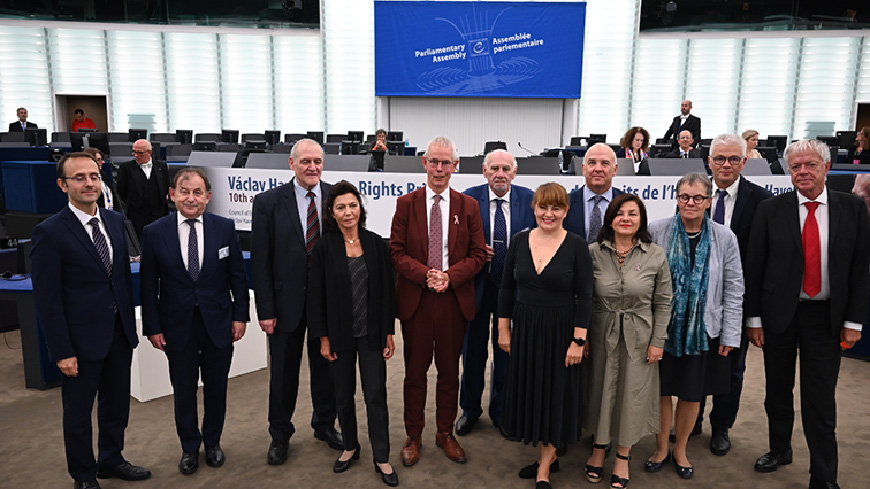
2023 Václav Havel Prize awarded to imprisoned Turkish human rights defender Osman Kavala

The eleventh Václav Havel Human Rights Prize has been awarded to imprisoned Turkish human rights defender, philanthropist and civil society activist Osman Kavala.

The 60,000-euro prize was presented at a special ceremony on the opening day of the autumn plenary session of the Parliamentary Assembly of the Council of Europe (PACE) in Strasbourg on 9 October 2023. For more on the award and its laureates, see https://www.trueheroesfilms.org/thedigest/awards/7A8B4A4A-0521-AA58-2BF0-DD1B71A25C8D

Mr Kavala, a supporter of numerous civil society organisations in Türkiye for many years, has been in prison continuously since 2017 following his arrest for his alleged links to the Gezi Park protests.

In a 2019 ruling, the European Court of Human Rights ordered his immediate release, finding his detention violated his rights and pursued an ulterior purpose, “namely to reduce him to silence as a human rights defender”, and could dissuade other human rights defenders. In 2022 the Court’s Grand Chamber confirmed that Türkiye has failed to fulfil its obligations under the European Convention on Human Rights. [see: https://humanrightsdefenders.blog/2022/07/27/kavala-ruling-of-european-court-of-human-rights-infringement-procedure-against-turkey/]

In a letter written from prison, read out by his wife Ayşe, Mr Kavala said he was honoured by the decision, and dedicated the Prize to his fellow citizens unlawfully kept in prison. He said the award reminded him of the words of Václav Havel, writing to his wife Olga from prison in 1980: “The most important thing of all is not to lose hope. This does not mean closing one’s eyes to the horrors of the world. In fact, only those who have not lost faith and hope can see the horrors of the world with genuine clarity.

Responding to the awarding of the 2023 Václav Havel Prize to Turkish prisoner of conscience, Osman Kavala, by the Council of Europe’s Parliamentary Assembly, Amnesty International’s Deputy Regional Director for Europe, Dinushika Dissanayake, said:

While we celebrate the fact that Osman Kavala has been recognised with this top human rights award, the fact that he cannot be in Strasbourg to collect it in person is heartbreaking. Instead, having already been in jail for almost six years, he is languishing behind bars in Türkiye on a politically-motivated life sentence without the possibility of parole.

Rather predictably: in a statement posted on X, formerly known as Twitter, Justice Minister Yılmaz Tunç said it was unacceptable for the CoE to award a “so-called” human rights prize to a convict, whose verdict of conviction was approved by one of Türkiye’s top courts.

A group of nine nongovernmental organizations including Human Rights Watch and Amnesty International said the prosecution of rights defender and businessman Osman Kavala and four codefendants in connection with mass protests a decade ago was unfair and essentially a political show trial from the beginning, calling for an urgent international response.

[https://www.dailysabah.com/politics/diplomacy/turkiye-slams-coe-for-awarding-convict-with-human-rights-prize]

https://www.coe.int/en/web/portal/-/2023-v%C3%A1clav-havel-prize-awarded-to-imprisoned-turkish-human-rights-defender-osman-kavala

Kavala ruling of European Court of Human Rights – infringement procedure against Turkey

July 27, 2022
Osman Kavala © 2017 Private

Several sources (here HRW) reported on the European Court of Human Rights (ECtHR) handing down a landmark judgment (announced on July 11, 2022) against Turkey for its failure to carry out the court’s order to free the imprisoned human rights defender Osman Kavala. See: https://humanrightsdefenders.blog/2022/04/27/unexpected-in-its-harshness-kavala-gets-life-sentence-without-parole/

The court found in Kavala v. Türkiye, a case brought by the Council of Europe’s Committee of Ministers, that Turkey failed to fulfil its obligation under Article 46(1) of the European Convention on Human Rights to comply with its judgment issued on  December 10, 2019.  The judgment is an important step toward accountability for Turkey’s systemic disregard for the convention system and as recognition of the urgency of implementing the court’s order to release Kavala.

This is the only second time, after Mammadov v. Azerbaijan, that the ECtHR has ever conducted infringement proceedings and determined that a member state has not complied with a European Court judgment,” said Helen Duffy of the Turkey Litigation Support Project.

It is an acknowledgement of Turkey’s ever-deepening rule of law crisis, which has involved seriously undermining the Convention system and the escalating use of criminal law for political purposes.”

In its new judgment, the court held that “Türkiye has failed to fulfil its obligation under article 46§1 to abide by the Kavala v. Türkiye judgment of 10 December 2019.”

The European Court underlined that:

Its finding of a violation of Article 18 taken together with Article 5 in the Kavala judgment had vitiated any action resulting from the charges related to the Gezi Park events and the attempted coup. It is nonetheless clear that the domestic proceedings subsequent to the above judgment, which resulted first in an acquittal and then a conviction, have not made it possible to remedy the problems identified in the Kavala judgment (para. 172).

The Grand Chamber judgment addresses these practices of the Turkish authorities by stating that “the measures indicated by Türkiye do not permit it to conclude that the State Party acted in good faith,’ in a manner compatible with the ‘conclusions and spirit’ of the Kavala judgment, or in a way that would make practical and effective the protection of the Convention rights which the Court found to have been violated in that judgment” (para. 173).

Aisling Reidy, senior legal adviser at Human Rights Watch said: “As the European Court has now confirmed Turkey’s failure to execute the 2019 Kavala judgment, the Committee of Ministers needs urgently to take all feasible measures to ensure the judgement is respected and Kavala released“.

The Committee of Ministers is expected to resume its supervision process and take more robust steps to discharge its mandate of ensuring the necessary individual and general measures are taken by Turkey to implement the court’s ruling.

Now, it is up to the Committee of Ministers, which oversees the implementation of the ECtHR rulings, what measures to take against Turkey after the country failed to comply with the court’s ruling. This could lead to Turkey’s suspension from the Council of Europe. In anticipation, the Foreign Ministry of Turkey said they expected the Committee of Ministers “to act without bias and with common sense” in a statement.

However, see: https://stockholmcf.org/coe-fails-to-sanction-turkey-over-jailed-philanthropist-opts-for-dialogue-instead/

https://www.hrw.org/news/2022/07/12/landmark-judgment-against-turkey-ignoring-european-ruling

Council of Europe starts infringement process against Turkey

February 3, 2022
Osman Kavala © 2017 Private

The Council of Europe Committee of Ministers voted on 2 February, 2022 to begin infringement proceedings against Turkey. Human Rights Watch called it an important step to support human rights protection in Turkey and uphold the international human rights framework. The resolution concerns Turkey’s failure over the past two years to comply with the European Court of Human Rights’ judgment in which the Court ruled that Turkey should free human rights defender Osman Kavala and fully restore his rights. See also: https://humanrightsdefenders.blog/2022/01/18/kavala-saga-continues-turkish-court-keeps-philanthropist-in-prison/

The Committee of Ministers’ vote to pursue infringement proceedings against Turkey for its politically motivated, arbitrary detention of human rights defender Osman Kavala shows a resolve to uphold the international human rights law framework on which the Council of Europe is based,” said Aisling Reidy, senior legal adviser at Human Rights Watch. “The resolution sends a reminder to all Council of Europe member states that European Court of Human Rights judgments are binding, and it is an important acknowledgement of Turkey’s rule of law crisis.

The Committee voted to send the case of Kavala v Turkey back to the European Court of Human Rights for a legal opinion on whether Turkey has met its obligations to comply with the judgment. If the European Court confirms – as it is expected to do – that Turkey has failed to implement its judgment, the Committee of Ministers may then take additional measures against Turkey.

These could include ultimately suspending Turkey’s voting rights in the Council of Europe and could even jeopardize Turkey’s membership. Turkey is the second country in Council of Europe history to be subjected to the sanction process for breaching member states’ obligations to implement European Court of Human Rights judgments. (first time was in 2017 against Azerbaijan in the case of Ilgar Mammadov).

The Kavala judgment is legally binding, yet the Turkish authorities have snubbed the Strasbourg court and ignored the decisions of the Committee of Ministers, which represents the Council’s 47 member states, calling for his release and the full restoration of his rights. Ankara has already reacted as expexted: it has accused the Council of Europe of “interfering in an ongoing judicial process

The Turkish courts and prosecutors have engaged in a series of tactics to circumvent the authority of the European Court and the Council of Europe, using domestic court decisions to prolong Kavala’s detention and extend the life of baseless prosecutions. The courts have issued sham release orders, initiated multiple criminal proceedings against Kavala on the same facts, and separated and re-joined case files accusing him of bogus offenses.

In 2021, Turkey merged the proceedings against Kavala with an entirely separate and much older case against football fans and others charged with a demonstration during 2013 protests a few kilometers away from Istanbul’s Gezi Park.

Turkey’s international partners, in particular countries that supported the infringement vote, should make it clear that Turkey’s continued failure to implement the Court’s judgment and to release Osman Kavala would have consequences on their relations with Turkey. In particular, the European Union should tie its proposed “positive agenda” with Turkey to Kavala’s release and make respect for rights a prerequisite for opening talks on the Customs Union modernization that Turkey is seeking.

Turkey knows that the European Court’s judgments are binding but has chosen to defy its obligations and the rule of law,” Reidy said. “Through the infringement proceedings and engagement from other countries, that needs to change, and Turkey should free Osman Kavala immediately and restore all of his rights.

https://www.hrw.org/news/2022/02/02/turkey-council-europe-votes-infringement-process

https://www.hurriyetdailynews.com/turkey-slams-council-of-europe-for-intervening-in-ongoing-kavala-case-171229

Kavala saga continues: Turkish court keeps philanthropist in prison

January 18, 2022

A Turkish court ruled Monday that prominent Turkish civil rights activist and philanthropist Osman Kavala should stay in prison, despite his more than four years in pre-trial detention.
The hearing took place as a Council of Europe deadline that could trigger infringement procedures looms. The European Court of Human Rights ruled in 2019 that Kavala’s rights had been violated and ordered his release. But Turkey has repeatedly refused to do so.
Kavala, who is in Silivri prison on the outskirts of Istanbul, did not participate in the hearing in line with an October statement that he would no longer attend trials via video conference because he didn’t have faith the court would deliver a fair trial.

Kavala, 64, is accused of financing nationwide anti-government protests in 2013, attempting to overthrow the government by helping orchestrate a coup attempt three years later and espionage. He denies the charges, which carry a life sentence without parole.
He was acquitted in February 2020 of charges in connection with the 2013 Gezi Park protests. As supporters awaited his release, Kavala was rearrested on new charges. The acquittal was later overturned and linked to charges relating to the 2016 coup attempt, which the Turkish government blames on the network of US-based Muslim cleric Fethullah Gulen, who denies any ties to the coup.
That trial is now part of a merged case involving 51 other defendants, including fans of the Besiktas soccer club who were acquitted six years ago of charges related to the Gezi protests before that decision also was overturned. Kavala is the only jailed defendant.

His continued imprisonment for 1,539 days is the continuation of lawlessness identified by the European Court of Human Rights,” Bayraktar his lawyer said. “End this lawlessness today so our client gets his freedom.
In October, Kavala’s case also caused a diplomatic crisis between Turkey and 10 Western countries, including the United States, France and Germany, after they called for his release on the fourth anniversary of his imprisonment.
Turkish President Recep Tayyip Erdogan openly disdains Kavala, accusing him of being the “Turkish leg” of billionaire US philanthropist George Soros, whom Erdogan alleges has been behind insurrections in many countries. He threatened to expel Western envoys for meddling in Turkey’s internal affairs.
The European Court of Human Rights’ 2019 decision said Kavala’s imprisonment aimed to silence him and other human rights defenders and wasn’t supported by evidence of an offense.
The Council of Europe, a 47-member bloc that upholds human rights, notified Turkey in December that it intended to refer the case to the court to determine whether Turkey refused to abide by final judgments, which are binding. It called on Turkey to release Kavala immediately and conclude the criminal procedures without delay. It asked Turkey to submit its views by Jan. 19 before a Feb. 2 session of the council.
Kavala is the founder of a non-profit organization, Anadolu Kultur, which focuses on cultural and artistic projects promoting peace and dialogue. https://humanrightsdefenders.blog/2020/09/16/osman-kavala-and-mozn-hassan-receive-2020-international-hrant-dink-award/

The next hearing is scheduled for Feb. 21.

next: https://www.amnesty.org/en/latest/news/2022/03/turkey-osman-kavala-and-co-defendants-must-be-acquitted-of-all-charges/

https://www.arabnews.com/node/2006211/middle-east

https://www.whio.com/news/world/turkish-court-rules/GT56VN3YVPXZYAHFJ6FCKYKRE4/

Turkey: arrests and backsliding on femicide

March 22, 2021

Living close to Turkey, I follow the situation there perhaps with more worry than others. And nothing good seems to happen:

Turkish police detained three district heads of the pro-Kurdish Peoples’ Democratic Party (HDP) and seven others in Istanbul on Friday over alleged links to militants, police said, two days after a court case began over banning the party.

Separately, Turkey’s Human Rights Association (IHD) co-chairman Ozturk Turkdogan was arrested by police at his home, IHD said, prompting human rights groups to call for his release. Turkdogan was then released on Friday evening, the association said.

Responding to the arrest today of Öztürk Türkdoğan, the president of Turkey’s Human Rights Organisation, Esther Major, Amnesty International’s Senior Research Adviser for Europe, said:

“The detention of Öztürk Türkdoğan is outrageous. With ink barely dry on the Human Rights Action Plan announced by President Erdoğan two weeks ago, his arrest reveals that this document is not worth the paper it is written on.

After over three years in jail without a conviction, one of Turkey’s highest-profile detainees, Osman Kavala, is “not optimistic” that President Tayyip Erdogan’s planned reforms can change a judiciary he says is being used to silence dissidents.
A philanthropist, 63-year-old Kavala told Reuters that after decades of watching Turkey’s judiciary seeking to restrict human rights, it was now engaged in “eliminating” perceived political opponents of Erdogan’s government.
Kavala was providing written responses via his lawyers to Reuters’ questions days after Erdogan outlined a “Human Rights Action Plan” that was said will strengthen rights to a free trial and freedom of expression. See: https://humanrightsdefenders.blog/2020/09/16/osman-kavala-and-mozn-hassan-receive-2020-international-hrant-dink-award/ and

Not surprisingly this is leading to reactions, such as a bipartisan letter penned by 170 members of the US Congress to Secretary of State Antony Blinken, in which the lawmakers have urged President Joe Biden’s administration to consider the “troubling human rights abuses” in Turkey.  “President Recep Tayyip Erdogan and his Justice and Development Party have used their nearly two decades in power to weaken Turkey’s judiciary, install political allies in key military and intelligence positions, crack down on free speech and (the) free press,” the letter said. Dated 26 February but made public on 1 March, the letter asks Washington to formulate its policy regarding Turkey considering human rights, saying that the Erdogan administration has strained the bilateral relationship. 

On top of this Turkey has pulled out of the world’s first binding treaty to prevent and combat violence against women by presidential decree, in the latest victory for conservatives in President Recep Tayyip Erdogan’s ruling party. The 2011 “Istanbul Convention| [SIC], signed by 45 countries and the European Union, requires governments to adopt legislation prosecuting domestic violence and similar abuse as well as marital rape and female genital mutilation. Conservatives had claimed the charter damages family unity, encourages divorce and that its references to equality were being used by the LGBT community to gain broader acceptance in society. The publication of the decree in the official gazette early Saturday sparked anger among rights groups and calls for protests in Istanbul. Women have taken to the streets in cities across Turkey calling on the government to keep to the 2011 Istanbul Convention.

Gokce Gokcen, deputy chairperson of the main opposition CHP party said abandoning the treaty meant “keeping women second class citizens and letting them be killed.” “Despite you and your evil, we will stay alive and bring back the convention,” she said on Twitter. Last year, 300 women were murdered according to the rights group We Will Stop Femicide Platform.
The platform called for a “collective fight against those who dropped the Istanbul convention,” in a message on Twitter.
The Istanbul convention was not signed at your command and it will not leave our lives on your command,” its secretary general Fidan Ataselim tweeted.

Kerem Altiparmak, an academic and lawyer specializing in human rights law, likened the government’s shredding of the convention to the 1980 military coup. “What’s abolished tonight is not only the Istanbul convention but the parliament’s will and legislative power,” he commented.

https://www.arabnews.com/node/1822001/middle-east

https://www.amnesty.org.uk/press-releases/turkey-outrageous-arrest-lawyer-makes-mockery-erdogans-human-rights-reforms

https://www.arabnews.com/node/1828581/middle-east

https://www.usnews.com/news/world/articles/2021-03-19/turkish-police-detain-pro-kurdish-party-officials-anadolu

https://www.arabnews.com/node/1818641/middle-east

https://www.hrw.org/news/2021/03/24/turkey-erdogans-onslaught-rights-and-democracy

Turkey: Our hearts remain in prison again this new year

January 4, 2021

On 2 January 2021 Nurcan Baysal – the winner of the 2018 Front line award [see: https://humanrightsdefenders.blog/2018/05/18/breaking-news-five-front-line-award-winners-2018-announced/] wrote a moving piece in Ahval about her friends and colleagues who are forced to spend their New Year in prison:

“OK,” I say to the children, “We are all overwhelmed in these corona days. Let’s decorate the house, the new year is coming. Down with the corona and with 2020. Let’s enter 2021 with hope. Come on, let’s make popcorn.” While I make the popcorn, I think of my dear friend Osman Kavala, who remains in prison.

I think back to an afternoon when a few human rights defenders had gathered. Whose turn was it to host us that day? “It’s me,” said Şeyhmus. “I’ll even buy you coffee.” Şeyhmus Gökalp, member of the Turkish Medical Association’s honorary board, is now in prison.

I know a walk would do me good. I go outside to get some air. I pick up pace as Leonarda Cohen sings – “Dance with me…” It’s cold outside, but the sun is shining, and I enjoy the birds on trees. I look at the beautiful sky.

I think of novelist Ahmet Altan’s second book written in prison, where he said he would never see the sky without prison walls. The very sky devastates me.

I walk through Diyarbakır’s Bağlar district. Gentrification will begin here soon. I walk up to the building that used to host Kardelen Women’s Centre. I think back to the early 2000s, and the enthusiastic inauguration of Kardelen – literally translates to English as “snow piercer,” refers to the flower snowdrop.

After the opening, we grab a bite in a corner with the then-mayor of Diyarbakır, Gültan Kışanak, and Çağlar, a young employee of the centre. We look at the endless row of coffeehouses that have put their tables on the sidewalk, making it harder for women to walk down that street. “We will change this male-dominated mentality,” Kışanak says proudly. Çağlar is also hopeful for the future.

Both Kışanak and Çağlar Demirel are now in prison.

What should I cook tonight? I open a jar of canned vegetables I prepared with my loving mother. I’ll sauté them, and make some rice on the side.

“Mum, should we put out pickles too?” asks my son. Let’s do it. My pickles have been good this year. I open the lid and I pop one in my mouth.

Nedim wrote in a letter that he liked pickles. Journalist Nedim Türfent and dozens more are in prison.

I go to Diyarbakır’s Sur district. I go in and out of the streets of my hometown, which get stranger every day. Ruins on one street, upscale cafés on the next. A Starbucks a few yards from abject poverty and hunger.

Along the Hevsel Gardens a nice walking path has been put up. I find myself thinking about whose dream that was. “There will be days when we will walk along the Tigris,” says Selçuk.

Selçuk Mızraklı, elected co-mayor of Diyarbakır, will not be able to see his beloved hometown for 9 years, 4 months and 15 days, he is in prison.

With the coronavirus… I feel like I’ve been home for years. The feeling of being trapped and its friend despair surround me. I feel like I haven’t been able to breathe for a long time. I make coffee and go out to the yard. I look at the sky, the stars. I remember my childhood, us sleeping on the roof under the stars, how much hope we had.

Meanwhile, the former leader of the Peoples’ Democratic Party (HDP) Selahattin Demirtaş whispers something from his prison cell.

“When you lose hope, look up at the sky, the stars are still there.”

May 2021 bring good health, but also bring back our loved ones. Let it bring freedom to thousands of people who are imprisoned unlawfully. Let this new year bring us hope, and hope for my hometown that has been destroyed.

https://ahvalnews.com/turkey-kurds/our-hearts-remain-prison-again-new-year

Osman Kavala and Mozn Hassan receive 2020 International Hrant Dink Award

September 16, 2020

The twelfth International Hrant Dink Award was presented on Tuesday, September 15th by an online ceremony. This year’s awards were granted to Osman Kavala who devoted his life to building a pluralistic and democratic society  and showed that human rights and social dialogue can be strengthened through culture [see also; https://humanrightsdefenders.blog/2020/01/29/turkey-defies-european-court-on-kavala-and-undergoes-upr-review/] and art and Mozn Hassan [see also; https://humanrightsdefenders.blog/2017/02/02/right-livelihood-has-to-go-to-egypt-to-hand-mozn-hassan-her-2016-award/]one of the pioneers of the feminist movement across the Middle East and North Africa, struggling against sexual violence and womens rights violations in Egypt.

The award ceremony was hosted by Şebnem Bozoklu and Alican Yücesoy in Turkish, and also by Ece Dizdar in English languages. Moreover, people and institutions from Turkey and all around the world, who shed light to humanity with their struggles are acknowledged as the ‘Inspirations’ of 2020. Among the Inspirations of this year, there human and women’s rights defenders from Turkey to Chile, Indonesia to Lebanon, Germany to the United States, India to China, as well as inspirational individuals and initiatives with their demands for peace, equal citizenship, democracy and justice.

At the ceremony, Rakel Dink sang one of the favorite songs of her husband Hrant Dink at Surp Toros Armenian Church in Tekirdağ Malkara, which is awaiting restoration. The night ended with the song “Son Dakika Golü” (Last Minute Goal) by Arto Tunçboyacıyan composed specially for the ceremony.

For more on the International Hrant Dink Award : http://www.trueheroesfilms.org/thedigest/awards/hrant-dink-award

Osman Kavala and Mozn Hassan receive 2020 International Hrant Dink Award

Turkish human rights defenders shocked by honorary doctorate for ECtHR president Spano

September 5, 2020

This post has been written by Harry Hummel, the Senior Policy Advisor of the Netherlands Helsinki Committee, with many thanks:

This week, European Court of Human Rights president Robert Spano visited Turkey. A high profile event in the country. In the face of government denial of the massive human rights violations it is committing, the voice of the European Court has an extraordinary importance. Human rights defenders therefore expressed unease about the programme of the visit, which included talks with authorities, an address to the Justice Academy and the acceptance of an honorary doctorate at Istanbul university, but no encounters with civil society human rights workers. One of the oldest human rights organisations in Turkey, the IHD, wrote: <https://ihd.org.tr/en/ihd-open-letter-to-robert-spano-president-of-the-european-court-of-human-rights/>

Universities in Turkey are controlled by the Board of Higher Education that was established in the aftermath of the 12 September 1980 coup d’état. Universities in Turkey do not have scientific or administrative autonomy whatsoever. In the past university rectors were elected by academics serving that university but now they are being appointed by the president himself, the head of the executive branch, following changes introduced during the latest state of emergency period. Furthermore, İstanbul University that we learnt was presenting you with an honorary doctorate dismissed hundreds of academics through the state of emergency decree laws and it is one of the institutions that has virtually become the symbol of the state of emergency.

Dear President, you will see young judges and public prosecutors before you at the Justice Academy of Turkey where you are going to teach. During the state of emergency between 2016 and 2018 more than 4,200 judges and prosecutors were dismissed from their posts while more than 8,000 judges and prosecutors were inaugurated. These figures indicate that 45% of all judges and prosecutors on active duty have three years of professional experience or less. Moreover, complaints lodged by thousands of judges and prosecutors are still pending before judicial authorities for the deliverance of a ruling.

Dear President, we do see the will to maintain communication with Turkish authorities in spite of all these negative developments. Turkey, however, is not merely composed of the political power itself. There stand before your court, on one side, the political power alleged to have violated rights and on the other side the victims of those rights violations.  Turkey has a quite developed and dynamic web of civil society organizations working in the field of human rights in spite of all these setbacks. In order for your visit to Turkey to genuinely be beneficial, your lending an ear to these civil society organizations that make the voices of rights victims be heard bears vital significance. We can list the following as examples: women’s organizations that have been defending the Council of Europe İstanbul Convention at a time when withdrawal from the Convention was on the agenda, Saturday Mothers who have long been searching for their children lost under custody and whose right to assembly has been prohibited, bar associations that objected to Law No. 7249 introducing multiple bar associations and regulations that went against the right to defense, and associations of lawyers who advocate for justice and rights, who are imprisoned to this end, who go on hunger strikes. We believe that it is not late to organize a public meeting with the press during which you can answer questions by civil society organizations.

Mixed feelings were expressed in particular about  the honorary doctorate. Former Istanbul University professor Mehmet Altan wrote an open letter to Spano <https://www.expressioninterrupted.com/open-letter-to-president-of-the-european-court-of-human-rights/> :

“The people who will be giving you an honorary doctorate are the very people who dismissed me and many other academics. Under normal circumstances, of course it would be pleasing to hear that you will be visiting Turkey. Unfortunately that’s not the case.”

The concerns about the doctorate were taken up by international human rights NGO Article 19 <https://www.article19.org/resources/open-letter-article-19-urges-president-spano-to-decline-honorary-degree/> :
ARTICLE 19 urges you to decline the offer of an honorary doctorate from Istanbul University due to the role of the University in the crackdown on the crackdown on civil society and purges of Turkish academia by the Turkish authorities.

More than 120,000 individuals <https://soe.tccb.gov.tr/> were dismissed through decree laws after the 2016 failed coup attempt, including more than 5,000 academics. While the process for these dismissals was not transparent, the Spokesman for the Council of Higher Education has previously confirmed in interviews that the management of the universities were responsible <https://www.bbc.com/turkce/haberler-turkiye-38906141?ocid=socialflow_twitter>  for preparing the lists of academics to be dismissed by decree. University rectors from other universities interviewed by the BBC in 2017 stated <https://www.bbc.com/turkce/haberler-turkiye-39055854>  that they prepared the dismissal lists in cooperation with the Intelligence services, using criteria defined by the government. 192 <http://bianet.org/english/print/183432-4-811-academics-from-112-universities-discharged-by-5-statutory-decress> academics <http://bianet.org/english/print/183432-4-811-academics-from-112-universities-discharged-by-5-statutory-decress>  were dismissed from Istanbul University by emergency decrees. Istanbul University itself dismissed at least 95 academics, <http://bianet.org/english/human-rights/176960-95-academic-suspended-in-istanbul-university-yok-suspends-4-rectors>  without due process or the opportunity for review. The consequences for those dismissed were devastating, as documented <https://www.hrw.org/news/2018/05/14/turkey-government-targeting-academics>  by Human Rights Watch.  Those dismissed from their academic positions were blacklisted, unable to find other work and had their passports cancelled. While the hundreds of academics who were dismissed for signing a peace petition had their criminal convictions overturned by the Constitutional Court, they still face unemployment as they were unable to return to their positions.

We also point out that the news about your acceptance of this honorary degree, as the Court’s most senior judge and particularly during an official visit, has raised huge concerns within Turkish civil society, undermining their trust and public confidence in the Court. We therefore respectfully urge you to decline the honorary degree you have been offered by Istanbul University.

In his speech accepting the honorary doctorate <https://echr.coe.int/Documents/Speech_20200904_Spano_Honorary_Doctorate_Istanbul_ENG.pdf> , Spano explained that accepting these kind of honors is part of the usual protocol for Court visits to Council of Europe member states:

It has long been a tradition as a matter of protocol that Presidents of the Court accept to be awarded the title of Doctor Honoris Causa during their official visits to Member States of the Council of Europe. Such offers have not been refused. In this regard the Court must always be seen to be independent and impartial and not making distinctions between Member States.

On this basis, I accept this award from this very prestigious institution which has been in existence for centuries as it will also give me, a former academic, an opportunity to stress the fundamental role of academic freedom and free speech in a democracy governed by the rule of law. These are core values which lie at the heart of the European Convention on Human Rights, a constellation of rights and fundamental freedoms which require that Government in all their actions be balanced and proportionate. In short, the Convention does not tolerate extremes.

The concerns of civil society are fueled by mixed feelings more generally <https://verfassungsblog.de/the-ecthr-and-post-coup-turkey-losing-ground-or-losing-credibility/>  about the approach of the Court in addressing the delaying and evading tactics of the Turkish authorities. In his open letter <https://www.expressioninterrupted.com/open-letter-to-president-of-the-european-court-of-human-rights/> , Mehmet Altan thanks the Court for a verdict against his own imprisonment. The verdict led to his release after a lot of legal wrangling by Turkish courts about its implementation. His dismissal has not been corrected however, a decision about this is lingering before inadequate Turkish appeal procedures (as are tens of thousands of other cases) which the Court however considers a ‘domestic remedy’ that needs to be exhausted before it can take up the issue. In the letter, he also mentions the case of his brother Ahmet Altan:

“The very section of the Court that you presided had given priority status to the application of Ahmet Altan, whose novels have been published in 23 countries, and who, even despite the Covid-19 pandemic has remained behind bars in Silivri Prison for the past four years. Even though the court is very much familiar with the file’s content, unfortunately we have been waiting for that priority to come into effect for the past four years.”

Whether the visit of Spano to Turkey has had a positive effect, will likely be also measured against progress in the case of Osman Kavala, a human rights defender who the Court has said should be released. His situation is under review by the Committee of Minissters, the Council of Europe’s supervisory body for execution of Court judgements. The Committee just this week repeated its call for his immediate release <https://www.coe.int/en/web/portal/-/implementing-echr-judgments-council-of-europe-urges-turkey-to-release-osman-kavala> .

See also:

https://ahvalnews.com/robert-spano/echr-should-call-spanos-resignation-after-turkey-visit-human-rights-defender-fincanci?language_content_entity=en and

https://www.washingtonexaminer.com/opinion/european-court-of-human-rights-president-degrades-court-with-turkish-award

European rights court president draws further ire by posing with members of Turkey’s ruling party

Turkey: who will defend the human rights defenders?

February 16, 2020

Milena Buyum, Amnesty International, wrote on 14 February 2020 a moving piece on the detention and suffering of her fellow human rights defenders in Turkey.

Some moments in life are forever etched in our minds. Everyone recalls where they were when they heard their favourite rock star died, or how they felt around the birth of a child. For me, 6 June and 5 July 2017 are two dates that will forever be on my mind. They are the days when I learned that my friends and colleagues, human rights defenders, had been detained by Turkish police…On 6 June 2017, I was in Istanbul on a work visit, meeting with journalists and lawyers ahead of the start of the trial of two writers. It had almost been a year since the attempted and bloody military coup of July 2016. The Turkish government had responded with a sweeping crackdown on dissenters from all backgrounds, which was continuing to gather pace. I was with the editor of a small newspaper when I heard that my colleague Taner Kılıç had been detained. I will never forget the sinking feeling during those first moments. Trying to make sense of the nonsensical is always difficult. Knowing about the crackdown had not prepared me for how I’d feel when someone I knew was caught up in it.

…..

It was around 8pm on 5 July when I saw several missed calls from a colleague in Turkey. When I rang back, I learned that Amnesty’s Director in Turkey, Idil Eser, and nine others were in detention after being arrested  while attending a workshop on the island of Buyukada. My friend and sister Ozlem was among them. I recall vividly the ensuing hours, making frantic calls to whoever I could think of to try and find out where they were and what was going on. How could people be arrested for attending a human rights workshop? It made no sense.

…….

This week, I will be in Istanbul for the verdict in the case of Taner and the Buyukada 10. If found guilty of ‘membership of a terrorist organisation’, they could face up to 15 years behind bars. At the last hearing in November, I was in the courtroom when the state prosecutor requested that Taner and five of the Buyukada 10 – Idil, Ozlem, Gunal, Nejat and Veli – be convicted, and recited those initial absurd allegations that had been destroyed under the weight of the evidence their defence had provided. This included the allegation that Taner had the secure messaging app ByLock on his phone. Since the coup attempt the authorities have used this allegation against tens of thousands of people to try to prove they were part of an armed terrorist organization. In Taner’s case it was proven to be baseless, including by the state’s own reports to the court. In fact, after 10 hearings in the case, all the accusations made against them have been shown, one by one, to be entirely baseless. How is it possible that the state is still asking for the convictions of our colleagues and friends? The situation facing them is not unique. Their situation is in many ways emblematic of the wave of repression that has gripped Turkey. On Tuesday, another landmark verdict is expected in the case of Osman Kavala and 15 others accused of conspiring to overthrow the government. Despite failing to produce a shred of evidence to support their claim, the prosecution has nevertheless sought life prison for them… [see also: https://humanrightsdefenders.blog/2020/01/29/turkey-defies-european-court-on-kavala-and-undergoes-upr-review/]

I have been in that courtroom for this trial ever since it began. Each time, the absurdity of the prosecution and the complete lack of evidence of any crime having been committed – let alone under terrorism laws – struck everyone in attendance as reserved to the pages of a nightmarish novel. When I walk into the Istanbul courtroom next week, I know there is only one outcome that could deliver justice.  Taner, Ozlem, Idil, Nala. Seyhmus, Ilknur, Ali, Peter, Veli, Gunal and Nejat must all be acquitted. For defenders of human rights, for our friends, for human rights in Turkey, this is the only way just end to this long saga.

https://www.amnesty.org/en/latest/news/2020/02/who-will-defend-the-defenders/