Posts Tagged ‘NGOs’

Positive communication is the (only) way forward for effective human rights work!

May 30, 2019

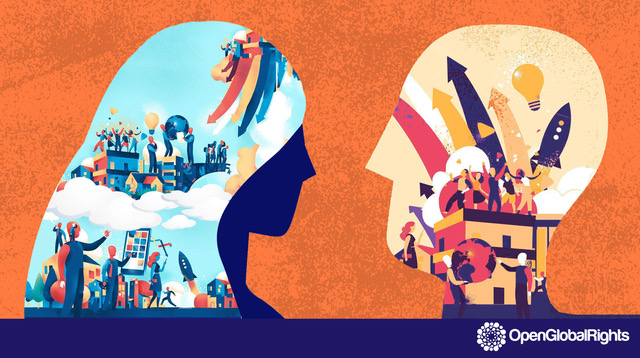
“For a human rights movement dedicated to exposing abuses, positive communication does not come naturally. But to make the case for human rights, we need to promise a brighter future” says Thomas Coombes – head of brand and deputy director of communications at Amnesty International – in a piece in Open Global Rights of 19 February 2019. I have perhaps also contributed to the gloom with many posts about the decline of the international guman rights regime [with some more constructive posts e.g. https://humanrightsdefenders.blog/2018/12/26/barbara-von-ow-freytag-argues-well-for-a-new-communication-based-approach/ ]. I think rightly Thomas argues: “to break this cycle and sell hope to the media, we need two things: challenging ideas and surprising stories“. Please read the full (short) piece:
For a human rights movement dedicated to exposing abuses, positive communication does not come naturally. We in the human rights community are driven by a desire to make known the suffering and injustice we see in the world, yet what people need from us is not information about what is going wrong, but hope and a means of making it better.

To make the case for human rights, we need to promise a brighter future. At Amnesty International we have a saying: better to light a candle than curse the darkness. But in the human rights movement, we spend a lot more time cursing the darkness. We want to expose terrible suffering so that people are shocked into action. But when we only show the abuses, people start to believe that we live in a world of crisis with no alternative. They accept that reality, give up, or turn to people who preach division, fear and a false sense of safety.

While the human rights movement will always have to expose abuses, we also need to give people a chance to unite behind a cause, challenge governments to live by their values and build support for our way of seeing the world. Hope-based communication is simply a smart strategy for shifting public opinion not by saying what is popular, but by making popular what needs to be said.

Hope-Based Communication is about illustrating what we want to see, not just what other people are doing. Because the human mind adapts easily to bad news, every dose of shock that we administer to the global conscience inoculates people. Without a tangible, believable alternative vision of how things should be, we risk reinforcing current rights abuses as a regrettable but inevitable reality.

Constant stories of crisis create an alarming picture of the world in our minds. When news is all about negative, sensational and exceptional events, it skews our view of other people, cultivates distrust and blinds us to important but unsurprising developments, as Rob Wijnberg, has argued in his manifesto for constructive news outlet The Correspondent. To break this cycle and sell hope to the media, we need two things: challenging ideas and surprising stories.

The environmental movement has already made that first step from dire warnings to big ideas that convince people that another world is possible. For example, in This Changes Everything, Naomi Klein writes about how promises of a bright green future offered a way forward: “What this part of the world has clearly shown is that there is no more potent weapon in the battle against fossil fuels than the creation of real alternatives.”

The human rights movement must now do the same thing, and new research offers us a way to completely reframe the way we talk about human rights. For example, Amnesty International Australia now says “Bring them here” of refugees, rather than asking the government to stop treating them like criminals. Anat Shenker-Osorio’s linguistic analysis of how advocates in Australia, the UK and USA make the case for human rights shows that we talk about human rights as an object that is given to individuals, rather than a tool for people to improve their communities and live together. It encourages us to be more specific about power relations and use the language of journeys instead of war.

We want to take society on a journey to a better place, but when we lean heavily on the language of conflict: we fight, recruit, mobilise, resist, defend, protect and counter. We build coalitions. We wage campaigns. We seek to win battles. We ask people to take sides. This language is divisive—it won’t power a constructive, unifying movement. Instead, we need to talk about building, growing and sticking together.

Research from the Common Cause Foundation shows that altruism is as great a motivator to good causes as self-interest, if not more. Successful movements are propelled forward by enthusiasm and passion. While Donald Trump united his base with the simple red baseball cap, ordinary people demanding women’s rights queued for hours to buy “Together for Yes” buttons in Ireland and thronged the streets wearing green scarves in Argentina.

More and more research points to the fact that fear and pessimism triggers conservative and suspicious views, while, hope and optimism tend to more liberal views. Joyful, inspiring content like Planned Parenthood’s Unstoppable campaign serves not just to inspire, it creates political momentum. Anger mobilizes, hope organizes.

New approaches to stories about people seeking refuge highlight not what they flee but what they create in their new home, how the act of welcome transforms the host, or the power of friendships that face adversity and politics.

The stories we tell become our reality, so we need stories of humanity and compassion, reinforcing the idea that human rights are about people standing up for each other

How do we talk about hope and opportunity when human rights defenders are under attack and we need to defend ourselves, to fight back? How can we be positive when it is our duty to document despair?

Human rights defenders have “long been on the front line”, as Kathryn Sikkink argues in Dejusticia’s Playbook for Human Rights Actors. She warns that the frame of crisis and peril inadvertently harms perceptions of the movement’s effectiveness and legitimacy.

The most urgent challenge is to rebrand what it means to do human rights. The space that we most need to create for civil society is a conscious space apart from today’s struggles in which we allow ourselves to envisage bold possibilities of a better world. Human rights should take pride in being the “slow change” movement, that brings about generational attitudinal and societal progress, offering the path out of the darkest times.


Check out this virtual guide for how you can make a shift towards hope based communications in your human rights work.


There is still a place for anger and sadness, if we balance them with a sense of how we make things better. For no matter how dark the story, there is always some glimmer of hope. And it is our job to kindle that flame. The darker the crisis, the more people exhausted by fear and anger will turn to extreme options. So, we have to give people what every human needs: hope. After all, you light a candle when it gets dark. Hope, like a candle, shines brightest in the dark.
the-future-of-human-rights-must-be-hopeful/

UN High Commissioner to present her Human Rights Report 2018 to Civil Society

May 29, 2019

On 14 June 2019 the UN High Commissioner for Human Rights Ms. Michelle Bachelet will present the UN Human Rights Report 2018 to Civil Society. The event wil take place from 14:00 to 15:00 on Friday, 14 June, in the Ground Floor Conference Room at Palais Wilson. Please note that the meeting is limited to NGOs holding annual accreditation with UNOG (confirm by 11 June to zghanem@ohchr.org).
However the electronic version of the Report is already available on the Office’s website: https://www.ohchr.org/Documents/Publications/OHCHRreport2018.pdf

The EU Human Rights Defenders’ mechanism – a short overview

May 28, 2019

Many readers of this blog wil already follow ProtectDefenders.eu [see also: https://humanrightsdefenders.blog/2018/02/27/10611/]. Still, for those who don’t here follows a short overview taken from a 31 May 2019 communication which gives an impressive tally of the last three year: 

Over the past three years, ProtectDefenders.eu – the EU Human Rights Defenders mechanism implemented by a Consortium of international civil society organisations, has emerged as a solid, successful and crucial tool for at-risk human rights defenders, and as an increasingly referenced instrument within the international human rights defenders community. As per the three-years report, ProtectDefenders.eu has stepped up the practical support available to HRDs at risk and local human rights NGOs, and mobilised resources in favour of at least 30,018 defenders in a timely and comprehensive manner.

In a context marked by the increasing demand for support from human rights defenders operating in the most difficult contexts, ProtectDefenders.eu…

  • has granted emergency support to 1,402 human rights defenders at high risk, in order to implement security measures, such as emergency relocation, individual security, medical support, or legal support. Over the past three years, the countries from which the highest number of HRDs received support were Syria, Burundi, Honduras, Russia, China, Iran, and DRC.
  • has facilitated and funded temporary relocation programmes for 459 human rights defenders (and their families when needed) with the support of comprehensive accompaniment schemes within host institutions from all over the world. For this purpose, ProtectDefenders.eu has maintained and broadened the EU Temporary Relocation Platform, supported the creation of new host organisations and engaged as an essential counterpart for human rights defenders in need for relocation and for host organisations.
  • has expanded the capacitites of more than 173 local human rights organisations, communities, and groups operating in the most dangerous contexts, through funding (such as seed-funding, core-funding and lifeline support) and contributions to develop sensitive initiatives and capacity-building programmes.
  • has provided capacity-development and training for at least 6,673 defenders aimed at empowering them to better manage their own security and to develop effective stragies and action to help them advance their their work in defence of Human Rights.
  • has provided effective guidance and immediate responses to 2,600 human rights defenders thanks to direct access to the 24/7 hotline, the ProtectDefenders.eu single-entry points, and direct contact with the Secretariat.
  • has monitored the situation of at least 1,323 human rights defenders in the field, through 284 fact-finding and advocacy missions, trial monitoring, accompaniment, or visits to prison.has mobilised public and media attention, as well as political responses on more than 5,100 individual cases such as attacks or threats against defenders through appeals, letters or petitions:
  • has reached out to at least 4,289 of the less connected, most targeted and at-risk defenders around the world, through 60 initiatives, such as missions to remote areas.

ProtectDefenders.eu aims at reaching out to the less connected and particularly targeted defenders and these groups (such as Women Human Rights Defenders, LGBTI+ rights defenders, land and environment rights defenders, indigenous rights defenders, or defenders from remote areas) represent approximately 75% of the beneficiaries.

https://www.protectdefenders.eu/en/newsfeed.html#newsletter-article-288

UK issues call for applications for funding human rights defenders work

May 14, 2019

On 13 May 2019 the UK Mission to the United Nations in New York issued a call for Programme Fund bids for the fiscal year 2019-2020.

placeholder

The UK Mission to the United Nations in New York is running an open call for project bids for funding under the Foreign and Commonwealth Office’s International Programme in support of the UK Government’s objectives at the UN in New York on Freedom of Religion or Belief and Human Rights Defenders. Funding will be available for ODA-eligible projects running between 1 April 2019 and 31 March 2020. Bids will be accepted from civil society, including NGOs and think tanks, as well as international organisations, including UN offices, agencies, funds and programmes. As a first step, interested parties must submit a written expression of interest to uk@un.intby Tuesday 21 May.

For more information on the programme, guidance for bidding, and additional deadlines, see the Programme Fund form below.

UN WEB TV: panel on human rights defenders and business

May 14, 2019
Panel on Safeguarding human rights defenders – Forum on Business and Human Rights 2018

On 27 November 2018 there was panel on “Safeguarding human rights defenders: new efforts and tackling growing threats” during the  Forum on Business and Human Rights. It is a bit old hat, but I wanted to show it as a good example of what is nowadays to be found on the internet as ‘on demand video’.

Brief description of the session :
The need for enhancing protection of human rights defenders who speak up against business-related human rights impacts is a standing item on the Forum’s agenda. This session led by the UN Working Group in collaboration with NGOs consists of two parts:
1. The first part of the session will be dedicated to showcasing new efforts to strengthen corporate respect and support for human rights defenders. Presentations will be brief, but meant to highlight encouraging initiatives and action.
2. The second part of the session will focus on the growing trend of criminalization and legal harassment of defenders who speak up against business-related impacts and identify concrete action to be taken by governments, business and others to address it. The panel aims to identify what “human rights due diligence” is needed and what are some of the practical considerations for preventing that companies become involved in criminalization and legal harassment of defenders who engage in legitimate efforts to address potential and actual adverse impacts. This will include identifying steps to be taken by:
•home States
•host States
•companies that cause negative impacts and who are the main targets of criticism
•companies that have business relationships to those causing the abuse (typically transnational corporations and their responsibility to address impacts in their supply chain)
•investors
•companies that invest in contexts where criminalization of human rights defenders is a salient issue

Moderator/ Introductory Remark…
•Michael Ineichen, Programme Director, International services for Human Rights
•Anita Ramasastry, Member, UN Working Group on Business and Human Rights

Speakers
•Brittany Benowitz, Chief Counsel, ABA Center for Human Rights
•Vaewrin Buangern, Community member from Lampang Province, Northern Thailand, Community member from Lampang Province, Northern Thailand
•Bennett Freeman, author of “Shared Space Under Pressure: Business Support for Civic Freedoms and Human Rights Defenders”, author of “Shared Space Under Pressure: Business Support for Civic Freedoms and Human Rights Defenders”
•Andreas Graf, Human Rights Manager, Sustainability & Diversity Department, FIFA
•Johanna Molina Miranda, Researcher on Human Rights and Business, CREER Lawyer, Specialist in International Law of Human Rights and International Humanitarian Law with studies in Politics and International Security and currently studying for a Masters in Public International Law.
•Mohammad Nayyeri, Legal Advisor and Program Manager, Justice for Iran
•Ana Sandoval, Peaceful Resistance “La Puya”, Guatemala, Peaceful Resistance “La Puya”, Guatemala
•Clément Nyaletsossi Voule, UN Special Rapporteur on Rights to Freedom of Peaceful Assembly and of Association

(Forum on Business and Human Rights)

Reprisal against Egyptian human rights defender Mohamed Soltan

May 12, 2019

On 10 May 2019, a number of NGOs issued a joint statement on the defamation campaign by Egypt against human rights defender Mohamed Soltan:

We, the undersigned organizations strongly condemn the defamation campaign by the Egyptian authorities against human rights defender Mohamed Soltan, 
…
 
Mohamed Soltan is a prominent human rights defender from The Freedom Initiative, an independent human rights advocacy group in Washington D.C. He spent nearly two years in prison in the case known as “Raba’ Operations Room,” in which authorities pressed politically-motivated charges in 2014-2015 against scores of critical journalists and political figures for “membership in an illegal group”, “publishing false news” and “planning to overthrow the ruling regime”, among other charges. Some of the charges do not constitute recognizable crimes under international law. In any case, the US State Department, and Human Rights Watch’s analysis of the casefile in April 2015, found that prosecutors failed to present any credible evidence to establish him as a suspect, let alone establishing Soltan’s individual criminal responsibility  for the alleged crimes. An Egyptian court sentenced him to life in prison in 2015.
 
In protest of his unjust detention by the Egyptian authorities, Soltan entered into an open-ended hunger strike and was supported by a worldwide campaign effort. The U.S. government intervened at the highest levels and successfully facilitated his release and return to the United States on May 30th, 2015. Since his release, Soltan has become a full-time human right advocate relentlessly defending democratic values and human rights.
 
The Freedom Initiative has worked diligently with Egyptian and international human rights organizations to shed light on the deteriorating human rights situation in Egypt. The organization’s annual flagship event, the Egypt Advocacy Day, involved two award-winning actors who joined over 100 Egyptians and Egyptian Americans from over 25 U.S. states and six countries for meetings with members of the U.S. Congress and State Department. The aim of the meetings was to engage the Egyptian diaspora in the U.S. with their elected representatives on human rights and democratic governance issues in Egypt
 
In response, the Egyptian authorities have apparently unleashed a systematic defamation campaign against some of those who participated in the meetings and against the organizers, particularly the award-winning actors, The Freedom Initiative and Soltan. The Egyptian government,as well as privately owned newspapers, falsely accused him of being a convicted terrorist, a member of the Muslim Brotherhood and working on behalf of foreign agents. The defamatory statements were reported on government-sponsored media outlets in Egypt and Saudi Arabia.
 
The coordinated harassment of Soltan is part of a broader repression of rights and freedoms in Egypt and is aimed to stigmatize human rights defenders, both nationally and abroad, and undermine the effectiveness of their work.
 
We stand in solidarity with Mohamed Soltan, The Freedom Initiative and all Egyptians who peacefully speak out against human rights abuses despite the hefty price. We urge the Egyptian government to respect its obligations under international human rights treaties and the Egyptian constitution, end the crackdown on critics, halt the persecution of human rights defenders and release all those detained for peacefully expressing their opinions.
 
Adalah Center for Rights and Freedoms
Amnesty International
Andalus Institute for Tolerance and Anti-Violence Studies
Cairo Institute for Human Rights Studies
Committee for Justice
Egyptian Front for Human Rights
Egyptian Human Rights Forum
EuroMed Rights
Front Line Defenders
Human Rights First
Human Rights Watch
International Federation for Human Rights (FIDH), under the Observatory for the Protection of Human Rights Defenders
Project on Middle East Democracy (POMED)
The Freedom Initiative

https://mailchi.mp/euromedrights/egypt-reprisal-against-human-rights-defender-mohamed-soltan-for-human-rights-advocacy?e=1209ebd6d8

The Emirates trying to do good with one hand but what horror with the other!

May 8, 2019

The two faces of the UAE on human rights:

While major NGOs are involved in a campaign to save the life of human rights defender Ahmed Mansoor, Sharjah – the third largest and third most populous city in the United Arab Emirates – launches an international award for refugee work.

Update 6 May 2019:  Ahmed Mansoor remains in isolation in Al-Sadr prison in Abu Dhabi with no bed or water, despite an unconfirmed report that he may have ended his hunger strike recently. See: https://humanrightsdefenders.blog/2019/04/10/mea-laureate-ahmed-mansoor-on-hunger-strike-in-emirates/

Mansoor is being kept in an isolation ward in Al-Sadr prison in Abu Dhabi, where he is being held in “terrible conditions” in a cell with no bed, no water and no access to a shower. His health has deteriorated significantly, and he is in bad shape, moving slowly when he is allowed out of his cell. He is not allowed to have regular family visits, another reason he started his hunger strike in mid-March. The NGOs – Arabic Network for Human Rights Information (ANHRI), ARTICLE 19, Cairo Institute for Human Rights Studies (CIHRS), CIVICUS, English PEN, FIDH and the World Organisation Against Torture (OMCT) under the Observatory for the Protection of Human Rights Defenders, Front Line Defenders (FLD), the Gulf Centre for Human Rights (GCHR), IFEX, International Service for Human Rights (ISHR), Martin Ennals Foundation, PEN International and Reporters Without Borders (RSF)- call on the UAE to immediately and unconditionally release Ahmed Mansoor, and other unlawfully detained human rights defenders.

————–

Civil Society and human rights NGOs are fighting back but against odds

May 5, 2019

This article by  (IPS) was published on 10 April 2019 in the context of International Civil Society Week (ICSW), which took place  in Belgrade. Under the title “Civil Society, Once the “World’s New Superpower,” is Battling Against Heavy Odds” it describes how human rights NGOs have come under pressure in recent years

Former UN Secretary-General Kofi Annan once described civil society organizations (CSOs), as “the world’s new superpower” ..but that political glory has continued to diminish over the years against the backdrop of repressive regimes, hard right nationalist governments and far right extremist groups.

Perhaps the most virulent attacks on NGOs are on their attempts to provide protection and security to migrants and refugees in the “dangerous crossings,” from North Africa across the Mediterranean Sea and the Mexico/US border. “There are now serious restrictions in civic space on every continent,” says the annual State of Civil Society Report 2019, released last week by the Johannesburg-based CIVICUS. And it singles out the Italian government’s decision to impose a hefty fine on one of the world’s best-known humanitarian organisations, Médecins Sans Frontières (MSF), while also freezing their assets, impounding their rescue vessel and investigating their staff for human trafficking…in retaliation for their efforts to save refugees from drowning in the Mediterranean Sea. There were also instances of civil society activists being charged, tried and convicted in the United States for providing water supplies for migrants crossing the deadly Sonoran desert on the US/Mexico border. As these attacks continue, international institutions are “struggling” to help shore up these NGOs because these institutions, including the United Nations, are “hamstrung by the interests and alliances of powerful states.”

The report points out these institutions did little to respond to the great challenges of the day– failing to fight overwhelming inequality and also were largely silent on human rights abuses of states such as Saudi Arabia and Sudan while letting down the people of Syria and the Rohingyas of Myanmar, among many others.

…

Asked if there is a role either for the United Nations or its member states to protect CSOs under attack, Mandeep Tiwana, Chief Programmes Officer at CIVICUS, told IPS the UN is making some efforts to put the issues of attacks on CSOs and activists in the spotlight. In December last year, he said, the President of the UN General Assembly, in a symbolic event, awarded the UN human rights prize to three civil society activists and an organisation dedicated to the protection of human rights defenders. [see: https://humanrightsdefenders.blog/2018/12/20/human-rights-defenders-receive-their-2018-un-prizes/]

Recently, on March 21, the UN Human Rights Council (UNHRC) adopted a first-of-its-kind resolution on the protection of environmental human rights defenders, said Tiwana. The UN Secretary General has a designated senior official to lead efforts within the UN system to address intimidation and reprisals against those cooperating with the UN system. And, he said, the Office of the High Commissioner for Human Rights and UN Women regularly champion the work of CSOs and women human rights defenders respectively. “However, in light of the growing restrictions on civic space, around the world, and even at the UN itself, these efforts are often not enough,” complained Tiwana. This is in part because the UN itself is also under pressure from (undemocratic) governments that restrict civil society at home, and wish to do so at the UN as well.

He said the CIVICUS Monitor, a participatory platform that measures civic freedoms finds that only 4% of the world’s population live in countries where the freedoms of expression, association and peaceful assembly are adequately protected…

“Our 2019 State of Civil Society Report points out, that the UN is hamstrung by the actions of powerful states that refuse to play by the rules including the US, China and Russia”. Tiwana said a number of rights repressing states are joining international bodies. In 2018, for example, Bahrain, Bangladesh and Eritrea, joined the UN Human Rights Council….

Second, states are withdrawing from international institutions and agreements, with the US withdrawing from the Paris Agreement on Climate and undermining UN resolutions on Palestine and the Occupied Territories. Philippines has pulled out of the International Criminal Court (ICC) in a bid to avoid international accountability for widespread human rights violations including attacks on civil society. In 2018, the new Global Compact for Migration also saw a string of states with hardline migration policies pull out between the agreement of the deal and its signing.

Third, rogue leaders are bringing their styles of personal rule into international affairs, ignoring existing institutions, agreements and norms, acting as unilateral strongmen or striking bilateral deals with other hardmen, undermining multilateralism and making it harder to scrutinise their actions, Tiwana noted. Potentially everything seems up for negotiation and nothing can be assured at the international level, even the 70-year-old international human rights norms that underpin civil society action, he warned.

The writer can be contacted at thalifeen@ips.org

http://www.ipsnews.net/2019/04/civil-society-worlds-new-superpower-battling-heavy-odds/

NGOs urge Putin not to sign Russia’s “Sovereign Internet Bill”

April 28, 2019
Participants in an opposition rally in central Moscow protest against tightening state control over the internet in Russia, 10 March 2019
Participants in an opposition rally in central Moscow protest against tightening state control over the internet in Russia, 10 March 2019  Igor Russak/SOPA Images/LightRocket via Getty Images

On 24 April 2019 nine major human rights, media and Internet freedom NGOs, called on Russian President Vladmir Putin, not to sign the so-called “Sovereign Internet Bill” as it will lead to further limitations of already restricted Internet and media freedoms in the country.

The bill (No. 608767-7) amends the laws “On Communications” and “On Information, Information Technologies and Information Protection” and states its aim as enabling the Russian Internet to operate independently from the World Wide Web in the event of an emergency or foreign threat. On 16 April 2019, the Russian State Duma approved the bill in the third reading amid widespread domestic criticism, protests and online campaigning around the country, and on 22 April, the Federation Council, the upper house of the Russian parliament, approved it. If signed by President Vladimir Putin, the bill would enter into force on 1 November 2019.

The bill creates a system that gives the authorities the capacity to block access to parts of the Internet in Russia, potentially ranging from cutting access to particular Internet Service Providers (ISPs) through to cutting all access to the Internet throughout Russia.

The bill gives control over Internet network routing to the state regulator for Telecommunications, Information Technologies and Mass Communications, Roskomnadzor. It provides that the ISPs should connect with other ISPs, or “peer,” at Internet exchange points (IXes) approved by the authorities, and that these IXes should not allow unapproved ISPs to peer. The bill would also create a centralised system of devices capable of blocking Internet traffic. The bill requires ISPs to install the devices, which the government would provide free of charge, in their networks.

Under this system, Roskomnadzor would monitor threats to Russia’s Internet access and transmit instructions to ISPs through the special devices about countering these threats. Cross-border Internet traffic would be kept under close state control. The draft does not specify what the range of instructions would be, but they could potentially include partially or fully blocking traffic both between Russia and the rest of the World Wide Web, and within Russia. Nor does the draft explain how the new equipment will work, or what specifically it will do. It is clear, however, that blocking would result from direct interaction between the government and the ISP and that it will be extrajudicial and nontransparent. The public would not know what has been blocked and why.

The bill states that the new measures will be activated in the event of a ‘security threat’. The draft does not define security threats, and instead gives the government full discretion to decide what would constitute a security threat and what range of measures would be activated using the new system to address a threat.

The bill also states that Russian ISPs remain obligated to filter and block content in accordance with existing Russian law.

Further, the bill creates a national domain name system (DNS) – a system that acts as the address-book for the Internet by allowing anyone to look up the address of the server(s) hosting the URL of a website they are looking for. The bill would require Internet providers to start using the national DNS from 1 January 2021. Forcing ISPs to use the national system will give Russian authorities the ability to manipulate the results provided to the ISP outside the ISP’s knowledge and control. Authorities will be able to answer any user’s request for a website address with either a fake address or no address at all. This not only allows them to conduct fine-grained censorship but will also let the national DNS to redirect users to government-controlled servers in response to any DNS requests instead of to a website’s authentic servers.

These proposals are very broad, overly vague, and vest in the government unlimited and opaque discretion to define threats. They carry serious risks to the security and safety of commercial and private users and undermine the rights to freedom of expression, access to information and media freedom.

The bill contravenes standards on freedom of expression and privacy protected by the International Covenant on Civil and Political Rights (ICCPR) and the European Convention on Human Rights (ECHR), to which Russia is a party. Both treaties allow states to limit freedoms to protect national security but impose clear criteria for such limitations to be valid. The UN Special Rapporteur on freedom of expression, commenting on the ICCPR, has reiterated that these limits should be “provided by law, which is clear and accessible to everyone,” and be predictable and transparent.

Human Rights Watch, ARTICLE 19 and other undersigned organisations are extremely concerned that the changes introduced in the bill threaten human rights and freedoms in Russia. Open, secure and reliable connectivity is essential for human rights online, including the rights to freedom of expression, information, assembly, privacy and media freedom. The bill could pose a threat to the Internet’s rights-enabling features if access to the World Wide Web is wholly or partially cut off, or if arbitrary blocking and filtering of content is carried out. It would facilitate state surveillance and curb anonymity online. It also risks severely isolating people in Russia from the rest of the world, limiting access to information and constraining attempts at collective action and public protest. The Bill’s negative impact on the freedom of expression will also affect the rights of journalists and media to work freely.

The adoption of the bill should be seen in the context of other Russian legislation that severely undermines protection of freedom of expression and privacy online and fails to meet international human rights standards. These include:

. The 2016 ‘Yarovaya Law,’ which requires all communications providers and Internet operators to store metadata about their users’ communications activities, to disclose decryption keys at the security services’ request, and to use only encryption methods approved by the Russian government. It was adopted to allegedly counter ‘extremism’ but in practice, it creates a backdoor for Russia’s security agents to access Internet users’ data, traffic, and communications.

. In 2017, Federal Law 327-FZ made amendments to the ‘Lugovoi Law’ (Federal Law FZ-398, 2013) that gave the General Prosecutor or his/her deputies a right to block access to any online resource of a foreign or international NGOs designated ‘undesirable’; and, to ‘information providing methods to access’ the resources enumerated in the ‘Lugovoi Law’, i.e. including hyper-links to old announcements on public rallies not approved by local authorities.

. The recent March 2019 bills mandate blocking and penalizing websites that publish what authorities deem to be “fake news” and “insult” to authorities, state symbols, and what the legislation vaguely describes as Russian “society.”

The President of the Russian Federation should reject the bill. The Russian Government should also review other Internet related legislation, abolish the above listed laws and bring its legal framework to full compliance with international freedom of expression standards.

ARTICLE 19

Civil Rights Defenders

Committee to Protect Journalists

Human Rights Watch

International Federation for Human Rights (FIDH)

International Media Support

International Partnership for Human Rights

Norwegian Helsinki Committee

PEN International

Reporters without Borders

https://www.ifex.org/russia/2019/04/24/sovereign-internet-bill/

https://www.hrw.org/news/2019/04/24/joint-statement-russias-sovereign-internet-bill

International Civil Society Week 2019: call for more NGO voice in the UN

April 14, 2019
The International Civil Society Week 2019 has finished. During the this meeting in Belgrade, that brought together over 850 civil society leaders, activists and concerned citizens from across the world, a large number of contribution were made and I will make reference to some of them in separate posts. Here one of the results:

A World Citizens’ Initiative as an instrument of citizen participation at the United Nations was promoted on 11th April 2019 at a plenary session of the International Civil Society Week 2019 (ICSW). Presenting the idea of a UN World Citizens’ Initiative (UNWCI), Caroline Vernaillen of Democracy International stressed that addressing the UN’s democratic deficit needs to be on the agenda, too. “The UN is a club of representatives of member states. There are no means for ordinary citizens to take influence and this has to change,” she said. The activist from Belgium stated that a UNWCI would help “create a citizen-based global political sphere.”

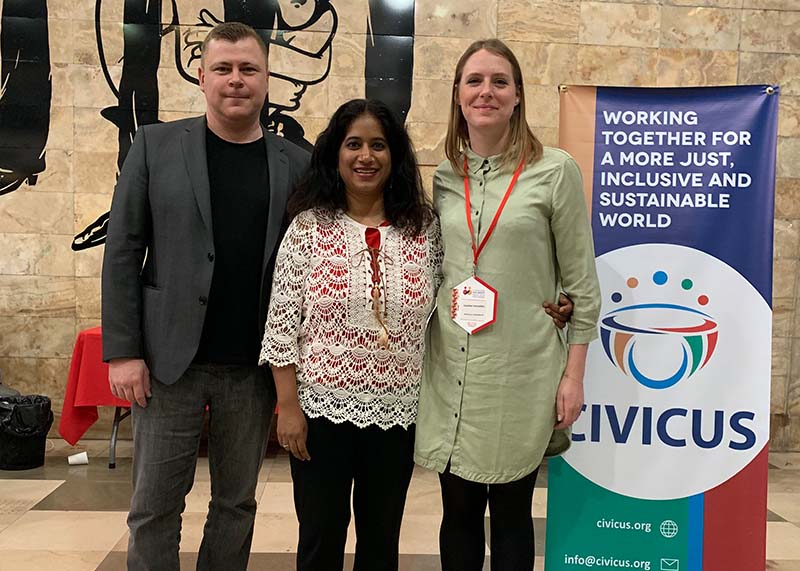
Caroline Vernaillen and Andreas Bummel with CIVICUS’ Secretary-General Lysa John (middle)

According to Vernaillen, the instrument of a UNWCI would allow global citizens to gather support for specific proposals which then would have to be considered and acted upon by the UN General Assembly. She emphasized that a similar instrument already exists in the European Union, the European Citizens Initiative.

CIVICUS, Democracy International and Democracy Without Borders have started preparing an international campaign to promote a UNWCI and participants of the civil society week were invited to join their efforts. The UNWCI campaign is planned to be launched in September or October 2019 when the next session of the UN General Assembly begins.

Joe Mathews, a board member of Democracy International and Co-President of the Global Forum for Direct Democracy, commented on Twitter that a World Citizens’ Initiative was a “powerful new idea” in direct democracy, “open to people everywhere, to attack big problems and check global power.”

The UNWCI campaign will be launched with a view of the 75th anniversary of the UN in 2020. On 11th April 2019, one of the numerous sessions of the civil society week dealt with this topic. Jeffery Huffines of CIVICUS gave an overview of the UN’s preparations of a UN2020 summit (see also this recent article). He urged civil society representatives to engage with this process and proposed that NGOs should think about whether there should be a global civil society forum on the occasion of UN2020.

The new initiative Together First was represented at this session by Giovanna Marques Kuele. She said that the UN needed to become “more democratic, more representative and more transparent.” Together First plans to identify the most important reform proposals and push for them ahead of a UN summit in 2020.

Speaking at the ICSW, the UN’s Assistant Secretary-General for Strategic Coordination, Fabrizio Hochschild, stated that on the occasion of 2020 UN Secretary-General Antonio Guterres “will call for a global youth driven conversation on what kind of world we want 25 years from now, in 2045.

World Citizens’ Initiative promoted at international civil society week