Posts Tagged ‘NGOs’

Palestinian NGOs dubbed terrorist were hacked with Pegasus spyware

November 10, 2021

Investigation by Front Line Defenders finds NGO employees’ phones were infiltrated months before Israel designated them as ‘terrorist organisations’

Phones of Palestinians working for human rights organisations recently designated by Israel as “terrorist organisations” [see: https://humanrightsdefenders.blog/2021/10/23/assault-by-israel-on-palestinian-human-rights-ngos/] were hacked using the Israeli-made spyware at the heart of a global surveillance scandal. [see: https://humanrightsdefenders.blog/2021/07/21/nsos-pegasus-spyware-now-really-in-the-firing-line/]

Dublin-based Front Line Defenders (FDL) examined 75 phones belonging to Palestinian human rights workers and detected that six were infected with Pegasus spyware between July 2020 and April 202. Four out of the six phones belong to staff members at NGOs that were blacklisted last month for alleged ties to a group labelled by some states as a “terrorist organisation”, a move that has sparked international condemnation.

Those alleged to have been hacked include US citizen Ubai al-Aboudi, who heads the Bisan Center for Research and Development, and French national Salah Hammouri, a researcher at Addameer. 

At a press conference in Ramallah on Monday, representatives of the six organisations called for the international community to take action. “We call on the United Nations to launch an investigation to disclose the party that stood behind using this programme on the phones of human rights activists, a move that put their lives at risk,” Tahseen Elayyan, a legal researcher with Al-Haq, told Reuters.

FDL’s findings, which were reviewed and confirmed by Citizen Lab and Amnesty International Security Lab, will raise further concerns about Pegasus, the controversial spyware alleged to have been used to hack heads of state, journalists and activists in a series of explosive stories published this summer.

NSO Group, the Israeli-based tech firm behind Pegasus, only licences the product to sovereign states or the law enforcement or intelligence agencies of those states.

Haaretz reported on Monday that the export licence issued by the Israeli defence ministry to NSO Group only permits Israeli security services to monitor Israeli phone numbers.

An FDL spokesperson told Middle East Eye on Monday that the organisation does not know which state was behind the hacking it uncovered, but believes that the timeline of events over the past month may be critical in answering that question.

On 16 October, three days before the organisations were designated, Al-Haq approached FDL, suspecting that a staff member’s phone had been hacked. The same day, an FDL investigator found initial traces of Pegasus on the phone.

The following day, on 17 October, FDL said it held a meeting with all six organisations to inform them of the initial findings and see if others would want their phones investigated. NSO Group: US blacklists Israeli firms for harming ‘national security interests’.

On 18 October, Israel’s interior ministry notified Hammouri of its decision to revoke his permanent residency in Jerusalem and deport him on the basis of his alleged “breach of allegiance to the State of Israel”.

Then on 19 October, Israeli Defence Minister Benny Gantz designated all six organisations which had gathered with FDL as “terrorist organisations.”

At this point, the organisations were reportedly only considered “terrorist” groups in Israel. But on 3 November – just ahead of the release of FDL’s findings –  Israel’s commander-in-chief of the Central Command issued an order to outlaw the organisations in the West Bank.

“It seems to us that [Israeli officials] were slow to react to what was transpiring and they were unprepared,” FDL spokesperson Adam Shapiro told MEE. “It suggests we caught them doing something they didn’t want us to.”

However, Shapiro emphasised that FDL could not say definitively what state was behind the hacking, a comment echoed by Addameer’s director, Sahar Francis.

“We don’t have evidence. We can’t accuse a certain party since we don’t have yet enough information about who carried out that action,” she told Reuters, calling on the UN to launch an investigation.

Israeli officials have not made a public statement yet about FDL’s findings. NSO Group told Reuters the company “does not operate the products itself … and we are not privy to the details of individuals monitored”.

The US government last week blacklisted the NSO Group and a second Israeli spyware firm, Candiru, saying their activities are contrary to US foreign policy and national security interests.

https://www.middleeasteye.net/news/israel-spyware-pegasus-used-hack-palestinian-rights-activists-phones

https://www.theguardian.com/world/2021/nov/08/hacking-activists-latest-long-line-cyber-attacks-palestinians-nso-group-pegasus-spyware

https://www.occrp.org/en/daily/15450-experts-pegasus-spyware-found-in-phones-of-palestinian-activists

https://www.timesofisrael.com/report-palestinian-activists-phones-hacked-with-controversial-nso-group-tech/

Joint Statement on the Sentencing of Two Members of Human Rights Group Viasna in Belarus

November 5, 2021
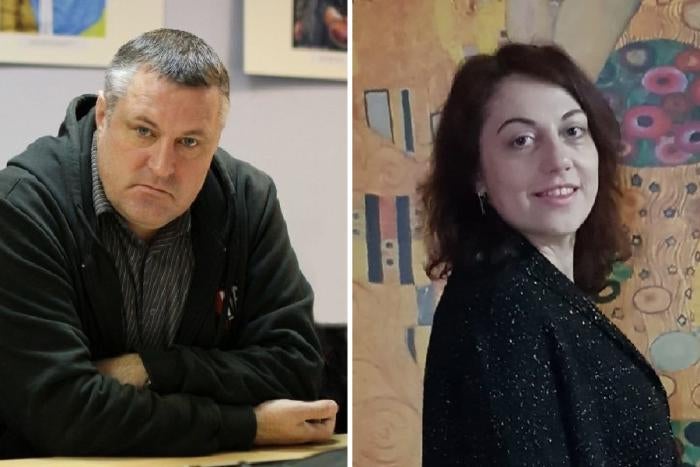
The head of Viasna’s Homieĺ office Leanid Sudalenka and Viasna’s volunteer Tatsiana Lasitsa.
The head of Viasna’s Homieĺ office Leanid Sudalenka and Viasna’s volunteer Tatsiana Lasitsa. © 2021 Human Rights Centre Viasna

On Wednesday, November 3, the Centraĺny District Court in Homieĺ delivered the verdict in the politically motivated criminal case against two human rights defenders with the Homieĺ branch of Viasna, a leading Belarusian human rights group. The court sentenced the head of Viasna’s Homieĺ office Leanid Sudalenka and Viasna’s volunteer Tatsiana Lasitsa to three and two and a half years in prison, respectively.

18 international and Belarusian organizations call on Belarusian authorities to immediately annul the outrageous verdict and drop all charges against Sudalenka and Lasitsa, as well as five other members of Viasna who are currently in jail on politically motivated charges.

“Politically motivated prosecutions of Viasna members and volunteers are part of the ‘purge’ of Belarusian civil society declared by Aliaksandr Lukashenka and his government. Belarusian authorities’ targeting of Viasna in particular is no doubt designed to punish the organization for its outstanding and courageous human rights work over the course of 25 years.”

On October 14, the prosecutor’s office requested three years’ imprisonment for Sudalenka and Lasitsa on charges of “organizing, financing, training, and preparation of actions grossly violating public order and financing such activities.” The charges were backed by absurd “evidence,” such as Sudalenka’s Facebook post offering to buy firewood for the family of someone accused of “mass rioting” in connection with the peaceful protests of 2020.

Sudalenka and Lasitsa have been in pretrial detention for over nine months, having been arrested on January 18 and 21, respectively. Their trial began in early September and was held behind closed doors.

See also: https://humanrightsdefenders.blog/2021/10/27/crackdown-on-human-rights-lawyers-in-belarus-continues/

On January 18, authorities also detained Viasna’s volunteer Maryia Tarasenka in connection to Sudalenka and Lasitsa’s case. She was released under her own recognizance three days after the arrest. Tarasenka left Belarus after prosecutor’s office requested two and a half years imprisonment for her in October.

The other five Viasna members currently behind bars on politically motivated criminal charges are Ales Bialiatski, the founder and chairman of Viasna, Valiantsin Stefanovic, Viasna deputy chairman, Uladzimir Labkovich, a lawyer and coordinator of the group’s campaign “Human rights defenders for free elections,” Marfa Rabkova, coordinator of Viasna’s network of volunteers, and Andrei Chapyuk, a volunteer for Viasna in Minsk.

The human rights defenders’ conditions of detention raise serious concerns: reports indicate they have been subjected to degrading and cruel treatment and their correspondence is often blocked. On October 13, Marfa Rabkova’s husband was allowed to see her for the first time in 13 months and reported she had been asking for but was denied medical care.

Around 100 Viasna human rights defenders and volunteers, as well as their family members, have also been interrogated and designated witnesses in criminal cases against their colleagues. At least seven have been designated suspects.

Belarusian law enforcement continues regular interrogations in connection with the criminal cases against Viasna employees, including activists of other civil groups and initiatives.

On September 17, 23 international and Belarusian human rights groups launched a campaign #FreeViasna, demanding the immediate release of the jailed Viasna human rights defenders. We continue calling on the Belarusian authorities to:

  • Fully abide by their international human rights obligations as a party to the International Covenant on Civil and Political Rights to respect the rights to freedom of association, peaceful assembly, and expression of all people in Belarus.
  • Fully respect the work of human rights defenders and lawyers and ensure that everyone can complain without fear of retaliation about actions and policies of individual officials and governmental agencies.
  • In line with these obligations, release Tatsiana Lasitsa, Leanid Sudalenka, Ales Bialatski, Valiantsin Stefanovic, Uladzimir Labkovich, Marfa Rabkova and Andrei Chapyuk immediately, drop all charges against Viasna staff and volunteers, including Maryia Tarasenka, and other human rights defenders, and ensure their right to a remedy for arbitrary detention and malicious prosecution.

Also woth mentioning is that on 4 November 2021 in response to the Belarusian authorities’ failure to respond satisfactorily to the 5 November 2020 Moscow Mechanism report, 35 OSCE states invoked the Vienna (Human Dimension) Mechanism and Belarus’ commitments under that Mechanism.

Signed:

Amnesty International

Article 19

Barys Zvozskau Belarusian Human Rights House

Belarusian Helsinki Committee

Center for Civil Liberties

Civil Rights Defenders

FIDH, within the framework of the Observatory for the Protection of Human Rights Defenders

Front Line Defenders

Helsinki Foundation for Human Rights

Human Rights Center Viasna

Human Rights House Foundation       

Human Rights Watch

International Partnership for Human Rights                    

Libereco – Partnership for Human Rights                

Norwegian Helsinki Committee

Östgruppen – Swedish Initiative for Democracy and Human Rights               

Right Livelihood                         

World Organisation Against Torture (OMCT), within the framework of the Observatory for the Protection of Human Rights Defenders

https://www.hrw.org/news/2021/11/03/joint-statement-sentencing-two-members-human-rights-group-viasna-belarus#

https://www.rferl.org/a/belarus-lawyer-sudalenka-jailed/31544089.html

https://www.gov.uk/government/speeches/human-rights-in-belarus-35-osce-states-invoke-vienna-mechanism

Assault by Israel on Palestinian human rights NGOs

October 23, 2021

As if the fight against terrorists is not already complex enough, Israel has muddied the water more by accusing six prominent Palestinian human rights groups of being terrorist organisations, saying they have undercover links to a militant movement. Not surprisingly. most of the groups document alleged human rights violations by Israel and the Palestinian Authority.

The six are Al-Haq, a human rights group founded in 1979, [and the winner of 5 human rights awards, see: https://www.trueheroesfilms.org/thedigest/laureates/0F74BF45-72C4-9FDD-F96D-2B87BF6C7728] Addameer, Defence for Children International – Palestine, the Bisan Center for Research and Development, the Union of Palestinian Women’s Committees and the Union of Agricultural Work Committees.

The Israeli defence ministry said they were linked to the Popular Front for the Liberation of Palestine (PFLP), a secular political movement with an armed wing that in the past carried out attacks against Israel. The groups “were active under the cover of civil society organisations, but in practice belong and constitute an arm of the [PFLP] leadership, the main activity of which is the liberation of Palestine and destruction of Israel”, the defence ministry said. It claimed they were “controlled by senior leaders” of the PFLP and employed its members, including some who had “participated in terror activity”. The groups serve as a “central source” of financing for the PFLP and had received “large sums of money from European countries and international organisations”, the defence ministry said.

The groups, well known for their human rights work, have indeed quite openly received funding from EU member states, the United Nations and other donors.

Shawan Jabarin, the director of Al-Haq, said the move was an attempt to stifle criticism. “They may be able to close us down. They can seize our funding. They can arrest us. But they cannot stop our firm and unshakeable belief that this occupation must be held accountable for its crimes,he told the Times of Israel.

The Israeli human rights group B’Tselem called the government’s declaration “an act characteristic of totalitarian regimes, with the clear purpose of shutting down these organisations”. It added: “B’Tselem stands in solidarity with our Palestinian colleagues, is proud of our joint work over the years and is steadfast to continue so.”

Human Rights Watch and Amnesty International, who work closely with many of these groups, said in a joint statement:

This appalling and unjust decision is an attack by the Israeli government on the international human rights movement. For decades, Israeli authorities have systematically sought to muzzle human rights monitoring and punish those who criticize its repressive rule over Palestinians. While staff members of our organizations have faced deportation and travel bans, Palestinian human rights defenders have always borne the brunt of the repression. This decision is an alarming escalation that threatens to shut down the work of Palestine’s most prominent civil society organizations. The decades-long failure of the international community to challenge grave Israeli human rights abuses and impose meaningful consequences for them has emboldened Israeli authorities to act in this brazen manner.

How the international community responds will be a true test of its resolve to protect human rights defenders. We are proud to work with our Palestinian partners and have been doing so for decades. They represent the best of global civil society. We stand with them in challenging this outrageous decision.

The US Department of State spokesperson Ned Price said his office had not been given advance warning of the designation. “We will be engaging our Israeli partners for more information regarding the basis for the designation,” Price said on a telephone briefing with reporters in Washington.

The move by the Israeli government represents a challenge for the many European countries that provide financing to the six organizations, European governments, .. now risk being accused of funding terrorism if they continue financing the six groups. One senior European official working in the region admitted the move was likely aimed at putting pressure on donors’ decision-making but said there needed to be an analysis of any evidence put forward by Israel, said CNN Europe.

See also the 4 November post by Just Security: https://www.justsecurity.org/78884/the-downstream-effects-of-israels-terrorist-designation-on-human-rights-defenders-in-the-us/

See also: https://humanrightsdefenders.blog/2019/11/27/al-haq-named-2019-recipient-of-human-rights-and-business-award/

https://www.theguardian.com/world/2021/oct/22/israel-labels-palestinian-human-rights-groups-terrorist-organisations

https://www.aljazeera.com/news/2021/10/22/israel-palestinian-human-rights-groups-terrorism

https://www.msn.com/en-gb/news/world/stars-sign-letter-criticising-israel-s-move-to-label-palestinian-charities-as-terror-organisations/ar-AAQNM7

See also: https://www.commondreams.org/news/2022/01/06/dont-abandon-us-palestinian-rights-group-rebukes-dutch-government-halting-funding

https://news.un.org/en/story/2021/10/1103982

48th session of the Human Rights Council: outcomes

October 19, 2021

On 11 October 2021 14 NGOs shared reflections on the key outcomes of the 48th session of the UN Human Rights Council, as well as the missed opportunities to address key issues and situations [See also: https://humanrightsdefenders.blog/2021/09/13/human-rights-defenders-issues-in-the-48th-session-of-he-un-human-rights-council/]:

We welcome the adoption of the resolution on the establishment of the UN Special Rapporteur on human rights and climate change, who will focus on the interdependence between human rights, a healthy environment, and combating climate change and we welcome the Council’s historic recognition of the human right to a clean, healthy and sustainable environment. These are vital steps towards addressing the climate crisis and achieving environmental justice.

Ensuring a safe and enabling environment for civil society participation at the national and international levels is essential.

We welcome the adoption by consensus of the resolution on cooperation with the UN in the field of human rights, in particular the invitation to the Secretary-General to submit his annual reprisals report to the General Assembly, which will ensure greater attention to the issue and contribute to a more coherent system-wide response across the UN.

We express concern over the reclassification of NGO written statements submitted to the 48th session of the HRC from Agenda Item 4 to Agenda Item 3 without informing or consulting with the submitting organizations, and without transparency for the reasons or scope of this reclassification.

We welcome that the resolution on equal participation in political and public affairs puts an important focus on the context of elections and on the impact of COVID-19, underscoring the importance of protecting civil society participation at every level  as part of an effective response to the pandemic, in post-pandemic recovery and as a vital component of democratic electoral processes. We regret that, in this and other resolutions, there has been systematic pushbacks against the inclusion of references to children’s right to participate in public affairs, in particular girls, in contravention of international human rights standards.

We also welcome the resolution on privacy in the digital age. Among other issues, the resolution responds to recent Pegasus revelations and includes new commitments on the use of privately-developed surveillance tools against journalists and human rights defenders. It is now essential that the Council goes further and champions the call made by various UN human rights experts to implement a global moratorium on the sale, export, transfer, and use of private surveillance technology without proper human rights safeguards. We also welcome new language in the text on privacy violations and abuses arising from new and emerging technologies, including biometric identification and recognition technologies. In future iterations of the text, we encourage the core group to go further in calling for a ban on technologies that cannot be operated in compliance with international human rights obligations.

With the withdrawal of the resolution on the realisation of a ‘better life’, we are glad to see that the Council’s mandate and resources will not be diverted to efforts that would distract from its core work or dilute human rights standards.

We regret that it was not possible to schedule the briefing by the Peacebuilding Commission (PBC) as per resolution 45/31 – and look forward to future opportunities for exchanges between the HRC and the PBC to learn from one another in efforts to address common contemporary challenges.

We deplore the abandonment of the Yemeni people by the HRC member States who did not support the renewal of the Group of Eminent Experts on Yemen. This failure of the HRC gives the green light to all parties to the conflict to continue their campaign of death and destruction in Yemen. We demand an international criminal investigative mechanism. Anything less is unacceptable.

We regret that the HRC has not responded to the calls of civil society and the evidence of widespread violations in countries including China, Egypt and Saudi Arabia where the situations manifestly warrant the establishment of international investigation and accountability mechanisms.

The establishment of a Special Rapporteur on the situation of human rights in Afghanistan supported by additional and dedicated expertise in OHCHR should bring much needed scrutiny. While we are disappointed that the Council did not establish the full-fledged investigative and monitoring mechanism that the situation warrants, we hope this decision represents a first step towards a stronger response to ensure accountability for human rights violations and crimes under international law in Afghanistan.

While the extension of international scrutiny in Burundi, including through ongoing documentation of violations, is welcome, we regret the absence of a clear strategy post-Commission of Inquiry. As the Burundian government continues to reject cooperation with the Council and its mechanisms and to deny violations, and given that the newly-created Special Rapporteur will not have access to the country for the foreseeable future, it is vital for the Council to rely on benchmarks to design the next steps of its action on, and engagement with, Burundi. We thank the COI for its important work since 2016. It has set the bar high for investigative mechanisms.

We welcome the extension of the mandate of the Special Rapporteur on the situation of human rights in Cambodia with a mandate to provide an additional oral update to the Council. However, the resolution falls short of the minimum action required to credibly address the increasing regression in democratic space and civil and political rights and to put in place necessary measures to create an environment conducive for free, fair and inclusive elections in 2022 and 2023, including mandating enhanced monitoring and reporting by the High Commissioner.

More than four years after the beginning of the conflict in the North-West and South-West regions in Cameroon, we deeply regret States’ failure, once again, to collectively address the country’s human rights crisis. As other international and regional bodies remain silent, the Council has a responsibility to act, including through the creation of an investigative and accountability mechanism. 

We welcome the renewal of the mandate of the Fact-Finding Mission (FFM) on Libya but regret that the mandate has only been extended for a 9-month period. The severity of ongoing and past violations and abuses in Libya, including war crimes, requires an FFM with a sustained and properly resourced mandate.

We welcome a second joint statement on Nicaragua, and urge concerned States to step up collective action in light of increasing repression ahead of the November 7 elections. Should the Government not revert course, it is fundamental that the Council takes stock and provides an adequate, strong response, including the establishment of an international mechanism at its 49th session.

We welcome the High Commissioner’s oral updates on the Philippines.  While the UN Joint Program on Human Rights (UNJP) might provide a framework for improvements, we remain concerned that the UN Joint Programme on Human Rights is instrumentalized by the Government only to please the international community. The national accountability mechanism fails to show meaningful progress. We continue to urge the Council to consider establishing a Commission of Inquiry on the Philippines, to eventually start the long-overdue independent and transparent investigation into the human rights violation in the country.

We welcome the robust resolution that extends the mandate of the Independent Expert on Somalia for a further year. 

While human rights advancements since 2019 in Sudan should be recognized, Sudan still faces significant human rights challenges including threats of the militarization of the State which is also the most challenging peril for women’s rights and WHRDs in Sudan. The transition is not complete, and political uncertainty remains. Against this backdrop, the Council’s decision to discontinue its formal monitoring of and reporting on Sudan is premature as the military establishment continues to pose a threat to democracy and stability in Sudan. We urge the Sudanese authorities to fully cooperate with the UN human rights system to address ongoing violations including sexual and gender based violence and the legacy of 30 years of dictatorship, including impunity for crimes under international law.

Signatories: International Service for Human Rights (ISHR), Cairo Institute for Human Rights Studies; DefendDefenders (East and Horn of Africa Human Rights Defenders Project); Commonwealth Human Rights Initiative (CHRI); FIDH; ARTICLE 19; International Commission of Jurists; FORUM ASIA; International Bar Association; Franciscans International; CIVICUS: World Alliance for Citizen Participation; Association of Progressive Communications – APC; child rights connect; Gulf Center for Human Rights

https://ishr.ch/latest-updates/hrc48-civil-society-presents-key-takeaways-from-human-rights-council/

New Right to Healthy Environment: NGOs urge action

October 11, 2021

On 11 October 2021 ReliefWeb published the open letter signed by 166 civil society organizations and individuals calling upon world leaders to put human rights at the centre of environmental policy (for signatories see link below).

“Respecting and protecting human rights and protecting the environment are inextricably linked. Yet while Heads of State from 88 countries have called to end siloed thinking in the Leaders Pledge for Nature, environmental policy-making still too often excludes or sidelines human rights.

Today we, the undersigned — a broad range of indigenous peoples’ organisations, civil society groups — including human rights, land and environmental defender organisations — academics and [UN] experts from the Global South and North — call on the world’s leaders to bring together human rights, environmental and climate in policy-making in order to secure a just, equitable and ecologically healthy world for all.

The reciprocal relationship between nature and people has existed since time immemorial, but it is now unbalanced. There are countless examples in all parts of the world of how forests, savannas, fresh water sources, oceans, and even the air itself, are being privatised, polluted and destroyed by industries such as agriculture, timber, pulp and paper, mining and oil and gas extraction. These and many other industries not only wreak destruction on Mother Earth, but they also have direct and devastating impacts on human rights. Indigenous peoples and local communities living in close proximity to the production, extraction and processing of raw materials suffer dispossession of their lands, impoverishment, deterioration of their health, and destructive impacts on their culture, among many other abuses. In turn, human rights, land and environmental defenders who seek to prevent these violations suffer threats, criminalisation and violent attacks, and increasingly, killings.

The costs of both environmental destruction and measures to address this often fall disproportionately on those already in precarious positions — such as indigenous peoples, afro-descendants, local communities, women, children and youths, and poorly-paid workers, particularly in the Global South but also in the Global North — while the profits of the largest and most environmentally-damaging industries, and the wealth of their owners and financers, continues to grow. It is unforgivable that polluting industries profit at the expense of the health and human rights of marginalised communities. And, ultimately, this environmental destruction has indirect human rights impacts on us all.

Just this month the Human Rights Council adopted a resolution recognising the Right to a Healthy Environment. Yet while there is evidence that the protection of human rights can lead to better environmental outcomes, calls for recognition of the holistic and indivisible nature of human rights and the environment often go unheeded in global, regional and national environmental and climate policy forums.

This must change. As a global community we face multiple, intersecting crises: increasing human rights abuses and environmental harms by companies, land grabs, the loss of food and water sovereignty, increasing poverty and inequality, increased attacks and killings of defenders, climate change-induced disasters and migration, the diminishing health of the oceans and critical biodiversity loss. Resolving these crises demands a holistic approach to environmental policy that embeds human rights and tackles systemic problems, including historically rooted social injustice, ecological destruction, state capture by corporations, corruption and impunity, as well as and social and economic inequality.

We urge world leaders to ensure that all policymaking related to the environment — including the climate and biodiversity crises, ownership and use of land, water and resources, ecosystem degradation, corporate accountability and trade, among others — address human rights and the environment in an integrated manner. This would help to catalyse the transformative action that is urgently required.

Respect for, protection, promotion and fulfilment of human rights, and the protection of those who defend them, must be an essential and non-negotiable part of measures adopted in upcoming negotiations at the UN Convention of Biological Diversity, COP15, and the UN Framework Convention on Climate Change, COP26. Human rights must also be central to regional and national level climate and environmental policies, such as proposed deforestation legislation in the UK, the EU and the USA, which must be further strengthened.

The time to act is now: we call on you to unite human rights, climate and the environment once and for all. In doing so, you can help us and our future generations to thrive by living in harmony with nature. And in doing so, you can affirm that both nature and people have intrinsic worth and that governments are serious in living up to their duty both to protect Mother Earth and to respect, protect and fulfil human rights.”

See also: https://humanrightsdefenders.blog/2021/09/13/global-witness-2020-the-worst-year-on-record-for-environmental-human-rights-defenders/

https://reliefweb.int/report/world/open-letter-civil-society-world-leaders-put-human-rights-centre-environmental-policy

https://www.scoop.co.nz/stories/WO2110/S00102/civil-society-calls-on-world-leaders-to-put-human-rights-at-the-centre-of-environmental-policy.htm

Big Coalition urges UN to denounce abuses facilitated by spyware technologies

October 4, 2021

During the 28th U.N. Human Rights Council (HRC) Access Now joined 94 other civil society organizations and independent experts in urging member states to denounce abuses facilitated by spyware technologies.

The Pegasus Project revealed a long list of journalists, activists, human rights defenders, lawyers, world leaders, and civil society actors that were a target of NSO Group’s Pegasus Spyware. The U.N. HRC should mandate comprehensive measures to investigate and prevent further violations linked to the sale, export, and use of Pegasus spyware and cases of targeted surveillance. For earlier post on this hot topic, see: https://humanrightsdefenders.blog/tag/pegasus/

Member States must urgently act to address the perpetual human rights abuses by States facilitated by NSO Group’s Pegasus spyware,” said Laura O’Brien, UN Advocacy Officer at Access Now. “The clandestine surveillance industry must be held accountable.

The recent revelations showcased the unprecedented scale of human rights violations by States facilitated by the use of Pegasus with Budapest-based photojournalist Dániel Németh being the latest victim targeted by the spyware.

In the Middle East and North Africa (MENA), governments continue to use digital surveillance tools to target journalists and activists. In 2016, a Citizen Lab investigation revealed that the UAE spied on human rights defender Ahmed Mansoor, who is now serving 10 years in prison under inhumane conditions. The Pegasus Project revealed that friends and family of slain Saudi journalist, Jamal Khashoggi, were also targets of Pegasus spyware with the iPhone of Khashoggi’s Turkish fiancée, Hatice Cengiz, targeted and successfully infected. Last June, Access Now and the Gulf Centre for Human Rights launched the MENA Surveillance Coalition, convening civil society organizations working to defend freedom of expression, privacy, and fundamental rights, to call for an end to the sales of digital surveillance tools to repressive governments in the region.

“Invasive surveillance invades and corrodes the lives and work of human rights defenders, journalists, and activists across the globe,” said Kassem Mnejja, MENA Campaigner at Access Now. “Companies like NSO have been given free rein to proliferate the market with the dangerous Pegasus spyware used to facilitate these dehumanising and unsafe actions — this must end now.”

Despite the mounting evidence of its human rights abuses, the NSO Group continues to repeat its false claim that its spyware is only used for legitimate purposes like investigating crime and terror. This cannot continue.

U.N. human rights experts and civil society groups have previously called on governments to immediately implement a global moratorium on the sale, export, transfer, and use of private surveillance technology. Supporting this call, civil society organizations and independent experts are today requesting member states of the U.N. HRC to urgently denounce and mandate independent investigations into the human rights violations facilitated by this technology.

Read the full letter.

https://www.scoop.co.nz/stories/WO2110/S00016/act-now-against-spyware-coalition-tells-un-human-rights-council.htm

New book: The vitality of human rights in turbulent times

September 14, 2021

“If attention is directed towards the dynamism of social movements and human rights activism around the world, a different set of views of the cathedral emerges says Gráinne de Búrca on 9 September 2021 about her book “Reframing Human Rights in a Turbulent Era“.

Cover for 

Reframing Human Rights in a Turbulent Era

In the book, she examines a number of human rights campaigns around the world and their degree of success as well as their limitations. “I argue that even in a very turbulent and difficult era when human rights are under challenge from all sides, human rights approaches not only retain vitality and urgency for activists, but have also delivered substantive results over time. I suggest that if attention is directed away from a predominant focus on a handful of prominent Global North NGOs, and towards the dynamism of social movements and human rights activism around the world, a fuller set of views of the cathedral—of the landscape of human rights—emerges. The book advances an experimentalist theory of the effectiveness of human rights law and advocacy which is interactive (involving the engagement of social movements, civil society actors with international norms, networks and institutions), iterative (entailing ongoing action) and long-term (pursuing of social and fundamental changes that are rarely rapidly achieved).

Yet there is little reason for complacency or sanguinity. These are highly challenging times for human rights, and for human rights defenders, activists and advocates everywhere. The tide of illiberalism continues to surge around the world, and liberal democracy is in an increasingly unhealthy state. Climate change and the COVID-19 pandemic have exacerbated existing inequalities, corporate power continues to grow and to elude governmental control, while powerful new alliances of religious and political actors have been moving not only to repress the rights of disfavored communities and constituencies, but also to try to reshape understandings of human rights in highly conservative, exclusionary and illiberal directions. Repression of civil society, and of freedom of assembly, expression and protest continues apace, with the number of killings of environmental and other activists growing each year.

At the same time, long-standing critiques of human rights from the progressive left have become popular and mainstream, with influential books in recent years deriding the weaknesses, failures and dysfunctions of human rights, and their complicity with colonialism and neoliberalism. Many of these critiques have been powerful and important, and several have prompted reflection and proposals for reform on the part of human rights practitioners and scholars

But several of the most prominent critiques go beyond a call for rethinking or reform. They argue that the age of human rights is over, that its endtimes are here, that human rights law and the human rights movement are ill-suited to address the injustices of our times, that the failure of human rights approaches to seek or bring about structural change or economic justice highlights their deeply neoliberal character or companionship, and that human rights advocates should perhaps no longer seek to preserve human rights, but should make way instead for more radical movements.

In my book, I argue that some of the more damning critiques are exaggerated and partial. Like the proverbial view of the cathedral, several of the sharpest criticisms focus only or mainly on one particular dimension of the human rights system, and tend to caricature and reduce a complex, plural and vibrant set of movements to a single, monolithic and dysfunctional one. At the same time that the most pessimistic of the critics are writing obituaries for human rights, multiple constituencies around the world are mobilizing and using the language and tools of human rights in pursuit of social, environment, economic and other forms of justice. From #MeToo, Black Lives Matter, Climate Justice and Indigenous movements to reproductive rights marches in Poland, Argentina, and Ireland, to protest movements in Belarus, Myanmar, Nigeria and Chile, the appeal of human rights at least for those seeking justice (even if not for academic critics) seems as potent as ever.

None of this is to suggest that human rights advocates should not constantly scrutinize and reevaluate their premises, institutions and strategies. On the contrary, hard-hitting critiques of human rights for failing to tackle structural injustices and economic inequality have helped to galvanize change and a reorientation of priorities and approaches on the part of various relevant actors and institutions. Human rights activists and movements should exercise vigilance to ensure that they serve and are led by the interests of those whose rights are at stake, that they do not obstruct other progressive movements and tactics, and that their approaches are fit for the daunting and profoundly transformative challenges of these pandemic times, including accelerated climate change, digitalization, ever-increasing inequality and illiberalism. With attention to these risks and dangers, the diverse and heterogeneous array of actors that make up the international human rights community have an indispensable role to play, in a turbulent era, within the broader framework of progressive social, economic, environmental and cultural movements.

https://www.openglobalrights.org/grainne-de-burca/

Results of 47th session of the Human Rights Council

August 7, 2021

The ISHR and 17 other organisations (see below for their names) share reflections on the key outcomes of the 47th session of the UN Human Rights Council, as well as the missed opportunities to address key issues and situations. See also: https://humanrightsdefenders.blog/2021/06/22/key-issues-affecting-hrds-in-47th-session-of-un-human-rights-council-june-2021/

CIVIL SOCIETY PARTICIPATION

We deplore the systemic underfunding of the UN human rights system and the drive for so-called efficiency, including the cancellation of general debates in June, which are a vital part of the agenda by which NGOs can address the Council without restrictions. We call for the reinstatement of general debates at all sessions, with the option of civil society participation through video statements.  We welcome the focus of the civil society space resolution on the critical role played by civil society in the COVID-19 response, and the existential threats to civil society engendered or exacerbated by the pandemic. For the resolution to fulfil its goal, States must now take action to address these threats; while we welcome the broad support indicated by a consensus text, this cannot come at the cost of initiatives that will protect and support civil society.

HUMAN RIGHTS ONLINE

We welcome a resolution on the promotion, protection and enjoyment of human rights on the Internet and its thematic focus on bridging digital divides, an issue which has become ever-important during the COVID-19 pandemic. We urge all States to implement the resolution by taking concrete measures to enhance Internet accessibility and affordability and by ceasing Internet shutdowns and other disruptions, such as website blocking and filtering and network throttling. In future iterations of the text, we encourage the core group to go further in mentioning concrete examples that could be explored by States in adopting alternative models for expanding accessibility, such as the sharing of infrastructure and community networks.  We welcome the resolution on new and emerging digital technologies and human rights, which aims to promote a greater role for human rights in technical standard-setting processes for new and emerging digital technologies, and in the policies of States and businesses. While aspects of the resolution risk perpetuating “technology solutionism”, we welcome that it places a stronger focus on the human rights impacts of new and emerging digital technologies since the previous version of the resolution, such as introducing new language reiterating the importance of respecting and promoting human rights in the conception, design, use, development, further deployment and impact assessments of such technologies.

GENDER EQUALITY AND NON-DISCRIMINATION

We are concerned by the increasing number of amendments and attempts to weaken the texts. We are particularly concerned by the continued resistance of many States to previously adopted texts and States’ willful misinterpretation of key concepts related in resolutions on human rights in the context of HIV and AIDS, accelerating efforts to eliminate all forms of violence against women and girls: preventing and responding to all forms of violence against women and girls with disabilities and preventable maternal mortality and morbidity and human rights on maternal morbidities. We deplore the instrumentalising of women’s rights and sexual and reproductive health and rights. We encourage States to center the rights of people most affected and adopt strong texts on these resolutions. We welcome the resolution on menstrual hygiene management, human rights and gender equality as the first step in addressing deep-rooted stigma and discrimination. We urge all States to address the root causes for the discrimination and stigma on menstruation and its impact.

RACIAL JUSTICE AND EQUALITY

The High Commissioner’s report highlighted the long-overdue need to confront legacies of slavery, the transatlantic trade in enslaved Africans and colonialism and to seek reparatory justice. We welcome the historic consensus decision, led by the Africa Group, to adopt a resolution mandating an independent international expert mechanism to address systemic racism and promote racial justice and equality for Africans and people of African descent. The adoption of this resolution is testament to the resilience, bravery and commitment of victims, their families, their representatives and anti-racism defenders globally. We deplore efforts by some Western States, particularly former colonial powers, to weaken the text and urge them to now cooperate fully with the mechanism to dismantle systemic racism, ensure accountability and reparations for past and present gross human rights violations against Black people, end impunity for racialized State violence and address the root causes, especially the legacies of enslavement, colonialism, and the transatlantic trade in enslaved Africans.

MIGRANTS RIGHTS

Whilst we welcome the return of a resolution on human rights of migrants, we deplore the continued failure of the Council to respond meaningfully to the severity and global scale of human rights violations at international borders including connected to pushbacks. International borders are not and must not be treated as places outside of international human rights law. Migrants are not and must not be treated as people outside of international human rights law. Expressions of deep concern in interactive dialogues must be translated into action on independent monitoring and accountability.

ARMS TRANSFERS AND HUMAN RIGHTS

We welcome the resolution on the impact of arms transfers on human rights and its focus on children and youth. However, we note with concern the resistance of the Council to meaningfully focus on legal arms transfers beyond those diverted, unregulated or illicitly transferred. The Council should be concerned with all negative human rights impacts of arms transfers, without focusing only on those stemming from diversion and unregulated or illicit trade.

CLIMATE CHANGE

We are disappointed that the resolution on human rights and climate change fails to establish a new Special Rapporteur. However, we welcome the increasing cross regional support for a new mandate. It is a matter of urgent priority for the Council to establish it this year.

COUNTRY SPECIFIC SITUATIONS

ALGERIA

While special procedures, the OHCHR and multiple States have recognized the intensifying Algerian authorities’ crackdown on freedom of association and expression, the Council failed to act to protect Algerians striving to advance human rights and democracy.

BELARUS

We welcome the renewal of the mandate of the UN Special Rapporteur on Belarus. Given the ongoing human rights crisis in Belarus, the mandate complements the OHCHR Examination in ensuring continuous monitoring of the situation, and the mandate remains an accessible and safe channel for Belarusian civil society to deliver diverse and up-to-date information from within the country.

CHINA

The Council has once again failed to respond meaningfully to grave human rights violations committed by Chinese authorities. We reiterate our call on the High Commissioner and member States to take decisive action toward accountability.

COLOMBIA

We are disappointed that few States made mention of the use of excessive force against protestors in a context of serious human rights violations, including systemic racism, and urge greater resolve in support of the right to freedom of peaceful assembly in the country and globally

ETHIOPIA

The resolution on Ethiopia’s Tigray region, albeit modest in its scope and language, ensures much-needed international scrutiny and public discussions on one of Africa’s worst human rights crises. We urge the Ethiopian government to engage ahead of HRC48.

ERITREA

We welcome the extension of the mandate of the Special Rapporteur on Eritrea, as scrutiny for violations committed at home and in Tigray is vital.

NICARAGUA

We warmly welcome the joint statement delivered by Canada on behalf of 59 States, on harassment and detention of journalists, human rights defenders, and presidential pre-candidates, urging Nicaragua to engage with the international community and take meaningful steps for free and fair elections. States should closely monitor the implementation of resolution 46/2, and send a strong collective message to Nicaragua at the 48th session of the Council, as the Council should ‘urgently consider all measures within its power’ to strengthen human rights protection in the country.

PALESTINE

We welcome the Special Rapporteur’s report that “Israeli settlements are the engine of this forever occupation, and amount to a war crime,” emphasizing that settler colonialism infringes on “the right of the indigenous population […] to be free from racial and ethnic discrimination and apartheid.” We also reiterate his recommendation to the High Commissioner “to regularly update the database of businesses involved in settlements, in accordance with Human Rights Council resolution 31/36.”

THE PHILIPPINES

While acknowledging the signing of the Joint Human Rights Programme with the UN OHCHR, the Government of the Philippines fails to address the long-standing issues on law enforcement and accountability institutions, including in the context of war on drugs. We continue to urge the Council to launch the long-overdue independent and transparent investigation on the on-going human rights violations.

SYRIA

We welcome mounting recognition for the need to establish a mechanism to reveal the fate and whereabouts of the missing in Syria, including by UN member states during the interactive dialogue on Syria, and the adoption of the resolution on Syria addressing the issue of the missing and emphasizing the centrality of victim participation, building on the momentum created by the Syrian Charter for Truth and Justice.

VENEZUELA

In the context of the recent arbitrary detention of 3 defenders from NGO Fundaredes, we welcome the denunciation by several States of persistent restrictions on civil society and again for visits of Special Rapporteurs to be accepted and accelerated.

*American Civil Liberties Union, Association for Progressive Communications, Cairo Institute for Human Rights Studies, Centro de Estudios Legales y Sociales (CELS), Center for Reproductive Rights, Child Rights Connect, CIVICUS: World Alliance for Citizen Participation, Commonwealth Human Rights Initiative, Conectas Direitos Humanos, Egyptian Initiative for Personal Rights, FIDH, Franciscans International, Human Rights House Foundation, International Bar Association’s Human Rights Institute, International Commission of Jurists, International Lesbian and Gay Association, International Service for Human Rights, US Human Rights Network

https://ishr.ch/latest-updates/hrc47-civil-society-presents-key-takeaways-from-human-rights-council/
69 NGOs address worsening situation in Eswatini

July 22, 2021

On 21 July 2021 FIDH and many other NGOs addressed an open letter to the Government of Eswatini and the international community:

We, the undersigned 69 civil society organisations, are deeply concerned about the eruption of state violence in Eswatini. We stand in solidarity with the people of Eswatini in condemning the government’s violent repression of mass protests demanding democracy and economic justice.

We support the UN Human Rights Commissioner’s call urging the authorities to fully adhere to human rights principles and reminding them that peaceful protests are protected under international human rights law. We call on the Government of Eswatini to immediately cease its brutal crackdown against civilians, restore and maintain internet access, and engage in inclusive dialogue with pro-democracy groups and politicians.

We call on the international community, including the United Nations, African Union, Southern African Development Community, and individual governments, to demand that the Government of Eswatini respect human rights, allow a thorough, independent investigation of who authorised violence against protesters, including shoot to kill orders, and support a peaceful transition to a democratic form of government.

Reports out of Eswatini indicate that, since late June, the army and police forces have killed dozens of unarmed civilians and injured around 1,000 people, including by shooting indiscriminately at and wounding protesters. The government has reportedly imprisoned hundreds of people, many of them young people, and shut down internet access across the country for several weeks, which Amnesty International calls “a brazen violation of the rights to freedom of expression and information.” Reports further indicate that security
forces have sought to intimidate human rights defenders and activists with unlawful surveillance, imposed a curfew, and restricted public gatherings and petition deliveries to the government. This political crisis caused by state-sponsored violence risks creating a humanitarian crisis, as hospitals struggle to treat the influx of people injured by security forces, food and fuel supplies become limited, and people’s movement and ability to conduct basic commerce is restricted.

Specifically, we lend our support to the demands of civil society organisations, political organisations, and people’s movements within Eswatini calling for a long-term resolution to the current political crisis through an inclusive political dialogue, the total unbanning of political parties, a transitional authority, new democratic Constitution, and a multiparty democratic dispensation.In the immediate term, we join democracy defenders in Eswatini in the following demands, calling for action from the Government of Eswatini to cease violence, restore and maintain communications services, and provide urgently needed humanitarian support:

● The immediate cessation of the killing of civilians and the return of the army to the
barracks;

● The immediate restoration of civic services such as the rapid issuing of death
certificates for those killed in the past days;

● Mandatory independent pathologists to conduct post-mortems on the deceased;

● Urgent humanitarian support to the affected families, workers and citizens who
need basic necessities such as food, sanitary towels, baby food, etc.

● The provision of direct financial support to resuscitate affected small and medium
enterprises;

● The full and permanent restoration of internet and communication services and
peoples’ right to freedom of expression; and

● The urgent availability of vaccines to all emaSwati and the end of unnecessary
lockdowns.

As the Government of Eswatini, Africa’s only remaining absolute monarchy, violates the human rights of residents, suppresses freedom of speech and assembly, and jails young people for demanding a brighter future, the international community cannot remain silent.

We call on partners in international civil society, regional governmental bodies, and diplomats to join us in amplifying the demands of the Eswatini people and seeking the protection of people’s human rights.

https://www.fidh.org/en/region/Africa/swaziland-eswatini-civilian-killings-must-stop-now

30 NGOs call on Google to drop plan for a Cloud region in Saudi Arabia

May 27, 2021
Groups call on Google to drop out of Saudi project over human rights concerns

© Getty Images

The Hill of 26 May 2021 reports that a coalition of more than 30 human rights and digital privacy rights groups called on Google to abandon its plans to establish a Google Cloud region in Saudi Arabia over concerns about human rights violations.

The groups, which include Amnesty International, Human Rights Watch and PEN America, wrote in their letter that Saudi Arabia’s record of tamping down on public dissent and its justice system that “flagrantly violates due process” made it unsafe for Google to set up a “cloud region” in the kingdom.

While Google publishes how it handles government requests for customer information and reports when requests are made through formal channels, there are numerous potential human rights risks of establishing a Google Cloud region in Saudi Arabia that include violations of the rights to privacy, freedom of expression and association, non-discrimination, and due process,” the groups said. See also: https://humanrightsdefenders.blog/2019/03/08/saudi-arabia-for-first-time-openly-criticized-in-un-human-rights-council/

The letter also pointed to Saudi authorities who have routinely sought to identify anonymous online dissenters and spy on Saudi citizens through digital surveillance. The groups also pointed to how they themselves are believed to have been put under surveillance by the Saudi government.

“Google has a responsibility to respect human rights, regardless of any state’s willingness to fulfill its own human rights obligations,” the letter continued, pointing to Google’s statement in which it expressed its commitment to human rights and to “improve the lives of as many people as possible.”

In order to address these concerns, the groups called on Google to conduct a “robust, thorough human rights due diligence process” and to “draw red lines around what types of government requests concerning Cloud regions it will not comply with” due to human rights concerns.

“The Saudi government has demonstrated time and again a flagrant disregard for human rights, both through its own direct actions against human rights defenders and its spying on corporate digital platforms to do the same,” the letter read. “We fear that in partnering with the Saudi government, Google will become complicit in future human rights violations affecting people in Saudi Arabia and the Middle East region.”

https://thehill.com/policy/technology/555597-groups-call-on-google-to-drop-out-of-saudi-project-over-human-rights