The ‘ink’ of my previous post [https://humanrightsdefenders.blog/2017/01/26/2017-6-predictions-on-trump-and-the-un-prophets-or-cassandras/] has hardly dried and I see the piece written by Max Fisher in the New York Times of 25 January 2017 that states that the latest draft orders suggest that President Trump intends to pursue his campaign promises of withdrawing the United States from international organizations: Read the rest of this entry »
Posts Tagged ‘New York Times’
2017 (7): Trump’s first orders to cut global funding and treaties
January 26, 2017Reprisals reach even an international NGO attending the Human Rights Council in Geneva
June 13, 2016This blog has always had a keen eye out for reprisals against human rights defenders as I believe strongly that this issue is one of the most crucial facing the human rights movement. See e.g. https://thoolen.wordpress.com/2014/03/13/zero-tolerance-for-states-that-take-reprisals-against-hrds-lets-up-the-ante/. Now it turns out that Florian Irminger, Head of Advocacy at the Human Rights House Foundation (HRHF), received a death threat during the 31st session of the UN Human Rights Council (in March). Evidence strongly suggests that a diplomat working for the Russian Federation in Geneva and attending the Human Rights Council made this threat [see confirmation in link at the end of this piece]. Read the rest of this entry »
Bahrain: #FreeNabeel campaign more urgent than ever in view of resumption USA security assistance
July 8, 2015Nedal Al Salman , Head of International Relations and Women & Children’s Rights Advocacy of the Bahrain Centre for Human Rights [BCHR], launched today a day of solidarity for the president of the BCHR, Nabeel Rajab, with videos of supportive MEP’s. There is an urgent resolution adopted by the EU Parliament about Bahrain and in particular the case of Nabeel Rajab. [https://thoolen.wordpress.com/2015/01/20/video-statement-of-troublemaker-nabeel-rajab-who-is-on-trial-today/]
You can join in the campaign by recording your self on video, state your name and the organisation you represent and say a few words about Nabeel Rajab and call for his release. Your video/photo can be shared on twitter under the hashtag #FreeNabeel [https://thoolen.wordpress.com/tag/nabeel-rajab/]
How difficult it is to match human rights diplomacy with geopolitical considerations is shown in the OP-ED in the New York Times of 7 July 2015 by Sayed Alwadaei, the director of advocacy at the Bahrain Institute for Rights and Democracy:
“Last week, the State Department announced the resumption of “security assistance” to Bahrain. This ended a four-year ban on the transfer of arms that the United States put into effect in 2011, after the Bahraini government’s harsh crackdown on Arab Spring protests. In a statement, the State Department argued that Bahrain had made enough progress in human rights reform to be rewarded by ending the embargo, even though the human rights situation in Bahrain was not “adequate.” The State Department dedicated 49 pages of its 2014 report on human rights, released last month, to Bahrain.
It is a damning document: detailing arbitrary detention, torture, prison overcrowding, constraints on free speech and more. The decision to renew security assistance — in the words of a State Department spokesman, “armored personnel vehicles, MRAPs, Humvees, TOW missiles, arms and ammunition, that kind of thing” — is not only incongruous but also shortsighted, with potentially disastrous consequences.
Prince Zeid Ra’ad Zeid al-Hussein of Jordan, the United Nations high commissioner for human rights, criticized acts of torture in Bahrain in his opening remarks at a session of the Human Rights Council in June. He called for “an immediate investigation” into allegations of torture in Bahrain’s prisons and for the release of “all those detained in connection with their peaceful activities.”
If Prince Zeid were a Bahraini, he could probably be arrested on charges of “insulting a statutory body” — as happened to the human rights defender Nabeel Rajab after he called for prosecution of officials who committed torture in prison. He now faces at least 10 years in prison on various charges relating to his activism.
I was arrested on March 16, 2011, a day after the government announced a state of emergency, a month after the protests started. A military court sentenced me to prison for protesting and talking to the media. What they did to me in prison will stay with me for life.
On my first day in Jaw Prison, about 20 miles south of the capital, Manama, an officer spat on me, grabbed me by the hair and threw me against a wall. During interrogation, another smacked me in the face and dared me to raise my arms to shield myself. They told me I’d be beaten even more if I did.
While I was in detention, four people were tortured to death, as Human Rights Watch has reported. In the interrogation rooms, we always thought of those who had been killed, wondering who might be the fifth. After my release from prison, I fled Bahrain and in 2012 sought asylum in Britain. This January, Bahrain revoked my citizenship, along with that of 71 others, leaving me stateless.
Bahrain’s situation has not improved since 2011. Last November, an inmate was beaten senseless and thrown into solitary confinement, where he died from his wounds during the night. In March, a prison riot broke out. Prisoners were angry about their treatment in overcrowded and unsanitary conditions, and about the unfair trials that had put more than a thousand of them there. Prison authorities are accused by prisoners of responding with excessive force.
What happened next was incomparable to what I was put through. According to a report published last month by a coalition of rights groups, including my own, prisoners said that police officers used birdshot and tear gas against inmates inside corridors and cells. Inmates were rounded up, beaten and held in the courtyards, where they spent weeks sitting in Bahrain’s heat. Former prisoners allege that officers forced inmates to kneel and lick their boots. An imprisoned academic named Abduljalil al-Singace has been on a hunger strike for over 100 days, in protest of the ill treatment suffered by prisoners in March. (There are growing concerns for his health.)
In light of the continuing abuses, the State Department’s praise of the release of the political prisoner Ibrahim Sharif as a sign of “meaningful reform progress” is absurd. Never mind that Mr. Sharif, sentenced to five years in 2011, had served most of his sentence, and that as a political prisoner, he should never have been imprisoned to begin with. And as one political prisoner was released, another, Sheikh Ali Salman, received a four-year sentence for his opposition activities. The police also called in his deputy for questioning last week, after he made a speech against torture in prison.
When the United States expressed concerns a few weeks ago to the Human Rights Council in Geneva about “the continuing criminal cases on grounds of political expression and assembly,” Bahrain rejected them as groundless. It is Bahrain’s prerogative to disregard its American ally’s qualms, but must the United States reward such disrespect by renewing military assistance?
The answer lies in geopolitics. Persian Gulf monarchs are on high alert as the United States nears a nuclear deal with their regional rival, Iran. They want to protect their position as the West’s strategic partners and maintain their influence in the Middle East. At the same time, the rise of the Islamic State is a potent threat to their security, which America seeks to bolster militarily. Resuming arms transfers rekindles not only the American-Bahraini relationship but also the hugely important American-Saudi one.
But these diplomatic considerations come at the cost of relinquishing whatever moral standing the United States had in Bahrain. Ending the suspension of military assistance was a misuse of America’s substantial leverage to bring positive change to the human rights situation in Bahrain and the Gulf, which has only deteriorated since 2011. For Bahrainis striving for a democratic country, America’s move is completely regressive.
President Obama promised a “tough conversation” with the Gulf monarchs when he met them in May. Was this the outcome of that conversation?”
George Clooney speaks out on sexual violence in Darfur
February 26, 2015
Getty Images
Whatever your opinion of George Clooney as an actor, there is no doubt that he is one of the most willing to use his celebrity for human rights causes. The latest example is his Op-Ed piece in the The New York Times, entitled, “George Clooney on Sudan’s Rape of Darfur” (together with John Prendergast and Akshaya Kumar, published on 25 February 2015) .
“Because Sudan’s government routinely blocks journalists from going into the Darfur region and severely restricts access for humanitarian workers, any window into life there is limited,” Clooney says. “The government has hammered the joint peacekeeping mission of the United Nations and African Union into silence about human rights concerns by shutting down the United Nations human rights office in the capital, Khartoum, hampering investigators of alleged human rights abuses and pressuring the peacekeeping force to withdraw.”
The 53-year-old actor then explains the evidence that has been received from citizen journalists and local human rights defenders with that videos have been smuggled out.
Read the complete piece here.
Cao Shunli’s story continues with struggle around independent autopsy
March 28, 2014
Vigil for Cao Shunli in March 2014 in Dublin – (c) Front Line
Didi Kirsten Tatlow reports in The New York Times of 28 March how the issue of Cao Shunli’s death in detention in China has not ended. A lawyer for Cao Shunli said her family wants an independent autopsy by pathologists from outside China, saying they do not trust local pathologists or the police to make an accurate report. “If we can we would like to invite an international expert or an international expert organization to come here to do an autopsy,” said the lawyer, Ms Wang Yu. “’The family has not requested an autopsy yet, though they want one, because they don’t trust anyone here to do a fair job,” [The Beijing Lawyers Association and the Beijing Municipal Justice Bureau seem to be putting pressure on the lawyer] Read the rest of this entry »
Clashing Views of China’s Human Rights Record at UPR session today
October 21, 2013The New York Times of Monday 20 October carries a post by Chris Buckley which looks at the documentation submitted for today’s UPR session on China and concludes that it seems as if there are two different countries facing scrutiny in Geneva. Read the rest of this entry »
MEA Nominee Mario Joseph to address prestigious law school of Indiana
May 3, 2013Human rights lawyer Mario Joseph, MEA Nominee 2013, will give the commencement address at the IU McKinney School of Law on Saturday 11 May in Indianapolis.
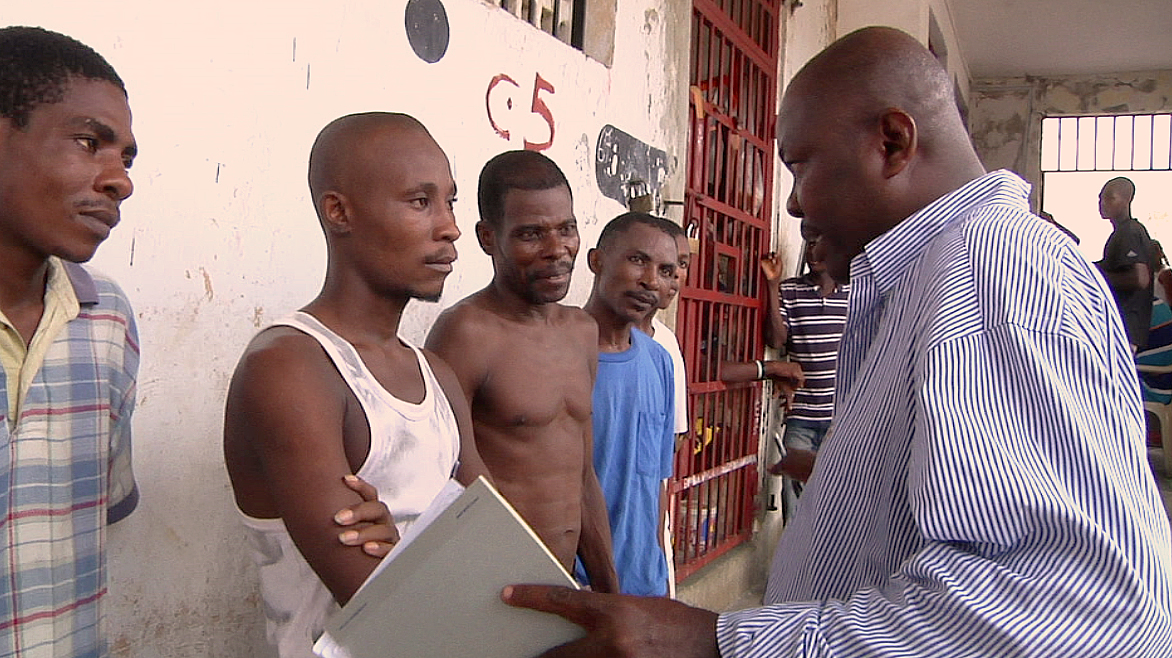
Mario Joseph, Haiti – Final Nominee MEA 2013
The announcement by the University describes him as “A finalist for one of the world’s most prestigious human rights awards“, who has been called “Haiti’s most prominent human rights lawyer” by The New York Times.
 Hans Thoolen on Human Rights Defenders and their awards