So congratulations to her and the Human Rights Foundation. Shaming works sometimes.
“After careful reflection I have decided to no longer move forward with my scheduled concert at Jeddah World Fest,” the singer said in a statement. “While I want nothing more than to bring my show to fans in Saudi Arabia, after better educating myself on the issues, I believe it is important for me to make clear my support for the rights of women, the LGBTQ community and freedom of expression.”
Other celebrities can learn from this, e.g. Mariah Carey who earllier this year defied calls from human rights activists to cancel her performance in Saudi Arabia.
{One of the women in prison is Loujain al-Hathloul and her sister, Alia, had criticised Mariah Carey for playing a concert the King Abdullah Economic City. She said: “My own baby sister said she is being whipped, beaten, electrocuted and harassed on a frequent basis.” She stated: “Remember, thanks to my sister @LoujainHathloul, you r able to perform in Saudi Arabia. I wish she can attend your concert. But she’s locked behind bars because she tried to improve women’s condition. Don’t forget to thank her on stage,” she wrote to Carey on Twitter. But Mariah Carey is an old hand when it comes to selling her soul: see e.g. https://humanrightsdefenders.blog/2013/12/19/mariah-carey-needs-better-informed-staff-and-donate-her-1-million-fee-to-human-rights-defenders-in-angola/].}
The Human Rights Foundation sent a letter to the rapper Nicki Minaj asking her to cancel her performance on 18 july 2019 at a Saudi Arabia music festival being funded by controversial Crown Prince Mohammed bin Salman. The organization said it “considers the Saudi regime to be one of the world’s worst human rights violators” and urged the singer, known for her provocative performances and racy lyrics “to cancel her performance, refuse the regime’s money and instead use her global influence to issue a statement demanding the release of the Saudi women activists who are currently in prison.”
Nicki Minaj, at the 2018 MTV Video Music Awards. (Photo: REUTERS/Carlo Allegri)
The letter also discusses the country’s abuse of its LGBTQ citizens, including how at least five men were beheaded in April for admitting to sexual relations with other men. It connected that to Minaj taking part “in World Pride festivities in her hometown of New York City” last month, pointing out the hypocrisy. Toward the end of the letter, the human rights group wrote, “If you move forward with this performance for a festival sponsored by the Crown Prince, you will be in league with the people who respond to freedom of expression and thought with murder.”
The organization said it sent the letter weeks ahead of the show so that Minaj can’t claim she is unaware. It noted that in 2015, the organization condemned the singer for signing on to perform “for the dictatorial regime of former president José Eduardo dos Santos and his family in Angola” for $2 million. “She performed anyway — and later claimed she was ‘high’ when she made the decision to perform. This time, Minaj and her team have been briefed about MBS two weeks in advance of her scheduled performance and therefore she cannot claim ignorance.” Minaj has not publicly commented on the letter. [see: https://humanrightsdefenders.blog/2015/12/18/merry-christmas-in-angola-nicki-minaj-performs-but-not-for-human-rights-defenders/]
Liam Payne and Steve Aoki are also part of the Jeddah World Fest, which was touted in a Saudi newspaper as the “largest musical festival of its kind in the region.”
As many news outlets report today it is 30 years ago that China cracked down on Tiananmen Square. China tries mostly to forget about it and make others forget it about it too. Still, it recenty came out to defend it as the “correct policy”. “That incident was a political turbulence and the central government took measures to stop the turbulence which is a correct policy” Defence minister Wi Fenghe Wei told a regional security forum in Singapore. “The 30 years have proven that China has undergone major changes,” he said, adding that because of the government’s action at that time “China has enjoyed stability and development“. On the other hand Wu Qian, a spokesman for the defence ministry, decried the use of the word “suppression” to describe the crackdown.
But it does cover Chinese rock musician Li Zhi, who has been outspoken and sung songs about social issues including the Tiananmen Square crackdown, and has not been seen for three months. The South China Morning Post of 2 June has a detailed piece on what happened to this singer: His upcoming tour has been cancelled and his social media accounts taken down. Then his music was removed from all of China’s major streaming sites – as if his career had never existed at all. “Now this square is my grave,” Li sang. “Everything is just a dream.”
The disappearance of Li, the musician, has left fans searching for answers. On February 20, the official Weibo social media account for the 40-year-old’s concert tour posted a photograph of its team in front of a truck about to embark on scheduled performances in Sichuan province in China’s southwest. Just two days later, however, the account posted an image of a hand wearing what appeared to be a hospital wrist band and the words: “Very sorry.” The next post, published the same day, announced without explanation that the tour was cancelled and that ticket purchasers would shortly receive a refund. Fans flooded the comment section with wishes for a speedy recovery.
But the suggestion that a health issue was behind the cancellations was later thrown into doubt. A statement published in April by Sichuan’s culture department said it had “urgently halted” concert plans for a “well-known singer with improper conduct” who was previously slated for 23 performances – the same number of concerts which Li had scheduled in the province. It said 18,000 tickets were fully refunded.
..Li’s presence on the Chinese internet was completely erased. An April 21 central government directive ordered all websites to delete any audio or video content relating to five of Li’s songs, according to China Digital Times, an organisation that publishes leaked censorship instructions. The authenticity of the directive could not be independently verified.
“There’s pretty much a consensus” among those working in the industry that Li’s disappearance from public view is due to the sensitive anniversary, said a music industry professional who spoke on condition of anonymity because of fear of government retribution. “He did a number of songs that were considered politically risky, making references to June 4, 1989, and so he’s been out of the picture,” the industry professional said.
Li’s current whereabouts could not be confirmed. His company and record label did not respond to repeated interview requests. Li’s songs alluding to the Tiananmen Square protests – The Square, The Spring of 1990 and The Goddess, in honour of the Goddess of Democracy that students erected – were part of his earlier works. In recent years, the bespectacled singer has avoided making public political statements, focusing more on promoting his performances. In 2015, state-run China Daily newspaper published a profile of Li, describing him as a performer who easily sells out concerts. After years of working as an independent artist, he signed last autumn with Taihe Music Group, a major Chinese record label. Fans who knew Li as a largely apolitical entertainer expressed bewilderment online about his disappearance. Others made veiled references to China’s internet censorship. On Zhihu, a question-and-answer website similar to Quora, one user wrote that people posed questions every day about what might have happened to Li, but these posts always disappeared the next morning “as if nothing had happened at all”.
Another user said: “I don’t dare to say it, nor do I dare to ask.” A fan who has been sharing Li’s music on his personal account spoke on condition of anonymity because he feared his employers would punish him for discussing the subject. “Everyone knows the reason for Li Zhi’s disappearance,” the fan said. “But I’m sorry, I can’t tell you, because I follow China’s laws and also hope that Li Zhi can return.” Quoting one of Li’s lyrics, the fan added: “The world will be all right.” Fans continue to circulate videos of Li’s performances online. His complete discography has been uploaded onto file-sharing websites, with back-up links in case the original ones are shuttered. Some users shared tribute art, including a black T-shirt with the words “improper conduct”. A few years ago, in a performance in Taiwan, Li bounced around on stage, strumming his guitar and repeating a chorus in apparent tribute to the spirit of Chinese propaganda.
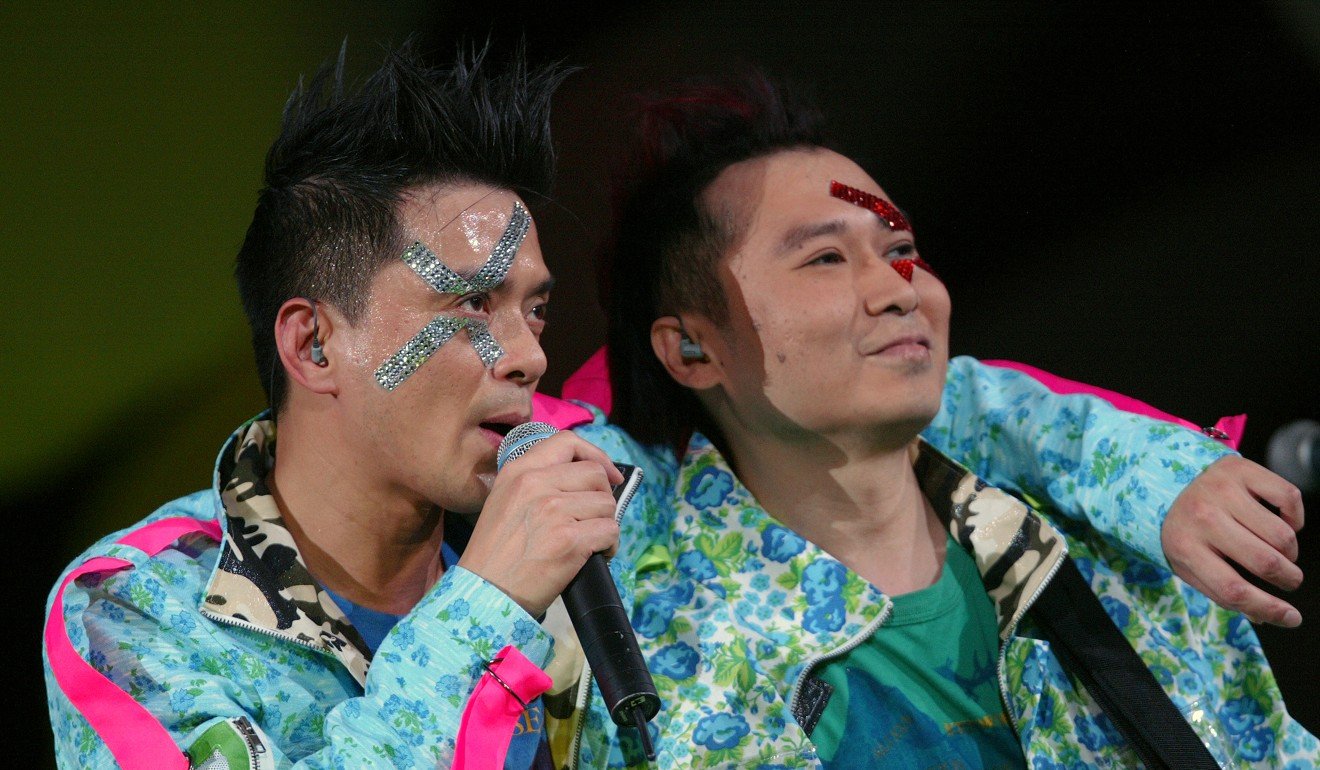
Foreign companies are not immune. Apple Music has removed from its Chinese streaming service a song by Hong Kong singer Jacky Cheung Hok-yau that references the Tiananmen crackdown. Tat Ming Pair, a Hong Kong duo, have been deleted entirely from the app. They released a song this month called Remembering is a Crime in memory of the protests.
Music by Tat Ming Pair – Anthony Wong Yiu-ming (left) and Tats Lau Yi-tat – has been deleted from the Apple Music app. Photo: K.Y. Cheng
Wikipedia also announced this month that the online encyclopaedia is no longer accessible in China. While the Chinese-language version has been blocked since 2015, most other languages could previously be viewed, Wikipedia said.
The Human Rights Foundation publised this video about China’s Million Person Muslim Prison Camps:
Corrected version: Last week I announced the 3 laureates of the Václav Havel Prize for Creative Dissent [see: https://humanrightsdefenders.blog/2019/05/15/2019-laureates-of-the-vaclac-havel-prize-for-creative-dissent-announced/] and one of them is Rap Against Dictatorship, which was threatened with legal action for their 2018 hit ‘My Country’s Got’, a viral rap video lambasting Thailand’s junta and justice system. Rap Against Dictatorship said two of its rappers are flying to Norway to attend the award ceremony, which will be held at the Oslo Freedom Forum – the same event which invited junta critic and Khaosod English writer Pravit Rojanaphruk to speak in 2015. “Liberate P and Jacoboi are our representatives to receive the prize. Please keep supporting us,” the group said.
“My country preaches morals but has a crime rate higher than the Eiffel Tower. My country’s parliament house is a soldiers’ playground. My country points a gun at your throat,” read some of the lyrics.
Police officials considered filing sedition charges against the rappers, to much ridicule on social media, but no legal action was taken.
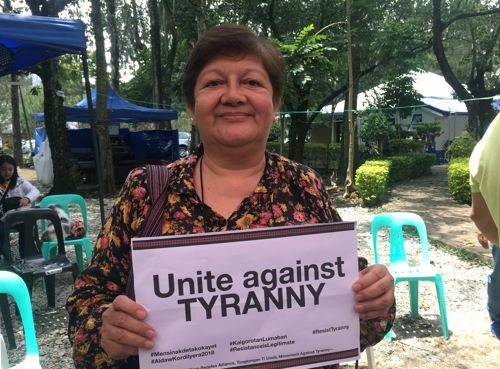
For those – like me – who missed the announcement of the winners of the Gwangju human rights awards 2019, here a belated post. [For more on this award see:http://trueheroesfilms.org/thedigest/awards/gwangju-prize-for-human-rights]. The winner is the Philippine human rights defender Joanna Carino.
The Jury said “Carino has created a great sensation for her unyielding strife and sacrifice in fighting against suppression and made a favorable impression on many citizens and activists today.”
The biennial special award went to Indonesia’s Dialita Choir, made up of women whose parents, relatives and friends were captured, tortured and exiled during the 1965-1966 communist purge in the Southeast Asian country. The members of Dialita co-initiate social change through singing performances. The award ceremony was on 18 May 2019 as part of events to mark the 39th anniversary of the democratic uprising. Hundreds of citizens were killed in the southwestern city during protests against the military junta of Gen. Chun Doo-hwan in May 1980.
As the Universal Declaration of Human Rights turns 70 – is it time for a new approach? asks Barbara von Ow-Freytag, Journalist, political scientist and adviser, Prague Civil Society Centre, in the World Economic Forum.This piece is certainly worth reading as a whole. It is close to my heart in that it stresses the need to have a hard look at how young human rights defenders focus their energy where they can achieve real, concrete change within their own communities. Their campaigns are grassroots-led and use local languages and issues their communities understand. They often use technology and creative formats, with a heavy dose of visual and artistic elements. Where the international scene seems to stagnate and even backpedal, better use of communication skills and tools (such as images) are certainly part of the answer:
As the Universal Declaration of Human Rights turns 70, a new generation of human rights defenders are reinventing themselves to fight for old rights amid a new world order. Based not on declarations, charters and international bodies, but on the values which underpin them – justice, fairness, equality – they shun the language of their predecessors while embracing the same struggle…However, in the new realities of the 21st century, the mechanisms to promote human rights that grew out of the Universal Declaration are showing their age. Authoritarianism is on the rise across the world, with popular leaders cracking down on human rights defenders.
Freedom House found 2018 was the 12th consecutive year that the world became less free. Civicus, which specifically monitors the conditions for civil society activists and human rights defenders, found civil society was “under attack” in more countries than it wasn’t, with all post-Soviet countries (except Georgia) ranging between “obstructed” and “closed”.
Image: Freedom House
Troublingly, both the willingness and the ability of Western bastions of human rights are also on the wane. Inside the EU, talk of illiberal democracy gains traction, and internal crises divert attention away from the global stage. Perhaps unsurprisingly, throughout Eastern Europe and the former Soviet Union, younger activists and civil society are giving up on western governments and international organizations to advocate on their behalf. Pavel Chikov, director of the Agora group, said recently that, “Russian human rights groups no longer have a role model,” calling the liberal human rights agenda “obsolete”.
Growing disillusionment has led many rights groups to shift away from appealing to outsiders for support. Younger campaigners no longer frame their work in the traditional language of human rights, and many do not even consider themselves human rights defenders. Instead of referring to international agreements violated, they focus on solving practical problems, or creating their own opportunities to advance values of equality, justice and fairness.
Formats too have changed. Throughout the region, tools used by civil society to raise social consciousness are becoming diverse, dynamic and smart. Instead of one-person legal tour de forces, genuinely grassroots, tech-powered, peer-to-peer or horizontal networks are proving effective. Media, music, art, film, innovative street protests, urbanism and online initiatives focused on local communities are coming to replace petitions and international advocacy.
Team 29, an association of Russian human rights lawyers and journalists, is among the most successful of this new generation. It has repositioned itself as part-legal aid provider, part-media outlet. Its website offers a new mix of news on ongoing trials, animated online handbooks for protesters, videos on torture and a new interactive game telling young people how to behave if they are detained by police.
What may look like PR-friendly add-ons are actually core to their operation. Anastasia Andreeva, the team’s media expert, says: “Before, we consulted some 30 clients, now we reach tens of thousands of people.”
Azerbaijani activist Emin Milli also embodies this journey of wider civil society – turning away from the international towards local solutions. In the early 2000s, he was a traditional human rights defender, successfully using international mechanisms, such as the Council of Europe to assist political prisoners.
The key to Meydan’s success is its accessibility. Milli says: “We do stories about ordinary people. Real Azeris who have everyday problems.” Through its smart coverage, investigating and highlighting how injustice affects these ordinary people, and not referring to UN-enshrined rights and responsibilities, Meydan is “giving a voice to people who fight for women’s rights, people who fight for political rights, for civil liberties, and everybody who feels they are voiceless”.
Music, too, is increasingly being used as a vehicle to realize human rights. Though he might shun the label, Azeri rapper Jamal Ali is perhaps one of the country’s most well-known “human rights defenders”. His songs about injustice and corruption regularly go viral, raising national and international awareness in the same way a statement at the UN General Assembly might have done three decades ago.
In a 2017 hit, he highlighted how two young men had been tortured by police and faced 10 years in prison for spraying graffiti on a statue of former president Heydar Aliyev. In response, the regime arrested Ali’s mother, demanding that he remove the video from YouTube, only to ensure that Ali’s song went even more viral among Azeri youngsters.
Gender equality and women’s rights is also being advanced through unexpected new champions. In Kyrgyzstan, 20-year-old singer Zere Asylbek sparked a feminist shockwave earlier this year with her video Kyz (“Girl”). “Don’t tell me what to wear, don’t tell me how to behave,” she sings, bearing her top to reveal her bra. Seen by millions, the Kyrgyz-language feminist anthem has set off a new #MeToo debate in the Central Asian country, where many young women are still abducted, raped and forced to marry.
In the wake of the video, a first “feminist bar” is about to open in Bishkek. Other feminist videos have been used to directly address the issue of bride-kidnapping, with animated cartoons being used as part of local campaigns to change mindsets in a conservative society.
Perhaps most excitingly, an all-female team of 18 to 20-year-olds is building the country’s first micro-satellite. “Girls taking us into space is the best message against sexism,” says Bektour Iskender, whose news site Kloop initiated the project. He says the girls’ project has a deep social mission, promoting national pride and the country’s return to advanced technological development.
These examples – and countless more – show that civic groups see no value in lobbying an increasingly disinterested West and sluggish international organizations. Instead they focus their energy where they can achieve real, concrete change within their own communities. Their campaigns are grassroots-led and use local languages and issues their communities understand. They target specific audiences, often using technology and creative formats, with a heavy dose of visual and artistic elements.
Addressing discrimination, environmental protection, corruption, health issues, women’s rights, they speak not about the failure of their states to abide by international accords, but about common dignity and life opportunities, addressing people on a direct human level.
Clearly, the values of the Universal Declaration of Human Rights are still valid, but their approach and the packaging have changed. “We all want to change the world,” says Sergey Karpov of the Russian online media and philanthropic platform Takie Dela. “Today communications are the best way”.
Khoi is an independent artist who is shaping public discourse in Vietnam. She reached stardom in 2010, when she won the highest award for songwriting in Vietnam. As a celebrity, Mai advocated for women’s rights, LGBT rights, and to end violence against women. More recently, she became the focal point of public discourse after nominating herself to run in the 2016 parliamentary elections. Her pro-democracy campaign sparked a nationwide debate about political participation and ultimately led to a meeting with then-U.S. President Barack Obama. Since running for parliament, Mai has had her concerts raided, has been evicted from her house twice, and is effectively banned from singing in Vietnam. In March 2018, she was detained at Hanoi airport on suspicion of “terrorism” after returning from a European tour.
Despite this harassment, Mai continues to find creative ways to spark conversation on art, human rights, and democracy. In February 2018, she released a new album, “Mai Khoi Chem Gio – Dissent.” In a review of the album, The Economist commented, “If music alone could break chains, this would be the music to do it.” Mai’s work aims to counter the authoritarian ways of thinking that justify social control. She is currently the subject of a feature-length documentary that is scheduled to air on Netflix in 2019.
“Mai Khoi is outstanding in her commitment to human rights,” said Havel Prize Committee Chairman Thor Halvorssen. “Through her music and her campaigns, she has put civil liberties and democracy on the forefront of public conversation in Vietnam.”
The Havel Prize ceremony will be broadcast live at oslofreedomforum.com at 3:00 p.m. Oslo time (GMT+2) on Wednesday, May 30.
On 7 December 2017Cherie Hu reported in Billboard that the United Nations High Commissioner for Human Rights will award the inaugural High Note Music Prize next year to a major recording artist in recognition of outstanding contributions to humanity and the promotion of human rights through music. The High Note Music Prize selection committee, which is in the process of being assembled, will work with the Office of the High Commissioner for Human Rights to select an international artist who has promoted human rights for at least a decade, a spokeswoman tells Billboard.
The annual award will be presented in fall 2018 during the High Note Honors Concert in London. Proceeds from the concert and its worldwide broadcast will benefit the UN Office of the High Commissioner for Human Rights, the Grammy Museum and the prize winner’s social justice charity of choice. The award will soon be added to THF’s Digest of Human Rights Awards: http://trueheroesfilms.org/thedigest.
Courtesy of High Note Project
The High Note Music Prize is part of the High Note Project, a new global social justice initiative launched by philanthropic producer David Clark. Clark previously collaborated with Nelson Mandela on the 46664 series of charity concerts in support of HIV/AIDS, featuring performances by the likes of Bono, Beyoncé, Queenand The Eurythmics. Clark is an executive producer of the project as is Chantel Sausedo, whose other credits include producing the Grammy Awards for TV, the Laureus World Sports Awards and In Performance At The White House specials.
Stuart Galbraith, CEO and founder of Kilimanjaro Live — the U.K. promoter behind heavy metal festival Sonisphere and the U.K. and European legs of the Vans Warped Tour — will be co-producing the Honors Concert in London. “We’re both pleased and proud to have been selected as the promoter of the High Note Honors Concert, which will be a significant global event for music and the artists of our time that are passionate about making a difference in the lives of others,” Galbraith said in a statement.
During the concert broadcast, the prize winner’s selected charity will also benefit from a Cause Flash social media campaign that aims to reach over 1 billion people worldwide. Conceived by Clark, Cause Flash was the digital platform behind Water Now, a social media campaign in support of UN World Water Day in 2015 that reached over 800 million people in seven days, marking the largest such campaign in history.
The High Note Project is supported by the UN Human Rights Office, which is launching a yearlong campaign on UN Human Rights Day to commemorate the 70th anniversary of the adoption of the Universal Declaration of Human Rights in 1948. As this anniversary approaches, “the need for people to stand up to protect human rights is more vital than ever,” Laurent Sauveur, director of external affairs for the Office of the UN High Commissioner for Human Rights, said in a statement. “Music is also a force to be reckoned with, and musicians have the power to mobilize. We are proud to help launch The High Note Project and High Note Music Prize in an effort to galvanize global awareness of the importance of human rights, and at the same time honor artists who passionately use their work to promote and protect the rights of others.”
GRAMMY-nominated singer and social justice advocate Andra Day, whose song “Rise Up” became an anthem for the Black Lives Matter movement, has also voiced her support for the Project: “I admire the mission of High Note and its decision to recognize musicians for their contributions through song”.
Justice and Peace NL with support from the City of the Hague and the Ministry of Foreign Affairs is organizing “The Hague Defenders Days” from 5 to 10 December 2016. A wide range of activities (debates, films and even a ball) are planned culminating in the ceremony of the Tulip Award on Human Rights Day 10 December. Most activities are open to the public (but not the Tulip ceremony):
Let’s celebrate the International Human Rights – and Human Rights Defenders Days in the city of peace and justice! Take the opportunity to learn from their experiences and share your own. Meet human rights defenders, debate about your rights, think out of the box and dance at the Human Rights Ball. Discover the defender or rebel in you! Download the flyer.
PROGRAMME
Portraits of Dutch and international human rights defenders by photographers Anette Brolenius and Daniella van Bergen.



 Hans Thoolen on Human Rights Defenders and their awards