The winners of this year’s edition of the Lorenzo Natali Media Prize, awarded by the European Commission, were announced on 11 October at a ceremony hosted at the Solvay Library in Brussels.
The winners of the International Prize are:
Three Venezuelan journalists Carmen Victoria Inojosa, Claudia Smolansky and a third whose name cannot be disclosed for security reasons, were awarded the International Prize for their compelling article ‘Así funcionan las casas clandestinas de la Dgcim en Caracas‘ published in Armando.info. Their work exposed the harrowing reality of systematic persecution in Venezuela, targeting political opponents and their families with alarming impunity.
With Tajikistan marking its Independence Day on 9 September 2023, CIVICUS and the Brussels-based International Partnership for Human Rights (IPHR) called on 7 September 2023 on Tajikistan’s authorities to immediately release imprisoned human rights defender Manuchehr Kholiqnazarov, and other activists and journalists detained for their human rights activities.
“Manuchehr Kholiqnazarov is a peaceful human rights lawyer and activist who has sat in jail for far too long on trumped-up charges,” said Mandeep Tiwana, CIVICUS Chief Programmes Officer. “As Tajikistan celebrates its national day, the authorities must free him and others unjustly imprisoned without hesitation.”
Authorities arrested Manuchehr on 28 May 2022 while he was a member of “Commission 44,” an official body investigating a November 2021 extrajudicial killing which sparked mass protests in Tajikistan’s Gorno-Badakhshan Autonomous Oblast (GBAO). Prosecutors falsely charged Manuchehr with participating in a criminal association and publicly calling for violent change of the constitutional order. After a closed trial which failed to meet international fairness standards, Tajikistan’s Supreme Court sentenced him to 16 years’ imprisonment in December 2022.
“It is completely absurd that the government appointed someone to a commission to investigate and report on human rights violations and then charged that same person for doing the work they were commissioned to do,” said IPHR director Brigitte Dufour. “Manuchehr should be released immediately.”
Manuchehr’s continued detention is symptomatic of the ongoing civic space restrictions in Tajikistan, which is one of the world’s most repressed countries. Tajikistan authorities have repeatedly levelled trumped-up charges of “extremism” and “terrorism” against journalists, bloggers and activists who criticise the government. CIVICUS Monitor, which assesses civic space worldwide, rates Tajikistan as “closed,” its worst possible ranking.
CIVICUS and IPHR recognise Manuchehr as part of the Stand As My Witness campaign, which advocates for the release of jailed activists and human rights defenders worldwide.
On 11 September 2023 the Norwegian Helsinki Committee, Human Rights Watch, Freedom for Eurasia, and Freedom Now demanded that he Tajik authorities drop trumped up charges against Nizomiddin Nasriddinov and immediately release him. Nasriddinov, a political activist, was recently extradited from Belarus at the request of the Tajik government.
Justice & Peace Netherlands is launching a new call for applications for human rights defenders at risk to participate in Shelter City. The deadline for applications is 14 September 2023 at 23:59 CEST. Shelter City is a global movement of cities, organizations and people who stand side by side with human rights defenders at risk. Shelter City provides temporary safe and inspiring spaces for human rights defenders at risk where they re-energise, receive tailormade support and engage with allies.
Justice & Peace aims to promote the safety of journalists, and in particular women journalists, worldwide so that they can build new strategies and continue their important work for freedom of expression in their country of origin. With support from the Dutch Ministry of Foreign Affairs, Justice & Peace will be able to provide two additional temporary safe spaces per year in The Hague for journalists at risk and provide them with tailor-made support.
To apply for Shelter City, use the online application form below. Application forms must be submitted by 14 September 2023. An independent commission will select the participants.
Note that selected human rights defenders will not automatically participate in Shelter City as Justice & Peace is not in control of issuing the required visas to enter the Netherlands.
80% of citizens in the world have less freedom of expression today than a decade ago. That’s more than 6 billion people in more than 80 countries. Far more people are experiencing increases in repression than decreases regardless of whether you measure it over 1, 5 or 10 years, freedom of expression organisation Article 19’s annual Global Expression Report shows. The report comprises 161 countries.
“There are more countries in which freedoms are in decline than countries seeing rises in expression”, the report says.
“What’s more, the countries in decline contain many more people than countries in advance, which tend to have much smaller populations. 95% of countries that advanced in the last decade had populations of under 50 million people, while only 74% of countries that declined over the same period had populations of that size.”
Key findings:
In the last year, 363 million people across 12 countries experienced declines in their freedom of expression, while 165 million people across 7 countries saw advances.
In the last 5 years, 4.7 billion across 51 countries experienced declines in their freedom of expression, while only 673 million people in 25 countries saw advances.
In the last 10 years, 6.3 billion people across 81 countries experienced declines in their freedom of expression, while 452 million people in 21 countries saw advances.
The report shows that threats are posed not just by autocratic governments, but also by legislation and law enforcement within democratic structures that erode human rights, as well as by corporate interests and organised crime.
“Where those groups and their interests overlap, freedoms are in acute danger”, Article 18 says.
“Conflict is the greatest and most immediate threat to free speech, particularly for those on the frontlines of expression: In 2022, journalists and human rights defenders were predominantly killed in countries suffering from conflicts, either internal or international.”
“However, political violence targeting civilians also became more common – and more deadly – during 2022, with more than 125,700 events globally leading to over 145,500 reported fatalities.”
From the report:
= 401 human rights defenders were murdered in 2022, including 186 in Colombia, 50 in Ukraine, and 45 in Mexico. 48% of those murdered were defending land, environmental, and Indigenous peoples’ rights.
– 87 journalists were murdered in 2022 – 33 more than in 2021 – including 19 in Mexico and 10 in Ukraine. 64 more were missing in 2022.
– At the end of 2022, 363 journalists were behind bars. The top jailers were Iran, China, Myanmar, Turkey, and Belarus.
“While the full-scale Russian invasion of Ukraine dominated the global conflict landscape as well as the headlines in 2022, violence also intensified in places like Myanmar and the Sahel, as did criminal violence and conflict in Latin America and the Caribbean, while domestic unrest and state violence against protest escalated in places like Iran.”
Maria Psara – writing for Euronews of 27June 2023 – says that European Union member States are trying to water down the directives for SLAPPs and Media Freedom…European lawmakers are accusing member states of trying to water down EU legislation aimed at strengthening protections for journalists and media freedom.
It would also establish several procedural safeguards and remedies, such as compensation for damages, and dissuasive penalties for launching abusive lawsuits. The JURI vote will form the basis of the Parliament’s position in negotiations with member states if it is also endorsed by the plenary in mid-July.
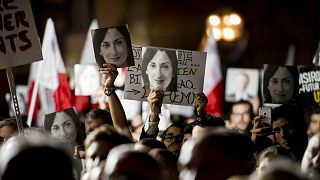
SLAPPs or Strategic lawsuits against public participation are a particular form of harassment used primarily against journalists and human rights defenders to prevent or penalise speaking up on issues of public interest. The Commission’s proposal has been dubbed as the ‘Daphne Law’ in honour of murdered Maltese journalist Daphne Caruana Galizia.
Member states, which together form the Council of the EU, have however sought to water down the text, drawing criticism for the Commission.
“I would like to express my regret concerning the weakening of the remedies against abusive court proceedings, in particular the deletion of the provision on compensation of damage and the weakening of the provision on award of costs,” Didier Reynders, Commissioner for Justice, said earlier this month after member states agreed on their negotiating position.
Parliament is seeking to redress that with German MEP Tiemo Wölken (S&D), the rapporteur on the draft directive, telling Euronews: “We made it stronger and we also added other provisions such as a creation of an ‘one stop shop’ which the SLAPPs targets can contact to receive help by dedicated national networks of specialized lawyers, legal practitioners and psychologists.”
It is not the first time member states are accused of trying to water down a proposal on media freedom. Earlier this month, a deal among the 27 member states on the European Media Freedom Act (EMFA) made a lot of eyebrows rise, because of a planned exemption to allow for the wiretapping of journalists. The regulation, first proposed by the Commission in September 2022, included safeguards against political interference in editorial decisions and against surveillance. The EU’s executive wanted to put focus on the independence and stable funding of public service media as well as on the transparency of media ownership and the allocation of state advertising.
“We have welcomed in particular as a political symbol the draft regulation for EMFA, as the Commission for the first time has adopted a legislative act dealing with all media, a traditionally sensitive subject dealt with at national level only,” Renate Schroeder, director of the European Federation of Journalists (EFJ), told Euronews. Yet, the EPJ and other NGOs, still criticised the proposal as “not ambitious enough”.
“In particular we believed that Article 4 on the protection of journalists’ sources and protection from surveillance has not met Council of Europe standards. We also advocated for stronger binding rules on media transparency,” Schroeder added.
But member states are seeking to add an exemption to Article 4, introduced by France and opposed by Germany only, that would allow them to spy on journalists in the name of national security.
The original proposal sought to ensure that governments could not “detain, sanction, intercept, subject to surveillance or search and seizure” journalists in order to uncover their sources, unless “justified by an overriding requirement in the public interest” while the deployment of spyware was to be restricted only to “serious crimes”.
The Council’s is hoping to broaden the number of offenses allowing such surveillance from 10 to 32.
“The text doesn’t protect journalists anymore and thereby makes the Act almost useless for journalists’ protection at least,” Schroeder said.
“It still proposes useful tools when it comes to independence of public service media, transparency on state advertisement, some minimum rules on media ownership and on editorial independence. But yes, some member-states are afraid of journalism and thereby give hands to illiberal countries such as Hungary who oppose the Act. We hope the European Parliament will be firm, but we are not too optimistic,” underlined the director of EFJ.
However, on 12 July, with 498 votes to 33 and 105 abstentions, MEPs adopted their negotiating position on new rules to protect those working on matters of public interest like fundamental rights, the activities of public officials or corruption allegations.
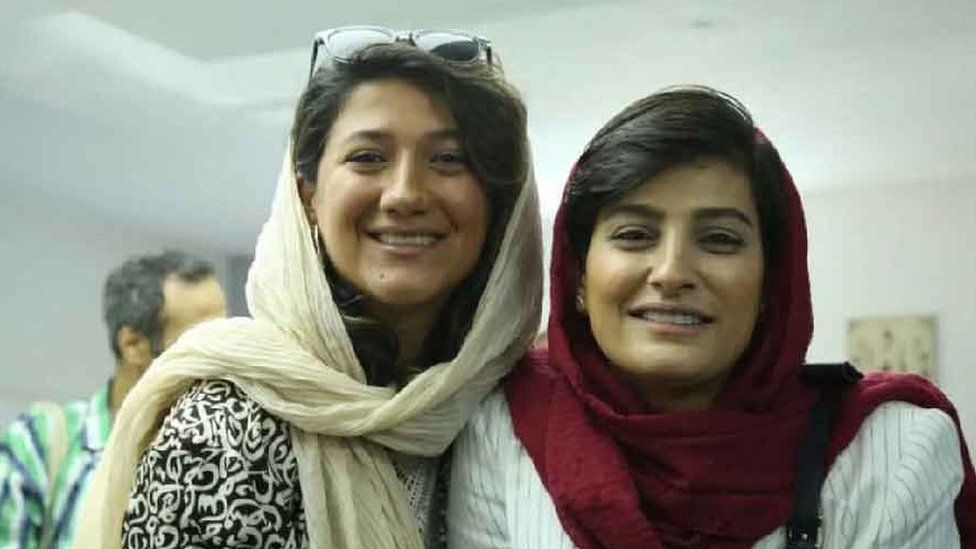
Image caption, Niloufar Hamedi and Elaheh Mohammadi have been detained in Iran for more than 200 days
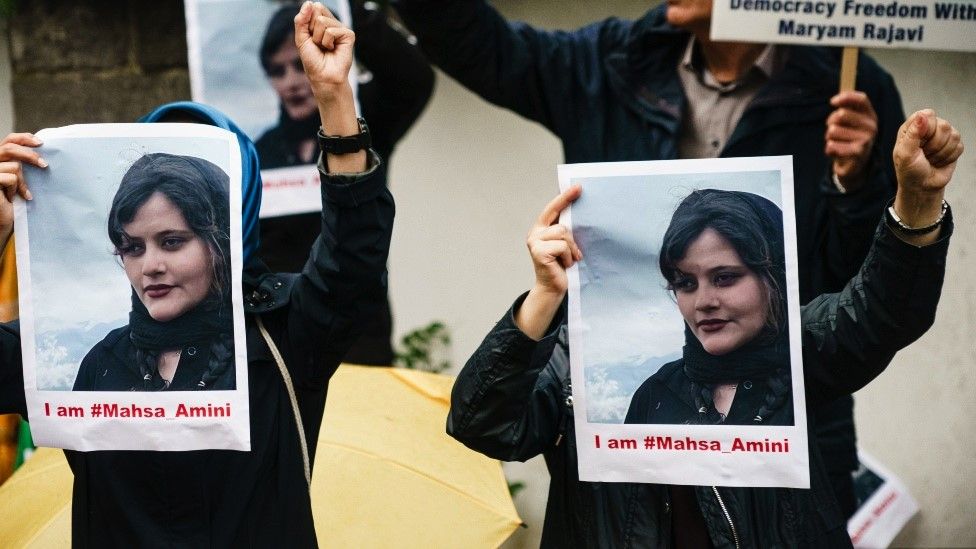
BBC Persian Service on 5 May 2023 drew attention to the fate of the two journalists who reported first on Mahsa Amini, whose name made headlines around the world when she died in custody last September, sparking waves of protests in Iran. But not many people have heard of Niloufar Hamedi and Elaheh Mohammadi.
The two female journalists helped break the story of Ms Amini’s death and have been detained in two of Iran’s most notorious prisons ever since. On Tuesday, they and the imprisoned Iranian human rights activist Narges Mohammadi were awarded the 2023 Guillermo Cano World Press Freedom Prize by the United Nations’ cultural agency, UNESCO.”They paid a hefty price for their commitment to report on and convey the truth. And for that, we are committed to honouring them and ensuring their voices will continue to echo worldwide until they are safe and free,” said Zainab Salbi, the jury chair. For more on Narges, see; https://www.trueheroesfilms.org/thedigest/laureates/07C20809-99E2-BDC0-FDC3-E217FF91C126
On 22 September, just six days after she tweeted a photograph of Mahsa’s grieving family, Niloufar Hamedi was arrested. Security forces also raided Elaheh Mohammadi’s home at the same time, seizing her electronic devices. On 29 September, she too was arrested.
Both Ms Hamedi and Ms Mohammadi were already known for hard-hitting news reports and coverage of human rights issues.
“Journalists in Iran are risking their lives on a daily basis to report on the conditions and oppressions there,” the Harvard fellows noted.
Image caption, Mahsa Amini’s death led to a wave of protests in Iran and rallies in solidarity around the world
Ms Hamedi and Ms Mohammadi have meanwhile been kept in harsh conditions at Evin prison in Tehran and Qarchak Women’s Prison, south of the city. Reports from inside Qarchak suggest that the facilities are inhumane, with a lack of medicine, food and even safe drinking water or clean air. Ms Mohammadi lost 10kg (22lbs) in the first three months of her detention, her husband wrote on his Instagram page.
Both women have also struggled to access legal support. The first lawyer appointed to represent the pair said in October that he was unable to communicate with them or access the legal documents surrounding their arrests. Less than a month later, he was himself arrested. The journalists’ families have struggled with the pain of not knowing what is going to happen to them.
“I’m asked, ‘What do the authorities tell you?’ I’m not even sure which institution or person to contact,” Ms Hamedi’s husband, Mohammad Hossein Ajorlou, said in an interview with Sharq.
He too has found it difficult to get information about what his wife is accused of and what is likely to happen to her.
At the end of October, Iran’s ministry of intelligence and the intelligence agency of the Revolutionary Guards issued a statement accusing Ms Hamedi and Ms Mohammadi of being trained by the US Central Intelligence Agency to foment unrest in Iran.
Their newspapers denied the allegations and insisted they had just been doing their jobs.
Last week, after they had both spent more than 200 days in custody, the Iranian judiciary announced that Ms Hamedi and Ms Mohammadi had been indicted and their cases referred to a court.
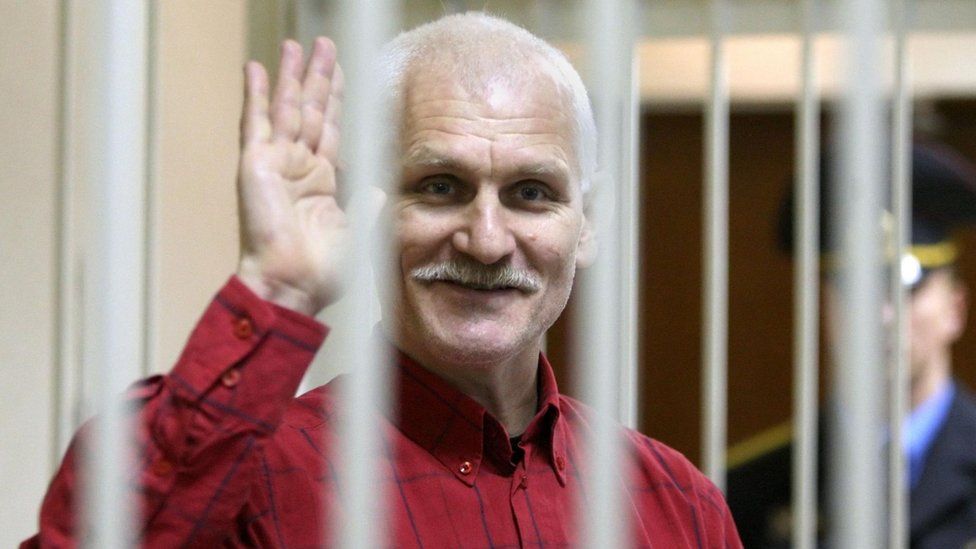
Belarus court sentences Ales Bialiatski to 10-year jail term, The sentencing of the Nobel Peace Prize winner and human rights defender has triggered protests. Media and human rights defenders across the world said that his arrest is ‘politically motivated’. See also: https://humanrightsdefenders.blog/2022/10/08/meet-ales-bialiatski-nobel-peace-prize-2022/
Image caption, Ales Bialiatski pictured in November 2021
Oliver Slow of BBC News reported as follows¨
…Supporters of Mr Bialiatski, 60, say the authoritarian regime of Belarusian leader Alexander Lukashenko is trying to silence him. He was arrested in 2021 following massive street protests over widely disputed elections the previous year, and accused of smuggling cash into Belarus to fund opposition activity. Demonstrators were met with police brutality and Lukashenko critics were regularly arrested and jailed during the demonstrations, which started in 2020.
Mr Bialiatski was in court alongside two fellow campaigners, Valentin Stefanovich and Vladimir Labkovich.
Mr Stefanovich was sentenced to nine years in prison, while Mr Labkovich received seven years, according to Viasna, the group Mr Bialiatski founded in 1996. All three had pleaded not guilty.
Mr Bialiatski’s wife, Natalya Pinchuk, said the trial was “obviously against human rights defenders for their human rights work”, describing it as a “cruel” verdict.
Referring to her husband’s letters from prison, where he has been held since arrest, she said: “He always writes that everything is fine. He doesn’t complain about his health – he tries not to upset me.”
Kostya Staradubets, a spokesperson for Viasna, said the sentences imposed on the three activists were “breaking our hearts”.
Speaking to the BBC World Service’s Newshour programme, he said: “We knew that our three colleagues would get long prison terms but anyway it’s still a shock, it’s breaking our hearts, not only the [prison] terms are long but the conditions also very horrific.
Belarus’s exiled opposition leader Svetlana Tikhanovskaya said the sentencing was “simply appalling”. “We must do everything to fight against this shameful injustice and free them,” she said.
Berit Reiss-Andersen, chair of the Norwegian Nobel Committee that awards the Nobel Peace Prize, said the verdict was a “tragedy” for Mr Bialiatski and described the charges as “politically motivated”.
In awarding the 2022 Nobel Peace Prize to Mr Bialiatski, Ms Reiss-Anderson said the Belarusian government had “for years tried to silence him”. “He has been harassed, he has been arrested and jailed, and he has been deprived of employment,” she said.
European Union foreign policy chief Josep Borrell condemned what he described as “sham trials”, adding they were “yet another appalling example of the Lukashenko regime trying to silence those who stand up in defence of human rights and fundamental freedoms of the people in Belarus”.
There are currently 1,458 political prisoners in Belarus, according to Viasna. Authorities claim there are none.
Human Rights Watch and others demand that the Rwandan authorities allow an effective, independent, and transparent investigation into the suspicious death of John Williams Ntwali, a leading investigative journalist and editor of the newspaper The Chronicles. Ntwali was regularly threatened due to his work as a journalist exposing human rights abuses in Rwanda and had expressed concern about his safety to Human Rights Watch and others.
“John Williams Ntwali was a lifeline for many victims of human rights violations and often the only journalist who dared report on issues of political persecution and repression,” said Lewis Mudge, Central Africa director at Human Rights Watch. “There are many reasons to question the theory of a road accident, and a prompt, effective investigation, drawing on international expertise, is essential to determine whether he was murdered.”
News of Ntwali’s death emerged in the evening of January 19, 2023. Police asked Ntwali’s brother to identify his body at Kacyiru Hospital morgue, telling him that Ntwali had died in a road accident the night of January 17 to 18. The police told the New Times website that Ntwali died in a motorbike accident in Kimihurura, Kigali, on January 18 at 2:50 a.m., but to date, have not provided details of the accident such as a police report, its exact location, or information on the others involved. Human Rights Watch is not aware of any reports about an alleged accident coming to light until the evening of January 19.
Ntwali was regularly threatened and attacked in the pro-government media for his investigative reporting. He played a leading role in covering and bringing attention to the plight of Kangondo neighborhood residents, who are in a long-standing dispute with authorities over land evictions. Recently, he also published videos on his YouTube channel about people who had suspiciously “disappeared.” His last video, posted on January 17, was about the reported disappearance of a genocide survivor who had spoken out about being beaten by police officers in 2018.
I don’t know what’s going to happen to me after CHOGM [the Commonwealth Heads of Government Meeting which took place in Kigali in June 2022]. I’m told that after CHOGM, they won’t play around with us anymore. I’ve been told five or six times. I receive phone calls from private numbers. Some [intelligence] people have come to my house twice to tell me. NISS [National Intelligence and Security Services] has told me: ‘If you don’t change your tone, after CHOGM, you’ll see what happens to you.’
On July 12, he told a friend he had survived a number of “staged accidents” in Kigali. “He was telling me about ordeals and threats he faces for his journalism,” his friend told Human Rights Watch.
Given these circumstances, Rwanda has a legal obligation to ensure a prompt, effective investigation that is capable of determining the circumstances of Ntwali’s death and identifying those responsible, with a view to bringing them to justice. An effective investigation must be independent, impartial, thorough, and transparent, conducted in full compliance with the Revised United Nations Manual on the Effective Prevention and Investigation of Extra-legal, Arbitrary and Summary Executions (The Minnesota Protocol on the Investigation of Potentially Unlawful Death).
Rwandan authorities have long targeted Ntwali. He was arrested in January 2016, in the lead up to the 2017 elections, and accused of raping a minor. Judicial officials later changed the charge to indecent assault and eventually dropped the case for lack of evidence.
At the time, Ntwali had been investigating several sensitive issues, including the death of Assinapol Rwigara, a businessman and father of would-be independent presidential candidate Diana Rwigara, whose candidacy to the 2017 elections was later rejected. The police said that Assinapol Rwigara died in a car accident in February 2015, but his family contested the authorities’ version of events.
Ntwali had also been arbitrarily arrested several other times and his website was blocked by a government regulator, apparently in retaliation for his reporting that was critical of the government.
“It is an embarrassment for the Commonwealth and a problematic message about its values that the country that presides over it is a place where the suspicious deaths of journalists and activists can be swept under the carpet,” Mudge said. “Rwandan authorities should not only not harm journalists but should be actively protecting them, and Rwanda’s partners should be holding the government to account in full for its obligations under international human rights law.”
The arrested suspects, Defense Minister General Guillermo García and Colonel Francisco Antonio Morán, will be arraigned on Monday before a judge in Chalatenango. El Salvador has also requested the U.S. to extradite Colonel Mario Reyes Mena, another suspect in the case who is believed to be the main person responsible for the murders.
The case concerns the murder of four Dutch journalists who worked for the now-defunct public broadcaster IKON: Koos Koster, Jan Kuiper, Joop Willemsen and Hans ter Laag. They traveled to El Salvador in 1982 to report on families living in the guerrilla zone during the country’s 12-year civil war. They were ambushed and shot on March 17, 1982 by the Salvadoran army.
A 1993 UN Commission of Inquiry marked Colonel Reyes Mena as “responsible for planning the ambush and assassination,” according to Zembla. That same year, an amnesty law was passed in El Salvador, which meant that Reyes Mena could not be prosecuted in that country. The criminal investigation into the murders of the four Dutch journalists was launched in 2013 and El Salvador’s amnesty law was lifted in 2016. The result was that perpetrators of crimes during the Salvadoran Civil War can now be prosecuted.
Reyes Mena, now in his 80s, was discovered to be living in the U.S. in 2018. “The case has already been investigated, I have never been charged. You are part of a communist plan to retaliate,” Reyes Mena told Zembla journalists who confronted him about the murders.
According to Zembla, a Dutch justice is being dispatched to the Central American country to speak with the arrested suspects.
“Mstyslav Chernov and Evgeniy Maloletka have a way of reporting that is painful to read and watch, but what really hurts is the truth that their reporting conveys: Russia brutally attacking Ukraine, and thereby Ukrainian civilians, under a fabricated pretense. While there are nuances to every story, there is no way facts can be negotiated. This is exactly what the Kremlin is doing: Distorting facts, spreading misinformation,” said DW Director General Peter Limbourg. “
The journalists, who both remain in Ukraine to continue their coverage of the war, welcomed the news about receiving the DW Freedom of Speech Award as an acknowledgment of their work. The award ceremony will be held on June 20 as part of the DW Global Media Forum.
AP journalist and novelist Mstyslav Chernov and freelance photojournalist Evgeniy Maloletka are both from eastern Ukraine. Previously, their reports and footage from the conflicts in Crimea and eastern Ukraine have been published in various international media, including BBC, Deutsche Welle, The New York Times, Washington Post, Der Spiegel and others. As a war reporter in several conflict zones such as Iraq or Syria, Chernov has been wounded multiple times. Before the war, Maloletka had also been working on a project about the Hutsul community in western Ukraine, their traditions and daily life, and on the impact of the conflict in the Donbas. Evgeniy Maloletka is a freelance photojournalist based in Kyiv.
The report “20 days in Mariupol: The team that documented city’s agony” offers a unique account of Mariupol under Russian siege, with Chernov and Maloletka being the last journalists in the city before their evacuation. They documented the city’s first deaths at the city hospital of Mariupol and the attack on the maternity ward with pregnant women and children in it, as well as numerous bombings. During this work, the journalists themselves were under constant attack and took great risks only to find a steady connection to upload their footage of the siege, bringing it to the attention of the international community. They were evacuated by Ukrainian soldiers to avoid them falling into the hands of Russians, who had been hunting them down.
AP Senior Vice President and Executive Editor Julie Pace: “Mstyslav and Evgeniy were the world’s eyes and ears in Mariupol, producing courageous and compelling reporting as the only international journalists inside the besieged city. The harrowing realities of Russia’s war would have remained unseen without their bravery. We are extremely proud of their work.“