To illustrate how international days can influence actions by NGOs, here an example from Syria:
The International Day of the Victims of Enforced Disappearances (30 August) the Platform of Families of Missing and Enforcedly Disappeared Persons in North and East Syria organized a solidarity stand in Qamishlo.
The event took place today under the slogan, “Our doors are still open, waiting for their return,” in front of the office of the United Nations High Commissioner for Refugees (UNHCR) in Qamishlo, Jazira Canton, with participation from relatives of the missing, activists, and human rights defenders.
Participants carried banners with messages in Kurdish, Arabic, and English, including: “A mother is still waiting at the window,” “Absence is a weight heavier than iron,” “No peace and no future without knowing the fate of the missing,” “Knowing the fate is the beginning of holding perpetrators accountable,” and “Our voices will not be silenced; we will continue demanding our loved ones.”
Abbas Ali Mousa, coordinator of the Platform of Families of Missing Persons in North and East Syria, told ANHA agency that the number of families affiliated with the platform ranges between 600 and 700.
Mousa explained that the event was held in solidarity with victims of enforced disappearances and their families, reaffirming their legitimate right to know the fate of their loved ones and emphasizing the necessity of establishing truth and justice.
Ilham Ahmed, the mother of journalist Farhad Hamo, who has been missing by ISIS mercenaries for 11 years, said: “I know nothing about my son or his fate.”
Ahmed added: “Despite repeatedly appealing to human rights organizations and relevant bodies, we have received no response or clarification.” She called on human rights organizations and groups working with abductees to reveal the fate of her son and all missing persons.
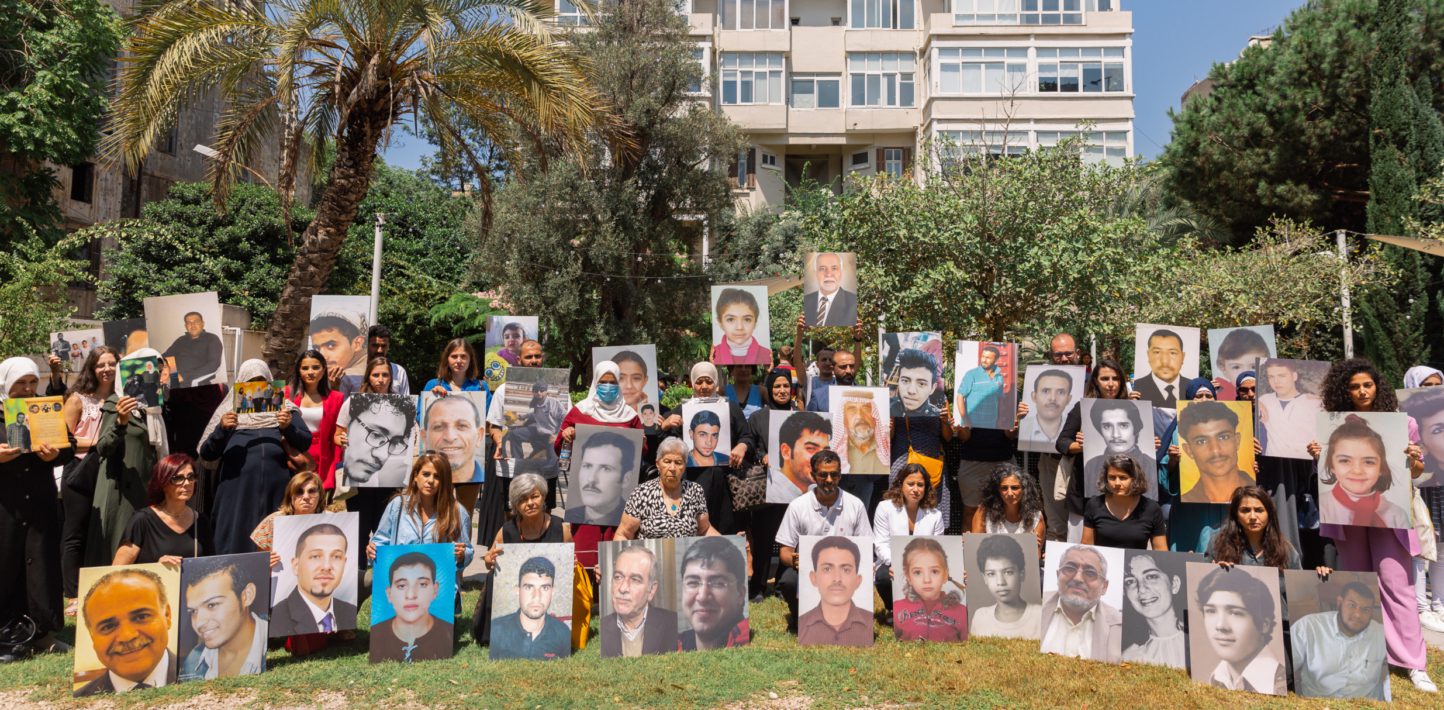
On 30 August 2023, Amnesty International reported on that Representatives of the families of people forcibly disappeared in Iraq, Lebanon, Syria and Yemen gathered in Beirut to demand that their governments uphold their rights to truth, justice and reparation, during an event organized by AI to mark the International Day of the Victims of Enforced Disappearances.
Across the Middle East, both state authorities and non-state actors, such as armed opposition groups, abduct and disappear people as a way to crush dissent, cement their power, and spread terror within societies, largely with impunity.
While most governments in the region have not yet investigated disappearances nor provided accurate numbers of those missing or disappeared, civil society organizations and UN bodies have published estimated numbers of people abducted and disappeared in each country. These numbers in Iraq, Lebanon, Syria and Yemen, when multiplied by a conservative estimate of the total years these individuals have been missing, suggest that families have spent more than a million years waiting for answers – an agonizing length of time.
“In the face of their governments’ apathy and complicity for the crime of enforced disappearances, the families of the disappeared across the Middle East have led the charge, year after year, in demanding their right to know what happened to their loved ones and to get justice and reparation – often at great personal risk,” said Aya Majzoub, Amnesty International’s Deputy Director for the Middle East and North Africa.
“Today we honour their perseverance and add our voice to theirs in calling for authorities to take real action to investigate these crimes, hold those suspected of criminal responsibility accountable and ensure these crimes are not committed again.”
Iraq
In Iraq, the UN estimates that between 250,000 to 1,000,000 individuals have been disappeared since 1968 – making it one of the countries with the highest number of disappearances in the world. Disappearances are still being carried out today at hands of militias affiliated with the government. Consecutive Iraqi governments have repeatedly failed to take meaningful steps to investigate disappearances or hold those suspected of criminal responsibility to account. Widad Shammari from Iraqi organization Al Haq Foundation for Human Rights, whose son has been missing since 2006, said: “I was a single protester until I met many others who shared my struggle, and we formed a strong coalition who fights for the truth for all the disappeared in the Arab region, not just Iraq.”
Lebanon
In Lebanon, the official estimate of those abducted or missing as a result of the 1975-1990 civil war is 17,415. Every year, on 13 April – the anniversary of the start of the Lebanese Civil War – the families of the missing and disappeared gather to mark the beginning of the conflict, repeating the mantra, “Let it be remembered, not repeated.”
The Lebanese authorities granted amnesty to the perpetrators of crimes that occurred during the civil war, but after years of campaigning, in 2018, the families of the disappeared successfully pressured the government to acknowledge the disappearances that took place. The government also passed a law that established the National Commission for the Missing and Forcibly Disappeared with a mandate to investigate individual cases, locate and exhume mass graves and enable a tracing process.
However, Wadad Halawani, whose husband was kidnapped in 1982 and who leads the Committee of the Kidnapped and Missing in Lebanon said: “Today, we raise our voice and shout out loud. The National Commission for the Missing and Forcibly Disappeared is 3 years old already. Only two years remain in its mandate. The Commission established a clear strategy for its work, but it cannot carry on without the needed financial and logistical support. The government must provide it with all the needed resources immediately.”
Syria
Since 2011, the Syrian authorities have forcibly disappeared tens of thousands of its actual or perceived opponents, including political activists, protestors, human rights defenders, journalists, lawyers, doctors, and humanitarian aid workers, as part of a widespread and systematic attack against the civilian population that amounts to crimes against humanity. Thousands have also gone missing after being detained by armed opposition groups and the so-called Islamic State. Given the Syrian government’s role in orchestrating the campaign of enforced disappearances, there has been total impunity for these crimes in Syria. The families have therefore resorted to international justice mechanisms.
In a momentous victory for the families, on 29 June 2023, the UN General Assembly voted to establish an international institution dedicated to shedding light on the fate and whereabouts of those missing and disappeared since the start of the armed conflict in Syria.
Fadwa Mahmoud from Families for Freedom, whose husband and son were disappeared in Syria in 2012 said: “We had big dreams in 2011. But we paid a very heavy price. My husband and son have been disappeared since September 2012… We faced our fears and raised our voice until it reached the United Nations …this [institution] is the product of our labour as the families of the detained…and this is its strength. We are demanding that we have an instrumental role in the institution.”
My husband and son have been disappeared since September 2012… We faced our fears and raised our voice until it reached the United Nations …this [institution] is the product of our labour as the families of the detained…and this is its strength.Fadwa Mahmoud from Families for Freedom, whose husband and son were disappeared in Syria in 2012
Yemen
In Yemen, human rights organizations have documented 1,547 cases of disappeared and missing people since 2015. All parties to the conflict, including the Huthi de facto authorities and the internationally recognized government forces, are still committing these crimes with impunity at a time when the world’s attention has turned away. Since the Human Rights Council voted in 2021 to end the mandate of the Group of Eminent Experts, following heavy lobbying from Saudi Arabia, efforts to hold all those suspected of criminal responsibility accountable in fair trials and realize victims’ rights to reparations have stalled.
The Abductees’ Mothers Association in Yemen said: “We were harassed and threatened and beaten-up during demonstrations, but we will not give up and we are determined at ensuring some progress every step of the way. We are not mothers of our own disappeared family members only; we consider ourselves mothers of every single disappeared person in the region and we will continue our fight for the truth for all of them.
This article – originally published by Prachatai, an independent news site in Thailand – was republished by Global Voices on 5 September 2022
To mark International Day of the Disappeared on August 30, a dozen people affiliated with the Mok Luang Rim Nam student activist group gathered at Ratchaprasong Intersection in downtown Bangkok. A small parade was held by activists in Siam Square to raise awareness about forced disappearances. The marchers carried portraits of abducted activists, some of whom were later found dead.
The group carried photos of Porlajee Rakchongcharoen, Surachai Danwattananusorn, Wanchalearm Satsaksit, and Siam Theerawut — Thai victims of forced disappearance. Hanging photos of the victims around their necks, some covered their heads with plastic bags in imitation of a suffocation torture technique.
Surachai Danwattananusorn, a veteran activist who fled the country after the 2014 coup, disappeared in December 2018 in a neighboring country, and his dead body was later found at the Thai-Laos border. Siam Theerawut also fled in 2014 and was arrested by Vietnamese authorities in 2019 before his reported extradition to Thailand. His whereabouts are still unknown.
Speaking on the occasion, activist Tanruthai Thaenrut said that the group wanted to raise awareness about forced disappearances, to tell people that the government is ignoring these disappearances and silencing the people to make disappearance seem normal.
A 2020 report by the UN Working Group on Enforced or Involuntary Disappearances estimates there are at least 75 victims of enforced disappearance in Thailand .
Uniformed police were seen standing guard at the National Police Headquarters on the way to Siam Square. Plainclothes police were reportedly taking photographs of event participants before the event started. When they reached their destination, the Superintendent of Pathumwan police station arrived with other police officers, to quietly monitor the situation.
During the gathering, activists staged a performance symbolizing an abduction. One of the participants placed a black bag over Tanruthai’s head while she was giving a speech. Two others then carried her away while other activists shouted, “Free our friends.”
Mint, a Thai traditional dancer-turned-activist who participated in the march, said that the performance signified that anyone could become a victim of forced disappearance. She noted that human rights lawyer Somchai Neelapaijit was abducted in the middle of Bangkok, and added that the fates of most people who disappeared remain unknown
On 30 August, 2022, the International Day of the Disappeared, the international community must recognize and respond to the widespread use of enforced disappearances in the People’s Republic of China, say an impressive group of NGOs (see list a the end):
Just over five years ago, on 13 August 2017, human rights lawyer Gao Zhisheng vanished for the third time. Gao, praised as the ‘Conscience of China’, had long fought for the rights of those who dared to speak out, who belonged to religious minorities, who were evicted from their homes when their land was seized, or who protested against exploitation. For that, he was in and out of prison and separated from his family for nearly a decade. For more than five years, his wife and children have had no idea of his whereabouts, nor even if he is alive. [see: https://www.trueheroesfilms.org/thedigest/laureates/33C77656-F58B-454E-B4C7-E1775C954F14]
Gao Zhisheng’s case is severe, and yet represents only the tip of the iceberg: many other activists and lawyers face a similar fate, such as Tang Jitian, disappeared in 2021, tortured, and detained in a secret location. UN experts, including the Working Group on enforced disappearance, have sounded the alarm from as early as 2011 about the use of enforced disappearances against those taking part in China’s human rights movement. It is used to silence those promoting rights and freedoms, to enable acts of torture and ill-treatment without any oversight, and to send a chilling message to any person who may dare to criticize the government.
The UN Secretary-General Antonio Guterres echoed this when he reminded the international community that enforced disappearance is a ‘method of repression, terror, and stifling dissent’. Relatives – themselves also victims of this crime– are deprived of their right to justice, and to know the truth, constituting a form of cruel and inhumane treatment for the immediate family.
But no matter how powerful a country is, no matter what security challenges (real or perceived) they may face, the experts rightfully emphasize: ‘There can never be an excuse to disappear people.’ Enforced disappearances are strictly prohibited under international law under any circumstances, and may constitute a crime against humanity when committed as part of a widespread or systematic attack against any civilian population.
The Chinese government continues to ignore calls for it to ratify the International Convention for the Protection of All Persons from Enforced Disappearance. It has disregarded requests for over nine years by the UN’s Working Group on Enforced and Involuntary Disappearances to visit the country, including its most recent on 7 January 2022. In the meantime, the number of cases of individuals disappeared presented before the Working Group soared, reaching 214 by 2021, out of which 98 remain outstanding.
It is urgent that the UN, governments, and civil society worldwide press China to end, unequivocally, all forms of enforced disappearance.
UN experts and civil society actors have documented many practices used by the Chinese authorities amounting to enforced disappearance. Some are written into Chinese law, or Chinese Communist Party guidance; others happen outside the scope of China’s own laws. Some target individuals for their actions or speech; others are wielded with the intent to terrorize a particular ethnic or religious community.
Residential Surveillance at a Designated Locations(RSDL)
‘Residential Surveillance at a Designated Location’ is allowed for in China’s Criminal Procedure Law, and authorizes holding someone in custody – prior to arrest – for up to six months in an undisclosed location. This ‘location’ is unofficial, selected at the discretion of the police, and the individual is isolated in solitary confinement without access to family, counsel or options to appeal the measure. This is especially true for those activists and dissidents accused of ‘national security crimes’. Incomplete government data admits to use of RSDL in some 23,700 instances, but civil society estimates that for the period 2013 to 2021, the real figure is closer to 85,000, with increased use over time. The practice continues despite having been condemned by UN experts as ‘a form of enforced disappearance’ that ‘may per se amount to cruel, inhuman or degrading treatment or punishment, or even torture.’ The experts’ assessment is clear: RSDL must be repealed. [see also: https://humanrightsdefenders.blog/2022/02/05/chinas-residential-surveillance-at-a-designated-location-needs-to-disappear/]
Liuzhi system
The liuzhi (留置) extralegal detention system mimics the practice of RSDL, but is used to specifically punish any public servant or Chinese Communist Party (CCP) member who allegedly ‘violates duties’ or commits ‘economic crimes,’ potentially reaching nearly 300 million victims. As with RSDL, liuzhi detentions can last up to six months, holding victims incommunicado and in solitary confinement at undisclosed locations. Yet, detentions are outside the scope of China’s laws, including the Criminal Procedure Law, as liuzhi is not part of the criminal justice system. Instead, it is run by China’s powerful extra-judicial anti-graft watchdog, the National Supervision Commission (NSC), a quasi-state body answerable only to the CCP. Legal safeguards, including the right to legal counsel, do not apply to individuals investigated under liuzhi, until and unless their case is sent for criminal prosecution. Incomplete official data acknowledges 11,000 individuals held under liuzhi; civil society estimates actual figures to surpass 57,000 disappeared victims. UN experts addressed a general allegation on this issue to China in September 2019.
Psychiatric incarceration (ankang)
Since the 1980s, China’s Ministry of Public Security has locked up individuals targeted for their political and religious beliefs in psychiatric hospitals for the criminally insane, known as ankang (安康) (‘peace and health’). Despite legal reforms, police continue to send human rights defenders for compulsory treatment without medical justification in both ankang facilities, and psychiatric hospitals for the general public. Civil society data indicates this is a regular, large-scale practice, where victims are denied contact with the outside world and often subjected to torture and ill-treatment, while families are not informed about their relatives’ forced hospitalization.
Enforced disappearance in Tibet
The Chinese authorities continue to disappear Tibetans, including religious leaders, critics and influential thinkers, subjecting them to torture and ill-treatment, and employing the threat of disappearance to instill widespread fear across Tibet. In February 2022, six UN experts raised concern over the physical well-being of Tibetan musician Lhundrup Drakpa, writer Lobsang Lhundrub, and school teacher Rinchen Kyi, arrested and disappeared ‘in connection with their cultural activities in favour of the Tibetan minority language and culture.’ In July 2021, four UN experts expressed similar concern over the enforced disappearance of Rinchen Tsultrim and Go Sherab Gyatso, pointing to a ‘worrying pattern of arbitrary and incommunicado detentions (…) against the Tibetan religious minority, some of them amounting to enforced disappearances.’
The 11th Panchen Lama, Gedhun Choekyi Nyima, one of the most important Tibetan Buddhist leaders, was disappeared in 1995 at the age of six. The Chinese government continues to ignore calls for his release, UN experts’ concerns, or the UN child rights committee’s request for access to establish his whereabouts and health.
Enforced disappearance in the Uyghur region
Beginning in 2017 in the Xinjiang Uyghur Autonomous Region (XUAR, or Uyghur Region), Uyghurs and Turkic Muslims have been detained incommunicado by Chinese government officials in internment camps, forced labor facilities, official prisons where they serve lengthy sentences, and other facilities where they are at risk of being subject to forced labor. Reports to the UN Working Group on enforced disappearances escalated dramatically, indicating a widespread and systematic practice. While the Chinese government refers to these camps as ‘vocational education and training centers’, administrative detention in the camps has no basis in Chinese, or international law.
Journalists and NGOs have reported countless testimonies of people whose family members are or were missing and believed to be detained in the XUAR, and yet who have no way to establish their family members’ whereabouts. They almost never receive official confirmation regarding their family member’s status from the Chinese authorities; efforts to gather information from Chinese consulates or embassies abroad have been largely unsuccessful. Very few detainees are allowed contact with the outside world. Even nominally ‘free’ Uyghurs living in XUAR have been effectively forbidden to speak with their family or friends abroad. Uyghurs in the country and overseas are wholly deprived of their right to truth.
We, the undersigned organizations, urge the international community as a whole to ensure sustained attention and take meaningful action to put an end to all forms of enforced disappearance in China. The authorities must release all those disappeared, ensure their relatives’ right to truth, justice, reparation, and guarantees of non-recurrence.
We stand in solidarity with all those missing, and with their loved ones, left longing for them to return alive.
On 29 August 2022, on the occasion of the International Day of Victims of Enforced Disappearances, AFAD, FIDH, Maayer Daak and Odhikar urge the government of Bangladesh to: 1) Halt all enforced disappearances and immediately return all disappeared persons to their families. 2) Set up an independent mechanism to investigate all cases of enforced disappearances. 3) Refrain from all forms of reprisals against human rights defenders, family members of the disappeared, and civil society activists, and ensure the safety and security of victims and their families. 4) Hold all perpetrators accountable. 5) Ratify the International Convention for the Protection of All Persons from Enforced Disappearance. 6) Adopt and implement domestic legislation criminalizing enforced disappearance in line with international law.
The Asian Federation Against Involuntary Disappearances (AFAD) is a federation of human rights organizations working directly on the issue of involuntary disappearances in Asia. AFAD was founded on 4 June 1998 in Manila, Philippines and was the recipient of the 2016 Asia Democracy and Human Rights Award. See: https://www.trueheroesfilms.org/thedigest/laureates/5E526725-F43B-83FB-3B7E-2B3C56D01F60 The International Federation for Human Rights (FIDH) is the world’s oldest non-governmental human rights organization. Founded in 1922, FIDH federates 192 member organizations from 117 countries. Its core mandate is to promote respect for all the rights set out in the UDHR. http://www.fidh.org Maayer Daak is a platform of the families of victims of enforced disappearances in Bangladesh with the common goal of seeking the whereabouts of their loved ones and advocating for justice. Odhikar is a human rights organisation in Bangladesh, established on October 10, 1994 by a group of human rights defenders, to monitor human rights violations and create wider awareness. It holds special consultative status with the ECOSOC of the United Nations.
Enforced disappearance refers to the arrest, detention or abduction of persons by agents of the State, or those acting with State authorization or support, whose whereabouts are unknown.
Once largely the product of military dictatorships, it has become a global problem, according to the UN, with hundreds of thousands of people “disappeared” in more than 80 countries. Impunity remains widespread.
While strictly prohibited under international human rights law, the SG, Mr. Guterres said enforced disappearance continues to be used across the world as a method of repression, terror, and stifling dissent.
“Paradoxically, it is sometimes used under the pretext of countering crime or terrorism. Lawyers, witnesses, political opposition, and human rights defenders are particularly at risk,” he added.
Having been removed from the protection of the law, victims, who can include children, are deprived of all their rights and are at the mercy of their captors.
They are frequently tortured and know that it is unlikely anyone will come to their aid. Some are even killed.
“Enforced disappearance deprives families and communities of the right to know the truth about their loved ones, of accountability, justice and reparation,” the Secretary-General said.
“The COVID-19 pandemic has added to the agony and anguish of enforced disappearance, by limiting capacities to search for missing persons and investigate alleged enforced disappearance.”
It was established by the UN General Assembly, which adopted a resolution in December 2010 expressing deep concern about the rise in incidents in various regions, and increasing reports of harassment, ill-treatment and intimidation of witnesses of disappearances, or relatives of people who were disappeared.
“The Convention for the Protection of all Persons against Enforced Disappearances is indispensable in helping to tackle this cowardly practice. But it requires the will and commitment of those with the power to do so,” the Secretary-General said. “States must fulfil their obligations to prevent enforced disappearance, to search for the victims, and to investigate, prosecute and punish the perpetrators.”
Mr. Guterres reiterated his call for countries to ratify the Convention, and to work with the UN Committee that monitors its implementation, as well as the Working Group on Enforced Disappearances, which assists families in determining the fate of their loved ones.
On this day Amnesty International, Human Rights Watch and the International Commission of Jurists (ICJ) issued a statement that the government of Nepal should promptly enforce Supreme Court rulings and permit the regular courts to try cases of enforced disappearance and other grave international crimes. On the International Day of the Victims of Enforced Disappearances, August 30, 2021, thousands of Nepali families are no closer to knowing the truth of what happened to their missing loved ones than they were when the country’s armed conflict ended 15 years ago.
Nepal’s Supreme Court has repeatedly ordered the government to investigate gross violations of human rights and international humanitarian law during the conflict from 1996 to 2006, and to conduct a meaningful, effective transitional justice process to establish the truth and provide justice for thousands of cases of serious abuses.
“The Nepali government stands in blatant violation of express orders of the Supreme Court by failing to conduct a credible, timely transitional justice process,” said Mandira Sharma, senior legal adviser for South Asia at the ICJ.
Many NGOs pay today attention to the International Day of the Victims of Enforced Disappearances. Here the example of AfricanDefenders (Pan-African Human Rights Defenders Network) which published the following on 27 August:
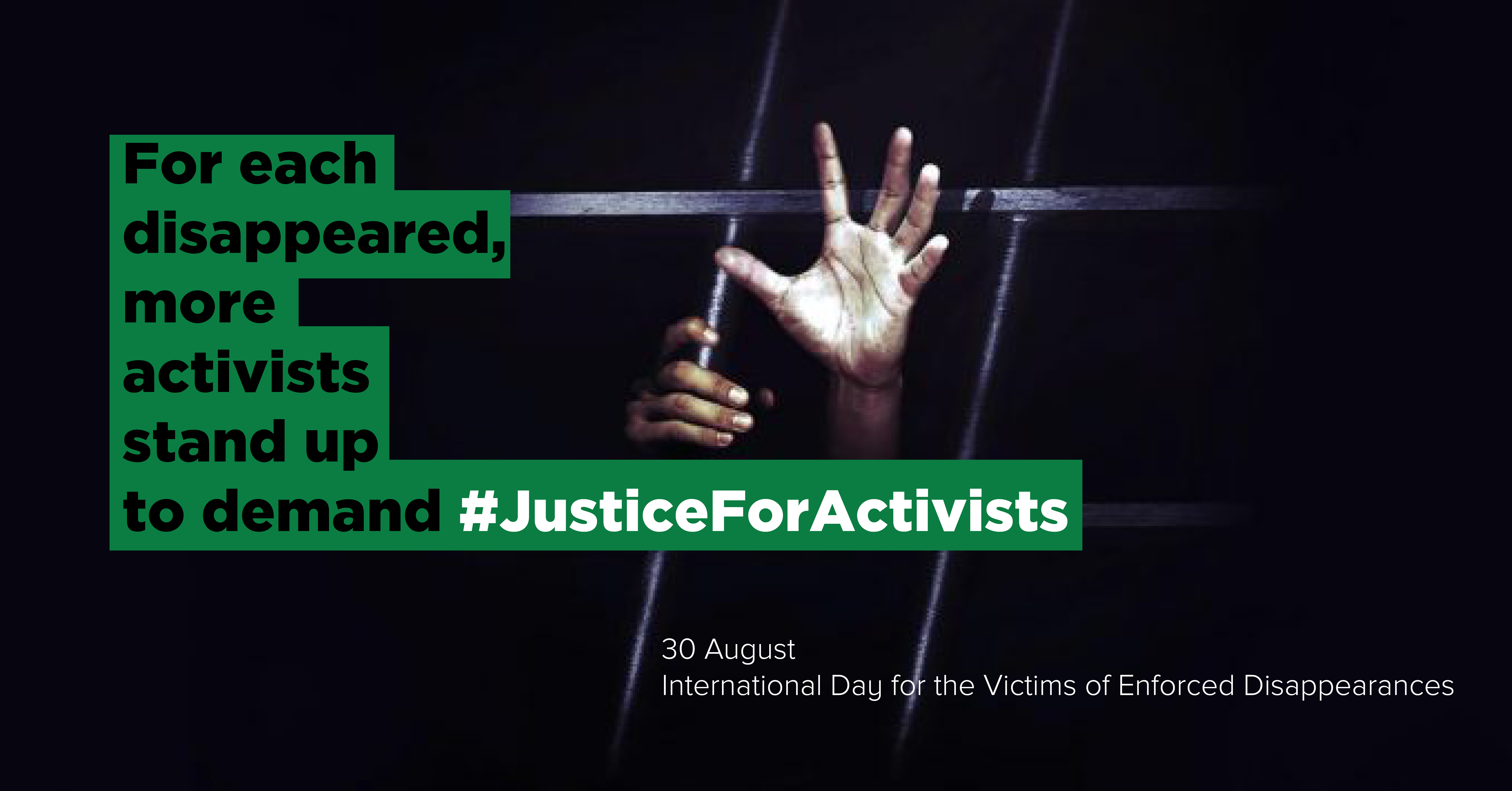
For each disappeared, more activists stand up! Stop enforced disappearances against human rights defenders
Some months later, on 10 December 2015, Burundian HRD Marie Claudette Kwizera was abducted in Bujumbura, Burundi by individuals believed to be members of the Burundian National Intelligence Service (SNR). Marie is still missing.
The cases of Sandra and Marie are not unique – it was just one of the few cases of enforced disappearance of African HRDs that made the headlines. Every year, African activists disappear without a trace, and without any media coverage. More importantly, no investigation is carried out, and no accountability is ensured. The alleged perpetrators continue to walk the streets, or, in most cases, rule the country, without any repercussions. Meanwhile, the victims are often tortured and many are killed, or live in constant fear of being killed, and the family and friends of the victim are left in the agony of not knowing the fate of their beloved.
In international human rights law, an enforced disappearance occurs when a person is abducted or imprisoned by state agents or by a third party with the authorisation, support or acquiescence of the state, followed by a refusal to acknowledge the person’s fate and whereabouts, which place the victim outside the protection of the law. When used systematically, it constitutes a crime against humanity according to the International Convention on the Protection of All Persons Against Enforced Disappearances (ICPPED).
Yet, it is a longstanding, systematic, and widespread tactic, often used by governments to silence HRDs, and as a strategy to spread terror within society. During the 1990s in Algeria, it is estimated that at least 7000 critical voices were abducted by government forces alone during the civil war. In Egypt, the Egyptian Commission for Rights and Freedoms’ campaign, “Stop Enforced Disappearances”, has documented more than 1000 cases of enforced disappearances of HRDs under Al-Sisi’s regime. During the current revolution in Sudan, hundreds of peaceful protests were abducted, disappeared, allegedly by the security forces. The fate and whereabouts of most of the victims remains unknown.
Despite threats and reprisals, the families and the communities of the victim continue to stand up and call for justice. For instance, every year, Burkinabe students commemorate Dabo Boukary, a student activist who disappeared during student protests in 1990. In Burundi, the impactful campaign “Ndondeza” (where are they?) continues to put pressure on the government and to call for justice. For each person that disappears, more activists stand up.
On 30 August, we commemorate the International Day of the Victims of Enforced Disappearance. We call on states to investigate cases of enforced disappearance and to ensure accountability; to ratify and implement the International Convention for the Protection of all Persons from Enforced Disappearances; and to ensure adequate reparations to the survivors, and their families.
We continue to stand in solidarity with HRDs that have disappeared, been tortured, and/or killed. We continue to demand #JusticeForActivists.

 Hans Thoolen on Human Rights Defenders and their awards