Posts Tagged ‘India’
December 20, 2013
On 19 December 2013, DHNS reported an excellent action by the Indian National Human Rights Commission [NHRC] which should be an example to national institutions worldwide: Peeved at the way state authorities treat human rights defenders, the NHRC has shot off a letter to all State governments asking them to sensitise their officers while dealing with human rights defenders who are making use of their Right to seek Information (RTI users as they are called in India). In his communication NHRC Secretary General, Parvinder Sohi Behuria, said the activists have been complaining that the States treat them as nuisance and take actions to harass them. “It would be of immense help if state government functionaries are sensitised about the problems being faced by NGOs and Human Rights defenders. They should be treated as partners in bringing about a positive change,” Behuria said.
via Treat RTI users as rights defenders.
Posted in Human Rights Defenders | Leave a Comment »
Tags: activism, harassment, human rights, Human Rights Defenders, India, National Human Rights Commission NHRC, national institutions, NHRC, Non-governmental organization, Parvinder Sohi Behuria, right to information, Right to Information Act, RTI
December 14, 2013

(Photo Courtesy-Dhwanil Kapasi)
To create awareness among the masses, the Flashpoint Human Rights Film Festival was held from 12-14 December 2013 in Mumbai, India. The three-day film festival was organised by Solaris Pictures in association with ACEE – The Third Eye and Movies That Matter and Alliance Francaise de Bombay. The third edition of the film festival was held at Alliance Francaise and entry was Entry free. The films screened included
One Day after Peace
Forbidden Voices
Salma
Inshallah Kashmir
Reportero
High Tech Low Life
United in Anger
Shahid
Bottle Masala in Moile
Mumbai hosts Third edition of Flashpoint Human Rights Film Festival from 12-14 December – Mumbai – DNA.
Posted in films, human rights, Human Rights Defenders | Leave a Comment »
Tags: film, film festival, Flashpoint Human Rights Film Festival, human rights, human rights films, India, Mumbai, Solaris Pictures
December 14, 2013
Laila Alawa in a post on PolicyMic of 13 December puts a good question:
should award givers not take care in selecting the one who hands out the award? She does not mince her words in stating that
Queen Noor of Jordan was the wrong choice by the
Thomson Reuters Foundation as she does not uphold the qualities that this foundation wants to reward.
Read the rest of this entry »
Posted in human rights, Human Rights Defenders | Leave a Comment »
Tags: Alaa Murabit, awards, human rights awards, India, Jordan, Libya, London Trust Women Conference, Neha Dixit, Queen Noor, Queen Noor of Jordan, Reuters, South Asia, thomson reuters foundation, Trust Women Awards, women human rights defenders, Women's rights
November 10, 2013
The Assam Tribune Online of 9 November provides us with an interesting illustration of how a combination of: (a) local activism, (b) introduction by an international NGO, and (c) invitation to an EU meeting can have result: Read the rest of this entry »
Posted in Front Line, human rights, Human Rights Defenders | Leave a Comment »
Tags: activism, Assam, Assam State Government, Civil society, EU-NGO Forum on Human Rights, Front Line Defenders, Human Rights Defenders, India, Indigenous rights, international NGO, KMSS, Krishak Mukti Sangram Samiti, meeting, Tarun Gogoi, The Assam Tribune Online
November 5, 2013
The Indian government should vigorously investigate allegations that officials are using the law on foreign contributions to repress groups critical of the government, Human Rights Watch said on 31 October 2013.

The government should amend the 2010 Foreign Contribution (Regulation) Act to protect the right to freedom of association and expression. Read the rest of this entry »
Posted in HRW, human rights, Human Rights Defenders | 4 Comments »
Tags: Civil society, Eurasia Review, Foreign Contribution Act, foreign funding, funding restrictions, Government of India, harassment, harss, HRW, human rights, Human Rights Defenders, Human Rights Watch, India, Non-governmental organization, South Asia, United Nations Special Rapporteur
October 18, 2013
The Hueiyen News Service Imphal, reports that on 19 October 2013 a number of NGOs in Manipur State [a state in northeastern India, with the city of Imphal as its capital] will come together to organise a new “Convention on Protection of Human Rights Defenders of Manipur“. The Convention has been planned against the backdrop of increasing targeting of human rights defenders and their organizations in Manipur by security forces operating under emergency laws. The convention will also discuss the patterns of targeting human rights defenders and adopt specific resolution and strategies to promote the human rights and protection of human rights defenders of Manipur.
via Protection of human rights defenders : 18th oct13 ~ E-Pao! Headlines.
Posted in human rights, Human Rights Defenders | Leave a Comment »
Tags: Advocacy Organizations, Civil society, coalition, emergency laws, Human right, Human Rights and Liberties, Human rights defender, Human Rights Defenders, India, Manipur, minorities, NGOs, Non-governmental organization, repression, security forces
June 17, 2013
On 17 June, 2013 the Observatory for the Protection of Human Rights Defenders [joint programme of the World Organisation Against Torture and the International Federation for Human Rights] issued a statement on the fate of 13 women human rights defenders in India.
 Read the rest of this entry »
Posted in FIDH, human rights, Human Rights Defenders, OMCT | Leave a Comment »
Tags: arbitrary arrest, freedom of demonstration, gang rapes, Human rights defender, Human Rights Defenders, India, International Federation for Human Rights, intimidation, judicial harassment, Kalighat, Kolkata, Maitree, Observatory, rape, West Bengal, Women Human Rights, women human rights defenders, World Organisation Against Torture
May 21, 2013
On 16 May 2013, human rights defender and maternal health activist Ms Madhuri Ramakrishnasway was arrested outside the court in Barwani in Madhya Pradesh, in a case brought against her after a protest. Madhuri Ramakrishnasway is a leader of Jagrit Adivasi Dalit Sangathan (JADS), a tribal and Dalit Rights Collective which has been working for fourteen years in Madhya Pradesh. Advocacy organisations often come together under the banner of JADS to hold peaceful protests in order to raise awareness of the extremely poor health care for women in pregnancy and labour. Sit-in protests are now taking place outside police stations in the district in solidarity with the human rights defender. Read the rest of this entry »
Posted in Front Line, human rights, Human Rights Defenders | Leave a Comment »
Tags: Adivasi, arrest, Bania (caste), Barwani, Dalit, freedom of demonstration, Front Line Defenders, human rights, Human rights defender, India, Madhuri Ramakrishnasway, Madhya Pradesh, poor health care, pregnancy and labour, right to health
April 29, 2013
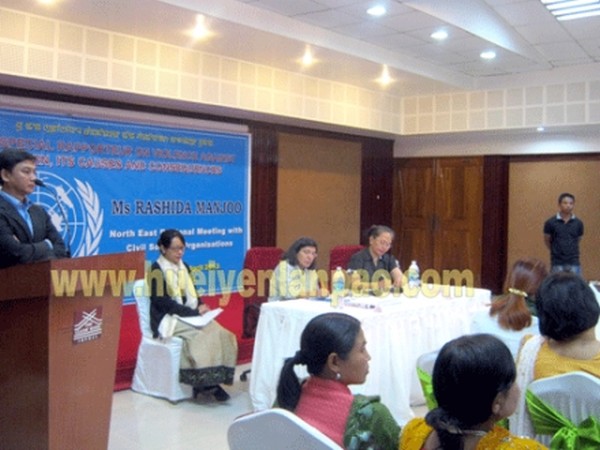
(Executive Director of HRA Babloo Loitongbam delivering the vote of thanks of the meeting)
The Indian agency E-Paonet reports in some detail on the visit by a UN Special Rapporteur to India. Let’s start by acknowledging India’s willingness to accept the Rapporteur (unlike other countries such as Eritrea I just reported on today)!
The Rapporteur in question is Rashida Manjoo the United Nations Special Rapporteur on Violence Against Women, its Causes and Consequences who held a consultative meeting with representatives of civil society organizations, women human rights defenders, victims and other advocates working on violence against women at Classic Hotel, on 28 April. As many as forty separate depositions were made during the meeting, the largest one during her current 10-day long official mission to India from April 22 to May 1. After hearing all the depositions, Rashida observed that it was not her mandate to comment on the depositions made before her, but assured that her report and recommendations would be based on facts and they would be placed on the table of the forthcoming session of the United Nations Commission on Human Rights, which is scheduled to take place June this year at Geneva for necessary actions. Read the rest of this entry »
Posted in human rights, Human Rights Defenders | Leave a Comment »
Tags: Assam Rifles, civil society organizations, consultation, Convention on the Rights of the Child, E-Paonet, fact finding, Human Rights Defenders, India, national ngos, New Delhi, Rashida Manjoo, UN Special Rapporteur, United Nations Special Rapporteur, Violence against women, West Bengal, women human rights defenders
April 3, 2013
For many years Dublin-based Front Line Defenders has continued a practice of issuing official-looking cards to whom they judge to be genuine human rights defenders. It is interesting to note that the news service Authint has picked up on this and issued a statement on 2 April 2013 saying: Defenders has issued an identity card to local human rights activist Abdul Qadeer Dar [in Kashmir]. Dar is an Executive Director of Voice of Victims and Chairman Peoples Rights Movement.” “The card is for those human rights defenders who have worked very closely with or have attended one of the Dublin Platforms or trainings”, Front Line told KNS. The “Card doesn’t empower the holder to represent Front Line defenders as it is not a membership organization. The card is intended to demonstrate that its holder is human rights defender with whom front Line Defenders has worked”.
via Defenders issued I Card to local HRA | Authint Mail.
Posted in human rights, Human Rights Defenders | Leave a Comment »
Tags: Abdul Qadeer Dar, Advocacy Organizations, Dublin, Frontline Defenders, Human right, Human Rights and Liberties, Human rights defender, India, Kashmir, Pakistan, protection


