Posts Tagged ‘illegal detention’

50 human rights NGOs address Joint Letter to Aung San Suu Kyi on Reuters Journalists

November 6, 2018

Over 50 NGOs have signed a joint letter to Aung San Suu Kyi requesting the immediate and unconditionally release of Wa Lone and Kyaw Soe Oo.

TO: Aung San Suu Kyi, State Counsellor, Myanmar

Read the rest of this entry »

19 missing human rights defenders in Egypt !!

November 6, 2018

Fears grow for 19 missing human rights defenders in Egypt. Hoda was one of 19 activists – eight women and 11 men – swept up Thursday 1 November as the regime escalates pressure on human rights NGOs. Four days later the location and fate of these activists is still unknown. One of the organisations hit hard by this crackdown is the ECFR, which documents enforced disappearances and the expanding use of the death penalty.

A number of prominent members of the group have been targeted before. In September, Executive Director of ECFR, Ezzat Ghoneim, was forcibly disappeared despite being released from Tora prison after serving a six-month prison sentence there. In October Egyptian authorities issued an arrest warrant for Ghoneim for failing to adhere to the terms of his release despite the fact that his family say he is still being held in secret detention.

Along with Ghoneim the group’s co-founder Azzouz Mahgoub was also forcibly disappeared in March. Last Thursday the ECFR announced the suspension of its work citing the current climate in Egypt as “incompatible with human rights work”. “The human rights situation in Egypt, especially with regard to the rights of detainees and human rights defenders, has been the worst in Egypt’s history in the past five years” ECFR said in a statement.

“Furthermore, the Egyptian authorities have committed the most serious violations beyond all humanitarian norms including the storming of women’s homes, their detention and the arrest of their families over the past three months alone.”

see also: https://humanrightsdefenders.blog/2018/04/03/egypt-the-foreign-funding-accusation-against-human-rights-defenders-goes-in-overdrive/

https://www.middleeastmonitor.com/20181105-fears-grow-for-19-missing-human-rights-activists-in-egypt/

Iranian Human Rights Defenders in trouble

September 27, 2018
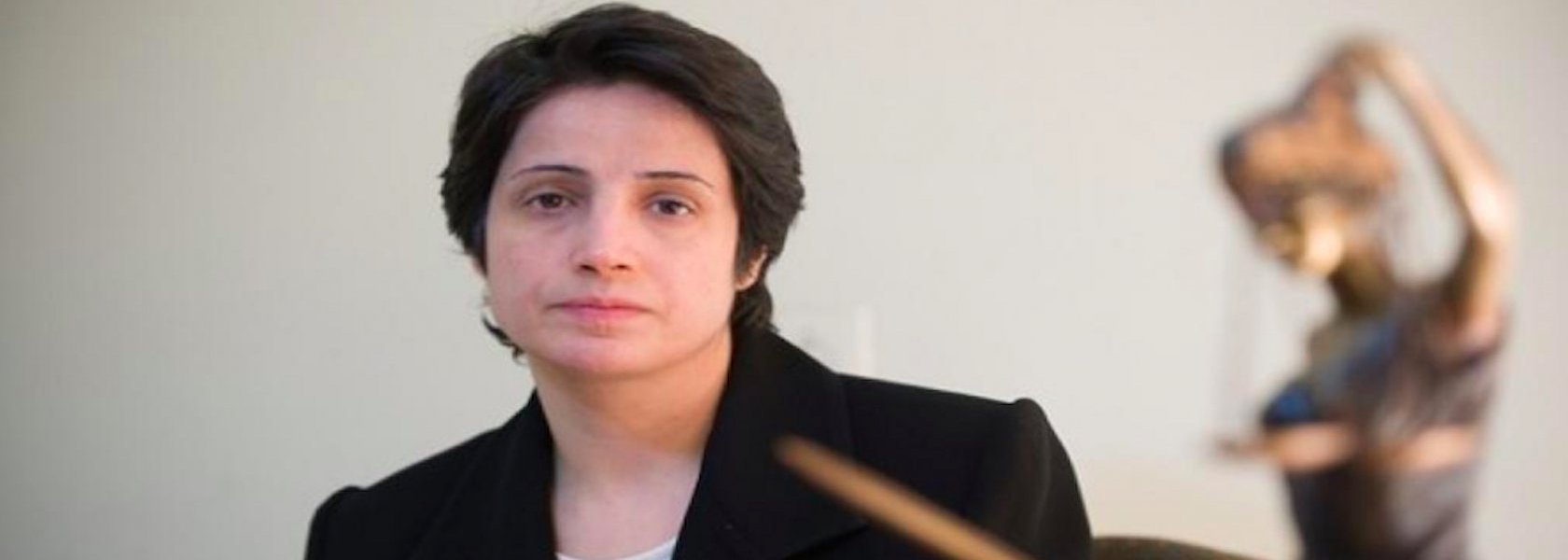
On 21 September 2018 the Observatory for the Protection of Human Rights Defenders (FIDH/ OMCT) petitioned the United Nations Working Group on Arbitrary Detention (WGAD) to seek the release of Iranian human rights lawyer Ms. Nasrin Sotoudeh. Ms. Nasrin Sotoudeh, a prominent defender and 2012 laureate of the European Parliament’s Sakharov Prize, was arrested on June 13, 2018 at her home in Tehran. [see: https://humanrightsdefenders.blog/2018/08/30/human-rights-defender-nasrin-sotoudeh-on-hunger-strike-in-iran/ ].. On September 16, 2018, Ms. Sotoudeh was informed that she would be denied her family visitation rights if she and her female visitors – including her daughter – did not wear a full hijab. Ms Sotoudeh has refused the condition and was denied the right to see her daughter on September 17, 2018.
The Observatory urges the Iranian authorities to immediately and unconditionally release Ms. Sotoudeh and to cease all acts of harassment and other abuses against her and all human rights defenders in Iran, in accordance with the provisions of the United Nations Declaration on Human Rights Defenders and with international human rights standards and international instruments to which Iran is a State party.

The semi-official ISNA news agency reported on Thursday 27 September that another human rights defender, Narges Mohammadi, has been granted a three-day leave from prison to visit her ailing father.

However, the recent terror attack in Iran may be expected to prompt the Guards to compensate by cracking down on domestic detractors and perceived opponents of their mission of defending and principles of the Islamic revolution. Certainly, some prominent figures within the Iranian activist and expatriate communities have been quick to raise alarms about the likelihood of this outcome. For instance, the Center for Human Rights in Iran quoted the Iranian human rights activist and Nobel Peace laureate Shirin Ebadi as saying of last Saturday’s attack, “Such actions lead to the justification of state violence and the arrest of many opponents in the name of fighting terrorism.” Meanwhile activists echoed the sentiment, saying, “Terrorism and violence in any form should be condemned in the strongest terms [but] such acts of violence should not become an excuse for state violence to suppress peaceful opposition.

Some good news from Cambodia: Tep Vanny and three other human rights defenders pardoned

August 22, 2018

Tep Vanny, second from left, gestures upon arrival at her home in Phnom Penh, Aug. 20, 2018.

Tep Vanny, second from left, gestures upon arrival at her home in Phnom Penh, Aug. 20, 2018. – AP Photo

Cambodia’s King Norodom Sihamoni on 20 August 2018 granted royal pardons to prominent land rights activist Tep Vanny and three others convicted for their roles in a protest over a land grab in the capital Phnom Penh’s Boeung Kak Lake community. Tep Vanny, 38, was arrested on 15 August 2016 after participating in a demonstration, handed six days in prison for “insulting a public official” and, instead of being released when the sentence was served, charged with “aggravated intentional violence” for a protest she held more than three years earlier in front of the home of Prime Minister Hun Sen.

On Feb. 23, 2017, the Phnom Penh Municipal Court convicted Tep Vanny of assaulting two security officers during the 2013 protest at Hun Sen’s home, sentencing her to 30 months in prison and making her pay 9 million riels (U.S. $2,250) in compensation to the officers. Three other female activists—Heng Mom, Bo Chhorvy, and Kong Chantha—were also convicted for “obstructing public officials” during the protest, but released on bail.

On Monday, King Sihamoni issued a royal decree at the behest of Hun Sen, overturning the convictions of all four activists without providing any reason for the decision. Speaking to RFA’s Khmer Service, Tep Vanny said: “I was given no prior notice that I would be released,”“The prison guards came to inform me just before 8:30 p.m. that I would be freed soon and said I should get my things ready. I told them they had come to tell the wrong person.”  Although I am happy tonight for the freedom to meet with my family, relatives, and community members, my pain remains with me, as I have spent over two years in jail,”.

Tep Vanny was awarded the 2013 Vital Voices Global Leadership Award for her work campaigning on behalf of the community evicted from Boeung Kak Lake, which was later filled with sand to make way for a development project with ties to Hun Sen and the ruling Cambodian People’s Party (CPP). On Monday, she appealed to Hun Sen to release all of the country’s remaining political prisoners, including former RFA reporters Uon Chhin and Yeang Sothearin, who have spent nine months behind bars on “espionage” charges.

Various rights groups had demanded Tep Vanny’s release in the lead up to the 15 August anniversary marking her two years in prison, with New York-based Human Rights Watch’s deputy Asia director Phil Robertson calling her conviction “just one of many outrageous cases in which the authorities have misused Cambodia’s justice system to harass and imprison peaceful land rights activists.” On Monday, London-based Amnesty International’s senior director of global operations Minar Pimple welcomed Tep Vanny’s release in a statement, but called it “long overdue.”

re Boeung Kak Lake case see my older: https://humanrightsdefenders.blog/2012/06/20/boeung-kak-lake-women-sentenced-for-peaceful-protest-in-cambodia/

Still this is only SOME good news as in the meantime Front Line reported that on 12 August 2018, human rights defender Nay Vanda received a court summon dated 9 August 2018 issued by the Vice Prosecutor of the Phnom Penh Municipal Court, summoning him to attend a trial at 7:30am on 27 August 2018 at the Phnom Penh Municipal Court. Subsequently, human rights defender Ny Chakrya also received the same court summons. These summons are related to charges brought against five human rights defenders on 2 May 2016. Nay Vanda, Ny Sokha, Yi Soksan and Lim Mony were charged  <https://www.frontlinedefenders.org/en/case/five-adhoc-members-detained#case-update-id-3050&gt; with bribing a witness under Article 548 of the Criminal Code, and Ny Chakrya was charged as an accomplice to bribery of a witness in accordance with Articles 28 and 548 of the Criminal Code. If convicted, they face between five to ten years imprisonment. It is anticipated that the three human rights defenders who have not received the court summons will receive them in the coming days. 

The Cambodian Human Rights and Development Association (ADHOC) <https://www.frontlinedefenders.org/en/profile/adhoc&gt;  is a human rights organisation founded in December 1991 by a group of former political prisoners aiming to address violations of rights and freedoms. See also: https://humanrightsdefenders.blog/tag/adhoc/

—–

Many links including: https://www.rfa.org/english/news/cambodia/pardons-08202018162801.html

Saudi Arabia still steering in the wrong direction

May 19, 2018

Saudi authorities detained seven women human rights defenders since 15 May 2018, say Human Rights Watch (HRW) and the Gulf Centre for Human Rights. “Crown Prince Mohammad bin Salman’s ‘reform campaign’ has been a frenzy of fear for genuine Saudi reformers who dare to advocate publicly for human rights or women’s empowerment,” HRW Middle East Director, Sarah Leah Whitson, said in a statement. Among the detained women are Eman al-Nafjan, a Saudi blogger, and Lujain al-Hathloul, a women right’s activist who had been arrested previously and held for 75 days for attempting to drive back into Saudi Arabia from neighbouring United Arab Emirates (UAE).

Rothna Begum, a women’s rights researcher at Human Rights Watch, said the government is trying to silence critics, particularly those who champion women’s rights reforms.  “While it’s not clear why they were arrested, today we have seen Saudi press reports come to suggest that these women are traitors and have been arrested because they are undermining the national unity of the country,” Begum told Al Jazeera.

Amnesty International condemned the commentary of the arrests as a “chilling smear campaign” and an “extremely worrying development for women human rights defenders” in the country.

[Since 2011, nearly 30 activists and dissidents have been convicted in Saudi courts, many of whom received sentences of up to 15 years, according to HRW.]

https://www.i24news.tv/en/news/international/middle-east/175098-180519-saudis-detain-women-s-advocates-ahead-of-driving-ban-lift

https://www.aljazeera.com/news/2018/05/saudi-arabia-arrests-women-rights-activists-180519075533018.html

For some of my earlier posts: https://humanrightsdefenders.blog/tag/saudi-arabia/

later: http://www.thesundaily.my/news/2018/05/24/saudi-driving-activist-released-after-crackdown-say-campaigners

Emirates: one year later human rights defender Ahmed Mansoor’s whereabouts remain unknown

March 21, 2018
 

The authorities in the United Arab Emirates (UAE) should reveal the whereabouts of prominent human rights defender and citizen-journalist Ahmed Mansoor and release him immediately and unconditionally, an impressive group of over twenty human rights organisations said on 20 March 2018.  This day marks one year since security forces arbitrarily arrested Mansoor, winner of the Martin Ennals Award for Human Rights Defenders in 2015, at his home in Ajman. The UAE authorities have continued to detain him in an unknown location, despite condemnation from UN human rights experts and independent human rights organisations.

The authorities have subjected Ahmed Mansoor to enforced disappearance since his wife last saw him in September 2017. They must reveal his whereabouts to his family and grant him regular access to them and to a lawyer of his choosing.  Following his arrest on 20 March 2017, the authorities announced that he is facing speech-related charges that include using social media websites to “publish false information that harms national unity.”  On 28 March 2017, a group of UN human rights experts called on the UAE government to release Mansoor immediately, describing his arrest as “a direct attack on the legitimate work of human rights defenders in the UAE.” They said that they feared his arrest “may constitute an act of reprisal for his engagement with UN human rights mechanisms, for the views he expressed on social media, including Twitter, as well as for being an active member of human rights organisations.”  Since his arrest, Mansoor has not been allowed to make telephone calls to his family and has been allowed only two short visits with his wife, on 3 April and 17 September 2017, both under strict supervision. He was brought from an unknown place of detention to the State Security Prosecutor’s office in Abu Dhabi for both visits. The authorities have refused to inform his family about his place of detention and have ignored their requests for further visits.

In February 2018, a group of international human rights organisations commissioned two lawyers from Ireland to travel to Abu Dhabi to seek access to Mansoor. The UAE authorities gave the lawyers conflicting information about Mansoor’s whereabouts. The Interior Ministry, the official body responsible for prisons and prisoners, denied any knowledge of his whereabouts and referred the lawyers to the police. The police also said they had no information about his whereabouts. The lawyers also visited Al-Wathba Prison in Abu Dhabi following statements made by the authorities after Mansoor’s arrest, which suggested that he was held being held there. However, the prison authorities told the lawyers there was nobody matching Mansoor’s description in the prison.  Instead of protecting Mansoor, the authorities have detained him for a year with hardly any access to his family and no access to a lawyer of his choosing. Their contempt for human rights defenders and brazen disregard for their obligations under international human rights law is truly shocking. [https://humanrightsdefenders.blog/2018/02/27/somewhere-in-a-prison-in-the-emirates-is-ahmed-mansoor-but-authorities-claim-not-to-know-where/]

Background to his case is documented in the joint statement and in my earlier posts: https://humanrightsdefenders.blog/tag/ahmed-mansoor/

Mansoor is a member of GCHR’s Advisory Board and a member of the advisory committee of Human Rights Watch’s Middle East and North Africa Division.

Signed:
Americans for Democracy and Human Rights in Bahrain
Amnesty International
Arabic Network for Human Rights Information (ANHRI)
ARTICLE 19
CIVICUS
Committee for the Respect of Freedoms and Human Rights in Tunisia
English PEN
Freedom Now, Morocco
Front Line Defenders
Gulf Centre for Human Rights (GCHR)
Human Rights First
Human Rights Watch
International Commission of Jurists (ICJ)
International Federation for Human Rights (FIDH), under the Observatory for the Protection of Human Rights Defenders
International Service for Human Rights (ISHR)
Maharat Foundation
Martin Ennals Foundation
Moroccan Association for Human Rights
PEN International
Reporters Without Borders
Scholars at Risk
Tunisian Association for Academic Freedoms
Tunis Center for Press Freedom
Tunisian Forum for Economic and Social Rights
Tunisian League for Human Rights (LTDH)
Tunisian Organisation against Torture
Vigilance for Democracy and the Civic State
World Organisation Against Torture (OMCT), under the Observatory for the Protection of Human Rights Defenders

http://www.martinennalsaward.org/ahmed-mansoors-remain-missing/

https://www.ifex.org/united_arab_emirates/2018/03/20/uae-ahmed-mansoor-1-year/

Somewhere in a prison in the Emirates is Ahmed Mansoor but authorities claim not to know where

February 27, 2018

 Two Irish lawyers attempt to reach human rights defender Ahmed Mansoor, who is held incommunicado in United Arab Emirates, but in vain.

Today the Martin Ennals Foundation reports that on 26 February 2018, two lawyers from Ireland approached the Ministry of the Interior in the United Arab Emirates (UAE) to try to gain access to distinguished human rights defender Ahmed Mansoor, who has been detained since 20 March 2017 for his human rights activities. Mansoor, who received the Martin Ennals Award for Human Rights Defenders in 2015, is a member of the advisory boards of the Gulf Centre for Human Rights (GCHR).

Given the widely documented use of torture and solitary confinement by UAE authorities, and the lack of any independent information regarding Mansoor, there are grave fears for his safety. Numerous organisations have expressed concern that he may be tortured and subject to ill treatment in detention.

See also: https://humanrightsdefenders.blog/2017/03/28/ahmed-mansoor-under-arrest-emirates-under-pressure/

In Abu Dhabi, the Irish lawyers approached the Ministry of the Interior headquarters, which is the authority controlling and running prisons. The Ministry referred the lawyers to the police, who are not responsible for prisons. The police then advised them to approach the Al-Wathba prison, which they did, only to be told Mansoor is not being held there. The inability of the authority responsible to provide any information on Mansoor is remarkable given that he has been detained for almost a year.

The mission was mandated by GCHR, the Martin Ennals Foundation, Front Line Defenders, the International Service for Human Rights (ISHR) and the Observatory for the Protection of Human Rights Defenders, a partnership of FIDH and the World Organisation Against Torture (OMCT).

Background

Ahmed Mansoor was arrested by a dozen security officers at his home in Ajman in the pre-dawn hours of 20 March 2017 and taken to an undisclosed location. The security officials conducted an extensive search of his home and took away all of the family’s mobile phones and laptops, including those belonging to his young children. The family had no information about Mansoor until a statement was issued on the Ministry of Foreign Affairs website on 29 March 2017 saying that he was in detention in the Central Prison in Abu Dhabi. Since his arrest, his family were allowed to visit him only twice – on 3 April and 17 September 2017, and he has had no access to a lawyer.

In their public statements, the UAE authorities have said that Mansoor is accused of using social media websites to “publish false information that harms national unity.” On the day of his arrest, the UAE’s official news agency, WAM, announced that he was arrested on the orders of the Public Prosecution for Cybercrimes and detained pending further investigation on charges of “using social media [including Twitter and Facebook] sites to publish false and misleading information that harms national unity and social harmony and damages the country’s reputation” and “promoting sectarian and hate-incited agenda”. The statement classified these as “cybercrimes,” indicating that the charges against him may be based on alleged violations of the UAE’s repressive 2012 cybercrime law, which authorities have used to imprison numerous activists and which provides for long prison sentences and severe financial penalties

In the weeks leading up to his arrest, Mansoor had used Twitter to call for the release of activist Osama Al-Najjar, who remains in prison, despite having completed a three-year prison sentence in 2017 on charges related to his peaceful activities on Twitter; as well as prominent academic and economist Dr Nasser bin Ghaith, arrested in August 2015 and sentenced to 10 years in 2017. Both men have been convicted of charges related to peaceful messages they posted on the social media platform Twitter. Mansoor had also used his Twitter account to draw attention to human rights violations across the region, including in Egypt and Yemen. He had also signed a joint letter with other activists in the region calling on leaders at the Arab Summit who met in Jordan in March 2017 to release political prisoners in their countries.

As a result of his selfless and tireless efforts to defend the rights of migrants and Emirati nationals in the UAE, he had become a thorn in the side of the UAE authorities and consequently the object of years of government harassment and persecution.

Since his arrest, a group of United Nations human rights experts have called on the UAE to release Mansoor, describing his arrest as “a direct attack on the legitimate work of human rights defenders in the UAE.” They said they feared that his arrest “may constitute an act of reprisal for his engagement with UN human rights mechanisms, for the views he expressed on social media, including Twitter, as well as for being an active member of human rights organizations.” The experts include special rapporteurs on human rights defenders, on the promotion and protection of the right to freedom of expression and opinion, along with the Working Group on Arbitrary Detention and the Working Group on Enforced or Involuntary Disappearances.

The lengths the UAE authorities will go to silence Mansoor are shown by their efforts to hack his iPhone. In a widely documented case, the UAE were exposed after Mansoor’s suspicions were raised and he contact the Citizen Lab at the University of Toronto in Canada. Citizen lab released the following report: https://citizenlab.ca/2016/08/million-dollar-dissident-iphone-zero-day-nso-group-uae/

Mansoor, along with Dr Nasser bin Ghaith, and online activists Fahad Salim Dalk, Ahmed Abdul-Khaleq, and Hassan Ali al-Khamis were arrested in April 2011 and charged with “publicly insulting” UAE rulers. On 27 November 2011, a panel of four judges of the Federal Court found all five men guilty and sentenced Mansoor to three years in prison, and the others to two years. The four men were released the next day, after the UAE president, Sheikh Khalifa bin Zayed Al-Nahyan, issued a pardon.

For more information: khambatta@martinennalsaward.org or visit www.martinennalsaward.org

12 human rights NGOs urge Uzbekistan to pick up pace with reforms

February 15, 2018

The Financial Times (amongst others) reports that changes in Uzbekistan are possibly going in the right direction. [“While Mr Mirziyoyev was part of the old system too, as prime minister for 13 years, his ousting of Mr Inoyatov was the boldest in a series of steps apparently designed to start opening the country up. He has freed 18 high-profile political prisoners — even if thousands more remain in jail — and taken nearly 16,000 people off a 17,500-strong security blacklist of potential extremists that stopped them travelling or getting jobs”.]  This echoes what HRW said on 5 September 2017 after delegation had made its first visit to Uzbekistan since the organization was banned there in 2010:  “The key is for the Uzbek government to transform the modest steps it has taken thus far into institutional change and sustainable improvements”. Now (13 February 2018) twelve international NGOs have publicly urged Uzbekistan to release journalists and human rights defenders.

Journalist Bobomurod Abdullaev faces up to 20 years in prison if found guilty. 

In a joint statement HRW, IPHR, Amnesty International, the Association for Human Rights in Central Asia, Civil Rights Defenders, the Committee to Protect Journalists, Freedom House, the Norwegian Helsinki Committee, Reporters Without Borders, Freedom Now, ARTICLE 19, and the Uzbek-German Forum for Human Rights have called on Tashkent to “ensure a thorough, impartial, and independent investigation into the alleged torture and other ill-treatment” of independent journalist Bobomurod Abdullaev.

[Abdullaev was detained in September on charges of “conspiracy to overthrow the constitutional regime” and faces up to 20 years in prison if found guilty. In October, Uzbek authorities arrested well-known economist and blogger Hayot Nasriddinov. They have accused him and others, including Akrom Malikov, an academic who was arrested in 2016, of plotting to overthrow the government.

At a time when the Uzbek government appears to be taking steps to reform the country’s feared security services, reports of a journalist’s torture in their custody should prompt an immediate investigation and decisive, public condemnation,” HRW Central Asia researcher Steve Swerdlow said in the statement.

There is a real opportunity for change in Uzbekistan – and yet we hear of journalists and bloggers still being detained and tortured. This case is a test of whether Uzbekistan’s human rights situation is really improving or not,” Brigitte Dufour, director of International Partnership for Human Rights (IPHR), said in the rights groups’ statement.

For my earlier posts on Uzbekistan, see: https://humanrightsdefenders.blog/tag/uzbekistan/

https://www.rferl.org/a/uzbekistan-12-rights-watchdogs-urge-tashkent-to-release-journalist-others/29039260.html

https://eurasianet.org/node/84971

https://www.ft.com/content/6c37419c-0cbf-11e8-8eb7-42f857ea9f09

Prominent UK lawyers: Suspend Saudi Arabia from UN Human Rights Council

February 2, 2018

In July 2016 two major NGOs (HRW and AI) teamed up to try and get Saudi Arabia suspended from the UN Human Rights Council (https://humanrightsdefenders.blog/2016/07/05/amnesty-and-hrw-trying-to-get-saudi-arabia-suspended-from-the-un-human-rights-council/). Now Al-Jazeera reports that British lawyers have called for Saudi Arabia to be removed from the United Nations Human Rights Council, stating that the kingdom detains political and free speech activists without charge.

In a report released on Wednesday 31 January 2018 in London, Rodney Dixon QC and Lord Kenneth Donald John Macdonald said more than 60 individuals were detained in September last year, “many of whom are believed to be human rights defenders or political activists”.

“Our main recommendation is that steps should be taken by the General Assembly to suspend the government of Saudi Arabia from the [UN] Human Rights Council,” Dixon told Al Jazeera. It is “completely contradictory and ironic for a government with systemic patterns of abuse – as we have highlighted in the report – to be sitting on the council, and in fact previously to have chaired the council….That suspension will act as a major lever for the government to clean up their act and make a proper new start.”

The report, titled Shrouded in secrecy: the human rights situation in Saudi Arabia following arrests in September 2017, was commissioned by the relatives of detainees and will be forwarded to Saudi authorities. “Those detained have not been charged with any offence, and the information about the reasons for their arrests and circumstances of their imprisonment are very limited,” the report said. “There is cause for serious concern about the treatment of many of those detained, including Mr Salman Al-Awda who has recently been hospitalised and others who are, effectively, disappeared.” Awda is one of Saudi’s most popular Muslim leaders with almost 150 million followers on Twitter. He was recently hospitalised after five months of solitary confinement. It remains unclear why he was arrested..

Saudi Arabia’s membership in the United Nations Human Rights Council expires in 2019. “The suspension of membership rights is not simply a hypothetical possibility,” the report said.In February 2011, the council called for Libya to be suspended as the government of Muammar Gaddafi was being accused of human rights violations against civilians during the uprising. A month later, the General Assembly voted for the suspension of Libya’s membership – marking the first time it has used its power to revoke a country’s membership.

http://www.aljazeera.com/news/2018/01/uk-lawyers-remove-saudi-human-rights-council-180131114753148.html

Today Ilham Tohti completes his fourth year in Chinese detention

January 15, 2018

Rightly Front Line Defenders reminds us that today, 15 January 2018, Ilham Tohti completed his fourth year in Chinese detention. The human rights defender, economics professor and advocate for the rights of China’s Uyghur minority was arrested following a raid on his home on 15 January 2014. In the course of his incarceration, Ilham Tohti has been subjected to recurring violations of international human rights standards with regard to detention conditions such as limitations of family visits, intercepted communication, solitary confinement, deprivation of food and intimidation. Ilham Tohti’s family and colleagues have also been subjected to judicial harassment. 

Ilham Tohti <https://www.frontlinedefenders.org/fr/profile/ilham-tohti>  formerly lectured as a professor at the Central University for Nationalities in Beijing. He has researched, taught, and written numerous articles on topics related to human rights violations in China’s northwestern Xinjiang Province, the homeland of China’s sharply repressed Uyghur minority. In 2006, the human rights defender founded Uyghur Online, a Chinese-language website for the dissemination of  Uyghur-centric news. Across these platforms, Ilham Tohti regularly criticised the exclusion of China’s Uyghur population from Chinese development, and encouraged greater awareness of Uyghur status and treatment in Chinese society. For these actions, Ilham Tohti was declared a “separatist” by the Chinese state and ultimately given a life sentence in prison.

Following his arrest on 15 January 2014, Ilham Tohti was tried at the Urumqi City Intermediate People’s Court on 23 September 2014. He was found guilty of “separatism” and sentenced to life in prison. Seven of the human rights defender’s students were arrested in the same year, and his niece was arrested in early 2016 for possessing photos of and articles written by the defender on her phone. On 10 October 2016, Ilham Tohti was granted the Martin Ennals Human Rights Award. {see earlier posts on Ilham https://humanrightsdefenders.blog/tag/ilham-tohti/]