Posts Tagged ‘human rights’
September 13, 2013
I remember from my visit to the Philippines in the early 80s that the nuns were extraordinarily active in the area of human rights (that was under Marcos). I was reminded of this when I saw the Bulalat report of 13 September that a long-time lay worker of a Catholic-run organization was arrested by elements of the Philippine Army on 8 September and the fierce reaction by Sister Somogod.

(Joel Yadao (in gray shirt) in June 2012. Photo courtesy of RMP-NMR) Read the rest of this entry »
Posted in human rights, Human Rights Defenders | Leave a Comment »
Tags: agrarian reform, arbitrary arrest, bulalat, catholic church, Economic rights, human rights, Human rights defender, illegal detention, impunity, indigenous groups, judicial harasment, military, Mindanao, Misamis Oriental, New People's Army, Northern Mindanao, nuns, peasant movement, Philippine Army, Philippines, rural areas, Somogod, United Church of Christ, Villanueva Misamis Oriental, Yadao
September 11, 2013
The UK government recently launched an Action Plan on Business and Human Rights by Vince Cable and William Hague.
On 5 September the CORE Coalition, whose members include Amnesty International, Oxfam, CAFOD and War on Want, supported by the Trades Union Congress, share the plan’s clear expectation that UK companies respect human rights throughout their global operations and supply chains, but question whether the governments proposals will be sufficient to reduce corporate abuses. CORE calls on the government to take effective steps to ensure companies respect human rights. The plan builds on the government’s commitment to implement the UN Guiding Principles on Business and Human Rights, agreed by the UN Human Rights Council in 2011. The principles set out what states need to do to protect people from corporate human rights abuses and the actions that businesses should take to respect human rights. “While it’s positive that the plan sets out clear expectations for UK companies to respect human rights wherever they operate and explicitly applies to businesses’ supply chains in the UK and overseas, there’s little clarity on how the government’s approach will require companies with the worst human rights records to change their behaviour. Sharing good practice and offering guidance for businesses are important but are not enough on their own,” said Marilyn Croser, Coordinator of the CORE Coalition. Anne Lindsay, CAFOD’s Lead Analyst on the Private Sector said: “For local communities in countries such as Colombia, Peru and the Philippines, the key question is, will this action plan prevent abuses of human rights by companies or just maintain the status quo? We welcome the references to protection of human rights defenders and investment agreements for example, but these principles need to be linked to a much more comprehensive set of follow up actions.” Oxfam’s Robert Nash, Private Sector Policy Adviser added: “This is a welcome signal to businesses that corporate abuses must be tackled. However, plans must go further to strengthen protection for vulnerable communities and the means for them to seek redress. This includes identifying and addressing failures on vital issues like the governance of land, transparency and accountability of investments, human rights requirements and empowering women, who are often the most at risk yet the most likely to be excluded from having their voices heard.” The absence of clear commitments to improve access to justice for victims of corporate human rights abuse overseas and the reliance on voluntary corporate self-governance to ensure businesses respect for human rights is of particular concern to CORE and its member organisations. Murray Worthy, Senior Economic Justice Campaigner at War on Want commented: “This plan places the burden of responsibility for businesses’ respect for human rights in the hands of the companies responsible for violations of human rights. Such voluntary self-regulation has been found wanting for years. It failed to prevent the deaths through negligence of over 1,100 Bangladeshi garment workers in the Rana Plaza disaster earlier this year. Now the government wants to extend this model so that even private military and security companies become self-regulating. The government needs to be more rigorous in preventing human rights abuses by UK companies.” Meanwhile, Owen Tudor, Head of the TUC’s European Union and International Relations Department, said: “Global businesses mustn’t be allowed to avoid their ethical duties, and governments must work with unions and campaigners to hold them to account… The UN and the ILO have set international standards for corporate behaviour and this action plan is a key element in making sure multi-nationals meet those standards. Globalisation has let too many businesses undercut livelihoods at home by exploiting people abroad. Unions will seek to build on this action plan but won’t hesitate to demand stronger action if it is needed.”
via UK action plan on human rights urged to go beyond business as usual | Ekklesia.
Posted in human rights | Leave a Comment »
Tags: Action plan, business, CAFOD, CORE, corporate accountability, Economic rights, Ekklesia, human rights, Human Rights and Liberties, Oxfam, Philippines, Trades Union Congress, UN Human Rights Council, United Nations, United Nations Human Rights Council, Vince Cable, War on Want, William Hague
September 10, 2013
In the context of my previous post, here is the reference to a side event organized by the ISHR on this topic which starts today (Tuesday) at 13h15-14h45 Swiss time in the Palais des Nations, Room 21. You can follow the event at www.ishr.ch/council/webcast.
Read the rest of this entry »
Posted in human rights, Human Rights Defenders | 1 Comment »
Tags: Advocacy Organizations, human rights, Human Rights and Liberties, Human rights defender, Human Rights Defenders, International Service for Human Rights, internet, retaliation, side event, UN Human Rights Council, webcast
September 10, 2013
Nine years after the killing of human rights defender Munir Said Thalib, Indonesian President Susilo Bambang Yudhoyono must take decisive and concrete action to ensure those responsible – including those at the highest levels – are brought to justice, and that all defenders of human rights are better protected. President Yudhoyono, who has himself described Munir’s case as a “test of our history”, but he has just one year of his presidency remaining in which to ensure full justice and reparations are delivered. The President’s failure so far to do so, at a time the protection of human rights defenders across the country remains seriously under threat, raises serious questions about his legacy.
Posted in FIDH, human rights, Human Rights Defenders | 1 Comment »
Tags: Civil society, death, diplomatic pressure, human rights, Human rights defender, Human Rights Defenders, Indonesia, indonesian authorities, investigation, legislation, Munir Said Thalib, murder, Netherlands, Non-governmental organization, poisoning, president susilo bambang yudhoyono, Susilo Bambang Yudhoyono
September 9, 2013
Today I simply copy the tribute paid by a blogger, A Paper Bird, to Sunila Abeysekera (1952-2013):

The last time I saw Sunila Abeysekera was almost three years ago, over breakfast on one of her very occasional visits to New York. Some people, myself included, were trying to talk her into applying for my old job at Human Rights Watch, a post I thought far too small for her. She politely demurred, in different terms: “My life is enough of a problem,” she said, “and the last thing I need in it is a large organization.” She talked about the dangers of having your work commodified and separated from the people it’s about – either by a bureaucracy, or by the kinds of personality cults that thrive around those who get called (as she was: often, unwillingly, and accurately) “heroes.” Both distract from the simple realities of the stories you try to tell, and the stories, she said, were what counted.At the same time, she was at one of those points (they came quite frequently) where her life was in serious danger in Sri Lanka. People were threatened enough by the stories for which she was witness and messenger that they wanted to kill her. Her friends wanted her to get out, and she herself said she wanted a quiet place somewhere, to rest and think. She said that kind of thing much more often than she meant it. The resting part was something of which she was utterly incapable. She never did it, not till the very last.
Sunila died on 9 September, back in Colombo, at 61, after a long battle with cancer. I didn’t know her very well, but I thought of her as a role model as well as friend. She was scholar, activist, intellectual, feminist, and listener. Others will have more and better things to say about her. I’ll just remember this: while always subordinating herself to the stories she had to tell – – horrible stories, many of them, about rape, torture, murder in the long Sri Lankan civil war – her passion for truth and her personal compassion were always part of them. Without being that kind of person, a kind you instantly recognize but can’t possibly describe, she would never have heard them, would never have won trust or become a witness. A lot of august philosophers these days write and theorize about the role of the witness in contemporary politics and ethics, but the writing was unnecessary as long as she was alive. You could point at Sunila, and understand.
I would say “rest in peace,” but wherever she is, she isn’t resting.
via Sunila Abeysekera, witness: 1952-2013 | a paper bird.
Posted in human rights | 1 Comment »
Tags: A Paper Bird, Colombo, death, human rights, human rights def, Human Rights Watch, New York, obituary, Sri Lanka, Sri Lankan, Sri Lankan Civil War, Sunila Abeysekera, woman human rights defender
September 9, 2013
On the occasion of the 20th Anniversary of the World Conference on Human Rights several commemorative meetings took place. I just came across the one organised by Geneva for Human Rights – Global Training (GHR) which held an Expert Seminar in Geneva on 6 June 2013 under the theme: ‘After Vienna: all rights for all !’.
It was sponsored by the Dutch Permanent Delegation and chaired by Professor Bertrand Ramcharan, former High Commissioner for Human Rights. Fifty-seven persons attended, including 17 experts. The aim of the Expert Seminar was to sensitize those attending the sessions of the current Human Rights Council decisions contained in the Vienna Declaration and Programme of Action (VDPA). The Seminar discussed the VDPA; shared experience and assessed the realization of its main provisions, in particular their implementation at the national level. Further, the seminar discussed the remaining protection gaps in the field of human rights and recommendations for future action. The report in PDF contains summaries of the experts presentations and a reference to the (intriguingly called) session: ‘brainstorming dinner”.
There seems to be no website for GHR but its address is:
Geneva for Human Rights – Global Training, 14, Avenue du Mail CH-1205 Geneva, Switzerland, Tel. +41 22 320-27-27
and emails are:
acz.hr@bluewin.ch
info@gdh-ghr.org
Posted in human rights | Leave a Comment »
Tags: 20th anniversary, experts, Geneva, Geneva for Human Rights - Global Training, GHR, human rights, Human Rights and Liberties, international protection, meeting, Vienna, Vienna Declaration, World Conference on Human Rights
September 8, 2013

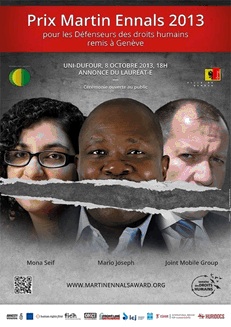
2013 Martin Ennals Award ceremony
October 8th, 2013, 6 pm
Please subscribe online: http://www.martinennalsaward.org
The Martin Ennals Foundation and the City of Geneva announce the 20th ceremony of Martin Ennals Award for human rights defenders. This event is integrated within Human Rights Week, a four-day event organized at the University of Geneva. This ceremony is open to the public. All who are interested in human rights are welcome to come and pay tribute to these men and women who are engaged in the defense of human rights, often risking their lives. It is crucial that the public knows the work of these individuals, not only in Geneva but also at the international level, in order to ensure that they can benefit from a certain degree of protection.
The following 3 nominees were carefully selected by the Jury of the Martin Ennals Award, made up of ten of the world’s leading human rights organisations:
- Ms Mona Seif (Egypt) who is one of the core founders of the ”No To Military Trials for Civilians”, a grassroots initiative that aims to stop military trials for civilians in Egypt.
- The Joint Mobile Group (Russia) seeks accountability for human rights abuses in Chechnya, notably enforced disappearances, torture in custody, and extra-judicial executions.
- Mr Mario Joseph (Haïti) has been referred to as Haiti’s most prominent human rights lawyer, and has worked on some of the most important cases including the one against former dictator Jean-Claude “Baby Doc” Duvalier.
Ms Navanethem Pillay, United Nations High Commissioner for Human Rights, will present the award to one of these nominees. The ceremony will be held in French and in English at Uni-Dufour, Jean-Piaget auditorium, U-600 at 6 pm. A live broadcast will be given in the Charles-Rouiller auditorium, U-300, located in the same building and it should also be streamed on the internet.
Posted in films, human rights, Human Rights Defenders, MEA | 2 Comments »
Tags: 2013 ceremony, City of Geneva, Egypt, Final Nominees for the Martin Ennals Award 2013, Geneva, Haiti, human rights, human rights awards, Joint Mobile Group, Mario Joseph, Martin Ennals Award, MEA, Mona Seif, Office of the United Nations High Commissioner for Human Rights, Russia, United Nations, University of Geneva
September 6, 2013

( Photo: EPA)
The piece below, taken from the Voice of Russia of 6 September 2013, is interesting for a number of reasons:
1. it addresses the almost comical issue of basing the Arab Court of Human Rights in Bahrain
2. it quotes at length the (understandably) sarcastic comments by Brian Dooley of Human Rights First in the Huffington Post
3. it is lovely example of a different but biased geopolitical perspective: Read the rest of this entry »
Posted in HRF, human rights, Human Rights Defenders | Leave a Comment »
Tags: Al-Jazeera, Arab Court of Human Rights, Arab League, Bahrain, Bahrain Centre for Human Rights, Bashar al-Assad, Boris Volkhonsky, Brian Dooley, Huffington Post, human rights, Manama, Maryam Alkhawaja, massive violations, politics, Voice of Russia
September 6, 2013
Truth commission archives are an important part of dealing with the past, which is a long-term process addressing a legacy of human rights violations. Read the rest of this entry »
Posted in human rights, Human Rights Defenders, UN | Leave a Comment »
Tags: archives, documenting, human rights, Human Rights and Liberties, human rights violations, impunity, meeting, Office of the United Nations High Commissioner for Human Rights, science, side event, Special Rapporteur, Swisspeace, Switzerland, Truth and Reconciliation Commission, Truth commissions, United Nations Human Rights Council
September 5, 2013
On 7 April 2013 I posted on this blog the announcement of the Anti-kidnap alarm for human rights defenders in form of the Natalia bracelet launched in Stockholm by Civil Rights Defenders.
This was followed 10 days later, 17 April, by a post referring to the Panic Button developed by Amnesty International (“How to turn a mobile phone into an alert system for human rights defenders: AI’s Panic Button”).
Now the New York based Human Rights foundation announces its Partnership with global encrypted communications firm Silent Circle to protect the private communications of political dissidents, human rights groups, and civil society organizations in at-risk scenarios. (http://humanrightsfoundation.org/HRF-Announces-Silent-Circle-Partnership-to-Support-Dissidents-04-09-2013.php)
There exist already the older and more wide-ranging tools of: “Security in a Box” (a collaboration between Front Line and Tactical Tech Collective – see http://security.ngoinabox.org/welcome) and Protection International‘s on-line Manual: http://protectioninternational.org/publication/new-protection-manual-for-human-rights-defenders-3rd-edition/.
While these (and perhaps other tools that I have missed!) may have all different features, the question could be asked who among the hard-pressed human rights defenders on the ground have the time and energy to sort through all this and pick what is most meaningful for them? Competition may well bring out the best but can also be confusing.
Posted in Front Line, human rights | 4 Comments »
Tags: Amnesty International, Civil Rights Defenders, Human right, human rights, Human rights defender, Human Rights Foundation, information technology, internet, Natalia project, Panic Button, protection, Protection International, Security-in-a-box, Silent Circle, Tactical Tech Collective, technology