On 13 March 2024 Human Rights Watch announced that it would be closing its long-running film festival. Founded in 1988, the Human Rights Watch Film Festival showcased nearly 1,000 independent films, was presented in over 30 cities across the globe, and is the world’s longest running human rights film festival.
“It’s with sadness and deep regret that we have made the difficult decision to close the Human Rights Watch Film Festival,” said Tirana Hassan, executive director of Human Rights Watch. “The film festival is a celebrated cultural institution that educated and inspired hundreds of thousands of filmgoers and filmmakers around the world over three decades, providing a critical space for connection, conversation, and action on human rights issues.”
The decision to close the festival was part of a wider restructuring due to financial constraints, Human Rights Watch said. Human Rights Watch Film Festivals will take place as planned across the United Kingdom and Ireland, opening on March 14, 2024, and across Canada starting on March 21.
Human Rights Watch is immensely proud of the talented film festival leadership and staff, who built partnerships across the human rights community and film industry. The festival established a mainstream platform for impactful films and in-depth conversations about human rights issues, with a priority focus on underrepresented perspectives from around the world.
The festival staff have been instrumental in pushing for increased accessibility standards in the film industry, resulting in three fully inclusive film festivals in the last two years. During the Covid-19 pandemic and the lockdowns that shuttered cinemas, the film festival team created a digital streaming site that tripled attendance figures, encouraged festival members to tune in for live conversations, and ensured that the public would not be isolated at home. The innovative site continued the festival’s work of creating spaces for dialogue, connection, and action on human rights issues.
“We owe the Human Rights Watch Film Festival’s success and impact to the longstanding commitment of our festival staff and consultants, volunteers, partners, the filmmakers, and of course our audiences,” Hassan said. “They helped to nurture the human rights storytelling movement that we see thriving today.”
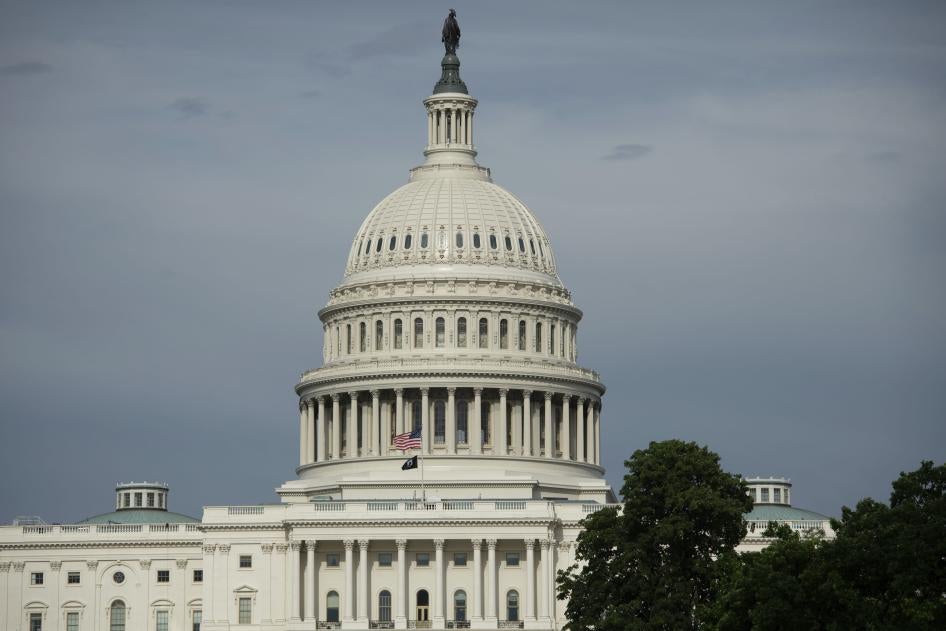
On 31 January 2024 several NGOs – including HRW and AI -came out in support of a bill in the US Senate. Senator Ben Cardin introduced the Human Rights Defenders Protection Act of 2024, which aims to protect individuals abroad “who face reprisals for defending human rights and democracy.” The law, if enacted, would strengthen the US government’s ability to “prevent, mitigate, and respond” to such cases.
Senator Cardin said this legislation “will help elevate, guide, and enhance US efforts to support these courageous individuals globally at a time when their efforts are more important than ever.”
HRW said: The bill would integrate support for rights defenders into various US policies and programs and encourage engagement with the private sector. It aims to improve assistance for rights defenders living in exile from their home countries and strengthen US tools to hold perpetrators of rights abuses accountable.Human Rights Watch has long documented the risks, threats, and attacks that rights defenders across the globe face. In Rwanda, for example, the government for many years has targeted with impunity rights defenders at home and extended its repression beyond its borders to silence Rwandan critics living abroad. Last December, the Emirati government brought new charges under its counterterrorism law against 87 activists and dissidents, including imprisoned rights defender Ahmed Mansoor.
The proposed legislation would create a new US visa for rights defenders who face a “credible fear of an urgent threat,” allowing those who qualify to reach safety before they are detained or harmed. It would also increase the number of US government personnel dedicated to democracy and human rights issues in the federal government and at embassies in countries with a high risk of rights abuses.
Andrew Fandino, Advocacy Director for the Individuals at Risk Program at Amnesty International USA. stated: “The Human Rights Defenders Protection Act of 2024 is a critical piece of legislation that will help strengthen and improve the U.S. government’s ability to support human rights defenders around the world,” ..“With over 401 human rights defenders killed globally in 2022 alone, now more than ever, human rights defenders need this additional support and protection.”
If passed, the legislation would require the US government to establish a “Global Strategy for Human Rights Defenders.” The strategy would survey current tools and resources to support human rights, identify how the government would prioritize and bolster protections for rights defenders, and establish specific goals for implementing the legislation’s policy objectives. This would link to the existing EU Guidelines on Human Rights Defenders (2008), and the OSCE Guidelines on the Protection of Human Rights Defenders (2014) and those of a small group of European countries.
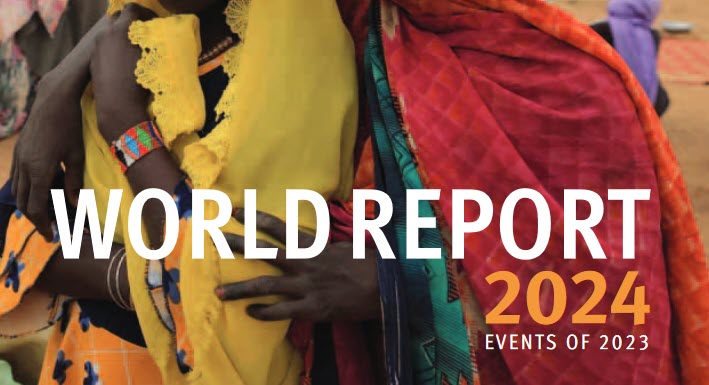
On 27 January 2024, Olivia Biliunaand Madison Whittemore in the Davis Vanguard produced a useful summary of the 2024 Human Rights Watch Report
After reflecting on the formidable human rights challenges of 2023, it has become evident that changes in how human rights are approached will be needed in 2024 to prevent the atrocious suppression and human rights crises that have been prominent in the past year, according to Human’s Rights Watch’s “World Report 2024: Our annual review of human rights around the globe.” [see: https://www.hrw.org/world-report/2024]
However, despite the human rights atrocities seen in 2023, the group added that there appears to be some hope for upholding human rights in 2024 through enforcing principles of international human rights law.
Looking back on 2023, the 2024 World Report reflects on renewed conflicts between Israel and Hamas that resulted in the abuse of many and a tragic loss of life, and other countries such as Ukraine and Myanmar that continue to struggle with their own intense conflicts.
Human Rights Watch notes that in accordance with the aforementioned conflicts, “Economic inequality rose around the world, as did anger about the policy decisions that have left many people struggling to survive.”
However, while many are quick to blame the government for being complicit in these human rights crises, the report maintains action is needed outside of just government action alone to help diminish these threats, since they “often transcend borders and cannot be solved by governments acting alone.”
In fact, the report notes the often forgotten importance of universal principles of international human rights and the rule of law which are more critical now than ever.
The 2024 World Report argues governments have the ability to help improve human rights and that they have double standards in “applying the human rights framework,” as stated in the 2024 World Report, and “chips away at trust in the institutions responsible for enforcing and protecting rights.”
The legitimate laws and universality of human rights are weakened when governments that are vocal about denouncing the Israeli government war crimes against Gaza citizens do not speak up about the crimes against humanity in Xinjiang, China, according to the 2024 World Report.
Governments have found it is easier to disregard international human rights matters because internationally there is no challenge to human rights nationally, writes Tirana Hassan, the executive director.
Hassan also noted that autocrats across regions have taken away both the independence of key institutions to protect human rights and the freedom of dissent, as stated by the 2024 World Report, “with the same endgame in mind: to exercise power without constraint.”
Hassan explains that with campaigning of civil rights groups and years of diplomatic negotiations, 83 countries were able to protect their citizens by adopting a political declaration that provided protection from explosive weapons in populated areas.
The international pledge to recognize the “long-standing practice of warring parties to use aerial bombing, artillery, rockets, and missiles in villages, towns, and cities” is the first to address this issue as the 2024 World Report states.
Some countries are addressing long-marginalized communities. With years of pressure, the Japanese government parliament has passed its first law to protect LGBT people from “unfair discrimination,” the 2024 World Report states.
With the humanitarian crises there has been questioning on the effectiveness of the human rights framework in the realm of protection, notes the 2024 World Report, adding, “especially in the face of selective government outrage, transactional diplomacy seeking short-term gain, growing transnational repression, and the willingness of autocratic leaders to sacrifice rights to consolidate their power.”
With that, the 2024 World Report also suggests the human rights framework will continue to be the plan to build “thriving, inclusive societies” and governments need to be persistent and, with urgency, defend human rights to handle the global and existential threats to humanity.
As also highlighted by Hassan in the report, the assault on Israel by Hamas-led fighters on Oct. 7 that deliberately killed hundreds of vulnerable civilians led to swift condemnation from many countries around the world.
In retaliation to the Oct. 7 attack, the Israeli government ceased all running water and electricity in the Gaza strip, “blocking the entry of all but a trickle of fuel, food, and humanitarian aid – a form of collective punishment that is a war crime,” the 2024 World Report noted.
The Israeli government and military continue frequently bombing the Gaza strip. Following these attacks, countries were outraged after they found out that Israel used a chemical called white phosphorus during the indiscriminate attacks on Gaza, with many countries even highlighting the attacks as “apparent war crimes,” stated by Human Rights Watch.
However, despite world-wide outrage after Israel’s war crimes on Gaza, countries have failed to publicly call the Israeli government out on its war crimes resulting in severe human rights abuses, the report detailed, noting even the U.S. and the European Union have acknowledged Israel’s human rights abuses on Gaza citizens, yet have continued to be complicit in the “ongoing crimes against humanity of apartheid and persecution against Palestinians.”
The report asserted the repercussions of governments failing to intervene undermine the legitimacy of the rules system designed 75 years ago to safeguard all citizen’s rights. In response to the inconsistencies, Hassan cites that governments like Russia and China aim to take advantage of the shaky legitimacy by attempting to infringe on human rights and take advantage of the system that is supposed to punish both countries.
Another example used by the 2024 World Report that displays these inconsistencies is the power battle between two influential generals in Sudan, Gen. Abdelfattah al-Burhan and Gen. Mohamed Hamdan Dagalo.
This conflict resulted in civilians facing deadly abuses and human rights infringements in the Darfur region—with numerous countries listed in the 2024 world report allegedly ignoring the horrendous abuses and abstaining from intervening.
Despite nations such as Gabon, Ghana, and Mozambique being on the Security Council, “the UN, under pressure from the Sudanese government, shuttered its political mission in Sudan.” the 2024 World Report stated, also concluding that “This marked the conclusion of the UN’s limited capacity in the country to safeguard civilians and openly address the human rights situation.”
Regardless of African governments refusing to hold the Sudanese government accountable, the report highlights that many have been strong advocates for resolving the human rights issues in other places like Palestine, even leading a full-fledged effort to investigate its human rights abuses last November and recently asserting that “Israel violated its obligations under the 1948 Genocide Convention in its military operations in Gaza.”
Domestic policies and foreign policies should hold value in human rights and their rules of laws at the forefront of governments, charged the 2024 World Report.
Even rights-respecting governments hold these principles as “optional, seeking short-term, politically expedient “solutions” at the expense of building the institutions that would be beneficial for security, trade, energy, and migration in the long term,” according to the 2024 World Report, adding transactional diplomacy carries a human cost that extends past borders, the group adds.
The 2024 Report writes that without awareness while making transactional diplomacy, risks are created. Removing human rights and the rule of law from a sensible direction creates leverage for right-violating governments too, the 2024 World Report adds, arguing, “It can also contribute to further human rights violations, including transnational repression,” which governments do when they commit human rights abuses against their nationals abroad or to those families living at home, the report continues.
According to the World Report of 2024, India, a democracy, under its Prime Minister Narenda Modi has moved toward an autocracy “with authorities targeting minorities, tightening repression, and dismantling independent institutions, including federal investigative agencies.”
Additionally, as cited in The Report, the US, Australia, the UK, and France chose trade and security over raising human rights concerns.
As reported by Executive Director Hassan, the Modi government’s repressive tactics went past borders and were empowered to do so from the Indian government’s “silence on the Indian government’s worsening rights record…including to intimidate diaspora activists and academics or restrict their entry into India.”
Rwandan’s government has had three decades of no punishment for their repression of civil and political rights at home, the 2024 World Report states, writing “to stifle dissent beyond its borders,” and noting, Rwanda, despite having risen on the international stage, has failed to recognize its problematic human rights violations.
Similarly, Chinese government abuses in Beijing escalate its repression against both Chinese and non-Chinese with failure of resistance from other countries, according to the 2024 World Report, explaining a Laos lawyer and human rights defender, Lu Siwei, received pressure from the Chinese government to return and authorities pushed out warrants.
The 2024 World Report claims nowhere is safe if repressive governments can get away with “strong approaches to silence human rights defenders, exiled politicians, journalists, and critics beyond their borders.”
As reported by the Human Rights 2024 World Report, with almost half of the global population being eligible to vote in 2024, both citizens and independent institutions need to participate in order to effectively have leaders who defend human rights, regardless of society and many institutions having “become renewed battlegrounds for autocratic leaders around the world looking to eliminate scrutiny of their decisions and actions.”
According to Hassan, the nations of Guatemala and Nicaragua are two stories of autocratic leaders consolidating power and failing to prioritize civil society.
For example, after Guatemala’s President-elect Bernardo Arévalo ran on an anti-corruption platform, a corrupt judiciary attempted to overturn Arévalo’s election triumph.
Similarly, the report refers to Nicaragua, where corrupt and authoritarian President Daniel Ortega uses “abusive legislation to shut down over 3,500 nongovernmental organizations” in order to dominate the political landscape and wield unchecked power.
The Human Rights report insists these “vital” checks and balances continue to be eroded, it poses great harm to human rights.
Judicial independence has also been drastically sabotaged in Poland, the report alleges, with the Polish government suppressing civil society groups through law enforcement and incarceration. Polish freedom and independence are extremely threatened, with the Law and Justice party most notably encroaching on women’s reproductive rights and essentially banning abortion, Hassan suggested in the report.
“In May 2023, an abortion rights activist was convicted of helping a woman to get abortion pills and was sentenced to eight months of community service – the first known prosecution of its kind in the EU,” the 2024 World Report noted.
On an environmental note, with the impending issue of global warming, the 2024 report highlights activists being shot by governments across the globe who want to “deter the climate movement.”
In another example, the report cites how one of the largest oil producers, the United Arab Emirates (UAE), continues to expand its production of fossil fuels; however, people are discouraged from exposing the UAE unless they are willing to face grave punishment.
Apart from punishing dissent, governments are using technology and social media platforms to “silence critics and censor dissent,” the 2024 World Report notes, citing a 54-year-old retired Saudi Arabian teacher named Muhammad al-Ghamdi, who received the death penalty after he expressed his opinions on X and Youtube and allegedly went against the country’s counterterrorism law.
Despite everything that occurred in 2023, there were also positive moments for human rights where institutions and movements succeeded, the 2024 World Report states, arguing, “Indeed, these successes illustrate why self-serving politicians and repressive governments work so hard to curtail them – and why all governments should recognize and support these fragile successes.”
Additionally, according to the Executive Director Hassan, the ICC issued warrants for Russia’s President Vladimir Putin and his children’s rights commissioner for war crimes related to deporting and transferring children and a court ruled that South Africa had a commitment to arrest Putin.
According to the 2024 World Report, the Xokleng Indigenous people succeeded when the Brazil Supreme Court, as noted by the 2024 World Report, “upheld all Indigenous peoples’ rights to their traditional lands,” despite efforts by the Santa Catarina state.
The 2024 World Report said, “These victories highlight the tremendous power of independent, rights-respecting, and inclusive institutions and of civil society to challenge those who wield political power to serve the public interest and chart a rights-respecting path forward” and that “all governments, in their bilateral relations and at the multilateral level, should redouble efforts to uplift key institutions and protect civic space wherever it is under threat.”
The human rights crisis highlights the importance for “mutually agreed principles of international human rights law everywhere,” the 2024 World Report notes.
It also points out that through governments centering their human rights obligations through moral governing, it will provide a diligent change to those affected.
The 2024 World Report concludes that consistently upholding human rights, “across the board, no matter who the victims are or where the rights violations are being committed, is the only way to build the world we want to live in.”
On 1 December, 2023, at about 4 p.m., four or more unidentified men abducted Diallo, the secretary-general of the Collective Against Impunity and Stigmatization of Communities (Collectif contre l’Impunité et la Stigmatisation des Communautés, CISC) in Burkina Faso’s capital, Ouagadougou. Diallo had just left the government’s passport office after a meeting with officers to renew his passport. The CISC issued a statement the same day saying that men in civilian clothes pushed Diallo into a vehicle and drove off. His whereabouts remain unknown.
On December 2, the United Nations special rapporteur on human rights defenders, Mary Lawlor, raised serious concerns about Diallo’s abduction. In a December 3 statement, The People’s Coalition for the Sahel, an alliance of civil society organizations, said that “the abduction of a prominent activist in broad daylight […] demands an immediate government response,” and called on the military authorities to take action.
“Burkina Faso authorities should urgently and impartially investigate the abduction of Daouda Diallo and release him if he is in government custody,” said Ilaria Allegrozzi, senior Sahel researcher at Human Rights Watch. “We are deeply concerned for Diallo’s safety and the safety of everyone working to improve respect for human rights in Burkina Faso.”
Since it took power in an October 2022 coup, Burkina Faso’s military junta has increasingly cracked down on peaceful dissent and the media, shrinking the civic space in the country. National and international journalists, as well as civil society members, face increasing harassment, threats, and arbitrary arrests. On December 2, the military authorities announced the suspension of “all distribution methods” of the French newspaper Le Monde daily, claiming an article published on Le Monde’s website on December 1 about a deadly attack by an Islamist armed group on a military base in Djibo, Sahel region, on November 26, was “biased.”
On 4 December the Martin Ennals Foundation and several other NGOs addressed an urgent letter to the Représentant Permanent de Burkina Faso at the UN in Geneva.
On 27 October, 2023 Human Rights Watch stated that FIFA has broken its own human rights rules in announcing a plan for hosting the next two men’s World Cups that effectively eliminates bidding and human rights due diligence.
Within hours after FIFA published its arrangements for the 2030World Cup, Saudi Arabiaannounced its ambitions to host the 2034 World Cup.
“Barely a year after the human rights catastrophes of the 2022 Qatar World Cup, FIFA has failed to learn the lesson that awarding multi-billion dollar events without due diligence and transparency can risk corruption and major human rights abuses,” said Minky Worden, director of global initiatives at Human Rights Watch “The possibility that FIFA could award Saudi Arabia the 2034 World Cup despite its appalling human rights record and closed door to any monitoring exposes FIFA’s commitments to human rights as a sham.”
In February 2023, Human Rights Watch contacted FIFA to request details on its due diligence and stakeholder consultation for selection of future World Cup hosts and awarding commercial sponsorship contracts. FIFA has not responded.
Because of regional rotation requirements, the six-country 2030 World Cup means that FIFA will only accept bids from Asia or Oceania for 2034, opening the way for Saudi Arabia to be the host. FIFA instead needs to keep open bidding for the 2034 World Cup and apply the same human rights benchmarks to all bidders in advance of selection, Human Rights Watch said.
FIFA’s Human Rights Policy, adopted in 2017, outlines its responsibility to identify and address adverse human rights impacts of its operations, including taking adequate measures to prevent and mitigate human rights abuses. Article 7 of FIFA’s Human Rights Policy states that “FIFA will constructively engage with relevant authorities and other stakeholders and make every effort to uphold its international human rights responsibilities.” This should include consulting a wide range of stakeholders, including potentially affected groups, domestic human rights monitors, athletes, fans, migrant laborers, and unions, before making major hosting decisions. [see also: https://humanrightsdefenders.blog/2022/04/17/fifa-world-cup-the-human-rights-plans-of-host-cities/]
Under FIFA’s human rights policies, countries bidding to host games must commit to strict human rights and labor standards. In the introduction to FIFA’s “Key Principles of the Reformed Bidding Process,” FIFA President Gianni Infantino writes: “Whoever ends up hosting the FIFA World Cup must …formally commit to conducting their activities based on sustainable event management principles and to respecting international human rights and labour standards according to the United Nations’ Guiding Principles.”
FIFA has so far failed to apply these principles in the award of the 2030 and 2034 World Cups.
In June, FIFA cancelled its planned announcement about the bidding process for the 2030 World Cup, instead announcing that:
in line with the principle of confederation rotation and of securing the best possible hosting conditions for the tournaments, the bidding processes for both the 2030 and 2034 editions would be conducted concurrently, with FIFA member associations from the territories of the Asian Football Confederations and the Oceania Football Confederation invited to bid to host the FIFA World Cup 2034
FIFA’s Overview of the Bidding Processes document sets a deadline for any member associations to confirm bidding by October 31, 2023, an unreasonably tight deadline for the 2034 World Cup 11 years away that should include national stakeholder consultation and could ultimately cost billions of dollars. Saudi Arabia’s appalling human rights record has deteriorated under Crown Prince Mohammed Bin Salman’s rule, including mass executions, continued repression of women’s rights under its male guardianship system, and the killing of hundreds of migrants at the Saudi-Yemen border. Torture and imprisonment of peaceful critics of the government continues, and courts imposed decades-long imprisonment on Saudi women for tweets. Sex outside marriage, including same-sex relations, is a crime, with punishments including death. Lesbian, gay, bisexual and transgender (LGBT) people in Saudi Arabia practice extreme self-censorship to survive their daily lives. LGBT players and fans visiting Saudi Arabia could face censorship, stigma, and discrimination on the basis on their sexual orientation and gender identity. See e.g.: https://humanrightsdefenders.blog/tag/saudi-arabia/]
Independent human rights monitors, journalists, women’s rights activists, and other peaceful critics are jailed, under house arrest, and cannot safely work in Saudi Arabia. Saudi Arabia has severe restrictions on journalists and free expression, a basic requirement for World Cup hosts, Human Rights watch said. In October 2018, Saudi agents murdered and dismembered the Washington Post columnist Jamal Khashoggi, who had been critical of the Saudi government, an assassination apparently approved by the crown prince himself.
“In Saudi Arabia, independent human rights monitoring is not possible due to government repression. This makes it effectively impossible for FIFA to carry out the ongoing monitoring and inspection of human rights its human rights policy requires,” Worden said.
While welcoming the Saudi bid to host the World Cup in 2034, FIFA has not said anything about how it proposes to assess its human rights conditions.
“With Saudi Arabia’s estimated 13.4 million migrant workers, inadequate labor and heat protections and no unions, no independent human rights monitors, and no press freedom, there is every reason to fear for the lives of those who would build and service stadiums, transit, hotels, and other hosting infrastructure in Saudi Arabia,” Worden said.
“FIFA is failing in its responsibility to the world of football to conduct World Cup bidding and selection procedures in an ethical, transparent, objective, and unbiased way,” Worden said. “If there’s to be any integrity in what remains of this process, FIFA needs to immediately delay and open the bidding process for the 2034 World Cup, make public its labor, human rights, and environment policies, and then make sure protections are fully carried out.”
On 1 November 2023 Erin Kilbride for Human Rights Watch wrote critically about a rather weird decision by the Swiss Government namely to suspend funding to 11 respected human rights organizations in Israel and Palestine.
The Swiss government says it plans to “carry out a fresh, in-depth analysis of all financial flows” and assess the “relevance and feasibility of programmes.” Earlier this month, European governments suspended more than $150 million in development aid, as Israel cutaccess to food, water, electricity, fuel, and medicines to more than 2.2 million people in Gaza, an act of collective punishment, which is a war crime under international humanitarian law.
The affected groups are: Adalah; Al-Shabaka; Gisha; 7amleh; Hamoked; Jerusalem Legal Aid and Human Rights Centre; MIFTAH: The Palestinian Initiative for the Promotion of Global Dialogue and Democracy; Palestinian Center for Human Rights; the Palestinian NGO Network; Physicians for Human Rights, and Women’s Center for Legal Aid and Counselling.
The West Bank, home to several organizations whose funding has been suspended, has seen a significant spike in Palestinians killed or held in administrative detention without charge or trial.
International support for local human rights defenders is a clear way to support protecting rights, documenting atrocities, and securing justice.
The Swiss guidelines instruct representatives to support defenders’ security through media work, emergency protection programs, and pushing for investigations into attacks. The EU Guidelines provide, “the EU’s objective is to influence third countries to carry out their obligations to respect the rights of human rights defenders and to protect them from attacks and threats.”
Today, the work of Israeli and Palestinian human rights defenders is more critical than ever. Instead of leaving them in limbo, the Swiss government should maintain its funding of defenders while it conducts its review.
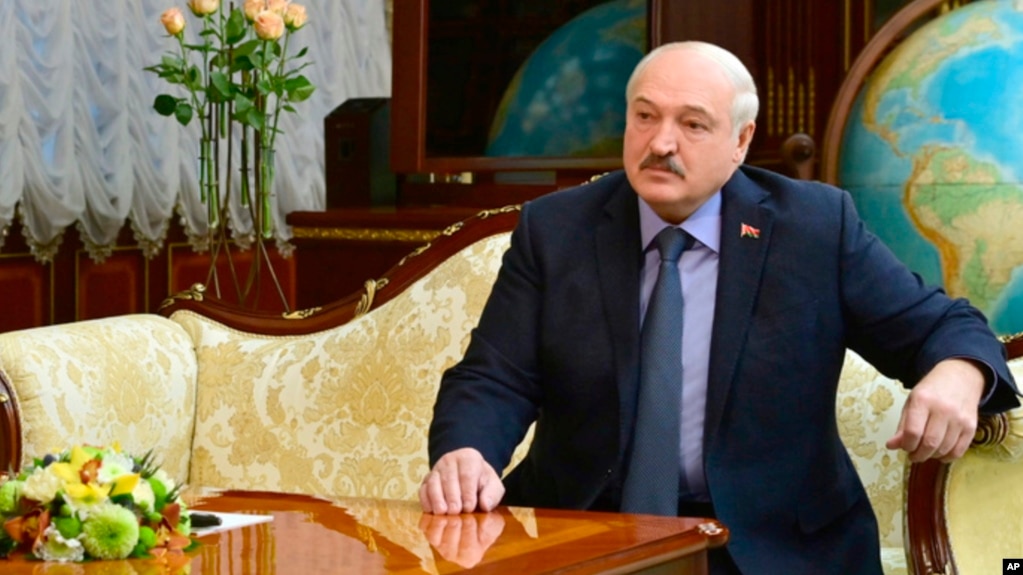
The human rights situation in Belarus is catastrophic, and only getting worse, the United Nations special rapporteur on the country said on 4 July 2023, according to AFP.
Belarusian leader Alexander Lukashenko’s regime in Minsk is deliberately purging civil society of its last dissenting voices, Anais Marin told the U.N. Human Rights Council.
“The situation remains catastrophic. Unfortunately, it keeps on worsening,” said the special rapporteur on the human rights situation in Belarus. “The Belarusian government amended an already restrictive legislation aimed at dismantling civic freedoms, leading to a surge in politically motivated prosecutions and sentencing.
“The lack of accountability for human rights violations fosters a climate of fear among victims and their families,” Marin said. Marin has been in post for five years and reminded the council that she alerted them two years ago to the “totalitarian turn” taken by Minsk, evidenced by the “disregard for human life and dignity” during the crackdown on peaceful protesters in 2020. In her annual report, the French political scientist said more than 1,500 individuals were still being detained on politically motivated charges, with a daily average of 17 arbitrary arrests since 2020.
“I have good reasons to believe that prison conditions are deliberately made harsher for those sentenced on politically motivated grounds, by placing them in punishment cells for petty infraction to prison rules,” said Marin.
“No one has been held accountable in Belarus for arbitrarily detaining tens of thousands of peaceful protesters in 2020, nor for the violence or torture many of them have been subjected to.
“This general impunity, and the climate of fear resulting from ongoing repression, have compelled hundreds of thousands of Belarusians into exile.
Human rights defenders face ongoing persecution, she said, with more than 1,600 “undesirable organizations forcibly dissolved, including all remaining independent trade unions.
“This illustrates a deliberate state policy of purging civic space of its last dissenting elements,” she said.
Marin said independent media outlets had been labelled as “extremist organizations,” while academic freedom is “systematically attacked.”
“Ideological control and disciplinary measures restrict freedom of opinion and their expression,” she said.
Primary and secondary education is also subject to “ideological control,” with children “discouraged from expressing their own opinions” and facing “threats and consequences” for holding dissenting views.
Consequences for speaking out
As for the Russian invasion of Ukraine, individuals face challenges when trying to speak out against it or question Belarus’s role in facilitating the 2022 invasion.
“Anti-war actions led to numerous detentions and arrests, some on charges of planning terrorist attacks — a crime which can now be punished by death,” she said.
Belarus was immediately offered the Human Rights Council floor to respond to Marin’s comments but was not present.
On 11 July HRW underlined this with the case of Belarusian lawyer Yulia Yurhilevich and journalist Pavel Mazheika who ace up to seven years in prison
Rights defenders are sure of Chechen law enforcers’ involvement in attack on Milashina says Roman Kuzhev, СK correspondent
The attack on the journalist Elena Milashina and the advocate Alexander Nemov has to do with Milashina’s publications in which she wrote about human rights violations in Chechnya, human rights defenders have noted.
The “Caucasian Knot” reported that on July 4, Elena Milashina, a journalist of the “Novaya Gazeta” outlet, and Alexander Nemov, an advocate for Zarema Musaeva, were attacked in Chechnya. They were beaten up by masked gunmen when they were on the way from the airport to Grozny, where the verdict in the case of Zarema Musaeva was to be announced. The head of Chechnya, Ramzan Kadyrov, has promised to “sort things out”; and Akhmed Dudaev, the head of the Chechen Press Ministry, have pointed out that “the style of Western intelligence services” is seen in the attack.
Svetlana Gannushkina, the head of the “Civic Assistance” Committee, is sure that the attack had to do with Milashina’s human rights activities. “They were waiting for her there to beat her for her so much writing on human rights issues, conducts inquiries and shows the real Chechnya,” Ms Gannushkina has stated.
According to her version, the attackers are definitely law enforcers. Gannushkina* has also added that the attackers would not be identified and punished. Oyub Titiev, a human rights defender, is also sure that Milashina was the attackers’ target. “Only law enforcers can beat a woman so openly and with such cruelty,” he has stated.
Ruslan Kutaev, the president of the Assembly of Caucasian Nations, is sure that Milashina would have been attacked at any moment while in Grozny.
A criminal case on the attack on Milashina and Nemov can be initiated under several articles, said Galina Tarasova, a lawyer. According to her story, the case should have been transferred to the central office of the Investigating Committee of the Russian Federation (ICRF).
This article was originally published on the Russian page of 24/7 Internet agency ‘Caucasian Knot’ on July 5, 2023 at 08:07 pm MSK. https://eng.kavkaz-uzel.eu/articles/62817
On 29 June 2023 Andrew Stroehlein wrote for Human Rights Watch a short obituary on ‘off-shoring refugees’, concluding “That offshoring refugees has been a costly, abusive, illegal failure should surprise no one apart from maybe a few politicians who believed their own slogans and a portion of the public who fell for the politicians’ expensive snake-oil cures”
Offshoring Refugees: A Costly, Abusive Failure. Australia no longer holds any refugees on the island country of Nauru. In welcome news, the last refugee kept there under the Australian government’s abusive offshore processing policy has finally been evacuated to Australia. The hope now is that Australia, and the rest of the world, will finally realize what an abusive failure such policies have been.The so-called “Australian model” – variously labelled “externalizing,” “offshoring,” or “outsourcing” – has been wrongly admired and repackaged elsewhere by unscrupulous politicians around the globe for years. In the EU, they bloviate over its supposed merits, and member state Denmark pushed plans to send asylum seekers to detention in Rwanda, a country known for torture in detention. The UK government’s efforts to mimic Australia have also focused on sending folks to Rwanda, with the UK home secretary bizarrely saying it was not only her “dream” but also her “obsession” to do so. The Court of Appeal has just ruled the scheme unlawful this morning – more good news. Of course, the US has been “outsourcing” for years. Under both Biden and Trump, US authorities force asylum seekers to wait interminably in Mexico, where they face kidnapping, rape, and extortion. And despite the good news about Nauru, Australia itself still holds about 80 refugees and asylum seekers in limbo in Papua New Guinea.The “appeal” of outsourcing was based on a kind of political sadism. Politicians promised to be “tough” on asylum seekers – meaning cruel and vicious toward powerless, desperate people. That, they told voters, would deter people from coming. The truth is, it’s been absurdly expensive, it’s led to appalling human rights abuses, and it hasn’t deterred anyone. Australia has spent billions on transferring 3,127 asylum seekers and refugees to Nauru and Papua New Guinea. Last year, the system apparently cost 22 million Australian dollars per person being held in Nauru (US$ 14.5 million). The abuses you get for that money are clear. HRW has documented how individuals and families with children spent years living in substandard conditions in these centers, where they suffered severe, inhumane treatment, violence, and medical neglect. At least 14 people subjected to Australia’s offshore detention system have died, half from suicide or suspected suicide. [re Australia, see also: https://humanrightsdefenders.blog/2021/07/21/australias-migration-detention-industry-again-denounced/] And offshoring hasn’t “worked” even in the most limited sense of what politicians promised. Desperate people searching for safety and the chance of a better life keep coming. They’re not going to stop fleeing war and oppression just because you threaten to send them to a third country when they arrive. That offshoring refugees has been a costly, abusive, illegal failure should surprise no one apart from maybe a few politicians who believed their own slogans and a portion of the public who fell for the politicians’ expensive snake-oil cures. But now, it should be obvious to everyone: cruelty is never a good policy.
On 26 June 2023 HRW called on Spain use its six-month tenure as EU Presidency to translate into concrete and bold actions commitment to protect fundamental rights and the rule of law.
Spain holds the presidency as the world marks the 75th anniversary of the Universal Declaration of Human Rights (UDHR) on 10 December 2023. In anticipation of this pivotal moment Spain should make every effort to uphold the rights and values enshrined in this historic document.
HRW calls upon the Spanish government to consider the following priority issues and recommendations:
Fundamental Rights and Rule of Law in EU member states
Two EU member states – Hungary and Poland – currently face scrutiny under Article 7 of the Treaty on European Union (TEU)…
The freezing of EU recovery and cohesion funds under the conditionality mechanism represents a welcome step but it is insufficient to address the gravity of the erosion of rule of law and human rights. While Hungary and Poland have adopted some limited measures in response to requirements under the mechanism, these have failed to address fundamental and long-standing concerns. ….We urge the Council to hold the Polish and Hungarian governments to account by using the powers conferred to it under the Treaties and to fulfil the strong mandate to act given to it by the European Commission and Parliament. The urgency of Spain’s leadership and responsibility cannot be overstated as it is one of only two remaining presidencies before Hungary and Poland in turn assume leadership of the Council. It is highly likely that during that time progress on rule of law will at best stall, and at worst Article 7 scrutiny will come to an end altogether…
Rights-Respecting and Principled EU Migration Policy
Spain’s EU Council presidency comes at a critical time for the EU’s migration policy after the Council agreed on 8 June on a negotiating position on an EU-wide reform of its asylum and migration system. Given its mandate to lead on behalf of member states the negotiations with the European Parliament on a final agreement, Spain has an opportunity to broaden the scope for a rights-respecting approach.
We call on your government to:
Support the establishment of proactive, state-led SAR operations in the Mediterranean Sea that could involve expanding the mandates and capacity of existing initiatives like EUNAVFOR MED and Frontex, funding professional rescue NGOs and ensuring predictable disembarkation.
Promote a discussion on the critical role of NGOs to ensure that they are fully able to carry out their lifesaving SAR activities, instead of facing obstruction and criminal and administrative penalties; and provide platforms for discussion of cooperation between member state rescue coordination centers and NGOs.
Advocate for independent and effective border monitoring mechanisms to document human rights violations at EU external borders, such as unlawful pushbacks, to ensure accountability for those responsible for human rights abuses and access to justice for victims.
Ensure that migration cooperation with third countries, and all provision of financial, technical, and material assistance, are contingent on clear and verifiable human rights commitments.
Enable a constructive trialogue on the asylum procedures regulation and the asylum and migration management regulation with a view to limiting the use of accelerated border procedures, the detention of asylum seekers including families with children, and discretionary use of the “safe third country” concept.
Promote a discussion on establishing more safe and legal pathways for migration as called for by EU Justice and Home Affairs Commissioner Johansson.[8]
Human Rights as a Pillar of EU’s Foreign Policy
The EU is equipped with solid instruments to ensure that human rights protection remains at the centre of its external action. The EU has shown resolve in its response to Russia’s invasion of Ukraine and has led at the United Nations to address key human rights crises.
..
During its Presidency, we call on your government to:
Continue to combat impunity for crimes committed in Ukraine, including by providing adequate resources to the International Criminal Court’s (ICC) regular budget, advocating and supporting the implementation of ICC arrest warrants, pressing Ukraine to ratify the Rome Statute and supporting independent investigations and prosecutions under universal jurisdiction.
Continue to support Human Rights Defenders (HRDs) at risk and share your experience with other EU member states. Encourage other EU member states to learn from and replicate Spain’s forward-leaning approach with the Program for Support and Protection of Human Rights Defenders at Risk that provides dedicated one-year residential visas for HRDs. Advocate with EU member states to use their discretion and facilitate access by HRDs to multi-year multi-entry Schengen visas in line with EU guidelines.
…
Recalibrate EU’s engagement with China to address the government of China’s human rights record through measurable deliverables; counter the government of China’s flawed narratives on its own human rights record; reject efforts to undermine international human rights institutions; lead the creation of a UN investigative and monitoring mechanism for crimes against humanity committed in Xinjiang; sanction or hold accountable those responsible for such crimes; and make plans to reduce dependency on a government that assaults human rights both domestically and in its foreign policy.