Posts Tagged ‘human rights of women’

Annual reports 2019: the women in the Arab world

December 30, 2019


And another end of year reflection, this one by the Collective for Research and Training on Development Action (CRTDA).

This is a Lebanon-based non-governmental organization started in July 1999. CRTDA works with partner civil society organizations in Lebanon and across the Arab World primarily in Yemen, Egypt, Syria, Morocco, Tunisia, and Algeria.

..For the Lebanese, everything that has happened this year has been overshadowed by the last
two months. These months have represented unprecedented empowerment, as we have seen a
mass uprising that cuts across sectarian lines aimed at ousting the political elite that have
propagated corruption, division, and inequality for many years. The unity felt in the streets has
been led by women, who have constantly showcased their bravery and leadership capacity
throughout this uprising.
Of course, this popular movement has also led to fresh challenges as the economic crisis
engendered by decades of mismanagement causes unemployment to spike, increasing poverty
among the most vulnerable populations and causing tension and polarization between
communities. In this context, of opportunity for women’s empowerment and challenge to peace
and stability between Lebanon’s communities, the work of CRTD.A both comes to fruition and
becomes increasingly important. At this cross-roads for Lebanon, we share with you some of
our highlights from the past year, and some of our hopes for the future.
This year, we saw women standing up to oppression and demanding change all over the
world. In Lebanon, women were at the forefront of the revolution: organizing, protesting, and
showing their bravery. They formed barriers with their bodies to keep the peace, and the icon of
the Lebanese protests was a woman, whose kick to a security officer became the symbolic image
of the revolution. Women’s rights, such as the right of women to pass on their nationality, have
taken a huge place in the protests, as women say enough is enough. What we have seen in
Lebanon has also been true for many countries across the world. In Sudan and Hong Kong,
women have become the icons of revolution, displaying their power to lead and to fight.
Women’s marches have also played a huge role in Chile’s demands for an end to a corrupt
system.
We have also seen women taking control of the narrative of environmental degradation, with
young icons such as Greta Thunberg showing that neither youth nor gender can get in the way
of determination and a powerful message. It is key for both our future and for empowerment
for women and girls to take initiative and make their voices heard to force the global elite to
face up to the biggest threat to our planet and our species. Women across the world have been
taking this initiative, from the Pacific Islands to the Amazon Rainforest.

For more information about their work, please check out the annual report via: https://bit.ly/378pQIY

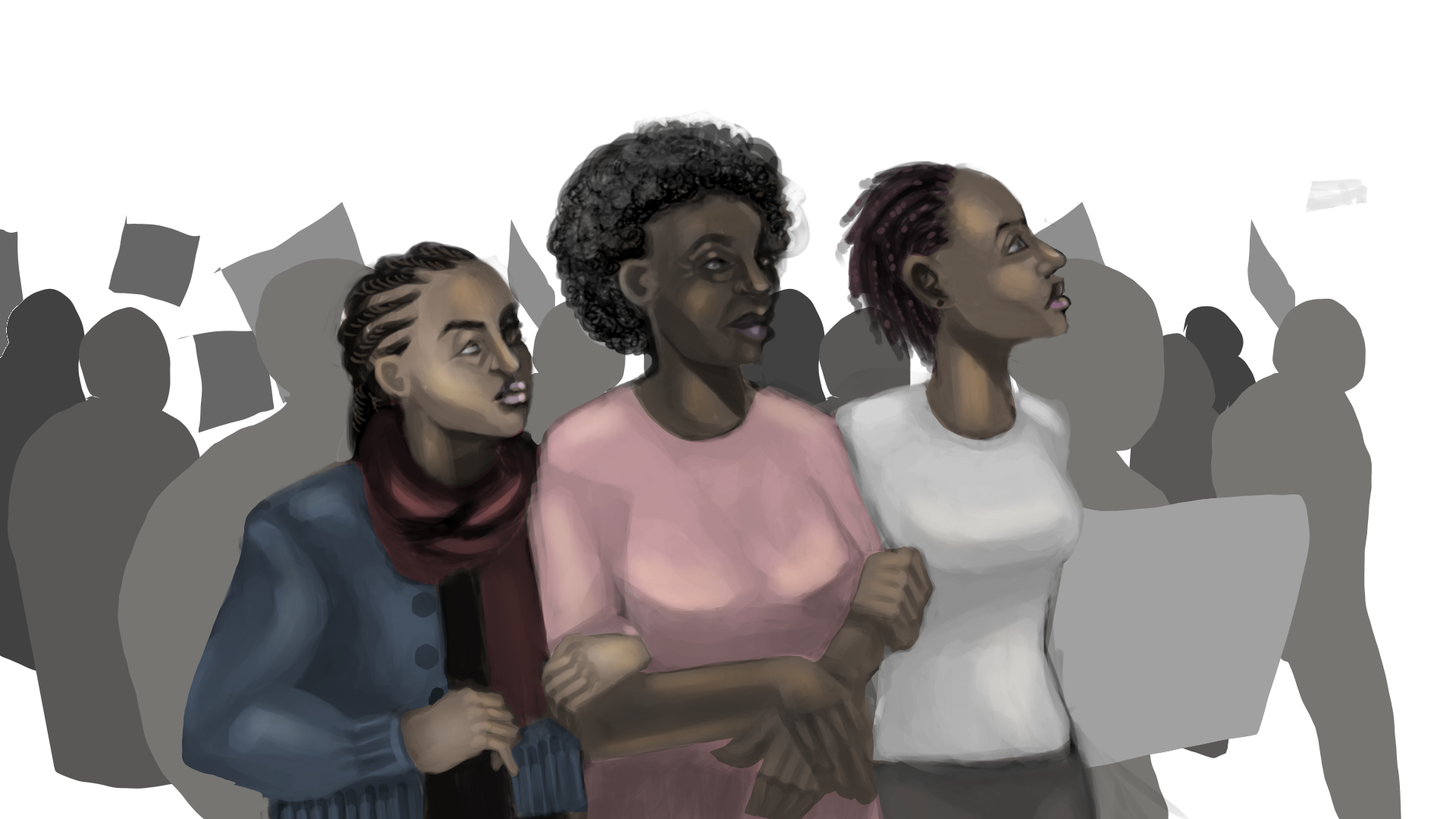
THE THREE WOMEN: audio from AfricanDefenders

December 1, 2019

AfricanDefenders & DefendDefenders launched on 29 November 2019 their audio campaign about African women human rights defenders and courage, simply called THE THREE WOMEN”. The story by Gentrix Barasa and beautiful Illustrations by Primordial M. Here is the first episode (https://twitter.com/hashtag/IAmTheThreeWomen) in the context of the 16 Days Campaign Against Gender Based Violence:

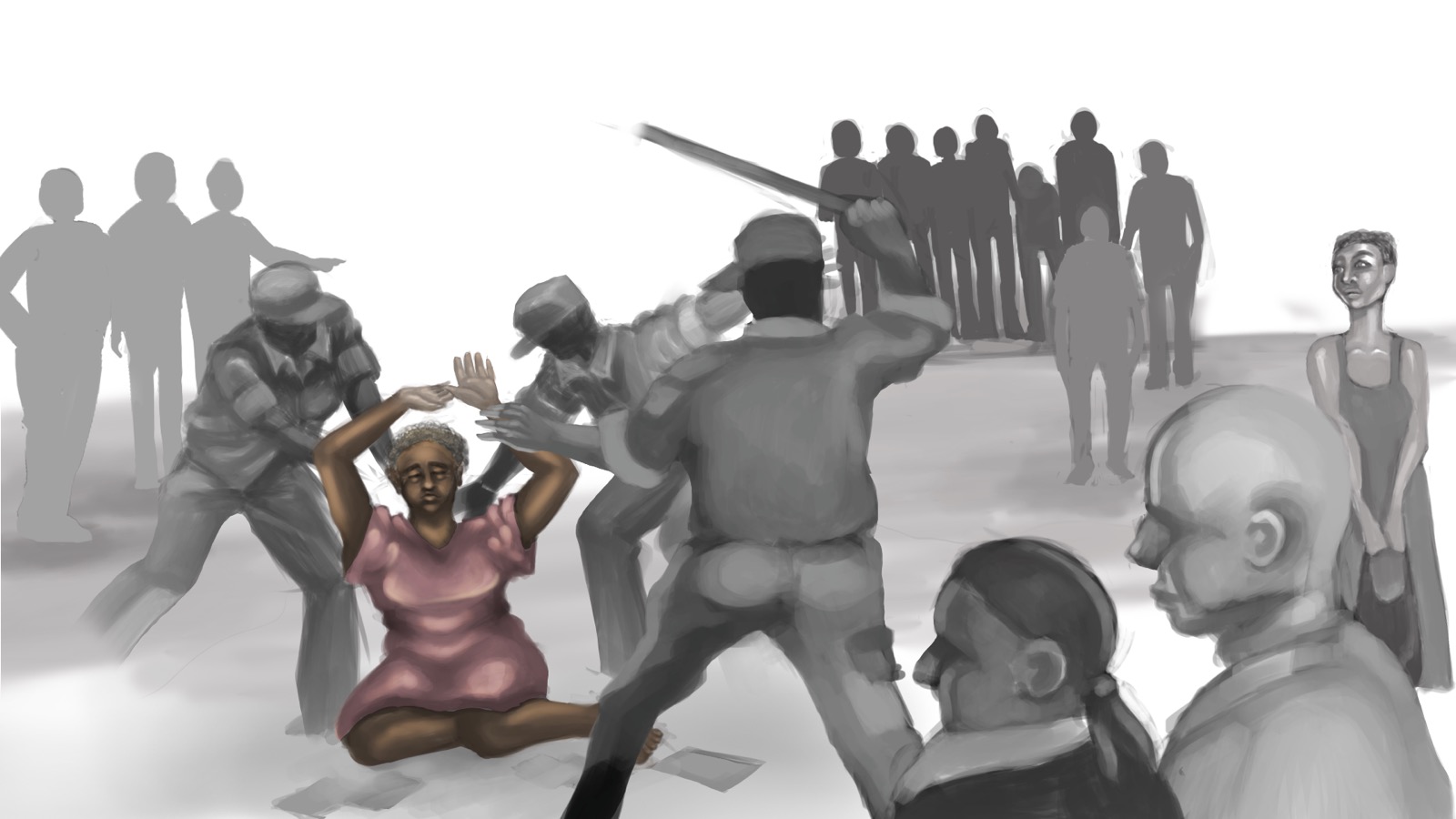
THE STORY OF MARTHA. A woman could be heard screaming from a distance in the town square. The distinct sound of a whip hitting her body could be heard reverberating throughout the town. A small crowd of onlookers were gathering around quietly, curious to see what was going on and to find out why this woman was being beaten. Nuru was rushing home so she could prepare lunch when she spotted the crowd of onlookers. Despite being aware that she would get in trouble with her father if she was late, she was drawn towards the woman.
“What is going on?” she asked the man standing beside her.

“Oh, Martha started with her nonsense again. They should beat that devil out of her.”

The men in the town, especially the elders, did not appreciate when women challenged societal norms. In their mind, Martha was turning their wives and daughters against them with all this talk of women’s rights and liberation. They had complained to the mayor of the town, Mr. Tapiwa, when they caught wind of the women’s march that Martha was organising.

“This one is from Tapiwa,” one of the policemen said before hitting Martha.

“I heard she is secretly a man,” Nuru heard a woman whisper, “why else would she behave like this? This is not how women are supposed to behave.”

“I heard she is just trying to break our marriages, so we are miserable and alone like her,” another whispered.

“She is a witch. She does not even have children and she is trying to tell us how to bring up our daughters.”

“I heard she is a prostitute. She is just trying to corrupt us,” the whispers continued.

“I feel bad for her, but she should know that activism is not the work of a woman,” a man chimed in.

The police eventually stopped harassing and beating Martha, before taking off. The crowd slowly dispersed, without offering her any help. Eventually, Nuru was the only one left.

She looked around nervously as if trying to make sure no one was looking. As much as she felt sorry for her, she was scared to go against the people of the town. She did not want to be an outcast like Martha. When she was sure no one was looking, she reached out for Martha’s hand helping her to her feet.

“Why did they do this to you?” Nuru asked, while watching the older woman wince in pain as she started walking.

“I was fighting for your rights.”

“What do you mean my rights?”

Martha gestured at a nearby bench for them to sit on.
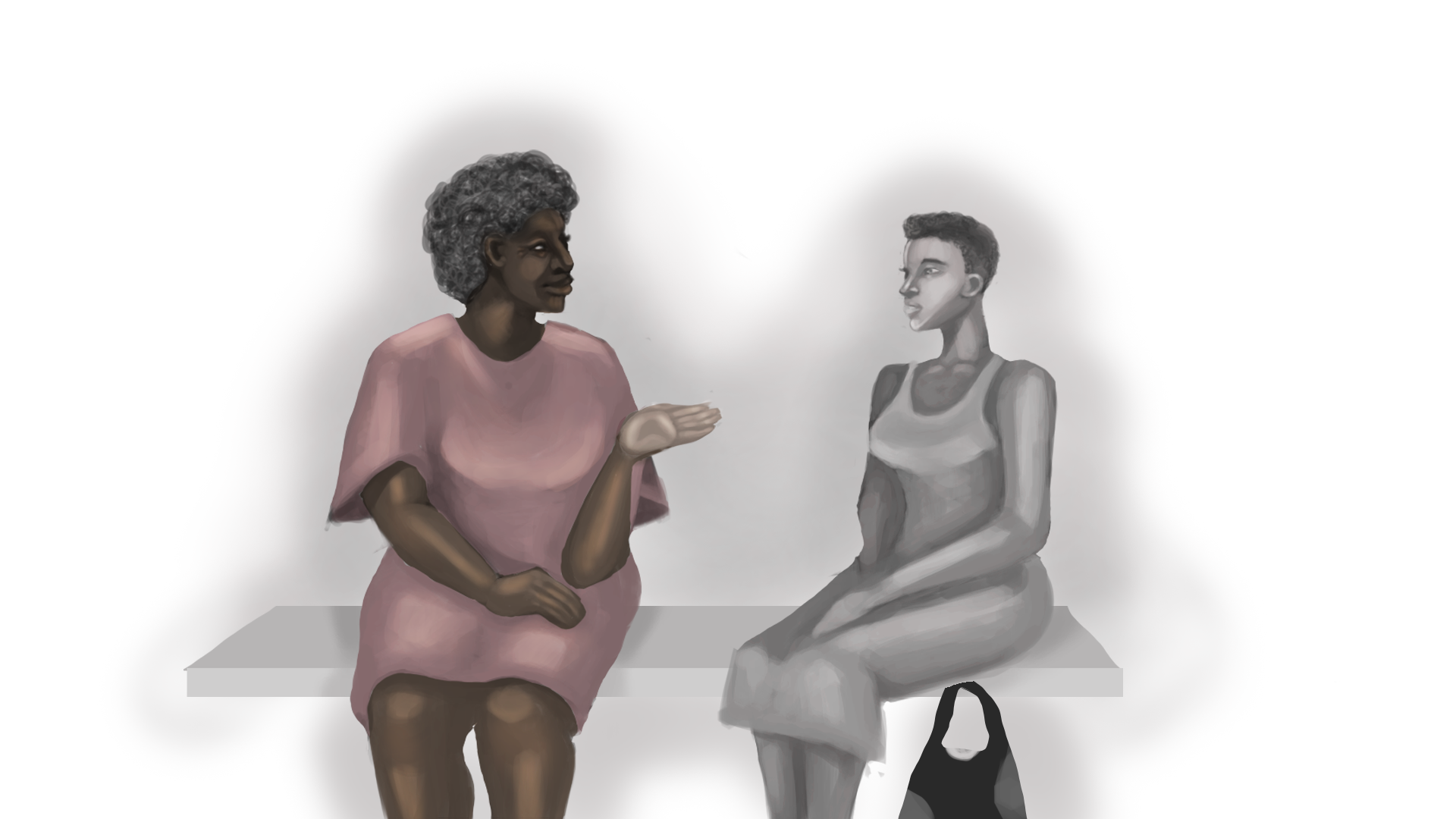
“Don’t you want to live in a world where you have choices?” Martha asked.

“I do have choices. I make choices every day,” Nuru said defensively.

Martha looked at Nuru, slightly raising an eyebrow. “Did you know you could own property, get an education, be equal to your father and brothers?” Martha continued.

Nuru stared into the distance with a look of longing. She had always wanted more for herself, but she had come to accept her life. Also, she was too scared to go against her father. “My father would never allow it, “she finally said.

Martha reached into her bag and retrieved a card. “This organisation can help you to learn more about your rights and can find you a good school. It is not his place to allow it. It is your right.”

Nuru hesitantly took the card and quickly pocketed it, afraid someone would see.

“I heard you are organising a march tomorrow.”

Martha nodded and handed her a flier with all the information about the march. “You don’t have to come to this if you don’t want to, but at least think about what I told you.”

Nuru nodded while gathering her things. She was still not quite sure if she would dare to go against her father, after all, who would take care of the house? “You are really nice,” Nuru said. She felt like Martha needed to hear some kind words. Then, Nuru took off.

Despite a restless night and the pain from the beating, Martha got up early the next morning to get ready for the march. The beating was the worst she had gotten since she started being outspoken about women’s rights. She had received calls and text messages all morning from people backing out of her march. It had worked – the beating had served as a warning to anyone planning to participate. Martha felt ashamed to admit it to herself, but they were really close to breaking her. She had tried so hard to not let them win, but that beating might have been the straw that broke the camel’s back.

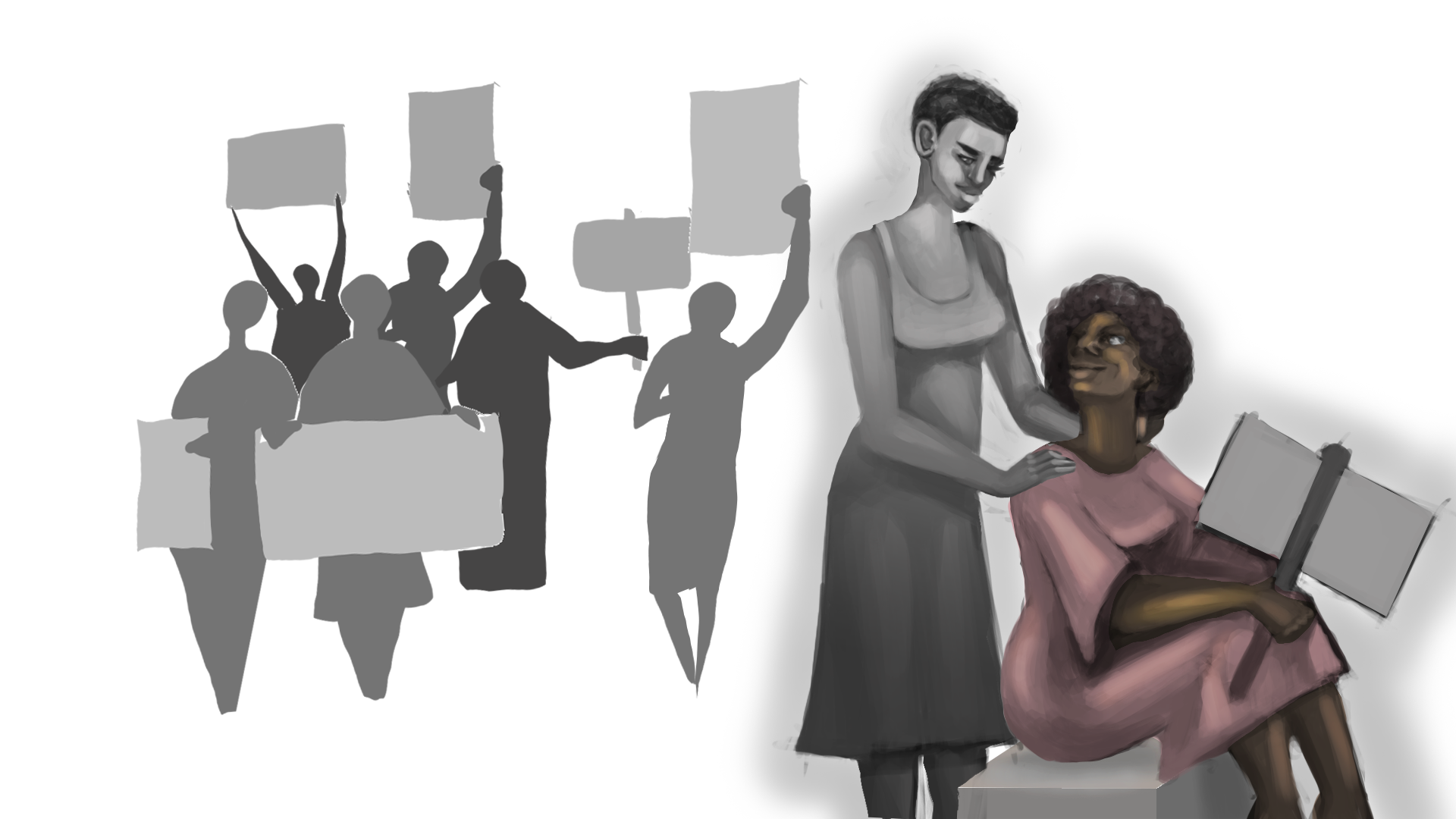
She held out hope that at least one other person would show up, but she had been standing there for an hour. At that point, it was apparent that the march was a complete failure. In that moment, it was hard to remember why she was fighting so hard for this. As she sat down on the side of the road, with the sign Don’t tell me how to dress – tell them not to rape, next to her, a single teardrop ran down her face. With a sigh she reached out for the sign, resigning to go home. Instead of feeling the wooden base of the sign, she felt a hand touching hers. She looked up in panic, expecting to see the policemen from the previous day. Instead, it was Nuru.

“What are you doing here?” Martha asked in a confused tone, quickly drying her tears.

“We want to fight for our rights.”

“We?” asked Martha, even more confused. She then saw a group of women behind Nuru.

“We came to stand with you and all the women and girls in town,” Nuru said.

Martha smiled. She stood up grabbing the rest of the signs and handing them out to the group. They started chanting the slogans on the signs, marching towards Mr. Tapiwa’s office.


THE THREE WOMEN
Media have critical role in breaking silence on violence against women

November 23, 2019

Swapna Majumdar wrote in the Daily Pioneer of 22 November 2019 “Don’t muzzle their voices”  about what role the media can play in the discourse on violence against women, human rights and empowerment?  Can it help survivors? How can the media be leveraged to change perceptions and end gender-based violence?

These are some of the questions that came up at the International Conference on Population and Development (ICPD+25) Summit held in Nairobi recently. A session focussed on the importance of the media in either shifting or perpetuating attitudes toward  gender-based violence in the context of the ICPD. [see also: https://humanrightsdefenders.blog/2019/11/19/16-days-of-activism-against-gender-based-violence-start-on-25-november-2019/]

“Violence against women is a human rights violation. Violence is about silencing us and the media is about breaking the silence. The media has a critical role to see that this silence is broken and women’s voices are amplified,” said Ing Kantha Phavi, Minister of Women’s Affairs of Cambodia. … However, the persistence of social stereotyping and social attitudes towards women prevented them from seeking help and services. This is where the media can help as it continues to play a crucial role globally in key conversations. The way gender-based violence (GBV) is covered and reported in the news media can influence the way our communities perceive the issue,” she said.

Lagipoiva Cherelle Jackson, an award-winning journalist from Samoa, agreed. “The media is a powerful tool in fighting GBV because they not only report on society but help shape public opinion and perceptions,” she contended. The Chief Editor of JiG, Jackson said that the language used by the media was critical and it had to be careful not to normalise sexual harassment, objectify women or blame survivors. Studies have shown that gender inequalities tend to get reinforced by media content that contributes to the normalisation of sexual assault and other forms of sexual violence. There is a tendency to reproduce stereotypes that associate violence by men as a symbol of their masculinity and power. Many news reports of violence against women tend to represent women as victims and as responsible for the violence.

Unfortunately, this is what has happened in Syria, according to Jafar Irshaidat, communications specialist, UNFPA, Syria. “We found that the media could play a harmful role in generating stereotyping and perpetuating certain myths about GBV. Their news reports also harmed survivors directly by disclosing their identities and shifting the blame away from the perpetrators. So we are working with the media on how they can change the narrative,” he said. This is where women journalists are making the difference.  In India, one of the important examples of how the media used its influence to impact positive change was seen by the reportage, by women journalists in particular, around the Delhi gang-rape in December 2012. This led to public mobilisation and the enactment of the Criminal Law (Amendment) Act 2013. This mandated the compulsory filing of First Information Reports (FIRs) in police stations, something that was neglected earlier. It also criminalised various kinds of attacks on women, including stalking, acid attacks and stripping.

“Women journalists have made significant contribution to changing the narrative and defending human rights through their reporting on gender-based violence,” stated Krishanti Dharmaraj, Executive Director, Centre for Women in Global Leadership (CWGL).  The CWGL, a global women’s rights organisation based out of Rutgers University is the founder and coordinator of the ‘16 Days of Activism Against Gender-Based Violence’, an international campaign used by activists around the world to eliminate of all forms of GBV.

“Women journalists who cover stories about gender-based violence are human rights defenders in their own right. They often face challenges, including misogynistic attacks online and offline, as a result of their work. “They also face the challenge of dealing with their own trauma as they help another girl or woman secure justice,” says Sarah Macharia, Global Media Monitoring Project (GMMP). The GMMP is the largest and longest-running research and advocacy initiative on gender equality in the world’s news media.

Implemented collaboratively with grassroots and national-level women’s rights groups, other civil society organisations, associations and unions of media professionals, university students and researchers around the world, the GMMP aims to advance gender equality in and through the media by gathering evidence on disparities in portrayal, representation and voice of women compared to men.

The latest GMMP study showed a decline in stories that focussed on gender violence, including issues such as rape, sexual assault, family violence, female genital mutilation and trafficking. At the same time, there were progressively higher proportions of women as sources in GBV stories.

“In 2005, women were 38 per cent of the people seen, heard or spoken about in the stories, compared to 46 per cent in 2015, a rise of almost 10 points in 10 years. At least three quarters of those who experience gender-based violence are women and yet, they constitute less than one half of people interviewed or are the subject of these stories,” said Sarah Macharia, GMMP coordinator. However,  even women journalists are reporting fewer of the stories. Macharia pointed out that in 2010, women journalists reported 41 per cent of the stories, compared to 30 per cent in 2015, a fall of 11 per cent in five years.

Last year, a survey conducted by the International Women’s Foundation and Troll Busters found women journalists, who experienced online abuse, reported short-term and long-term emotional and psychological effects. About 40 per cent had avoided reporting certain stories as a result of these incidents.

In India, the #MeToo movement has been a catalyst to tackle GBV violence in the media with many women journalists coming out to share their stories of sexual assault and harassment. However, hardly any media organisation has provided physical security, legal advice and psychological support to women journalists affected by sexual violence and sexual harassment.

Women journalists face a triple risk:  Risk as every other woman; the same risks as their male colleagues and risks that impact them specifically because they are women journalists. Unless impunity for attacks on women journalists ends, these risks will continue to impact their work.

https://www.dailypioneer.com/2019/columnists/don—t-muzzle-their-voices.html

UNiTE Campaign: I am a human rights defender: this is my story

November 23, 2019

The 16 Days of Activism [see: https://humanrightsdefenders.blog/2019/11/19/16-days-of-activism-against-gender-based-violence-start-on-25-november-2019/] generate many different actions. Here an example from Canada:
a Panel with the following Speakers :

  • Tata DIKO | Founder, Lady in Action (LIA)
  • Nandar | Founder, Purple Feminist Group
  • Carine SACERDOCE | Co-Founder, Club de défenseurs des droits de la fille
  • Areeg ABASS | National Officer on Sexual and Reproductive Health, Sudan

Event - I Am a Human Rights Defender


16 Days of Activism against Gender-Based Violence start on 25 November 2019

November 19, 2019

The 16 Days of Activism against Gender-Based Violence is an annual international campaign that kicks off on 25 November, the International Day for the Elimination of Violence against Women, and runs until 10 December, Human Rights Day. It was started by activists at the inaugural Women’s Global Leadership Institute in 1991 and continues to be coordinated each year by the Center for Women’s Global Leadership. It is used as an organizing strategy by individuals and organizations around the world to call for the prevention and elimination of violence against women and girls.

In support of this civil society initiative, the UNiTE campaign [United Nations Secretary-General’s UNiTE by 2030 to End Violence against Women campaign] calls for global actions to increase awareness, galvanize advocacy efforts, and share knowledge and innovations.

2019

16 Days of Activism against Gender-Based Violence 2019 - Generation Equality stands against rape

In 2019, the UNiTE campaign will mark the 16 Days of Activism against Gender-Based Violence, from 25 November to 10 December, under the theme, “Orange the World: Generation Equality Stands against Rape!”

While the names, times and contexts may differ, women and girls universally experience rape, sexual violence, and abuse, in times of peace or war. Rape is rooted in a complex set of patriarchal beliefs, power, and control that continue to create a social environment in which sexual violence is pervasive and normalized. Exact numbers of rape and sexual assaults are notoriously difficult to confirm due to frequent latitude and impunity for perpetrators, stigma towards survivors, and their subsequent silence. In recent years, the voices of survivors and activists, through campaigns such as #MeToo, #TimesUp, #Niunamenos, #NotOneMore, #BalanceTonPorc, and others, have put the spotlight on the issue of sexual violence and have reached a crescendo that cannot be silenced or ignored anymore.

As an example see my anthology of 2017: https://humanrightsdefenders.blog/2017/12/07/women-human-rights-defenders-day-2017-an-anthology/

That is why, under the umbrella of UN Women’s Generation Equality campaign that marks the 25th anniversary of the Beijing Declaration and Platform for Action, the UNiTE Campaign is calling on people from all walks of life to learn more and take a stand against the pervasive rape culture that surrounds us. You can share your photos, messages and videos showing how you are participating in the campaign on Facebook, Instagram, and Twitter using #OrangeTheWorld and #GenerationEquality. You can also join the conversation on social media by sharing the campaign materials that you can download here.

For more information about “Orange the World: Generation Equality Stands against Rape” and action ideas, see this year’s concept note.

Subscribe to the mailing list for updates.

https://www.unwomen.org/en/what-we-do/ending-violence-against-women/take-action/16-days-of-activism

Multimedia campaigns can help prevent gender-based violence in Pakistan

November 1, 2019

The report below was published in Dawn. It shows that thinking about multimedia tools in the struggle against gender-based violence is alive and well at the ground level where it matters most:

Speakers at the Media Conference in Peshawar on Thursday 17 October 2019 called for the resolution of the issues of media persons to enable them to effectively play their role as human rights defenders. The event titled ‘media, gender and right to service’ highlighted the significance of different mediums of media and stressed the need for their use for the eradication of sexual and gender-based violence and change in the people’s attitudes towards social issues through better awareness.

It was organised by Blue Veins in collaboration with the Peshawar Press Club and Right to Public Service Commission. Provincial anti-harassment ombudsperson Rukhshanda Naz said gender-based violence was one of the most prevalent human rights abuses. She said journalists could play a fundamental role in highlighting the voice of the people, whose rights were violated. Ms Naz said media could help highlight interventions and change attitudes, practices and behaviours, which drove violence against women.

Chief Commissioner of the Right to Public Services Commission Mohammad Mushtaq Jadoon said the media was playing the role of an ‘agenda setter’, which could easily disseminate information and influence public opinion. He said the use of modern media tactics could promote human rights.

Programme coordinator of Blue Veins Qamar Naseem said media was one of the pillars of power to influence public attitudes and social structure. He said the government and non-government service providers were struggling to improve response services to gender-based violence, so they needed to become skilled at engaging journalists in their coordinated efforts as an integral part of advocacy.

Journalists Aqeel Yousafzai and Waseem Ahmad called for the adoption of multimedia engagement approach. They said an intensive multimedia campaign would help reduce and prevent gender-based violence and ensure that the survivors have safe and improved access to services.

Chairman of the Department of Journalism and Mass Communication, University of Peshawar, Dr Faizullah Jan said to improve the role of media towards better understanding of gender roles, social attitudes and root causes of gender-based violence, there was a need for ensuring adequate capacity development and sensitisation for effective media reporting on gender-based violence issues.

General secretary of Khyber Union of Journalists Mohammad Naeem said such events could suggested actions to policymakers and the media for advocating a stronger legal and regulatory environment to support voluntary, equitable and rights-based programmes. The conference also contributed into the signing of a statement by media representatives promising commitment to addressing sexual and gender-based violence in collaboration with provincial and national stakeholders.

https://www.dawn.com/news/1511475

South Africa needs its women human rights defenders

August 23, 2019
Call to action: Former judge Yvonne Mokgoro says society must prioritise women’s rights. (Muntu Vilakazi/City Press/Gallo Images)

Inspired by a lecture on 14 August by former judge Yvonne Mokgoro about the dire social and economic condition of women in South Africa at a women’s month event hosted by the International Commission of Jurists and the Centre for Applied Legal Studies, On 23 August 2019, three women human rights defenders in South Africa (Mateenah Hunter, a human-rights lawyer, and Shaazia Ebrahim and Tim Fish Hodgson who work for the Africa team of the International Commission of Jurists in Johannesburg) published a piece on the plight of women in South africa:

Mokgoro, South Africa’s first black female judge and a retired justice of the Constitutional Court, emphasised in her keynote address that poor, black women particularly continued to disproportionately bear the brunt of the most severe forms of poverty and inequality in South Africa. Poor black women face difficulties accessing a number of constitutionally recognised rights, including education, healthcare, land and housing. This, despite far-reaching constitutional protections of women’s rights and socioeconomic rights in South Africa’s Constitution…

Mokgoro’s moving and passionate address created an open environment in which women human-rights defenders and public-interest lawyers voiced their experiences of gendered socioeconomic rights violations in South Africa.
Mokgoro articulated the deep frustration of South African women with the government and broader society’s failure to act to curb and prevent the social, cultural and economic violence suffered by the women of South Africa. “Women constitute most of society. Why can’t we make women’s rights at the forefront? We must structure the rules to meet the needs of women,” Mokgoro said. She was moved to tears as she spoke.

Tumelo Matlwa and Amelia Rawháni-Mosalakae, lawyers at the Centre for Applied Legal Studies, spoke to the all-too-common difficulties faced by women in South Africa who are married in community of property and who — because of an under-protective legal system and the disinterest of banks in their welfare — unwillingly take on their husbands’ debts. Poverty, they concluded, “is a form of economic violence that has a disproportionate effect on women”.

Fatima Shabodien, feminist activist and strategy director at the Raith Foundation, spoke directly to the sexual harassment crisis in the nongovernmental organisation (NGO) sector in South Africa, which has received extensive media coverage, and about the responses of a number of organisations to allegations of sexual harassment. …She urged human rights defenders, public interest lawyers, boards of NGOs and donors to demand that allegations of sexual harassment are dealt with expeditiously and effectively and that there are real and lasting consequences for perpetrators.

This was brought into sharp relief by Nonhle Mbuthuma, a community land rights activist and member of the Amadiba Crisis Committee. It is primarily women, Mbuthuma indicated, who are risking their lives and wellbeing by signing affidavits to go to court to fight against the use of their land for mining in the name of economic development. [see also: https://humanrightsdefenders.blog/2018/11/25/the-human-rights-defenders-in-ais-2018-write-for-rights-campaign/]

Mokgoro’s intervention was aimed at encouraging lawyers, judges and government officials to reverse this practice that often renders women invisible, thus limiting the transformative potential of the Constitution in their lives. Mokgoro called for an “engendering” of socioeconomic rights towards the social and economic liberation of women from the feminisation of poverty, citing Professor Sandra Fredman.

As young human-rights defenders, we are inspired by Mokgoro’s life, love, learning and labour through which she continues to contribute to the creation of a nonsexist society in which the oppressive effects of patriarchy are eliminated. We take this opportunity, in “Women’s Month”, to remember all those women, who, like Mokgoro, have struggled against the odds to bring us to this point.

  • The many women who risked their lives fighting apartheid and colonialism, including the thousands of women who marched to the Union Buildings in 1956, demanding that the apartheid government withdraw pass laws.
  • The women who fought to secure a seat at the table during our constitutional negotiations despite their initial marginalisation and ensured that women’s rights are now afforded significant constitutional protection;
  • The women who continue to campaign tirelessly for women’s reproductive rights and against gender-based violence.
  • The women public interest lawyers who bring women’s socioeconomic rights cases to our courts.
  • The women in grassroots social movements around the country who continue to claim their constitutional rights and insist that they are written into the story of our constitutional rights jurisprudence.
  • The women in homes around the country giving their love and labour on a daily basis to ensure that care work that is so crucial to our families and communities is undertaken.
  • The women in townships, urban centres and rural areas around the country who work as domestic workers, community health workers, informal traders and farm workers and many other precarious jobs; who sacrifice spending time with their own families to provide them with the basic necessities of life in the absence of sufficient support from the state.
  • The women of Marikana, who are still fighting for simple justice for their murdered husbands and partners and their decimated families, seven years after the Marikana massacre.

………

As Toni Morrison said: “If there’s a [story] that you want to read, but it hasn’t been written yet, then you must write it.” Mokgoro has reminded us that the story of the constitutional realisation of women’s socioeconomic rights has yet to be fully written. And she has inspired us to continue — alongside the many women activists currently doing so —to write it.

https://mg.co.za/article/2019-08-23-00-sas-women-are-fighting-for-social-justice-remarkable-women

Hell and Hope: a documentary film about three women who escaped ISIS and made a new life in Germany

August 13, 2019

‘Hell & Hope’. This documentary is filmed in Germany in 2018, where 1,100 Yazidi survivors of ISIS brutalities found refuge. There, they have managed to rebuild shattered lives even as mothers and sisters are missing – presumed enslaved or killed – fathers and brothers dead. Before it was too late for Salwa in Iraq’s Sinjar, before the militants came, she says it was Yazidi men who prevented them from running.The men refused to run despite their wives asking them to. ‘We men don’t run away, we stay and fight’. But the women didn’t know how to drive, so they couldn’t run either. I doubt if in all of Sinjar, even four women know how to drive – if they knew how to drive, they would have escaped and survived. The men could’ve stayed and fought if that was what they wanted. They should have fought and not let us face what we faced.” said Salwa, Yazidi Survivor Knowing how to drive seems like a small thing, in the grand scale of what was happening in Iraq and Syria. And yet it is that small independence they were denied that might have made all the difference.

The camera follows three women – Lamiya, Salwa and Bazi – as they go about their lives in Germany; to classes, to work. Lamiya was one of two Yazidi women survivors who won the EU’s prestigious human rights award – the Sakharov Prize – for their work in advocating for their besieged community. [see: https://humanrightsdefenders.blog/2016/11/01/sakharov-prize-2016-went-ultimately-to-two-yazidi-women/]

……

Despite the gripping horror of each story, there is not much different in the perspectives offered than what we’ve heard over the years now in countless pieces of reporting – the kidnappings, the slavery, the killings. What’s new is the fine detail that comes out when you have multiple women tell broadly the same story; the banality of evil.

Two of the three women who spoke expressed disgust, contempt and were especially distressed by the encouragement given to Daesh terrorists by their wives. It was felt as a deeper betrayal, even though Salwa explains why they did it: “What we saw was that the women encouraged their husbands. This is why I always say that women should see the world and get an education. They controlled women’s minds. What was Daesh telling their wives? They would say that women don’t go to heaven, that a woman is incomplete. Only men go to heaven, so in this life, women must please their husbands, and when they go to heaven, they can ask for their wives to join them. After a Daesh militant kills Yazidis, because they are infidels, he will go to heaven and if he is satisfied with his wife, he will ask for her to come.”

..how did they make it out of that hell? The German government reached out. “The girls did not apply for asylum. The government of the German state of Baden Württemberg came up with a special quota program to give girls, children and other victims a direct residence permit for 3 years.” Amish Srivastava, Director, Hell & Hope…

Watching the documentary is an exhausting experience, but the viewer is forewarned. One of the first lines that appear on the screen is “Girls risked their lives to escape Islamic State captivity. Few succeeded.”

https://www.thequint.com/entertainment/movie-reviews/hell-and-hope-isis-yazidi-women-escaped

Gladys Mmari is African Human Rights Defender of the Month (July)

August 8, 2019
On 7 August 2019 DefendDefenders’ blog annouinced that Gladys Mmari, Tanzania, was chosen as Human Rights Defender of the Month July 2019:

Gladys Mmari is a driven Tanzanian human rights defender (HRD), and the founder of MAFGE (Male Advocacy For Gender Equality) – a non-governmental organisation (NGO) focused on women empowerment through educating both women and men. “So much of the work that I do is cultural conversation. We have grown up talking about these issues among women, but now, I have to work with men as well – making it more challenging,” Mmari stresses. She fosters the idea that male voices should be heard, and educated, in women’s rights, and that it is important to establish an equitable understanding between the genders, while breaking down gender stereotypes. “We need to stop romanticising the idea of women empowerment, and co-empower one another to achieve the goals of an equal world,” Mmari affirms.

After obtaining a law degree, she worked as a human rights researcher in Tanzania, with a focus on the African Court on Human and Peoples’ Rights and indigenous rights. Then, she worked for AfricAid, an NGO specialised in cultivating leadership in young women and girls. She recalls a young boy who, following one of her sessions, asked her why he could not participate in the dialogues. He also wanted to boost women and girls’ rights. “It was a turning point for me,” Mmari says. “The time has come to work together and empower each other to revisit the many socio-cultural constraints that have stopped us from equality.” Her organisation MAFGE was hereby born.

She pinpoints numerous challenges faced in her work. “It is challenging to mobilise men to join, to ensure impact to women empowerment.” Furthermore, “most organisations that deal with women empowerment want to fund women organisations. And they do not want to see men in women organisations.”

She also points out the political situation in Tanzania as a great hurdle. Political rallies in the state deviate and misconceive the importance of HRDs, putting them at risk. As she expresses a sincere concern for Tanzanian HRDs, she mentions that the government is currently registering all NGOs under a single entity. “Here there is potential importance of this initiative, as this could be used for something productive such as acting as a more centralised human rights platform allowing more structured approaches, information passage, and funding opportunities. It is a step forward, unless it is a political interest”.

Gladys will continue to fight for women’s rights. “Women are born into unequal societies, and their achievements are unacknowledged and their potential left untapped [..] I can imagine my children and grandchildren living in a world with equal rights, and that they’ll get the opportunities and securities that I missed as a woman. That’s what keeps me going.”

Through MAFGE, she is also running a crowdfunding campaign, to strengthen gender equality in Tanzania.

https://www.defenddefenders.org/blog/human-rights-defender-of-the-month-july-2019-gladys-mmari/

#MeToo movement leaders win Sydney Peace Prize 2019

May 6, 2019
Activist Tarana Burke speaks during the during the TIME 100 Summit, April 23, 2019,
Activist Tarana Burke founded the #MeToo movement in 2006. Source: AAP

SBS reports that the founder of the global #MeToo movement, Tarana Burke, and one of the leading faces of the Australian movement, Tracey Spicer, have been jointly awarded the Sydney Peace Prize for their work in the #MeToo movement. [For more on this and other awards: http://www.trueheroesfilms.org/thedigest/awards/sydney-peace-prize]. The two human rights defenders have received the award for their work in revealing and protesting against sexual harassment, particularly the widespread 2017 investigations into sexual harassment in the media industry.

Tracey Spicer addresses the UsToo lunch at the Westin Hotel in Perth, 2018.

Tracey Spicer has been one of the spearheads of Australia’s movement against sexual harassment. AAP

Ms Burke said that receiving the peace prize highlights the prevalence of sexual violence and strengthens belief that the issue can be eradicated.  “The #MeToo movement will continue this work until we shift the culture to one that believes that every person, no matter their identity or circumstance, has the right to consent and safety,” Ms Burke said.

Ms Spicer greatly contributed to revealing sexual harassment in the Australian media industry, through work investigating multiple allegations of sexual harassment and bullying by Australian TV personality Don Burke.  Ms Spicer expressed her “tremendous honour” in accepting the Sydney Peace Prize alongside Ms Burke. “I dedicate this prize to everyone who is a survivor of sexual violence: your voices are being heard.” Ms Spicer also created Now Australia in 2018 to support survivors who have been sexually harassed, and to support the National Inquiry into Sexual Harassment being led by the Australian Human Rights Commission.

See also: https://humanrightsdefenders.blog/2019/03/16/civicus-publishes-report-on-women-human-rights-defenders-and-the-struggle-against-silencing/