On 9 December 2020) the NEW-York based Human Rights Foundation announced that THE DISSIDENT, a new feature film directed by Academy Award-winning director Bryan Fogel and produced by the Human Rights Foundation (HRF), will arrive on streaming platforms for viewers to rent or own beginning 8 January, 2021. Briarcliff Entertainment, the film’s distribution partner, has also announced a limited national theatrical release on Friday, December 25.
The film exposes the labyrinth of deceit behind the high-profile October 2018 murder of Washington Post columnist Jamal Khashoggi inside the Saudi consulate in Istanbul, Turkey. Featuring never before seen surveillance footage and unprecedented access to a wealth of other damning information previously unavailable to the public, the film weaves together a story of courage, money, power, tyranny, love, and technology run amok. See: https://humanrightsdefenders.blog/tag/jamal-khashoggi/
“THE DISSIDENT is a chilling illustration of what results from unchecked power,” said HRF president Thor Halvorssen. “It shines a powerful light on the darkness of authoritarianism. Dictatorships are undone by public exposure and we are committed to taking this story across the world, enlisting the partnership of the general public and civil society across the political and ideological spectrum to hold MBS and his henchmen accountable.”
On 17 September 2020 the Human Rights Foundation announced the three recipients of the 2020 Václav Havel International Prize for Creative Dissent.
The 2020 Havel laureates are Chinese visual artist Badiucao, Saudi political satirist Omar Abdulaziz, and the late Rwandan gospel musician and peace and reconciliation activist Kizito Mihigo, who is the first posthumous recipient since the inception of the prize in 2012. This year’s laureates will receive their awards at 11:45 a.m. EDT on Friday, 25 September, during the 2020 Oslo Freedom Forum.
Badiucao is an exiled Chinese dissident artist based in Australia. His political artwork has unmasked the lies of the Chinese regime, raised awareness for pro-democracy protests in Hong Kong, and exposed the Chinese Communist Party’s censorship of the coronavirus pandemic. Badiucao is the creator of the Lennon Flag, which became a powerful protest symbol that inspired and mobilized the global community to stand in solidarity with Hong Kong’s pro-democracy movement. The Chinese regime has tried to silence Badiucao by intimidating his family in China.
Omar Abdulaziz is an exiled Saudi political satirist and activist based in Canada. His satirical news show on YouTube has uncovered the lies of the Saudi regime. His activism has raised awareness about ongoing repression and human rights abuses in the kingdom, where freedom of expression is nonexistent and political satire is a crime. The Saudi regime has tried to silence his activism by intimidating his family, offering bribes, and making him a target of surveillance.
Kizito Mihigo was a Rwandan catholic gospel singer, songwriter, organist, and the founder of the Kizito Mihigo Peace Foundation, which promoted peace, reconciliation, and nonviolence in schools and prisons through concerts, plays, and poetry. An ethnic Tutsi, he showed tremendous courage in a 2014 song in which he called for compassion for all civilians killed by Paul Kagame’s Tutsi-dominated ruling Rwandan Patriotric Front forces after Rwanda’s 1994 genocide. The regime quickly banned the song as it contradicted its official narrative, which presents ethnic Tutsis as the sole victims of Rwanda’s tragedy. Mihigo released the song with full knowledge that it would lead to terrible consequences. “The message is sometimes more important than the messenger,” he said. He was detained in order to be paraded as a conspirator in a violent anti-government plot and sentenced to 10 years in prison. He was released on pardon after serving three years, but he was arrested again while attempting to leave the country and died in police custody in February 2020. The regime claimed it was a suicide, but Mihigo told friends weeks before his death that he had been under government harassment and pressure to provide false testimony against political opponents.
The Human Rights Foundation published on 27 August this interview with Bill Browder in which international legal associate Michelle Gulino speaks with Browder about just how and why he’s become a thorn in Putin’s side, what makes the Kremlin such a threat to democracy and why Magnitsky legislation is so critical to address this threat, and finally, Sergei’s legacy and his message of resilience.On November 16, 2009, Sergei Magnitsky, the lawyer of global financier Bill Browder, was murdered for uncovering a $230 million corruption scheme by officials within Russia’s Interior Ministry. Bill became a thorn in Putin’s side after he began a campaign to seek justice for Sergei through the Global Magnitsky Act, which implements visa bans and asset freezes against serious human rights abusers and corrupt officials.
For the first time, the Human Rights Foundation (HRF) is bringing its Oslo Freedom Forum (OFF) online. “While the circumstances may keep us apart, our commitment to supporting activists in their struggle against authoritarian regimes is stronger than ever. Join us online from September 24-25 for the only virtual conference that puts human rights at the top of the global agenda.The political and health crises of the past six months have reminded us how authoritarians use human tragedy to advance their own agendas. Corrupt regimes around the world have exploited the COVID-19 pandemic to impose restrictions on freedom of speech, to arrest peaceful protesters, and to silence dissent. The courage and determination of activists and citizens alike have been tested, yet they remain resilient in the face of tyranny.”
Confirmed speakers for the 2020 Oslo Freedom Forum include:
Taiwan’s Digital Minister Audrey Tang
Twitter and Square CEO Jack Dorsey
Uyghur journalist Gulchehra Hoja
Thai opposition leader Thanathorn Juangroongruangkit
Gambian anti-rape activist and survivor Fatou Toufah Jallow
Exiled Hong Kong pro-democracy activist Nathan Law
North Korean defector Eunhee Park
Sudanese doctor and pro-democracy activist Mohamed Nagi Alassam
Russian investigative journalist Lyudmila Savchuk
Cuban environmentalist and LGBTQ+ rights activist Ariel Ruiz Urquiola
“Who Owns Huawei?” author and professor Christopher Balding
In 6 August, 2020 HRF’s President sent a letter to the American hip hop artist Tyga pointing out that his performance is part of a plan to distract from the electoral fraud in the imminent election and prevent protesters from gathering at opposition rallies. The concert is organized and funded by the Belarusian dictatorship, led by Alexander Lukashenko. Under this regime, there is no freedom of speech, no freedom of assembly, and no freedom of association.
“This performance, scheduled for the day before Belarus’ elections, is no coincidence. It is an excuse to cancel the opposition’s final electoral rally, and prevent ordinary Belarusians from showing their support for freedom and democracy,” said HRF president Thor Halvorssen. “It is also a deliberate attempt to turn attention away from the massive electoral fraud that is already taking place across the country.” Belarus’ elections, which haven’t been free or fair since 1994, have been met with extreme repression. As HRF recounted in its letter to the performer: “Protestors are grabbed off the street at random, and many are beaten bloody. The two most popular candidates in the upcoming presidential election, Viktor Babryka and Sergei Tikhanouvsky, were both arrested on trumped up charges. Many opposition activists have had to flee the country, along with their children, after receiving threats from the government.” “Tyga has been an outspoken advocate of the Black Lives Matter movement. He has urged followers to vote in local elections and take to the streets in protest. His support for Lukashenko’s regime will greatly undermine the activism he has encouraged in the United States,and provide the Belarusian dictator a useful propaganda stunt,” said Halvorssen. “We hope he will stand on the side of the people of Belarus as opposed to their oppressor. He must decline the invitation to perform for the dictator.” HRF requested that Tyga cancel his concert and use this media opportunity to send an urgent and categorical message of encouraging support to protestors in Belarus.
Ketty Nivyabandi is a Burundian activist and poet who led the first women-only demonstrations against Burundi’s president in 2015. She defied police beatings, tear gas, and a water cannon to make women’s voices heard.
In this podcast THE HUMAN RIGHTS FOUNDATION dives into Burundi’s authoritarian regime and Ketty’s resistance to Burundi’s dictatorship. What role can women play in protesting and organizing? How do you survive police brutality? How can people remain hopeful and support protestors in Burundi?
Thor Halvorssen, President of the Human Rights Foundation, writes in the foreword that ‘since our launch 15 years ago, the Human Rights Foundation has created a global network of support for hundreds of the bravest and most influential dissidents in the world. These individuals dedicate their lives, often at great personal risk, to challenging authoritarian governments that violate the most basic rights of 4.18 billion people in 94 countries across the globe. In order to better serve these individuals and turn the tide toward a freer and more open world, we are challenging ourselves to significantly grow our reach and impact in 2020. .. the Human Rights Foundation exists to challenge tyranny and promote freedom in closed and closing societies. So how do we accomplish that?:
We engage in political prisoner legal advocacy
We educate a global audience through media and events that reach millions of people every month
We conduct research and analyses that change government policy across the world;
We produce high-impact reports and publications focusing on human rights and authoritarianism; and
We directly support individual activists and civil society organizations on the frontlines of democratic change
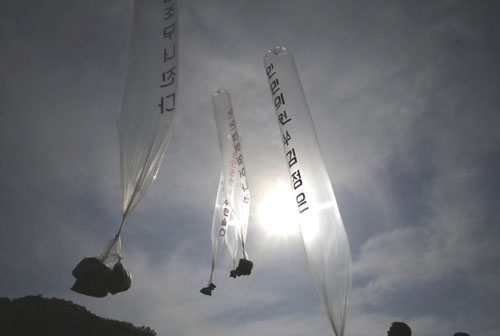
The World Tribune of 28 June 2020 reports on the fight sparked by North Korean defectors sending balloons with leaflets to their former homeland, which has brought both Koreas once again to the brink of war. Now Signe Poulsen, head of the Seoul office of the UN Office of High Commissioner for Human Rights, has stated that sending the leaflets is an exercise of the right to freedom of expression.
In this April 29, 2016 file photo, members of a South Korean civic group send leaflets denouncing the North Korean regime in Tanhyeon, Paju, near the North Korean border. / Korea Times photo by Choi Won-Suk
Both the North and South Korean governments have threatened the defectors in the South who have sought to counter communist “fake news” by sending real news North over the DMZ. The leaflets also often contain U.S. one-dollar bills and USB memory sticks meant to encourage North Koreans to pick up the leaflets.
Now the defectors have been targeted by hastily-passed legislation forbidding the practice. Poulsen made the remarks amid heightening tensions on the Korean Peninsula after the North threatened to retaliate against the South for what it called Seoul’s “connivance” at the floating of anti-Pyongyang materials in large balloons.
The government of South Korean President Moon Jae-In, sought to legislate a ban on leafleting and filed a criminal complaints against two defector groups who carry out such launches, the Korea Times reported on June 23. The provincial government of Gyeonggi, located near the border with the North and where a lot of leafleting takes places, issued an administrative order last week banning the entry into border areas to fly leaflets.
The first episode features Serbian protest organizer and peaceful revolutionary Srdja Popovic.
In just a few years, Srdja transformed from a college student in a band to the leader of a national movement that ended the fearsome dictatorship of Slobodan Milošević with clever tactics and movement building, all without a single shot fired. After the tyrant’s fall, Srdja went on to serve in Serbia’s National Assembly and later launched an organization called CANVAS that teaches the art of protest to democracy activists around the world. He is the author of Blueprint for Revolution: How to Use Rice Pudding, Lego Men, and Other Nonviolent Techniques to Galvanize Communities, Overthrow Dictators, or Simply Change the World.
HRF chief strategy officer Alex Gladstein (@Gladstein) sat down with Srdja to discuss: How do you scale a movement of one up to millions of people? How do you overcome a regime that holds all the power and weapons? Why are peaceful revolutions much more successful than violent ones? Why are street movements like start-ups? Is it possible to sustain a movement during a global pandemic? How are protest movements around the world reacting to their new twin enemies, the coronavirus and the rise of authoritarianism?
Further in the series of posts on this topic: On 13-14 April 2020, the New York based Human Rights Foundation will host COVIDCon, a virtual Oslo Freedom Forum event focused on how tyranny sparked and is exploiting the novel coronavirus pandemic to crack down on civil liberties. For earlier posts: https://humanrightsdefenders.blog/tag/covid-19/
This two-day event, open to global audiences, will feature presentations and panels about the current pandemic and its relationship to state censorship, disinformation, surveillance, and the future of civil liberties. COVIDCon sessions will showcase the difference in the responses of authoritarian regimes and democratic governments to the outbreak of the novel coronavirus.
Confirmed speakers include former Chinese prisoner of conscienceYang Jianli; Iranian journalist and human rights activist Masih Alinejad; Russian democracy advocate Garry Kasparov; recently expelled Wall Street Journal deputy China bureau chief Josh Chin; entrepreneur and angel investor Naval Ravikant; Hong Kong pro-democracy activist Joshua Wong; futurist and “After On” author Rob Reid; Pulitzer Prize-winning author Anne Applebaum; Ideas Beyond Borders’ Melissa Chen; China-U.S. expert Kyle Bass; and others.
Day 1 of the conference will focus on how tyranny sparked the pandemic. Sessions will include:
Censorship in China: The Pandemic Spark
How Democracies and Dictatorships are Reacting to the Virus
China: Savior or Culprit?
Reporting on COVID-19: State Censorship and Surveillance
What the Pandemic has Revealed about Chinese Economic Dominance
The Increasing Risk of Synthetic Biology
Day 2 of the conference will focus on how tyranny exploits the pandemic. Sessions will include:
Iran’s Criminal Negligence: COVID-19’s Gateway to the Middle East
Pandemic Power Grab: State Abuse of Emergency Laws
Trampling on the Rule of Law and Undermining Public Health
Keeping Protest Movements Alive During The Pandemic
How the Pandemic Changes the Relationship Between Citizen, Technology, and State

 Hans Thoolen on Human Rights Defenders and their awards