Posts Tagged ‘Human Rights Defenders’

BRICS leaders should have addressed human rights at their recent summit

July 30, 2018

Russian President Vladimir Putin (L) Indian Prime Minister Narendra Modi (C) and Turkish President Recep Erdogan (R) interact during a family photo during the BRICS summit meeting in Johannesburg, South Africa, 27 July 2018. EPA-EFE/GIANLUIGI GUERCIA / POO

As they met in Johannesburg last week, BRICS leaders focused on the economy, development, peacekeeping, health and industrialisation issues within the bloc (accounting for 40% of the world’s population). However, equally important issues such as the protection and realisation of human rights in the respective countries remained off the agenda. Jennifer Wells, an intern with AI South Africa, on 30 July 2018, gave a useful reminder of what could and should have been also addressed:

Brazil

Brazil has one of the highest murder rates in the world, with around 60,000 people murdered each year…Brazil’s failure to protect black Brazilians from police violence remains critical as this year marks the 25th anniversary of the Candelaria killings. The tragedy, in which eight young black boys were killed by off-duty police officers in Rio de Janeiro in 1993, represents the endemic racism within the Brazilian security forces. The situation was aggravated by the murder of Rio de Janeiro human rights defender and councilwoman Marielle Franco on 14 March 2018. [https://humanrightsdefenders.blog/2018/03/16/marielle-franco-38-year-old-human-rights-defender-and-city-councilor-of-rio-assassinated/]

Russia

human rights defenders and civil society activists continued to face harassment, intimidation and arbitrary arrests across the country. The trial of human rights defender Oyub Titiev started in Chechnya. He, like several other human rights defenders, is being prosecuted on trumped-up criminal charges. Law enforcement agencies continue to launch cases on fabricated “extremism” and “terrorism” charges. [https://humanrightsdefenders.blog/2018/01/15/chechen-human-rights-defender-oyub-titiev-arrested-on-trumped-up-charges/] The Ukrainian film director Oleg Sentsov, serving 20 years on “terrorism” charges, is on day 75 of a hunger strike demanding the release of “64 political prisoners from Ukraine”. The right to freedom of peaceful assembly has been increasingly restricted in Russia since 2012 and remains under severe clampdown. …. The rights of LGBTI people are trampled upon daily and the authorities continue to refuse to investigate the horrific gay purge in Chechnya. The World Cup has come and gone, but the suppression of freedoms and shrinking of civil liberties continues unabated.

India

It’s a similar story in India where human rights defenders are consistently under threat, attacked and threatened, often from security forces. India has witnessed horrific instances of alleged extrajudicial executions by security forces for years as police and federal forces have effective immunity from prosecution. In the North-Eastern state of Manipur, human rights defenders who have lost their loved ones in alleged extrajudicial executions and are now campaigning for justice, face unprecedented attacks. Salima Memcha, a widow who lost her husband to an alleged extrajudicial execution, was verbally threatened by security personnel. Her house was also vandalised by them. Three other human rights defenders in Manipur have faced similar reprisals for campaigning for justice for their loved ones.

China

In China, the government continues to enact repressive laws under the guise of “national security” that present serious threats to human rights. Nobel Peace Prize laureate Liu Xiaobodied in custody whilst other human rights defenders are detained, prosecuted and sentenced on vague charges such as “subverting state power”, “separatism” and “picking quarrels and provoking trouble”. Controls on the internet have been strengthened and freedom of expression and freedom of association are under attack.[see also:https://humanrightsdefenders.blog/2018/04/12/how-china-extracts-televised-confessions-from-human-rights-defenders/]

South Africa

In the host nation, nearly a quarter of century after adopting arguably one of the most progressive constitutions in the world, the country is bedevilled by profound inequalities, which persistently undermine economic, social and cultural rights. Failures in the criminal justice system continue to present barriers to justice for victims of human rights abuses and violations, including the state’s failure to hold perpetrators accountable for the killing of 34 striking mineworkers in Marikana in 2012 by the South African Police Service. Access to sexual and reproductive health services remain a human rights issue as does the provision of quality education.

https://www.dailymaverick.co.za/article/2018-07-30-what-brics-leaders-should-have-talked-about/

Announcement of the Human Rights Defenders World Summit in Paris, October 2018

July 24, 2018

ProtectDefenders.eu, the EU Human Rights Defenders mechanism, is organising the HUMAN RIGHTS DEFENDERS WORLD SUMMIT 2018 – to be held in Paris, October 29-31 2018 at Palais de Chaillot (Espace Niemeyer). The event is organised with a coalition of international NGOs and human rights defenders networks – including Amnesty International, AWID, the International Service for Human Rights, and ProtectDefenders.eu’ board members FIDH, Front Line Defenders, OMCT, and RSF -, with the support of the European Union.

On the occasion of the 20th Anniversary of the UN Declaration on Human Rights Defenders, the Human Rights Defenders World Summit 2018 will constitute an opportunity to review the progress made in the defence of human rights and in the protection of all those that defend these rights in all their diversity since the adoption of the Declaration. By creating a unique platform for the human rights defenders’ voices to be heard, this Summit will also call for the international community to reinforce its commitments to protect human rights defenders, celebrate the essential work HRDs carry out in the most difficult environments, and raise awareness about the threats, obstacles and restrictions HRD are constantly confronted with. The Summit intends to shape the upcoming human rights defenders’ agenda, showing the way forward to the international community engaged in the protection of human rights defenders and the promotion of a safer and more enabling environment.

To learn more about the Human Rights Defenders World Summit 2018, and meet the HRDs who are confirming their participation, check for updates at the Summit’s website.

Open call for human rights defenders

The  Human  Rights  Defenders  World  Summit  2018 will bring together a diverse group of over 150 HRDs, from around the world, for three days of meetings, panel discussions, networking and workshopping. These HRDS who are at the forefront of the struggles for social, political and environmental changes will have the opportunity to connect, work and debate together and engage with regional and international human rights organisations, global leaders from governments, the United  Nations, and the private sector. In addition to a focus on those HRDs who are most vulnerable and at risk, the Summit will be a unique space to convene marginalised groups, including ethnic and religious minorities, diverse gender identity activists, indigenous peoples and other defenders who are geographically remote from centres of power, media and international attention.

For achieving this goal, the World Summit is launching an open call for human rights defenders to present their candidacies. The aim of this call is to reach out to the most isolated and less connected defenders, traditionally underrepresented, members of less visible categories and groups or profiles of special concern. This call is, thus, very important to ensure and reinforce the representativeness, inclusiveness and diversity of the Summit’s participants.

This call will be open until 1st September, and is available in the HRD World Summit website, in English, French, Spanish, Arabic, and Russian. Please, share it widely within your network!

Communication and coordination

Louise Levayer – llevayer@amnesty.fr

Javier Roura – jroura@protectdefenders.eu

Website

https://hrdworldsummit.org

Facebook

https://www.facebook.com/hrdworldsummit2018

Twitter

https://twitter.com/HRDWorldSummit

China, Russia and Pakistan in UN fail at attempt to muzzle human rights defenders (for now)

July 7, 2018

On 6 July 2018 Stephanie Nebehay reported for Reuters that China, Russia and Pakistan lost their bid on Friday to weaken a U.N. resolution upholding the crucial rule of human rights defenders. The United Nations Human Rights Council adopted a resolution calling on all states to protect civil society groups from threats and intimidation, and prosecute reprisals against them. Chile presented the resolution text on behalf of more than 50 countries on the final day of a three-week session. Amendments proposed by China, Pakistan and Russia – declaring that civil society groups must respect “the sovereignty and territorial integrity of states” and that their funding must be “legal and transparent” – were soundly defeated. So, in spite of increasing retaliation against human right defenders and pressure on civil society in many countries [see recently: https://humanrightsdefenders.blog/2018/06/08/ishr-new-report-on-reprisals-and-restrictions-against-ngo-participation-in-the-un/ ], the UN is still able to resist some of the more blatant attempt to silence critics.

China and Russia are often the least tolerant of civil society at home. They are now seeking to introduce similar restrictions at the international level,” John Fisher of Human Rights Watch told Reuters. Their attempts to place national sovereignty above international human rights law “would turn guarantees of peaceful assembly and association on their heads”.

“These amendments were a swing and a miss for China and its allies on the Council,” Sarah Brooks of the International Service for Human Rights told Reuters, using an American baseball term. “Their efforts to limit civil society’s independence and shut down civil society voices were rebuffed by a strong message – from member states across the globe – about the importance of keeping defenders’ voices at the table”.

[At the current session, China tried unsuccessfully to block the accreditation of Uighur activist Dolkun Isa, U.N. sources said. China’s delegation publicly challenged activists speaking on behalf of Uighur and Tibetan ethnic minorities. Council president Vojislav Suc, Slovenia’s ambassador, said allegations of intimidation and reprisals had emerged during the session and urged “all necessary measures” to prevent such acts.]

https://www.reuters.com/article/us-un-rights/china-russia-fail-to-curb-activists-role-at-u-n-rights-forum-campaigners-idUSKBN1JW2EM

Inventivity of evil: how states restrict HRDs access to the UN in 10 case studies

June 27, 2018

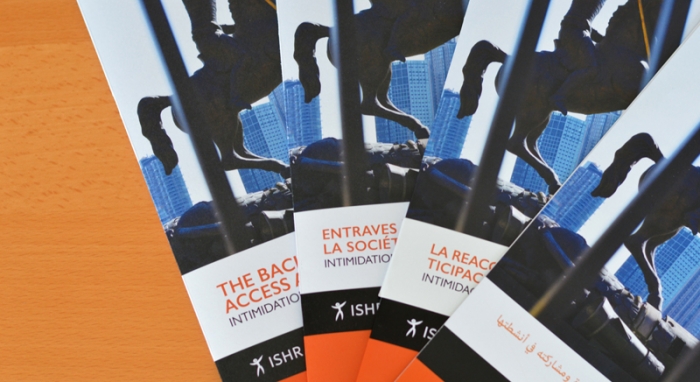
In a new report entitled “The Backlash Against Civil Society Access and Participation at the United Nations” the ISHR outlines the many different ways States employ to keep critical voices out of multilateral spaces. ISHR’s new report provides a road map for States and UN representatives to prevent and counter restrictions on civil society participation in UN processes.

Civil society has the right to ‘unhindered access to and communication with international bodies. However, that right is not being respected.  ISHR’s new report documents a broad range of obstacles faced by human rights defenders, from opaque bureaucracies and procedures to reprisals, physical threats and attacks. ‘States decide who gets through the door,’ said ISHR’s Eleanor Openshaw.  ‘States that fear calls for accountability and justice do what they can to prevent civil society access to and participation in UN spaces’.

Click on the video below to get an insight into the report:

Opaque practices and procedures provide covers for States seeking to block NGO entry.  An NGO seeking to participate in a UN high-level event can be a victim of the ‘no-objection’ procedure.  This is the means by which any State can veto their participation without being named or providing any justification. ‘The no-objection procedure is poorly defined, and provides no formal criteria for objections to NGO participation,’ said ISHR’s John Indergaard. ‘It’s carte blanche to exclude legitimate NGOs for illegitimate reasons.’

Even when civil society representatives make it into an actual UN building, they have been thrown out without explanation or asked to leave while events were ongoing. At some high-level events and committee meetings, NGO representatives have been barred from giving statements or bringing in documents related to their work. Physical attacks and intimidation against those seeking to cooperate with the UN are well documented.  ‘These restrictions and reprisals are all aimed at dissuading civil society participation,’ said Openshaw. ‘They need to be challenged in each and every case.’

For some of my earlier posts on reprisals: https://humanrightsdefenders.blog/tag/reprisals/

DRAMATIC ESCALATION OF HRDS KILLED IN RECENT YEARS

June 21, 2018

On Wednesday 20 June 2018, Dublin based international human rights organisation, Front Line Defenders along with the HRD Memorial Network, launched a major new report on the killing of human rights defenders (HRDs) at the UN Human Rights Council in Geneva. The report, Stop the Killings, analyses the root causes of killings of HRDs in 6 countries: Brazil, Colombia, Guatemala, Honduras, Mexico and the Philippines, which between them have accounted for 80%  HRDs killed in the last three years. 

In its Annual Reports for the last 4 years, Front Line Defenders has reported the killing of 879 HRDs. These were not random killings but the targeted elimination of those working to improve their own communities.  The use of lethal violence to silence those who defend the rights of the most vulnerable has become widespread, and is endemic in a number of countries. In its 2017 Annual Report, Front Line Defenders reported the killing of 312 HRDs in 27 countries; the true figure is certainly higher. Two-thirds of those killed were working on the environment, land rights and indigenous peoples’ rights, often in remote, rural areas.

Among the key drivers of killings and violence against HRDs detailed in the report are::

  • state failure to recognise the legitimacy and importance of the work of HRDs;
  • smear campaigns against HRDs by the state and/or its agents;
  • economic policies which prioritise the ruthless exploitation of natural resources over the protection of the environment and the land;
  • rights of peasant communities and indigenous peoples;
  • lack of effective systems to document and investigate attacks on HRDs and provide protection;
  • collusion by the state and/or its agents in the killing of HRDs.

The report was launched by United Nations Special Rapporteur on Extrajudicial, Summary or Arbitrary Executions, Agnes Callamard, at a special side event during  Human Rights Council proceedings on Wednesday 20 June 2018.

The full text of the report can be downloaded from: https://share.riseup.net/#VWzkKTN4f-156VE4dc-r_Q

See also my: https://humanrightsdefenders.blog/2018/01/05/front-lines-2017-report-confirms-worst-expectation-over-300-hrds-killed/

https://humanrightsdefenders.blog/2017/07/15/documenting-the-killings-of-environmental-defenders-guardian-and-global-witness/


Civil society and human rights: topic of side event in Geneva 25 June

June 21, 2018

“How to Respond to Challenges Facing Civil Society Organisations Working on Human Rights?” is the topic of a side event on Monday, 25 June 2018(12:30 – 14:00) at the Palais des Nations, Room XXIII.

Challenges to the work of civil society organisations exist in every part of the world and take a variety of forms. Based on recent reports on civil society space of the OHCHR and the EU Fundamental Rights Agency, this event gathers various stakeholders, including NGOs, governments, UN agencies and other intergovernmental organizations, to reinforce the importance of civil society engagement, and address the many challenges which hinder its effective functioning. This surely will include the question of reprisals against HRDs cooperating with the UN.
Questions to be addressed include: What are the major challenges facing civil society organisations? What are some examples of emerging good practices? How can we ensure that the needs of underrepresented parts of civil society are taken into account? What is the role of the Human Rights Council in ensuring a safe and enabling environment? Can we identify ways forward and concrete next steps?

SPEAKERS

  • Ambassador Michael Gaffey, Permanent Representative of Ireland to the UN in Geneva
  • Michael O’Flaherty, Director of the European Union Agency for Fundamental Rights (FRA)
  • Lopa Banerjee, Director of UN Women’s Civil Society Division
  • Peggy Hicks, Director of the Research and Right to Development Division of the Office of the High Commissioner for Human Rights (OHCHR)
  • Phil Lynch, Director of International Service for Human Rights (ISHR)

Moderator: Hilary Power, Amnesty International

For some of my earlier posts on this topic: https://humanrightsdefenders.blog/tag/civil-society-organisations/

https://drive.google.com/file/d/1FEf6ho01IE65f0u84nY7cmlYlSdgBziS/view

Euromed Rights announces its General Assembly for 23-24 June 2018

June 20, 2018

Euromed Rights [formerly known as the Euro-Mediterranean Human Rights Network (EMHRN)] announced that on 23 and 24 June, 2018, more than a hundred representatives from 80 organisations working on Human Rights on the two shores of the Mediterranean are expected to head to Brussels to attend the 11th General Assembly of EuroMed Rights. As the Euro-Mediterranean region is consumed by the migrants’ impasse, a deep social-economic crisis, the deterioration of international conflicts and the restauration of authoritarian regimes, meetings like this one are more meaningful than ever. Being the only regional organisation that gathers human rights defenders and organisations from both sides of the Mediterranean, EuroMed Rights has a crucial role to play in order to tackle the deterioration of human rights in the region with a strong, common voice.

{The General Assembly is the supreme body of EuroMed Rights and gathers every three years to elect the new President and the new Executive Committee members. The President and the Executive Committee are elected for a period of three years which could be renewed for two further terms. The Executive Committee members are also appointed as political referents for different focus areas.}

https://euromedrights.org


Guide to HRD issues at the 38th session of the UN Human Rights Council

June 15, 2018

The UN Human Rights Council will hold its 38th regular session at Palais des Nations in Geneva from 18 June to 6 July 2018. The International Service for Human Rights (ISHR) has – as usual – published an excellent alert full of substantive issues (see link at the bottom of this post). Here I just highlight some of the session’s features that are of special interest to human rights defenders;

Sexual orientation and gender identity. The first interactive dialogue with the new Independent Expert on protection against violence and discrimination based on sexual orientation and gender identity will be held between 9:00 and 12:00 on Monday 18 June. The Council will consider the new report of the mandate holder as well as the report of the country visit to Argentina.
In a joint written submission to the Independent Expert submitted in the lead-up to the presentation of his report to the Council, a group of 12 NGOs detail State obligations that if  implemented, would work towards ensuring that LGBTI defenders’ rights are protected (based in existing international human rights law and articulated in the Yogyakarta Principles (YP) and Yogyakarta Principles plus 10, (YP +10). ISHR and ILGA will organise a side-event that will build on this submission and discuss in more detail State obligations set out in the YP +10. The event will take place on 21 June 2018 from 15:00 to 16:30 in Room XXIII.

Reprisals. Reports of cases of intimidation and reprisal against those seeking to cooperate with the UN not only continue, but grow.  Item 5 of the Human Rights Council’s agenda provides a key opportunity for States to raise concerns about reprisals, and for governments involved in existing cases to provide an update to the Council on any investigation or action taken toward accountability to be carried out. [see recent: https://humanrightsdefenders.blog/2018/06/08/ishr-new-report-on-reprisals-and-restrictions-against-ngo-participation-in-the-un/]

Women human rights defenders and women’s rights. The Annual Full Day Discussion on the human rights of women will take place on Thursday 21 June from 16:00 to 18:00. It will focus on the specific impact of online violence on the work of women human rights defenders. It is crucial that the Council’s discussions and resolutions recognise the critical role of women human rights defenders (WHRDs) and organisations led by women and girls as rights holders and agents of change. The Council will hold an interactive dialogue with the Special Rapporteur on violence against women, its causes and consequences on 20 June between 09:00 and 12:00 and will consider her report including the report of her visit to Australia. The Council will also hold an interactive dialogue with the Working Group on the issue of discrimination against women in law and in practice and will consider their reports including a report on the country visit to Samoa and Chad.

Business and human rights. The Council consider the report of the Working Group on the issue of human rights and business. It examines the duty of States to protect against human rights abuses by business enterprises to whom they provide support for trade and investment promotion. It will also consider the Working Group’s report on its mission to CanadaPeru, and on the sixth session of the Forum on Business and Human Rights. Both country reports contain specific sections analysing the situation of human rights defenders, with the report on Peru raising serious concerns about the high level of threats, attacks and violence against local leaders and human rights defenders. The interactive dialogue will be an opportunity for States to follow-up to recommendations made in the UPR in that regard. The core group on the resolution on business and human rights (Argentina, Norway, Ghana and Russia) have announced that they will present a resolution at this Council session to request the OHCHR to continue with the accountability and remedy report with a focus on non-State based remedy mechanisms. The first informal consultation on the draft resolution will be held on 18 June at 16:30 in Room XXIV.

Other thematic reports

The Council will also hold an interactive dialogue and consider the report of the new Special Rapporteur on the rights to freedom of peaceful assembly and of association. Switzerland with Costa Rica also announced that they will be running the resolution on the protection and promotion of human rights in the context of peaceful protests. The first informal consultations will be held on 19 June from 11:30 to 12:30 in Room V.

The Council will also hold an interactive dialogue and consider the report of the Special Rapporteur on the promotion and protection of the right to freedom of opinion and expression, which examines regulation of user-generated content online. The Council will consider the report of the High Commissioner on procedures and practices in respect of civil society engagement with international and regional organisations. The core group on the civil society space resolution (Chile, Ireland, Japan, Sierra Leone and Tunisia) announced that they will present a resolution this session.

The Council will also consider the reports of and hold interactive dialogues with the Special Rapporteur on the independence of judges and lawyers, including the report of his mission to Poland, and with the Special Rapporteur on extrajudicial, summary or arbitrary executions, including reports of her missions to Iraq and El Salvador.

Country specific developments

Burundi During its 36th session, the Council passed two resolutions on Burundi. One resolution was led by the European Union and extended the mandate of the Commission of Inquiry. The second resolution was led by the African Group and requested OHCHR to urgently dispatch a team of three experts to engage with the Burundian authorities and all other stakeholders to “collect and preserve information, to determine the facts and circumstances in accordance with international standards and to forward to the judicial authorities of Burundi such information”. The aim was to establish the truth and ensure that the perpetrators are held accountable. Read here ISHR’s analysis of the two resolutions. At the 38th session, the Council will hear the oral briefing by the High Commissioner on the mission of OHCHR on 4 July between 15:00 and 18:00. The Council will also hear an oral briefing by the Commission of Inquiry on 27 June between 09:00 and 12:00. For more information on the situation of human rights defenders in Burundi, check ISHR Briefing Paper for the UPR here. [see also: https://humanrightsdefenders.blog/2016/10/26/enough-is-enough-ngos-call-for-burundi-suspension-from-un-human-rights-council/]

China. By any measure, the Chinese government is not living up to the commitments to protect and promote human rights inherent in its Human Rights Council membership. Since the twelve-country joint statement on the human rights situation in China in March 2016, there has been no concerted effort to use the Council space creatively to call for accountability and transparency related to violations in China. This, despite the fact that in July 2017, Chinese security authorities presided over the death in custody of Liu Xiaobo, the first Nobel Peace Prize winner to die in detention since Carl von Ossietzky died in Nazi Germany in 1938… In this context NGOs , incl. the iSHR, continue to call for the release of individuals arbitrarily detained and/or held incommunicado, including Wang Quanzhang, Gui Minhai, Tashi Wangchuk, Lee Ming-che, and Yu Wensheng. [see also: https://humanrightsdefenders.blog/2018/03/07/china-and-the-un-human-rights-council-really-win-win/]

Eritrea. The Council will hold an interactive dialogue with and consider the report of the Special Rapporteur on the situation of human rights in Eritrea on 25 June. A cross-re­gional group of non-governmental organisations urged the Council to support and co-sponsor at the 38th session a streamlined resolution that accurately reflects the gravity of the situation on the ground, renews the mandate of the Special Rapporteur under the Council’s agenda item 4, and sets out a framework for needed reforms to improve the human rights situation in the country and advance accountability.

Other country situations include: 

  • An interactive dialogue on the oral update by the High Commissioner on the situation of human rights of the minority Rohingya Muslim population and other minorities in Rakhine State of Myanmar, and the oral report of the Special Rapporteur on the situation of human rights in Myanmar
  • An enhanced interactive dialogue on the report of the High Commissioner on the findings of the team of international experts on the situation in the Kasai regions of the Democratic Republic of the Congo (DRC) and on the oral update by OHCHR on the situation of human rights in the DRC
  • An oral update by the High Commissioner on the situation of human rights in Ukraine
  • An oral update by the Independent Expert on the situation of human rights in the Central African Republic
  • An interactive dialogue with the Commission of Inquiry on Syria (oral update) and consideration of the summary report of OHCHR on the high-level panel discussion on violations of the human rights of children in Syria
  • An interactive dialogue with the Special Rapporteur on the situation of human rights in Belarus on his report
  • During this session, the Council will adopt the UPR working group reports as part of the 29th session of the UPR. These reports list recommendations the following States under review are expected to implement: France, Tonga, Romania, Mali, Botswana, the Bahamas, Burundi, Luxembourg, Barbados, Montenegro, the United Arab Emirates, Israel, Liechtenstein, and Serbia.

This session of the Council will provide an opportunity for BurundiMali and the United Arab Emirates to to accept recommendations made in relation to human rights defenders, as proposed in ISHR’s briefing papers on those countries.

The Council appointed new Bureau members due to the departure of the Ambassadors of Chile and Germany. The members of the Bureau for 2018 now comprises of the following Ambassadors:

  • Vojislav ŠUC (Slovenia), President of the Human Rights Council
  • Evan P. GARCIA (Philippines), Vice President
  • Cristobal Gonzalez-Aller Jurado (Spain), Vice President
  • Juan Eduardo EGUIGUREN (Chile), Vice President and Rapporteur
  • François Xavier NGARAMBÉ (Rwanda), Vice President

Panel discussions

During each Council session, panel discussions are held to provide member States and NGOs with opportunities to hear from subject-matter experts and raise questions. All panel discussions will be broadcast live and archived on http://webtv.un.org. Four panel discussions are scheduled for this upcoming session:

  • The Annual Full Day Discussion on the human rights of women will be held in two sessions. First, on 21 June from 16:00 to 18:00, the panel will focus on the impact of violence against women human rights defenders and women’s organisations in digital spaces. The concept note of the panel is available here.
  • The second panel will be held on 22 June from 10:00 to 12:00 and will focus on advancing women’s rights through access and participation in information and communication technologies (ICTs). The concept note of the panel is available here.
  • A panel discussion will be held on 26 June from 16:00 to 18:00 on the human rights of internally displaced persons in commemoration of the twentieth anniversary of the Guiding Principles on Internal Displacement. The concept note of the panel is available here.
  • The Annual Thematic Panel Discussion on technical cooperation in the promotion and protection of human rights will be held on 4 July from 10:00 to 12:00. The topic will be “Human rights and the Sustainable Development Goals: enhancing human rights technical cooperation and capacity-building to contribute to the effective and inclusive implementation of the 2030 Agenda for Sustainable Development”. The concept note of the panel is available here.

The ISHR and other NGOs will again organize quite a few side events on which I will report separately.

https://www.ishr.ch/news/hrc38-key-issues-agenda-june-2018-session

Seven more land rights defenders killed in Guatemala in a single month

June 13, 2018

The seven people killed in the last four weeks were all involved in defending their communities’ land, territory or the environment, and they were all members of the Campesino Development Committee (CODECA) or the Altiplano Campesino Committee (CCDA). The wave of attacks began on 9 May, when CODECA coordinator Luis Arturo Marroquín, 47, was shot dead by unidentified assailants in San Luis Jilotepeque. The next day, CCDA member José Can Xol, 37, was also shot to death by unidentified assailants in Choctún Basilá in the municipality of Cobán.

On 13 May, 31-year-old Mateo Chamám Paau, another CCDA member, was found dead in San Juan Tres Ríos, also part of Cobán. He had previously been threatened because of his activism. Then, on 30 May, two men attacked Ramón Choc Sacrab, an Indigenous Q’echí’ leader and regional CCDA leader in Ixloq San Pedrito, Cobán. He died two days later from the injuries sustained to his throat and face. On 4 June, the CODECA community leaders Florencio Pérez Nájera, 42, and Alejandro Hernández García, 40, were found dead in the southern Jutiapa region shortly after attending a community meeting. Their bodies bore machete wounds. Four days later, 68-year-old Francisco Munguia, another CODECA community leader, was also hacked to death by assailants with machetes in Guatemala’s Jalapa region.

To date, no one has been arrested or charged in connection with these killings, which have occurred within a context of extreme violence, including threats, attacks and smear campaigns to demonize human rights defenders. President Jimmy Morales has referred to CODECA using stigmatizing and defamatory language in recent weeks, thus contributing to the atmosphere of hostility and violence against its members. The Unit for the Protection of Human Rights Defenders in Guatemala (UDEFEGUA), a non-governmental organization, documented 493 attacks against human rights defenders in 2017, and there have already been 12 killings this year. Those working on rights related to land, territory and the environment are among the most commonly targeted.

The ray of hope I signaled recently [https://humanrightsdefenders.blog/2018/05/25/ray-of-hope-2-guatemala-and-impunity/], turned out be just a ray. On 16 January 2018 Cargill’s withdrawal sendt an important signal to the palm oil industry, and set an important precedent for environmental and social accountability. “However, it brings with it real concern for ongoing repression,”​ said Jeff Conant, Senior International Forests Program Director for Friends of the Earth. “Unfortunately, land defenders continue to be under threat, and companies that have profited from activities in the region have a responsibility to prevent these threats.”​

ISHR: new report on reprisals and restrictions against NGO participation in the UN

June 8, 2018

There are many different approaches States employ to keep critical voices out of multilateral spaces. ISHR’s new report of 30 May 2018 [The Backlash Against Civil Society Access and Participation at the United Nations] outlines what these are and provides a road map for States and UN representatives to prevent and counter reprisals and restrictions on civil society participation in UN processes.

Civil society has the right to ‘unhindered access to and communication with international bodies’. However, that right is not being respected.  ISHR’s new report, ‘The Backlash Against Civil Society Access and Participation at the United Nations‘ documents a broad range of obstacles faced by human rights defenders, from opaque bureaucracies and procedures to physical threats and attacks.

States decide who gets through the door,’ said ISHR’s Eleanor Openshaw.  ‘States that fear calls for accountability and justice do what they can to prevent civil society access to and participation in UN spaces’. Opaque practices and procedures provide covers for States seeking to block NGO entry.  An NGO seeking to participate in a UN high-level event can be a victim of the ‘no-objection’ procedure.  This is the means by which any State can veto their participation without being named or providing any justification. ‘The no-objection procedure is poorly defined, and provides no formal criteria for objections to NGO participation,’ said ISHR’s John Indergaard. ‘It’s carte blanche to exclude legitimate NGOs for illegitimate reasons.

Even when civil society representatives make it into an actual UN building, they have been thrown out without explanation or asked to leave while events were ongoing. At some high-level events and committee meetings, NGO representatives have been barred from giving statements or bringing in documents related to their work. Physical attacks and intimidation against those seeking to coöperate with the UN are well documented.

These restrictions and reprisals are all aimed at dissuading civil society participation,’ said Openshaw. ‘They need to be challenged in each and every case.’

I have published many posts on the issue of reprisals [https://humanrightsdefenders.blog/tag/reprisals/] starting with https://humanrightsdefenders.blog/2014/03/13/zero-tolerance-for-states-that-take-reprisals-against-hrds-lets-up-the-ante/

Click on the video below to get an insight into the report: